Archive

Life of Pi
Just saw the new Ang Lee 3-D CGI extravaganza ‘Life of Pi’, and while I’ll leave the reviewing to others, the movie had some interesting themes which relate directly to the subjects I cover in multisense realism. It’s a good film, especially in 3D. I’m generally not a fan of CGI-heavy fare, but given the difficulty of filming on a boat with a live tiger, I can see the advantage of the digital option.
First off, the device of giving the two main characters unusual and unintentional names has an interesting symmetry. The boy calls himself Pi for other reasons than the association with arithmetic truth and the Bengal tiger is called Richard Parker because of an administrative mixup. Right away we have an animal with a person’s name and a person with a name of an eternal truth. Then there is a ship named Tsimtsum, which is from the Lurianic Kabbalah interpretation and parallels the idea cosmological I refer to as the ‘Big Diffraction’. This page sums it up as follows:
Tsimtsum (Variant spellings – TZMZUM – ZIMZUM – TZIMTZUM)
The concept of Tsimtsum is a 16th century kabbalistic explanation of how God, if infinite and omnipresent, could form a material, physical world separate from himself. If God is everywhere and in everything, how could he create a place where he was not? How could God create a world infused with evil?
Tsimtsum was a concept first taught by Isaac Luria, a kabbalist rabbi, who posited that God vacated a region within himself in order to create the world. Through this act of “shrinking,” “withdrawal,” or “contraction” (the literal meaning of the Hebrew word tsimstum), God brought into being a vacuum in which to create something other than Himself. He could then fill this vacuum or empty space by the simultaneous process of self-revelation and creation.
The name Richard Parker has symbolism as well:
Edgar Allan Poe’s uncompleted adventure novel The Narrative of Arthur Gordon Pym(1837) is the story of four shipwrecked sailors who find themselves facing starvation in a small lifeboat. The four draw lots to see who will be sacrificed and cannibalized by the other three. In this fictional account, a man named Richard Parker draws the short stick and is promptly stabbed and eaten by the surviving trio.
Ironically, in 1884 four survivors of a factual shipwreck stood trial for the murder of their ship’s cabin boy, Richard Parker, who was killed and eaten in a true to life version of Poe’s story. This real life event occurred some 47 years after Poe wrote his adventure novel.
Martel might be also making reference to a third allusion with his use of the name Richard Parker. Clifford Richard Parker, 28, was a clerk from Guernsey who was aboard the Titanic as a second class passenger. He was lost at sea and his body was never identified.
I have not read Yann Martel’s book, but even in this blockbuster audience oriented production, the contemplation of philosophical matters is pretty close to the surface. You don’t need to be familiar with any literary references to pick up on the importance of dualism, materialism, and idealism in the story. The interesting twist of the story, which I think is very much in synch with what I am trying to do here, is that it is constructed so that its message ultimately reflects the mindset of the audience. To the Western minded materialist, it validates the idea that religion is a spoonful of bullshit to help the bitter medicine of life go down, while for the spiritually oriented, the story can be seen to celebrate that metaphor and fiction are an indispensable foundation of the universe and in fact an affirmation of divinity.
This duality is embodied in many different ways in the film which highlight in particular the indifference of nature in its oscillation between carnivorous hostility and heavenly delights. Remarkably, even this indifference itself oscillates along with the cycles, phasing in destiny and irony along with struggle and doubt. The author seems to conclude, as I do, that the universe is both teleology and teleonomy, with each view obscuring the other in nearly equal measure.
To me, this relativistic focus on philosophy of mind is the beginning of a whole new way of understanding the universe. Of course, the idea of relativity in dualism is not new, but what I propose is new is the integration of that understanding into physics. If I wasn’t so wary of delusional expectations, I would say that it seems as if this understanding of mind and matter is gradually coming to a rolling boil from a lot of different directions. All roads seem to lead to the reconciliation of opposites right now, coincidentally or not, in 2012.
Quantum Zeno Twilight Zone
The Quantum Zeno Effect
It is easy to show using standard theory that if a system starts in an eigenstate of some observable, and measurements are made of that observable N times a second, then, even if the state is not a stationary one, the probability that the system will be in the same state after, say, one second, tends to one as N tends to infinity; that is, that continual observations will prevent motion …
— Alan Turing
“…an unstable particle, if observed continuously, will never decay. One can “freeze” the evolution of the system by measuring it frequently enough in its (known) initial state.” – Wiki
It’s so strange to me that in all of the incredibly exotic implications of quantum mechanics and relativity, including the obliteration of matter and time, the possibility that what is being measured is measurement itself is never considered. We would rather assume that we are telepathically controlling the outcome of subatomic events than imagine that perhaps the events we are witnessing are the atoms which compose the measuring instruments which are imitating, in their own language, our intention to witness and objectify.
Think of it like a mirror image of divination. If you have played at all with the I Ching or Tarot cards, you will find that whatever insights they might seem to provide about your situation, they seem to present an even more insightful mirror to your question itself. Unlike quantum mechanics, we can see that divination can be falsified. Or can it? Like any cold reading sham psychic, we can pull the wool over our own eyes and reinterpret any previous prophecy which turns out false and find that on another level it could seem true, or that we had to believe that false prophecy at the time in order for some more important thing to happen, etc.
There was a Twilight Zone where William Shatner is trapped by his own obsessive superstition, unable to leave the room because of a tabletop oracle’s innuendos.
Nick of Time, 11/18/1960
Shatner: “Does anything exciting ever happen around here?”
Mystic Seer: “It is quite possible”.
“Am I gonna be promoted, for Pete’s sake?” is Shatner’s second question.
“It has been decided in your favor” is the response from the card from the box underneath the bobble headed Old Nick.

His fiancee fondles his keychain with a rabbit’s foot and four leaf clover and as Shatner calls his office and validates the oracle’s prophecy, he falls into a compulsive dependency on the oracle’s increasingly menacing fortunes.
Superficially, this reads as a simplistic cautionary tale of confirmation bias and the perils of superstition, but if it were that simple, all ideas of luck and fate would little appeal in this post modern age. Instead, it seems that more than ever people openly express gratitude to divine providence for their ‘blessings’.
Shatner’s insistence on using the same machine at the same table reflects this kind of proprietary intimacy with the super-personal. Superstition, or over-personal sense-making is a kind of inflammation of the pattern recognition faculties on the top end, the executive end of the psyche. The surprising thing, however, and the thing which can throw us into a recursive paranoia or delusional optimism if we are not careful, is that our capacity to see and know is not completely separate from the fabric of events themselves. In the moment of divination, there is inherently a kernel the truth of that moment, and in subsequent moments, the narrowness of that truth is exposed, just as all conditional truths of any moment are eventually exposed in the infinity of the unconditional.
Serling: “Two people permanently enslaved by the tyranny of fear and superstition, facing the future with a kind of helpless dread. Two others facing the future with confidence, having escaped one of the darker places in The Twilight Zone*.”
What does this have to do with Quantum Mechanics?
If my conjecture is right, then photons and other particle/wave functions are not literally objects, in the same way that exchanging smiles is not a literal exchange of projectiles across space. The exchange of smiles is procedural-semantic. It is to see and imitate an expression of subjective feeling which cannot be meaningfully broken down. The contortion of facial muscles, baring of teeth, etc has some evolutionary roots, sure, yes it does. The activity of neurotransmitters, ion pumps, and contracting proteins in sequence from the brain to those muscle fibers also presents an impersonal mechanism, relative to us, which can be credited for producing the smiles – mirror neurons, oxytocin, dopamine, sex hormones also after puberty, all kinds of microscopic amazing that we would not care at all about if it did not theoretically explain something personal about ourselves.
The teeth baring and the synapse doping are the meta and root impersonal perspectives respectively. The former posits a behavioral cause built on stochastic extractions of accumulated chance (the opposite of Shatner’s Nick, which is driven by unfalsifiable retro-correspondence – overly tele teleology which projects a future based on an ungrounded relativism of the past) while the latter posits a deterministic cause built on inevitable consequences of static universal law (math and physics). In the chart below, I try to show how these levels form the top and bottom of only half of the picture – the Realism half. Occidental reasoning is objective and impersonal, squeezing all of consciousness and identity into a mosaic of digital permutations and Bayesian feedback loops.
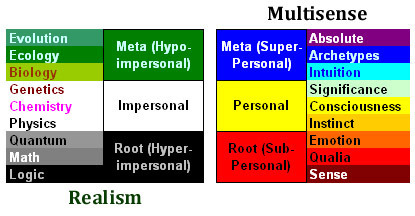
The missing half of quantum mechanics is the Eastern half or Orientverse. In order for logic to exist, something has to make sense of it. There has to be some capacity for discernment to detect, compare detections, and cause changes based on those comparisons. There has to be choice. This isn’t some sentimental appeal for naive anthropocentrism, this is, in my understanding, an inescapable ontological axiom – *the* axiom beneath all axioms.
How to discern on our own level then, between superstition and coincidence? How can we know anything for sure if we are in some sense participating in the creation of our own reality. What the Quantum Zeno Effect really is, finally, is a clue to how participation itself drives significance in the identical way that motion drives mass. It ‘matters’ how much you do and how much you care – it is what makes things matter. We can’t help but wanting to matter, and that means wanting to participate in something that matters.
What matters is generally located on the Eastern, Multisense side of the chart: Peer involvement. Consciousness is that ego driven stream of thoughts and intentions – the means through which subconscious instincts must be conditioned by hand into significance. Significance is accessed through language and ideas, in memory and esteem. It’s that charismatic glow and undeniable glamor of substantial power. Something that matters, not just to my own mind, but to everyone. Whether they like it or hate it, significance cannot be ignored – literally. Significance is the personal experience of signal promiscuity, a contagious association factor which runs through our experience longitudinally, connecting the dots through our days, years, and lives. To signify is literally to arrest one’s attention. To reduce personal choice over one’s own interest is an invasion (often a welcome invasion) of sorts.
This is what the Zeno Effect is all about: The equivalence of attention, significance, and time.
Quantum anti-Zeno effect studies are interesting too.
“The essence of the quantum Zeno effect is that repeated interrogation if the system is still in the inital state tends to quench the system in this state as the frequency of interrogations grows. The reason for that is that the quantum evolution generated by the hermitian Hamiltonian is time reversible, and hence the probability p(t) of intial state occupancy behaves as p(t) ≃ 1 − (t/ τ)² for short times t, with τ being the characteristic time scale. […] If we make N interrogations within the time T For this reason, the Zeno effect in decay processes is very hard to observe.”
[…]
“Frequent observing if the Schördinger cat is alive, kills it faster. Such experiment requires “tuning” of atomic transition frequency, or the photon band gap edge within the range of, which can be for instance done using external static electromagnetic field and Zeeman, or Stark effect. Summarizing, we have shown that near threshold decay can be exploited to observe the quantum anti-Zeno effect. Typical near threshold decay processes are characterized by ultra short period of quadratic decay, followed by a long phase of non-exponential decay, with a very large rate at the begining, gradually slowing down in the course of the dynamics. Monitoring if the decaying system remains in the initial state, shifts the system back to the fast initial phase of the non-exponential decay. In effect,
more frequent measurement, cause faster decay.”
Not that the Zeno and Anti-Zeno effects do not contradict each other, although it can be confusing. It’s a bit like remembering a car crash, and seeing the car in your memory speeding ahead at 80mph forever. It is frozen at high speed. In the same way, when we look at something which gradually decays less and less, we can make it decay faster by interrogating it more often during it’s high rate of decay phase. At least I think that’s what they are saying here. In the other study it seems like maybe they are using random measurements to accelerate anti-Zeno, but I’m not sure. That could make sense too – shifting the burden of choice onto the receiving/interrogated instrument rather than the transmitting instrument. Either way, I still think it makes more sense to see the measurement of quantum as a complex interaction among instruments rather than literal particles – what is being transmitted is like a smile, not like separate thing-which-is-not-a-thing.
*Twilight Zone trivia – the name comes from the submarine exploration, the point at which the ocean is so deep that sunlight begins to be unable to penetrate it.
Unified Formulation
If you want a formula, here’s what I’ve got for you at this point. I’m not saying it’s pretty (to everyone), but think of what calculus looked like to Newton’s critics (not to compare myself to Newton):
The United Formulation for the equivalence of proprietary temporal-algebraic signifying phenomenology (ℵ↔Ω) and public spatio-topological relativity (ωª) is
ॐ ⊇ { ((ℵ↔Ω) ↑ºt ) ⊥ (ωª ↓ (H←d)) }
or
“Everything is the superset or equal to {(Psyche (multiplying through time) as ordinal qualities) juxtaposed (aka ‘versed’) against (Cosmos dividing Psyche through telescopically scaled relativistic spatial cardinality)}
TL;DR to follow:
*ॐ* stands for Asolute Totality-Singularity: A proposed maximum inertial frame : an Everythingness which exists as ground of being in contradistinction to it’s own self-diffraction. The formula explains the self-diffraction as a private phenomenological multiplication through time and public morphological division across space.
“ℵ↔Ω”
refers to the expansion of the range of possible experiences along an x axis from eidetic-metaphorical to entopic-literal phenomenology.
“↑ ºt”
refers to the elevation of qualitative rank through time. The universe which contains human society presumably contains the potential for deeper and richer experiences – more fantastic and more awful than a universe of only simple organisms or inorganic systems.
“⊥”
reflects the orthogonal/perpendicular nature between the temporal-subjective side of the equation and the spatial-objective side.
“ωª ↓”
is anomalously symmetric to ℵ↔Ω, such that ω is the bottom-up, outside-in perspective of fundamental particles which are nested within each other telescopically (ª), from microcosmic to astrophysical scales of mechanism. This reductive determinism (↓) presents the mirror image to the intentionality of “↑ ºt”, which motivates with promise (high º) and threat (high negative º).
“H←d”
describes thermodynamic entropy (H) and the arrow of time (←) which relentlessly crushes or grinds all somethings into anythings and nothings. The role of distance (d) or space is to magnify this process, allowing larger, denser accumulations of mass and wider fields of dispersal into dust.
From an information entropy perspective, “d” would be understood as the metaphorical ‘distance’ instead; the mismatch of sense channels across different scales leads to a loss of intelligibility that increases exponentially from the microcosmic scales up, so that what is perceived as space on the macro scale is literally a failure to communicate on lower levels. It is the accumulated gating of sensory-motive uncertainty (noise).
Meta and Root
Here are some proposed scale/scope relations between interior phenomenology and exterior realism. The idea that mathematics is the root of quantum physics should be clear enough without much explanation. Taking that relation literally and applying it throughout, the sense of the whole picture can maybe be understood.
Math is to QM as Physics is to Math, as Chemistry is to Physics, etc. These, I propose are convenient break points on the ‘impersonal’ range of the universal continuum. These are nested algebraic topologies in spacetime. They are the exteriorized representations of the personal range experiences. There is a presentation-representation and agent-world relation here, so that the world in which a person relates to other persons is scoped as physics (classical mechanics and thermodynamics) chemistry and genetics. The impersonal view of a person is that: genetic, chemical, and physical activity in the body. Biology, ecology, and evolution extend this world into broader dis-identification categories – evolutionary species, environmental ecology, biological anatomy.
The impersonal side deals with structures extended in public space. The corresponding agents to these large scale worlds are the ephemeral, super-personal levels of awareness. Less real, but potentially more personally meaningful; characters, influences from culture, myth, family, etc are tied to ideas of the afterlife and luck – experiences above and beyond individual control.
Taking it down to the bottom third of the chart, the correlations work here too. Quantum is the world of emotion (which I describe as quorum mechanics – quantum is ‘atomic mood’), Math is the world of qualia (i.e. the interqualitative space – trigonometric functions, symmetries, algebraic equivalence), and Logic is the world of sense (the inevitable shadow of sense cast by the interaction of multiple participants).
[Hypo-Impersonal] Evolution :: Meta (Super-Personal) Absolute
[Hypo-Impersonal] Ecology :: Meta (Super-Personal) Archetypes
[Hypo-Impersonal] Biology :: Meta (Super-Personal) Intuition
[Impersonal] Genetics :: (Personal) Significance
[Impersonal] Chemistry :: (Personal) Consciousness
[Impersonal] Physics :: (Personal) Instinct
[Hyper-impersonal root] Quantum :: (Sub-personal root) Emotion
[Hyper-impersonal root] Math :: (Sub-personal root) Qualia
[Hyper-impersonal root] Logic :: (Sub-personal root) Sense
Data and Dualism
“Define “dualist” and “supernatural.”
Many years ago, I participated in a USENET discussion about whether data structures in computers existed. The debate raged on. One side argued that they did, because look, there they are in the code. The other side argued that they did not, because at the machine level, it was just 1’s and 0’s represented by voltage levels. No consensus emerged.
Now, we know everything about computers, and if we cannot answer such a question about them, what hope do we have about the brain and mind, about which we know almost nothing?”
Not to dredge up any bad memories from USENET, but I think my framework provides a conclusive way of understanding the issue. Unfortunately my model also predicts that many people, because of their specialized intellectual focus, may not be able to understand the model.
The question of whether data structures exist in computers can be resolved this way:
1. Since we are not the computer, we can only talk about the behavior of the device on different levels. With our own mind, we can go much further.
2. In the case of computer data, we can say that voltage levels (which are really statistical averages of electromagnetic dynamism…the extent to which matter pushes and pulls matter) exist in a geometric sense of bodies across space. This is the literal presentation of microelectronic structure. If we anchor our intellectual inertial frame in exterior geometric realism, then it is the 1’s and 0’s which are the representations – unreal except for our labeling of them. There are no literal ones or zeroes in a computer, rather they are in the story which we tell ourselves to enable our control over semiconductor arrays.
3. If we anchor our intellectual inertial frame in the algebraic-sequential presentation instead, then the logic behind the Boolean instructions are the relevant reality as they can be exported into many different mechanisms. The specific materials and geometry which are used to execute instructions are only there to serve the encoded information.
This should explain why both sides are correct and incorrect in their own way, but neither side understands the other’s point of view. The issue of our own consciousness escalates this problem to a new level, as not only is there the same antagonism between geometric-topological materialists and information-theoretic idealists, but both of them together are equally blind to a whole other axis of non-commutative qualities related to perception and participation.
For the Explanatory Gap, we really have two orthogonal dualisms, Western arithmetic-physicists who see the universe from the outside in and what I might call Eastern spiritualist-idealists who see the universe from the inside out. The same principles of reconciliation apply here, but the application of them is even more inflammatory. The solution involves a profound relativism which recontextualizes the literal and figurative, fact and fiction, in a way which challenges many (all?) established religious, philosophical, and scientific assumptions, birthing an entirely new view of cosmos and psyche. It is a hard sell, but I suspect that unfortunately it may be the only solution which can actually work.
Leibniz and Life Thread
I agree with what you say, but there’s no need to humanizethe coffee filters nor humanize intelligence or consciousness.I’m not talking here about IQ. My point (speaking here as Leibniz) is thatnature down to the lowliest beings (a grain of sand) has intelligenceof some sort. Nature is alive, and life is intelligence.
My point though is just because we put fibers into a mold or dots on a page into a form we can recognize doesn’t mean that we have created new life and intelligence. There is a difference between assembling something from tiny spatial-object parts and something reproducing itself from teleological-experiential wholes. A mannequin is not a person. The plaster and steel the mannequin is made of may certainly have a quality of experience, and although it is hard to speculate on exactly what kinds of experiences those are or what level of microcosm or macrocosm they are associated with, one thing that I am quite certain of is that the plaster and steel mannequin is not having the experience of a human person, no matter how convincing of a mannequin it looks to us to be. The same goes for cartoons, drawings, photos, movies..those things aren’t alive or intelligent, but they are made of things which, on some level, are capable of sense participation. Computers are just a more pronounced example. As they improve they may be more convincing imitations of our human intelligence, but that quality of awareness is only a recorded reflection of our own, it is not being generated by nature directly and it is neither alive nor intelligent.
You hit on a weak point. There is no agreed-upon version of Leibniz’s definition of substance.
Leibniz [snip] considers substance as “a being gifted with the power of action”.
visit this group at http://groups.google.com/group/everything-list?hl=en.
I think it’s circular to define a monad as a being gifted with the power of action if we are using the monad hypothesis to try to explain consciousness, which can be considered the power of action in the sense that L intends here. I don’t think that in that sentence he is suggesting that the mechanical automatons which were built in his lifetime would be beings gifted with the power of action. Machines don’t exactly have a ‘power’ of action, but their operation results in the effect of the action of their parts.
In the 17th century, it was easier to say that rather than having the power of actions, machines are simply subject to reaction, and as such are not beings and not monads. However, it can be said that since that time the gap has closed, because
1. Genetics and evolution reveal mechanistic sub-personal and super-personal levels which paint our power of action as dual mechanisms of reaction. Scripted from below and selected naturally from above, we are functionally indistinct from a machine, or so it would seem logically.
2. Nuclear physics reveals a microcosm replete with action-reaction dynamism. If they are monads, then the question of why some of their configurations are gifted beings and others are reactive non-beings becomes the more relevant question.
3. Fully automatic mechanisms; everything from automatic transmissions to Google computer driven cars show that mechanical reactions seem to be a fair substitute in many cases for the functions and behaviors of gifted beings. We now have interactive machines and the promise of robots and even nanobots which can seek out their own energy sources and reproduce.
Those three add up to a pretty strong case for functionalism ruling out any meaningful difference between man, monad, and machine. Most people who understand that case are understandably persuaded that it must be the case, especially with what seems to be a strengthening of the case continuously with studies which seem to undermine the authenticity of free will and the veracity of our personal perception. At the same time, AI would seem to be making gains in the application of mechanically-intelligent systems, at least to a wider and wider range of technologies.
Why I think that this is actually not the whole truth is that because of
1. The Hard Problem and Explanatory Gap. Logically, and with automatic mechanism, there is no reason for any such thing as experience to exist in the universe and no justification for strong emergence. Not only is there no reason for an eyeball to open the brain up to a world of color and images, and nothing for color and images to be made of, and nowhere for them to exist in the universe, even the idea of something like geometric logic to exist in the universe is ultimately as superfluous as consciousness. There is simply no plausible function for any kind of aesthetic richness. There is no material support for any more than a single channel of information transfer, as is revealed by the lack of utility within computers for anything other than invisible, intangible execution of binary coded voltage manipulations. The computer doesn’t need to experience anything visual, you do. But why?
2. The Brain as Reducing Valve. Studies such as the recent one on psilocybin (http://www.pnas.org/content/early/2012/01/17/1119598109), the 1995 Crick & Koch study showing that the visual cortex doesn’t contain visual experience (http://papers.klab.caltech.edu/26/1/69.pdf), and now this study on neuroimaging trance states (http://www.plosone.org/article/info%3Adoi%2F10.1371%2Fjournal.pone.0049360) are part of a body of evidence suggesting that activity in the brain is not correlated with what we might expect. Complex, aesthetic experiences like a psychedelic trip or composing an intricately worded message seem to coincide with lower activity in the relevant areas of the brain rather than higher levels. The Koch study tells me that the visual cortex is about using our brain to pay attention to visual patterns, but not about actually seeing. The images are not there in the brain, despite those blurry blobs (http://us.gizmodo.com/5843117/scientists-reconstruct-video-clips-from-brain-activity) which are being extracted by analyzing the neural evidence of that attention. I think that we are painting digital pictures based on where we are looking, not what we are seeing, and that these blurry images, rather than heralding an age of better and better images lifted from fMRIs of brain activity, should be understood to be the end of the line for phrenological assumptions about the brain where images literally reside inside the brain. This ultimately is no different from looking for small kitchens in the brain where the smells of remembered aromas are cooked up. It’s a category error. Stop it.
3. The Fundamental Wonder of Consciousness. Awareness is not remotely like anything else from our perspective. The visceral depth of realism cannot be easily accounted for by mere arithmetic equivalences. For a computer, ‘trying harder’ simply means allocating more resources to a job. If you want your human robot to lose weight, you simply instruct the robot to do so programmatically, and it will consume less calories and exercise more. What we face as conscious beings is much different. We may logically understand that it is critical to our survival and well being to lose weight, yet in practice, we are loathe to actually do the simple tasks which we know will cause that to happen.
What stops us is a feeling which, like pain or blue, has to be experienced to be understood. We are compelled by a subjective, semantic experience which we not only find unpleasant and therefore modifies our behavior mechanically, but it has qualities that somehow compel the interpretation of the experience as being unpleasant in the first place. The qualities can even be separated out so that we can learn to like the unpleasant sensations and addicted to them as in anorexia or bulimia. Besides the Hard Problem question of ‘Why does experience exist in the universe?’ and the Explanatory Gap of ‘How is qualia appearing from my brain?’, the nature of qualia itself is orders of magnitude more subtle and interesting than any underlying information-theoretic function behind it. It’s like creating a symphony orchestra to play every time a traffic signal turns red, or a thousand traffic signals turn red in a row. Where are these qualities coming from? Why are they so wonderful and awful?
4. Multisense Realism. I have put together what I think is a better explanation which makes sense of all of the above. By placing sense or experience itself as the fabric of the cosmos (not matter, not information, not quantum), then it makes sense that aesthetic richness rather than pure function would be the primary product of the cosmos. This product, which I call significance is accomplished through the juxtaposition of one kind of presentation (of private sequential experiences of a highly plastic, dynamic, and multivalent nature) with its opposite (a public spatial relativity of objects in discrete, static, literal positions and scales).
This juxtaposition of presentations and nested meta-presentation levels give rise to analytic geometry vs algebra on one ‘side’, and synthetic metaphor and gestalt on the other. The interplay not only created significance in the form of more meaningful subjective experiences for evolved living organisms, but a more magnificent collection of objects on the exterior side. The felt ordinality of our superior interiority (we’re number one!) is matched in some ways by the known cardinality of our place in an increasingly vast exteriority.
The quantitative and qualitative sides both make their own aesthetic contribution, but ultimately it is the aesthetics of the thing and not the computable function of the thing which is worthwhile. Without the subjective experience, the vastness of stars in the universe or molecules in a grain of sand on a beach is indistinguishable from nothing at all. Without either the sense of a universe within us or a universe without us, there would be no possibility of what we know as ‘realism’. Significance alone can create a beautiful experience, but without the appearance of entropy and loss, that significance can gain no traction, grounding. I suspect that it’s not the Higgs Boson or any other particle, but external realism itself which ‘causes’, or rather embodies gravity.
8 Great Philosophical Questions That We’ll Never Solve
8 Great Philosophical Questions That We’ll Never Solve
Here is my shot at answering these quickly. I think I have six of the eight solved, but feel free to disagree. (Re-posted from my more informal blog s33light.org)
1. Why is there something rather than nothing?
Nothing doesn’t exist, rather ‘no-thing’ is an idea that a thinking thing has about it its own absence. I suggest that the question should be better worded “Why is there something rather than everything?” The answer to that is because the nature of awareness is to divide and insulate the wholeness of the largest inertial frame (simultaneous eternity) into multiply nested diffracted fragments.
2. Is our universe real?
Yes, but ‘real’ just means that it makes sense in the most possible ways to the most possible participants. The whole idea of ‘real’ is impossible in a universe of disoriented simulations. Realism is a matter of convergences of multiple channels of sense participation, so that greatest integrity of mutual reinforcement is the local standard, i.e. ‘In the land of the blind, a one eyed man is king’. A dream is real until you wake up into a more real experience. The previous reality is redefined within the richer participation as a dream, illusion, delusion, etc. This is not completely relativistic however, as realism is ultimately anchored in the Absolute inertial frame
3. Do we have free will?
Surprisingly yes, but not nearly as much as we might think. Despite the well-meaning misinterpretations of experiments by Libet and others, the possibility of a universe which is completely deterministic is incompatible with ordinary experience. In reading these words for example, there is no conceivable purpose that would be served if not for the possibility that the reader will consciously evaluate the ideas being expressed for use in their own personal agenda. These sentences do not address the sub-personal or impersonal agendas of neurology or evolutionary biology, but rather the person who is doing the reading. This is a complicated topic since consciousness is by definition held out of its own reach, but my understanding is that free will is no less real than determinism, and that both appearances are opposite-seeming points on a continuum of sense-making. Free will is what determinism is on the inside, determinism is what free will looks like on the outside, and the more we can relate to another, the more ‘inside’ we feel that we both are.
4. Does God exist?
You can call it God if you want to. Or Nature. Sense. Totality, Absolute, Tao, Singularity, Ein Sof, Brahman, Transcendental Signifier. I don’t personally anticipate a human-like face on this kind of ‘everythingness’, but there may be all kinds of alternate forms of intelligence which influence our lives from a ‘larger now’…ourselves in the future? Probably better not to think about it too much unless you really have no choice.
5. Is there life after death?
If time is a figment of awareness, then death could bring about the end of human constraints on time perception and a rejoining with the Absolute. In that case, there could not only be life after death, but many lives or every life after death. It is difficult to think of any circumstance which would satisfy everyone one way or another that there is or is not life after death. I will count this question as the first legitimately unsolvable in the negative. In theory, if we were able to connect the internet up to the afterlife or something so that we could communicate with the dead at will, that would probably satisfy most people.
6. Can you really experience anything objectively?
No. Experience is a juxtaposition of finite sense capacities. Without a subjective perspective, there is no sense, and sense is what defines objects.
7. What is the best moral system?
One which does not value a system over morality. Morality is a sense, and like other senses, some people have more finely developed capacities than others.
8. What are numbers?
Numbers are figures which refer to particular lowest common denominator themes in organization of experiences and objects. They seem enigmatic because all experiences and objects can be understood to ‘cast a quantitative shadow’ but they should not be confused with the concretely real experiences with which we might associate them. Reducing the universe to numbers is like trying to figure out the questions to a crossword puzzle based on the answers. It doesn’t work that way, but it isn’t obvious why. Numbers do not make sense by themselves, something real has to makes sense of them with physical presence and participation. Computers cannot be built out of a vacuum, they require rigid bodies capable of sustaining recursive enumeration operations – not fog or cartoons – only discrete ‘stuff’ can compute.
Mathematics of Mind
“This is your sense of consciousness – it’s a mathematical relationship among causal elements, and so the mindfulness of the monk or the agony of the cancer patient, those are all different polytropes in this very high dimensional space, and you measure the size of them, the size of the conscious repertoire by the number phi (Φ).” –
Christof Koch on the Neurobiology and Mathematics of Consciousness
Good stuff for the Easy Problem…still no Hard Problem solution. If high dimensional polytropes can represent agony or mindfulness – why have agony or mindfulness? What translates them into experience and why?
I still have not seen anyone recognize that the assumption of impersonal micro-structures translating into personal non-structures might be unfounded. When we underestimate consciousness, it becomes a synthetic product rather than the ground of being from which we cannot escape. Mathematics exists in consciousness, but consciousness, if it could exist in mathematics, would have no reason to exist in any perceptual forms. Data is data. Why would mathematical functions do all of this decoration?
I suggest that consciousness isn’t built up from nothing by tiny parts, it is recovered from everything by sensitivity.
Quorum Mechanics: My Non-Standard Model of Particle Physics
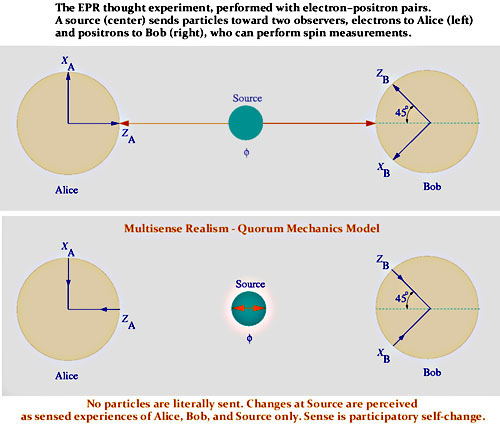
I doctored up this illustration to support my answer to how the double slit experiment works (Quora). The main point that I am trying to make (and I think it is, if true, a fundamental, history-of-the-world-changing scientific idea) is that if we suppose that our own sense of perception and participation in the universe has its ancestry in a primitive/primordial form* of sense, then the lowest levels of microcosm may look much different than we assume.
what I am calling quorum mechanics suggests that rather than a mechanical projection of particles from a source to observers, all QM interactions are a two way street. Perhaps that can only be a one-way street at any given moment, but either way, the idea is that all forms of physical being can experience change in its own disposition and through this sensitivity can also infer exterior dispositions through comparing their own dispositions. This comparison is projected subjectively as a an invariant disposition, or “position” objectively.
I don’t know that anyone has fully understood the radical simplicity of this idea and its implications for tying consciousness together with the cosmos, solving the Hard Problem and Explanatory Gap, but I hope that this picture above helps. I’m not even looking at the angles here of the EPR paradox, I’m just taking the arrows out of the space between the observers and source, and making all three into sub-servers experiencing others through their own local range of the infinity within.
My model has some similarities to Relational quantum mechanics (wikipedia.org) and if I stretch it, also to Wheeler–Feynman absorber theory, (because I think that ‘time’ is nested regularities of disposition), but ultimately goes far beyond either one. As far as I know, my model is the only model which suggests a simple and plausible explanation for both matter and experience in the cosmos.
*rather than arising magically at some level of physiological description for no real reason.
(original diagram cannibalized from the EPR Wikipedia entry)
 Multisense Realism
Recent Comments