Archive
Nothing is an o…
Nothing is an object in its own frame of reference.
A simple thing to say, but the implications are profound when taken literally. I do take them literally, so that like time and length, objectivity itself is relativistic*. There are no truly objective objects, only experiences which are frozen by distance and unfamiliarity. What is truly objective is, ironically, subjectivity. The sense of perceiving and participating, while nested in an elaborate way for human participants, is, in my view, the simplest possible phenomenon within which all other phenomena are described. The capacity for experience is absolute and irreducible, even though the capacity for human qualities of experience is contingent upon a Matroyshka doll nesting of continuous non-human experiences.
*I call this variation of object and non-object qualities by proximity and similarity ‘eigenmorphism’ (proper form).
Quora Question on Entropy
Help me understand this. If entropy is about signal transmission, and is measured by “how much information is missing,” it implies a transmitter and receiver – in other words, a relationship. Entropy is an appealing notion because at first glance the receiver of the information cannot suddenly know more than what is transmitted. But the amount of information the receiver can receive seems to be highly relative and transformable.This is if I understand correctly that entropy is not a measurement of a system’s physical properties, but of how much information is missing when that system is observed. For sure, a system will emit is information, and there will be a less than 100% reception of that signal for any system observing it. That number cannot be 101%…. But there are two sides to a relationship, and a system’s entropy is not related to some total “information” it “contains”… So there are simple workarounds to that 100% threshold.
For example, if I look at a blade of grass that I hold in my hand, I can only receive so much information about it, and I cannot get more information than what it is transmitting to me… Unless I then look at it under a microscope and now the information loss (entropy) has decreased. If entropy were a law of the universe, my act of changing my receptor would be “impossible.”
It seems to me that labeling entropy as an unbreakable law is a naive notion, and instead I see it as a useful property of observation. Does entropy deserve the status of “law of the universe”?
The subject of entropy is, appropriately highly entropic. There are a lot of different ways that the word is used, some more figuratively than others. Thermodynamic entropy is not the same as information entropy, in the sense that if we make an MPEG compressed video of a glass of ice melting into room temperature water, the first half of the movie would take more resources to compress than the last half, given that the last half would feature only a glass of still water. As the thermodynamic entropy of the actual ice increases, the information entropy of the content of the video decreases. The sensitivity of the video camera is limited, so it can’t detect the microstates of the water molecules.
I think this speaks to the question of perception, and how our designation of what constitutes a ‘system’ is more arbitrary than it may seem. All of our instruments and all of our sensing and sense-making capabilities are potentially as limited as the video camera. Our attention is squeezed into an anthropocentric range, so that our window on ourselves and the universe does not allow us to discern ultimately what is ‘a law of the universe, or simply an assumption based on our perceptions’. Everything that we can understand about the universe is furnished to us only by our perceptions, intuitions, and understanding.
Our perception leads us to expect a universe of laws and realities beyond itself, but these too are either ultimately subjective conditions, or else subjectivity itself must include the possibility of transcending itself. The difference between what we presume to be our private perceptions and what we presume to be something more is…. entropy. There is no way to obtain 100% of the information about anything. Even given omniscient access to the entire history of the universe, the nature of the universe may be intrinsically open ended within any given inertial frame.
What I am suggesting is that just as entropy is the gap between what we experience and what we think could be experienced (‘objectively’), what we consider information may only appear to be finite because of the gap between our native perceptual frame of reference and the target frame of reference. Rather than being a true description of what a phenomenon is, ‘information’ may be as fictional in its amputation of subjective qualities as perception is in its failure to pick up on physical properties. The definition of entropy itself can be thought of as gradually reversing or flipping in proportion to the distance (literal and figurative) between two perceptual frames. Take these words for example. If you read English, then your absorption of their meaning is rather loose and general. You get the idea of what I am saying, and even sort of ‘hear’ an inner narrator voice that stands in for me. It’s all rather fuzzy, but it works really well. Entropy is actually what allows you to get the gist of what I am saying or even what I am not saying (reading between the lines).
By comparison, someone who cannot read English at all may have a much clearer view of what these characters ‘actually’ look like (without as much fuzzy interpretive conditioning). In the same way, some people find it easier to draw realistically if they are copying an image upside down. Entropy and significance, subjectivity and objectivity are not functional properties, they are aesthetic ranges. The universe as a whole can, in the same way, be considered primarily an aesthetic phenomenon as a whole, in which any part can reduce another to a functional stereotype using variations on the theme of distance or insensitivity.
Die Enge des Bewusstseins, ‘the narrowness of consciousness’
To invent, I have said, is to choose; but the word is perhaps not wholly exact. It makes one think of a purchaser before whom are displayed a large number of samples, and who examines them, one after the other, to make a choice. Here the samples would be so numerous that a whole lifetime would not suffice to examine them. This is not the actual state of things. The sterile combinations do not even present themselves to the mind of the inventor. – Henri Poincaré
As part of his response, Albert Einstein writes:
… It is also clear that the desire to arrive finally at logically connected concepts is the emotional basis of this rather vague play with the above-mentioned elements. But taken from a psychological viewpoint, this combinatory play seems to be the essential feature in productive thought — before there is any connection with logical construction in words or other kinds of signs which can be communicated to others.
…It seems to me that what you call full consciousness is a limit case which can never be fully accomplished. This seems to me connected with the fact called the narrowness of consciousness (Enge des Bewußtseins)*.
Here Poincaré and Einstein are discussing the nature of creativity and the particular issue of how our personal awareness both does and does not generate novelty. Like the debate over free will, I see this as largely about the hierarchical flow of subjectivity. The personal level of awareness, as noted by Freud and Jung among others, is sandwiched between what could be called a sub-personal or sub-conscious range (Id) and a super-personal or metaphenomenal range (Collective Unconscious). Jung picked up where Freud left off, seeing that Super-Ego was not necessarily just a facade of social pressures against which the Ego cowers, but a living, trans-personal terrain of archetypal influences. The Jungian view looked at this terrain as being tied up in his idea of synchronicity – meaningful coincidence which can be decoded through a language of cross-cultural metaphor. Joseph Campbell wrote and spoke extensively on this language (‘The Power of Myth, ‘The Hero With A Thousand Faces’, etc.).
What I have not seen is a physical theory which takes the synchronicity and myth seriously. When we do take it seriously, I think that it meshes perfectly with the implications of the Theory of Relativity, and with what Poincaré and Einstein are talking about with the narrowness of consciousness. All that needs to be done is to relocate the concept of literal inertial frames of reference with a more figurative notion of phenomenal inertial framing. The idea of levels of consciousness is probably one of the most ancient and enduring concepts in mysticism. Whether they are seen as levels which can only be attained through a proscribed path or as introspective potentials which we can all access by ourselves, the desire to partition human experience as a hierarchy seems to be irresistible. Irresistible, that is, until recently. Contemporary psychology has largely moved away from hierarchies and grand schemas, focusing instead (with debatable success) on more modular, pharmacologically addressable functions.
While I appreciate many of the hierarchical maps of consciousness, like those so diligently compiled by Ken Wilber, I suggest that we begin from scratch, with an eye toward simplicity and correlation with general systems. In addition, the foundation for this view should be sensory-motive rather than information-theoretic or material-energetic. By sensory-motive, I refer to what Einstein talks about above. While the effect of creativity is teleological and communicative, the process itself is driven by what he calls combinatory play: ‘the essential feature in productive thought — before there is any connection with logical construction in words’.
Just as this sub-cognitive sensible engagement is overlooked in modern, computational theories of mind, so too is the possibility of microsensory phenomena overlooked in modern physics. I see this not as an accident, but rather the same oversight on a different scale. The idea that our own sensations emerge from a different source than the sensations which are telegraphed from the source to instrument of detection to scientific observer is not necessary if we generalize Einstein’s ‘combinatory play’ to the outer-shell of all of physics.
The MSR hypothesis is called Eigenmorphism. It is that what separates our body from our sub-conscious experience, and our sub-conscious from our personal experience can be understood in terms of a psychophysically extended narrowness of consciousness. There aren’t any inertial frames which simply exist, but only those which can be inferred through the combination of sensed perspectives. Modes of description, whether in the aesthetic of substances, quantities, or qualities are all ultimately narrowed channels of fundamental sense-making, which must be absolutely primordial. The various forms and functions which can be measured publicly are comparable to what Einstein meant about what is logically motivated and communicable, but what the deeper participation cannot be seen as the object of sight. Light, as a the most pervasive version of sense, is not a thing or an energy, but a participation multiplier – a way of being simultaneously here, there, and not literally here or there. I project my narrow attention through a mind which is already narrowed by a hierarchy of sub-personal and super-personal filters, each of which are also narrowed from scales of sensory participation so vast and unfamiliar that I read them only by the mechanical, impersonal traces that they leave. The universe that we live in is not a solipsistic narrowing of consciousness, but a nested universality of aesthetics – a combinatory play.
*The narrowness of consciousness which Einstein mentions is from William James:
“The sum total of our impressions never enters into our experience, consciously so called, which runs through this sum total like a tiny rill through a flowery mead. Yet the physical impressions which do not count are there as much as those that do, and affect our sense-organs just as energetically. Why they fail to pierce the mind is a mystery which is only named and not explained when we invoke die Enge des Bewusstseins, the narrowness of consciousness’ as its grounds.”.
Metaphysical vs Metaphenomenal
One of the most contentious areas in philosophy revolves around what I consider to be a misconception about the relation between the physical and phenomenal. In particular, the term ‘metaphysical’ forces supernatural connotations onto what would otherwise be non-ordinary but natural experiences and states of mind. I think that the problem is in failing to recognize the physical and phenomenal as each having their own ranges which both overlap and oppose each other. What I mean is, synchronicity and precognition are not metaphysical, they are metaphenomenal. The surprising part is that this means that the ordering of events in which we participate is actually a subjective experience nested within many other subjective and perhaps trans-subjective subjective experiences on different scales. Einstein talked about the relativity of simultaneity, and the metaphenomenal (aka collective unconscious) works in a similar way.
When we make time physical without acknowledging the role that phenomenology has in producing both the form and content of “time”, we introduce a false universal voyeur which effectively flattens all aesthetic qualities and participation into a one dimensional vector in one direction. By taking the term metaphysical, we unintentionally validate this flattened view of the universe in which physics is nature, and phenomenology, particularly deep or non-ordinary phenomenology, can only be non- or meta- physical and therefore supernatural, aka superstitious, aka illusory. If we look at how physics treats its own non-ordinary phenomena, such as quantum entanglement, quasars, and dark energy, we do not see the term ‘illusion’ or ‘folk astronomy’ being thrown around. Their strangeness is acknowledged in a way which invites curiosity rather than fear. The mystery is safely projected into the impersonal realm of physics and the super-impersonal realm of theoretical physics. By contrast, the metaphenomenal range is super-personal or transpersonal, containing experiences which challenge our conventional expectations about the realism of physical bodies, locality, and time.
It is not incorrect to say that for these reasons the metaphenomenal can be considered metaphysical, however I think that is where we are placing the emphasis on the wrong set of properties. Instead of using experiences such as intuition, synchronicity, and even divination as scientific clues to a super-personal range of awareness, we are distracted by the apparent contradiction to physics (as if ordinary awareness did not contradict physics already). To rehabilitate our perspective, I suggest considering the relation between the different ranges of physical (ontic) and phenomenal (telic) phenomena in this way:
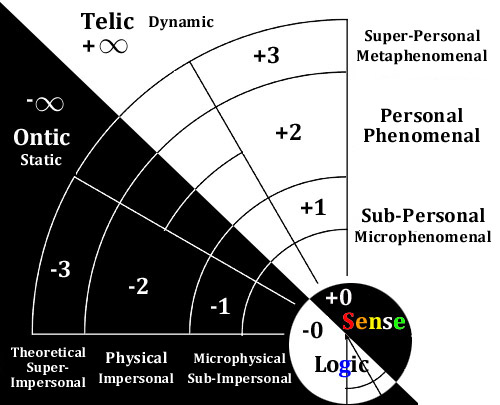
The term ‘paranormal’ is, like supernatural and metaphysical, the same kind of misnomer. If we see physics as a product of more primitive phenomenal sense, then it is consciousness itself which is doing the normalizing, so that it cannot be considered ‘normal’ itself. In another sense, since it is our consciousness which is defining normalcy, it does indeed identify its own regularity and meta-regularities and challenges those definitions as well. The metaphenomenal serves not only as an extension of the personal psyche into the collective unconscious, but also as a line in the sand beyond which sanity is not guaranteed.
Microphysical and Microphenomenal
The same thing occurs in another way, in an opposite way, on the bottom end of my chart. The sub-personal roots of microphenomenology and the sub-impersonal seeds of microphysics are the bottom up layers of causality and are more directly related than the top layers. The sub-personal (sub-conscious, id) urges and the microphysical (binary, semaphore-digital) are low level signs which are used to literally motivate and control. It is a common language of pushing things around.
To be able to exercise control it is necessary first to be able to see that which is to be controlled as separate in some sense from that which controls. There must be a way to sense them as ‘things’ or as a kind of inertial field which resists your intentions to cause a sensible effect. This experience of ‘things outside the self’ is the beginning of motivation, desire, intelligence, etc. In this way, motive and mechanism are born. The teeth in your mouth and the teeth of a gear exploit the same mechanical power to physically endure and prevail.
In the schema I propose, the fabric of the universe is tessellated or braided into these levels of nested counterpoint. The higher level objectifies the lower level into things because the higher level enjoys a more complete, but distanced panoramic view. The predator’s perspective engulfs the prey’s perspective. Biological organisms also objectify other living things and their own living body as higher than non-living things. Organisms with nervous systems take it one step beyond, seeing their own lives as a kind of meta-thing to direct as separate from the body. The human brain corresponds to a further, and perhaps ultimate mutation on the theme of self-reflection. There are physical implications for all of this but they have to do with time more than materials and structure. The expansion of time gives us more raw experiential material, more moments and more awareness of past and future within each moment. Technology and leisure make a virtuous cycle, bringing innovations which give us more things to do with our minds and bodies, and with the world.
Robert Anton Wilson wrote about the Jumping Jesus phenomenon – that it took X number of years for the first person to be born who had the impact of a Jesus or a Buddha, and how we now have several of them living at any particular moment. Buckminster Fuller and Terrence McKenna are among those who had this hyper-enthusiasm for the future which underlies today’s Singularity ethos. The ever ‘tightening gyre’, the transcendental object at the end of history, etc. It would seem, however, that at the same time, this enthusiasm is somehow perpetually deluded, and forever producing time wasting, leisure robbing coercions as well. As the acceleration increases, so does the mass, and a kind of stalemate plus or minus is maintained.
Conclusion
By shifting from the ad hoc, monolithic model of phenomenology as a kind of malfunctioning folk physics, or as physics belonging to an illusion that must be overcome spiritually, I propose a sense-based, multivalent view in which the metaphenomenal is understood to be both less than and more than physically real with high orthogonality, and the microphysical is understood to be less than and more than cosmologically meaningful with high isomrophism. The (one) mistake that David Chalmers made, in my opinion, is in accidentally introducing the idea of a zombie rather than a doll to the discussion of AI. Similar to error of the terms metaphysical and supernatural, the zombie specifies an expectation of personal level consciousness which is absent, rather than sub-personal level consciousness which is present on the microphysical levels. We can understand more clearly that a doll is not conscious on a personal level, no matter how many things it can say, or how many ways its limbs can be articulated. On the micro-physical level however, the material which makes up the doll expresses some sensory experience. It can be melted or frozen, broken or burned, etc. The material knows how to react to its environment sensibly and appropriately, and this is how material is in fact defined – by its sensible relations to material conditions. Just as we can assemble a 3D image on a 2D screen out of dumb pixels, so too can be automate a 5D human impostor on a 4D behavior stream of a doll.
By properly locating the micro-level physics beneath the personal-level phenomenology, we can see that beneath the micro-level physics there can be an even more primitive micro-phenomenology. On the top end as well, beyond the ontological truths of mathematics and logic, there are teleological apprehensions of aesthetics and meaning – without necessarily invoking a God personality (although that can work too, I just don’t see it as making as much sense as transpersonal Absolute).
*the super-impersonal is similar to the metaphenomenal in that it is difficult and esoteric, but opposite in that it is extrinsic rather than intrinsic. Where the metaphenomenal uses symbols as archetypes, loaded with metaphor and occult mystery, the superimpersonal (which would be more correct to call metaphysical) uses arcane mathematical and logical expressions. These are a kind of anti-metaphor as they relate to precisely defined, universally understood public information. The whole point is to expose the theory and completely, so that anyone is welcome to try to learn how to understand and use them, without any initiation rituals or strange pictures.
Seeing Visibility
Given that light has many strange properties, both on our natural scale as rays and on the elementary scale as photons, there is every reason to doubt that light qualifies as something which is unambiguously physical. On the other hand, since we cannot imagine a completely new color wheel, it would seem to say that the experience of seeing light is “real”, and not, a label for certain kinds of information that is fabricated in the brain. People who become blind at an early age, for example, experience stimulation to their visual cortex as tactile stimulation rather than seeing lights or spots.The condition of blindsight shows that parts of our brain can receive optical information without our having experienced that information personally as visual sensation.
In a way, white light can be considered to be what it looks like when transparency is concentrated. White light is when the quality of visibility is so saturated that it exceeds the range of discernment . A bright light illuminates a room not with whiteness but with clarity. To shed light on something is to flood the visual field with an immediacy of aesthetic acquaintance that suggests veridical qualities of the environment being illuminated. This is why we have metaphors such as ‘seeing the light’. Because it is about being connected with the presence of what is true and sensible, rather than being passively bombarded with particles. It can be said that our experience of seeing is not a direct detection of what is true, since there are so many ways to reveal optical illusion.
By calling it an illusion, we are framing the phenomena in a way as to implicate human fallibility rather than physics. Somehow we are wrong about what our eyes report, yet it is not clear that our assumption about what our eyes are reporting is scientifically valid. In fact, if it were not for these optical illusions, science would have very little to go on in determining the nature of vision as separate from physical truth, so it is actually the gaps between our expectations and the truth which reveal more truth, both about the nature of visual awareness, optics, electromagnetism, and quantum mechanics. Optical illusions are an encyclopedia of the nature of perceptual illusion, physical reality, and the relation between the two.
The folk science explanation for light perception generally begins with the idea that we can see light hitting our retina. That may be true, but not scientifically. The part that light plays in our visual system ends with the isomerization of rhodopsin in the retina. If what we see as “light” is in the visual cortex, then obviously what the visual cortex receives is not photons from the outside world, and it is not a direct analog that shows up as a small screen of images in an MRI. To even guess at some of the content of our visual field requires a blind statistical reconstruction. There is no plain-text transmission of images in our brain to simply hack into and view.
The effect that light has on the retina is merely to trigger the geometric extension of Vitamin A molecules and stop the flow of glutamate to the bipolar cells. That is well behind the first ganglion that would lead to the optic nerve and visual cortex. I propose instead that photons are not entities that are independent of their transmitters and receivers, and that light is therefore not physical but rather inter-physical, aka, phenomenal, aka sensory. Photons are measures of the sensitivity of our mode of detection. It is neither ray, beam, particle, or wave, but rather a rhythmic phenomenalization of matter – a feeling that matter has about what is going on around it. By making inferences beyond our sensible grasp, I think that Quantum Theory has given noun and verb-like properties to what are ultimately adjectives. Bosons and fermions may not be like that at all, but rather they are opportunities for matter to re-acquaint itself. The elementary measurable features of the cosmos may not be particles or strings, but qualities which characterize the capacity of matter to measure and interact with itself. Physics is a mirror. For every action and equal and opposite reaction, because equal and opposite reaction is a perfect reflection of our mode of scientific inquiry. We are investing our coins of empiricism in nature, extracting the empirical value, and recording the profit in our scientific ledger, like good, serious 18th century gentlemen.
It seems to me that only a medium which is intrinsically filled with the sense of color, form, and intensity across the many physical scales could reliably and veridically bridge the gap between public material realism private experience.The notion of a seeing light as a Rube Goldberg patchwork of conveyance into separate effects on every level*, all transported through a one dimensional collision detection schema is not consistent with reality. There are too many examples of people who have seen things in dreams and visions, too many qualities of visual experience which cannot be decomposed sensibly to pixels or lines for the photon explanation to be satisfactory. The qualia of color alone, whose idiopathic shifts and wheel-like symmetry have no place in the smooth continuum of the electromagnetic spectrum.
I suggest that light is only one specific form of a more universal medium, and that this medium is already known to us informally by the word ‘sense’. Sense as in sensation, sensitivity, sensor, but also as in making sense, sixth sense, and ‘in the sense of’. The unity of all sense can be more precisely expressed as ‘primordial identity pansensitivity’, ‘nested sensory-motive participation’, or even something like ‘self-tesselating aesthetic re-aquaintence’, depending on how technical and pretentious we want to get. From this Absolute firmament, and I think only from this firmament, can we get the full range of private experience, public physics, symbolic information, and the capacity to compare and contrast them. Only when physics is seen as identical with sense can physics be completed.
On the elementary level, with a nested sense primitive, we get relativistic locality (so eigenmetrics rather than eigenstates). Sense is modulating its own self-transparency and reflectivity to generate eigenmetric milieus – levels of scale that foster certain kinds of aesthetic themes and activities. The micro-world with its mathematical-molecular-insectoid clarity is different from the soft, lush features of zoological-arboreal-botanical existence. On some level perhaps, sense is nearly undiluted, and so the entire history of the cosmos is as a single now – a white whole singularity in which the now cannot even be completed and the here cannot hold even the hint of a ‘there’. On that level, there is non-locality.
*optical, molecular, cellular, ocular, neurological, psychological, sociological, zoological..
The Opportunity Principle
A better way to model photons, and other elementary particles would be as opportunities for discernment. Instead of seeing them as entities whose measurement presents uncertainty to us, think of the uncertainty as the entity itself. The photon is like a cursor – it is present where the action is at the moment – it points to the moment, and to the opportunity for interpretation of the moment. Bosons and Fermions are not like forcers and forcees, but more like trails left behind from motivation etching sensation into sense.
Our experience of light is of that which enables visual sense. Vision is a mode of sensory presentation and representation based on aesthetic distinctions. Foreground/background, contrasting color qualities and intensities. Each photon should not be considered a physical phenomenon in its own right, but rather as a fragment of vision or sensation. It is not like a pixel, since the pixel requires an observer to be seen. The photon should not be thought of as a particle or a wave, but as a chance to detect and interpret. Whether we see a light or feel heat, whether it is part of an interference pattern or a collection of wholes composed of no parts, whether it is within our experience or beyond our understanding…all of these possibilities are presented at the elemental level. Each ‘particle’ is a window not just on the Totality, but on the self-masking, self-reflecting, transparency-augmenting nature of nature. The fabric of the universe is both certain, uncertain, and a participation in self-definition.
Electricity and Magnetism

Animated diagram showing the operation of a tuned circuit (LC circuit). The capacitor stores energy in its electric field E and the inductor stores energy in its magnetic field B (green). This jerky animation shows “snapshots” of the circuit at progressive points in the oscillation. The oscillations are slowed down; in an actual tuned circuit the charge oscillates back and forth tens of thousands to billions of times per second.
In electronics an LC circuit, also called a resonant circuit, tank circuit, or tuned circuit, consists of two electronic components connected together; an inductor, represented by the letter L, and a capacitor, represented by the letter C. The circuit can act as an electrical resonator, an electrical analogue of a tuning fork, storing energy oscillating at the circuit’s resonant frequency.
This is one of the clearest ways that I have come across to visualize the relationship between electricity and magnetism. On the right, the capacitor plates emphasize the polar nature of EM, so that electric force is a metaphor for binary switching – a bridging across a gap which inverts and imitates.
On the left, the induction coil emphasizes the ‘tropic’ nature of EM. The magnetic field arises as a summary of the turns, like a squaring of all of the possible orientations and angles. The turningness is juxtaposed against the flowing-ness, which are both juxtaposed against the separation and ratio-ness of the Electric side.
Of course, through Relativity, we can understand (or try to) that both the Electric and Magnetic fields are identical except that they are observed through perpendicular frames of reference. If you are synchronized to the current flow, then it is an electric circuit of positive and negative charge interactions. If you are synchronized to the resistance of the flow, then it is a magnetic field of North/South attraction-repulsion.
The deeper issue for me is really what is happening underneath all of the arrows and theory. What was actually being observed to oscillate when we first measured the frequency of a beam of light? Is it a needle of a magnetic meter? Unlike sound waves which can be said to be collisions of molecules, the energy of electromagnetic waves seems to be more like a propensity for matter to glow, spark, and change direction. It is the Promethean vibration into sensory awareness and motive expression. Matter becomes more transparent to itself, more able to ignore gaps, resistance, and gravity. What electromagnetism seems to really be is something like ‘the phenomenalization of matter’, or the twisting/stretching of inertial frames.
Consciousness and The Interface Theory of Perception, Donald Hoffman
A very good presentation with lot of overlap on my views. He proposes similar ideas about a sensory-motive primitive and the nature of the world as experience rather than “objective”. What is not factored in is the relation between local and remote experiences and how that relation actually defines the appearance of that relation. Instead of seeing agents as isolated mechanisms, I think they should be seen as more like breaches in the fabric of insensitivity.
It is a little misleading to say (near the end) that a spoon is no more public than a headache. In my view what makes a spoon different from a headache is precisely that the metal is more public than the private experience of a headache. If we make the mistake of assuming an Absolutely public perspective*, then yes, the spoon is not in it, because the spoon is different things depending on how small, large, fast, or slow you are. For the same reason, however, nothing can be said to be in such a perspective. There is no experience of the world which does not originate through the relativity of experience itself. Of course the spoon is more public than a headache, in our experience. To think otherwise as a literal truth would be psychotic or solipsistic. In the Absolute sense, sure, the spoon is a sensory phenomena and nothing else, it is not purely public (nothing is), but locally, is certainly is ‘more’ public.
Something that he mentioned in the presentation had to do with linear algebra and using a matrix of columns which add up to be one. To really jump off into a new level of understanding consciousness, I would think of the totality of experience as something like a matrix of columns which add up, not to 1, but to “=1”. Adding up to 1 is a good enough starting point, as it allows us to think of agents as holes which feel separate on one side and united on the other. Thinking of it as “=1” instead makes it into a portable unity that does something. Each hole recapitulates the totality as well as its own relation to that recapitulation: ‘just like’ unity. From there, the door is open to universal metaphor and local contrasts of degree and kind.
*mathematics invites to do this, because it inverts the naming function of language. Instead of describing a phenomenon in our experience through a common sense of language, math enumerates relationships between theories about experience. The difference is that language can either project itself publicly or integrate public-facing experiences privately, but math is a language which can only face itself. Through math, reflections of experience are fragmented and re-assembled into an ideal rationality – the ideal rationality which reflects the very ideal of rationality that it embodies.
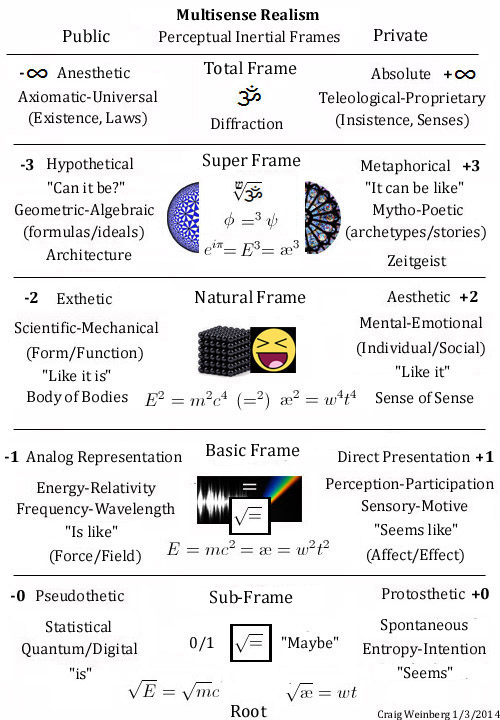
 Multisense Realism


Recent Comments