Archive

Posts Tagged ‘physics’

Continuum of Sense

March 18, 2016 3 comments

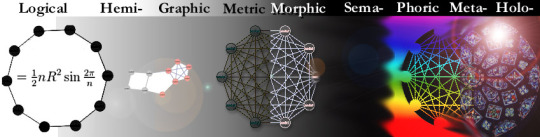
I have been writing for a long time now about what I call the Multisense Continuum, or the ACME-OMMM duality. In the course of developing this hypothesis, I have learned about other such efforts, detailed below, including a recent paper:

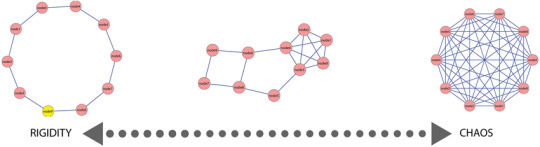
Rigidity-chaos semantic continuum

image

Drawing on network models, this is a promising approach, however the irony was apparent to me in the choice of terms. To see the opposite of psychological rigidity as chaos may be trivially true, however, it may also be that the chaos is a projection of the rigid, systemizing approach.

The model that I propose sees chaos as only one aspect, and not the most important aspect of the opposite of rigidity. This continuum is so universal, that I think it extends beyond ‘reality’ to embrace all of nature.

image

Here are some other variations:

Tough-Minded vs. Tender-Minded (William James)

interpreted the European divide between empiricists/positivists on the
one hand and German idealists/rationalist on the other hand in a
psychological way. He talked of the “tender-minded” and the
“tough-minded.” The tender-minded are the German idealists and
rationalists. (this linked source is gone, see new link for James’ original work)

The Divided Brain (Iain McGilchrist)

Psychiatrist Iain McGilchrist describes the real differences between the
left and right halves of the human brain. It’s not simply “emotion on
the right, reason on the left,” but something far more complex and
interesting.

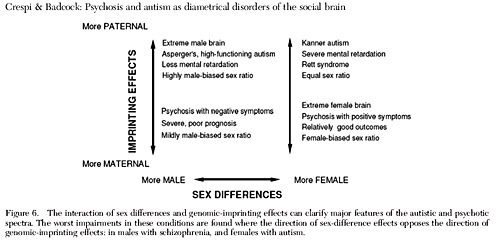
Autistic-Psychotic Spectrum     (PDF)

image

‘Thin-boundares” and “Thick-boundaries”

Significantly thinner boundaries compared to control groups have been
found in art students (Beal, 1989, Hartmann, 1991), music students, and
mixed groups of creative persons (Beal, 1989), frequent dream recallers
(Hartmann, 1991, Hartmann Elkin, & Garg 1991), adults with
nightmares (Hartmann, 1991, Levin, Galin, & Zywiak 1991; Galvin,
1993), adolescents with nightmares (Cowen and Levin, 1995), “lucid
dreamers” (Galvin, 1993), male as well as female fashion models (Ryan
2000), persons with unusual mystical experiences (Krippner,,
Wickramasekera, Wickramasekera, & Winstead, 1998), and persons with a
diagnosis of Borderline Personality Disorder, Schizoid Personality
Disorder or Schizotypal Personality Disorder (Hartmann, 1991).
Interestingly, although art students have much thinner boundaries than
average, this is not true of established artists, who have boundary
scores in the normal range (Beal, 1989).

Groups that score significantly “thicker” than average
on the BQ include naval officers, salespersons, lawyers, patients with a
diagnosis of Obsessive-compulsive Personality Disorder, persons
suffering from “Alexythymia” (Hartmann, 1991), and patients (from two
different sleep disorders centers) with a diagnosis of Sleep Apnea
(Hartmann, 1992).

Empathizing-Systemizing Continuum

Empathizing and systemizing traits were independent in women, but
largely dependent in men. In men, level of systemizing skill required by
field of study was directly related to social interactive and
mindreading deficits; men’s social impairments correlated with prolonged
go/no-go response times, and men tended to apply systemizing strategies
to solve problems of empathizing or global processing: rapid perceptual
disembedding predicted heightened sensitivity to facial emotion. In
women, level of systemizing in field was related to male-typical digit
ratios and autistic superiorities in detail orientation, but not to
autistic social and communicative impairments; and perceptual
disembedding was related to social interactive skills but independent of
facial emotion and visual motion perception.

…and my own bloggings:

Zooming in on Reductionism and Extremely Gendered Brains

War of the Worldviews

Multisense Continuum

Ironically, but unsurprisingly, the idea of the continuum of sense itself may only be coherent when approached from the ‘East side’ of the spectrum. This has to do with what is known as Theory of Mind.

What Is Really Real?

March 12, 2016 Leave a comment

If everything we hear, touch, smell, see are electrical impulses interpreted by our brain, then what is real out there?


In my view, to really answer that question we must forget everything that we think that we know about electrical impulses and brains and look at the phenomena again with fresh eyes. We must also ask questions about sensation and what is meant when we use the world “real”. Most importantly we must ask what our own capacities and biases are and what we can guess is true about reality and sensation vs what is true about our perspective as a human.
I think that I have answers to these questions, but they may not make sense unless you have asked them yourself. I would suggest that you first try to answer them yourself, even write out the answers, before consulting external sources, including this answer. Also write down what sources you think that your beliefs come from.
Question one: Why do most dreams seem real until you wake up?
Most people have probably had the experience of waking up and thinking, ‘Why would I not suspect that Mother Theresa falling asleep in my lap is impossible? She’s not even alive anymore.’ From this can we not conclude that our sense of realism is infinitely plastic? Even though some people may have lucid dreams where they do know that they are dreaming, or who do wake up after realizing that they are dreaming, it still does not explain why we can ever experience surreal, impossible, or nonsensical dreaming without questioning it. There is nothing that we can dream of which is so weird that it would cause us to question the reality of it. From this we must conclude that either our sense of realism is as much of an electrical hallucination as anything else we could sense. Is realism actually nothing more than failing to question one’s experience, or is there more to it than that?
Question two: How can you tell when you actually do wake up?
Many people have probably had the experience of false awakening, or a dream within a dream (even within a dream, within a dream, within a dream, etc). Each time you experience waking up in a dream, you have the feeling that you are awake but you are not, yet when you really do wake up, there seems to be an authenticity which is experienced directly and unmistakably. This sets up a curiously intransitive relation between false awakening and true awakening, namely, when we are dreaming, we can experience being awake, and we can doubt that we are awake, but when we really are awake, sane, and sober, we cannot fully doubt that we are awake. We can doubt it intellectually, and philosophically*, but this to me seems a very superficial kind of doubt which evaporates the moment that we are confronted with the sights, sounds, and feelings of our waking life. This suggests a contradiction to the first answer that I have give, bringing a third question:
Question three: How can we both know that all of our perception could be deception, but nevertheless feel that this knowledge is somehow insufficient to doubt the real world?
For this question, I think that the key is to realize that we have not taken skepticism far enough. If we consider that all perception is potentially deception, then we must also consider that this proposition itself is potentially deception. In other words, since we cannot know what is real, we cannot know that we cannot in some sense know what is real and in another sense not know. How do we know that nature doesn’t contradict itself?
At some point**, we have to admit that something is ‘given’ which cannot be doubted. Further we can conclude that what is given is not ‘knowledge’ but direct experience. However weak the veracity of our perception, knowledge is an even weaker proposition. Sellars attack on the myth of the given†, therefore, is itself deriving its own authority to attack from a myth of authority to attack which is itself under attack by his argument. His reasoning seems to exclude itself from criticism – assuming that scientific theories have access to a level of sanity about themselves which dreams could not simulate.
Question four: What do we really mean when we talk about ‘electrical impulses in the brain’?
When we talk about electricity, I think that we tend to have in mind something like sparks or lightning bolt. A bright, crackling appearance of a natural power or force which is independent of material objects but jumps between them at the speed of light. Further, theories developed by scientists such as Faraday and Maxwell explain this electric force in terms of perturbations or waves in an electromagnetic field. The electromagnetic field itself is invisible and intangible, so when we see lighting, hear thunder, or feel a shock, we are actually experiencing a second hand effect of matter rather than electricity itself.
To clarify:
This is not a picture of electricity, it is a picture of ionized air molecules colliding violently and releasing photons.
In a vacuum, there are no sparks and there is no sound. Sparks require a material medium which refracts light. Sound is always the collision of matter and is interrupted by a vacuum. While light is transmitted through a vacuum, there is no way to know for sure whether light is actually present in a vacuum, or whether photons are something else which can jump non-locally from place to place.
This is my own speculation, but it is not unprecedented. The Wheeler-Feynman absorber theory postulates that “every bit of radiation must be completely absorbed somewhere” (see Landon Carter’s answer to Can you explain Wheeler–Feynman absorber theory in layman’s terms?). If this is true, then it opens the door to radiation being an entanglement-disentanglement between ‘radiators’, even to the point of seeing space-time as emergent from it. Photons, electrons, even atoms themselves may not be true particles or wave in a vacuum, or fields or forces, but are more like examples of the ability to signal perceivability on the microphysical scale.
What I am suggesting is that absorber theory is on the right track, but does not go far enough. Not only is time meaningless for a photon (because of the constancy and insuperability of c) but even the assumption that some thing is emitted or absorbed could also be unfounded. Indeed, if my view is right, every equation and observation that we have about subatomic particles could be explained in terms of directly perceived micro-phenomenology.
This is not to say that “photons can see“, but that photons have no existence whatsoever other than as visibility (and thermodynamic tangibility) itself. Quantum fields and wave-functions mus then be considered purely abstract statistical entities which do not point to a deeper layer of inference beyond detection, but to the phenomenon of detection itself – to sensory-motor presentation. This uproots the entire foundation of both physicalism and functionalism to suggest the primacy of aesthetic participation behind any possibility of physical forms or logical functions. Sense is what the universe is made of, not stuff that makes sense, or that makes illusions of sense.
Rolling this back to ‘electrical impulses in the brain’, what we are really seeing when we look at an MRI is not electrical impulses, but electrical changes in the MRI instrument itself which are synchronized with the electrical changes of water molecules in brain tissue. This synchronization is not a collision of photons but a low level perceptual entanglement (which, in my hypothesis should be understood as a re-acquaintence or re-entanglement of spatiotemporally disentangled perceptual unity).
This is how I think that the brain works – we live our lives not as bodies or brains or electricity, but as the synchronization of changes which are diffracted across those various scales (Planck, atomic, organic, cellular, neurological, anthropological). These should not be thought of as scales primarily of space or distance but first of perceptual-partcipation, then time, then space. We are not bodies, or patterns of electrochemical information, or even pattern itself, but the capacity to perceive and participate which must rationally precede all appearance of ‘patterns’. Our brain activity is a 3+1 dimensional tip of an iceberg which transcends dimension itself, and which appears as a brain only because of the way that the limits of our human perception is even further limited by the sub-human bandwidth of our sensory organs.
From this, I conclude that what we perceive as the natural world, including brains, as well as everything that we infer from our perceptions, such as electromagnetism, are neither myth nor given but ‘myth-giving’ experiences. These experiences are, like our ordinary experiences, both concretely real within their own frame of reference and unreal from a ‘perceptually distanced’ or diffracted perceptual frame. A dream is a real dream, and only becomes unreal upon awakening into another dream which is more substantial and shared by more frames of reference. Reality should be understood as the real density of phenomenal overlap, such that there is not Reality so much as “Real Realism” – a quality of significance and coherence within a particular frame of perception in which the significance of the weight of perceptual experience accumulated through the entire history of experienced time (which would include all clock/calendar time, as well as all psychological time) is felt intuitively or instinctively.
Reality is real alright, but it is only the density of the constraints imposed by our condition as a human lifetime defining itself in the context of all other lives and times. I cannot prove what I am proposing to the satisfaction of reactionary skepticism (see Craig Weinberg’s answer to Is dualism no more than philosophical debris given the advances in neuroscience?) however I think that it is possible to reinterpret all of physics, mathematics, and information science successfully in this sense-first framework. Language and etymology are a valuable tool, since we can look at common-sense associations across cultures. Metaphors link literal, public facing phenomena such as weight or gravity with private facing phenomena such as importance or seriousness. There is, in my estimation, a whole other universe of connection between the sense of what is ‘out there’ and the sense of what is ‘in here’, which I try to scratch the surface of in my writing.
*Pyrrho, the founder of Skepticism is worth mentioning here, he
“founded a new school in which he taught fallibilism, namely that every object of human knowledge involves uncertainty. Thus, he argued, it is impossible ever to arrive at the knowledge of truth. It is related that he acted on his own principles, and carried his skepticism to such an extreme, that his friends were obliged to accompany him wherever he went, so he might not be run over by carriages or fall down precipices. It is likely, though, that these reports were invented by the Dogmatists whom he opposed. ” Internet Encyclopedia of Philosophy
** Descartes famously arrived at his cogito “I think therefore I am” as a result of taking his Cartesian doubt to its limit. Doubt, after all, cannot itself be doubted, and a belief in disbelief is still a belief.
† Another philosopher living in the 20th century, Wilfrid Sellars, was influential for his “Attack on the Myth of the Given”. Where Descartes skepticism led him to view himself as unquestionable, Sellars saw perception as inseparable from conception, so that just as an ambiguous image can appear to be a duck or a rabbit, our theory about what we are looking at cannot be subtracted from the experience of looking at it. Because of this, his view is that scientific theory can supersede the empirical reports of our senses. In my terms, he is saying that sense-making is more fundamental than sense experience.


A Theory of Aesthetic Diffraction

November 22, 2015 Leave a comment

aesthetic_diffraction

“If we split the atom cloud into two parts and recombine them after some time, a wave pattern forms” – source article

Yesterday I was looking at the sun on the water and thinking about how it is an analogy for consciousness and the brain and quantum entanglement. Each point of light reflects an image of the same sun, even though it appears disconnected and changing chaotically on the surface waves. At the same time, we can see a larger group coherence and intermediate scale, waves-of-waves coherence.

In the top image we understand that the coherence reflects a single light source onto a changing surface, in the brain we speculate on biochemical mechanisms within the surfaces which are connecting to each other. In the bottom image, we conflate the wave pattern with the surface itself, but then eliminate the surface altogether. What is being reflected or experienced is obscured altogether in the bottom up QM model.

By thinking of the sunlight as a metaphor for the mind-body problem, we can see how the explanatory gap can be closed. Using physics to look for consciousness is the same as looking at the surface of the water to look for the sun. In this case, the ‘sun’ isn’t a distant star, but the immediately present aesthetic experience of conscious.

Ready for some neologisms? Okay, this gets ugly.

A Theory of Aesthetic Diffraction

In my Multisense Realism project, I have tried to piece together some ideas about consciousness and physics. These include:

  • Light as sight. Photons are reflected incidents of ‘seeing’ or some other aesthetic acquaintance on the micro-level.
  • Aesthetic participation or sense as the root of consciousness, rather than an evolution of survival based intellect, information integration, or biophysics.
  • Local aesthetic phenomena (sense modalities as well as sense content) are like puzzle pieces of universal Pansense or Multisense Continuum which includes physics.
  • Sense as the absolute frame of reference or ‘Sole Entropy Well’.*
  • Space time are the mulitplication/diffraction of sense.
  • Sense is aesthetic content, like universal qualia, rather than a subject-object relation.
  • Significance is the saturation of sense, and its teleological function.

To these I would now add:

The brain is a Polysynchronizing Aesthetic Diffraction Engine.

(Composed of smaller, neuronal PADEs, which are in turn composed of smaller molecular PADEs.)

If we really wanted to see if this is true, I think that there might be a way to begin to find out. A couple of clues:

On the physics side, try turning Permittivity (ε) and Permeability (μ) ‘inside out’, so that we are thinking in terms of electromagnetic effects as reflections of sensory-motive affects rather than causal “fields”. The affect is not itself a field but a spatio-temporal or quantized diffraction…a temporalized, and then spatially dislocated disentanglement from the otherwise boundaryless, absolute context of Pansense.

Looking at the etymology of permit and permeate, we can get another clue in the original sense of the Latin root mittere ‘to send, let go.’ By contrast, permeate is to ‘go through’, from the root meare ‘pass, go’. The expectation of electric and magnetic fields is that they are different ways of looking at the same thing, but the difference is hard to define other than mathematically. I think that as long as we are take the concepts of force and field literally, we will be missing a critical opportunity for understanding nature.

When we turn permittivity and permeability inside out, we go from a Western concept of isolated material objects separated by a vacuum, to an Eastern-like concept of trans-material experiences which are temporarily fragmented from the totality of experience. This fragmentation or diffraction looks like distance or scale and the disappearance of the past, when viewed through the brain.

The Western model conceives of matter as complex nested fields which permit and are permeated by radiant forces. Inverting that takes us from a world of external waves oscillating meaninglessly to a world of felt affects and semi-intentional effects. Behind electromagnetic effects observed within local body frames of reference are phenomenal experiences of ‘going’ and ‘letting go’** in relation to the eternal and trans-local.

The per-mitting of ‘electricity’ translates to the fracturing or branching (think of lightning or a spark) of chaotic motive impulses to release across external frames of reference. The per-meating of ‘magnetism’ translates to a re-cycling or reabsorbing of motive impulses into what Leibniz might have called pre-established harmonies and Sheldrake might call morphic resonance. The difference in what I’m talking about is that what is resonating is not a vacuum or an aether – not a physicalized medium, but ordinary feelings, sensations, and experiences. In this way, relativistic models can be reconciled with quantum models through aesthetic participation as the final transceiving/transducting hyposurface†. This is literally ‘emergence’…the inflection point between these two extremes:

1. The information-based electrodynamic microcosm, which is reflected back to sense as its shadow. The shadow appears to its originator as polarized in terms of automaticity vs chaos-probability. The appearance of the originator can be inferred by inverting the qualities of the shadow, so that rather than crests and troughs of determinism, we can understand ourselves as that which appreciates and creatively determines the shadow.

2. The anchoring frame-based (gravitostatic?) astrocosm derived from the constancy of light speed and gravity. This is the sense of holarchy of scale as well as a hierarchy of importance. Physics can have no preferred frame of reference, so the preferring has to come from:

3. The participation-based mesocosm. Between the two extremes of mindless subatomic computation and mindless block space-time geometry is perception itself. An angle or ray of participation, illuminating and isolating ‘attentions’ while presenting the opportunity to create ‘intentions’.

For us, the mesocosm is reflected back to itself as an elaborate organic chemical hypersurface, nested within another zoological hypersurface. I think that the appearance of neurochemistry as we encounter it objectively is only a single surface or layer of aesthetic presentation which anchors the representation of the larger history of our particular experience as it grew from the physical to the chemical, genetic, biological, zoological, and anthropological frames.

On the perception side, I think that there are clues to be found in researching cross-modal perception and what I might call trans-modal perception. Cross-modal perception is an innate sense of isomorphism across sense modalities such as visual to verbal (Kiki-Bobo effect), onomatopoeia (phonetic to verbal). Trans-modal perception is a term that I propose could be used to talk about such phenomena as sounds which can be felt tangibly (i.e. high pitch sounds are highly localized and penetrating to the ear, while low, booming sounds envelope the entire room, drawing attention to the micro-personal or the oceanic shared transpersonal respectively.)

Conditions such as tinnitis, vertigo, epileptic halos, and synesthesia also seem to promise deeper understanding of sense as they point to the possibility of sense modalities as divergent categories of pansense rather than emergent properties of the functioning of sense organs. Just as physics requires instruments to push the limits of speed and detection into super-human ranges, a true study of consciousness requires examples or methods which transcend normal ranges of human experience. Autistic and psychotic spectrum conditions are especially important as a guide for the underlying axis of human sense-making, and I suspect that they can be meaningfully defined in terms of high and low permeability/permittivity (branching out of electricalimpulses, and recycling back to magnetic ground-state).

*This could be thought of as the sole/absolute ‘surface’ of aesthetic diffraction.

**This maps back to a language theme that I come back to frequently from the PIE root words ‘wag’ and ‘wegh’, like yin and yang…a universal oscillation or tessellation between push-pull (electric or sense-mitting phase) and relax-reflect (magnetic or sense-mearing phase) qualities of experience. Magnetic effects can be thought of as in between electric flux and gravitational grounding. Gravity shows us the orientation of mass toward massive frames of reference, while magnetism shows how local disorientation of mass can be accomplished through electric fluctuation (effort or kinetic energy).

† I say hyposurface to say that sense is both the larger context which contains all levels or planes of description as well as transcendent to the idea of planes and surfaces themselves. Sense is trans-spatiotemporal. Space, time, planes, frames, etc are carved out of the totality as a diffraction rather than as an emanation from fore-fields in a vacuum.

Is Time an Infinite Set of Moments?

November 9, 2015 2 comments

…or is the whole notion of an infinite set a paradox?

Since a set is by definition a defining of a boundary, whenever we talk about sets which are infinite we are talking about a boundary containing unbounded contents. Such a boundary makes it necessary that boundary-making itself is presumed to be outside of things being bound, i.e. it is taken as axiomatic that boundary making is part of a theory which does not change anything except our own understanding.

Things get murky however, when we consider time an infinite set. In Zeno’s Paradox of the Tortoise and Achilles, for example, the idea of an infinite set is used to trick us into thinking that motion is impossible. The logic is that for something to move one unit of distance, it must first move an infinite number of smaller distances. We can reverse this logic, however, and say that to divide one distance into an infinite number of smaller distances in the first place would take an infinitely long time if we had to actually make those measurements in some way, provided each measurement takes a non-zero amount of time.

Here is the difference between the map and the territory. Actually moving across a distance is a ‘territory’; a concrete reality. The idea that there is some number of points in which could be measured along that distance is a theoretical abstraction. When we apply the abstraction of infinity to the reality of concrete phenomena, we get paradox. The tortoise’s lead appears to always be getting smaller and smaller, but is still a nonzero fraction of the total distance ahead of Achilles, no matter how much faster Achilles is. What distracts us is that we are taking our own measurement for granted. Yes, it’s true that each measurement at time t will find the tortoise ahead of Achilles if we keep giving the tortoise a fraction of his original head start after calculating Achilles position, but infinity doesn’t end at that measurement. Infinity means not only that there will always be a measurement where the tortoise is ahead, it also means that there will always be an interval after the measurement where Achilles overtakes the velocity challenged reptile. In short, an infinite set means that the set always will extend beyond itself.

The physical allegory of the infinite set is a universe of stars and galaxies which expands into an infinity of empty space.  But can emptiness really envelope things or is it the expansion of things which exists on its own without any envelope? Is the assumption of empty space really a projection of our own intellectual expectations of set-making? I think that it is important to see that Einsteinian spacetime calculations would work the same either way. Spacetime need not be a literal container of mass-energy, if mass-energy is already entangled at superliminal rates. It makes it easy to think of General Relativity as referring to a spatiotemporal entity (a ‘reference mollusk’ as Einstein called it, or a Minkowski space), but the reality may be that spacetime is nothing more than the influence that the entangled consensus of mass-energetic relations has on itself. This way, no envelope of infinite emptiness is required around the Big Bang, and the vacuum can leave its quantum contents behind to revert to a true void. The vacuum energy gets turned inside out…it’s not inside of spacetime, it’s inside of relativity, i.e. universal perceptual entanglement.

Eastern and Western Eternity

If the Western view of time is an unlimited set of (limited) moments, then eternity is purely conceptual – the perpetually incomplete ‘set-hood’ of that set. The Western sense of eternity is also of perpetually filling itself with more and more clock ticks. Eastern mystics have promised instead that the fundamental truth of nature is the antithesis of that: A timeless connectedness of all things, or a universal connectability (The Force, Field, Love*, God) from which all ‘things’ are seemingly detached. Such a detachment is described as an illusion or temporary masking of underlying unity which remains eternal and pervasive. From the Eastern view, it is not space and time which contain all phenomena, but rather times and spaces are emergent dissociations within the grand phenomenality.

With the advent of General Relativity, the pendulum of Western thought began unknowingly to swing Eastward. Eternity came to be seen as a universal 4D manifold which distorts rates and lengths of physical processes. The distortions are understood to be relative to frames of reference; they are the ‘appearances’ of each frame to any other rather than a fixed physical property common to all frames. Frames themselves are, like the tortoise, given an unfair advantage of inheriting our ignorance of the nature of perception. Physics has attributed a frame-making capacity from a purely theoretical warrant, a warrant which magically acquires real powers of perceptual transformation (Lorentz contraction/dilation) which define the universe.

Some will complain that inertial or Galilean frames have nothing to do with perception, that they are tied only to linear velocity, however this takes velocity relations for granted in the same way that infinite sets take sets for granted. Here is where Relativity and QM completely agree. They both hinge on the concrete physical fact of measurement as the relation between properties such as space, time, position, and momentum. The measurement is a thing that separates the uncollapsed theoretical wave from the concrete wave-effects which are common to matter.

I submit that measurement itself is only the superficial way of understanding what is going on behind SR, GR, and QM. What makes measurement possible – all measurement – is an intrinsic relatability or sense which pervades all of physics. It is only parsimonious to assume at this point that this relatability is identical to the awareness which underlies our own conscious experience.

As it stands now, theoretical physics must resort to a kind of dualism where the idea of an ‘observer’ is somehow presumed separate from conscious observation. Any deviation from this premise is taboo and treated with antipathy. The Western imagination has been captured by positivism, so that all legitimate phenomena begin with an assumption of being separable from phenomenology. This unfortunately leaves phenomenology itself orphaned from physics, and the purest contents of conscious experience orphaned from legitimacy. We turn to the idea of “emergence” to reclaim some semblance of coherence, but emergence itself is no more physical or derivable from logic than consciousness itself.

Relativity applies to instantaneity as well as simultaneity.

To further bridge the Einsteinian notion of eternity with the Eastern one, I suggest a relativity of instantaneity. We can see from time lapse photography, for example, that different rates of exposure present nature at speeds of time. If we had nanobots we could surely step down our own body motions so that we could interact remotely with nanoscale objects at scales and speeds which would not be possible to us on the macro scale.

We can also see how the ocean appears to slow to a crawl when seen from the air. Interestingly, the trails that boats make in their wake appear to flow against a solid background of standing ocean waves.

image

In this photo you can’t see it, but next time you are flying over the water, notice how the narrow wake tracks which cross-cross the static ocean shimmer with movement. I’m curious about the physics of this – is it the distance of the plane or the speed which averages out the speed of water, and then the motion of the boat which makes some of the speed visible? Some kind of phase-cancellation?

It is this kind of transformation which I’m referring to as the relativity of instantaneity. The scope of the instant depends on perspective, and physics, having no preferred perspective, can have no way to define any separation between instants or any set which unites them. In this way, emergent properties themselves emerge from perception.

East vs West

I suspect that both views of time are reflections of the perspective from which they emerge. Eastern or Empathizing psychologies focus on the unity of categories in the category-making mind itself while Western, Systemizing modes focus on impersonal categories, the origin of which is seen as irrelevant. As the two modes have grown apart, they are no longer able to locate each other without distorting them into a straw man. The Western mind sees the Eastern view as an overestimation of our own presence (including the present moment) while the Eastern mind sees the fatal flaw of the Western effort to deflate the presence of the now and its presenter. Interestingly, the antipathy flips in the assignment of blame, with the Western skeptic taking personal umbrage at the individuals who they see as peddlers of ‘woo-woo’ superstition and postmodern ‘word salad’. By contrast, the Eastern mystic sees the Western resistance as a function of impersonal forces of spiritual immaturity. This dynamic of projection and inversion is a good place to study the lensing of consciousness. The model which I propose suggests that studying how people argue will show that fundamentalist positions on either side will have more in common with each other neurologically than there will be differences. From there we can begin to map the blind spot of the Western approach as it cascades down through academic policies, experiment design, and finally economics, and politics.

The Western approach is intrinsically bottom up in that it begins with a collection of external particulars and then extrapolates generalities and universal laws. Scientific thought is an analytic introspection which is intended to generate a synthetic ‘extraspection’. Our naive, introspective sense of the present time is as Edwin Schrodinger and Ken Wilber point out is “the only thing that has no end”. Meaning that we literally cannot locate within the present any beginning or ending. Only memories within the present which seem to explain things outside of the present can be found:

We dissipate our energies in fantasy mists of memories and expectations, and thus deprive the living present of its fundamental reality and reduce it to a “specious present”, a slender present that endures a mere one or two seconds, a pale shadow of the eternal Present.
-Ken Wilber, No Boundary

It seems clear to me that the Western view is dominated by the specific function of the intellect, which is to isolate problems and analyze them sequentially. Using the intellect to analyze itself, we conflate mental kinds of functions with nature in general and have learned to mistake this map of our own map-making for the territory. Because the Western mind identifies with itself rather than with the consciousness behind thought, it inverts our own existence into a ‘specious presence’. First an orphaned soul in an Enlightened machine, then a self-modeling semantic mechanism, the personal presence has now been so aggressively deflated that many insist that it has no existence at all.

If the Western view overlooks the magnitude of significance of the present in its modeling of time, the Eastern view overlooks the overwhelming influence of non-human scales of the present in the universe. The human scale of ‘now’ is overly preferred, so that the Western half of the universe, with its bottom up chains of causality, can be discounted irrationally (hence the woo-woo). This means that the vital and important contributions of science and technology can be dismissed by the Eastern approach, thus losing all credibility with Western thinkers. The sentiment that thoughts create reality is straw-manned to imply that human thoughts create all reality, when the truth is that human influence may be both more powerful and less powerful than we imagine.

Coming Together Over Time

I propose that the way to transcend the problematic notions of time in both the Western and Eastern modes is to see time as the “most common sense” through which eternity ‘pretends’ to be each moment, and how the eternal moment pretends to its own eachness. Time is what limits the unlimited and opens the limited to the possibility of the infinite.

Because the Western view of time has resulted in an all-but-insignificant present, it has contrived an all-but insignificant subjective conscious presence to act as an almost-disposable timekeeper. The ‘observer’ in physics is naught but a convergence of particular coordinates…coordinates which themselves are only defined by there own axiomatic coordination. The cosmos appears as an unorchestrated orchestration…an autoverse rather than universe.

The Eastern view inflates the present and the subjective presence to the absolute extreme, so that the cosmos appears as an unfalsifiably teleological monolith. This infuriates the Western mind, hearing soft-headed homilies of ‘There are no coincidences’ and ‘Everything happens for a reason’ to justify pre-scientific superstition. This would be a solipseverse rather than a universe – a universe which fits into single self. Monotheism splits the difference, with a Unisolipse – a single God self who is not us, but who is like us and can help us and care about us.

What I propose is that each of these models fall out naturally as reflections from a sense-based foundation. The true universe is an orchestration of (orchestration-unorchestration) of perceived qualities and conditions. A paratheistic or ambitheistic society of self-elaborating experiences.

*Love to me seems more human-centric or mammal-centric to me, but I think that Love could be better understood in this context as the most recent form of empathy or sense. Sense allows wholes and parts to partially disconnect and reconnect with the whole.

Should Quantum and Consciousness be Connected?

October 13, 2015 1 comment

Quora question:

Are there any reasonable reasons to believe that there is a connection between quantum physics and consciousness?


I don’t think that we need to believe in such a connection, but there are certainly reasonable justifications for seeking it out.

From the consciousness side, the issue is that sooner or later we have to get around to asking exactly how experiential qualities like flavors and images come into being. There has to be an inflection point or event horizon…some process through which psychological phenomena are transduced or emerge from actual physical substances. For example, we can see exactly where a computer displays graphic phenomena, but that display is

1) not part of any computational process
2) not comparable to any part of the brain
3) dependant on the visual experience of a conscious user to interpret

This would seem to put our direct, ordinary experience outside of a detectable physical location. Since quantum phenomena violate our classical expectations of physical location, it might be a good place to start. Futher, we know that electromagnetic activity in the brain correlates to conscious experience, and that electromagnetism is reducible to QED.

From the quantum side, there are a few different issues. One is that it isn’t classical. It’s not merely the fact that QM is ‘weird’, but that the particular ways in which it is weird suggests more thought-like properties than stuff-like properties. If we are willing to surrender classical realism for an abstract, counter-intuitive universe, then why rule out that this universe is in fact the same as the one in which our interior experience resides?

Another issue that I think qualifies as a reasonable consideration is that we are finding more and more examples of quantum effects which are macroscopic and organic. Rather than quantum theory settling down into a more unified interpretation, it continues to spawn more possibilities and more strangeness. When we consider what is really meant by photons entangled through time rather than space (Weird! Quantum Entanglement Can Reach into the Past) are we really that far from a universal sense of memory?

The idea that consciousness is related to quantum need not be a reason for us to place ourselves, as Homo sapiens, into the fundamental fabric of existence. Instead, it may be that our human awareness and quantum share a common ancestor. Several of the founding fathers of Quantum Physics emphatically supported the idea that QM is grounded in participation and process rather than objective ‘things’.

I have proposed that QM and Relativity share a connection to rudimentary awareness: Frames of reference, worldlines, multiple worlds, holographic simulation, etc all speak to an influence which bridges a gap between a cosmos with no possibility of preference to one which is dominated by localized perspectives and irreversible change. To me, there is an obvious conceptual intersection between quantum uncertainty and special relativity, and that intersection is in the sharability of sensory experience. This seems to be the inflection point. Both spacetime and causality can be seen to be emergent from a foundation which is perceptual-participatory rather than information-theoretic, spatio-temporal, or mass-energetic. It’s a matter of flipping our expectation of inputs and outputs serving to distribute objective “information” units, to seeing information as the the appreciation of common throughput qualities.

The human qualities of consciousness may not have as direct an effect as some supporters of New Age metaphysics may like*, but it may very well have an effect on which aspects of physics we think we can explore and which aspects we are afraid of. Just as particles have biases in terms of spin and charge, human psychology tends to become polarized. We are only beginning to understand the connection between genes, gender, and what has been termed the empathizing-systemizing spectrum. Autism and psychosis have been linked to the extremes of the E-S spectrum, along with ties to gender influence in gene expression.

If we have built a science which concentrates an overwhelmingly ‘S‘ or genetically ‘male’ perspective, and then use academic processes which only serve to amplify that bias, then it should not be a surprise when the great missing links in our cosmology come to us as shadow projections: Despised foes from across a gap of prejudice. If your psychology is highly biased toward the Systemizing side of consciousness, then you will know it because reading these words will cause you unusually vivid anger and outrage. Rather than a calm consideration of these ideas, it seems (and this is borne out in brain lateralization studies also) that your certainty only grows more fanatical and rigid. It’s not your fault. Ironically the mind is controlled by chemical influences and evolutionary defense mechanisms which deny themselves in our awareness.

If your psychology is overwhelmingly ‘E‘, then I would expect that you might feel more hurt and confused when reading this. The feeling is that this information isn’t really ‘for you’, or that I haven’t developed my own consciousness enough to really understand spirituality. Where the S-minded scientist shouts ‘Woo-woo!’ and demands evidence, the E-minded mystic retires to aloofness. One demands submission to the truth, while the other resigns such demands with transcendence and pluralism. Both views dismiss the authority of subjectivity, but in opposite ways.

To resolve this tendency toward psychic extremism, we may need to go much further in our efforts to seek objectivity than we have imagined. We may need to update our understanding of subjectivity to make it more objective, and our understanding of objectivity to make it more subjective. QM makes this especially true, as objectivity itself has proved to be fundamentally elusive.

This is where Gödel comes in. Formal systems may not only not be enough, they may prevent us from grasping the most essential truths of nature…that we are not observers of an illusory world, but participants in a spectrum of world-like experiences ranging from the very real to the very surreal.

*or at least, not in every state of consciousness or in states of consciousness that are accessible to everybody.

I Think Therefore I Am?

September 22, 2015 6 comments

The only thing that can be verified 100% to exist is your own consciousness (“I think, therefore I am”) does this effect/change your own beliefs in any way and how so?

In a way it is true that our consciousness is the only thing that we can verify 100%, however, that way of looking at it may itself not be 100% verifiable. Since cognition is only one aspect of our consciousness, we don’t know if the way that ‘our’ consciousness seems to that part of ‘us’ is truly limited to personal experience or whether it is only the tip of the iceberg of consciousness.

The nature of consciousness may be such that it supplies a sense of limitation and personhood which is itself permeable under different states of consciousness. We may be able to use our consciousness to verify conditions beyond its own self-represented limits, and to do so without knowing how we are able to do it. If we imagine that our consciousness when we are awake is like one finger on a hand, there may be other ‘fingers’ parallel to our own which we might call our intuition or subconscious mind. All of the fingers could have different ways of relating to each other as separate pieces while at the same time all being part of the same ‘hand’ (or hand > arm >body).

With this in mind,  Descartes’ cogito “I think therefore I am” could be re-phrased in the negative to some extent. The thought that it is only “I” who is thinking may not be quite true, and all of our thoughts may be pieces to a larger puzzle which the “I” cannot recognize ordinarily. It still cannot be denied that there is a thought, or an experience of thinking, but it is not as undeniable that we are the “I” that “we” think we are.

The modern world view is, in many ways, the legacy of Cartesian doubt. Descartes has gotten a bad rap, ironically due in part to the success of his opening the door to purely materialistic science. Now, after 400 years of transforming the world with technology, it seems prehistoric to many to think in terms of a separate realm of thoughts which is not physical. Descartes does not have the opportunity to defend himself, so his view is an easy target – a straw man even. When we update the information that Descartes had, however, we might see that Cartesian skepticism can still be effective.

Some things which Descartes didn’t have to draw upon in constructing his view include:

1) Quantum Mechanics – QM shifted microphysics from a corpuscular model of atoms to one of quantitative abstractions. Philosophically, quantum theory is ambiguous in both its realism/anti-realism and nominalism/anti-nominalism. Realism starts from the assumption that there are things which exist independently of our awareness of them, while nominalism considers abstract entities to be unreal.

  • Because quantum theory is the base of our physics, and physics precedes our biology, quantum mechanics can be thought of as a realist view. Nature existed long before human consciousness did, and nature is composed of quantum functions. Quantum goes on within us and without us.
  • Because quantum has been interpreted as being at least partially dependent on acts of detection (e.g. “Experiment confirms quantum theory weirdness”), it can be considered an anti-realist view. Unlike classical objects, quantum phenomena are subject to states like entanglement and superposition, making them more like sensory events than projectiles. Many physicists have emphatically stated that the fabric of the universe is intrinsically participatory rather than strictly ‘real’.
  • Quantum theory is nominalist in the sense that it removes the expectation of purpose or meaning in arithmetic. “Shut up and calculate.” is a phrase* which illustrates the nominalist aspects of QM to me; the view is that it doesn’t matter whether these abstract entities are real or not, just so long as they work.
  • Quantum theory is anti-nominalist because it shares the Platonic view of a world which is made up of perfect essences – phenomena which are ideal rather than grossly material. The quantum realm is one which can be considered closer to Kant’s ‘noumena’ – the unexperienced truth behind all phenomenal experience. The twist in our modern view is that our fundamental abstractions have become anti-teleogical. Because quantum theory relies on probability to make up the world, instead of a soul as a ghost in the material machine, we have a machine of ghostly appearances without any ghost.

To some, these characteristics when taken together seem contradictory or incomprehensible…mindless mind-stuff or matterless matter. To others, the philosophical content of QM is irrelevant or merely counter-intuitive. What matters is that it makes accurate predictions, which makes makes it a pragmatic, empirical view of nature.

2) Information Theory and Computers

The advent of information processing would have given Descartes something to think about. Being neither mind nor matter, or both, the concept of ‘information’ is often considered a third substance or ‘neutral monism’. Is information real though, or is it the mind treating itself like matter?

Hardware/software relation
This metaphor gets used so often that it is now a cliche, but the underlying analogy has some truth. Hardware exists independently of all software, but the same software can be used to manipulate many different kinds of hardware. We could say that software is merely our use of hardware functions, or we could say that hardware is just nature’s software. Either way there is still no connection to sensory participation. Neither hardware nor software has any plausible support for qualia.

Absent qualia
Information, by virtue of its universality, has no sensory qualities or conscious intentions. It makes no difference whether a program is executed on an electronic computer or a mechanical computer of gears and springs, or a room full of people doing math with pencil and paper. Information reduces all descriptions of forms and functions to interchangeable bits, so the same information processes would have to be the same regardless of whether there were any emergent qualities associated with them. There is no place in math for emergent properties which are not mathematical. Instead of a ‘res cogitans’ grounded in mental experience, information theory amounts to a ‘res machina’…a realm of abstract causes and effects which is both unextended and uninhabited.

The receding horizon of strong AI
If Descartes were around today, he might notice that computer systems which have been developed to work like minds lack the aesthetic qualities of natural people. They make bizarre mistakes in communication which remind us that there is nobody there to understand or care about what is being communicated. Even though there have been improvements in the sophistication of ‘intelligent’ programs, we still seem to be no closer to producing a program which feels anything. To the contrary, when we engage with AI systems or even CGI games, there is an uncanny quality which indicates a sterile and unnatural emptiness.

Incompleteness, fractals, and entropy
Gödel’s incompleteness theorem formalized a paradox which underlies all formal systems – that there are always true statements which cannot be proved within that system. This introduces a kind of nominalism into logic – a reason to doubt that logical propositions can be complete and whole entities. Douglas Hofstadter wrote about strange loops as a possible source of consciousness, citing complexity of self-reference as a key to the self. Fractal mathematics were used to graphically illustrate some aspects of self-similarity or self-reference and some, like Wai H Tsang have proposed that the brain is a fractal.

The work of Turing, Boltzmann, and Shannon treat information in an anti-nominalist way. Abstract data units are considered to be real, with potentially measurable effects in physics via statistical mechanics and through the concept of entropy. The ‘It from Bit’ view described by Wheeler is an immaterialist view that might be summed up as “It computes, therefore it is.”

3) Simulation Triumphalism

Disneyland
When Walt Disney produced full length animated features, he employed the techniques of fine art realism to bring completely simulated worlds to life in movie theaters. For the first time, audiences experienced immersive fantasy which featured no ‘real’ actors or sets. Disney later extended his imaginary worlds across the Cartesian divide to become “real” places, physical parks which are constructed around imaginary themes, turning the tables on realism. In Disneyland, nature is made artificial and artifice is made natural. Audioanimatronic robots populate indoor ‘dark rides’ where time can seem to stop at midnight even in the middle of a Summer day.

Video games
The next step in the development of simulacra culture took us beyond Hollywood theatrics and naturalistic fantasy. Arcade games featured simulated environments which were graphically minimalist. The simulation was freed from having to be grounded in the real world at all and players could identify with avatars that were little more than a group of pixels.

Video, holographic, and VR technologies have set the stage for acceptance of two previously far-fetched possibilities.  The first possibility is that of building artificial worlds which are constructed of nothing but electronically rendered data. The second possibility is that the natural world is itself such an illusion or simulation. This echoes Eastern philosophical views of the world as illusion (maya) as well as being a self-reflexive pattern (Jeweled Net of Indra). Both of these are suggested by the title of the movie The Matrix, which asks whether being able to control someone’s experience of the world means that they can be controlled completely.

The Eastern and Western religious concepts overlap in their view of the world as a Matrix-like deception against a backdrop of eternal life. The Eastern view identifies self-awareness as the way to control our experience and transcend illusion, while the Abrahamic religions promise that remaining devoted to the principles laid down by God will reveal the true kingdom in the afterlife. The ancients saw the world as unreal because the true reality can only be God or universal consciousness. In modern simulation theories, everything is unreal except for the logic of the programs which are running to generate it all.

4) Relativity

Einstein’s Theory of Relativity went a long way toward mending the Cartesian split by showing how the description of the world changes depending upon the frame of reference. Previously fixed notions of space, time, mass, and energy were replaced by dynamic interactions between perspectives. The straight, uniform axes of x,y,z, and t  were traded for a ‘reference-mollusk’ with new constants, such as the spacetime interval and the speed of light (c). The familiar constants of Newtonian mechanics, and Cartesian coordinates were warped and animated against a tenseless, Non-Euclidean space with no preferred frame of reference.

Even before quantum mechanics introduced a universe built on participation, Relativity had punched a hole in the ”view from nowhere’ sense of objectivity which had been at the heart of the scientific method since the 17th century. Now the universe required us to pick a point within spacetime and a context of physical states to determine the appearance of ‘objective’ conditions. Descartes extended substance had become transparent in some sense, mimicking the plasticity and multiplicity of the subjective ‘thinking substance’.

5) Neuroscience

Descartes would have been interested to know that his hypothesis of the seat of consciousness being the pineal gland had been disproved. People have had their pineal glands surgically removed without losing consciousness or becoming zombies. The advent of MRI technology and other imaging also has given us a view of the brain as having no central place which acts as a miniature version of ourselves. There’s no homunculus in a theater looking out on a complete image stored within the brain. There is also no hint of dualism in the brain as far as a separation between how and where fantasy is processed. To the contrary, all of our waking experiences seamlessly fuse internal expectations with external stimuli.

Neuroscience has conclusively shattered our naive realism about how much control we have over our own mind. Benjamin Libet’s showed that by the time we think that we are making a decision, prior brain activity could be used to predict what the decision would be. With perceptual tests we have shown that our experience of the real world not only contains glaring blind spots and distortions but that those distortions are masked from our direct inspection. Perception is incomplete, however that is no reason to conclude that it is an illusion. We still cannot doubt the fact of perception, only that in a complex kind of perception that a human being has, there are opportunities for conflicts between levels.

Neuroscientific knowledge has also opened up new appreciation for the mystery of consciousness. Some doctors have studied Near Death Experiences and Reincarnation reports. Others have talked about their own experiences in terms which suggest a more mystical presence of universal consciousness than we have imagined. Slowly the old certainties about consciousness in medicine are being challenged.

6) Psychology

Psychology has developed a model of mental illness which is natural rather than supernatural. Conditions such as schizophrenia and even depression are diagnosed and treated as neurological disorders. The use of brain-change drugs, both medically and recreationally has given us new insights into the specificity of brain function. Modern psychology has questioned earlier ideas such as Freud’s Id, Ego, and Superego, and the monolithic “I” before that so that there are many neurochemical roles and systems which contribute to making “us”.

To Decartes’ Cogito, the contemporary psychologist might ask whether the I refers to the sense of an inner voice who is verbalizing the statement, or to the sense of identification with the meaning of the concept behind the words, etc.

In all of the excitement of mapping mental symptoms to brain states, some of the most interesting work in psychology have languished. William James, Carl Jung, Piaget, and others presented models of the psyche which were more sympathetic to views of consciousness as a continuum or spectrum of conscious states. By shifting the focus away from first hand accounts and toward medical observation, some have criticized the neuroscientific influence on psychology as a pseudoscience like phrenology. The most important part of the psyche is overlooked, and patients are reduced to sets of correctable symptoms.

7) Semiotics

Perhaps the most underappreciated contribution on this list is that of semioticians such as C.S. Peirce and de Saussure. Before electronic computing was even imagined, they had begun to formalize ideas about the relation between signs and what is signified. Instead of a substance dualism of mind and matter, semiotic theories introduced triadic formulations such as between signs, objects, and concepts.


Baudrillard wrote about levels of simulation or simulacra, in which a basic reality is first altered or degraded, then that alteration is masked, then finally separated from any reality whatsoever. Together, these notions of semiotic triads and levels of simulation can help guide us away from the insolubility of substance dualism. Reality can be understood as a signifying medium which spans mind-like media and matter-like media. Sense and sense-making can be reconciled without inverting it as disconnected ‘information’.

8) Positivism & Post-Modernism

The certainty which Descartes expressed as a thinker of thoughts can be seen to dissolve when considered in the light of 20th century critics. Heavily criticized by some, philosophers such as Wittgenstein, Derrida, and Rorty continue to be relevant to undermining the incorrigibility of consciousness. The Cogito can be deconstructed linguistically until it is meaningless or nothing but the product of the bias of language or culture. Under Wittgenstein’s Tractatus, the Cogito can be seen as a failure of philosophy’s purpose in clarifying facts, thereby deflating it to an empty affirmation of the unknowable. Since, in his words “Whereof one cannot speak, thereof one must be silent.” we may be compelled to eliminate it altogether.

What logical positivism and deconstructivism does with language to our idea of consciousness is like what neuroscience does through medicine; it demands that we question even the most basic identities and undermines our confidence in the impartiality of our thoughts. In a sense, it is an invitation for a cross-examination of ourselves as our own prosecution witness.

Wilfrid Sellars attack on the Myth of the Given sees statements such as the Cogito as forcing us to accept a contradiction where sense-datum (such as “I think”) are accepted as a priori facts, but justified beliefs (“therefore I am”) have to be acquired. How can consciousness be ‘given’ if understanding is not? This would seem to point to consciousness as a process rather than a state or property. This however, fails to account for lower levels of consciousness which might be responsible for even the micro level processing.

In my view , logic and language based arguments against the incorrigibility fail because they overlook their own false ‘given’, which is that symbols can literally signify reality. In fact, symbols have no authority or power to provide meaning, but instead act as a record for those who intend to preserve or communicate meaning.

An updated Cogito

“I think, therefore I am at least what a thinker thinks is a thinker.”

Rather than seeing Cartesian doubt as only a primitive beginning to science, I think it makes sense to try to pick up where he left off. By adding the puzzle pieces which have been acquired since then, we might find new respect for the approach. Relativism itself may be relative, so that we need not be compelled to deconstruct everything. We can consider that our sense of deconstruction and solipsism as absurd may be well founded, and that just because our personal intuition is often flawed does not mean that kneejerk counter-intuition is any better.

With that in mind, is the existence of the “I” really any more dubious than a quark or a rainbow? Does it serve us to insist upon rigid designations of ‘real’ vs ‘illusion’ in a universe which has demonstrated that its reality is more like illusion? At the same time, does it serve us to deny that all experiences are in some sense ‘real’, regardless of their being ineffable to us now?

*attributed to David Mermin, Richard Feynman, or Paul Dirac (depending on who you ask)
Gaede’s EM Ropes

July 11, 2015 Leave a comment

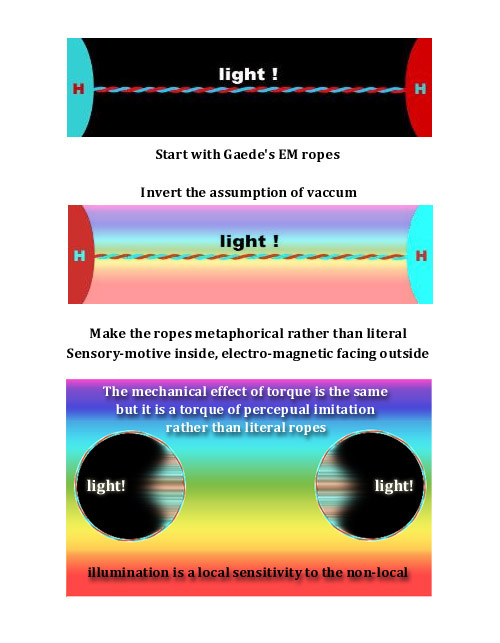
According to Bill Gaede’s hypothesis, light is “a torque signal propagating from one atom to another along a rope”. MSR defines the universe as being the totality of sensory presence, so that atoms are a localizing partial masking of that presence. Electromagnetism is a torque-like effect in which that masking is partially released or made permeable-permissive so that empathic-imitative sharing arises.
ropelight

Leaving Space, Time, and Spacetime Behind

May 12, 2015 2 comments

Are Space and Time an Illusion? Considered in this video:

  • 1. Give up your intuitions of how space and time work.
  • 2. Facts about observers (particles are considered observers):
    • a. observers disagree on how much time passes between events.
    • b. observers disagree on how much space there is between things at any given moment.
    • c. observers don’t fully agree on the chronological order of events.
    • d. observations are consistent so that no observer can be ‘wrong’.
  • 3. Spacetime is emergent from a deeper objective reality of causality.
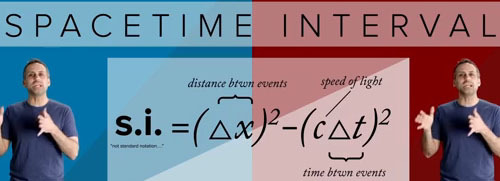
    • a. all observers agree on spacetime interval
      image
    • b. Spacetime intervals tell us about which causes influence which effects.
    • c. Causality is more objectively real than spacetime.
    • d. Spacetime is a tenseless, Non-Euclidean 4D mathematical Minkowski space.
    • e. Our intuitions of space and time are arbitrary and abstract.
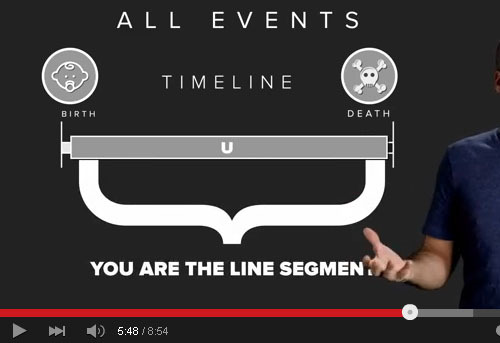
    • f.  We are real, however, if we think of our entire lives as a fixed geometric object in spacetime rather than a moving window on the line segment of our life:
image

He begins to sum up at 6:03

“Imagine we’re all reading a flip book made of graph paper. We agree on the events of the story, but we don’t agree where they happen on the page, on how many pages there are between events, or even on the order of some of those events, and yet we’re all reading the same book…only there’s no graph on the paper, there are no pages, and there is no book. All of that is just an imposition our brains make in order to perceive whatever it is. So why do we perceive reality in such a vividly spatial and temporal way? Good question, No one really knows.”

At this point is where I jump up and raise my hand. I think that I might know the answer to that question:

The mistake being made in our sophisticated rewrite of naive intuition about space and time is that the constancy of the spacetime interval is due to an objective ‘same book’ (or bookless book or whatever we are supposed all be reading.) To go to the next step into multisense realism, we must not only give up our intuitions about space and time being different, but we must give up our counter-intuitions about spacetime being literal.

If we consider instead that there is no final Minkowski block time universe out there, no ‘same book’, or even same language out there, but rather a shared capacity to read/write, in here, then both the naive intuition and sophisticated counter-intuition makes sense as perspectives within a larger context. Not just in human experience, or even within particles or probability laws, but deeper than that.

In this new schema all is read/written beyond spacetime but still ‘within’. Within us as well as ‘within’ every kind of non-human experience. This pervasive context ‘within all awareness’ would be an absolute context which is pervasive and devoid of any formal sense of distance or time. An anti-void. This absolute frame of reference can be understood as sense itself (something like “ference” rather than reference): Direct participation of perceptual qualities that need not be realistic, but also extend to phenomena which we are familiar with as fiction, imagination, myth, etc.

This is not to say that human imagination could necessarily describe the entire continuum of sense, but like the visible spectrum is to electromagnetism, it defines a range which is a thin slice of the whole, but much more than merely one color. The one ‘color’, call it white, would correspond to the single combined sense of timeless, spaceless realism that is studied under math and physics, but is nevertheless bereft of aesthetic qualities such as emotion, flavor, or (other) colors.

All that has ever been experienced can be seen, in this absolute frame of reference to be ‘right here and right now’, but for our local inhibitory conditions of human limitation. From our human perspective there is a cost in making awareness so immense that it embraces all other partitions; it becomes unreal or fictional, delusional, supernatural, absurd, or accidental*. The ‘heavens’ are not only causally closed at one level of awareness, but on another, they open up to non-linear, surreal mythscapes with no temporal rooting but deep symbolic meaning.

Jung spoke of the collective unconscious, Australian aborigines refer to a primordial Dreamtime, and many a psychedelic explorer have reported such aesthetically saturated realms. Anthropologists find that it is very common for cultures to assume that children are born into this world from a dreamier, more divine kind of world. These shamanistic-psychotic surrealities need not be considered ‘real’, however neither can their surreality and flirtation with prophetic intuitions be dismissed as mere accident. Even as a kind of placebo effect, the transcendental levels of experience must be accounted for in any would-be-complete view of the universe.

There is a lot to understand about our own spectrum of consciousness before we can even begin to approach the totality of awareness, which may be an unbounded, or self-binding rather than a fixed continuum. Non-human states of awareness might be both ‘larger’ and ‘smaller’, faster and slower than we can conceive of. This conception of the totality of experience as beyond causality turns causality into a kind of ‘nozzle’ of spacetime. Causality focuses the ocean of creativity; interiorizing some and exteriorizing others into relative degrees (the ancestor of our ‘five senses’ in which, for example, feeling seems ‘closer to us’ than seeing).

The pieces of this puzzle of human consciousness can, in my estimation, reveal a kind of ‘red shift’ and ‘blue shift’ which can be thought of in human terms as the stereotypically** autistic and psychotic extremes of human consciousness.

To return to the video, the multisense realism view would add:

  • 4. Nonlocal spacetime and “space ⊥ time” as (space and time in their naive, perpendicular local appearance) both emerge from a deeper common sense, which is trans-local.
    • a. this common sense can be thought of as the capacity for sense itself, or rather, for the particular kind of worldly sense of causality and agreement, which we might call realism.
    • b. realism is a common, but not exclusively common sense but is the reflection of an even more fundamental sense, which is novel and unprecedented rather than probabilistic or determined by laws.
    • c. the common sense of realism divides experience mechanistically and unintentionally
    • d. the uncommon sense beyond realism multiplies intentionally, seeking and building significance.
    • e. what we call causality is itself caused. Our distanced observations of realism is a kind of low-res substitute or icon that carries some semblance of the totality, but in an aesthetically neutralized, minimalistic form.
    • f. by using the built in, self-organizing clues of nature, we can begin to see how the holographic universe must be extended to include our own ‘visible spectrum’.
  • 5. The agreement of the Spacetime Interval is not evidence of a rigid body of 4D absolute reality, but rather evidence of the potential for agreement itself, i.e. the revelation of underlying local sensory unity with distant sensory conditions.
    • a. this is what the constancy of light speed and gravity are ‘really about’: not photons or forces, but ordinary sensory experience in self-diffraction.
    • b. light is not a particle or a wave, it is a local sensation on the cusp of spacetime emergence. Light is local sensation, and sensation is a boundary condition within sense.
    • c.  this means that sensation is more of a temporary subtraction from the eternal than an isolated piece of information.
    • d.  the extremes of human consciousness should be seen as a richer, more significant version of a guiding theme in all of sense: that of psychotic-unpredictable-figurative entropy and autistic-static-literal information.
    • e.  the phenomenon of seeing can be used metaphorically to begin to understand these extremes, as well as ordinary experiences of common sense, by working with the idea of language as a gravitational lensing in which the light of sense is bent by local accumulations of significance (mass).
  • 6. Paradoxically, what all observers agree on is their potential for agreement and fact of their own disagreement.
    • a. We can reclaim our naive intuitions about space and time being different, as this perpendicular aesthetic is an accurate reflection of our own subjective tunnel through eternity.
    • b. We can claim the Minkowski counter-intuition as a brilliant, and useful creation myth which is derived from common insensitivity, rather than common sense.

This is way too much to take in all at once (even for me), and I have no doubt that it sounds crazy to most people (that too is part of the Lorentz-like contractions and dilatations of sense-making). This is only the very tip of the iceberg…just something to get down in writing…for now.

*Whether the out-of-range portions of the spectrum of sense appear to be insane, error, or divine depends upon the frame of reference from which they are experienced.

**not talking about real people who demonstrate autistic or psychotic symptoms, but the themes exposed by the stereotyping of those symptoms, some of which are being researched under Imprinted Brain Theory.

A Couple of Scientific Conversations

April 17, 2015 2 comments
Quantum and the Bell

EM Imagine I set up Schroedinger’s cat and a machine that will open the box after 10 seconds and ring a bell if the cat is alive. I set it up, and wait 10 seconds, and don’t hear a bell. What’s happened to the wavefunction?

CM What happened is that a person, you, have made an observation based on an expectation that you have of a particular experiment.

EM But I didn’t interact with the apparatus. No signal was transferred between me and it.

CW If you didn’t interact with the apparatus then how do you know the bell didn’t ring?

EW Because I’ve noticed 10 seconds passing and not registering a bell ringing in that time?

CW Why would you expect to hear a bell ringing unless you know that you can hear that bell and that bell is part of the apparatus?

EM I wouldn’t do, but are you trying to say that being aware of that counts as interacting with the apparatus?

CW Of course. Does RAM exist if it’s just filled with 0s?

EM Sure, but the idea of RAM in my head isn’t RAM in reality.

CW Being able to hear a bell isn’t in your head either. Being able to hear a bell and infer a meaning to the apparatus from that sensory experience (or your unfulfilled expectation thereof) is what your interaction consists of.

EM Yes, and neither unfufilled expectation or potential ability to hear a bell are real interactions with the real apparatus.

CW They are if you can really hear a bell (which is part of the apparatus) and if you can really understand that hearing the bell constitutes a result of your experiment.

If a dead person doesn’t hear the bell is it still a valid observation?

EM As far as the mathematics was concerned, it was “observed” (decohered) by the time the bell rang. But “being able to hear the bell” is not an interaction. *Actually* hearing the bell is, but that doesn’t happen.

CW Your view takes sense for granted to the point that it denies a difference between a living observer and no observer.

As far as the mathematics was concerned”
Which proves my point. Mathematics truncates consciousness.

EM Your point is… what? Believing in single observers and WF collapse is more rational then just interpreting the mathematics that explains your results in the first place?

CW The mathematics don’t explain the results, they only diagram a skeleton of one measurement of the results. The actual experiment and results take place outside of mathematics.

Are molecules conscious?

Does polymerase have any sense when it transcribes DNA into RNA? Do ribosomes have any sense when they translate RNA into amino acids?

What we can say is that DNA, ribosomes, etc are all expressions of consciousness on a certain scale (microbio-chemo) as seen through another scale of consciousness (anthro),

There is a story, an experience going on that is represented to us as a ribosome, a molecule, etc, and we are seeing its body through our body. A facade that is filtered by another filtering facade. I call this Eigenmorphism. Form itself, like matter and energy, is relativistic. Whether a given phenomenon is a feeling or a structure depends on the distance across the frames of reference involved. Nothing is an object in its own frame of reference, including the universe. Our mistake since the Enlightenment is in Over-Copernicanising physics and dismissing the native frame of reference (sense) as an epiphenomenon or emergent property of the distant frame (physics)

Bang!

March 24, 2014 Leave a comment

If Big Bang was a singular event that created space, time and matter, then one must view the universe as a rapidly expanding billiards table of N dimensions with all events pre-determined. There can be no intervening force or new element of causality possible. There can be no uncertainty, and any notions of either free will or divine intervention are illusory.

If the Big Bang created time, then I think that it should not be thought of as an event (in time), but rather as the hub that all events have in common. The Big Bang never happened, it did happen, it is still happening, it hasn’t happened yet. Because we are measuring it from inside of spacetime, and using instruments that are limited to only the most generic spatial-quantitative measurements, our results reflect a narrowly defined model of the origin of causality itself. It is the fallacy of the instrument – we have a hammer of physics so everything that physics measures looks like a nail. What I propose instead is a Big Diffraction, where the birth of spacetime is an influx of dissociation into countless semi-permeable perceptual frames of reference that are united beyond spacetime.

If we place ourselves in the moment of the Big Bang, we cannot judge it on a human scale of time, since that scale of time had not been invented yet. If the universe itself is awareness, the first trillionths of a second of the invention of time are no less likely to feel like five minutes than they are an eternity. As the singularity breaks into multiplicity (Tzimtzum for fans of the Kabbalah), it is inventing the possibility of multiplicity for the first time. Eternity is spawning micro-eternities in which each micro-view is stretching out eternity so that it seems both ever longer and slower and seems to have originated in an ever more brief instant. Time is all about comparing frequencies of awareness – beats per measure. Time is relativistic because time is relativity itself – the framing of perceptual reference.

What we see through a telescope is an objectified version of the story of objectification that serves as a creation myth for the anti-mythology of functionalism. Free will was never inside of spacetime to begin with. It was not created, it creates. If free will is illusory, then it is that which is illusory which gives birth to realism and physics, not the other way around. The universe is a single thread of singing, signaling, significance-building experience,weaving and winding through a maze of its own self-imposed alienation. Divinity is optional, and free will is scarce, but the universe is only a billiard table if you limit the vocabulary of inquiry to that of billiard balls.

The Third Eve

Who we are becoming.

Shé Art

The Art of Shé D'Montford

Astro Butterfly

Transform your life with Astrology

Be Inspired..!!

Listen to your inner self..it has all the answers..

Rain Coast Review

Thoughts on life... by Donald B. Wilson

Perfect Chaos

Steven Colborne's Philosophical Theology Blog

Amecylia

Multimedia Project: Mettā Programming DNA

SHINE OF A LUCID BEING

Astral Lucid Music - Philosophy On Life, The Universe And Everything...

Rationalising The Universe

one post at a time

Conscience and Consciousness

Academic Philosophy for a General Audience

yhousenyc.wordpress.com/

Exploring the Origins and Nature of Awareness

DNA OF GOD

BRAINSTORM- An Evolving and propitious Synergy Mode~!

Musings and Thoughts on the Universe, Personal Development and Current Topics

Copyright © 2016 by JAMES MICHAEL J. LOVELL, MUSINGS AND THOUGHTS ON THE UNIVERSE, PERSONAL DEVELOPMENT AND CURRENT TOPICS. ALL RIGHTS RESERVED. UNAUTHORIZED USE AND/OR DUPLICATION OF THIS MATERIAL WITHOUT EXPRESS AND WRITTEN PERMISSION FROM THIS SITE’S AUTHOR AND/OR OWNER IS STRICTLY PROHIBITED.

Paul's Bench

Ruminations on philosophy, psychology, life

This is not Yet-Another-Paradox, This is just How-Things-Really-Are...

For all dangerous minds, your own, or ours, but not the tv shows'... ... ... ... ... ... ... How to hack human consciousness, How to defend against human-hackers, and anything in between... ... ... ... ... ...this may be regarded as a sort of dialogue for peace and plenty for a hungry planet, with no one left behind, ever... ... ... ... please note: It may behoove you more to try to prove to yourselves how we may really be a time-traveler, than to try to disprove it... ... ... ... ... ... ...Enjoy!

Creativity✒📃😍✌

“Don’t try to be different. Just be Creative. To be creative is different enough.”

Political Joint

A political blog centralized on current events

zumpoems

Zumwalt Poems Online