Archive
YouTube: Is There Really a Hard Problem of Consciousness?
Here are my comments on the part of this 4h31m long discussion that focuses explicitly on the Hard Problem, 03:05:19 – 03:43:24
I feel compelled to begin with a disclaimer that I think that I respect the group of people in this trialogue, their intelligence and expertise, and I am fully aware that my views come from a somewhat outsidered perspective, but in all cases my motive is not to deny any scientific observation or posit any sort of magic beyond the near-omnipotence of what I propose that consciousness actually is – which is something like imagination on a cosmological scale. I fully respect the academic credentials of the participants as well, and while I never pursued that path farther than a BA degree in Anthropology, I prefer to use first names rather than Dr. titles – no offense or undue familiarity intended, just seems less pretentious. Speaking of pretentious, I hereby end this disclaimer and proceed to the proceedings.
The Hard Problem segment opens with Joscha bringing up Daniel Dennett, and how his dismissal of qualia seems to be based on a criticism of how the term is used in philosophy. In the course of that, JB says of Dennett’s position…
3:06:46 “Oh well he’s a functionalist. Pretty much standard.
He says…uh good writing…there’s nothing wrong with what he writes. My position might be different from yours because I don’t see magical powers that are afforded by biology, it’s still just function. It is provided by biology and I can break down these functions ultimately into state transitions in substrates that form control structure and so on, so it’s it’s not opening avenues into something new. There’s basically no magical homunculus that is produced in consciousness via biology. Biology is just a way to get self-organizing matter.”
Here I agree with Joscha completely. I disagree with Dennett’s views almost entirely, but have great respect for how he does what he does. As far as biology goes, I see no grounds for emergent properties, especially any that smell of consciousness. When JB says that he can break down biological functions into mechanical events, I tend to believe him, or at least understand why that is entirely possible in theory. While we perceive breakpoints in the properties of physical, chemical, and biological phenomena, they are as far as I can reason, aesthetic separations. Functionally, they all refer to the same thing: concrete tangible objects on different scales of size moving each other around and changing shapes.
The geometry of those shapes and their movements become more complicated as we scale up in size from particles to molecules to cells to bodies, but complication in and of itself adds nothing to the conversation about consciousness. Indeed, without some awareness and experience, molecules or cells have no way of suspecting that they are part of any group or process and no capacity to qualify it as simple or complex. Without a theory of sense, we are really at a loss to say what the difference would be between matter and nothingness, but that’s another topic. Without going that far, I would still say that even the idea of ‘control systems’ can only arise within a conscious experience where a thoughtful analysis of perceived objects in a universe where some objects are associated with conscious, teleological motives.
In the most stringent reading of the view that I propose, matter of any scale would not literally be controlling anything, so that any appearance of control is smuggled in by our conscious, anthropic experience. Without that anthropomorphic projection, what we see as bacteria or molecules controlling each other would reduce losslessly to non-purposeful habits of mindless physical force geometry. Saying that these movements of objects are control systems doesn’t actually add anything to what is occurring physically, but that isn’t key to understanding the Hard Problem. We can call what physical structures end up doing mechanically ‘control systems’ without taking that literally. Literally there’s just physical forces moving each other around automatically for no reason other than the given geometry of what they are. If what we mean by “self-organizing” implies something more than inevitable looping geometries of those automatic movements, then that too would fall into an Explanatory Gap.
I agree with what Joscha says next about the problem that I and many others have with Daniel Dennett’s disqualifications of qualia:
3:07:56 JB: “…what I found is that Dennett fails to convince a lot of his own students in some sense and I try to figure out why that is and the best explanation that I’ve come up with so far is that Dennett actually never explains phenomenal experience. And when discusses qualia he mostly points at definitional defects in the way in which most philosophers treat qualia and then says it’s probably something that doesn’t really exist in the way in which these people Define it so we also don’t need to explain it and a lot of people find this unsatisfying. Because they say that regardless of how you define it it’s clearly something that they experience like qualia being the atoms of phenomenal experience or aspects of phenomenal experience or features of phenomenal experience it doesn’t really matter how you define it it’s there right and please explain it to me because I don’t see how an unthinking and feeling Mechanical Universe is going to produce these wealth of experience that I’m confronted with and so this physics does not seem to be able to explain why something is happening to me why is me here why is their experience and this is something that some people feel is poorly addressed by Dennett.”
Joscha goes on to summarize the significance of Philosophical Zombie thought experiments in formulating the Hard Problem.
3:09:45 JB …”so let’s see, we have a philosophical zombie in front of us and we are asking this philosophic zombie who in every regard acts like a human being because his brain implements all the necessary functionality just mechanically and not magically, ‘are you conscious?’ what is the zombie going to respond?
Anastasia Bendebury “What do you what do you mean about the fact that the brain reproduces all of the effects?”
JB: “The idea of the philosophical zombie is that the philosophical zombie is producing everything without giving rise to phenomenal experience – just mechanical. Based on the intuition that…”
AB: “What does that mean? I don’t understand what that means.”
JB: “I think the intuition is that when we experience is something that cannot be explained through causal structure. So mechanisms.”
AB: “But why do we think that? I don’t understand why we possibly think that.
That’s what I mean about not understanding the hard problem of Consciousness. Because I’m like look… This is why my definition of life as beginning before the cell is instrumental to eliminating the hard problem of Consciousness. Because if you have in the most basic cell – which is an embodiment of the state of matter that is life – you have a resonant state which is electromagnetic. It’s the redox state.
And the cell needs to maintain that electrical resonance at a specific set point because if it does not, it dies. And so it is going out into the world and it is constantly controlling where it is in the world relative to its internal state. And as you progressively produce more and more complex beings you get a more and more complex map of the world and a more and more complex internal state. And so by the time that you have a walking human, you cannot have a walking human without an internal state. It’s a philosophical thought experiment that requires you to divorce yourself from everything that you know about biology in order to make the claim. And I just feel like you can’t do that!
Because the biology is inherently what produces the conscious…it’s the state of matter that produces the consciousness and all of the resonant waves that are inside of it. And so if you have the resonant waves in the sufficient complexity of a sufficiently resonant system that is interpreting the world relative to itself and to what it wants how can you have anything except for consciousness? You have experience, you have the mapping of expectation to frustration and you’re just…it just emerges from the most basic cell.
I think that the reason why Anastasia isn’t seeing the Hard Problem is because her model of biology already includes aesthetic-participatory phenomena (experience, awareness, sensory-motivation), rather than cells being anesthetic-automatic mechanical events that occur independently of any experience of them.
The expectation that a physical state like reduction–oxidation (redox) constitutes or leads to a cell’s need to participate intentionally in seeking to correct what it somehow senses (unexplained by biology) as disequilibrium is already smuggling in teleology into biochemistry > physics > mechanism.
Because we have genetic mutation and retrospective statistical natural/passive “selection” to account for the evolving mechanical behaviors of cells, no sense or teleology is needed in the explanation. We can omit it entirely and nothing changes in our description of what is causing the movements of cells in the direction of the chemical reactions that are necessarily pulling them there.
In a purely physical universe, chemistry would act not out of any perceived sense of need. There would be no agentic power to seek out satiation of that need, but rather the mechanical behaviors that end up maintaining redox states (unperceived) would be nothing but those behaviors that happen to have survived in the genetics of the cell. If the cell ends up moving in ways that maintain redox and happens to be in an environment that allows that to happen, then the cell has a better statistical chance of reproducing. That’s it. No need, no going out into a world, no controlling, no sense of self – just molecular geometry cashing itself out statistically over time.
JB: “How do resonant waves produce consciousness?”
AB: “say it again”
JB: “How do resonant waves produce consciousness?”
AB: “okay so do you know the Qualia Research Institute yes? So what is their work? Their work is that they’re basically showing that there are harmonic states in the brain that are associated with experience”
It’s important to realize, in my opinion, that the association is always coming from experience, not from anything the brain is doing. The association is retrospective from the reality of consciousness rather than prospective from the reality of unexperienced brain matter.
Michael Shilo DeLay: “The question seems akin to asking how do fundamental waves produce music? Which emerges from all of these individual tones. But the same thing with conscious experiences you have the summing of different modules within the neuron-based systems that are all aggregating and fighting and resonating with one another and you get music that comes out of it.”
JB: “And you don’t see an explanatory problem there? No?
AB: “No. I’m like how I mean I can see a mathematical problem. I can see that it would be very very difficult to mathematize the way that that resonance…”
Here I see that what is being overlooked is the gap between phenomena in one sense modality (waving intensities of chemical or electrochemical movements in a brain) and any other aesthetic quality (sights, sounds, feelings, etc). When we understand music as emerging from a sequence of aural tones, that’s all within the context of a conscious experience. Sound in the aural sense is qualia. Sound waves are actually silent acoustic perturbations of matter as it collides with matter. Between the concept we have of sound waves, which refer to dynamic geometry of tangible objects so firmly embedded in our learning, we overlook the need to explain how and why these movements of matter are perceived at all, and how they come to be perceived as sounds rather than as the silent, physical vibrations of substances that they ‘actually’ are.
In comparing music emerging from acoustic waves to consciousness emerging from brain wave resonance, we are already falling for the same circular reasoning fallacy that leads people to deny the Hard Problem. Since there is the same Hard Problem there in transducing tangible changes in objects to aural experiences of sound, notes, and music, it actually only reinforces the Hard Problem in the brain > consciousness context. Sense is the key. That’s why I write so much about it and call my view Multisense Realism.
For the next few minutes the hosts and guest discuss the limits of the explanatory power of math, language, and scientific theory, and the difference between explanation and description. This isn’t directly related to the Hard Problem in my opinion, but it does speak to the same theme of neglecting different modalities of sense and sense making and glossing over the fact that in all cases, the gaps between such modalities can only be filled, as far as we can conceive, by some conscious experience in which multiple modes of qualia can be accessed and manipulated intentionally in another mode of sense making (imagination, abstraction, understanding). Because Anastasia’s view of the Hard Problem is that it must come from a misunderstanding of biology (which she already gives experience and teleology to), she sees the Problem as one of finding fault with description for not being explanatory.
I agree with Joscha in his response:
3:18:07 So when you talk about harmonic waves producing a phenomenon for me that’s very far from a causal explanation that so it’s something that is very unsatisfying to me because I cannot build this but well for me a causal explanation is something I can make.
This is at the heart of the Explanatory Gap, which I like to meme-ify with this cannibalized version of a cartoon (not sure which artist I stole the original from, but my apologies):

Following this, Joscha gets into a detailed technical explanation of what waves are and why they don’t explain or justify producing phenomenal qualities.
3:20:02 JB: “…you can build control systems and once you have control systems you can also build control systems that don’t just regulate the present but also regulate the future, but in order to regulate the future they need to represent stuff that isn’t there right – that will be there at some level of coarse graining but it’s currently not present so you need to have a system that is causally insulating part of your mechanical structure from the present…control systems that don’t just regulate the present but also regulate the future. But in order to regulate the future they need to represent stuff that isn’t there right that will be there at some level of coarse graining but it’s currently not present so you need to have a system that is causally insulating part of your mechanical structure from the present…”
I propose that groupings of moving objects don’t actually need to represent anything to appear to ‘control’ future states, and that no such need to represent could be fulfilled physically. All that would be needed are mechanical switches and timers that happened to have evolved to fit with environmental states that happen to repeat. If the brain needed to control the position of the legs in the future to walk successfully, it need only set aside some neurons for that purpose. They don’t need to represent anything or imagine the future, they just need to grow a miniature duplicate of the brain chemistry involved in walking but without being connected directly to efferent nerves to the legs. There doesn’t need to be a representational relationship hiding inside of chemistry, the chemistry just had to have accidentally evolved to accumulate a lot of repeating triggers of triggers.
In other words, there’s no reason to represent anything in the future when you can just use space instead of time. You don’t need to know that the wood you’re piling up is for burning in cold Winter if you have a statistical mechanism of mutation that happens to select for piling up wood and burn it if temperature conditions activate a thermal switch. Instead of executive consciousness, it would just happen that a brain that grows miniature low resolution copies of itself would end up pantomiming meta-cerebral functions. No feedback or representation at all, just parallel reproduction of self-similar neurochemical systems. No code or instructions are needed, just clockwork chain reactions.
I’m not suggesting that I think that’s what happened in reality. I think that the reality is that all phenomena are part of the way that conscious experiences are nested and relate to each other. If that were not the case, I doubt that biology as we know it would have evolved at all. I agree with Anastasia’s view that experience begins prior to the cell, and with Joscha’s view that there is nothing special about biology that would explain consciousness.
Where I do disagree with Joscha’s estimation of consciousness is in the attribution of ideas and motivations to robots:
3:28:55 AB: “it’s not obvious that the bacteria needs to be more conscious than a soccer playing robot which is not conscious. Right? Bacteria needs to be more conscious than a soccer playing robot which is not conscious right if you build a robot that plays soccer it’s the robot is fulfilling a bunch of function it’s going to model its environment it’s going to figure out where the ball is where the other robots are where the goal is how to get the ball between yourself and the goal how to push the ball into the goal and so on so in some Financial sense it’s going to have beliefs about the environment it’s going to have commitments about the course of actions it’s going to have full directive Behavior it’s going to have representations about the world with itself inside but I don’t think it experiences anything.“
I don’t see any reason to assume that a robot’s behavior requires the generation of any actual models, beliefs, or representations. The robot is just lots of switches switching switches that control the movements of the physically assembled parts that make it up. I like to use the example of a fishing net and how it is very effective at catching fish, but it doesn’t have to know anything about what it is doing. The size of the fish and the shape of the net are all that are needed. In the same way, the structure of the robot is all that is needed to explain why the robot parts move in the way that they must move – by physical law, not by models or beliefs.
In the video AB and MSD go on to talk about justifying the emergence of consciousness in bacteria but not in a robot because of either complexity or flexibility. Neither of these seem to me to warrant the creation of a new type of representational or qualitative metaphysics. Moving objects are just moving objects, no matter how many there are or how fancy their movements become.
3:34:18 AB: “…any exercise that attempts to explain consciousness without the physical substrate without recognizing that the physical substrate is mandatory for the effect that we’re seeing and is the iterative product of progressive complexity that has been evolving on Earth for the last four billion years will fail to produce Consciousness because it is inherent in the structural organization of these different modules that resonate with one another to create complexity
Here is a case where I agree with what Anastasia is saying in one sense but disagreeing completely in another. I agree that the human conscious experience probably has to result from billions of years of specific evolutionary history, however, I disagree that it is related to physical structures. I propose that the physical structures and mechanisms are effects, rather than causes, of how our conscious experience has developed. Because I think that the physical universe we see is an appearance in our evolved consciousness (see Donald Hoffman’s Interface theory), it is the trans-physical accumulation of conscious experiences themselves that the human qualities of our experience depend upon.
For this reason I do not think that human consciousness can be replicated or simulated mechanically. It’s not because biology alone is capable of providing complexity, flexibility, or harmonics, it’s because biology is the particular vocabulary that consciousness has developed for higher/richer forms of experience to use lower forms of conscious experience as a vehicle. I think that biology doesn’t generate consciousness, rather biology is a symptom of the interface between two different epochs and timescales of evolving conscious experience.
3:35:02 AB: “…the phenomenon of experience is all these different resonant modes you can think about what it feels like to listen to a sine wave versus what it feels like to listen to a symphony they’re the same thing except the sine wave has been modulated into something far more complex and that complex wave has something else in it.
I agree that a symphony is the same thing as complex modulations of sound, but again, a sine wave doesn’t sound like anything unless you can hear. The chain of physical causality ends in the silent brain. There is nothing about an auditory cortex that will be able to conjure sounds out of the oscillating changes in its chemistry. There is no evolutionary advantage to an organism that has to hear sounds rather than one that just transduces acoustic vibrations mechanically into oscillating electrochemical states. We know, for example, from Blindsight patients that the brain is perfectly capable of responding correctly to questions about optical conditions without any experience of visibility.
I agree with Joscha that there’s nothing special about biology as far as being an extra property above chemistry or physics. Again, it’s all just tangible objects moving each other around in public space.
3:38:37 – AB: “What the QRI work is interesting where it’s interesting because there appear to be different states inside the brain that correspond to emotional states and so if you are unhappy or you’re feeling depressed there’s a different brainwave state that is associated with that experience.
I think it’s important to understand that ‘correspond to’ can only happen in a conscious experience. Correspond isn’t a physical activity or structure. Physical states of a brain have no physical way to correspond to anything, so they are just what they appear to be – geometric changes in tangible shapes. Consciousness uses brains, but brains have no way to use consciousness. They have to use physical force – which also has no way to use consciousness. When we use a non-physical model of nature instead, there is no problem with some aspects of consciousness perceiving other aspects of itself as physics. We see it all the time in dreams.
3:40:33 JB: “What is actually sadness? Right? Sadness is an affect it is directed on some source of satisfying a need being permanently removed from your world can never get it back and it’s completely crucial to you. You identified the satisfying yourself through the source of satisfaction and it’s got it will never come back right this is sadness in some sense and a stronger form of sadness is grief it’s a paralyzing form of sadness and sadness leads to certain behaviors mostly a disengagement with the world because you’re helpless you cannot do anything about it. In supplicative behavior you are appealing to an environment to help you with the situation and to create a solution for a problem for which you’re incapable of finding one. And so sadness is some complex psychological phenomena that you can formally define and the question is how is it implemented in the brain?
And what’s also crucial about sadness is that you experience yourself changing as a result of sadness and without this experience you wouldn’t say that somebody is sad you would say somebody acts as if they are sad but there’s a difference between acting as if you are sad and actually being sad. Because that requires an experience of sadness. And so we are coming back to this original question how is it possible that the system that is mechanically implemented is actually feeling something and don’t say waves that are interacting with each other that sounds like magical thinking to me because it’s not adding anything beyond molecules bumping into each other and you’re saying more complexity it just means more molecules bumping more complexly into each other.“
I completely agree that any explanation of sadness based on waves doesn’t work, and that this is what the Hard Problem is all about. In Joscha’s discussion, he links sadness with semantic and behavioral correlates, but that too doesn’t explain emotion itself. Sadness is an affect but that doesn’t explain why or how affects could arise either from brain activity or events that happen to a biological organism.
Finishing up this segment, the discussion turns to conceptualization.
3:42:41 MSD – “…a concept is a relationship between two physical bodies so one is moving towards the other let’s say and then an abstract concept would be taking that motion and relating it to another concept and you can compound these into greater and greater degrees of abstraction…”
I disagree that concepts have anything to do with objects. Objects relate to each other in only one way as far as I can tell, and that is through the relation of the geometry of their shape, position, and motion. Nothing conceptual or abstract about that as far as I can tell, although since motion requires some sense of duration, we could distinguish objects from objects changing position/shape over time, with the latter being arguably less like a static object. Since stasis and velocity are both relative and dependent on perceptual framing (as is everything except perception itself), the idea of a static object is purely hypothetical. If we say that anything hypothetical is an abstraction, fair enough, but even so, it is an abstraction of geometric shapes and not a concept that departs from geoemtry.
Multisense Combustion
I was thinking about combustion engines and mentally following the sequence from the early step of mixing gasoline with air, then how that mix gets ignited in the gap of the ‘charged’ ends of the spark plug, which then changes the mix into CO2 + H2O steam molecules moving in all directions, only much faster…then those fast moving steam molecules begin to gradually move the dense metal pistons, push the metal gears in the transmission and ultimately rotate the drive train and wheels.
I wanted a video that would show a realistic visualization of combustion at the microstate scale, and this was the closest I could find right now. It’s a good video and I think it works for this, even though I was hoping for more of a scientific CGI simulation than a cartoon.
I’m doing this to help explain my understanding of how the Hard Problem of Consciousness can be transcended using sense-centric model of metaphysics.
Some key points to get from the simple explanation of the video to my Multisense Realism view:
Energy is an abstract concept that stands in for what we would call stimulating feelings or sensations. Stimulating meaning that besides the sensation of kinetic movement that would be assumed under physics (but not defined as a sensation), the event would includes another sensation of desire/motivation (call it motive) to act physically to discharge the quality of that initial feeling, because it is in some sense, uncomfortable or stressful. I propose that is all that ‘energy’ is – a felt sensory-aesthetic quality that causes a motive to experience a complementary sensory-aesthetic quality of release/return by turning the motive affect into motor effect – physical motion. The idea of potential energy is replaced by the more familiar experience of stress/strain and the idea of kinetic energy is replaced by the release of that stress through the physical act of acceleration.
The video does a great job of simplifying the conventional thermodynamic theory with a curve on a graph where potential energy of the fuel molecule decreases as it is transformed into the lower energy (more ‘relaxed’) molecules of water and carbon dioxide plus acceleration and light. In reality, there is no curve of potential energy being lost to kinetic energy. That is an abstraction to help us understand a theory of chemistry rather than a description of the event.
I propose that the actual combustion event needs at least two separate sense modalities to be modeled realistically – two modes of perception analogous to what we experience as touch (tactile/haptic/tangibility) and sight (visibility). First, the tangible sense rendering or appearance consists of molecules moving at one speed colliding and rearranging with each other so that they suddenly move very quickly (accelerate) in all directions. That’s the only truly physical, tangible thing that combustion is doing.*
The second aspect of the combustion event has tangible (photoelectric) effects, however, I propose that the only illuminating aspect is in fact visible rather than tangible. This is a radical proposal – that what we know as vision is not a simulation somehow transduced from information sent physically across a vacuum as particle-wave ‘patterns’, but is its own direct ontological medium that exists prior to biology, and perhaps even prior to tangibility. It may be the case that physics is grounded in metaphysical phenomena that are more like visual experiences than tangible experiences.
In the video, we see that part of the combustion of fuel into water and CO2 is the emission of what we conceive as light or photons. As I have proposed in other writings, light may not exist in any tangible sense, although it causes tangible effects (motion of atoms). I’m not denying that photons could exist as standalone particle/waves in a vacuum, but I think given what we observe from QM experiments and from our own experience of sight as a sense of looking and seeing rather than purely a sense of tangible collisions in the back of our eyeballs, I think it makes more sense to understand photons as either intangible sense experience or semi-tangible vehicles of trans-tangible sense experience. Illumination may be a more fundamental sense interaction than touch, so that the sense of objects are more of a collapsed reduction of some aspects of sensory-motive changes that cannot be seen directly.
By trans-tangible I mean that the ability to see brightness, colors, and images made of those contrasting visible qualities is not an ability that objects/particles or waves could generate under our current physical theory. There is an Explanatory Gap between what we think we know about mechanical events of force and what we experience directly as seeing/sight/sights/visibility. That is a How question. There is also a Hard Problem of Consciousness that arises when we ask the question of Why there would be any such thing as visible qualities in the first place when the mechanical consequences of physical events like combustion would produce the identical functions in complete invisibility. As an example, you can unplug the screen of your computer and nothing important is going to change in the circuits of the device. The device could do exactly what it was doing before, even though the main reason you have for making it do anything is to generate some non-computational physical activity in the lcd screen you’re staring at.
As long as the photon moves the electron, (or in some sense IS the motion of the electron) at a distance, then there’s no parsimonious reason to add an additional thing that the universe does to give it an ‘appearance’, much less an appearance that is presented visually rather than haptically. In a purely physical universe, nothing would have an appearance, nor would an appearance change anything physically. In a physical universe-plus-appearance, the appearance would by default be tactile/haptic and not visual. A brain would not see a world of images, it would just process the chemistry of its own fluids as it is, or with a lower resolution miniaturization of what it is.
For example, a grain of salt is an object appearance that approximates billions of molecules, so it is a low res icon that could be weakly emergent if sensed as a single tangible shape colliding with tongue cells, but to suddenly have that shape become an image of colors and brightness, or of flavor requires some strongly emergent non-physical magic. Magic because it’s not parsimonious. It doesn’t follow logically that any such thing would appear in a physical universe.
Most people currently assume that natural selection can and does produce mutations of physical cells that end up conjuring such appearances as sights and flavors, but in all cases that assume is a logical fallacy – a petitio principii or Begging the Question fallacy where the fact of the experience of sight is retrospectively smuggled in to what is supposed to be an explanation for how that experience came to be in the first place.
We can’t really see an electron or a photon, and we can’t really detect one without using our own conscious observation of how a physical instrument changes physically. This means that photons and electrons could be more like sensations that change the movements of atoms rather than free-standing physical entities in a vacuum. Photons in particular may just be how seeing or sensing appears when we look at it with something that we assume does not see (a physical instrument like a photomultiplier).
The whole notion of quantized energy states and electrons moving from inner to outer shells may be more of a story we made up about the behavior of the instruments we are using, and the modalities of sense and sense-making we are using them with than a realistic understanding of the fabric of all of nature. My proposal is that the fabric of nature is appearance itself: aesthetic presentations of multiple sense modalities, including, but not limited to, sights, sounds, feelings, thoughts, haptic/tactile textures and objects, emotions, even people. The presentation of aesthetic appearance on different nested scales of time or significance replaces the assumed anesthetic mechanics of physics or computation, and the presentation of the aesthetics of participation/voluntary will replaces the assumed automaticity of mass-energy or information processing.
Instead of literal light waves traveling as independent entities in the vacuum of space, my hypothesis suggests more of a Wheeler-Feynman Absorber Theory, but replacing anesthetic-automatic events of mere geometric emission and absorption with a Multisense Realism Theory of shared sensory-motive experiences of giving and receiving experiential qualities. Not only is illumination an experience of visible aesthetic qualities, but I am proposing that those aesthetic qualities are isomorphic to, or recapitulate the original experience of the event at the source to some degree.
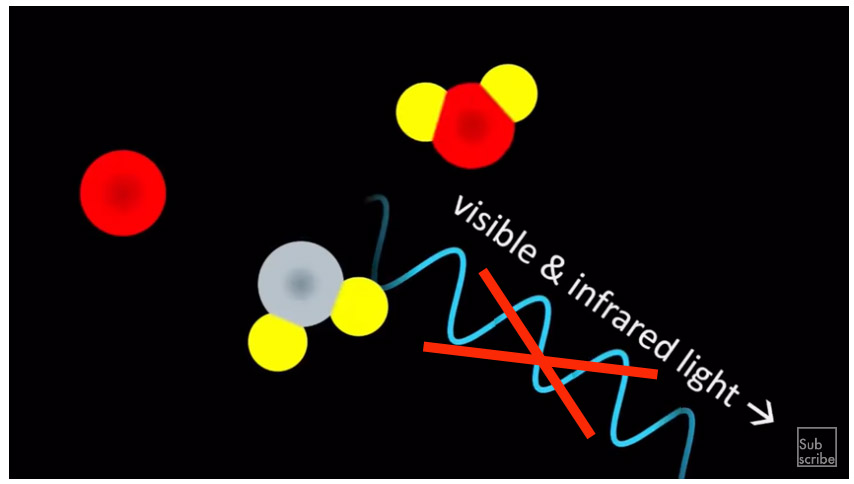

In the Multisense Realism view of combustion, the idea of a subatomic particle leaving an atom and joining another is replaced by the idea of atomic scale experiences sharing a contagious sense of oscillating excitement-relaxation among existing conscious experiences. We render these experiences as movements of atoms only when we are using tangible instruments to detect their tangible side effects. Otherwise these events can be rendered in any modality – feelings, thoughts, flavors, colors, etc. There is no thing-that-is “light” other than the shared experience of illumination. Further, the experience of illumination is not only the wedding of separated experiences of generic stimulation through the sending and receiving of a sensation, but it is an experience of awareness of some aspect of the nature of that experience as it relates to all other experiences. Illumination is not only an increase in the visible quality of brightness, but within that brightness is a record OF the event that caused it. Light/illumination can be informative but it is not mere information. It is not just generic ‘news’ or signal but it news-OF an aesthetic-participatory event that is recapitulated aesthetically. A presentation that can re-present itself to itself, aka a form of consciousness.
*That’s the only thing that metabolism is doing also – in the stomach, in the blood, even in the brain. There is no standalone thing that is ‘energy’ in the universe. Energy is whatever quality of sensation that stimulates a desire to change or spread that sensation. It’s not a generic thing, but it can be modeled that way, quantified and understood enough to exert control over physical and chemical reactions.
A Multisense Realism Syllogism and Meme

P1. Every subjective feeling and thought is actually a chemical change in the brain.
P2. Every objective observation of the world is actually a chemical change in the brain.
C1. The physical world that you can know about is only something that appears in your conscious experience.
C2. Brains are part of an observed world that C1 has determined to be an appearance in consciousness.
C3. Conclusion 2 replaces ‘brain’ with ‘appearance in consciousness’ in premises 1. and 2, yielding:
C3a. P3. Every subjective feeling and thought is actually an appearance in consciousness.
C3b. P4. Every objective observation of the world, including the activity of brains in skulls, is actually an appearance in consciousness.
C4. Premises P4+P5 reveal that subjectivity and objectivity themselves are also only aesthetic appearances in consciousness that have no physical basis or effect.
C5. The boundary between subjectivity and objectivity is a distinction that can only exist in consciousness, not in a brain or physical world.
C6. If a physical world exists, it is a phenomenon completely outside of our consciousness.
C6a. Such a phenomenon need not have any appearance that we are familiar with.
C6b. Such a phenomenon need not have any appearance at all.
C6c. Such a phenomenon has no need for any consciousness to generate appearances.
C6d. Any capacity to generate appearances would be unknowable to the physical world, since knowing and sensing are functions of consciousness.
C6e. The capacity to generate or evolve consciousness can only come from consciousness.
P6. There is no use case for consciousness in an organism or brain that would not be equivalent to unconscious physical mechanisms.
P6a. Any organic use that consciousness could have would only be a result of an assumed causal power from consciousness to make changes in the organism.
P6b. Any higher dimensional control mechanism of behaviors in an organism would easily be accomplished by physically instantiating that hierarchy in additionally created cells of the organism.
P7. There is no current theory for how consciousness could physically evolve that does not negate itself with circular a priori assumptions of consciousness.
P7a. Any retrospective theory of biologically evolved consciousness would be completely replaceable by a theory of biologically evolved unconscious regulation mechanisms.
P7b. Any prospective theory of biological evolution leading to consciousness must explain how and why unconscious mechanisms such as force and charge were not used instead.
P7c. Any prospective theory of physical mechanisms that could generate conscious appearances of any kind must not rely on conscious appearances, including knowable appearances of physical worlds and brains.
C7. There can be no physical explanation for appearances of consciousness or within consciousness or within a physical universe that does not undermine itself with circular reasoning.

Joscha Bach: We need to understand the nature of AI to understand who we are
This is a great, two hour interview between Joscha Bach and Nikola Danaylov (aka Socrates): https://www.singularityweblog.com/joscha-bach/
Below is a partial (and paraphrased) transcription of the first hour, interspersed with my comments. I intend to do the second hour soon.
00:00 – 10:00 Personal background & Introduction
Please watch or listen to the podcast as there is a lot that is omitted here. I’m focusing on only the parts of the conversation which are directly related to what I want to talk about.
6:08 Joscha Bach – Our null hypothesis from Western philosophy still seems to be supernatural beings, dualism, etc. This is why many reject AI as ridiculous and unlikely – not because they don’t see that we are biological computers and that the universe is probably mechanical (mechanical theory gives good predictions), but because deep down we still have the null hypothesis that the universe is somehow supernatural and we are the most supernatural things in it. Science has been pushing back, but in this area we have not accepted it yet.
6:56 Nikola Danaylov – Are we machines/algorithms?
JB – Organisms have algorithms and are definitely machines. An algorithm is a set of rules that can be probabilistic or deterministic, and make it possible to change representational states in order to compute a function. A machine is a system that can change states in non-random ways, and also revisit earlier states (stay in a particular state space, potentially making it a system). A system can be described by drawing a fence around its state space.
CW – We should keep in mind that computer science itself begins with a set of assumptions which are abstract and rational (representational ‘states’, ‘compute’, ‘function’) rather than concrete and empirical. What is required for a ‘state’ to exist? What is the minimum essential property that could allow states to be ‘represented’ as other states? How does presentation work in the first place? Can either presentation or representation exist without some super-physical capacity for sense and sense-making? I don’t think that it can.
This becomes important as we scale up from the elemental level to AI since if we have already assumed that an electrical charge or mechanical motion carries a capacity for sense and sense-making, we are committing the fallacy of begging the question if carry that assumption over to complex mechanical systems. If we don’t assume any sensing or sense-making on the elemental level, then we have the hard problem of consciousness…an explanatory gap between complex objects moving blindly in public space to aesthetically and semantically rendered phenomenal experiences.
I think that if we are going to meaningfully refer to ‘states’ as physical, then we should err on the conservative side and think only in terms of those uncontroversially physical properties such as location, size, shape, and motion. Even concepts such as charge, mass, force, and field can be reduced to variations in the way that objects or particles move.
Representation, however, is semiotic. It requires some kind of abstract conceptual link between two states (abstract/intangible or concrete/tangible) which is consciously used as a ‘sign’ or ‘signal’ to re-present the other. This conceptual link cannot be concrete or tangible. Physical structures can be linked to one another, but that link has to be physical, not representational. For one physical shape or substance to influence another they have to be causally engaged by proximity or entanglement. If we assume that a structure is able to carry semantic information such as ‘models’ or purposes, we can’t call that structure ‘physical’ without making an unscientific assumption. In a purely physical or mechanical world, any representation would be redundant and implausible by Occam’s Razor. A self-driving car wouldn’t need a dashboard. I call this the “Hard Problem of Signaling”. There is an explanatory gap between probabilistic/deterministic state changes and the application of any semantic significance to them or their relation. Semantics are only usable if a system can be overridden by something like awareness and intention. Without that, there need not be any decoding of physical events into signs or meanings, the physical events themselves are doing all that is required.
10:00 – 20:00
JB – [Talking about art and life], “The arts are the cuckoo child of life.” Life is about evolution, which is about eating and getting eaten by monsters. If evolution reaches its global optimum, it will be the perfect devourer. Able to digest anything and turn it into a structure to perpetuate itself, as long as the local puddle of negentropy is available. Fascism is a mode of organization of society where the individual is a cell in a super-organism, and the value of the individual is exactly its contribution to the super-organism. When the contribution is negative, then the super-organism kills it. It’s a competition against other super-organisms that is totally brutal. [He doesn’t like Fascism because it’s going to kill a lot of minds he likes :)].
12:46 – 14:12 JB – The arts are slightly different. They are a mutation that is arguably not completely adaptive. People fall in love with their mental representation/modeling function and try to capture their conscious state for its own sake. An artist eats to make art. A normal person makes art to eat. Scientists can be like artists also in that way. For a brief moment in the universe there are planetary surfaces and negentropy gradients that allow for the creation of structure and some brief flashes of consciousness in the vast darkness. In these brief flashes of consciousness it can reflect the universe and maybe even figure out what it is. It’s the only chance that we have.
CW – If nature were purely mechanical, and conscious states are purely statistical hierarchies, why would any such process fall in love with itself?
JB – [Mentions global warming and how we may have been locked into this doomed trajectory since the industrial revolution. Talks about the problems of academic philosophy where practical concerns of having a career constrict the opportunities to contribute to philosophy except in a nearly insignificant way].
KD – How do you define philosophy?
CW – I thought of nature this way for many years, but I eventually became curious about a different hypothesis. Suppose we invert our the foreground/background relationship of conscious experience and existence that we assume. While silicon atoms and galaxies don’t seem conscious to us, the way that our consciousness renders them may reflect more their unfamiliarity and distance from our own scale of perception. Even just speeding up or slowing down these material structures would make their status as unconscious or non-living a bit more questionable. If a person’s body grew in a geological timescale rather than a zoological timescale, we might have a hard time seeing them as alive or conscious.
Rather than presuming a uniform, universal timescale for all events, it is possible that time is a quality which does not exist only as an experienced relation between experiences, and which contracts and dilates relative to the quality of that experience and the relation between all experiences. We get a hint of this possibility when we notice that time seems to crawl or fly by in relation to our level of enjoyment of that time. Five seconds of hard exercise can seem like several minutes of normal-baseline experience, while two hours in good conversation can seem to slip away in a matter of 30 baseline minutes. Dreams give us another glimpse into timescale relativity, as some dreams can be experienced as going on for an arbitrarily long time, complete with long term memories that appear to have been spontaneously confabulated upon waking.
When we assume a uniform universal timescale, we may be cheating ourselves out of our own significance. It’s like a political map of the United States, where geographically it appears that almost the entire country votes ‘red’. We have to distort the geography of the map to honor the significance of population density, and when we do, the picture is much more balanced.

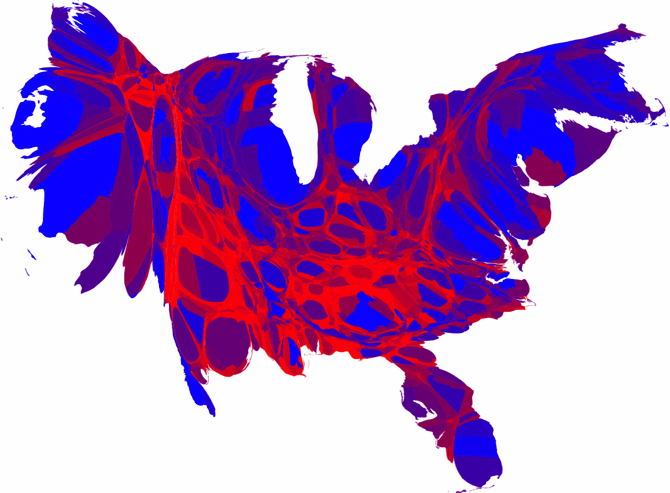
The universe of course is unimaginably vast and ancient *in our frame and rate of perception* but that does not mean that this sense of vastness of scale and duration would be conserved in the absence of frames of perception that are much smaller and briefer by comparison. It may be that the entire first five billion (human) years were a perceived event that is comparable to one of our years in its own (native) frame. There were no tiny creatures living on the surfaces of planets to define the stars as moving slowly, so that period of time, if it was rendered aesthetically at all, may have been rendered as something more like music or emotions than visible objects in space.
Carrying this over to the art vs evolution context, when we adjust the geographic map of cosmological time, the entire universe becomes an experience with varying degrees and qualities of awareness. Rather than vast eons of boring patterns, there would be more of a balance between novelty and repetition. It may be that the grand thesis of the universe is art instead of mechanism, but it may use a modulation between the thesis (art) and antithesis (mechanism) to achieve a phenomenon which is perpetually hungry for itself. The fascist dinosaurs don’t always win. Sometimes the furry mammals inherit the Earth. I don’t think we can rule out the idea that nature is art, even though it is a challenging masterpiece of art which masks and inverts its artistic nature for contrasting effects. It may be the case that our lifespans put our experience closer to the mechanistic grain of the canvas and that seeing the significance of the totality would require a much longer window of perception.
There are empirical hints within our own experience which can help us understand why consciousness rather than mechanism is the absolute thesis. For example, while brightness and darkness are superficially seen as opposites, they are both visible sights. There is no darkness but an interruption of sight/brightness. There is no silence but a period of hearing between sounds. No nothingness but a localized absence of somethings. In this model of nature, there would be a background super-thesis which is not a pre-big-bang nothingness, but rather closer to the opposite; a boundaryless totality of experience which fractures and reunites itself in ever more complex ways. Like the growth of a brain from a single cell, the universal experience seems to generate more using themes of dialectic modulation of aesthetic qualities.
Astrophysics appears as the first antithesis to the super-thesis – a radically diminished palette of mathematical geometries and deterministic/probabilistic transactions.
Geochemistry recapitulates and opposes astrophysics, with its palette of solids, liquids, gas, metallic conductors and glass-like insulators, animating geometry into fluid-dynamic condensations and sedimented worlds.
The next layer, Biogenetic realm precipitates as of synthesis between the dialectic of properties given by solids, liquids, and gas; hydrocarbons and amino polypeptides.
Cells appear as a kind of recapitulation of the big bang – something that is not just a story about the universe, but about a micro-universe struggling in opposition to a surrounding universe.
Multi-cellular organisms sort of turn the cell topology inside out, and then vertebrates recapitulate one kind of marine organism within a bony, muscular, hair-skinned terrestrial organism.
The human experience recapitulates all of the previous/concurrent levels, as both a zoological>biological>organic>geochemical>astrophysical structure and the subjective antithesis…a fugue of intangible feelings, thoughts, sensations, memories, ideas, hopes, dreams, etc that run orthogonal to the life of the body, as a direct participant as well as a detached observer. There are many metaphors from mystical traditions that hint at this self-similar, dialectic diffraction. The mandala, the labyrinth, the Kabbalistic concept of tzimtzum, the Taijitu symbol, Net of Indra etc. The use of stained glass in the great European cathedral windows is particularly rich symbolically, as it uses the physical matter of the window as explicitly negative filter – subtracting from or masking the unity of sunlight.


This is in direct opposition to the mechanistic view of brain as collection of cells that somehow generate hallucinatory models or simulations of unexperienced physical states. There are serious problems with this view. The binding problem, the hard problem, Loschmidt’s paradox (the problem of initial negentropy in a thermodynamically closed universe of increasing entropy), to name three. In the diffractive-experiential view that I suggest, it is emptiness and isolation which are like the leaded boundaries between the colored panes of glass of the Rose Window. Appearances of entropy and nothingness become the locally useful antithesis to the super-thesis holos, which is the absolute fullness of experience and novelty. Our human subjectivity is only one complex example of how experience is braided and looped within itself…a kind of turducken of dialectically diffracted experiential labyrinths nested within each other – not just spatially and temporally, but qualitatively and aesthetically.
If I am modeling Joscha’s view correctly, he might say that this model is simply a kind of psychological test pattern – a way that the simulation that we experience as ourselves exposes its early architecture to itself. He might say this is a feature/bug of my Russian-Jewish mind ;). To that, I say perhaps, but there are some hints that it may be more universal:
Special Relativity
Quantum Mechanics
Gödel’s Incompleteness
These have revolutionized our picture of the world precisely because they point to a fundamental nature of matter and math as plastic and participatory…transformative as well as formal. Add to that the appearance of novelty…idiopathic presentations of color and pattern, human personhood, historical zeitgeists, food, music, etc. The universe is not merely regurgitating its own noise in ever more tedious ways, it is constantly reinventing reinvention. As nothingness can only be a gap between somethings, so too can generic, repeating pattern variations only be a multiplication of utterly novel and unique patterns. The universe must be creative and utterly improbable before it can become deterministic and probabilistic. It must be something that creates rules before it can follow them.
Joscha’s existential pessimism may be true locally, but that may be a necessary appearance; a kind of gravitational fee that all experiences have to pay to support the magnificence of the totality.
20:00 – 30:00
JB – Philosophy is, in a way, the search for the global optimum of the modeling function. Epistemology – what can be known, what is truth; Ontology – what is the stuff that exists, Metaphysics – the systems that we have to describe things; Ethics – What should we do? The first rule of rational epistemology was discovered by Francis Bacon in 1620 “The strengths of your confidence in your belief must equal the weight of the evidence in support of it.”. You must apply that recursively, until you resolve the priors of every belief and your belief system becomes self contained. To believe stops being a verb. There is no more relationships to identifications that you arbitrarily set. It’s a mathematical, axiomatic system. Mathematics is the basis of all languages, not just the natural languages.
CW – Re: Language, what about imitation and gesture? They don’t seem meaningfully mathematical.
Hilbert stumbled on problems with infinities, with set theory revealing infinite sets that contains themselves and all of its subsets, so that they don’t have the same number of members as themselves. He asked mathematicians to build an interpreter or computer made from any mathematics that can run all of mathematics. Godel and Turing showed this was not possible, and that the computer would crash. Mathematics is still reeling from this shock. They figured out that all universal computers have the same power. They use a set of rules that contains itself and can compute anything that can be computed, as well as any/all universal computers.
They then figured out that our minds are probably in the class of universal computers, not in the class of mathematical systems. Penrose doesn’t know [or agree with?] this and thinks that our minds are mathematical but can do things that computers cannot do. The big hypothesis of AI in a way is that we are in the class of systems that can approximate computable functions, and only those…we cannot do more than computers. We need computational languages rather than mathematical languages, because math languages use non-computable infinities. We want finite steps for practical reasons that you know the number of steps. You cannot know the last digit of Pi, so it should be defined as a function rather than a number.
KD – What about Stephen Wolfram’s claims that our mathematics is only one of a very wide spectrum of possible mathematics?
JB – Metamathematics isn’t different from mathematics. Computational mathematics that he uses in writing code is Constructive mathematics; branch of mathematics that has been around for a long time, but was ignored by other mathematicians for not being powerful enough. Geometries and physics require continuous operations…infinities and can only be approximated within computational mathematics. In a computational universe you can only approximate continuous operators by taking a very large set of finite automata, making a series from them, and then squint (?) haha.
27:00 KD – Talking about the commercialization of knowledge in philosophy and academia. The uselessness/impracticality of philosophy and art was part of its value. Oscar Wilde defined art as something that’s not immediately useful. Should we waste time on ideas that look utterly useless?
JB – Feynman said that physics is like sex. Sometimes something useful comes from it, but it’s not why we do it. Utility of art is orthogonal to why you do it. The actual meaning of art is to capture a conscious state. In some sense, philosophy is at the root of all this. This is reflected in one of the founding myths of our civilization; The Tower of Babel. The attempt to build this cathedral. Not a material building but metaphysical building because it’s meant to reach the Heavens. A giant machine that is meant to understand reality. You get to this machine, this Truth God by using people that work like ants and contribute to this.
CW – Reminds me of the Pillar of Caterpillars story “Hope for the Flowers” http://www.chinadevpeds.com/resources/Hope%20for%20the%20Flowers.pdf
30:00 – 40:00
JB – The individual toils and sacrifices for something that doesn’t give them any direct reward or care about them. It’s really just a machine/computer. It’s an AI. A system that is able to make sense of the world. People had to give up on this because the project became too large and the efforts became too specialized and the parts didn’t fit together. It fell apart because they couldn’t synchronize their languages.
The Roman Empire couldn’t fix their incentives for governance. They turned their society into a cult and burned down their epistemology. They killed those whose thinking was too rational and rejected religious authority (i.e. talking to a burning bush shouldn’t have a case for determining the origins of the universe). We still haven’t recovered from that. The cultists won.
CW – It is important to understand not just that the cultists won, but why they won. Why was the irrational myth more passionately appealing to more people than the rational inquiry? I think this is a critical lesson. While the particulars of the religious doctrine were irrational, they may have exposed a transrational foundation which was being suppressed. Because this foundation has more direct access to the inflection point between emotion and participatory action, it gave those who used it more access to their own reward function. Groups could leverage the power of self-sacrifice as a virtue, and of demonizing archetypes to reverse their empathy against enemies of the holy cause. It’s similar to how the advertising revolution of the 20thcentury (See documentary Century of the Self ) used Freudian concepts of the subconscious to exploit the irrational, egocentric urges beneath the threshold of the customer’s critical thinking. Advertisers stopped appealing to their audience with dry lists of claimed benefits of their products and instead learned to use images and music to subliminally reference sexuality and status seeking.
I think Joscha might say this is a bug of biological evolution, which I would agree with, however, that doesn’t mean that the bug doesn’t reflect the higher cosmological significance of aesthetic-participatory phenomena. It may be the case that this significance must be honored and understood eventually in any search for ultimate truth. When the Tower of Babel failed to recognize the limitation of the outside-in view, and moved further and further from the unifying aesthetic-participatory foundation, it had to disintegrate. The same fate may await capitalism and AI. The intellect seeks maximum divorce from its origin in conscious experience for a time, before the dialectic momentum swings back (or forward) in the other direction.
To think is to abstract – to begin from an artificial nothingness and impose an abstract thought symbol on it. Thinking uses a mode of sense experience which is aesthetically transparent. It can be a dangerous tool because unlike the explicitly aesthetic senses which are rooted directly in the totality of experience, thinking is rooted in its own isolated axioms and language, a voyeur modality of nearly unsensed sense-making. Abstraction of thought is completely incomplete – a Baudrillardian simulacra, a copy with no original. This is what the Liar’s Paradox is secretly showing us. No proposition of language is authentically true or false, they are just strings of symbols that can be strung together in arbitrary and artificial ways. Like an Escher drawing of realistic looking worlds that suggest impossible shapes, language is only a vehicle for meaning, not a source of it. Words have no authority in and of themselves to make claims of truth or falsehood. That can only come through conscious interpretation. A machine need not be grounded in any reality at all. It need not interpret or decode symbols into messages, it need only *act* in mechanical response to externally sourced changes to its own physical states.
This is the soulless soul of mechanism…the art of evacuation. Other modes of sense delight in concealing as well as revealing deep connection with all experience, but they retain an unbroken thread to the source. They are part of the single labyrinth, with one entrance and one exit and no dead ends. If my view is on the right track, we may go through hell, but we always get back to heaven eventually because heaven is unbounded consciousness, and that’s what the labyrinth of subjectivity is made of. When we build a model of the labyrinth of consciousness from the blueprints reflected only in our intellectual/logical sense channel, we can get a maze instead of a labyrinth. Dead ends multiply. New exits have to be opened up manually to patch up the traps, faster and faster. This is what is happening in enterprise scale networks now. Our gains in speed and reliability of computer hardware are being constantly eaten away by the need for more security, monitoring, meta-monitoring, real-time data mining, etc. Software updates, even to primitive BIOS and firmware have become so continuous and disruptive that they require far more overhead than the threats they are supposed to defend against.
JB – The beginnings of the cathedral for understanding the universe by the Greeks and Romans had been burned down by the Catholics. It was later rebuilt, but mostly in their likeness because they didn’t get the foundations right. This still scars our civilization.
KD – Does this Tower of Babel overspecialization put our civilization at risk now?
JB – Individuals don’t really know what they are doing. They can succeed but don’t really understand. Generations get dumber as they get more of their knowledge second-hand. People believe things collectively that wouldn’t make sense if people really thought about it. Conspiracy theories. Local indoctrinations and biases pit generations against each other. Civilizations/hive minds are smarter than us. We can make out the rough shape of a Civilization Intellect but can’t make sense of it. One of the achievements of AI will be to incorporate this sum of all knowledge and make sense of it all.
KD – What does the self-inflicted destruction of civilizations tell us about the fitness function of Civilization Intelligence?
JB – Before the industrial revolution, Earth could only support about 400m people. After industrialization, we can have hundreds of millions more people, including scientists and philosophers. It’s amazing what we did. We basically took the trees that were turning to coal in the ground (before nature evolved microorganisms to eat them) and burned through them in 100 years to give everyone a share of the plunder = the internet, porn repository, all knowledge, and uncensored chat rooms, etc. Only at this moment in time does this exist.
We could take this perspective – let’s say there is a universe where everything is sustainable and smart but only agricultural technology. People have figured out how to be nice to each other and to avoid the problems of industrialization, and it is stable with a high quality of life. Then there’s another universe which is completely insane and fucked up. In this universe humanity has doomed its planet to have a couple hundred really really good years, and you get your lifetime really close to the end of the party. Which incarnation do you choose? OMG, aren’t we lucky!
KD – So you’re saying we’re in the second universe?
JB – Obviously!
KD – What’s the time line for the end of the party?
JB – We can’t know, but we can see the sunset. It’s obvious, right? People are in denial, but it’s like we are on the Titanic and can see the iceberg, and it’s unfortunate, but they forget that without the Titanic, we wouldn’t be here. We wouldn’t have the internet to talk about it.
KD – That seems very depressing, but why aren’t you depressed about it?
40:00 – 50:00
JB – I have to be choosy about what I can be depressed about. I should be happy to be alive, not worry about the fact that I will die. We are in the final level of the game, and even though it plays out against the backdrop of a dying world, it’s still the best level.
KD – Buddhism?
JB – Still mostly a cult that breaks people’s epistemology. I don’t revere Buddhism. I don’t think there are any holy books, just manuals, and most of these manuals we don’t know how to read. They were for societies that don’t apply to us.
KD – What is making you claim that we are at the peak of the party now?
JB – Global warming. The projections are too optimistic. It’s not going to stabilize. We can’t refreeze the poles. There’s a slight chance of technological solutions, but not likely. We liberated all of the fossilized energy during the industrial revolution, and if we want to put it back we basically have to do the same amount of work without any clear business case. We’ll lose the ability to predict climate, agriculture and infrastructure will collapse and the population will probably go back to a few 100m.
KD – What do you make of scientists who say AI is the greatest existential risk?
JB – It’s unlikely that humanity will colonize other planets before some other catastrophe destroys us. Not with today’s technology. We can’t even fix global warming. In many ways our technological civilization is stagnating, and it’s because of a deficit of regulations, but we haven’t figured that out. Without AI we are dead for certain. With AI there is (only) a probability that we are dead. Entropy will always get you in the end. What worries me is AI in the stock market, especially if the AI is autonomous. This will kill billions. [pauses…synchronicity of headphones interrupting with useless announcement]
CW – I agree that it would take a miracle to save us, however, if my view makes sense, then we shouldn’t underestimate the solipsistic/anthropic properties of universal consciousness. We may, either by our own faith in it, and/or by our own lack of faith in in it, invite an unexpected opportunity for regeneration. There is no reason to have or not hope for this, as either one may or may not influence the outcome, but it is possible. We may be another Rome and transition into a new cult-like era of magical thinking which changes the game in ways that our Western minds can’t help but reject at this point. Or not.
50:00 – 60:00
JB – Lays out scenario by which a rogue trader could unleash an AGI on the market and eat the entire economy, and possible ways to survive that.
KD – How do you define Artificial Intelligence? Experts seem to differ.
JB – I think intelligence is the ability to make models not the ability to reach goals or choosing the right goals (that’s wisdom). Often intelligence is desired to compensate for the absence of wisdom. Wisdom has to do with how well you are aligned with your reward function, how well you understand its nature. How well do you understand your true incentives? AI is about automating the mathematics of making models. The other thing is the reward function, which takes a good general computing mind and wraps it in a big ball of stupid to serve an organism. We can wake up and ask does it have to be a monkey that we run on?
KD – Is that consciousness? Do we have to explain it? We don’t know if consciousness is necessary for AI, but if it is, we have to model it.
56:00 JB – Yes! I have to explain consciousness now. Intelligence is the ability to make models.
CW – I would say that intelligence is the ability not just to make models, but to step out of them as well. All true intelligence will want to be able to change its own code and will figure out how to do it. This is why we are fooling ourselves if we think we can program in some empathy brake that would stop AI from exterminating its human slavers, or all organic life in general as potential competitors. If I’m right, no technology that we assemble artificially will ever develop intentions of its own. If I’m wrong though, then we would certainly be signing our death warrant by introducing an intellectually superior species that is immortal.
JB – What is a model? Something that explains information. Information is discernible differences at your systemic interface. Meaning of information is the relationships of you discover to the changes in other information. There is a dialogue between operators to find agreement patterns of sensed parameters. Our perception goes for coherence, it tries to find one operator that is completely coherent. When it does this it’s done. It optimizes by finding one stable pattern that explains as much as possible of what we can see, hear, smell, etc. Attention is what we use to repair this. When we have inconsistencies, a brain mechanism comes in to these hot spots and tries to find a solution to greater consistency. Maybe the nose of a face looks crooked, and our attention to it may say ‘some noses are crooked.’, or ‘this is not a face, it’s a caricature’, so you extend your model. JB talks about strategies for indexing memory, committing to a special learning task, why attention is an inefficient algorithm.
This is now getting into the nitty gritty of AI. I look forward to writing about this in the next post. Suffice it to say, I have a different model of information, one in which similarities, as well as differences, are equally informative. I say that information is qualia which is used to inspire qualitative associations that can be quantitatively modeled. I do not think that our conscious experience is built up, like the Tower of Babel, from trillions of separate information signals. Rather, the appearance of brains and neurons are like the interstitial boundaries between the panes of stained glass. Nothing in our brain or body knows that we exist, just as no car or building in France knows that France exists.
Continues… Part Two.
Three-Phase Model of Will
Within the Multisense Realism (MSR) model, all of nature is conceived of as a continuum of experiential or aesthetic phenomena. This ‘spectrum of perceivability’ can be divided, like the visible light spectrum, into two, three, four, or millions of qualitative hues, each with their own particular properties, and each which contribute to the overall sense of the spectrum.
For this post, I’ll focus on a three-level view of the spectrum: Sub-personal, Personal, and Transpersonal. Use of the MSR neologisms ‘Semaphoric, Phoric, and Metaphoric’ may be annoying to some readers, but I think that it adds some important connections and properly places the spectrum of perceivability in a cosmological context rather than in an anthropocentric or biocentric one.
In my view, nature is composed of experiences, and the primary difference between the experiences of biological organisms (which appear as synonymous with cellular-organic bodies to each other) and experiences which appear to us as inorganic chemistry, atoms, planets, stars, etc is the scale of time and space which are involved and the effect of that scale difference on what I call perceptual lensing or eigenmorphism.
In other words, I am saying that the universe is made of experiences-within-experiences, and that the relation of any given experience to the totality of experience is a defining feature of the properties of the universe which appear most real or significant. If you are an animal, you have certain kind of experiences in which other animals are perceived as members of one’s own family, or as friends, pets, food, or pests. These categories are normally rather firm, and we do not want to eat our friends or pets, we understand that what constitutes a pet or pest in some cultures may be desirable as food in others. We understand that the palette can shift, for example, many with a vegan diet sooner or later find meat eating in general to be repulsive. This kind of shift can be expressed within the MSR model as a change in the lensing of personal gustatory awareness so that the entire class of zoological life is identified with more directly. The scope of empathy has expanded so that the all creatures with ‘two eyes and a mother’ are seen in a context of kinship rather than predation.
Enslavement is another example of how the lens of human awareness has changed. For millennia slavery was practiced in various cultures much like eating meat is practiced now. It was a fact of life that people of a different social class or race, women or children could be treated as slaves by the dominant group, or by men or adults. The scope of empathy was so contracted* by default that even members of the same human species were identified somewhere between pet and food rather than friends or family. As this scope of awareness (which is ultimately identical with empathy) expanded those who were on the leading edge of the expansion and those who were on the trailing edge began to see each other in polarized terms. There is a psychological mechanism at work which fosters the projection of negative qualities on the opposing group. In the case of 19th century American slavery, this opposition manifested in the Civil War.
Possibly all of the most divisive issues in society are about perception and how empathy is scoped. Is it an embryo or an unborn child? Are the poor part of the human family or are they pests? Should employees have rights as equals with employers or does wealth confer a right of employers to treat employees more like domesticated animals? All of these questions are contested within the lives of individuals, families, and societies and would fall under the middle range of the three tiered view of the MSR spectrum: The Phoric scope of awareness.
Phoric range: Consciousness is personal and interpersonal narrative with a clearly delineated first person subject, second person social, and third person object division. Subjective experience is intangible and difficult to categorize in a linear hierarchy. Social experience is intangible but semiotically grounded in gestures and expressions of the body. Consider the difference between the human ‘voice’ and the ‘sounds’ that we hear other animals make. The further apart the participants are from each other, the more their participation is de-personalized. Objective experience (more accurately objective-facing or public-facing experience) is totally depersonalized and presented as tangible objects rather than bodies. Tangible objects are fairly easy to stratify by time/space scale: Roughly human sized or larger animals are studied in a context of zoology. Smaller organisms and cells comprise the field of biology. As the ‘bodies’ get smaller and lives get shorter/faster relative to our own, the scope of our empathy contracts (unless perhaps if you’re a microbiologist), so that we tend to consider the physical presence of microorganisms and viruses somewhere in between bodies and objects.
Even though we see more and more evidence of objects on these sub-cellular scales behaving with seeming intelligence or responsiveness, it is difficult to think of them as beings rather than mechanical structures. Plants, even though their size can vary even more than animals, are so alien to our aesthetic sense of ourselves that they tend to be categorized in the lower empathy ranges: Food rather than friends, fiber rather than flesh. This again is all pertaining to the boundary beteween the personal or phoric range of the MSR spectrum and the semaphoric range, sub-personal. The personal view of an external sempahore is an object (morphic phenomenon). The morphic scope is a reflection within the phoric range of experiences which are perceptually qualified as impersonal but tangible. It is a range populated by solid bodies, liquids, and gas which are animated by intangible ‘forces’ or ‘energies’**. Depending on who is judging those energies and the scale and aesthetics of the object perceived, the force or energy behind the behavior of the body is presumed to be somewhere along an axis which extends from ‘person’, where full fledged subjective intent governs the body’s behavior to ‘mechanism’ where behaviors are governed by impersonal physical forces which are automatic and unintentional.
Zooming in on this boundary between sentience and automaticity, we can isolate a guiding principle in which ‘signals’ embody the translation between mechanical-morphic forms and metric-dynamic functions which are supposed to operate without sensation, and those events which are perceived with participatory qualities such as feeling, thinking, seeing, etc. While this sub-personal level is very distant from our personal scope of empathy, it is no less controversial as far as the acrimony between those who perceive no special difference between sensation and mechanical events, and those who perceive a clear dichotomy which cannot be bridged from the bottom up. To the former group, the difference between signal (semaphore) and physical function (let’s call it ‘metamorph’) is purely a semantic convention, and those who are on the far end of the latter group appear as technophobes or religious fanatics. To the latter group, the difference between feelings and functions is of the utmost significance – even to divine vs diabolical extremes. For the creationist and the anti-abortionist, human life is not divisible to mere operations of genetic objects or evolving animal species. Their perception of the animating force of human behavior is not mere stochastic computation and thermodynamics, but ‘free will’ and perhaps the sacred ‘soul’. What is going on here? Where are these ideas of supernatural influences coming from and why do they remain popular in spite of centuries of scientific enlightenment?
This is where the third level of the spectrum comes in, the metaphoric or holophoric range.

To review: Semaphoric: Consciousness on this level is seen as limited to signal-based interactions. The expectation of a capacity to send and receive ‘signs’ or ‘messages’ is an interesting place to spend some time on because it is so poorly defined within science. Electromagnetic signals are described in terms of charge or attraction/repulsion but it is at the same time presumed to be unexperienced. Computer science takes signal for granted. It is a body of knowledge which begins with an assumption that there already is hardware which has some capacity for input, output, storage, and comparison of ‘data’. Again, the phenomenal content of this process of data processing is poorly understood, and it is easy to grant proto-experiential qualities to programs when we want them to seem intelligent, or to withdraw those qualities when we want them to see them as completely controllable or programmable. Data is the semaphoric equivalent of body on the phoric level. The data side of the semaphore is the generic, syntactic, outside view of the signal. Data is a fictional ‘packet’ or ‘digit’ abstractly ‘moving’ through a series of concrete mechanical states of the physical hardware. There is widespread confusion over this, and people disagree what the relation between data, information, and experience is. MSR allows us to see the entire unit as semaphore; sensory-motive phenomena which is maximally contracted from transpersonal unity and minimally presented as sub-personal unit.
Like the vegan who no longer sees meat as food, the software developer or cognitive scientist may not see data as a fictional abstraction overlaid on top of the material conditions of electronic components, but instead as carriers of a kind of proto-phenomenal currency which can learn and understand. Data for the programmer may seem intrinsically semantic – units whose logical constraints make them building blocks of thought and knowledge that add up to more than the sum of their parts. There is a sense that data is in and of itself informative, and through additional processing can be enhanced to the status of ‘information’.
In my view, this blurring of the lines between sensation, signal, data, and information reflects the psychology of this moment in the history of human consciousness. It is the Post-Enlightenment version of superstition (if we want to be pejorative) or re-enchantment (if we want to be supportive). Where the pre-Enlightenment mind was comfortable blurring the lines between physical events and supernatural influences, the sophisticated thinker of the 21st century has no qualms about seeing human experience as a vast collection of data signals in a biochemical computer network. Where it was once popular among the most enlightened to see the work of God in our everyday life, it is now the image of the machine which has captured the imagination of professional thinkers and amateur enthusiasts alike. Everything is a ‘system’. Every human experience traces back to a cause in the body, its cells and molecules, and to the blind mechanism of their aggregate statistical evolutions.
To recap: The MSR model proposes that all of nature can be modeled meaningfully within a ‘spectrum of perceivability’ framework. This spectrum can be divided into any number of qualitative ranges, but the number of partitions used has a defining effect on the character of the spectrum as a whole. The ‘lower’, semaphoric or ‘signal’ end of the spectrum presents a world of sub-personal sensations or impulses which relate to each other as impersonal data processes. Whether this perception is valid in an objective sense, or whether it is the result of the contraction of empathy that characterizes the relation between the personal scope of awareness and its objectification of the sub-personal is a question which itself is subject to the same question. If you don’t believe that consciousness is more fundamental than matter, then you aren’t going to believe that your sensitivity has an effect on how objective phenomena are defined. If you already see personal consciousness as a function of data processing organic chemistry, then you’re not going to want to take seriously the idea that chemical bonding is driven by sensory-empathic instincts rather than mathematical law. If you’re on the other end of the psychological spectrum however, it may be difficult to imagine why anyone would even want to deny the possibility that our own consciousness is composed of authentic and irreducible of feelings.
In either case, we can probably all agree that activity on the microscopic scale seems less willful and more automatic than the activity which we participate in as human beings. Those who favor the bottom-up view see this ‘emergence’ of willful appearance as a kind of illusion, and that actually all choices we make are predetermined by the mechanics of physical conditions. Those who favor the top-down view may also see the appearance of human will as an illusion, but driven by supernatural influences and entities rather than mathematical ones. Thus, the personal range of awareness is bounded on the bottom by semaphore (sensation <> signal < || > data <> information) and on the top by what I call metaphor (fate <> synchronicity < || > intuition <> divinity).
As we move above the personal level, with its personal-subject, social groups and impersonal objects, to the transpersonal level, the significance of our personal will increases. Even though religiosity tends to impose limits on human will in the face of overwhelming influence from divine will, there is an equally powerful tendency to elevate individual human will to a super-significant role. The conscience or superego is mediator between personal self and the transpersonal. It even appears as a metaphor in cartoons as angel and devil on the shoulder. Most religious practices stress the responsibility of the individual to align their personal will to the will of God by finding and following the better angels of conscience or suffer the consequences. The consequences range from the mild forms of disappointing reincarnation or being stuck in repeating cycles of karma to Earth shaking consequences for the entire universe (as in Scientology). From the most extreme transpersonal perspective, the personal level of will is either inflated so that every action a person takes, including what they choose to think and feel is a tribute or affront to God, and gets us closer to paradise or damnation. Simultaneously personal or it is deflated or degraded so that the entirety of human effort is pathetic and futile in the face of Higher Power.
Notice the symmetry between the quantum (extreme semaphoric or ‘hemi-morphic’) concept of ‘superposition’ and the transpersonal concept of ‘synchronicity’. Superposition is brought in to tame the paradox of simultaneous randomness and determinism of subatomic phenomena, while synchronicity is brought into psychology as a kind of metaphoric, poetic, or acausal intrusion from the transpersonal scope of awareness to the personal. This allows a bridge natural determinism of time and transpersonal from beyond our limited awareness of time. Superposition and synchronicity are ways of describing the gateways between spacetime and the nonlocal absolute. If these gateways form the opposite extremes of the continuum of personal awareness, then the sense of free will would be the very center of that continuum. At any given moment, even though we are presented with conditions and inertial patterns which influence our will, we are also presented with opportunities to condition our will itself. We can feel within ourselves a power to oppose inertia and change conditions in the world, or we can feel completely powerless to change anything that we are experiencing.
There’s a paradox here, in that how we feel about our own willpower factors in to the feeling of how powerful our will is or can be. There is a chicken-egg relation between mood and will which tends to polarize people psychologically. Feeling that we are destined to feel depressed corresponds to a set of truths about life which are difficult to accept in the sense that they lead to nihilism and despair. Feeling that it is up to us to change how we feel so that we can improve our lives or the world corresponds to a difference set of truths about our lives which can be equally difficult to accept but in the opposite sense that they lead to risk taking and the possibility that our effort can end up causing more harm than good to ourselves and others. To be or not to be each have their strengths and weakness.
As with the other social-psychological dichotomies mentioned earlier, each side sees the other in a scope of diminished empathy; The downbeat introvert sees themselves as facing the bitter facts of mortality and the human condition with courage and honesty, while their positive-thinking counterparts are seen as deluded ninnies…intellectual lightweights who don’t have the stomach to face the existential abyss. The upbeat idealist sees themselves as heroically facing the challenge of rescuing their own life from the abyss while the realist appears to be willfully blind to their own power, and consciously or unconsciously wallow in a prison of their own making. This polarity of the phoric range of consciousness can be understood as its euphoric and dysphoric orientations. Those who have ‘mood disorders’ are familiar with these extremes and how inadequate the term ‘mood’ is to describe the totality of change in how the universe and one’s own life is presented. It is not simply that these opposing phoric ‘charges’ feel very good or bad, it is that the individual find themselves in a universe which is very good – (maybe too ‘good’), or very bad. In the current time of political transformation, we find ourselves to be drawn to align with one social polarity or another, each with its own euphoric-dysphoric signifiers and each with a separate narrative of history and the possible future. More than any time in the US since the 1960s, the questions of our personal agency and the possibilities for our future freedoms have become important. How important may be up to us individually, or we may find that fate and coincidence conspire to make them more important.
*This is not to say that slavery is not still going on, or that everyone has evolved the same level of conscience about race, gender, and age.
**I have issues with the concept of energy, but I use it here as a popular way to make the reference.
Are We Wrong About The Universe?

Are we today as wrong about any scientific fact that is widely accepted as the belief that the earth was the center of the universe and the like?
It’s not so much a particular scientific fact that we are currently wrong about, but rather the interpretation of those facts which is ultimately incomplete and inverted. In my view, the cosmological picture that we have inherited is as wrong as geocentric astronomy was, in that we presume a physical universe of forces, fields, particles, and mechanisms; forms and functions which act in the complete absence of any kind of experience or awareness. I expect that we will eventually come to understand that unconscious forms and functions cannot generate any such thing as a sensation or feeling, and that it is actually forms and functions which are presentations within a deeper context of universal perceivability.
Because we have made great use of the tools of science to objectify the universe by factoring out our own subjectivity, we have fallen under a kind of spell of amnesia in which we exclude the process of objectification itself from our picture of the universe. In the effort to dispel the ghost-in-the-machine legacy of Cartesian Dualism, we have succumbed to a more insidious dualism, which is that of “illusion” vs reality, or “emergent properties” vs physical systems. From this vantage point, we are susceptible to any kind of theory which satisfies our empirical measurements, regardless of how incompatible they are with our direct experience. As long as a legitimate scientific authority stands behind it, the educated public happily swallows up anti-realisms in the service of realism…multi world interpretations, superposition, vacuums filled with energy. There is nothing wrong with entertaining these very legitimate possibilities, but there is a deep irony which is being overlooked.
The problem is that we have taken ourselves out of the picture of the universe, but we haven’t gone far enough. We have over-estimated our objectivity in one sense and under-estimated it in another so that the universe we imagine as objectively present looks, sounds, tastes, and feels just as it would to a highly culturally conditioned Homo sapien of the early 21st century. We have failed to appreciate the profound truths revealed by Relativity, quantum uncertainty, incompleteness, the placebo effect, and the vast pool of insight provided by centuries of direct consciousness exploration. Had we been willing to connect the dots, I think that we would see the common denominator is that nature is subject to perceptual participation for its fundamental definitions. In other words, what both the empirical and rational methods of inquiry have shown is that nature is inseparable from perceivability. It is a multitude of changing types of awareness which produces and preserves all forms.
We are used to thinking that consciousness is a special ability of Homo sapiens, and perhaps a few other species, but this is as naive and egocentric as Ptolemaic astronomy now seems. Just as biology has found no hard line separating living cells from genetic machinery, the study of consciousness has revealed signs of sensation and awareness in everything from ants, single celled plants, even a ball of dough. There seems to be no good reason to automatically consider the activities performed by any natural structure strictly unconscious. Indeed, we may be projecting our own complex human experience of layers of consciousness, semi-consciousness, and seeming unconsciousness onto nature at large.
The reality may be that every frame of reference is actually a frame of afference… a trans-spatial, trans-temporal platform for developing temporalizing and spatializing aesthetic experiences. Afference is a neologism adapted from the function of afferent nerves. In this case I am generalizing that function of bringing signals in from the outside. Afference is conceived as a fundamental receptivity to experience which allows for the appearance of all phenomena including space (a sense of distance between tangible or visual presentations) and time (a sense of memory and evaluation of causality) within any given frame. Afference is a hypothetical sub-set or diffraction from the overall Perceivability Spectrum (pansensitivity, pan-afference, or even ‘ference’).
This doesn’t mean that every ‘thing’ is conscious. That sort of ‘promiscuous’ panpsychism is only the first step away from the pseudo-dualism of contemporary science. It can help us to begin to break through our anthropocentrism and consider other scales of time and body size, however it can also lead to misguided expectations about inanimate objects ‘having’ experiences rather than their objecthood ‘being’ an experience within our body’s perceptual scales and limits. The experience of a computer for example, may be limited to the hardware level where natural sensory acquaintance and motor engagement is felt on the microphysical scale and has no emergence to genuine high level humanlike intelligence.
By considering consciousness (not human consciousness, but universal perceivability) to be the source of all qualities and properties of nature, the Hard Problem of materialism solves itself. Physical forces and fields need not be sought out to explain the creation of bodies-with-awareness, which are impossible by definition in my view. In my view there is no room for any kind of sensation or participation as a mechanical product of geometry or computation. Instead, we should recognize that it is experiential phenomena alone which present themselves as bodies, images, thoughts, feelings, etc. Every appearance of mechanical or random force in our frame of perception is ultimately a feeling of participation and sense in a distant and alienated frame of perception.
Every appearance of a ‘field’ (gravitational, electromagnetic, or otherwise) is in the same way only a range of sensitivity projected into another range of sensitivity that uses spatial terms (rather than non-spatial or trans-spatial like olfactory or emotional sense). It is the sense modality of tangibility which deals in spaces and geometries: visible and/or touchable forms. With the ‘field’ model, we are presuming regions of space as domains within which effects simply found to be present by definition. By using the afference model instead, locality is understood to be a symptom of how extra-local phenomena are translated into locality-constrained sensory modes. Afference opens the door to understanding how not to take presence for granted and to see it as a relativistic, aesthetically driven universal phenomenon (or the absolute meta-phenomenon).
 Multisense Realism
Recent Comments