Archive
What exactly is our life?
Quora: What exactly is our life?
How do you see the life?
Your philosophical explanation. How should one look at what he experiences, he sees, he thinks? How to live it?
What is the purpose of life we have been given and how to find it? How do you make most out of it?
In one sentence and explanation of this sentence. What is life, really?
Our life is perception and participation in experiences of particular aesthetic qualities.
Perception and participation are, in my opinion, opposing modes of a universal primitive, which I call sense.
Who and what we are is the product of countless nestings and interleavings of experiential capacities, diffractions of sense. As Homo sapiens, we are a centuryish long experience, seemingly ‘folded in on ourselves’ on several levels: Personally, socially, culturally, anthropologically, zoologically, biologically, chemically, and materially. That’s not including possible super-personal ranges of sense. More important than the complexity and the holarchy however is the simplicity and identity.
Contrary to both Western-mechanistic views which under-signify subjectivity and Eastern-spiritual views which I think over-signify subjectivity, I propose that life is always in the juxtaposition of the generic anesthetic of public bodies and the proprietary aesthetic of private experiences. My conjecture here is somewhat panpsychic or panexperiential – matter, cells, organisms, etc are all associated with some kind of interior experience which are hidden from each other by physics. Physics is actually perceptual relativity – nature defining and describing itself in an expanding array of sense modalities, and simultaneously contracting and obscuring sense through spatial attenuations such as scale incompatibility, distance, crushing and scattering.
The point of all of this as pertains to the question is that with the Western view, we have lost our native coherence as beings in our own right. Instead human presence is decomposed and de-presented into aggregates of sub-personal and impersonal behaviors; evolutionary, biological, computational. My view is that just because we find it easier to pin down forms and functions outside of our own subjective experience does not mean that the universe finds our personal day-to-day experience any less of a legitimate phenomenon than the comings and goings of quarks or galaxies. In our success at having graduated from religion and philosophy by focusing on our own insignificance and flawed sense, we have unintentionally turned our erstwhile objectivity into an anti-anthropomorphic anthropomorphism. We reject all that is personally significant in favor of an a-signifying, anesthetic, mechanism…which unfortunately has, in my opinion, begun to show some unpleasant side-effects for human life.
If you ask me, then, what we should do with this life as human beings in this place at this time, I think that it is to reclaim our authentic status as whole participants in a significant human life. We are to understand, now, that although the exterior of the universe is mechanistic and entropic, the interior is quite the opposite. The human condition is extremely tricky, and it seems that everyone seems to be missing some important piece to their own puzzle so that it is not so simple to say ‘Carpe diem’ and save the world. Everything fights back and slips through your fingers, ignores you and dissolves into regret…or else rockets into success leaving your unable to appreciate the struggles of others. It’s… weird. Isn’t it?
Updated Introduction
3. Overview
I am always trying to sum up multisense realism in a simple way, as I think it ultimately is pretty simple, but it is hard to put it simply because it requires that we overturn some core assumptions about how we look at the self and the universe.
I consider my model to be neither dualist nor monist, but an “Ouroboran” monism, meaning that physics itself is the capacity for sensory experience and discernment and that it is involuted in a reflexive, “umbilical” relation to itself. The idea is that experience and matter are the private and public ranges of physical phenomena. The involution (like a Klein bottle or Möbius strip) refers to the orthogonal or perpendicular juxtaposition between sensorimotive-based private experience and spacetime-based public realism.
If we begin with this diagram which I have pilfered from memeengine:

and then progress, like those schizophrenic cat portraits, into the mind bending rabbit hole that is Multisense Realism…

Here, I am trying to introduce the notion of a continuum between the three ‘ism’s above, to indicate that the cosmos supports all three inherently because it is that juxtaposition/symmetry which is actually more primary than any of them. Not the symmetry itself – which is more of a mathematical relation that is somewhat abstract, but the capacity to detect and respond to patterns like symmetry – the capacity to sense and participate in the universe. What I wound up with was more of a yin yang taijutsu arrangement which maybe hints at an East side where experience is purely subjective, a West side which is all representations of what is presumed purely objective, and a midrange which is about perception as a body in the world of comparably scaled bodies.

Not content with that, I went on to try to get more of the flavor of it with nested scale bodies in a Cartesian grid of blue vector arrows representing energy and function (the disowned idealism of the West haunts the machine as ‘energy’ and ‘information’). On the East side, there is the solipsistic fisheye distortion which is all cluttered up with my conceptions of sub-personal, super-personal, and the arrow of motive power.

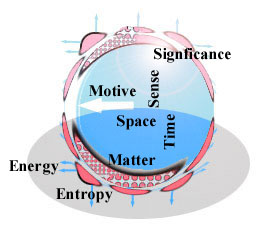
Wrapping this mess up, I put the atomic dots where they belong, on the inside surface of the experiential bubble of the Absolute. Make sense? Haha.
In Multisense Realism, all of physics is understood to relate to the capacity to discern between public and private views of phenomena. Public physics appears to us as ‘matter and energy’ on the outside and ‘perception and participation’ on the inside. The gap which makes this involution or twist possible is the modulation between the presence and absence or sensory presence, with the absence being what is called entropy or spacetime (which become essentially the same thing under this model of physics). To make things more confusing, this modulation of entropy and sensitivity is nested within many layers of itself, as a fractal. A cell encapsulates a world of molecular interaction. An organ encapsulates a world of cells, etc.
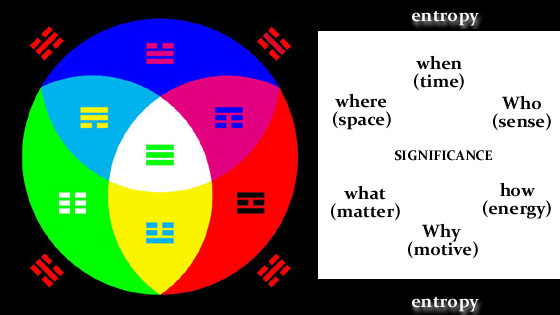
What started as an observation about the common positions that people seem to take within philosophy of mind debates became a hypothesis about the continuum of public and private sense experience, a re-interpretation of light, cosmology, consciousness, and the introduction of new concepts like significance and solitropy.
These two images try to capture the overall picture of how all major features of the cosmos can smoothly fit together.

Chalmers – Consciousness: The Logical Geography of the Issues
The argument for my view is an inference from roughly four premises:
(1) Conscious experience exists.
(2) Conscious experience is not logically supervenient on the physical.
(3) If there are positive facts that are not logically supervenient on the physical facts, then physicalism is false.
(4) The physical domain is causally closed.
(1), (2), and (3) clearly imply the falsity of physicalism. This, taken in conjunction with
(4) and the plausible assumption that physically identical beings will have identical conscious experiences, implies the view that I have called natural supervenience: conscious experience arises from the physical according to some laws of nature, but is not itself physical.
The various alternative positions can be catalogued according to whether they deny (1), (2), (3), or (4). Of course some of these premises can be denied in more than one way.
Denying (1):
(i) Eliminativism. On this view, there are no facts about conscious experience. Nobody is conscious in the phenomenal sense.
Denying (2):
Premise (2) can be denied in various ways, depending on how the entailment in question proceeds—that is, depending on what sort of physical properties are centrally responsible for entailing consciousness. I call all of these views “reductive physicalist” views, because they suppose an analysis of the notion of consciousness that is compatible with reductive explanation.
(ii) Reductive functionalism. This view takes consciousness to be entailed by physical states in virtue of their functional properties, or their causal roles. On this view, what it means for a state to be conscious is for it to play a certain causal role. In a world physically identical to ours, all the relevant causal roles would be played, and therefore the conscious states would all be the same. The zombie world is therefore logically impossible.
(iii) Nonfunctionalist reductive physicalism. On this view, the facts about consciousness are entailed by some physical facts in virtue of their satisfaction of some nonfunctional property. Possible candidates might include biochemical and quantum properties, or properties yet to be determined.
(iv) Holding out for new physics. According to this view, we have no current idea of how physical facts could explain consciousness, but that is because our current conception of physical facts is too narrow. When one argues that a zombie world is logically possible, one is really arguing that all the fields and particles interacting in the space-time manifold, postulated by current physics, could exist in the absence of consciousness. But with a new physics, things might be different. The entities in a radically different theoretical framework might be sufficient to entail and explain consciousness.
Denying (3):
(v) Nonreductive physicalism. This is the view that although there may be no logical entailment from the physical facts to the facts about consciousness, and therefore no reductive explanation of consciousness, consciousness just is physical. The physical facts “metaphysically necessitate” the facts about consciousness. Even though the idea of a zombie world is quite coherent, such a world is metaphysically impossible.
Denying (4):
(vi) Interactionist dualism. This view accepts that consciousness is non-physical, but denies that the physical world is causally closed, so that consciousness can play an autonomous causal role.
Then there is my view, which accepts (1), (2), (3), and (4):
(vii) Property dualism. Consciousness supervenes naturally on the physical, without supervening logically or “metaphysically”.
There is also an eighth common view, which is generally underspecified:
(viii) Don’t-have-a-clue physicalism: “I don’t have a clue about consciousness. It seems utterly mysterious to me. But it must be physical, as physicalism must be true.” Such a view is held widely, but rarely in print (although see Fodor 1992).
To quickly summarize the situation as I see it: (i) seems to be manifestly false; (ii) and (iii) rely on false analyses of the notion of consciousness, and therefore change the subject; (iv) and (vi) place large and implausible bets on the way that physics will turn out, and also have fatal conceptual problems; and (vi) either makes an invalid appeal to Kripkean a posteriori necessity, or relies on a bizarre metaphysics. I have a certain amount of sympathy with (viii), but it presumably must eventually reduce to some more specific view, and none of these seem to work. This leaves (vii) as the only tenable option.
—David Chalmers, The Conscious Mind
My view would require an extra option in between vi and vii –
(vi.5) Oroborean monism. Physics supervenes reflexively on its own (proposed) capacities to experience. Interaction is not logical but self-evident, with multivalent causation to and from private intention and public extension as ordinary sensory-motor participation.
Three Dimensions of Time?

Another way of thinking about subjectivity (as I have modeled it with the multisense continuum as sub-personal, personal, and super-personal ranges of awareness) is that time has three dimensions.
Unlike the three dimensions of space, where the dimensions are presented as converged and simultaneous, the three dimensions of time are more like parallel gears or lenses which are relativistic to the scope of the participant’s awareness rather than to the position of their body. In short, as the structure of space resembles space itself, this new model proposes that the structure of time should be understood in a progressive way, as a multi-stage evolution of structure which is smeared across the totality of interior perception.
If that were true, then my candidates would be as follows, and you can think of them as three levels of description of a clock, oscillation, progression, and orientation.

1. Oscillation. On the lowest level of accurate clocks, there is a recursive sensory-motor engine. Be it a bobbing float, a swaying pendulum, a spring, or a piezo-electric material being stimulated to vibrate, the source of momentum for a clock is the tension between release and restraint, resolved as oscillation. We don’t know that an electric current on a quartz crystal generates an experience of release and restraint, but I suspect that on it’s own molecular scale, there is such an experience, 32,768 times per (human scaled) second.
A very simple water clock could consist of just a leaky measuring cup. In that case, there would not be an oscillation, but a smooth flow. If you watch flowing water, however, it is your awareness which tends to oscillate, tracking between the recursive rushing of the flow through a fixed position and the fluidity of the total motion downstream. In a water clock, the amount of water which leaks out is abstracted quantitatively. When we say, for instance, that there are X number of gallons in a pool, we don’t mean that there are literally gallon-sized units which water comes in that are all squeezed into the pool. We mean there is enough water in the pool to fill X number of gallon jugs if we wanted to. This is a bit of a detour, but it is important because we seem to have forgotten this in physics and now routinely mistake our quantum measurements for the underlying phenomenon which drives that which we believe we are measuring as well as the measuring device itself.
The more relevant point here, is that while the lowest level of time can be either the smooth fluidity of force* or the oscillating dissipation of that force. With the oscillation we get a better sense of the recursive quality of the sub-personal experience. The sub-personal is characterized by its intolerable recursiveness. So generic and monotonous is the stream of identical passing moments of the oscillator that our attention cannot face it for long. We need hands or digits or hash marks on a ruler to help us keep track of their progress indirectly. To a human mind, the experience of the trillions of micro-organic presences which make up our body at any given moment, is recursive madness. The experiential qualities of molecular and quantum levels beneath that, can only be more insanely generic, vast, and uniformly repetitive.
3. Progression. In the middle, personal range of chonometric experience, the hands of a clock are used to denote the wheel of the sun’s progress across sky. Because of the pervasiveness of the sun’s presence, it is only necessary to capture twelve hours at a time, since it should be obvious whether an hour is am or pm by countless perceptual cues internally and externally. The sundial or mechanical clock with round face emphasize the cyclical nature of the progress of time, really a helical sense of second, minute, hour, progressive cycles and day/night oscillating cycles.
In modern time, the worldliness of the solar clock has been shattered in favor of digital time. In digital time, cycle and oscillation are pushed into the sub-personal range of awareness to yield a pure coordinate space. Time no longer passes, rather it is set and synchronized to a satellite signal.
The implications of this psychologically are a double edged sword. Digital time is precise, accurate, and uniform, but its granular nature has replaced the flow of time with dehydrated instants. The meaning of time is purely relative now, an enumerated code tied to geography and policy. Time doesn’t so much ‘march on’ anymore as it does march in place on multiple levels. Time is now an infinite commodity of finite moments, meaningless, disconnected, and interchangeable. We have, in a sense, stopped time while in another sense, we have made time more inescapable and relentless. We are pushing the personal sense of active progress and flow into an impersonal sense of fixed point geosynchronous addressing.
Fortunately we still feel our own lives personally as progress and growth. Our cycles are longer and more spacious than they were a century ago, causing strange red shifting and blue shifting in the extension of childhood, adolescence, and old age but contracting adulthood. Stripping away the superstition of the past has reduced the human life from a pageant of astrological or religious significance ordered by time to its bare bio-genetic mechanisms. Aging is nothing more than a set of symptoms to be banished through medication and cosmetics, diet, and exercise. Otherwise, one year is much the same as the next. Our window of progress has been contracted to match our pay cycle or school schedule. Groundhog Week is always beginning, ending, flying by, or dragging.
Progress is about passing significant milestones. We talk about dates A.D. or B.C. (formerly Before Christ, not secularized as Before Common Era), or characterize them in Ages, Bronze, Iron, Industrial, etc. In our own lives too we think in terms of relationships, residence changes, jobs, or other shifts in the content of our life story – a matrix of befores and afters. These markings in our personal progress are totally unlike the impersonal measures of oscillation and cycle, which are fixed recursively. The chronometry of our lived experience is not so much marked as it is ritually scarred. From the inside, the clockwork thematic and plastic. It retains the irreversible arrow of time, but hyper-extended into aching nostalgic ruins and amputated in chronic disillusion. The retelling of stories and reimprinting of memories smooths out the rough edges, compensates for the incompensible and runs out the clock on personal ages we can’t bear to revisit in their full glory. Memory is a mindfuck. Part propaganda, part revelation…which leads me to.
3. Orientation. Clocks and calendars provide us with a birds-eye view of time. Beyond flow, oscillation, and progress, the wheel or grid of time gives us a presentation of time as universal collection. A science fiction zodiac of possible futures. If oscillation begins with outward flow, then it ends with containment within. Flux and flow persist as perturbations of currency, ripples on the surface of an Akashic plenum of eternity. Finding our way to and from this ocean is perhaps the greatest mystery – one which we have tried to solve with intuition and divination. This is the scientifically despised layer of time which can be described as super-personal, or super-signifying.
Jung talked about the collective unconscious, echoing what every mystic tradition has said about a world beyond time itself – a nexus of hyper-convergence where meaning originates or terminates. Archetypes, symbols from dreams, alchemical models, all point to a kind of absent presence of a divine Totality. Campbell’s ‘hero with a thousand faces’. A bottomless well of teleology and significance – images, encounters, mythic adventures.
Perhaps as the thin trickle of water clock drips out of its vessel, so too does the trickle of possibility drip into our imagination. Unlike the despised drip-drip-dripping of the Sub-Personal level Chinese water torture, the Super-Personal drip into our Personal ‘now’ is generally welcome, if not desperately so. Novelty and variety are precious and we are fiercely proprietary about them. We want to be the first to know, to see, to feel the future for ourselves. ‘What’s next’ is the hope for release from cycles and oscillation – for transcendence and cessation. “Tis a consumation devoutly to be wish’d”.
*flowing from private sensory potentials to public motor presentations (aka thermodynamic entropy, or the arrow of time…a continuous public declaration of pure irreversibility, which is the source of all motive, all expansion, or fractal self-diffraction of the cosmos).
Who’s In Control?
About freewill, thought origination, etc. I do not claim to have the answers but share the following observations.
Our experience reflects two phenomena which can be summed up as the totality of our existence. Those two are the physical and the mental. I believe a little further contemplation reveals that the two can be reduced to one. We are aware of the separation and boundaries of the physical, this thing, that thing, etc. However, when it comes to the mental we experience no such separation. Does not the mental comprise it all? If the mental, awareness or consciousness was divided, bounded, separated or limited how could one thing have awareness of the other? If you and I are defined by our awareness, mentality, consciousness, knowing or whatever you wish to call it and are separate how can we be aware of each other and where or what defines the boundary between us? Obviously, our brain does not confine our consciousness. If it did we could not be aware of anything else. By definition there cannot be an Infinite and anything separate.
Does not the fact that I am aware of me, other people, the world and the universe mean that I AM beyond the aforementioned?We are aware of physicality changing, seemingly coming and going, etc. and in a constant state of flux. However, awareness remains changeless, invulnerable and cannot be created or destroyed. Can we not then conclude that there can be no limit, boundary or separation within Consciousness? If so, we can further conclude that there is only Consciousness because if there is no separation in Consciousness there can obviously be nothing existing separate from it. There is only, All that Is and we are IT. Many will say claiming to be God is a flagrant affront to God or a terrible sacrilege. But, in fact, the opposite is actually the case. If we claim to be separate from God we necessarily limit Him/Her/IT. God cannot be infinite or limitless and be separated by other “stuff”.
How then do we explain individuality? Since we have established by deductive reasoning that there can be no separation, we can now conclude that there is no separate you and I. Further, since nothing can exist separate from Consciousness, nothing but Consciousness exists.
Yet we are aware. Can we not now further conclude that we are all that is or the Consciousness that we have already established is all? Taking this line of reasoning a little further, while we have awareness, we are at the same time aware of not being fully aware. We seemingly are aspects of infinite intelligence but not infinite or at least not aware of it.
From here we can only speculate. I suggest that Infinite intelligence chose to express and Its only means of so doing was to project an illusion of physicality or that which we experience as this universe with inhabitants of limited awareness. They could not have full awareness or they would cease to be the projection but the Projector.
The next question then is, do we really have individual thinking, freewill and are we really capable of changing or controlling anything? I am, of course, totally aware of how we think we are and how difficult it is to give up such an idea and I’m not going to make judgment one way or the other at this point except to say I have struggled a lot with the question and will simply throw out some thoughts on the subject.
Back to the physical and the mental. We have already established that the physical does not really exist. Only the mental is capable of creating a thought. The physical is nothing but objects including our body and brain. I do not believe a brain ever created a thought. The physical cannot possibly create. The brain may very well act as some sort of filter or receiver but I do not believe it can ever be creative. Further substantiating this is the fact that we do not have much idea what our next thought will be. Nor can we control what it will be or how long or often it may reoccur. Likewise, we have many thoughts we would rather not have at times. If we were controlling them why would we have undesirable ones? You have no idea what your next thought will be but I do and you cannot possibly avoid it unless you stop reading right now. Your next thought will be visualizing a flying elephant. So, I believe it obvious that our thoughts are originating from somewhere beyond the physical brain.
About control of life otherwise. We did not control when or where we were born. We had no control of who were our parents, siblings or status, financial, fame or otherwise. We had no control of our gender, original health, inherent tendencies, etc. We had no control of our early upbringing, how we were treated, what we were exposed to, nourishment, etc. We had no control of our early education or exposure to outside influences, etc. We had no control whether we were bullied or abused sexually or otherwise.
We now do not control our bodily functions, heartbeat, digestion, respiration, etc. We have little if any control over viruses, infections, immune systems, accidents, etc.
We do not control when, where or how we die. We do not control all those little or sometimes big unexpected events occurring daily in our lives. Yet, we think we are in control of our lives.
Of What?
We think we are making decisions between multiple choices but are we really? We say we could have chosen the other option. But why didn’t we? We weighed the options, consequences, etc and made a decision. In other words it would have required different consequences or circumstances for us to have made a different decision. But only what is, IS. So, was a different decision ever in the picture? Who could deny that things would be a lot different if we were truly determining the events of our lives?
It is very obvious that our lives are being greatly influenced if not totally controlled by outside forces.
So, you ask, what then is the point in it all? Why this essay? Why make the effort to be good? Why not just live fast, love hard and die young? You are what you are and you’re not going to deviate from it. Afterall, you’re not really in control!
Does it really matter whether or not we are in control? If it makes us feel better, than fine. What difference does it really make if we get over there and realize that, hey, we weren’t really in control afterall? Will we not just laugh and say, I sure as hell thought I was.
Or could it be that within the projection, the mentality of the inhabitants really does have freedom of choice? It’s all illusion anyway but as Thomas Troward said, even though it is illusion, because it is a projection of the Almighty it is real as far as we’re concerned.
In keeping with the spirit of the question, I will answer it not in the way that I would like to ideally, but in the way that my circumstances seem to compel me. Having to get to sleep soon, I don’t have time to craft a thorough answer, (which nobody will probably bother reading) and if I leave it until tomorrow I might not remember what I was going to say. Here then is my circumstantially compromised, short order version of my contribution. I’ll be happy to go into it in further detail later on if anyone is interested.
1. Mental and physical are neither the same thing nor different things, they are opposite ends of a continuum of sensory-motor participation, which is, in my estimation, the fundamental component of the cosmos.
2. Free will and determinism are similarly not mutually exclusive but are defined by and help to define the aforementioned opposite ends of the universal continuum, which can be best understood as public and private ranges of experiential ontology. Public experiences are based on spatial extension, and private experiences are based on temporal narratives, and the two aspects are orthogonal/perpendicular in every way. They two ends also merge in another range of the continuum, which I call the profound edge, where transcendent experiences blur the boundary of private and public.
3. Physical matter actually is ‘real’ in the sense that the foundation of realism lies in the persistence of matter’s spatial extension, which acts as the single firmament of public interaction. All other interaction is biographical and private.
4. The nature of free will is complicated because our understanding of the nature of human consciousness is still very primitive, made more difficult by the seemingly irreconcilable approaches of what could be called the Oriental program, which places subjectivity as the absolute foundation and materiality as derived illusion, and the Western program which leads to the opposite and mutually exclusive conclusion. In my analysis, the opposition of these two programs to each other is a critically important revelation of the nature of consciousness itself, as the capacity to select either extreme and to dial between them mirrors the function of human culture and individual psychology in general.
In my opinion, strict adherence to either the Eastern or Western extremes tends to lead to a pathological worldview, in the sense that fanatical defensiveness and hypocrisy replace a respect for the plain truth. Moving forward to a new synthesis requires, in my opinion, that we keep the Eastern model of hierarchical levels of awareness (chakras, alchemical monochord, etc) but reconcile it with the Western model of physical scale (molecular, cellular, somatic, geological-evolutionary, astrophysical). The way that I propose arranges the sensory-motor experiences hierarchically so that our personal awareness and participation is flanked by a sub-personal or root range of qualia and a super-personal or meta range of intuition and inspiration flavored feelings, insights, and connections.
Anyhow, yes, our personal will does have a modicum of freedom, which expands in proportion to how deeply ‘within’ the context is. Within our own imagination, we have a fantastic degree of freedom, but are still limited ontologically by our human description and by the physics of privacy itself. The further we get from the immediacy of our private realm, the more that our freedom is constrained by the confluence of our own sub-personal and super-personal agendas as well as the nearly infinite impersonal agendas which surround our body in the public presentation of our world. To make things happen in the public world requires slowing our will down, ordering it strategically and persistently, matching the conditions of our environment, and making all manner of compromises. In the end, we may not see that much is left of what we thought we had intended personally, but nevertheless, we were the ones who had to pay attention and care about the outcome, so that’s something. Besides, often we find that the surprises that we discover in the public world are beyond what we could have intentionally dreamed up for ourselves, for better or worse…and that, I suspect is usually part of the larger (super-personal) agenda… if there is one.
Chosen
I wondered about what anyone/everyone thought about the notion of ‘chosenness’ as a way to understand where we are here in the world.
What I propose is that a complete description of the universe must include:
1. The experience of significance.
This speaks to the idea of chosen-ness, of choice, of free will, of improbability as a quality as the subject of appreciation.
2. The experience of the significance of the idea of insignificance.
I word “the significance of the idea of insignificance” in this convoluted way to reflect the natural sequence in which the revelation of objectivity has occurred across all human societies. As far as I know:
a. *all* cultures begin their history steeped in animistic shamanism, divination, creation myths and charismatic deities and
b. *no* cultures develop eliminative materialism, mathematics, and mechanism earlier than philosophy or religion, and
c. *all* individuals experience the development of their own psyche through imaginative, emotional, and irrational or superstitious thought
d. *no* individuals are born with a worldview based only on generic facts and objectivity. Healthy children do not experience their lives in an indifferent and detached mode of observation but rather grow into analytical modes of thought through experience of the public world.
We are so convinced by the sophisticated realism of objective insignificance that we tend to project it into a default position, when in fact, it does not occur naturally that way. It is we who choose subjectively whether or not to project objectivity beneath our own ability to choose it.
The fact is, if were it that simple; were objectivity the final word, then we should have had no reason to be separated from it in the first place. The whole notion of illusion depends on the non-illusory capacity of our own reason to deduce and discern illusion from reality, so that to question our own ability to freely choose, to some extent, how we reason, gives us no possibility of ever contacting any truth to deny.
Looking at 1. and 2. more scientifically, I would link significance with teleology (choice) and insignificance with teleonomy (chance). I have proposed that while these two opposite potentials seem mutually exclusive to us from our subjective experience, that from an absolute perspective, they are in adjacent ranges of the same continuum. I suggest that the subjective experience of sensation, and nested layers of meta-sensation constitute significance, and that this significance is what allows the possibility of choice based on personal preference. It is the choice capacity itself which divides the sense of the world for the chooser between the chosen and the unchosen. This ontological fracture is what gives the impression that there is a difference between chance and choice and creates the possibility of feedback loops in which we can question both:
a. the reality of choice by choosing to adopt the perspective of impersonal chance, as well as
b. the reality of chance by choosing to adopt the perspective of super-personal choice.
In both cases we cannot arrive at a perspective without exercising our will to choose one over the other, even for hypothetical consideration. There is no ontological possibility of our abdicating our choice altogether, although the position which elevates insignificance compels through an appeal to do just that. This is true of contemporary forms of science in general, as the outside-in bias inherently demands compulsory and involuntary acceptance of facts and unambiguous inferences between them rather than recognizing the self-same subjective autonomy which drives the scientific consideration from beginning to end. Science relies on peer-review to enforce the belief in disbelief – the faith that peer-review itself is an unexplained artifact of human weakness, and that the rest of the universe has no need for such deliberations, nor could it generate them even if it were useful.
In practical terms, what this means is that
a. you can choose to pursue the chosen-feeling significance of your experience, but you risk increasing possibility of delusion and conflicting intuitions.
b. you can choose to pursue the unchosen analytical feeling of the significance of insignificance, but you risk cutting yourself off from the most unbelievable experiences of personal truth and participation.
In both cases the potential rewards are equally intense. If you open the door, you open the door to Heaven and Hell. If you close the door, you can be more effective as a practical agent on Earth. Sometimes the choice seems to be coerced by circumstance. Sometimes we open the door in some contexts more often and close it more in others. Our choices can change and evolve. Sometimes it doesn’t matter either way.
The universe that we find ourselves in is chosen on the inside, chance on the outside, but it is only because we are inside that we can discern the difference. Without an inside, nothing can choose to recognize a difference.
Being No One – Thomas Metzinger
A very good, concise presentation. I disagree with his ultimate conclusions, not because of faulty reasoning, but because of the same overlooked assumptions which most contemporary thinkers miss. Despite the appeal to transparency of modeling to explain the existence of subjective qualities, there really is no connection offered at all. A model is a cognitive index through which one instance of experience or presentation can be encapsulated within another. This is a re-presentation. Data which moves from one table to another, which is concatenated or compressed, is not a model unless a conscious entity interprets it that way. A DVD full of laser pits is not a color and sound recording unless it is decoded to a video screen by a DVD player. The DVD player is not playing a movie unless a movie-literate audience is available to watch it.
The problem with the idea of the phenomenal self model, as I see it, is that there is no computational benefit or physical resource which could account for the extra-physical, extra-informational presentation of the ‘model’ to the unmodeled system. In Raymond Tallis’ book ‘Aping Mankind’, he talks about the obvious disadvantages to such an introduction of conscious presentation into unconscious systems, which, after all, have successfully driven the rest of the universe, from the synthesis of nucleic acids to the neutralization of countless pathogens in our immune system. For something as important as executive control of the organism as a whole, an error ridden, self-deluded agent is the last thing that you would want sitting in the cockpit. Imagine if your digestive system relied on such a volitional dreamer to assimilate your nutrients or remember to regulate the pH of your blood.
No, I’m afraid that no information-based architecture can be used to thoroughly explain subjective experience, although it can explain how the particular human quality of subjective experience can be repaired, augmented, manipulated, etc. With information, we can’t even emulate human consciousness, but we can emulate some important products of it, IMO.
I think that I have found a better way to approach phenomenal facts. Rather than assuming that the experience of seeing red is indirect and non-physical I propose instead that physics has a private and a public range (which themselves have overlapping and underlapping regions).
I suggest that experience of seeing red is not synonymous with factual knowledge, but rather all factual knowledge is a category of direct sensory-motor experience. Experience or sense is primary, beneath matter, energy, spacetime, quantum, information, and arithmetic. Not human sense, but sense as universal fundamental.
As human beings, we are staggeringly complex, multilevel organisms. Our direct experience encompasses nested sub-personal experiences and super-personal signifiers as a recapitulation or compound direct experience. The experience of seeing red is a simpler experience, not because it is an illusion or functionally expedient representation, but because it is, on the native level of a whole person, a direct and ‘pre-factual’ physically real presence. Physical reality referring specifically to that which has both privately and publicly ranged presentation.
It’s a complete reworking of physics, I admit, but I humbly say that I think that it reconciles physics, philosophy, subjectivity, and information theory.
All You Touch and All You See
“All you touch and all you see is all your life will ever be.” – Pink Floyd
Beginnings
Option 1: In the beginning, there was X. At some point, some iteration of X(X) bridged the presumably senseless world of X to the real world which we know.
Option 2: In the beginning, there was X and X was sentient.
Option 3: In the beginning, there was sense.
Option 4: The idea of beginning is a function of sense, so that sense is more fundamental than beginnings and sequences.
Option 5: The universe could be a perpetual collection of conditions without any fundamental capacities or beginnings.
Sense from the senseless
To see a universe as brought into being by senseless effects such as the spontaneous appearance of physical ‘forces’ or as a permanent physical fact leaves sense itself unexplained. How do several things operate as a ‘group’, simply by spatial proximity? What makes a pattern or signal different from noise? What really is a ‘beginning’ other than a distinction made from an expectation of sequence?
This may seem to be a silly issue, but I think that whether or not we take sense for granted guides the entire future of science. From physics to neuroscience to computer science, our assumptions about the capacity to sense and makes sense lead us either to discover a fundamental physical principle of orientation uniting subjectivity and objectivity, or drives us further into alienation. Without sense, we are forced to double down on either the primacy of object-hood or the primacy of disembodied simulation, either route leading inevitably to an orphaning of the self – a ghost-machine within a machine-ghost.
Digital Oblivion
Understanding the relation between symbols and reality is notoriously difficult, partly because our experience of reality is overrun symbols to the extent that the vast majority of what we consider real has been mediated through symbolic description rather than direct experience. Our appreciation for direct experience has naturally tended to atrophy in adaptation to this environment so that we no longer consider ourselves to be an authoritative source on any subject. We define our own presence in terms of learned knowledge to the extent that many people find it impossible to separate their actual sensory-motor experience from the understanding of neurology. The former is relegated to the trash heap of ‘illusion’ or ‘models’ and the latter is elevated to the status of objective reality.
Giulio Tononi’s recent Integrated Information Theory, (covered in a SciAm article by Christof Koch) takes a good first step at measuring consciousness by quantifying in formulas the degree to which information is integrated, but by working from the outside in, it fails to grasp the absolute authenticity of awareness itself, and the role that it plays in putting the ‘in’ into ‘in-formation’.
For example, from the Wiki, the diagram showing how to decompose systems into overlapping complexes assumes some primitive level of association that just comes built in with math, or physics, or reality.

Unfortunately this oversight really makes the question of what consciousness is fade out completely, as we have already assumed some sort of discernment and attachment among digits, bytes, or other theoretical ensembles of data.
Philosophers seem to have an advantage over many scientists in being able to question pattern recognition itself and to see semiotic relations between minds and matter rather than data as objective facts. Almost without exception, information science and quantum physics theories seem fuzzy on the difference, and often staunchly deny map-territory distinctions at all. Cognitive science and neurology both seem to be unaware or dismissive of the depth of the Explanatory Gap and Hard Problem of Consciousness, which are seen to be purely philosophical indulgences. In fact, the location of meaning in subjective sense capacities rather than objects is an essential key to understanding the relation of consciousness and physics.
Divorced from physics, computational theories posit a Platonic universe of digital perfection, unhampered by tangible resources. Neglecting the fact that all computation we know of occurs as the result of physical interaction, modern information-centric theories have little to bring numbers down to Earth. Rather than seeing numbers as a counting of static, memorable, locatable, digitally addressable objects, the enthusiasm for Boolean logic seems to have transcended materiality altogether and replaced consciousness itself. Every week there seems to be a new article proclaiming the possibility of digital simulation, each one more cavalier than the last in its dismissal of concrete realism. It is as if to say ‘With our simulated awareness of simulated logic, we simulate understanding that the only reality of sense stems from the unreality of senseless imitation (whatever that is).’
Truth or Consequences
My point in all of this is that our straying from realism has been a fruitful excursion this far, but that we are now seem to be approaching a fork in the road where we will have to place our bets on the authenticity of ourselves or that of objects or information. If we continue to define the self in terms of unrelated bits and pieces of not-self, we will have successfully disappeared our opportunity to thrive and explore the universe in favor of an automatic cataloging and curating of emptiness. What difference does it make what we choose for our supreme X, as we have already determined its nature in advance.
For all possible X, be it genetic, quantum-universal, information-theoretic, we can be sure that they will share the same curious quality of not resembling ourselves in any way. Where we are irrational, indecisive, sentimental, X is inevitable, automatic, and without need for aesthetic presence. We envision an endless web of digital patterns, racing around each other, working out probabilistic games by necessity rather than choice. Yet somehow, we remain the ones who see and touch this world – still unexplained perceiving participants; translators between one meaningless ensemble of data and another.
Scientific Philosophy
An interview with Professor Massimo Pigliucci on the benefits of combining scientific fact gathering with philosophical introspection. He is the author of the book:
Answers for Aristotle: How Science and Philosophy Can Lead Us to A More Meaningful Life
I’m glad to see more consideration for philosophical thought in connection with the interpretation of science. He mentions Hume’s distinction between ‘is’ and ‘ought’, to point out how the existence of scientific fact does not, in and of itself, compel us toward any particular moral code. No matter what science can tell us something ‘is’, the question of what ought to be done about it still remains up for us to decide.
I am torn between wanting to applaud this effort at synthesizing empirical and rational epistemology, and I do, as far as it goes. Professor Pigliucci seems to express here a voice of well reasoned compatibilism, and to extend this reason to the subject matter itself. It is here where I am more critical of this approach, although in the contemporary context it is very much within the intellectual consensus.
While it is indeed a profound shift from pre-scientific moralism to expound a relativistic-existential world where we are each called upon to build our own meaning and morals, I find that this is not the whole picture. Rather than a neat, compartmentalized notion of reasoning which can be traced back to evolutionary biology and neuroscience in all cases, I see much more of a momentum of perception and participation, with universe as theater. This is not to suggest a naive idealism – indeed genetics and biochemistry are overwhelmingly powerful influences in staging our personal slice of the universal theater, but morality cannot be understood with toy models of social relation. The grip of morality on the individual, society, and species is far more visceral and irrational – made of shame and disgust, of soaring pride and worshipful appreciation of superlative qualities. To understand morality is to plumb the depths of myth – of monstrous crimes and the horrific images associated with them.
I think the distinction between the good, the bad, and the ugly is one which ultimately splits along the primary fault of consciousness, which I call sense and motive, or afferent vs efferent phenomenology. The afferent mode is our sensory input, our receptivity to beautiful and awful feelings, while the efferent mode is our motive output – our projection of selfish or enlightened actions in the world. This dyad-dialectic is primordial and intertwined so that our morality often uses one to justify the other. In movies, evil is typically represented by ugly characters in dark costumes. Throughout history people have been persecuted as witches or subhumans based on aesthetic prejudices.
It is interesting, in the wake of the horrors of the 20th century, despite being bombarded with evidence of the banality of evil, we are still surprised to find the most obscene crimes being committed by seemingly ordinary people, including priests, housewives, and police officers. Despite the noticeable lack of organized violence by fringe groups professing interest in magick, loud anti-social music, and extreme body modification, such otherwise ordinary people are often treated with moral suspicion. This double standard, which I think arises from the unconscious equivalence between taboo perceptual themes and transgressive actions is beyond neurology and evolutionary biology and follows from experience itself.
Evolutionary biology can certainly help explain why the contents of taboo themes, which often deal with morbidity, mortality, and sexuality would tend to be associated with a repulsive affect by default, but it does not explain the specific content of that affect. It does not tell us about what fear is and what it tells us about ourselves. It is great to be able to quiet the mind’s questions with reassurances about neurotransmitter interactions and references to particular regions of the brain, but this approach can also cast us in the role of explaining away ourselves. By oversignifying the sub-personal and super-personal levels of our physical mechanism, the personal level of our native experience is depersonalized and robbed of its significance.
To talk about love and fear in terms of neuropeptide cocktails is all well and good for medical purposes, but the unfolding of a human identity in a human life is not so easily reduced into an exercise of forensic pathology. For anyone who has experienced powerfully significant moments in their life, it is not enough to hold up a molecule or a flowchart of hominid foraging, because the experience goes well beyond how one feels personally. Love and fear appear to operate transpersonally, to ‘warp the luck plane’ as it were, inviting unusual synchronicities and dramatic confrontations with would not occur otherwise. Our life, it would seem, can be known to us as a kind of organism made of events, of significance through time.
At this point, I think it might be career suicide for a scientist or philosopher to bring up these ideas (even though they have enjoyed popularity in the the 20th century), so I do not expect to see them in print. I hope that this will change soon, but in the mean time, I am glad that people are beginning to at least see a glimmer of a role again for the mind of the individual.
 Multisense Realism
Recent Comments