Archive
Comparing Worldviews

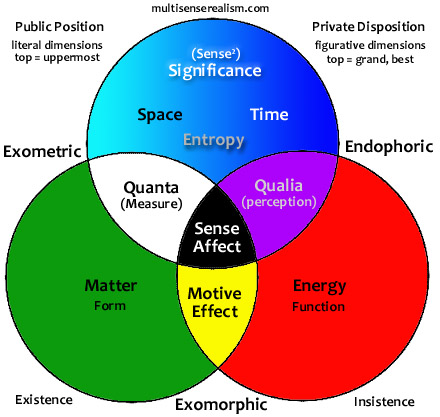
Side by side comparison of what seems to be the prevailing cosmology (above) and MSR (below). In the consensus worldview, aka Western post-modern view, quantitative function replaces all other modalities of sense and sense itself is absorbed into automatism. Energy is merged with matter as ‘particle-waves’ or ‘probability wave functions’, just as space is merged with time through relativity. Rather than a universe of concrete participation, the illusion of realism ’emerges’ from the evolving complexity of statistical interactions. At what level this emergence occurs, why it occurs, or how are left to future generations to explore.
Conspicuously absent are all traces of subjectivity, participation, and significance. Motive effect is understood only as a caused effect – the playing out of inevitable mechanical agendas which stem from a few ‘simple rules’. All forms of privacy are unknown and entropy is divorced from sensory interpretations. All sensations are thought to be partial revelations of an objective truth, so that any deviation from that empirical fact is considered an error.
MSR sees the absence of sense as a the gaping hole in this schema. While emergence is appropriate for understanding how many phenomena which appear to be novel are often found to be inevitable upon further inspection, it is entirely an entirely inappropriate machina ex deus for phenomena which have no plausible origin from the known functions of the system. The consequences of overlooking the key principle which unites all phenomena (sense), are that we wind up with an impoverished worldview, a Straw Man of cosmology in which we ourselves have no possible place.
Consciousness, in Black and White
It occurs to me that it might be easier to explain my view of consciousness and its relation to physics if I begin at the beginning. In this case, I think that the beginning was in asking ‘What if the fundamental principle in the universe were a simple form of awareness rather than something else?’
Our choices in tracing the lineage of consciousness back seem to be limited. Either it ’emerged’ from complexity, at some arbitrary stage of biological evolution, or its complexity evolved without emergence, as elaboration of a simple foundational panpsychic property.
In considering which of these two is more likely, I suggest that we first consider the odd, unfamiliar option. The phenomenon of contrast as a good place to start to characterize the theme of awareness. Absolute contrasts are especially compelling. Full and empty, black and white, hot and cold, etc. Our language is replete with evidence of this binary hyperbole. Not only does it seem necessary for communication, but there seems also to be an artistic satisfaction in making opposites as robust as possible. Famously this tendency for exaggeration clouds our thinking with prejudice, but it also clarifies and makes distinction more understandable. In politics, mathematics, science, philosophy, and theology, concepts of a balance of opposites can be found as the embodiment of its essential concepts.
For this reason alone, I think that we can say with certainty that consciousness has to do with a discernment of contrasts. Beneath the linguistic and conceptual embodiments of absolute contrasts are the more zoological contrasting pairs – hungry and full, alive and dead, tired and alert, sick and healthy, etc. At this point we should ask, is consciousness complex or is it simple? Is the difference between pain and pleasure something that should require billions of cellular interactions over billions of years of evolution to arrive at accidentally, or does that seem like something which is so simple and primordial that nothing could ever ‘arrive’ at it?
Repetition is a special form of contrast, because whether it is an event which repeats cyclically through a sequence or a form which repeats spatially across a pattern, the underlying nature of what repeats is that it is in some sense identical or similar, and in another sense not precisely identical as it can be located in memory or position as a separate instance.
I use the phrase “repeats cyclically through a sequence” instead of “repeats sequentially through time” because if we take our beginning premise of simple qualities and capacities of awareness as preceding even physics, then the idea of time should be grounded in experience rather than an abstract metric. Instead of conceiving of time as a dimension in which events are contained, we must begin with the capacity of events to ‘know’ each other or in some way retain their continuity while allowing discontinuity. An event which repeats, such as a heartbeat or the circadian rhythms of sunlight, is fundamentally a rhythm or cycle. That is the actual sense experience. Regular, frequent, variation. Modulation of regularity.
Likewise, I use the phrase “repeats spatially across a pattern” instead of “repeats as a pattern across space” because again, we must flip the expectation of physics if we are to remain consistent to the premise of sense-first. What we see is not objects in space, it is shapes separated by contrasting negative shapes. What we can touch are solids, liquids, and gases separated from each other by contrasting sense of their densities. Here too, the sense of opposites dominates, separating the substantial from the insubstantial, heavy from light, hard from soft.
An important point to make here is that we are adapted, as human beings with bodies of a particular density and size, to feel the world that relates appropriately to our body. It is only through the hard lessons like plague and radiation that we have learned that indeed things which are too small for us to see or feel can destroy our bodies and kill us. The terror of this fact has inspired science to pursue knowledge with an aggressive urgency, and justifiably so. Scientists are heroes, informing medicine, transportation, public safety, etc as never before in the history of the world and inspiring a fantastic curiosity for knowledge about reality rather than ideas about God or songs about love. The trauma of that shattering of naive realism haunts our culture as whole, and has echoes in the lives of each generation, family, and individual. Innocence lost. The response to this trauma varies, but it is hard to remain neutral about. People either adapt to the cold hard world beyond themselves with fear or with anger. It’s an extension of self-consciousness which seems uniquely human and often associated with mortality. I think that it’s more than confronting their own death that freaks out the humans, it’s the chasm of unknowable impotence which frames our entire experience on all sides. We know that we don’t really know.
The human agenda becomes not merely survival and reproduction, but also to fill the existential chasm with answers, or failing answers, to at least feel fulfilled with dramatic feelings – with entertainments, achievements, and discoveries. We want something thrilling and significant to compensate for our now unforgettable discovery of our own insignificance. With modernism came a kind of Stockholm syndrome turn. We learned how to embrace the chasm, or at least to behave that way.
At the same time that Einstein began to call the entire foundation of our assumptions about physics into question, the philosophy of Neitzsche, along with the science of Darwin and Freud had begun to sink in politically. Revolutions from both the Left and Right rocked the world, followed in some nations by totalitarianism and total war. The arts were transformed by an unprecedented radicalism as well, from Duchamp, Picasso, and Malevich to Stravinsky and Le Corbusier. After all of the pageantry and tradition, all of the stifling politeness and patriarchy, suddenly Westerners stopped giving a shit about the past. All at once, the azimuth of the collective psyche pitched Westward all the way, toward annihilation in a glorious future. If humans could not live forever, then we will become part of whatever does live forever. The human agenda went transhuman, and everyone became their own philosophical free agent. God was indeed dead. For a while. But the body lives on.
The point of this detour was to underscore the importance of what we are in the world – the size and density of our body, to what we think that the world is. Not only do we only perceive a narrow range of frequencies of light and sound, but also of events. Events which are too slow or too fast for us to perceive as events are perceived as permanent conditions. What we experience exists as a perceptual relativity between these two absolutes. Like the speed of light, c, perception has aesthetic boundaries. Realism is personal, but it is more than personal also. We find agreement in other people and in other creatures which we can relate to. Anything which has a face earns a certain empathy and esteem. Anything that we can eat has a significance to us. Sometimes the two overlap, which gives us something to think about. Consciousness, at least the consciousness which is directed outwardly from our body, is all about these kinds of judgment calls or bets. We are betting that animals that we eat are not as significant as we are, so we enjoy eating them, or we are betting that such a thought is immoral so we abstain. Society reflects back these judgments and amplifies them through language, customs, belief systems, and laws. Since the modernist revolution, the media has blanketed the social landscape with mass production of cliches and dramatizations, which seems to have wound up leaking a mixture of vanity and schadenfreude, with endless reenactments, sequels, and series.
It is out of this bubble of reflected self-deflection that the current philosophies rooted in both reductionism and emergentism find their appeal. Beginning with the assumption of mechanism or functionalism as the universal principle, the task of understanding our own consciousness becomes a strictly empirical occupation. Though the daunting complexity of neuroscience cannot be overstated, the idea is that it is inevitable that we eventually uncover the methods and means by which data takes on its fancy experiential forms. The psyche can only be a kind of evolutionary bag of tricks which has developed to serve the agenda of biological repetition. Color, flavor, sound, as well as philosophy and science are all social peacock displays and data-compressing virtual appendages. The show of significance is an illusion, an Eloi veneer of aesthetics over the Morlock machinations of pure function.
To see oneself as a community of insignificance in which an illusion of significance is invested is a win-win for the postmodern ego. We get to claim arbitrary superiority over all previous incarnations, while at the same time claiming absolute humility. It’s a calculated position, and like a game theory simulation, it aims to minimize vulnerability. Facts are immutable and real, experiences are irrelevant. From this voyeuristic vantage point, the holder of mechanist views about free will is free to deny that he has it without noticing the contradiction. The emergent consciousness can speak glowingly out of both sides of its mouth of its great knowledge and understanding in which all knowledge and understanding is rendered void by statistical mechanics. Indeed the position offers no choice, having backed itself into a corner, but to saw off its own limbs with one hand and reattach them with another when it is not looking.
What is gained from this exercise in futility beyond the comfort that comes with conformity to academic consensus is the sense that whatever happens, it can be justified with randomness or determinism. The chasm has been tamed, not by filling it in or denying it, but by deciding that we are simply not present in the way that we think. DNA acts, neurons fire, therefore we are not thinking. Death is no different than life which has paused indefinitely. An interesting side effect is that as people are reduced to emergent machines, machines are elevated to sentient beings, and the circle is complete. We are not, but our products are. It seems to me the very embodiment of suburban neuroses. The vicarious society of invisible drones.
Just as 20th century physics exploded the atom, I would like to see 21st century physics explode the machine. Instead of releasing raw energy and fragmentation, I see that the blasting open of mathematical assumptions will yield an implosion into meaning. Pattern recognition, not information, is the true source of authenticity and significance. They are the same thing ultimately. The authenticity of significance and the significance of authenticity speak to origination and individuation over repetition. Not contrast and dialectic, not forces and fields, but the sense in which all of these facets are yoked together. Sense is the meta-syzygy. It is the capacity to focus multiplicity into unity (as in perception or afference) and the capacity for unity to project into multiplicity (participation or efference).
These are only metaphorical descriptions of function however. What sense really is and what it does can only be experienced directly. You make sense because everything makes sense…in some sense. That doesn’t happen by accident. It doesn’t mean there has to be a human-like deity presiding over all of it, to the contrary, only half of what we can experience makes sense intentionally, the other half (or slightly less) makes sense unintentionally, as a consequence of larger and smaller sequences which have been set in motion intentionally. We are the evidence. Sense is evident to us and there is nothing which can be evident except through sense and sense making.
 Multisense Realism
Recent Comments