Archive

Cone Cosmogony


The first image is from https://www.facebook.com/headexchange. The second has been modified to include the Multisense Realism model.
Specifically, “Me” has been removed from the center of the mandala and turned into part of the z axis. The center of the wheel is now Form-Function, and Now, indicating that consciousness is at its most pointillistic and fragmented. This would be the sharpest, most systematizing-autistic quality of consciousness, quantitative and reductionistic.*
The diameter of the circles corresponds to space or distance (really wavelength ratio/scale), so that the wheel represents a flat cross section of eternity. Time is the diagonal axis which is can be thought of as the z axis ‘deferred’. If our experience (feeling, thought, etc) extends from eternity to now as a qualitative spectrum (as symbolized by the chakra graphic), then ‘time’ is the interference pattern between eternal experience and fully public, discrete events.
The top of the cone is labeled eternity, although it is eternity in the sense of the eternal moment rather than a linear history of time. Eternity can also be called the Absolute, or God, Tao, Consciousness, Aesthetic Foundation, and many other names. Identifying with the Absolute while still in our body is the opposte end of the consciousness spectrum – the most colorful, florid, artistic-empathic-psychotic range of awareness.
* See previous posts on Imprinted Brain Theory and the Autistic-Psychotic spectrum.
The Holo-solo-meta-sema-graphic Principle
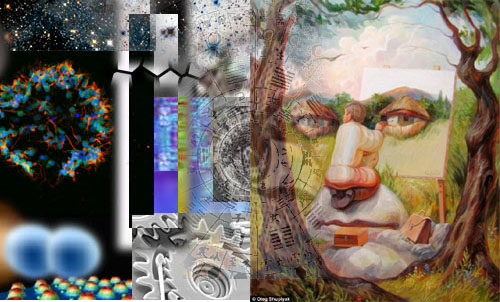
Think of the multisense continuum as a clarification of the holographic principle. What people often mean by holographic when ascribing it to the universe as a whole is something like ‘The Universe is not really real, but is a Matrix-like projection in which the totality is reflected in each part.’ If we ignore that theory for a moment and examine the linguistic origins of the word holographic instead, there are some worthwhile tie-ins to Multisense Realism. MSR is a way of stretching out this concept of holography, so that the extent to which it seems holographic is part of the hologram. Realism is not a fixed, absolute foundation, but an aesthetic quality of orientation. Realism is not a neutral designation of that which is factual versus that which is not, but also has a set of qualities, almost a personality which opposes the fantastic qualities of imagination, dreams, and psychosis. Where the aesthetics of fantasy are typically saturated, vivid, or florid, realism is relatively bland or rigid. Realism supports rigorous logic and causality. A graph can be thought of as the essence of realism in a way – not reality itself, but the mapping of the mappable aspects of reality…a realistic approach to realism.
Notice that holos and graph are polarized. They aren’t simple opposites where graph = parts and holos = whole, although graphing does break wholes into regular parts, but there is also a sense of a graph is of a static mental resource; an object or so called rigid body which we use to index information. A graph is a chart.* By contrast, holos is the uncharted and boundless context which does not respect strict divisions.
Holos means whole, but if you look up the etymology of hologram there is something interesting:
”hologram (n.)1949, coined by Hungarian-born British scientist Dennis Gabor (Gábor Dénes), 1971 Nobel prize winner in physics for his work in holography; from Greek holos “whole” (in sense of three-dimensional; see safe (adj.)) + -gram.”
So holos doubles as a term that has something to do with feeling ‘safe’:
”safe (adj.) c.1300, “unscathed, unhurt, uninjured; free from danger or molestation, in safety, secure; saved spiritually, redeemed, not damned;” from Old French sauf “protected, watched-over; assured of salvation,” from Latin salvus “uninjured, in good health, safe,” related to salus “good health,” saluber “healthful,” all from PIE *solwos from root *sol- “whole” (cognates: Latin solidus “solid,” Sanskrit sarvah “uninjured, intact, whole,” Avestan haurva- “uninjured, intact,” Old Persian haruva-, Greek holos “whole”). “
This root sense of wholeness as safety, solidity, health, healing, etc is the natural anchor of anchors…the foundational aesthetic (of the aesthetic foundation). All experiences in all possible universes must begin from this un-locused locus. Un-locused because it precedes its own definition or observation. The baby at the boob has no frame of reference, no learning process to understand the importance of nutrition or survival – there is only to appreciate the experience of being re-connected to the womb’s holos in a new and disorienting context…What is this context?
”-graph modern word-forming element meaning “instrument for recording; that which marks or describes; something written,” from Greek -graphos “-writing, -writer” (as in autographos “written with one’s own hand”), from graphe “writing, the art of writing, a writing,” from graphein “to write, express by written characters,” earlier “to draw, represent by lines drawn” (see -graphy). Adopted widely (Dutch -graaf, German -graph, French -graphe, Spanish -grafo). Related: -grapher; -graphic; -graphical.”
Compared with holos, -graph is a very different kind of term. Where holos is a rich and profound metaphor, -graph is a relatively prosaic and literal term about something in the real world…writing or recording. Holos is an appreciation of primordial safety; an orientation to a frame of reference which is absolute and beyond thought. Once someone is born into a human life or an animal’s life, this holos is buried in a cocoon of defenses which face the anti-holos of spacetime and physics and the sense that was formerly whole is averaged out as
“sole (adj.) “single, alone, having no husband or wife; one and only, singular, unique,” late 14c., from Old French soul “only, alone, just,” from Latin solus “alone, only, single, sole; forsaken; extraordinary,” of unknown origin, perhaps related to se “oneself,” from PIE reflexive root *swo- (see so).”
As a sole individual in a physical world, we have developed ways to re-connect with each other. Some of them are ways of reconnecting to our shared history as mammals and primates, and some, like writing are more recent human inventions. The idea of writing is to inscribe a thin stream of thought into physics, into spacetime so that others can recreate it in their local experience. It’s a bridge, a trans-fer or meta-phor, which means carrying over of feeling or meanings. What is the carrier?
”semaphore (n.)”apparatus for signaling,” 1816, probably via French sémaphore, literally “a bearer of signals,” ultimately from Greek sema “sign, signal” (see semantic) + phoros “bearer,” from pherein “to carry” (see infer). Related: Semaphoric (1808).”
The sema- or sign is a recontextualized piece of the world. We use it to passively bear our sharing of communication, as an insulator would bear a conducting wire, or a conducting wire would bear an electromagnetic flux. There are layers of nesting which span the continuum from holos to solus to meta to sema to graph.
Wholeness to self to likeness to sign to signed. The distance between our human self and the ‘signed’ or ‘graphed’ physical world is what gives that physical world its gravitas…its grave realism. Mortality adds a layer of biological gravity…the signs which threaten the self of the experience of life. The closer that a given phenomenon is to the whole, the more it is metaphorical and self-referential.
Once we grasp this continuum, we can see how subjective and objective phenomena are an elaboration of a theme of awareness and degrees of alienation from the whole. We can go into more advanced areas of understanding the continuum and see that while the graph end of sense reflects in micro the holos itself, it is only a reflection and has no generative power of its own. Even though we locally experience a tension between the holos and graph which seem equal, or even overpowered by physics, that is only because of how deeply our human experience is nested within billions of sensations, feelings, and thoughts since the beginning of spacetime.
In the absolute frame of reference, all is consumed by, with, and for holos. The graph appearance, and even the holographic principle is the local view of the self’s experience of being alienated. It’s a compromise between Descartes’ substance dualism and Eastern/perennial philosophy’s holism, but it is still fixed in the Cartesian graph of spacetime and Newton’s mechanics of mass and energy. We imagine that each physical particle is a packet containing a ghost of the whole, but I think that it now makes more sense to say that it is the particle itself which is, in the absolute frame or reference, more like the ghost. It’s relativistic, but all relation traces back to the orientation of the absolute. There is no orientation derived purely from disorientation, which is why we cannot build a sign or a self or a holos from a machine (graph).
*Descartes, whose family name means ‘of the charts’, and also can be associated with the French word charteus, meaning pertaining to papyrus/paper has an interesting connection to the role of Rene Descartes in developing the digital view of space in terms of Cartesian coordinates. Cards, charts and papers refer to objects which carry meaning – blank vehicles to be used either as a container for metaphor, or as the medium of choice for a stream of digital semaphores. The critical place that Descartes holds in the development of the Early Modern Period, cannot be overstated. In his 1641 Meditations, Descartes divided the cosmos, for better or worse, into mind and matter (res cogitans and res extensa), paving the way for Newton, Leibniz and others to see physics as an expression of precise mathematical truths. The Enlightenment Era marks the Western world’s separation from perennial, Eastern philosophy and the discovery of a new, Cartesian world of purely mechanical objects. The card, or graph aspect of the cosmos is seen as the new orientation, a counter-aesthetic to one which assumes theistic holos. The Western counter-aesthetic of modernism questions the beliefs of the past, asserting instead that the natural world is innocent of religious enchantment until proven otherwise.
A New Final Frontier
If Dark Matter and Dark Energy represents 96% of the “known” universe, even if it paradoxically turns out that we know virtually nothing about it, what other kinds of ratios-in-ignorance lurk as shockingly in our self-significant lives? – Quora Question
There are 23% of Dark Matter and 73% of Dark Energy.
Next time that you are in room with another person, take a moment to realize what that room looks like from the other person’s perspective. Imagine being that person and seeing the room from their perspective. Now imagine that moment in which you are imagining yourself as them as a fleeting instant in their lifetime in which your presence is all but completely unnoticed. Understand that moment is, for them, only one of an eternity of moments of a life completely other than your own.
The degree to which their age, gender, cultural identity and personal experience differs from your own is the degree to which the life they have been living is different from your own – different views of history where different events are weighted differently in significance. Events which are historical to you are, for an older person, events in their own lives which have not entirely passed, but rather live on as changes which happen to no longer be present, but whose influence can be traced through their future, backwards.
Now extend this expectation of other lives to animals and plants, no matter how small, to cells, and perhaps even to genetic histories, to chemistry and physics. Histories and perspectives so alien that the smallest hydrogen nuclei have more in common with the largest stars than they have differences, and measures of time become liminocentric, with the infinitesimal moment blurring into the astronomical eternity, and the blasting of singular furnace of mass into hypercardinal intergalactic multiplicities is divided up into all-but-infinite fractals of all-but-infinite moments of multisense realism. Each moment, each perspective a holographic reflection of itself within the fisheye reflection of the whole that it embodies. Each perspective is bound to a private cache of evanescent histories, transparent and shifting in the changing light of the mood and the moment.
What we don’t see of the universe, by virtue of the limitation of our perceptual tunnels as individuals, as humans, as animals and organisms…what we don’t see of each others experience and of the experience on scales beyond that of organic life dwarfs the ratio of dark energy. What is elided from our experience and possible experience is the true final frontier.
Physics as the Production of Realistic Fantasy and Fantastic Reality
When working with private physics, the operators used are metaphorical and implicit, not explicit. Qualia is LIKE the “mass” of privacy. The will to will is like the “Energy” of privacy, and realism is like the “c²”. In my understanding, the notion that c is the speed of light is really a legacy understanding – a pre-Relativity convention within Relativity. It makes more sense to me now that light just happens to be the fastest quality of sense that we have access to. The true nature of c is as the speed of sense, or experience itself. It is not a speed, but the absolute limit of velocity. The still-here-ness of the universe..
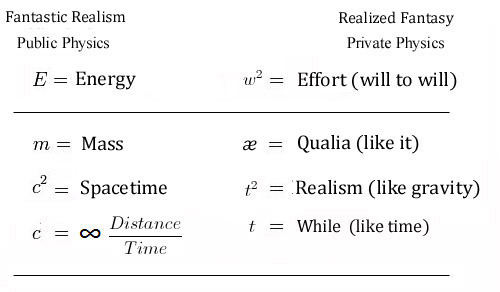
From an absolute view, quantified properties like mass, energy, and spacetime can be considered to be like reality but the only true reality is what experience is like. All conditions of the public universe are contingent upon an aesthetic palette, otherwise it would be implausible that any such palette could exist.
Private physics and public physics provide two different senses or fantasy, and two different senses of reality. Human experience is fantastically rich in an aesthetic sense and fundamentally real because it is the source of our participation in the universe. Our experience of the non-human universe is fantastic in the sense of its overwhelming magnitude and complexity, Its reality is persistent and reliable.
If we are serious about our science, we should consider that being overwhelmed by grandeur is a human experience which reflects the disparity in physical scale between us and the larger exteriority. The Public universe by itself would have no such feeling of grandeur, but what we feel about the inaccessible vastness of the cosmos is equaled by the vast inaccessibility of feeling by public physics.
Something else that has come up through this recent addition of physics to MSR, is the idea that Gravity is time squared, and that time is the square root of gravity. This makes sense to me, if we are talking about the equivalent conjugates of c² and t² as pubic spacetime and private realism. It should work out that Spacetime = the public shadow of Realism, and therefore Spacetime is literally Gravity and Realism is literally figuratively Gravity, as in the grave, serious nature of experience. If c is the constancy of distance and time coordinates, c² is the gravity which warps them from within.
Colorball II Diagram

Key:
Absolute (+∞) :: Anesthetic (-∞)
Entelethetic (+3) :: Hypothetic (-3)
Aesthetic (+2) :: Exthetic (-2)
Immediate (+1) :: Etheric (-1)
Protosthetic (+0) :: Pseudethetic (-0)
The new terms in this second version are:
- Protosthetic (+0), referring to the minimum quality of awareness as well as the quality of minimum awareness. On a scale of +0* to +∞, this level is the +0 because it represents experiences which have been aesthetically masked to appear imperceptible. This can be thought of as the personal unconscious, as opposed to the collective unconscious, which is the Absolute level that is positioned on top of the diagram, but is actually the entire sphere. It’s number would be +∞.
The entire left half of the sphere can be thought of as a slice within the protosthetic range, just as the greyscale can be thought of as variations on black and white. - Pseudethetic (-0) is the outside-in version of Protosthetic. Where protosthetic phenomena seem alienated or unconscious but are, on some level, a symptom of experience, pseudethetic phenomena are not as conscious as they appear to be. The -0 range is about artifice and simulation, and can include anything from a puppet or stuffed animal to a sophisticated AGI system. Protosthetic would include states in which we are personally unconscious, but can be thought of as that which wakes us up from a sub-personal level.
- Exthetic (-2) is a term I’m trying out as the public-facing conjugate to Aesthetic. This is the common sense of structure that the real world generally seems to have. It is the sense of concrete exteriority which we rely on to engage with the world rather than in our mind. The sense of fixed mass objects in space and linear causality, and all of the other macroscopic cues that pervade classical physics, as well as all of the hard sciences.
- Entelethetic (+3) is intended to refer to a level of hyper-aesthetic dreams, symbols, and archetypes. Also knows as the collective unconscious or Dreamtime, this band of sensitivity is super-natural and trans-personal (yet still private). The word borrows from Entelechy, which has to do with a drive toward self-actualization, which is apt considering the visionary nature of this ‘third eye’ view.
Teleological-Absolute (+∞) :: Universal-Axiomatic (-∞)
Mytho-Poetic (+3) :: Geometric-Algebraic (-3)
Mental-Emotional (+2) :: Scientific-Mechanical (-2)
Sensory-Motive/Perceptual (+1) :: Electro-Magnetic/Relativistic (-1)
Proto-Aesthetic (+0) :: Quantum-Digital (-0)
Sketch for a New Physics
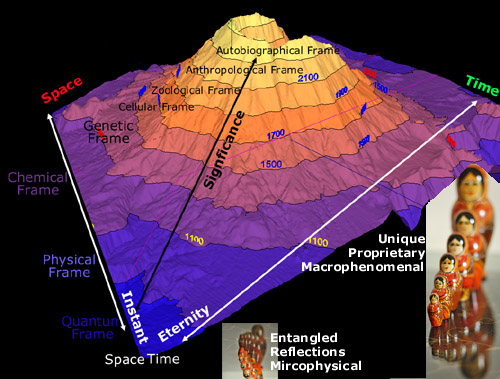
Using a topographical metaphor, this diagram shows the relation of significance in direct proportion to the dimorphism of space and time. I call this eigenmorphism. For example, as human beings, our native frame is the Autobiographical level (top). Our experience has a high significance, which means
1) rich qualia – larger nows and more nesting of personal, sub-personal, and super-personal frames allow for deeper sensory vocabularies.
2) a highly divergent space-time presentation (space and time are opposite for us, but identical for quantum phenomena or astrophysical phenomena).
3) a highly divergent spectrum of realism. The Matroyshka dolls with reflection underneath represent this range of clear/real, vs blurred/intuitive, and reflective/fiction. By contrast, the entangled reflections of the microphysical level of physics are neither real nor fictional. With space and time fused, matter and energy become interchangeable foregrounds for information processing.
 Multisense Realism
Recent Comments