Archive
Mathematical Musings
Here are some of the more mathematical concepts related to Multisense Realism.
Position on Mathematics
Mathematics does not exist on its own. It does not haunt the vacuum of space. It does not manifest as public objects or substances. It has no will or motivation.
Mathematics is two distinctly different (opposite) things:
1) A private experience of imagined sensory symbol-figures which accompany a motive of quantitative reasoning.
2) A collection of public objects interacting in a logical, causal way, without any private representations, as a consequence of the shapes of multiple rigid bodies.
The problem with functionalist expectations is that they seduce us into a shell game so that when we look at math ‘out there’ (2), we smuggle in the meaning from ‘in here’ (1), and when we look at meaning in here (1) we mis-attribute it to the blind enactment of material bodies.
We assume that the world outside of our minds runs on math not because it actually does, but because our awareness of the public arena is a grossly reduced, indirect logical construction. The universe without, like the universe within, runs on qualitative sensory-motor experiences.
Turning the functionalist expectations around then, we find that the activity of the brain is not the source of human experience, but rather the effect of many kinds of experience on many levels (physical, chemical, biological). These experiences are not generated by information or mathematics, but rather information is an analysis of experiences by someone who knows almost nothing about them first hand.
We are used to thinking of ‘data’ in terms of digital vs analog. Consider however that both of these categories are a-signifying formats. I would like to propose a principle by which subjective, signifying experience is introduced – a qualitative instrumentality of being.

Think of the number line – abstract, linear, literal. A conception of pure quantitative non-awareness. It’s a semantic artifact from which all qualitative content has been stripped. It’s like a Supremetist work of art, really.
The act of measurement itself is to invert qualitative experience – to collapse it into value coordinates on a numberline, allowing us to treat it as a hypothetical object, aka, a figure.
Ordinal position applies to the literal, outward facing specifications of rank. This is where the universe gets the ideas for front and back (anterior and posterior) and interior exterior. As in Chess, rank refers to the relative power of the piece – the order of their significance to the game.
Ordinal disposition applies to the figurative, inward facing qualities associated with rank. This is where the universe gets the ideas for best and worst (superior and inferior). Feeling like a King or Queen, being treated like royalty, having access to first choice in dividing the spoils, etc. Ordinal disposition is about the experiential privilege of rank while ordinal position is about the mechanics associated with delivering or deriving that privilege.
by contrast, Cardinal position I am saying refers to the relative size of a real public phenomenon. The range here is along an axis from the micro to the mega, and can refer to increasing scopes and scale or increasing quantitative complexity. This is about structures nested within structures, separated by spaces of varying size. Rather than in/out, front/back, or high/low-superior/inferior, cardinal position is about spatial-topological extension – long/short, large/small.
Cardinal disposition rounds out the four as an evaluation based on rarity. Like the pawns in chess, their generic abundance relative to the two unique pieces and the three duplicated pieces indicates their disposable rank. This is different from ordinal disposition in that superiority/inferiority derives not from order in a sequence, but from degree of commonality. Where cardinal position is about space and geometry, cardinal disposition is about feelings derived from time and algebra; frequency. How often. Sooner/later. Cheap/dear. Ordinary/exotic. The magic here is in pattern recognition. ‘Three in a row’ is an example of how low caste occurrences can ascend to uncommon value.
The terms for the columns and rows in chess, rank and file, are useful here. The rank can be seen as the vertical axis of qualitative position and disposition, while the single-file of pawns exemplifies the horizontal axis of quantitative position and disposition. Poker hands are a good metaphor to see this as well. Pairs, three and four of a kind, flushes display cardinal significance, straights, high cards, and Royal flushes display ordinal significance. The other hands, full house, straight flush, demonstrate an appreciation of the cardinal disposition of combined cardinal and ordinal values.
Causation Diagram
 I suggest that consciousness isn’t built up from nothing by tiny parts, it is recovered from everything by sensitivity. Unlike traditional causation models, Multisense Realism posits a radiant centripetal locus (‘here and now’) divided into lower (interior) and upper (exterior) sense conjugates. The blue and yellow connote the mirroring of the conjugates, signifying that subjective and objective modalities are not merely different but are opposite, or orthomodular ontologies:
Yellow: Interior significance (doing*being)(timespace) and
Blue: Exterior entropy (matter/energy)/spacetime
In the lower yellow half, the subjective experience of ‘now’ (M1) represents the tip of an iceberg of mental events (M) through constraints on experiential scope . The scope of a human experience is limited on the ‘near’ end by sampling rate and on the ‘far’ end by long term memory. The event horizon of the M1 now degenerates from proprietary availability toward Mφ (totality of experience, significance, or consciousness itself) along a proposed fractional Fibonacci ratio.
The blue upper half, by contrast, depicts the counterpart to M1 as ΣP, or the sum of all physical presentations relative to any given M stack. Note that physical presentations (P) are understood to be the ‘back end’ of mental presentations (M), i.e. a better symbol for physical presentations here might be shaped like a W to mirror M.
In the blue half of the diagram, the fading nested ellipses represent a different, public kind of constraint on sense – obstruction and scale. Beginning from the outside at P1 (the Big Bang) and proliferating into smaller and more granular forms. The spread between the cosmic and the microcosmic pushes out from the middle.
Degree of figurativeness in qualia equates to privacy of qualia.
1. Subjects necessarily have access to more qualia which applies to their autobiographical experience than qualia which refers to external, publicly accessible experience.
2. It is proposed that the more strictly personal a quale is, the greater the set of interconnected psychological associations that exists for the individual and the richer and more imaginative those associations can be.
3. Mathematically, the more personal an experience is to us, the more ways we can shift its meaning, making qualitative floridity and associative fluidity directly proportional to privacy.
Sole Entropy Well Model
Loschmidt’s Paradox, which as I understand it is basically “If the universe is always increasing from low entropy to high entropy, then where did the initial low entropy come from?” can be approached in a different way than what has been suggested so far. Boltzmann’s entropy curve proposes that our universe’s Big Bang is only one of many bubbles or waves which we find ourselves in anthropically.
What I propose instead is a single well of bottomless low entropy, which perpetually lengthens as all possible Boltzmann entropy waves are anticipated and absorbed before they can threaten the negentropic monopoly of the well.
In this view, the range of possible kinds of signals becomes quantitatively bound on one extreme by the Absolute (where all signals are fused in singularity of significance) and spacetime (where all signals are divided in absolute cardinality or insignificance). Like velocity, which ranges from stillness to c, the phenomenon of significance actually defines the parameters of its own measure. Entropy has meaning only in relation to expected significance, such that anything less than 100% entropy has some portion of Absolute significance. The most insignificant event can still only have 99.999…% entropy, and even the negentropic monopoly of the Absolute can only ever attain 0.000…1% entropy.
This way, the Big Bang becomes a perpetually receding event horizon of absolute and eternal negentropy, – a Borg-like ‘bright whole’ which tyrannically absorbs and subordinates all potentials and possibilities into a single continuum-schema of sense. This continuum must accommodate all paradoxes which amounts to a lot of fancy devices like nesting signals within each other on multiple interrelated layers or castes, and orthomodular juxtapositions such as private-public. These devices accomplish what I call the Big Diffraction.

The initial signal, which is the bootstrap for all sense-motor phenomena, is initiation itself, and as it defines all future coherence, it is perpetually hogging all possible signals for all time, banishing any rival Multiverse by perpetual deferment and delay.
The Doctor Prescribes Brian Eno – Blog of the Long Now
The Doctor Prescribes Brian Eno – Blog of the Long Now
In the video, Brian Eno brings up two points which relate to the last posts about intelligence, wisdom, and their relation to entropy.
“I think that one of the things that art offers you is the chance to surrender, to not be in control any longer”.
Right. That makes sense. Art debits the private side of the phenomenal ledger. The side which is concerned with the loaning of time to be returned to the Absolute with interest. Wisdom, especially in the exalted forms of Eastern philosophy, is all about surrender and flow. Dissolving of the ego. The ego is the public interface for the private self, and the seat of the kind of intelligence addressed by causal entropic forces – machine intelligence, strategic effectiveness. Important locally but trivial ultimately, in the face of eternity.
On the other side of the ledger is the chance to strive and control using intelligence. Western philosophy tends toward cultivating objectivity and critical thinking. It is a canon of skeptical intelligence and empiricism from which science emerged. Clear thinking and resisting the desire to surrender are what debit the public facing side of the ledger. Art and Science then, are the sense and motive of human culture…the tender and tough, the wag and wegh, and yes, the yin and yang.
Eno also says “The least interesting sound in the universe, probably, is the sine wave. It’s the sound of nothing happening. It’s the sound of perfection, and it’s boring. As David Byrne said in his song, Heaven is a place where nothing ever happens. Distortion is character, basically. In fact, everything we call character is the deviation from perfection. So, perfection to me, is characterlessness.”
Aha, yes. Tying this back to the Absolute, it is the diffraction, the shattering of timelessness with spacetime (aka Tsimtsum) which creates the third element – entropy. The Absolute can only be completed by its own incompleteness, and entropy is the diagonalization of experience into public facing entropies and private facing reflections of the Absolute…quanta and qualia, science and art.
Updated Introduction
3. Overview
I am always trying to sum up multisense realism in a simple way, as I think it ultimately is pretty simple, but it is hard to put it simply because it requires that we overturn some core assumptions about how we look at the self and the universe.
I consider my model to be neither dualist nor monist, but an “Ouroboran” monism, meaning that physics itself is the capacity for sensory experience and discernment and that it is involuted in a reflexive, “umbilical” relation to itself. The idea is that experience and matter are the private and public ranges of physical phenomena. The involution (like a Klein bottle or Möbius strip) refers to the orthogonal or perpendicular juxtaposition between sensorimotive-based private experience and spacetime-based public realism.
If we begin with this diagram which I have pilfered from memeengine:

and then progress, like those schizophrenic cat portraits, into the mind bending rabbit hole that is Multisense Realism…

Here, I am trying to introduce the notion of a continuum between the three ‘ism’s above, to indicate that the cosmos supports all three inherently because it is that juxtaposition/symmetry which is actually more primary than any of them. Not the symmetry itself – which is more of a mathematical relation that is somewhat abstract, but the capacity to detect and respond to patterns like symmetry – the capacity to sense and participate in the universe. What I wound up with was more of a yin yang taijutsu arrangement which maybe hints at an East side where experience is purely subjective, a West side which is all representations of what is presumed purely objective, and a midrange which is about perception as a body in the world of comparably scaled bodies.

Not content with that, I went on to try to get more of the flavor of it with nested scale bodies in a Cartesian grid of blue vector arrows representing energy and function (the disowned idealism of the West haunts the machine as ‘energy’ and ‘information’). On the East side, there is the solipsistic fisheye distortion which is all cluttered up with my conceptions of sub-personal, super-personal, and the arrow of motive power.

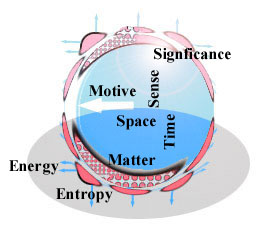
Wrapping this mess up, I put the atomic dots where they belong, on the inside surface of the experiential bubble of the Absolute. Make sense? Haha.
In Multisense Realism, all of physics is understood to relate to the capacity to discern between public and private views of phenomena. Public physics appears to us as ‘matter and energy’ on the outside and ‘perception and participation’ on the inside. The gap which makes this involution or twist possible is the modulation between the presence and absence or sensory presence, with the absence being what is called entropy or spacetime (which become essentially the same thing under this model of physics). To make things more confusing, this modulation of entropy and sensitivity is nested within many layers of itself, as a fractal. A cell encapsulates a world of molecular interaction. An organ encapsulates a world of cells, etc.
What started as an observation about the common positions that people seem to take within philosophy of mind debates became a hypothesis about the continuum of public and private sense experience, a re-interpretation of light, cosmology, consciousness, and the introduction of new concepts like significance and solitropy.
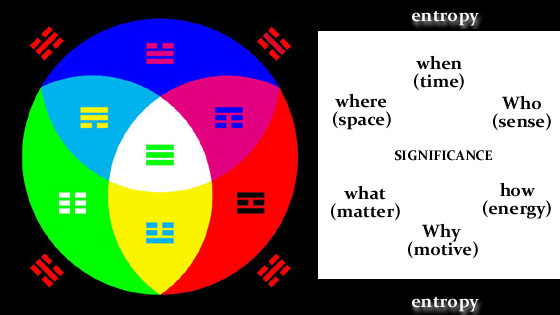
These two images try to capture the overall picture of how all major features of the cosmos can smoothly fit together.

After Einstein’s Mollusk

I’m beginning to realize that Multisense Realism is an extension to the absolute of the approach that Einstein took in developing General Relativity. In doubting the existence of gravity as a product in space, he opened the door to a simpler universe where physical things relate to each other in an ordered way, not because some particular propulsion system is in place, but because the frame of reference of physical order itself is not rigid as we assume. He actually calls this new, flexible relativism of space co-ordinates ‘mollusks’:
“This non-rigid reference-body, which might appropriately be termed a “reference-mollusk,” is in the main equivalent to a Gaussian four-dimensional co-ordinate system chosen arbitrarily. That which gives the “mollusk” a certain comprehensibleness as compared with the Gauss co-ordinate system is the (really unqualified) formal retention of the separate existence of the space co-ordinate. Every point on the mollusk is treated as a space-point, and every material point which is at rest relatively to it as at rest, so long as the mollusk is considered as reference-body. The general principle of relativity requires that all these mollusks can be used as reference-bodies with equal right and equal success in the formulation of the general laws of nature; the laws themselves must be quite independent of the choice of mollusk.”
– Albert Einstein, Relativity: The Special and General Theory. 1920.
XXVIII. Exact Formulation of the General Principle of Relativity
Einstein’s transcendence of ‘rigid reference bodies’ with flexible and independent inertial frames captures the essence of relativity but only scratches the surface in exposing the rigidity of physics, which, even in the post-Einsteinian era reduces the participant to a zero dimensional vector generic ‘observer’. While this adherence to rigid simplicity is critical for ‘freezing the universe’ into a static frame for computation purposes, it introduces an under-signifying bias to all matters pertaining to subjectivity – particularly emotion, identity, and meaning. In its drive for simplicity and universality, physics inadvertently becomes an agenda for the annihilation of the self and psyche.
Part of the genius of Einstein was to glimpse the tip of the iceberg of this confirmation bias and challenge it successfully through his mastery of field equations. In my view, Einstein’s vision was only partially understood, just long enough to develop a kind of Empire Strikes Back counter-revolution. After the initial flush of Bohr and Heisenberg’s relativistic-probabilistic interpretations of Quantum Mechanics in the 1920’s (The Spirit of Copenhagen), physics seems to have sought out a new level of reductionism. Information science has dissected Einsteins Mollusk into bits and strings, and re-imagining flexibility and independence as phantoms of a Multi-World Matrix. Einstein’s cosmological animism has been transformed into a cosmological animation – a simulation of matter-like information (that doesn’t matter) in a vacuum virtual sea of Dark Energy.
Rather than seeing this as a sign that we have come to a bold new understanding of cosmic existentialism, I see this as a black octagon sign of having mistaken the cul-de-sac for a highway. We have failed to understand ourselves and our universe and need to turn the whole thing completely around. The way to do this, I propose, is to go back to Einstein’s mollusk and pick up where he left off, questioning the rigidity of physical reference bodies.
In a way, I am suggesting that we relativize relativity itself. Not in the pop culture appropriation of relativism as merely the principle that ‘everything is relative’, but to understand how relation itself is the principle through which ‘everything’ is realized, and that that principle is identical with ‘sense’, i.e. subjective participation and perception of self and other.
While physical science is perfectly content to predict and control matter, I have no doubt that pursuing this goal exclusively should carry the kind of warning which science fiction has been giving us from the start: We should be careful of developing technology that we can’t handle and the way to handle technology is to evolve our own humanity.
It is for this very reason, that purely mathematical approaches to understanding the universe as a whole and consciousness are ultimately doomed. Their rigidity arises from a reference frame which is intrinsically incompatible with the floridly eidetic and creative frame of human privacy. Where General Relativity envisioned a flexible reference body of spacetime coordinates which contrasted with Galilean-Cartesian uniformity, this new reference frame that should be explored contrasts against both the Classical, Einsteinian, and Quantum frameworks. Multisense realism provides a Meta-Relativistic framework which honors the canonical conjugates of general relativity in proprietary privacy of subjectivity. The universe within, like Bohm’s implicate order, is as alien to spacetime relativism as Einstein’s mollusk was to Newton. The new mollusk is not one of space and time united, but of time and ‘time again’, of literal and figurative significance, symmetry and meta-juxtaposition. The new framework begins with no beginning, but rather an infinite centripetal involution which is accessed directly through intra-corporeal participation and inter-corporeal perception.
Critique of Lanza’s Biocentricism Principles
- What we perceive as reality is a process that involves our consciousness. An “external” reality, if it existed, would by definition have to exist in space. But this is meaningless, because space and time are not absolute realities but rather tools of the human and animal mind.
- Our external and internal perceptions are inextricably intertwined. They are different sides of the same coin and cannot be divorced from one another.
- The behavior of subatomic particles, indeed all particles and objects, is inextricably linked to the presence of an observer. Without the presence of a conscious observer, they at best exist in an undetermined state of probability waves.
- Without consciousness, “matter” dwells in an undetermined state of probability. Any universe that could have preceded consciousness only existed in a probability state.
- The structure of the universe is explainable only through biocentrism. The universe is fine-tuned for life, which makes perfect sense as life creates the universe, not the other way around. The “universe” is simply the complete spatio-temporal logic of the self.
- Time does not have a real existence outside of animal-sense perception. It is the process by which we perceive changes in the universe.
- Space, like time, is not an object or a thing. Space is another form of our animal understanding and does not have an independent reality. We carry space and time around with us like turtles with shells. Thus, there is no absolute self-existing matrix in which physical events occur independent of life.
In my view, biocentrism is almost on the right track. Lanza is right that space and time are not absolute realities, but I think he may be wrong that they are tools of the human and animal mind. I think that individual cognitive bias, especially in assuming the quality of awareness and agency outside of the individual, is fantastically underestimated. If living organisms were not here to make geological time seem slow, I see no particular reason to assume that time and space would not also be the ‘tools’ used by the mineral kingdom, or in the astrophysical scale. Why assume that organic life is what the universe is all about? Left to their own devices inorganic minerals like zinc and manganese do this:

Speed it up to a rate of a thousand years a second and you’ve got something more like sparks or even…feelings within the Earth’s crust.
For his #2, I agree that they are different sides of the same coin, but I would not say that they cannot be divorced from the other. The multisense continuum is a syzygy where interior realism and exterior realism are identical in some sense, overlapping in some sense, orthogonal in some sense, and elaborated to separate and idiopathic extremes in another sense. We don’t have to have a doctrine where every phenomenon must translate meaningfully into the other side of the coin. Fiction and fact influence each other, but they can influence themselves independently of each other as well.
#3 I think is pulling from initial enthusiasm over the Copenhagen interpretation and applying it in the familiar new age way. I’m not saying there is no truth to that, and yes, in most general sense, all descriptions of the universe are inextricably linked to the presence of an ‘observer’, but my conjecture continues to be that we have got Quantum Mechanics completely inside out. The interpretation I suggest is that the further we get into the microcosm, the more our measurements are solipsistically reflecting the instruments being used, so that what we assume are exotic particle-waves appearing and disappearing, making two opposite choices at once, being in two places at once, etc are not objective realities at all but rather the end of our ability to detect objects in space and the beginning of subjects ability to construct experiences through time. It’s that simple. Shocking, but I think it deserves serious consideration.
4. Eh, again, this ‘probability state’ is a figment of the mathematical imagination. Probability is great for a posteriori analysis but it is literally nonsense as a concrete reality. Probabilities, potentials, emergent properties, “information”,…these are all 21st century figments of hypertrophied empiricism. No superposition of bytes ever did anything to anything by itself. What Lanza should do here is connect the ‘different sides of the same coin’ notion up to matter and see that matter and consciousness are literally different aspects of the same thing (and that thing is the very capacity to experience the symmetry of matter and consciousness…’sense’ or perception and participation.) Once you aren’t chained to living organisms being the only source of experience, and biological time being the only scale that experiences can occur through, then there is no reason to think that there has ever been a universe without consciousness – they are, in fact, the same thing.
5. I see where he is coming from and agree in the sense that the universe cannot be explained only as a bottom-up emergence from nothingness, it requires the contrary principle as well – which would be something like a continuous recovery of everythingness from diffracted or masked states (I have been calling it ‘solitropy‘ or ‘wholes through holes’…trans-rational or elliptical algebras).
6. I agree, only I don’t discriminate against non animals. Everything senses or makes sense to something, and with solitropy, it is possible that if the entire universe collapsed into a singularity (again?), it would still retain exactly the same totality of sense that it has ever had. There is only one thing, and it is an experience, and it divides itself into experiences of un-division.
7. Yes, space is a form of understanding and not primitively real, but the experience of acoustics – cymatics, vibration, the tangible aesthetics of inanimate substances should be a clue that space awareness is not limited to animals. Crystalized minerals, whirling solar systems, etc have been exploring space with matter for billions of human years (even if its just been a long summer’s day on those geological scales). What Lanza does not consider is that the universe might be a worthwhile spectacle without any animal life at all. He has the right idea about the realism of the universe being much more profoundly localized than we currently assume, and even in a round about way that life is the fundamental thing that we as living organisms should concern ourselves with, but if we really want to connect all of the dots, I think that we need to see it isn’t biology that makes the universe go round, it’s sense.
Merely Mortal
Merely Mortal: Qualia and Nonformation, Part I
Ever since being introduced to mereology by my friend and philosophical co-presenter/mentor, Stephen P. King, (you can hear one of those introductions in our recent radio chat), I have thought in the back of my mind that there is either something promising or distracting about it. Is it a piece to the puzzle, or a piece that doesn’t belong? This itself is something of a mereological question.
Underlap Uxy =df ∃z(Pxz ∧ Pyz)
Overlap Oxy =df ∃z(Pzx ∧ Pzy)
Proper Parthood PPxy =df Pxy ∧ ¬ Pyx
Equality EQxy =df Pxy ∧ Pyx
Proper Parthood PPxy =df Pxy ∧ ¬ Pyx
Proper Extension PExy =df ¬Pxy ∧ Pyx

Reflexivity Pxx
Transitivity(Pxy ∧ Pyz) → Pxz
Antisymmetry (Pxy ∧ Pyx) → x=y
Mortality and mereology seem like an unlikely pairing at first glance. Mortality is such a powerfully real and ubiquitous influence on living beings and this philosophical study of parthood relations is so abstract and obscure, but what is it death except a cessation of wholeness? A bullet hole will perforate and fragment, a heart attack will stop the circulatory support for the brain, old age will chip away at all of the systems until one part fails to prop up the whole. Death, decay, and disintegration are closely related.
With Stephen’s knowledge of mathematics and philosophy, we have long been trying to put our finger on the precise nature of the subject-object dualism. While my mind favors word pairings rooted in direct experience, like literal-figurative, sensorimotive-electromagnetic, perceptual-relativity, and significance-entropy, his intellectual territory covers more formal models of analytical mathematical truth, the Stone duality, The Pontryagin duality, Bisimulation, Non-wellfounded Set Theory, etc.
Stone Duality relates algebra to geometry:
Putting Stone’s programme in categorical language, let A be some category of “algebras” and S one of “spaces”, the exact nature of which we leave open. Then by a Stone duality we mean an adjunction
in which TX is the algebra (maybe of open subspaces) associated with a geometrical object X, and PA is the space of primes of an algebra A.

What is Abstract Stone Duality?
It is a revolutionary theory of topological spaces and continuous functions that treats them directly, just as traditional geometry was about lines and circles, without smashing the continuum into dust. ASD provides a natural language for real analysis that describes the solution-space of an equation continuously in its parameters, even across singularities. Since it is presented syntactically, in a way that generalises ordinary algebraic notation, it is inherently computable. It was inpired by Marshall Stone’s study of the categorical duality between topology and algebra, taking his slogan “always topologize” seriously by topologising the topology. It also exploits the analogy between continuous and computable functions, on which Dana Scott built the theory of denotational semantics of programming languages.
Pontryagin duality (file under ‘how can anyone understand this):
The 2-adic integers, with selected corresponding characters on their Pontryagin dual groupthe Prüfer p-group or the p-quasicyclic group or p∞-group, Z(p∞), for a prime numberp is the unique p-group in which every element has ppth roots


Non-wellfounded sets and Bisimulation:
From the trusty SEP:
“The term non-wellfounded set refers to sets which contain themselves as members, and more generally which are part of an infinite sequence of sets each term of which is an element of the preceding set.
…The topic of bisimulation is one of the earliest goals in a treatment of non-wellfounded sets.
Let (G,→) be a graph. A relation R on G is a bisimulation if the following holds: whenever xRy,
- If x → x′, then there is some y → y′ such that x′ Ry′.
- If y → y′, then there is some x → x′ such that x′ Ry′.
These are sometimes called by the suggestive names zig and zag.

The Stone duality in particular has come up early and often as a natural fit for what I see as the ACME-OMMM continuum (is it too pretentious to call it the אΩc?). Stephen has suggested that my conception of the אΩc maps to the Stone duality; that the relation between subjecthood and objecthood is equivalent to the equivalence between topological spaces and logical algebras.
I agree that topological spaces are a good match for the ‘Occidental/West’ OMMM side, but I’m not sure that logical algebras could define the subjective picture completely because logic does not persuade us in our poetic modes. Algebra might offer something, given the etymology of the word:
Algebra (from Arabic al-jebr* meaning “reunion of broken parts”)
This is important because it fits with my idea of qualia as subtractive gestalts. By subtractive I mean that our experience of making sense is of recovering gestalt wholeness through eliding or subtracting out the gaps. In this sense, qualia can be described as the ur-algebra, from which all algebra follows.
In the Stone duality too, algebra is distinguished from geometry especially because of its ability to represent a continuous process rather than a static grouping of vectors. This continuous nature of algebraic process fits with my understanding that ‘time’ is not a natural primitive but an artificial derivative of experienced qualities like sequence, symmetry, and repetition.
Repetition requires at minimum that something can identify that something seems:
- identifiable as different from everything or anything
- identical in some way, even though it is instantiated separately
- identical to an instantiation that is remembered as a previous instantiation
Here I am trying to get under the floorboards of the Church-Turing and question what mathematics takes for granted: Pattern, pattern recognition, sense-making. Symbol grounding and realism will come later as a consequence of multiple sense channels.
The word algebra then has two important pieces to the ACME side – the idea of subtractive gestalts and continuous process. So far so good. The problem I have is with the mathematical constraint. Logic, binary or otherwise, is the life’s blood of all of mathematics and while life is filled with logics, I am convinced that we cannot get to feelings and participation from number operations alone.
With the poetic heights and psychotic depths of far ACME (‘Oriental/East’) phenomenology, it must be recognized that there is a reason that logic seems to fail us. Logic gives us ideal truth values of 1 or 0, but not experiential-particpatory values of good or bad. Our sense of ‘awesome’ or ‘horrifying’ is not simply doubleplus true/untrue. I think it is more accurate to say that our qualities of experience cast shadows that can be quantified, but it is not possible to reconstruct the experience from only those shadows.
If someone had to recreate our universe from scratch using only our descriptions of it, there is no way they could wind up with anything like what we experience using only a logical, rational framework. We need something beyond forms and scripted processes, beyond parts and wholes, something like Trans-Rational Algebras and Immereology.
Merely Mortal: Symmetry and The Self, Part II
In part I, I looked at applying (my limited understanding of) the Stone Duality to the multisense continuum. The idea of logical algebras vs topologies makes sense in many ways to describe how subjectivity contrasts with objectivity, especially if we treat the topology side literally and the algebra side figuratively.
Algebra is interesting because it distills the representational power out of numbers and uses it against them. The idea of “x=” is a spectacular bit of basic intellectual gymnastics, and I would say the foundation of all higher math and science. One of the reasons why it is so important is that it represents a discovery of something about how we think in the real world. Put these together and algebraic transformations give us the power to mechanize real world processes. A formula is a kind of template of formed sense, an idea of a set of ideas which are crystallized or fixed like a mold through which we can conduct a customized yet auto-matic process. Automatic: Self-willing. It does the work for us.
To accomplish this automation of logical function, algebra relies on certain active ingredients besides ‘x=’, such as symmetry. Symmetry is so fundamental that it is difficult to explain what it is beyond simply pointing to an example of it. The Wiki on symmetry defines it with a familiar dualism:
Symmetry (from Greek συμμετρεῖν symmetría “measure together”) generally conveys two primary meanings. The first is an imprecise sense of harmonious or aesthetically pleasing proportionality and balance; such that it reflects beauty or perfection. The second meaning is a precise and well-defined concept of balance or “patterned self-similarity” that can be demonstrated or proved according to the rules of a formal system: by geometry, through physics or otherwise.
Although the meanings are distinguishable in some contexts, both meanings of “symmetry” are related and discussed in parallel.
That parallel is also the same parallel of ACME-OMMM. Symmetry is a both a subjective aesthetic experience and it is a deferred experience of calculation also. Symmetry imparts both a feeling of significance and it can be computed as an arithmetic relation. How does it do this? Understanding symmetry seems to hold the key to understanding sense itself.
To experience symmetry, first there has to be pattern recognition to separate and define something as distinct from everything. You need a form of attention that not only allows attention to forms, but qualitatively appreciates form in general. This would seem to transcend the assumptions of theories of qualia based on representation alone, as symmetry detection evaluates not only what a particular form means but the degree to which it fulfills an expectation of completeness. Symmetry is part of that completeness, and but it is a part which has a special twinkle. It amplifies significance, so that the more nested levels of symmetry you add, the more of an impression (for better or worse) it makes.
This is at the heart of how sense makes sense; to present, to represent, and to infer the representation through the unpresented difference. We are compelled by what is absent to infer it ourselves. In this way we are personally woven into our experience of the world. Our participation is embedded in the presentation from the start through metaphorical feedback loops which continuously augment underlying expectations of wholeness, equality, fairness, etc. Symmetry. The degree of explicitness and robustness with which these expectations are fulfilled is the wave function of mood and the glue that holds the particles of logic. (Note the Stone duality of mood topology vs logic algebra)
To quote Intothecontinuum:
“Symmetry is merely an expression of how something stands in relation to itself.”

This strikes me as more profound even than it seems. So much so that I would excise the word ‘merely’. The idea of something standing in relation to itself is nothing short of a miracle. In order to relate to itself, something has to be able to, in some sense, also not be itself. This is how identity functions. To say A=A only works because the sameness of A and A is brought to our attention by presenting them grammatically in two separate instances. We mentally fill the gap between the two lines of the equals sign, which is the same gap between the two A’s. Through a presentation symmetry, we are invited to infer an unpresentable relation.
This happens through time as well, through tempo and rhythm. Wholes become parts by reflecting wholes. This is what vertically integrates the different levels (castes) of perception and structure. Each level recapitulates the others in a fisheye distortion of frequency and scale that presents its own inertial frame, with itself as the nucleus, as the maximally significant frame. The good news: sanity. We don’t have to be aware of the problems of every part of the cosmos. The bad news: isolation. To have richly qualitative subjective experience, you have to borrow the significance from somewhere.
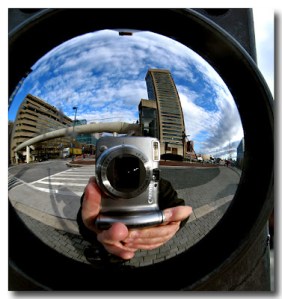
Where experienced consciousness differs from anything that logical algebras can produce is in the way that problems are solved rather than savored. To solve (here we go again…solace, solar, soul) is to stand, to make still, but not to understand. It does accounting but no explaining. Our experience of self shaped not only by the need to solve (like gravity, to seek static unity) but to revolve:
(from L. revolvere “turn, roll back,” from re- “back, again” + volvere “to roll” (see vulva). Meaning “travel around a central point”)
Most everything we do is a circuit. It’s Monday, again. It’s summer, again. Time to do the laundry again, etc. Circuits within circuits, we revolve around a multi-symmetrical meta helix of nested perception.
I remain convinced that these purely mathematical approaches are too aloof from the kind of visceral substantiation that I am looking for. Logical algebras can solve parts into a whole*, but the whole is still an abstraction no different than the parts. There is no symbol grounding, no core authenticity to lend realism.
Add a new kind of mereology to this though, and maybe we can get somewhere. In the actual universe in which we live and breathe, perhaps we need to compare apples to pomegranates instead of apples to apples (this is opening up a whole other Middle Eastern synchronicity apparently).

The parthood that we see in mereology is one which turns logic toward understanding the computable aspects of parts and wholes from a topological perspective: a literal or conceptual compartmentalization.
(16) Everything is part of itself.
(17) Any part of any part of a thing is itself part of that thing.
(18) Two distinct things cannot be part of each other.
If we turn this around however, and focus on the orthogonal axis: time/subjectivity instead of space/objectivity, I think we can see a different picture. If our wholes and parts are subjects rather than objects, participatory ‘apartments’ rather than bounded compartments, then the idea of selfness and ‘itself-ness’ takes on an entirely different, opposite meaning. Note the difference; selfness is like Leibniz monad, solipsistic and divided while itself-ness includes defines sense of self as a sense of a sense of self. This relates to what I call solitropy.
- Every ‘one’ is an awareness of the availability of the experience of being alone or apart, which has a quality of solitude.
- Being apart can only be defined against a background of being unified or ‘together’.
- All experiences are a part of each other, but not identically so. For this to be possible, ‘likeness’ is how sense organizes and orients itself.
*Algebra (from Arabic al-jebr* meaning “reunion of broken parts”)
Merely Mortal Part III, Qualia and Language
Since we can use mereology to address topologies, and through the Stone duality we see how topologies and algebras are related, then what is required to understand subjectivity is a kind of anti-mereology. Unlike measurable forms and functions, every felt ‘thing’ (experience) is defined not only by being a part of any one thing, but instead reflects meaningful gestalts that potentially relate to all other experiences. The qualities or qualia that we experience seem to be part of an orderly palette which serves to bind us to an orderly life experience. The inexplicable perceptual notes and pigments make up this palette are exquisitely granular yet broadly inclusive, and through this, they bind us as caring participants to each moment of our life in the cosmos.
Qualia doesn’t stop there, though. Serving as the orientating principle of what is sane and real to us is just the beginning. The connection of self to umwelt (niche which reflects the expectations and requirements of ourselves>culture>species>physical form) is the basis of all significance, but we have elaborated these presentational bookends of I and it into a hyper-universe of dynamically self-enriching extensions. Re-presentations. Symbols. Quantitative models, maps, and metaphors. Words.
Human language utilizes multiple sets of qualia which ‘insist’ within various inertial frames or channels of perception. Within the cognitive channel of our understanding, these frames of perceptual relation can be seen to be like horizontal slices of a vertically stacked whole:
- Meaning: Sensory-motive layer. The raw feels of our afferent perception and efferent participation as conscious living beings. It is this ground floor of qualia that is the direct presentation to which all layers of representation must ultimately resolve.
- Showing: Gestural-emotive layer. Body expression and non-verbal communication. Steven Pinker has some interesting things to say on this, although I think focusing on linguistic formalism is not the way to understand consciousness itself – rather, language is a container or vehicle for consciousness.

- Speaking: Laryngeal-acoustic layer. Humans are great at making and controlling sounds with our larynx and we are good at distinguishing them from other sounds. We have taken it to a whole other level, with precise mimicry and richly communicative vocal textures. Voice is not only for yelling and and whispering, but singing, orating, dramatizing, etc.
- Writing: Optical-graphological layer. Our visual system is good for seeing and remembering shapes and our hands allow us to inscribe those shapes on whatever suitable objects we have available.
- Communicating: Linguistic-symbolic layer. Speaking, writing, and expressing communication are direct qualia in themselves, but they are multiplexed also. Our understanding begins where the limits of the physical acts associated with communication leave off. Our lives continue in the hyper-reality of symbolic extension, seamlessly blended with our perception of the outside world. We see and hear direct meaning through the semiotic forms that we have adopted.
Language has given us a new hyper-dimension of sense through an explosion of grammatical conventions and multi-layered semantic logics. It has opened a synthetic channel of verbal semiosis which bridges the gap between minds (as well as widening the chasm between them). In one sense, communication is a simulation of multiple separate instances, but in another sense it is a dissemination of a potentially unified common sense which is accessible from multiple locations or times. Language provides a truer isomorphism to interior experience than gross physical behaviors can provide. As in a dream, many hours or lifetimes can be condensed elliptically into a single story-time that is passed from person to person and group to group. The story itself evolves and takes on the qualities of different groups as it accumulates character specific to the times, places, and people who participate in the communication.
Communication allows us to elide the gaps among the elements of stories so that what can be expressed goes well beyond the limitations of the here and now, increasing our mental capacities immensely. The spread of communicated forms elides the distance between subjects themselves and weave an invitation to commune upon a common sense. Combining these two propensities to converge subjects and subjectivities, we make possible a recovery not just of an actual whole but of a potential whole; thesis, hypothesis, communicated ideas and ideas about improving communciation of ideas. A symmetry not only of parts across space but of participation through time that intentionally amplifies and consolidates intentionality. Human creativity is a revelation of novelty, a dis-covery of a future, not only a production of useful accessories.
This is not to say that all experiences exist as a priori complete facts somewhere and we are just reissuing them, but that experiences insist as potentials, and it is our participation and voluntary interest which brings them from fictional insistence into factual existence. Interest alone doesn’t magically cause things to exist, but interest motivates us to find opportunities which progress our efforts or convince us to give up. This experiential psychscape doesn’t make sense from a mechanistic perspective. Unlike conventional mereology, with subjectivity, every part of every experience is itself independent of that experience, and every distinction between experiences can only be made in the context of underlying unity between them.
The functionalist has no way to ground motive in anything purely qualitative. A musical masterpiece cannot be explained in terms of quantitative terms, where any composition with the same amount of harmony and variation would have to be equally esteemed. There is no appreciation for the semantics of language, the aesthetic dimension of poetic resonance not just of forms to forms, but content to content, content to form, and formed content to novelty and revelation of unified communal truths.
Merely Mortal Part IV: Making Some Sense of Subjectivity
The multisense realism approach includes the following convictions and conjectures:
- Something very important is missing from all of our current models of consciousness.
- The missing piece is not an obscure and distant mechanism but rather is the plainly obvious coherence and qualitative significance of experience itself.
- Instead of looking for this piece as a consequence of forms and functions in the world, we might also consider that forms and functions are symptoms of perception and participation. (Not necessarily human perception, of course).
- Reality or realism arises through the recovery of agreement between multiply diffracted channels of perception and participation (aka ‘sense’ and ‘motive’ or afferent/inbound and efferent/outbound phenomenology)
The relation between forms and functions (geometric topologies and logical algebras) has been formalized through the Stone duality. For every geometric form there is a corresponding algebraic function. I have proposed a similar correspondence in what I consider to be a more authentic representation of the cosmos in the form of the ACME-OMMM continuum (אΩc). In the אΩc, the forms and functions covered by the Stone duality are only half of the big picture. The other half, the ‘Eastern’, ACME facing half can be understood as having qualities which are perpendicular or orthogonal to those conceived of by Stone, while at the same time having common themes.
Quantitative relations are rooted in the mereology of objectivity. Rules about set membership and well-foundedness present a schema of precise internal consistency. I suggest that the lack of such a schema of certainty and discrete mereology in subjectivity is not an accident, but actually is a clue as to the genuine and concretely real nature of phenomenology. Where algebra employs logical functions, aesthetics and emotion extend far beyond that to raw feeling and creative imagination. If anything, it seems more reasonable to see logic as a narrow subset within a much larger range of possible experiences – ‘transrational algebras’ which use ‘immereological’ leaps to recover gestalts from broken fragments.
Algebra is anabolic, building up complex sequential functions from simpler digits. Using meaningless variable names, it extends the power of numbers to allow for the ‘coining’ of fixed relations through which a continuous process of variable value can flow. Transrational algebras, in contrast, are experiential truths which are ‘chipped off the old block’.
The idea that there are a relatively small number of basic literary plots figures into this:
1 Plot:
“Foster-Harris claims that all plots stem from conflict.”
3 Plots:
- “’Type A, happy ending’”; Foster-Harris argues that the “Type A” pattern results when the central character (which he calls the “I-nitial” character) makes a sacrifice (a decision that seems logically “wrong”) for the sake of another.
- “’Type B, unhappy ending’”; this pattern follows when the “I-nitial” character does what seems logically “right” and thus fails to make the needed sacrifice.
- “’Type C,’ the literary plot, …does not hinge upon decision, but fate…
7 Plots
7 basic plots as remembered from second grade by IPL volunteer librarian Jessamyn West:
- [wo]man vs. nature
- [wo]man vs. [wo]man
- [wo]man vs. the environment
- [wo]man vs. machines/technology
- [wo]man vs. the supernatural
- [wo]man vs. self
- [wo]man vs. god/religion
20 Plots:
Tobias, Ronald B. 20 Master Plots.
- Quest
- Adventure
- Pursuit
- Rescue
- Escape
- Revenge
- The Riddle
- Rivalry
- Underdog
- Temptation
- Metamorphosis
- Transformation
- Maturation
- Love
- Forbidden Love
- Sacrifice
- Discovery
- Wretched Excess
- Ascension
- Descension.
36 Plots
Polti, Georges.
- Supplication (in which the Supplicant must beg something from Power in authority)
- Deliverance
- …
Note that the three Plots are all explicitly contrary to logic. This is the story we never get tired of hearing: Don’t trust logic alone. Why should we tell this to ourselves and to our children, especially if it isn’t true? Why do we want to be told this?
Even the most cynical explanation for this assumes that there is an inherent draw toward fantasy. Something about consciousness prefers fiction to fact, despite all evidence to the contrary. We can say that magical thinking is simply wishful thinking and that wishful thinking is simply orphaned wants which stem from conflicting and unfulfillable biological agendas, but how does that explain how we clothe these wishes in an inexhaustible variety of textures?
It has been said for instance that Star Wars is really just a Western dressed up as science fiction. Indeed, all popular stories can be reduced to Westerns or myths, the basic plot, the Hero with A Thousand Faces, etc, but it isn’t just faces that have been randomly swapped or names that have been changed, it is a mythos, an entire world of compelling details which cohere together harmoniously, revealing an alternate realism to our own but which is added in some sense to our collective experience. Unlike logical algebra, the eidetic transrationality of fiction uses function as a skeleton on which to hang the meat of meaningful names and places. Trans-rational algebras emphasize aesthetic richness rather than computation or pragmatic function. This supports my assertion that quanta are flat qualia or even inside-out qualia.
We can learn a lot just by understanding the various dialectics of subjectivity and objectivity, the literal vs the figurative, private vs public, entopic vs eidetic, qualitative vs quantitative, etc, but we can go further if take those anomalous symmetries as an indication of a deeper unity of realism. I suggest that participation and perception are not ‘energies’ which are unlike forms, but that they are the sole presentation of tangibility, and as such are neither axiomatic nor non-axiomatic. Just as the yellow light on a traffic signal is neither ‘stop’, ‘go’, nor ‘do not stop or go’, the roots of subjectivity are ‘immereological’. Think of the red and green signals as the extremes of yellow, the deterministic periphery to which perception and participation are the quasi self-deterministic center. Our ‘good’ and ‘bad’ are not only built up of generic collections of true and false but are dynamic expressions of ourselves. Just as an image on the surface of a bubble reflects the entirety of its optical context, consciousness does not require assembly from basic elements – it already is everything, it only pretends to be something in particular.
The idea of ellipsis gives us a way of distinguishing how a computer assembles programmatic functions from how subjective experience is accessed. In a dream we are not aware when we have begun dreaming, or what the transition was like from sleep to dream. The ellipsis (…) in this case extends prior to the experience. Instead of elliptically referring to a pattern that continues predictably as might an arithmetic sequence (0,1,1,2,3,5,8…) the nature of subjectivity is such that we can derive an implicit sense of what is going on without having to be explicitly told – even if, as in a dream, what is going on may not make much rational sense. We find ourselves in a dream environment, with no introduction of characters or plot but without any sense of the absence of such an introduction. We are amnesiacs who may not even have the capacity to be aware of our amnesia. We arrive in our lives this way too, with a …”I must have previously joined my own life, already in progress”.
It is possible that our biology prepares for us a boot sequence with an elliptical quality like this to mask any jarring questions that compromise our chances for survival, but that seems unlikely to me owing to the universality of it. What would be the big deal if we booted up like a computer, a tabula rasa that requires drivers be loaded to know how to detect inputs and outputs? Why have an illusory pretense of false continuity? Maybe a survival machine would benefit from sensing the truth about its own mechanism? Instead, I think this elliptical quality of being able to broadly generalize both before and after the fact of experience exposes one of the fundamental difference between subjective experience and objective process. We care whether things make sense or not. A machine doesn’t.
With the Stone duality’s equivalence of geometry and algebra can help us understand some important aspects of subjectivity, but like all purely quantitative models, it lacks the immersion and exigency which underpins subjective realism. Although algebra can give us a key piece of the puzzle of consciousness in its etymological sense of recovery of a whole from broken parts, that recovery is generic and a-signifying. We need an algebra which begins as a division of everythingness instead of an assembly from nothingness – an elliptical transrationality which honors the many layers of perception and participation which contribute to experience.
We can use Boolean algebras and game theory to model some of functions of participation such as self modeling or self interest, but this alone does not and cannot evoke the visceral realities of subjective agency. The realism of pain and pleasure cannot be simulated mathematically. This is not begging the question, it is a self-evident truth: Daffy Duck does not feel pain when he is shot in the face with a shotgun. It doesn’t matter how many Daffy Ducks, or how sophisticated their rendering is, there is still no experience of what it is like to be Daffy Duck. Unlike Conway’s game of life, biological life seems to require that there are qualities associated with their experiences rather than just the fact of the significance of those experiences to the outcome of the game. The desirability of survival may seem like a given to us, but ultimately there is no formal correlation that follows. A scripted machine needs only the ability to process the script provided – experience or quality would not and could not logically enhance that process.
Talking about models and representations in the context of consciousness can get us lost so that we overlook the pool of sense from which all models are initiated and into which they all must be resolved. We make models so that we can better understand what we are modeling. To model modeling itself, we should not assume that this can be accomplished by treating the originating phenomenon the same way as we have treated the targets. I suggest that psyche is founded on the trans-rational presentations which are algebraic in the sense of recovering gestalts, but they are not limited to the logic and reason of numbers, nor does that make them imaginary or irrelevant.
Consciousness is natively loose, casual, and simple. It is elliptical in the sense of being not-too-fussy about filling in the details, but at the same time giving the impression that the details are there. It doesn’t write an algorithm to dream up a character or story, it captures a feeling and jumps to a conclusion. It guesses and hopes, it lies and schemes. It is trans-rational.
Mortality
What started this whole series off was thinking about how causes of death, even from natural causes, is a mereological problem. Some piece is missing somewhere in the body which cascades into countless causes with a single irrevocable result. A bullet hole, a drowning, a cumulative unraveling of telomeres which stops cells from replacing themselves…its all about defective parts that break the integrity of the whole.
With consciousness, the whole is not a composite of parts, it is a multiplicity of nested temporal narratives in which we play parts. It is the who and why that anchors us into the weave of space-time existence. We are not only like, as some may sneer, ‘unique snowflakes’. We are much more than that. We are uniqueness itself, turned inside out into billions of microscopic meat-puzzles that we complete. To this collection of cells, we are like an escapement mechanism; an arrow of time leading inevitably from wholeness to corruption and death. For us, the body’s escapement is our encasement, our mortal coil of cycling causes and conditions. Each lifetime another meta-mythos of experience, giving time to timeless themes again and again.
Sole Entropy Well Model
Another way of visualizing the integration of physics and psyche uses the concepts related to Boltzmann’s entropy curve to conceive of the Totality/Singularity/First Cause as a bottomless fractal entropy well, as follows:
Boltzmann’s idea, as I understand it, is to explain Loschmidt’s Paradox, which (also as I understand it) is basically “If the universe is always increasing from low entropy to high entropy, then where did the initial low entropy come from?”
Boltzmann’s hypothesis places the low entropy we know as the Big Bang as just one of many statistically inevitable fluctuations of entropy distribution. It’s a bubble or wave of non-disorder that we find ourselves in anthropically (because such a bubble is the only context that a low entropy phenomenon like human minds could evolve within). Other possibilities include a Big Crunch type negentropy that accounts for the entropy trough that must precede any entropy rise.
What I suggest is a bottomless low entropy, such that the one event in which any negentropy at all occurs would automatically be the singularity into which all subsequent fluctuations would be swept. Sort of like a black hole for negentropy, hogging all possible signals for all time, banishing any rival Multiverse possibility to perpetual delay.
What this does is place Boltzmann himself, his statistical rules, and their physical enactments all within the anthropic condition in which they are possible. Statistical rules, and laws of any kind including those which define entropy are themselves physical structures which can only emerge from a bottomless entropy well. These kinds of laws and their underlying sense of possibility, probability, events, succession, recursion, regularity, comparison, persistence, etc can only be universal if every part of the universe makes some kind of sense – i.e. has some piece of this infinite negentropy.
Entropy then becomes a property like velocity, (which ranges from stillness to c), a fraction of a totality rather than an open ended scalar quantity. Entropy is a relative measure which has meaning only in relation to significance, such that anything less than 100% entropy has some quantity of absolute significance (Totality-Singularity = 0.000…1% entropy)
This way, the Big Bang becomes a perpetually receding event horizon of absolute and eternal negentropy – a Borg-like ‘bright whole’ which tyrannically absorbs and subordinates all potentials and possibilities into a single continuum-schema. This continuum must accommodate all paradoxes which amounts to a lot of fancy plate spinning and superposition, using devices like nesting outer and inner realism within each other on multiple interrelated yet mutually isolated layers or castes. These devices accomplish what I call the Big Diffraction.

In a Nutshell
By request, an attempt to sum up Multisense Realism in jargon-free language:
- The universe will seem to support either faith or reason. Reason requires belief in disbelief and faith requires disbelief in disbelief. In between reason and faith is reality, but neither reason without faith nor faith without reason can make sense of everything. The insistence that it can is ultimately a bias that tends to become crazy and dangerous if acted upon in real life as if it were the whole truth.
- All of the shortcomings of religion and science can be accounted for by each side mistaking objects for subjects and subjects for objects.
- We can fix this by looking at how we look at the universe, so that we take our own experience more literally and physical existence more figuratively. Photons become nothing but atomic experiences. Consciousness becomes the physical inertia of events which tie body, brain, world, and lifetime together.
- Consciousness is what divides the universe into symmetrical parts. It separates being, doing, and time from matter, energy, and space. This division makes it so that the former are presented as interior and ranging widely in quality, realism, and meaning while the latter is presented as exterior, real, and meaningless.
- This division replaces the idea of the Big Bang as an event in time and space, so that the Big Bang is the division of the universe into subjective times in objective places.
- The symmetry is not limited to subjective and objective groupings, so that consciousness can be used to focus on many different ways of making sense of itself and the universe.
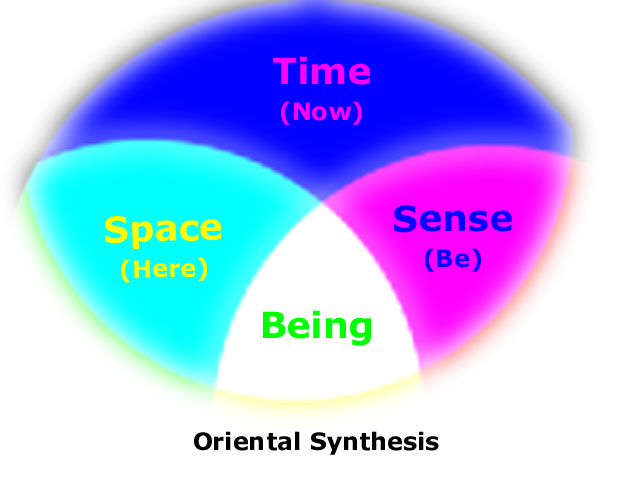

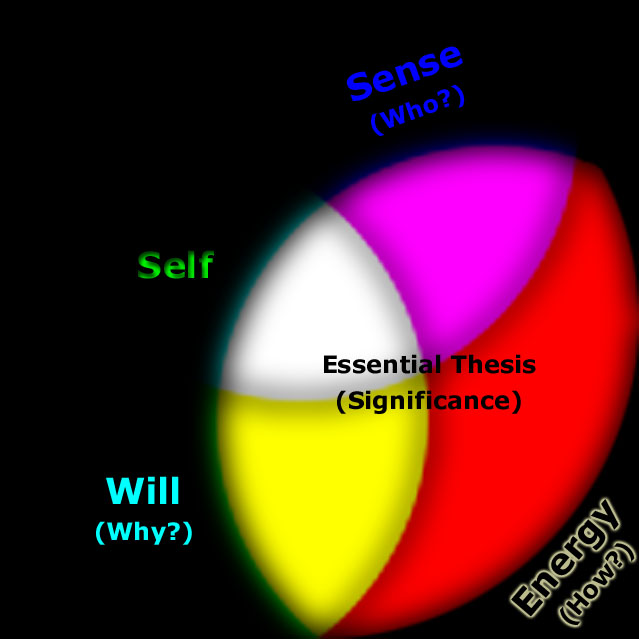
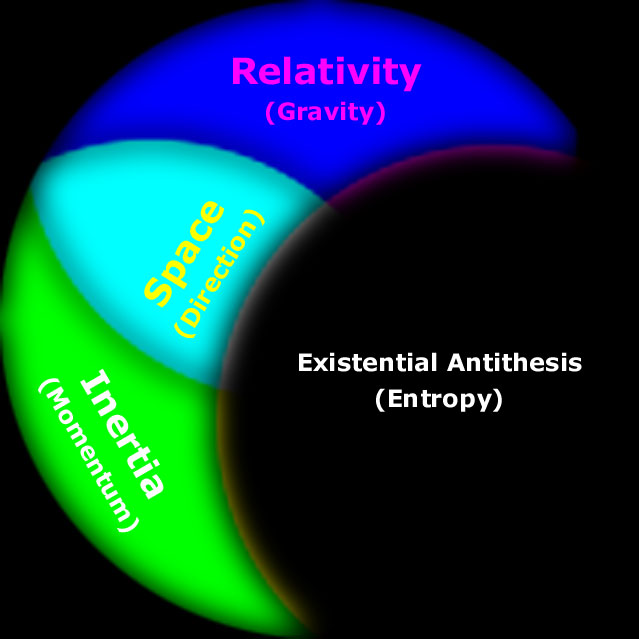
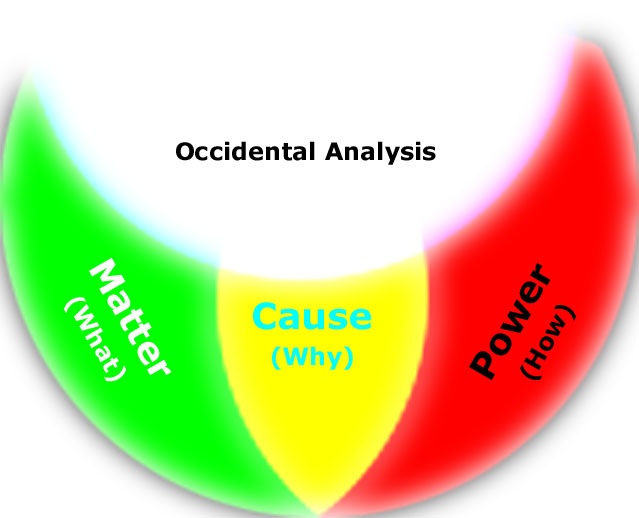
Meaningful Groupings of the Multisense Syzygy
Essential Thesis
Emphasizes Subject Realism: Sensorimotive Perception & Participation
Existential Antithesis
Emphasizes Object Realism: Electromagnetic & Quantum Mechanism
Oriental Synthesis
Be Here Now. Abstract celestial themes.
Occidental Analysis
Instrumental Reasoning. Concrete material themes.
 Multisense Realism

Recent Comments