Archive
MSR Legend 3
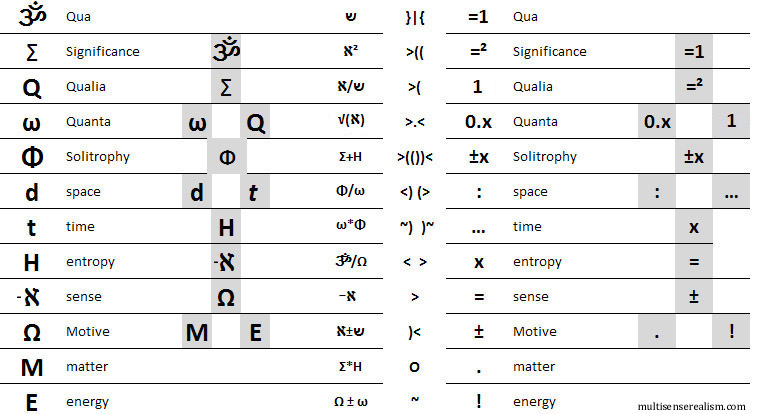
One more of these for tonight, as i’m still in a semiotic frenzy, as I’m sure you can tell.
Breaking The Fourth Wall

Sense (in the Absolute sense) reveals itself reflexively as the Uni-verse, aka monad of non-orientable self-juxtaposition, aka, “the Pansensitive Meta-Lectic Solitrophic-Holarchic Multiphoric-Unametry”, provider of implicit unity (likeness) across multiplicity (private sensory afference) and explicit participation (public motor efference) through intentional animism and automatic mechanism.
reflexive
1. Directed back on itself.involution
entanglement; a spiraling inwards; intricacy
(mathematics) A function, transformation, or operator that is equal to its inverse, i.e., which gives the identity when applied to itself.tessellation
the careful juxtaposition of shapes in a pattern; “a tessellation of hexagons”.non-orientable
A surface S in the Euclidean spaceR3 is orientable if a two-dimensional figure (for example,) cannot be moved around the surface and back to where it started so that it looks like its own mirror image (
). Otherwise the surface is non-orientable.
The Möbius strip is a non-orientable surface
The Ouroboros or Uroboros is an ancient symbol depicting a serpent or dragon eating its own tail.
The Ouroboros often symbolize self-reflexivity or cyclicality, especially in the sense of something constantly re-creating itself, the eternal return, and other things such as the phoenix which operate in cycles that begin anew as soon as they end. It can also represent the idea of primordial unity related to something existing in or persisting from the beginning with such force or qualities it cannot be extinguished. While first emerging in Ancient Egypt, the Ouroboros has been important in religious and mythological symbolism, but has also been frequently used in alchemical illustrations, where it symbolizes the circular nature of the alchemist’s opus. It is also often associated with Gnosticism, and Hermeticism. Carl Jung interpreted the Ouroboros as having an archetypal significance to the human psyche.[citation needed] The Jungian psychologist Erich Neumann writes of it as a representation of the pre-ego “dawn state”, depicting the undifferentiated infancy experience of both mankind and the individual child.
Early alchemical ouroboros illustration. From the work of Cleopatra the Alchemist (Greco-Roman Egypt).Autopoiesis (from Greek auto-, meaning “self”, and poiesis, meaning “creation, production”) refers to a closed system capable of creating itself. The term was introduced in 1972 by Chilean biologists Humberto Maturana and Francisco Varela to define to the self-maintaining chemistry of living cells. Since then the concept has been also applied to the fields of systems theory and sociology.
Bootstrapping or booting refers to a group of metaphors which refer to a self-sustaining process that proceeds without external help.
The phrase appears to have originated in the early 19th century United States (particularly in the sense “pull oneself over a fence by one’s bootstraps”), to mean an absurdly impossible action, an adynaton.Trompe l’œil (French for deceive the eye) is an art technique that uses realistic imagery to create the optical illusion that depicted objects exist in three dimensions. Forced perspective is a comparable illusion in architecture.
Breaking the fourth wall is when a character acknowledges their fictionality, by either indirectly or directly addressing the audience. Alternatively, they may interact with their creator (the author of the book, the director of the movie, the artist of the comic book, etc.). This is more akin to breaking one of the walls of the set, but the existence of a director implies the existence of an audience, so it’s still indirectly Breaking The Fourth Wall. This trope is usually used for comedic purposes.



Consciousness, in Black and White
It occurs to me that it might be easier to explain my view of consciousness and its relation to physics if I begin at the beginning. In this case, I think that the beginning was in asking ‘What if the fundamental principle in the universe were a simple form of awareness rather than something else?’
Our choices in tracing the lineage of consciousness back seem to be limited. Either it ’emerged’ from complexity, at some arbitrary stage of biological evolution, or its complexity evolved without emergence, as elaboration of a simple foundational panpsychic property.
In considering which of these two is more likely, I suggest that we first consider the odd, unfamiliar option. The phenomenon of contrast as a good place to start to characterize the theme of awareness. Absolute contrasts are especially compelling. Full and empty, black and white, hot and cold, etc. Our language is replete with evidence of this binary hyperbole. Not only does it seem necessary for communication, but there seems also to be an artistic satisfaction in making opposites as robust as possible. Famously this tendency for exaggeration clouds our thinking with prejudice, but it also clarifies and makes distinction more understandable. In politics, mathematics, science, philosophy, and theology, concepts of a balance of opposites can be found as the embodiment of its essential concepts.
For this reason alone, I think that we can say with certainty that consciousness has to do with a discernment of contrasts. Beneath the linguistic and conceptual embodiments of absolute contrasts are the more zoological contrasting pairs – hungry and full, alive and dead, tired and alert, sick and healthy, etc. At this point we should ask, is consciousness complex or is it simple? Is the difference between pain and pleasure something that should require billions of cellular interactions over billions of years of evolution to arrive at accidentally, or does that seem like something which is so simple and primordial that nothing could ever ‘arrive’ at it?
Repetition is a special form of contrast, because whether it is an event which repeats cyclically through a sequence or a form which repeats spatially across a pattern, the underlying nature of what repeats is that it is in some sense identical or similar, and in another sense not precisely identical as it can be located in memory or position as a separate instance.
I use the phrase “repeats cyclically through a sequence” instead of “repeats sequentially through time” because if we take our beginning premise of simple qualities and capacities of awareness as preceding even physics, then the idea of time should be grounded in experience rather than an abstract metric. Instead of conceiving of time as a dimension in which events are contained, we must begin with the capacity of events to ‘know’ each other or in some way retain their continuity while allowing discontinuity. An event which repeats, such as a heartbeat or the circadian rhythms of sunlight, is fundamentally a rhythm or cycle. That is the actual sense experience. Regular, frequent, variation. Modulation of regularity.
Likewise, I use the phrase “repeats spatially across a pattern” instead of “repeats as a pattern across space” because again, we must flip the expectation of physics if we are to remain consistent to the premise of sense-first. What we see is not objects in space, it is shapes separated by contrasting negative shapes. What we can touch are solids, liquids, and gases separated from each other by contrasting sense of their densities. Here too, the sense of opposites dominates, separating the substantial from the insubstantial, heavy from light, hard from soft.
An important point to make here is that we are adapted, as human beings with bodies of a particular density and size, to feel the world that relates appropriately to our body. It is only through the hard lessons like plague and radiation that we have learned that indeed things which are too small for us to see or feel can destroy our bodies and kill us. The terror of this fact has inspired science to pursue knowledge with an aggressive urgency, and justifiably so. Scientists are heroes, informing medicine, transportation, public safety, etc as never before in the history of the world and inspiring a fantastic curiosity for knowledge about reality rather than ideas about God or songs about love. The trauma of that shattering of naive realism haunts our culture as whole, and has echoes in the lives of each generation, family, and individual. Innocence lost. The response to this trauma varies, but it is hard to remain neutral about. People either adapt to the cold hard world beyond themselves with fear or with anger. It’s an extension of self-consciousness which seems uniquely human and often associated with mortality. I think that it’s more than confronting their own death that freaks out the humans, it’s the chasm of unknowable impotence which frames our entire experience on all sides. We know that we don’t really know.
The human agenda becomes not merely survival and reproduction, but also to fill the existential chasm with answers, or failing answers, to at least feel fulfilled with dramatic feelings – with entertainments, achievements, and discoveries. We want something thrilling and significant to compensate for our now unforgettable discovery of our own insignificance. With modernism came a kind of Stockholm syndrome turn. We learned how to embrace the chasm, or at least to behave that way.
At the same time that Einstein began to call the entire foundation of our assumptions about physics into question, the philosophy of Neitzsche, along with the science of Darwin and Freud had begun to sink in politically. Revolutions from both the Left and Right rocked the world, followed in some nations by totalitarianism and total war. The arts were transformed by an unprecedented radicalism as well, from Duchamp, Picasso, and Malevich to Stravinsky and Le Corbusier. After all of the pageantry and tradition, all of the stifling politeness and patriarchy, suddenly Westerners stopped giving a shit about the past. All at once, the azimuth of the collective psyche pitched Westward all the way, toward annihilation in a glorious future. If humans could not live forever, then we will become part of whatever does live forever. The human agenda went transhuman, and everyone became their own philosophical free agent. God was indeed dead. For a while. But the body lives on.
The point of this detour was to underscore the importance of what we are in the world – the size and density of our body, to what we think that the world is. Not only do we only perceive a narrow range of frequencies of light and sound, but also of events. Events which are too slow or too fast for us to perceive as events are perceived as permanent conditions. What we experience exists as a perceptual relativity between these two absolutes. Like the speed of light, c, perception has aesthetic boundaries. Realism is personal, but it is more than personal also. We find agreement in other people and in other creatures which we can relate to. Anything which has a face earns a certain empathy and esteem. Anything that we can eat has a significance to us. Sometimes the two overlap, which gives us something to think about. Consciousness, at least the consciousness which is directed outwardly from our body, is all about these kinds of judgment calls or bets. We are betting that animals that we eat are not as significant as we are, so we enjoy eating them, or we are betting that such a thought is immoral so we abstain. Society reflects back these judgments and amplifies them through language, customs, belief systems, and laws. Since the modernist revolution, the media has blanketed the social landscape with mass production of cliches and dramatizations, which seems to have wound up leaking a mixture of vanity and schadenfreude, with endless reenactments, sequels, and series.
It is out of this bubble of reflected self-deflection that the current philosophies rooted in both reductionism and emergentism find their appeal. Beginning with the assumption of mechanism or functionalism as the universal principle, the task of understanding our own consciousness becomes a strictly empirical occupation. Though the daunting complexity of neuroscience cannot be overstated, the idea is that it is inevitable that we eventually uncover the methods and means by which data takes on its fancy experiential forms. The psyche can only be a kind of evolutionary bag of tricks which has developed to serve the agenda of biological repetition. Color, flavor, sound, as well as philosophy and science are all social peacock displays and data-compressing virtual appendages. The show of significance is an illusion, an Eloi veneer of aesthetics over the Morlock machinations of pure function.
To see oneself as a community of insignificance in which an illusion of significance is invested is a win-win for the postmodern ego. We get to claim arbitrary superiority over all previous incarnations, while at the same time claiming absolute humility. It’s a calculated position, and like a game theory simulation, it aims to minimize vulnerability. Facts are immutable and real, experiences are irrelevant. From this voyeuristic vantage point, the holder of mechanist views about free will is free to deny that he has it without noticing the contradiction. The emergent consciousness can speak glowingly out of both sides of its mouth of its great knowledge and understanding in which all knowledge and understanding is rendered void by statistical mechanics. Indeed the position offers no choice, having backed itself into a corner, but to saw off its own limbs with one hand and reattach them with another when it is not looking.
What is gained from this exercise in futility beyond the comfort that comes with conformity to academic consensus is the sense that whatever happens, it can be justified with randomness or determinism. The chasm has been tamed, not by filling it in or denying it, but by deciding that we are simply not present in the way that we think. DNA acts, neurons fire, therefore we are not thinking. Death is no different than life which has paused indefinitely. An interesting side effect is that as people are reduced to emergent machines, machines are elevated to sentient beings, and the circle is complete. We are not, but our products are. It seems to me the very embodiment of suburban neuroses. The vicarious society of invisible drones.
Just as 20th century physics exploded the atom, I would like to see 21st century physics explode the machine. Instead of releasing raw energy and fragmentation, I see that the blasting open of mathematical assumptions will yield an implosion into meaning. Pattern recognition, not information, is the true source of authenticity and significance. They are the same thing ultimately. The authenticity of significance and the significance of authenticity speak to origination and individuation over repetition. Not contrast and dialectic, not forces and fields, but the sense in which all of these facets are yoked together. Sense is the meta-syzygy. It is the capacity to focus multiplicity into unity (as in perception or afference) and the capacity for unity to project into multiplicity (participation or efference).
These are only metaphorical descriptions of function however. What sense really is and what it does can only be experienced directly. You make sense because everything makes sense…in some sense. That doesn’t happen by accident. It doesn’t mean there has to be a human-like deity presiding over all of it, to the contrary, only half of what we can experience makes sense intentionally, the other half (or slightly less) makes sense unintentionally, as a consequence of larger and smaller sequences which have been set in motion intentionally. We are the evidence. Sense is evident to us and there is nothing which can be evident except through sense and sense making.
Public Space, Private Time, and the Aperture of Consciousness

In the first diagram, I’m trying to show the relation between public and private physics, and how the aperture of consciousness modulates which range is emphasized. Contrary to the folk model of time that we currently use, multisense realism proposes that time is only conceivable from the perspective of a experiential narrative. Time cannot be translated literally into the public range of experience, only inferred figuratively by comparing the positions of objects.
Through general relativity, we can understand spacetime as a single entity defined by gravity and acceleration – to quote Einstein, a
“non-rigid reference-body, which might appropriately be termed a “reference-mollusk,” is in the main equivalent to a Gaussian four-dimensional co-ordinate system chosen arbitrarily”.
While space and time can indeed be modeled that way successfully, what has been overlooked is the opportunity to see another profoundly fundamental symmetry. What GR does is to spatialize time. This is a great boon to physics since physics has focused exclusively on public phenomena (for good reason, initially), GR has enabled accurate computations on astronomical scales, taught us how to make cell phone networks work on a global scale, send satellites into orbit, etc. Einstein accomplished this by collapsing the subjective experience of time passing (which can change depending on how you feel about what’s going on) into a one dimensional vector of ‘observation’. Not any special kind of observation, just a point of reference without aesthetic dimensions of feeling, hearing, tasting – only a generic sense of position and acceleration. This is the public perspective of privacy, i.e. not private at all, but a footprint which points to the privacy which has been overlooked but assumed.
This is great for modeling some aspects of public phenomena, but in reality, there is no actual public perspective that we can conceive of. There is no voyeur’s view from nowhere which defines perspectives without any mode of sensory description. That view from ‘out there’ is purely an intellectual abstraction, a hypothetical vantage point. Why is this a big deal? It’s not until you want to really understand subjectivity in its own terms – private terms. By spatializing time, GR strips out the orthogonal symmetry of space vs time which we experience and redefines it as an illusion. Our native experience of time is as much the opposite of space as it is similar. Time is autobiographical, it is memory and anticipation. We can stay in the same place while time passes. Our time also moves with us, with our thoughts and actions.
Space, by contrast, is a public field in which we are tangibly located. If we want our thoughts to stay somewhere, we must leave some material trace – write a note or make a sign. When we want to meet someone, establishing the spatial coordinate for the meeting is based on a literal location – a physical address or reference (by the palm tree in the South Square Mall). The time coordinate is more figurative. We look at clocks with made up numbers which we have intentionally synchronized, or pick an event in our shared narrative experience (after the movie is over). If our watches are wrong, it doesn’t matter as long as they are both wrong in the same way. If we actually need to be a specific palm tree, it doesn’t matter if we are both wrong in the same way, we will still be at the wrong location. Time, in this sense is a social convention, while space is an objective fact.
Looking at the diagram, I have put this sense of time as a social convention in the center right, as the clip art alarm clock. This is the familiar sense of time as personal commodity. Running out of time. The bells emphasize the intrusive nature of this face of time – our behavior is constrained by conflicting agendas between self and others, home and school or work, etc. There is a pie to be allotted and when the clock strikes X, the agenda is expected to follow the X schedule. The label just under this clock marks the point of punctuality, where the time that you care about personally no longer matters, and the public expectation of time takes over.
Above this personal, work-a-day agenda sense of time, I have included a Mayan calendar to reference a super-personal sense of time. Time which stretches from eternity to the eternal now. Time which is measured in fleeting flashes and awe-inspiring syzygies. Time as cosmological poetry, shedding light on experience through experience. This is time as a dance with wholeness.
Beneath the alarm clock I have used the guts of a digital clock to emphasize the sub-personal sense of time. The alarm clock face of time collapses the mandala-calendar’s eternal cycle into personal cycles, but the digital clock breaks down even the numbers themselves into spatial configurations. Time is no longer moving forward or even cycling, but blinking on and off instantaneously.
This all correlates to the diagram, where I tried to juxtapose the public space side of the camera with the private experience side. The subjective disposition of our awareness contracts and dilates to influence our view. At the subjective extreme, the view is near sighted publicly and far sighted privately. For the objective-minded individuals and cultures, the view outside is clear and deep, but the interior view is purely technical. The little icons have some subtle details that came out serendipitously too – with the headless guy on top vs the camera guy on the bottom, but I won’t go into that…rabbit hole alert. The last few posts on psychedelics and language relate…it’s all about how spacetime extends intentionality from private aesthetics to public realism through diffraction of experience.

Bergsonian-Deleuzian Multiplicity and Gaede’s Ropes

Looking at the Bergsonian-Deleuzian concept of multiplicity, I can see that it shares the same underlying dialectic as Multisense Realism. I noticed that if I add some insight from Bill Gaede’s Rope model of the atom (YouTube 04:25), I can map electromagnetism to the Continuous-Discrete framework of Bergson.
Where Gaede conceives of a literal thread across the diameter and around the circumference of the atomic nucleus, I think that it should be flipped. Rather than a literal thread I see a capacity for felt participation: ‘motive’ or maybe ‘efference’. Electricity is not a thread across the atom, it the experience of jumping from one atom to another. The atoms themselves would not look like balls of magnetic yarn, but feel like obstacles within the private sense field or ‘afference’ of each atom. This corresponds to magnetic field and Difference in kind, however, it’s a loose correspondence. Sense and motive is electromagnetism from the inside, but it is also gravity and electromagnetism, feeling and knowing, being and doing. It’s the absolute fundamental.
Electricity, in the Gaede model, would correspond to that which defines the literal, linear, direct aesthetic. The symmetry and juxtaposition across the diameter of the atom appears to us as a quantum gear shifting mechanism. That’s because we are detecting it from the outside with other bodies, so there is always a spacetime gap to be hopped across. The loop-like aspect of the atom, by contrast It is both a spherical range of sensitivity in public space and a circuit of oscillating affect or disposition (private experience). To make a long story story short, the atom, in my model, is an interaction with continuous-private-aesthetic qualities and discrete-public-anesthetic (skipping) qualities, aka qualia and quanta. The larger cosmological picture involves the division of qualia from the Absolute (Qua), the diffraction of quanta from qualia (spacetime existence), and the saturation of reconstituted qualia (quanta existential spacetime entropy stripped out) on return to the Absolute.

This can work for a neuron as well as an atom, but again, loosely. Each frame of reference has its own unique vocabulary. A neuron is figuratively like Bill Gaede’s atom model. A galaxy or a solar system is similar also, as is the alchemical Caduceus, the chakra system, the ankh… None of them are identical, but the theme is similar. Winding and tightening, spinning and accelerating, contracting and relaxing.


Ehh, How Do You Say…
The use of fillers in language are not limited to spoken communication.
In American Sign Language, UM can be signed with open-8 held at chin, palm in, eyebrows down (similar to FAVORITE); or bilateral symmetric bent-V, palm out, repeated axial rotation of wrist (similar to QUOTE).
This is interesting to me because it helps differentiate communication which is unfolding in time and communication which is spatially inscribed. When we speak informally, most people use a some filler words, sounds, and gestures. Some support for embodied cognition theories has come from studies which show that
“Gestural Conceptual Mapping (congruent gestures) promotes performance. Children who used discrete gestures to solve arithmetic problems, and continuous gestures to solve number estimation, performed better. Thus, action supports thinking if the action is congruent with the thinking.”
The effective gestures that they refer to aren’t exactly fillers, because they mimic or indicate conceptual experiences in a full-body experience. The body is used as a literal metaphor. Other gestures however, seem relatively meaningless, like filler. There seems to be levels of filler usage which range in frequency and intensity from the colorful to the neurotic in which generic signs are used as ornament/crutch, or like a carrier tone to signify when the speaker is done speaking, (know’am’sayin?’).
In written language, these fillers are generally only included ironically or to simulate conversational informality. Formal writing needs no filler because there is no relation in real time between participating subjects. The relation with written language was traditionally as an object. The book can’t control whether the reader continues to read or not, so there is no point in gesturing that way. With the advent of real time text communication, we have experimented with emoticons and abbreviations to animate the frozen medium of typed characters. In this article, John McWhorter points out that ‘LOL isn’t funny anymore’ – that it has entered sort of a quasi-filler state where it can mean many different things or not much of anything.
In terms of information entropy, fillers are maximally entropic. Their meaning is uncertain, elastic, irrelevant, but also, and this is cryptic but maybe significant…they point to the meta-conversational level. They refer back to the circumstance of the conversation rather than the conversation itself. As with the speech carrier tone fillers like um… or ehh…, or hand gestures, they refer obliquely to the speaker themselves, to their presence and intent. They are personal, like a signature. Have you ever noticed that when people you have known die that it is their laugh which is most immediately memorable? Or their quirky use of fillers. High information entropy ~ High personal input. Think of your signature compared to typing your name. Again, signatures are occurring in real time, they represent a moment of subjective will being expressed irrevocably. The collapse of information entropy which takes place in formal, traditional writing is a journey from the private perpetual here of subjectivity to the world of public objects. It is a passage* from the inner semantic physics, through initiative or will, striking a thermodynamically irreversible collision with the page. That event, I think, is the true physical nature of public time – instants where private affect is projected as public effect.
Speakers who are not very fluent in a language seem to employ a lot of fillers. For one thing they buy time to think of the right word, and they signal an appeal for patience, not just on a mechanical level (more data to come, please stand by), but on a personal level as well (forgive me, I don’t know how to say…). Is it my imagination or are Americans sort of an exception to the rule, preferring stereotypically to yell words slowly rather than using the ‘ehh’ filler. Maybe that’s not true, but the stereotype is instructive as it implies an association between being pushy and adopting the more impersonal, low-entropy communication style.
This has implications for AI as well. Computers can blink a cursor or rotate an hourglass icon at you, and that does convey some semblance of personhood to us, I think, but is it real? I say no. The computer doesn’t improve its performance by these gestures to you. What we might subtly read as interacting with the computer personally in those hourglass moments is a figment of the Pathetic fallacy rather than evidence of machine sentience. It has a high information entropy in the sense that we don’t know what the computer is doing exactly, if it’s going to lock up or what, but it has no experiential entropy. It is superficially animated and reflects no acknowledgement to the user. Like the book, it is thermodynamically irreversible as far as the user is concerned. We can only wait and hope that it stops hourglassing.
The meanings of filler words in different languages are interesting too. They say things like “you see/you know”, “it means”, “like”, “well”, and “so”. They talk about things being true or actual. “Right?” “OK?”. Acknowledgment of inter-subjective synch with the objective perception. Agreement. Positive feedback. “Do you copy?” relates to “like”…similarity or repetition. Symmetric continuity. Hmm.
*orthomodular transduction to be pretentiously precise
Biocentrism Demystified: A Response to Deepak Chopra and Robert Lanza’s Notion of a Conscious Universe.
1. I hope we all agree that our information about facts is incomplete, and will always remain so, at least in the foreseeable future.2. The only reality that makes sense to me is what Stephen Hawking calls ‘model-dependent reality’ (MDR).3. Other uses of the word ‘reality’ (other than MDR) imply ‘absolute reality’. If you disagree with this statement, please try defining ‘absolute reality’ in a logical way, using words which mean the same thing to everybody. My belief is that you will not be able to do that, and that means that MDR is all you have for discussion purposes.4. Naturally, there can be many models of reality. So which of the MDRs is the right one, and who will decide that? In view of (1) above, this is a hopeless situation, and that is why I avoid getting into philosophical discussions.5. At any time in human history, there are more humans favouring a particular MDR over other MDRs. Let us call it the majority MDR (MMDR).
6. An MMDR may well prove to be wrong when we humans acquire more information; from then we have a new MMDR, till even that gets demolished.
7. I believe that materialism is a better MDR than its opposite (called idealism, subjectivism, or whatever). For more on this, please read my article at http://nirmukta.com/2011/06/19/stephen-hawkings-grand-design-for-us/. Here is an excerpt from that article:
‘ There are several umbrella words like ‘consciousness’, ‘reality’, etc., which have never been defined rigorously and unambiguously. H&M argue that we can only have ‘model-dependent reality’, and that any other notion of reality is meaningless.
Does an object exist when we are not viewing it? Suppose there are two opposite models or theories for answering this question (and indeed there are!). Which model of ‘reality’ is better? Naturally the one which is simpler and more successful in terms of its predicted consequences. If a model makes my head spin and entangles me in a web of crazy complications and contradictory conclusions, I would rather stay away from it. This is where materialism wins hands down. The materialistic model is that the object exists even when nobody is observing it. This model is far more successful in explaining ‘reality’ than the opposite model. And we can do no better than build models of whatever there is understand and explain.
In fact, we adopt this approach in science all the time. There is no point in going into the question of what is absolute and unique ‘reality’. There can only be a model-dependent reality. We can only build models and theories, and we accept those which are most successful in explaining what we humans observe collectively. I said ‘most successful’. Quantum mechanics is an example of what that means. In spite of being so crazily counter-intuitive, it is the most successful and the most repeatedly tested theory ever propounded. I challenge the creationists and their ilk to come with an alternative and more successful model of ‘reality’ than that provided by quantum mechanics. (I mention quantum mechanics here because the origin of the universe, like every other natural phenomenon, was/is governed by the laws of quantum mechanics. The origin of the universe was a quantum event.)
A model is a good model if: it is elegant; it contains few arbitrary or adjustable parameters; it agrees with and explains all the existing observations; and it makes detailed and falsifiable predictions.’
>”Other uses of the word ‘reality’ (other than MDR) imply ‘absolute reality’. If you disagree with this statement, please try defining ‘absolute reality’ in a logical way,”
Absolute reality is the capacity for perceptual participation, aka, sensory-motor presentation, aka qua(lia-nta). That is the bare-metal prerequisite for all forms of order or matter, subject or object. Not only metaphysics but meta-ontology. The cosmos is not something which is, the cosmos actually invents “is” by “seeming not to merely seem”.
Please try defining ‘model’ in a way that does not assume some form of sensory presentation and participation. What is a model except a sensory experience which seems to refer our minds to another?
While I agree that no participant within a given experience has an absolute perspective of that experience, I disagree that the MDR is a solipsistic ‘model’ which is generated locally. The fact that we recognize the relativism of perceptual inertial frames (PIF = my term for MDR) is itself a clue that the deeper reality is this very capacity for relativism of perspective. Although the relativism itself may be the only final commonality among all perspectives, that commonality is not a tabula rasa. We can say things about this ‘common sense’ – things which have to do with contrasts and inverted symmetry, with proximity and intensity, relationship, identity, and division. These principles are beneath all forms and functions, all sensations and ideas, substances and patterns, and through them, we can infer more elusive fundamentals. Pattern recognition which is beyond pattern. Gestalt habits which are beyond mereology or cardinality…higher octaves of simplicity. Trans-rational, non-quantitative properties.
All mechanisms and all physics rely on a root expectation of sanity and continuity – of causality and memory, position, recursive enumeration, input/output, etc. If you are going to get rid of absolute reality, then you have to explain the emergence of the first MDR – what is modeling? Why does the universe model itself rather than simply ‘be’ what it is?
My solution is to accept that this assumed ‘modeling’ is physics itself, and that physics is experienced-embodied relativity. In the absolute sense, matter a special case of a more general (non-human) perception or sense. Not a continuum or a ZPE vacuum flux, but ordinary readiness to experience private sensory affects and produce (intentionally or not) public facing motor effects. What the universe uses to model is not a mathematical abstraction floating in a vacuum, but a concrete participatory phenomena, which we know as human beings to be sensory-motor participation. Not everything is alive biologically, but everything that seems to us to exist naturally as matter probably has a panexperiential interaction associated with it on some level of description. It’s about turning the field-force model inside out, turning away from the de-personalized objectivity of the last few centuries and toward a realization of personal involvement in genuine presentations (customized and filtered though they may be) rather than assembled representations.
The MMDR should not embrace materialism or idealism by default because one seems simpler than the other. We should accept only a solution which honors the full spectrum of possible experiences in the cosmos, from the most empirically public to the most esoterically private. This does not mean weighting the ravings of one lunatic the same as a law of gravity, but rather acknowledging that if there is a lunatic, then the universe is in some sense potentially crazy also, and within that crazy is something even more interesting and universal than gravity…an agenda for aesthetic proliferation… a Multisense Realism.
Illusion is a meaningless term in science as far as I can see. Illusion is about an experience failing to meet expectations of consistency across perceptual frames (models)…except that we know that inconsistency is likely the only such consistency, beyond the root common sense. Whatever illusions we experience as people are not necessarily absent on other levels of inspection. Quantum illusions, classical illusions, biological illusions, etc. Every instrument relies on conditions which create their own confirmation bias, including the human mind. We should not, however, make the mistake of allowing non-human, inanimate instruments tell us what our reality is. They can’t see our consciousness in the first place, remember? Our human equipment is not as sensitive in detecting public phenomena, we cannot see more than a small range of E-M, etc, but neither is a gas spectrometer sensitive in detecting human privacy.
We see that when we adopt the frame of mechanism, idealism seems pathologically naive and if we adopt the frame of idealism, mechanism seems pathologically cynical. This should be regarded along the lines of the double-slit test: evidence that our assumptions are not the whole story, and to seek a deeper unity than mechanistic or idealistic appearances.
But Which Eye Is The Binocular One?
“He must learn that his extreme powers of discrimination do not make him weak and inferior – but rather strong and superior.” – Matthew Oliver Goodwin
“Regione caecorum rex est luscus.” (In the land of the blind, the one-eyed man is king.)
– Desiderius Erasmus
Here is a tale about the ontology of perception, or as I like to call it, the laws of private physics. It takes place not in regione caecorum, but in regione luscus – that is, it takes place in the country or land of the one-eyed rather than the blind. In this land, there was once born someone who claimed to have a second eye, and through it, they could see a kind of “depth” and experience an aesthetic of personal engulfment which could not be accessed or appreciated with only a single eye.
The wise men of the land heard these claims and set out to prove, with their one eyed instruments and one eyed reasoning, whether or not this magical experience of stereoscopic vision could exist. As they suspected, their results confirmed that there was no depth nor sense of “embeddedness” which could be felt visually. Vision, they said, was incapable of representing volume.
Two Eyed Sally protested, but to no avail. It was plain to everyone that volume cannot be communicated without touching an object with your body directly. The eye does not touch objects directly, so sensing depth by vision is a hallucination and Sally is crazy.
One day another person was born who also claimed to have a second eye and could see that Sally had two eyes also but that everyone else had one eye. To this, the wise men responded in their most scientific and rational way, doing the only thing that can be done in such a circumstance…
“Burn the witches!”, they bellowed.
Many years passed, and after many witches were burned, very few people spoke about their second eye experiences anymore. When they did it was, obliquely, through stories and metaphors, or as comedy. Increasingly, the one-eyed view of the world had become more and more successful, explaining nearly everything and producing amazing devices like the split-view monocle which allowed one to have two slightly different views of the same thing, allowing people who learned to use the monocle to become much better coordinated. Two views were better than one.
At this point, one of the wisest wise men accidentally ingested a few micrograms of a semi-synthetic fungal extract, and began to hallucinate that he had a second eye. His perceptual solitude became perforated with the legendary aesthetic depths and subjective embeddedness. He reported his amazing experience, and before he knew it, people all over the world were duplicating his unintentional experiment intentionally.
Around the same time, other wise men were playing with light. For years, they had observed an unexpected interference pattern whenever light was projected through a mask with more than one slit. This reminded some of the more unconventional thinkers of the myth of binocular vision, and for a time it seemed that stereoscopy could be a legitimate phenomenon. Strangely, social events seemed to mirror this loosening of constraint and a kind of renaissance or ‘mind opening’ seemed to be blooming on every front.
The more clear-headed of the wise men however, those whose single eyed vision was particularly sharp and acute, warned of trouble. The very thought of people with double the normal amount of eyes, idling in some kind of sickening optical illusion was revolting and they set out to figure out exactly what was the fucking problem with these patterns and slits, and with the strange reports from the fungus eaters as well.
They devised ingenious experiments in which the stereoscopic patterns could be explained. By using instruments which only could see one thing at a time, the validity of the monoscopic model could be deduced. Terms like ‘wave function collapse’ and ‘decoherence’ were a soothing balm for the anxieties of the wise men.
Gradually the rash of thinkers who took stereoscopic delusions seriously were drummed out of the wise man academy, and depth of field was discredited. Instead of being studied as a strange physical phenomenon, depth perception became something else – an ‘epiphenomenon’. Epiphenomena of this kind are an ’emergent property’ which sort of ‘un-exists’ in a never-never land hidden away in neurons…or maybe calcium ions…or radiological zappity zaps.
Even if some of the sensations of stereoscopic vision felt real to some people, it would be because of the ability of these zappings to compare and extract information about each other. Such information might be useful after all, because it allows more data to be simulated at once and more data about the environment means a better chance at survival and reproduction. It could be that the people with the two eyed delusion were not witches or criminally insane after all, they are just unfortunate mutants who have a disability.
There was still some question, however, about how the light knew which slit was the right one to go through, and about whether it was the second eye which was the defective one or whether it just corrupted the first eye. Interpretations abounded about multiple universes and entangled eyeballs. All of these interpretations had in common the same thing: they concluded by re-asserting the validity of flat vision. They could all agree on one thing – that three dimensional sight was supernatural hogwash. The details of how and why were complicated and esoteric, but they are consistent and verifiable, (as long as you use instruments and experiments which are designed to filter out anything unscientific and ignore your own corrupted judgments).
“And so, little by little, a little later
These critics set to work
To make nonsense out of the sense of what we were doing.
And they succeeded.
They destroyed our hero’s faith in himself.
He didn’t have it any more.
After a few, disappointing times
In the big auditorium.
The light gone out of him.
We all stopped going.
And the man who had once seemed so tall
And who now seemed so much smaller
Left our town
Saying no, no, no
[…]
They put us back on the narrow path.
This is the way things have been in our town
For as long as anyone cares to remember.
By the way
How are things in your town?”
Updated Introduction
3. Overview
I am always trying to sum up multisense realism in a simple way, as I think it ultimately is pretty simple, but it is hard to put it simply because it requires that we overturn some core assumptions about how we look at the self and the universe.
I consider my model to be neither dualist nor monist, but an “Ouroboran” monism, meaning that physics itself is the capacity for sensory experience and discernment and that it is involuted in a reflexive, “umbilical” relation to itself. The idea is that experience and matter are the private and public ranges of physical phenomena. The involution (like a Klein bottle or Möbius strip) refers to the orthogonal or perpendicular juxtaposition between sensorimotive-based private experience and spacetime-based public realism.
If we begin with this diagram which I have pilfered from memeengine:

and then progress, like those schizophrenic cat portraits, into the mind bending rabbit hole that is Multisense Realism…

Here, I am trying to introduce the notion of a continuum between the three ‘ism’s above, to indicate that the cosmos supports all three inherently because it is that juxtaposition/symmetry which is actually more primary than any of them. Not the symmetry itself – which is more of a mathematical relation that is somewhat abstract, but the capacity to detect and respond to patterns like symmetry – the capacity to sense and participate in the universe. What I wound up with was more of a yin yang taijutsu arrangement which maybe hints at an East side where experience is purely subjective, a West side which is all representations of what is presumed purely objective, and a midrange which is about perception as a body in the world of comparably scaled bodies.

Not content with that, I went on to try to get more of the flavor of it with nested scale bodies in a Cartesian grid of blue vector arrows representing energy and function (the disowned idealism of the West haunts the machine as ‘energy’ and ‘information’). On the East side, there is the solipsistic fisheye distortion which is all cluttered up with my conceptions of sub-personal, super-personal, and the arrow of motive power.

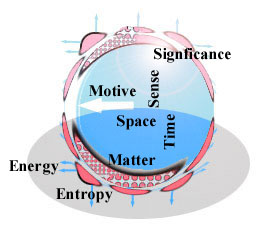
Wrapping this mess up, I put the atomic dots where they belong, on the inside surface of the experiential bubble of the Absolute. Make sense? Haha.
In Multisense Realism, all of physics is understood to relate to the capacity to discern between public and private views of phenomena. Public physics appears to us as ‘matter and energy’ on the outside and ‘perception and participation’ on the inside. The gap which makes this involution or twist possible is the modulation between the presence and absence or sensory presence, with the absence being what is called entropy or spacetime (which become essentially the same thing under this model of physics). To make things more confusing, this modulation of entropy and sensitivity is nested within many layers of itself, as a fractal. A cell encapsulates a world of molecular interaction. An organ encapsulates a world of cells, etc.
What started as an observation about the common positions that people seem to take within philosophy of mind debates became a hypothesis about the continuum of public and private sense experience, a re-interpretation of light, cosmology, consciousness, and the introduction of new concepts like significance and solitropy.
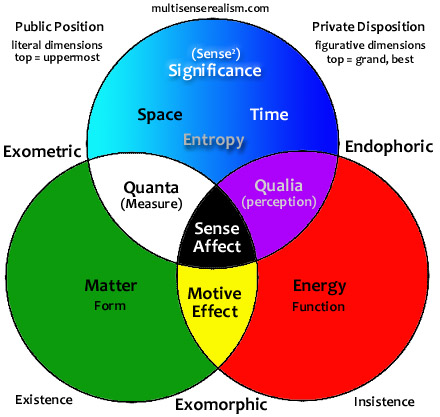
These two images try to capture the overall picture of how all major features of the cosmos can smoothly fit together.

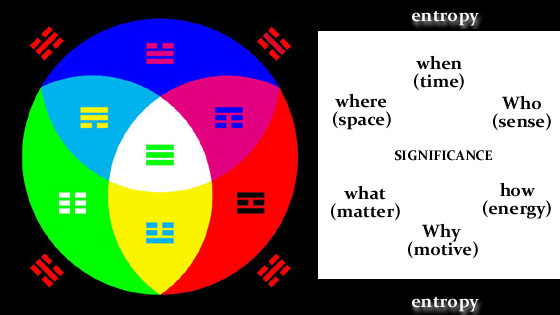
 Multisense Realism
Recent Comments