Archive
Chess, Media, and Art
I was listening to Brian Regan’s comedy bit about chess, and how a checkmate is such an unsatisfying ending compared to other games and sports. This is interesting from the standpoint of the insufficiency of information to account for all of reality. Because chess is a game that is entirely defined by logical rules, the ending is a mathematical certainty, given a certain number of moves. That number of moves depends on the computational resources which can be brought to bear on the game, so that a sufficiently powerful calculator will always beat a human player, since human computation is slower and buggier than semiconductors. The large-but-finite number of moves and games* will be parsed much more rapidly and thoroughly by a computer than a person could.
This deterministic structure is very different (as Brian Regan points out) from something like football, where the satisfaction of game play is derived explicitly from the consummation of the play. It is not enough to be able to claim that statistically an opponent’s win is impossible, because in reality statistics are only theoretical. A game played in reality rather than in theory depends on things like the weather and can require a referee. Computers are great at games which depend only on information, but have no sense of satisfaction in aesthetic realism.
In contrast to mechanical determinism, the appearance of clichés presents a softer kind of determinism. Even though there are countless ways that a fictional story could end, the tropes of storytelling provide a feedback loop between audiences and authors which can be as deterministic -in theory- as the literal determinism of chess. By switching the orientation from digital/binary rules to metaphorical/ideal themes, it is the determinism itself which becomes probabilistic. The penalty of making a movie which deviates too far from the expectations of the audience is that it will not be well received by enough people to make it worth producing. Indeed, most of what is produced in film, TV, and even gaming is little more than a skeleton of clichés dressed up in more clichés.
The pull of the cliché is a kind of moral gravity – a social conditioning in which normative thoughts and feelings are reinforced and rewarded. Art and life do not reflect each other so much as they reflect a common sense of shared reassurance in the face of uncertainty. Fine art plays with breaking boundaries, but playfully – it pretends to confront the status quo, but it does so within a culturally sanctioned space. I think that satire is tolerated in Western-objective society because of its departure from the subjective (“Eastern”) worldview, in which meaning and matter are not clearly divided. Satire is seen as both not as threatening to the material-commercial machine, which does not depend on human sentiments to run, and also the controversy that satire produces can be used to drive consumer demands. Something like The Simpsons can be both a genuinely subversive comedy, as well as a fully merchandized, commercial meme-generating partner of FOX.
What lies between the literally closed world of logical rules and the figuratively open world of surreal ideals is what I would call reality. The games that are played in fact rather than just in theory, which share timeless themes but also embody a specific theme of their own are the true source of physical sustenance. Reality emerges from the center out, and from the peripheries in.
*“A guesstimate is that the maximum logical possible positions are somewhere in the region of +-140,100,033, including trans-positional positions, giving the approximation of 4,670,033 maximum logical possible games”
Consciousness and The Interface Theory of Perception, Donald Hoffman
A very good presentation with lot of overlap on my views. He proposes similar ideas about a sensory-motive primitive and the nature of the world as experience rather than “objective”. What is not factored in is the relation between local and remote experiences and how that relation actually defines the appearance of that relation. Instead of seeing agents as isolated mechanisms, I think they should be seen as more like breaches in the fabric of insensitivity.
It is a little misleading to say (near the end) that a spoon is no more public than a headache. In my view what makes a spoon different from a headache is precisely that the metal is more public than the private experience of a headache. If we make the mistake of assuming an Absolutely public perspective*, then yes, the spoon is not in it, because the spoon is different things depending on how small, large, fast, or slow you are. For the same reason, however, nothing can be said to be in such a perspective. There is no experience of the world which does not originate through the relativity of experience itself. Of course the spoon is more public than a headache, in our experience. To think otherwise as a literal truth would be psychotic or solipsistic. In the Absolute sense, sure, the spoon is a sensory phenomena and nothing else, it is not purely public (nothing is), but locally, is certainly is ‘more’ public.
Something that he mentioned in the presentation had to do with linear algebra and using a matrix of columns which add up to be one. To really jump off into a new level of understanding consciousness, I would think of the totality of experience as something like a matrix of columns which add up, not to 1, but to “=1”. Adding up to 1 is a good enough starting point, as it allows us to think of agents as holes which feel separate on one side and united on the other. Thinking of it as “=1” instead makes it into a portable unity that does something. Each hole recapitulates the totality as well as its own relation to that recapitulation: ‘just like’ unity. From there, the door is open to universal metaphor and local contrasts of degree and kind.
*mathematics invites to do this, because it inverts the naming function of language. Instead of describing a phenomenon in our experience through a common sense of language, math enumerates relationships between theories about experience. The difference is that language can either project itself publicly or integrate public-facing experiences privately, but math is a language which can only face itself. Through math, reflections of experience are fragmented and re-assembled into an ideal rationality – the ideal rationality which reflects the very ideal of rationality that it embodies.
Playing Cards With Qualia
Here is an example to help illustrate what I think is the relationship between information and qualia that makes the most sense.

Here I am using the delta (Δ) to denote “difference”, n to mean “numbers” or information, kappa for aesthetic “kind” or qualia, and delta n degree (Δn°) for “difference in degree”.
The formula on top means “The difference between numbers and aesthetic qualities is not a difference in degree. This means that there is no known method by which a functional output of a computation can acquire an aesthetic quality, such as a color, flavor, or feeling.
Reversing the order in the bottom formula, I am asserting that the difference between qualia and numbers actually is only a difference in degree, not a difference in kind. That means that we can make numbers out of qualia, by counting them, but numbers can’t make qualia no matter what we do with them. This is to say also that subjects can reduce each other to objects, but objects cannot become subjects.
Let’s use playing cards as an example.
Each card has a quantitative value, A-K. The four suits, their colors and shapes, the portraits on the royal cards…none of them add anything at all to the functionality of the game. Every card game ever conceived can be played just as well with only four sets of 13 number values.
The view which is generally offered by scientific or mathematical accounts, would be that the nature of hearts, clubs, diamonds, kings, etc can differ only in degree from the numbers, and not in kind. Our thinking about the nature of consciousness puts the brain ahead of subjective experience, so that all feelings and qualities of experience are presumed to be representations of more complicated microphysical functions. This is mind-brain identity theory. The mind is the functioning of the brain, so that the pictures and colors on the cards would, by extension, be representations of the purely logical values.
To me, that’s obviously bending over backward to accommodate a prejudice toward the quantitative. The functionalist view prefers to preserve the gap between numbers and suits and fill it with faith, rather than consider the alternative that now seems obvious to me: You can turn the suit qualities into numbers easily – just enumerate them. The four suits can be reduced to 00,01,10, and 11. A King can be #0D, an Ace can be 01, etc. There is no problem with this, and indeed it is the natural way that all counting has developed: The minimalist characterization of things which are actually experienced qualitatively.
The functionalist view requires the opposite transformation, that the existence of hearts and clubs, red and black, is only possible through a hypothetical brute emergence by which computations suddenly appear heart shaped or wearing a crown, because… well because of complexity, or because we can’t prove that it isn’t happening. The logical fallacy being invoked is Affirming the Consequent:
If Bill Gates owns Fort Knox, then he is rich.
Bill Gates is rich.
Therefore, Bill Gates owns Fort Knox.
If the brain is physical, then it can be reduced to a computation.
We are associated with the activity of a brain.
Therefore, we can be reduced to a computation.
To correct this, we should invert our assumption, and look to a model of the universe in which differences in kind can be quantified, but differences in degree cannot be qualified. Qualia reduce to quanta (by degree), but quanta does not enrich to qualia (at all).
To take this to the limit, I would add the players of the card game to the pictures, suits, and colors of the cards, as well as their intention and enthusiasm for winning the game. The qualia of the cards is more “like them” and helps bridge the gap to the quanta of the cards, which is more like the cards themselves – digital units in a spatio-temporal mosaic.
Physics as the Production of Realistic Fantasy and Fantastic Reality
When working with private physics, the operators used are metaphorical and implicit, not explicit. Qualia is LIKE the “mass” of privacy. The will to will is like the “Energy” of privacy, and realism is like the “c²”. In my understanding, the notion that c is the speed of light is really a legacy understanding – a pre-Relativity convention within Relativity. It makes more sense to me now that light just happens to be the fastest quality of sense that we have access to. The true nature of c is as the speed of sense, or experience itself. It is not a speed, but the absolute limit of velocity. The still-here-ness of the universe..
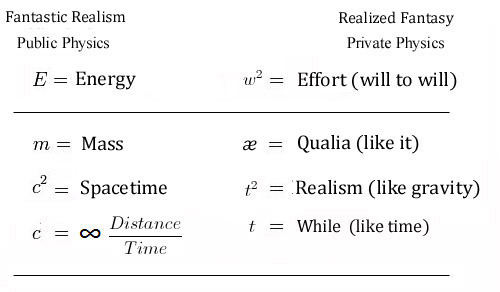
From an absolute view, quantified properties like mass, energy, and spacetime can be considered to be like reality but the only true reality is what experience is like. All conditions of the public universe are contingent upon an aesthetic palette, otherwise it would be implausible that any such palette could exist.
Private physics and public physics provide two different senses or fantasy, and two different senses of reality. Human experience is fantastically rich in an aesthetic sense and fundamentally real because it is the source of our participation in the universe. Our experience of the non-human universe is fantastic in the sense of its overwhelming magnitude and complexity, Its reality is persistent and reliable.
If we are serious about our science, we should consider that being overwhelmed by grandeur is a human experience which reflects the disparity in physical scale between us and the larger exteriority. The Public universe by itself would have no such feeling of grandeur, but what we feel about the inaccessible vastness of the cosmos is equaled by the vast inaccessibility of feeling by public physics.
Something else that has come up through this recent addition of physics to MSR, is the idea that Gravity is time squared, and that time is the square root of gravity. This makes sense to me, if we are talking about the equivalent conjugates of c² and t² as pubic spacetime and private realism. It should work out that Spacetime = the public shadow of Realism, and therefore Spacetime is literally Gravity and Realism is literally figuratively Gravity, as in the grave, serious nature of experience. If c is the constancy of distance and time coordinates, c² is the gravity which warps them from within.
Colorball II Diagram

Key:
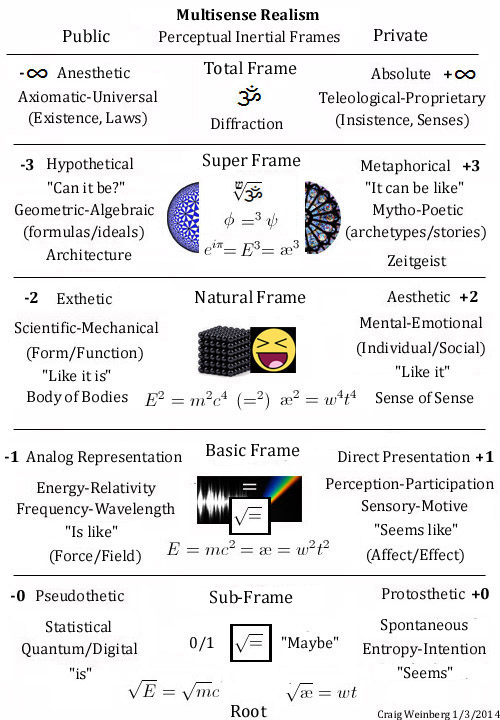
Absolute (+∞) :: Anesthetic (-∞)
Entelethetic (+3) :: Hypothetic (-3)
Aesthetic (+2) :: Exthetic (-2)
Immediate (+1) :: Etheric (-1)
Protosthetic (+0) :: Pseudethetic (-0)
The new terms in this second version are:
- Protosthetic (+0), referring to the minimum quality of awareness as well as the quality of minimum awareness. On a scale of +0* to +∞, this level is the +0 because it represents experiences which have been aesthetically masked to appear imperceptible. This can be thought of as the personal unconscious, as opposed to the collective unconscious, which is the Absolute level that is positioned on top of the diagram, but is actually the entire sphere. It’s number would be +∞.
The entire left half of the sphere can be thought of as a slice within the protosthetic range, just as the greyscale can be thought of as variations on black and white. - Pseudethetic (-0) is the outside-in version of Protosthetic. Where protosthetic phenomena seem alienated or unconscious but are, on some level, a symptom of experience, pseudethetic phenomena are not as conscious as they appear to be. The -0 range is about artifice and simulation, and can include anything from a puppet or stuffed animal to a sophisticated AGI system. Protosthetic would include states in which we are personally unconscious, but can be thought of as that which wakes us up from a sub-personal level.
- Exthetic (-2) is a term I’m trying out as the public-facing conjugate to Aesthetic. This is the common sense of structure that the real world generally seems to have. It is the sense of concrete exteriority which we rely on to engage with the world rather than in our mind. The sense of fixed mass objects in space and linear causality, and all of the other macroscopic cues that pervade classical physics, as well as all of the hard sciences.
- Entelethetic (+3) is intended to refer to a level of hyper-aesthetic dreams, symbols, and archetypes. Also knows as the collective unconscious or Dreamtime, this band of sensitivity is super-natural and trans-personal (yet still private). The word borrows from Entelechy, which has to do with a drive toward self-actualization, which is apt considering the visionary nature of this ‘third eye’ view.
Teleological-Absolute (+∞) :: Universal-Axiomatic (-∞)
Mytho-Poetic (+3) :: Geometric-Algebraic (-3)
Mental-Emotional (+2) :: Scientific-Mechanical (-2)
Sensory-Motive/Perceptual (+1) :: Electro-Magnetic/Relativistic (-1)
Proto-Aesthetic (+0) :: Quantum-Digital (-0)
Biology From The Inside

This gif is one of the set that has been going around, but it reminds me of the concept that I have of biological awareness (as opposed to primordial awareness which is embodied by physics and does not require biology). Whether the inorganic universe is four dimensional (3 + 1 time) or just seems that way from within a two dimensional hologram, it seems likely to me that the experience of biological organisms is best modeled along a fifth axis (aesthetic qualities as more than the sum of their conditional parts).
What I like about the repeating gif, besides the coincidental “5” relating to the fifth dimension, is that it suggests a kind of morphological respiration. Front to back, parts to whole, a seamless, self-metabolizing transformation. As a biological organism, my experience of the outside world is limited to that which can be modeled as objects – that is, through an aesthetically reduced feature set in which a bunch of five dimensional urges and responses are flattened into a four dimensional narrative on multiple levels.
In a previous post, I was looking at how sensitivity might be understood as being ‘key composited’ or perhaps ‘discomposed’ across multiple frames of reference. By this I mean that the apparent distribution of our psychological interface across the tissue of the brain can be compared to a flatland visualization:
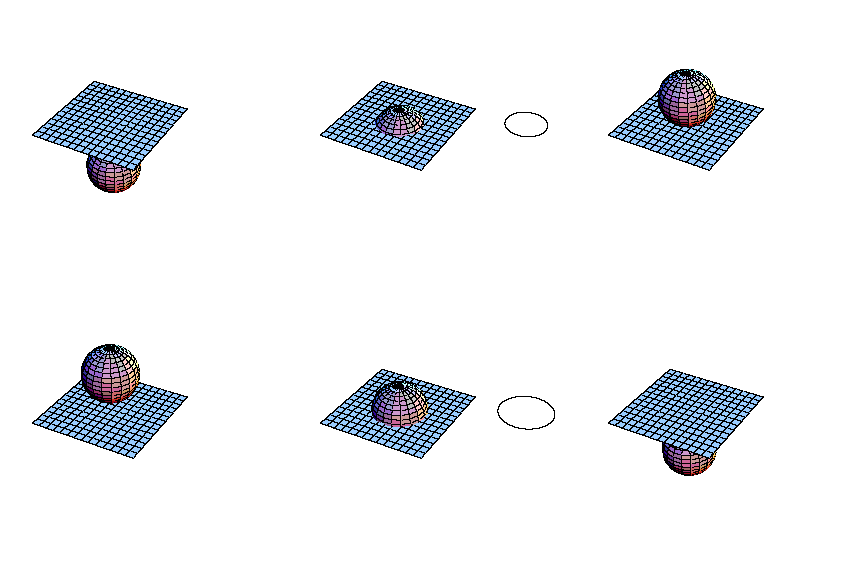
If instead of the sphere, it were a hand passing through the flatland plane, it would appear to the omniscient flatlander that there were five separate circles appearing separately, yet somehow seeming coordinated in their action. The fingers are part of a single hand, but within the constraint of the two dimensional sensitivity, the unity of the hand is discomposed across space in the literal sense, but figuratively some kind of unity can be inferred through the synchronized coincidence of the movement.
Now imagine that instead of another graphable dimension, the fifth dimension is one which is as orthogonal to spacetime as the three dimensions of space are to the one dimension of time. Feeling, like pain and pleasure, are like a coloring, or keying which cuts across multiple layers of seemingly unrelated public events. Not only is feeling a different kind of thing as forms or functions but it is a dimension in which dimension itself is transcended. Feeling is not a model or a measure, but rather it is the primordial context from which all measure is derived and all modeling is made demonstrable.
From the discomposed perspective ‘out there’, we are a coincidence of coincidences. A mysteriously synchronized, dynamic orchestration of hundreds of billions of neurons, organelles, molecules, etc which corresponds to the behavior of an animal’s body.

The feelings which we experience are not located in the tissue of the brain, rather the brain itself is part of the wider landscape of the totality of experience. The brain as a whole is, like our body as a whole and all of the cells and molecules that make it up at any given time, a four dimensional reduction of a transdimensional privacy.
Under Eigenmorphism, the base of each pyramid of perception is made up of the apex of countless low level pyramids of perception. When we look at an fMRI or the brain, we are trying to look at the view from top of our own pyramid through the blind eyes of its own bottom. Feeling is stripped out (not to mention the higher dimensions of meta-feeling/emotion/cognition/intuition) and we are left with a four dimensional mechanical skeleton with no interiority.
Being so impressed with ourselves and what we have accomplished by questioning our naive introspection with science, we naturalize the discomposed view and epiphenomenalize the native, gestalt perspective. All of this makes perfect sense within the flatlanded context of topological physics, where spontaneous appearances and disappearances are assumed only to reflect each other, rather than private transdimensional presentations.
I suspect that the universe which is experienced in the absence of all living organisms is a much different thing that it would appear to us. What we see as a four or two dimensional manifold is only a snapshot of discomposed histories. It seems inanimate to us because we seem so animated to ourselves. The highest awareness of our own interior physics seems to us unreal and crazy…and it is, relative to the inertia of human awareness as a whole. Like the inverted image of our retina however, I think that because our disposition spans so many levels of life and physical experience, we tend to see the mechanical patterns which all of the layers have in common, rather than the coincidence which is also animating them from the top down.
Like the transformer car in the gif, the signature of our presence and intention coincides with the interplay of entropy and significance. The living cell, from our perspective looking through our eyes and a microscope’s lens, looks like a homeostatic emergence. Seemingly conjured, like Brownian motion, from the statistical collisions of countless microphysical conditions.
This is not completely untrue. The mechanical conditions of a cell can be disrupted mechanically. There is bottom up causality. What has not been properly investigated yet is the other perspective. The one responsible for the biological property of healing and global integrity. If we think of the flux between entropy and significance as a carrier tone for biological life, then it might be easier to conceptualize how the universe is as much a dynamic interaction of nested simplicities as it is a mechanical progression from simplicity to complexity. The image of the metabolic transformer stands in contrast to the stillness of the axis of its transformation.
The Keys to Sensitivity


Chroma key compositing typically uses a green or blue screen to key a particular color to be recorded as transparent. In the example above, I have placed green keys on a cosmic (astrophysical + microphysical) background to give an idea of how to conceive of the relation between publicized and privatized experience.
The green of the keys represents the intrinsically singular sensitivity which is ‘behind’ the key silhouettes, just as wearing a green shirt on camera in front of a green screen chroma key will, in a sense, portray your shirt as a ‘receiver’ of the composite image.
This metaphor is closer to what I propose for psychophysical unity – not so much a Receiver theory of consciousness where the brain acts as an antenna for metaphysical signals, or an Emergent theory of consciousness where brain functions accumulate as a representation of signals, but as a Divergent theory in which sensitivity is whole within its private frame of reference, but fragmented across what appears to be space and time from the perspective of a similarly keyed sensitivity*.
Consider that if you are far enough away from a mosaic, it looks like an image, but if you are very close, you see only colored tiles. The difference in spatial ratios on our visual sense influences whether we see the artist private-personal intentions to express the picture’s content, or their public-impersonal technique in placing tiles. If instead of a static mosaic tiles, we think of it as a dynamic television screen of pixels, the metaphor can be extended through narrative time. The pixels do not tell a story, but the image does…over time…to a human audience.
The pixels are not “producing” the story, nor are they “receiving” it, although there is both receiving and projecting of electromagnetic sensations on the public-impersonal level. The complexity of the sequence of patterns on the screen also does not produce the story either, and no amount of complication within the hardware will cause stories to be experienced, just as no degree in the complication of a plot will cause the story itself to become sensitive. Patterns are representations within experience, not experiences themselves. Consciousness is not the green of the key, it is the transparent sensitivity that the green represents. If there is receiving or emerging, it is sensitivity receiving sensitivity, and sensitivity emerging from sensitivity.
*Sensitivity here could mean ‘person’ or ‘observer’ but I want to make it clear that what I propose does not depend on human like experience. I see all forms of observation as participation, and I want to break the automatic association that we have between experience and Homo sapiens personal subjectivity. For pansensitivity to replace energy or information as the primordial identity, it must be understood that all objects, forms, and physical conditions diverge from the totality of sense (not just primitive sub-personal sense, but the whole band of sub-personal, personal, super-personal, and impersonal sense).
There is no Objective Color thread
That’s really interesting, too much for me to all read but I appreciate the effort put into this.
I do disagree on your first point though. There is such a thing as objective color. Photons have wavelengths, and specific wavelengths are specific colors, regardless of how our eyes and brains interpret them.I read a part of the article you linked, and if you do take into account how the eye and brain interpret colors, there is still objective color. Apparently we do all have different ratio’s of red vs green vs blue cone cells, but as the article says, our brains are still in agreement over what exactly is yellow. So our eyes might be different, but our brains correct that difference.
Think about the nature of the visible spectrum. We perceive it as being composed of soft but distinct bands of hues, usually seven or eight: red, orange, yellow, green, cyan, indigo, violet, and sometimes fuchsia, which is not a spectral color. Colors such as grey, white, brown, beige, and pink do not correspond to any one frequency, so they cannot be said to map to the wavelength of any particular photon, yet we perceive them as discernible colors.

The color palette is of course, also a wheel in which colors are seen as ‘opposite’ to each other, and which generate various effects when placed adjacent to each other, as seen in various optical ‘illusions’:

I put scare quotes around the word illusions because this information has helped me understand that what we see is never an illusion, only our cognitive expectations about what we see can be illusory. By manipulating the various layers of sensation and perception to expose their conflicts, we can tease out the truth about color, and by extension consciousness. There is no ‘actually’, there is only ‘seems like from some perspective’. The experiment showed that our color perception can be altered for weeks after subjects return to an unaltered optical state*. Our brains correct the difference because they are not translating the wavelength of photons but mimicking relations within the optical experience as a whole.
Now think about the visible range of the electromagnetic spectrum. Does it have seven soft bands or is it an absolutely smooth quantitative continuum? Does the continuum form a wheel with primary and secondary oppositions, or is it an unbounded linear progression? Does it repeat in octaves, where one frequency suddenly recapitulates and merges the beginning and ending of a sequence, or does it monotonously extend into the invisible spectrum?

Our eyes tend to differ, and photons might be the same, but color is not photons. In fact, photons from the outside world only do one thing in our retina, and that’s isomerize rhodopsin molecules – meaning that the proteins in our rod and cone cells are studded with vitamin A molecules which stretch out in the presence of visible light. From there, the folded proteins in the cells sort of swell open and actually cut off what is know as ‘Dark Current’ – the continuous flow of glutamate which is interpreted as seeing light *in its absence*. Physical light, in a sense turns our experience of darkness off.

Once we let all of this information sink in, it should be clear that the experience of color is just that – an experience. It correlates to optical conditions, but it also correlates to conditions in which there are no optical inputs at all. Even where it is isomorphic to exterior measurements, there are no colored photons inside of the brain that we are seeing. We are seeing the same neural conditions that we feel, smell, taste, and hear, and synesthesia confirms that as well. This does not mean that neural conditions are a solipsistic simulation, however, but that’s a whole other conversation (which I have my own ‘crackpot’ theory for 🙂 http://multisenserealism.com)
*http://color.psych.upenn.edu/brainard/papers/AIC01.pdf
What is a thought?
An elementary thought – not a thought made up of other thoughts.
- What is the nature of a thought?
- What is it made of?
- What is an example of the most basic thought?
As an image is to visual sense, and a sound is to auditory sense, a thought is a unit of cognitive sense. The difference between perceptual senses and cognitive senses is that cognitive senses are directly participatory. While we can imagine a sound or image, the experience resembles a request that is fulfilled behind the curtain, by some faculty of imagination. With thinking, we feel that we ourselves are directly expressing ourselves rather than passively watching a presentation of thought in the mind’s eye.
To me, this suggests that the cognitive level of awareness is a meta-level of perception. It specializes in abstracting sub-personal levels of sensation into a communicable form, and in the rehearsal of hypothetical experiences. In this way, the base level sensory-motive interactions of the body-world experience are extended. Senses can be interpreted with more perspective and intelligence, while motives can be executed with more strategic forethought. Thinking is a way of making an enriched present and future by distilling from the past. The distilling process is inherently sequential, as the oceanic nature of experiential aesthetics is reduced to a sequence of gestures and symbols which can be projected and received not only as sensory-motive presentations, but also as information-theoretic representations.
If a feeling were a cube that is full of some kind of juice of experiential significance, a thought would dehydrate the juice, leaving the cube with just the residue of its former significance. The empty cube can now contain other thoughts and feelings – stacks of them. What thought lacks in experiential qualities, it makes up for in versatility.
What is the nature of a thought? Metaphor. The etymology of metaphor has to do with carrying over, and the root word ‘phor’ is also found as ‘fer’, as in euphoria and inference. If a feeling is an aesthetic quality which we carry (or ferry), then meta-phor implies a stepping outside of the system – a carrying of carrying itself. This is what thought allows us to do – to pick up fragments of our feeling and experience as if we had a mental thumb and forefinger which we can use to arrange into larger re-fer-ences with larger or smaller application. Without the basic capacity to isolate some significant sense from experience and to apply it to another experience as if they were related independently of our intent, there could be no thought. Thought is pretending.
What is it made of? In my view, all things are ‘made of’ what I call sense. The power to perceive and participate in perception. Thought seems different from electromagnetism or mass-energy because we are directly within it. Physics presents our body with features of other experiences as external bodies. The results of that exteriorized view, are, in my view, responsible for the alienation that we encounter when we try to re-absorb our own subjectivity after we have objectified it as physical forms and functions. In particular, thoughts are made, as far as we know, of the experiences of Homo sapiens or perhaps earlier hominids as well. Honey is made of bees sense and motive, thought is made of human sense and motive.
What is an example of the most basic thought? If we look at what infants seem to be thinking about, “mama” seems popular. They seem to want a lot of help and attention. When we wake up in the morning, there seems to be a sense of remembering where we are and what has been going on. Likewise, before falling asleep, our hynagogic state of consciousness seems to hinge on dissolving our sense of locality and memory. We can slip in and out of fragmented dream states until the figure-ground relation seems to tessellate us into a less thoughtful and more relaxed mode of being. Thought then, like a birds tweet, may begin as a localizing beacon. To think is to encapsulate your experience and to consider whether to alert others about it. We weave a web of memories within ourselves and our social group – externalizing, perhaps, the process which is represented by our own neurology.
 Multisense Realism
Recent Comments