Archive
Semiotics: What are the implications of the Saussurian sign (signifier/signified) for a theory of meaning?
In my theory of meaning, Saussurian concepts of signifier and signified are a good start, but I propose a fundamental change. In his answer, Keith Allpress offers:
here is where I think we stand:
Shannon removed content from meaning but using bits.
Saussure claimed that language creates meaning.
and points out the limitations of post-modern/relativistic/deconstructionist approaches. I would say that the computationalist approach is similarly limited, in that there is no compelling reason that ‘it from bit’ should apply to all aspects of meaning. I think that what is missing from these two approaches is the same thing, only seen from opposite sides. To understand more about that thing, we can begin by asking:
“What cares about the difference?”
I think where Saussure and modern semiotics in general went too far is in presuming representation without presentation. The error of the computationalist view is even more subtle, as it presumes presentation as an emergent property, thereby taking it outside of the realm of science, but without admitting it. To me, this is a very seductive but misguided approach which leads directly to the Emperor’s emergent clothes.
Taking the term ‘signifier’, we can crack the kernel of truth that semiotics-as-cosmology is based on. Just as it is not incorrect to call someone who is driving a car a ‘driver’, neither is driver a complete description of the role of human beings in the world. What is missing? What *cares* that something is missing? What fills the gap is what I call aesthetic participation, or sensory-motive presence. In my view, before ‘information’ (a difference that makes a difference per Bateson) or sign, there must be the raw sensitivity to detect and interpret such ‘differences’ or ‘signs’ and to *care* about those differences. What we have done, by reifing pattern as objectively real things which are recognized, or de-realizing things as subjectively constructed patterns is to void the existence of sense and sense-making itself.
Not to get too cheeky, but what I propose is that beneath Bateson’s adage is a deeper context from which information and signs emerge: an aesthetic phenomenon which likes its own likeness by making its own differences. I call this primordial pansensitivity, or ‘sense’ and the particular quality of appreciation that it cares about I call ‘significance’. Significance cannot be automated, it must be earned directly through intimate acquaintance. It may sound like I am talking about human intimacy here, but I mean nothing of the sort. By acquaintance (stealing that word from Chalmers), I mean sensory-motive encounters on a fundamental level: before humans, before biology, and before even matter. The universe has to make sense before anything can make sense of it.
The aesthetic agenda is purely hedonistic. It is to develop ever richer textures and modalities of appreciation. While the universe is replete with repeating patterns, it never seems to repeat its particular, proprietary holons. A whirlpool, hurricane, and galaxy all share the same unmistakable topology, but nobody would mistake one for the other. Not just the scale but everything that constitutes their appearance and role in the universe is different. In calling the universe signs or bits we are losing the appreciation and proprietary character. The unique and worthwhile becomes generic and inevitable. It ultimately is to make meaning meaningless.
Names (representations) can be related to each other in ways that nature (presentations) cannot be. The equal sign is itself a name for one of these relations. In nature nothing can be absolutely equal to anything else. All of nature is unrepeatably unique in a literal sense, but will seem to be made of repetition and variation from any particular perspective within it. In this way, the postmodernists are right. We have only the presence of our own ability to feel that can be known absolutely as it is. Everything else that exists for us, within our individually customized experience has some degree of approximation/representation.
What makes this even more complicated and confusing is that there are different levels of sense-making whcih can contradict each other. We would like to think of signs as simply a case of dictionary definitions were signs literally signifiy what we expect they should signify. Even the identity principle of A = A is subject to a deeper degree of expectation about what A and = mean in different contexts. We can look at a surreal painting and say ‘that is a painting of something impossible’, but it is only our expectation that the paint shapes refer to something other than themselves which is being misled. What surrealism signifies is not ‘real’, but neither is it nothing.
Where the computationalists are right is in seeing the uniformity of arithmetic principles across all phenomena which can be measured. Reducing all transactions to bits obviously has been tremendously transformative in this century. By banishing the aesthetic qualities (qualia) to an emergent never-never land, however, we have been seduced by the representation of measure (quanta). Simulation-type theories now abound, in which the entire history of human experience (including the development of science, but shh…) is marginalized as a confabulation/illusion/model and the only true reality one which can never been contacted in any way except through theoretical abstraction. We either live in an unreal world, or the world which we now think is real is not the one that we actually live in. We are being asked to believe that meaning is meaningless and that the only alternative to solipsism is a kind of ‘nilipsism’* in which even our ennui is yet another meaningless function of the program.
To turn the page on this era of de-presentation**, I suggest that we look at the roots of semiotics more deeply, and recognize that signs themselves depend upon a deeper context of sensation and sense-making which goes beyond even physics or human experience.
*a word I made up to describe the philosophy that the self (ipse) must be reduced to a non-entity.
**another neologism that I use to refer to what Raymond Tallis calls the ‘Disappearance of Appearance’…the overlooking of the phenomenon of aesthetic presence itself.
Time for Nested Causality
What do you about the simultaneity of cause and effect?
“The greater part of operating causes in nature are simultaneous with their effects, and the succession in time of the latter is produced only because the cause cannot achieve the total of its effect in one moment. But at the moment when the effect first arises, it is always simultaneous with the causality of its cause, because, if the cause had but a moment before ceased to be, the effect could not have arisen…. The time between the causality of the cause and its immediate effect may entirely vanish, and the cause and effect be thus simultaneous, but the relation of the one to the other remains always determinable according to time.” (Kant, 1787, The Critique of Pure Reason)

As the crickets’ soft autumn hum
is to us
so are we to the trees
as are they
to the rocks and the hills.– Gary Snyder
Syzygy Integrals and Other Neoquantisms
 Syzygy Integral
 Syzygy Integral with labels
When applying the syzygy integral to a sense modality such as vision, the Δæ would refer to the difference in the microphenomenal qualities, such as pixel hue, saturation, value, or contrast/edge detection, etc.. the entire palette of what I would call entopic or generic visual encounters. As shown in optical illusions, these elemental graphic features depend on their surrounding context, and two pixels or shaded regions which are measured to be optically identical can be perceived quite differently.

For this reason and others, I suggest that the fundamental nature of all phenomena is only definable in terms of specific properties, but of a pseudo-specific quorum of detectable differences. It looks like a lighter grey on the bottom because of the adjacent contrasts, and it is my conjecture that this kind of pseudo-specificity is at the heart of all measurements, particularly those which we have used to define subatomic particles.
On the top of the integral, the ∇Æ would refer to an entirely different, top-down mode of visual perception. Instead of a delta (Δ) to stand for a the difference of generic micro-phenomenal qualia, the nabla symbol (∇) is used to stand for a divergence from a larger perceptual context. This relates to the binding problem, i.e., when we see two dogs walk behind the same fence, we do not perceive them as becoming the same dog – the narrative continuity does for our overall understanding what the ‘illusory’ plasticity does on a microphenomenal level. To see the ) as a smile in the emoticon : – ) requires both a low level fudging of pixels into a curve, as well as the ability for our expectation of a face to be projected from the top down. The emoticon is a minimalist example, but a better example would be something like this:

Terms like pareidolia, apophenia, simulacra, and eidetic hallucination all have in common this potential to misread a more proprietary, macrophenomenal text on top of a relatively generic, microphenomenal context.
What the syzygy integral is supposed to model is that any given sense modality is a special kind of integration between top-down or holotrophic orientation and bottom up, entropic orientation. In the case of visual sense, the top-down images are encountered like those in an Rorschach inkblot, as endless wells of imaginative psychosexual association. The personal range of the psyche is here encountering influences from the super-personal range of the overall presence of this moment in relation to their lives, and their lives in relation to eternity.
The bottom-up ‘entopic’ confabulation (entopic hallucinations are those which are geometric designs, etc as opposed to eidetic hallucinations which are images such as specific faces) is where the personal psyche encounters the sub-personal influence of neurological, biological, and chemical events as it impinges on them visually. An entopic hallucination presumably maps much more directly to neurochemical patterns in the visual cortex, whereas the eidetic, storytelling hallucinations would be much more obscure and proprietary. A hallucination of Darth Vader or Dick Cheney might be hard to tell apart from looking at an fMRI, but it should not be so difficult to get a fix on zig zag patterns vs concentric circles, etc.
The syzygy integral of vision then would be this continuum between the sub-phenomenal adhesive that holds the graphic canvas together and the cohesive that renders the meta-phenomenal meanings and figures phenomenally visible. It’s not an ordinary integral, since it has an encircled triple bar in the center, which denotes a participatory intent (motive effect), and an aesthetic contour (sense affect). The term syzygy, an old favorite of mine (its a real word), refers to a union of opposites, either figuratively as in yin-yang, or literally as in an solar eclipse where the Moon is opposite to the Sun behind the Earth.
In the syzygy integral for vision, the vast sweep of possible interpretations from the meta to the micro level is interrupted by the inflection point of the moment as it is localized from eternity (the absolute). That which is seen had been both filtered from above and built up from below, but the visual encounter is defined even in opposition to that. The seeing is not the seen. All visual forms are opposed to an equally rich continuum of possible ways to appreciate those forms and images. The syzygy integral is not just a map of what there is ‘there and then’ but the entire domain of what each and every there and then still means ‘here and now’.
As the syzygy integral can be used to describe vision (vision = the participatory integration of graphic differences and imaginative likeness) or sound (sound = the participatory integration of phonic differences and psychoacoustic likeness), so too should it be able to describe the character of all phenomena. The underlying formula (Grand syzygy ingegral) uses the * asterisk and # pound to denote the limit of infinite figurative unity and the limit of literal, finite granularity respectively. In this case, the encircled triple bar refers to the Primoridal Identity Pansensitivity, from which all other syzygies are diffracted.
 Grand Syzygy Integral
The syzygy integral without the contour circle I am calling the information integral.
 Information Integral
Unlike the syzygy integral, which defines every piece of information as an aesthetic encounter or re-acquaintance, the information integral refers only to the skeletal functionality of sense. Locally we may experience novel encounters or acquaintances, but some would argue that all experiences can only be re-acquaintances from the absolute perspective. I think that it may make the most sense to think of even that either-or condition as just another superimposed quality of the absolute. Awareness is infinitely novel, infinitely repeating, and paradoxically non-paradoxical. It is only the disorientation of locality which provides orientation.
The information integral strips away all of the mystical trappings – the supertext and subtext contours, and refers instead to the conventional concepts of information theory. Here, the triple bar is still a participant and intentional arbiter of interpretation between signal and noise, but without the aesthetic complication. This is the standard view of information processing as a functional exercise, only with the additional acknowledgement of a core superposition of telic intention and ontic unintention, absolute improbability and immaculate reliability.
Alien Hand/Limb Syndrome
“The alien hand syndrome, as originally defined, was used to describe cases involving anterior corpus callosal lesions producing involuntary movement and a concomitant inability to distinguish the affected hand from an examiner’s hand when these were placed in the patient’s unaffected hand. In recent years, acceptable usage of the term has broadened considerably, and has been defined as involuntary movement occurring in the context of feelings of estrangement from or personification of the affected limb or its movements. Three varieties of alien hand syndrome have been reported, involving lesions of the corpus callosum alone, the corpus callosum plus dominant medial frontal cortex, and posterior cortical/subcortical areas. A patient with posterior alien hand syndrome of vascular aetiology is reported and the findings are discussed in the light of a conceptualisation of posterior alien hand syndrome as a disorder which may be less associated with specific focal neuropathology than are its callosal and callosal-frontal counterparts.” – http://jnnp.bmj.com/content/68/1/83.full
This kind of alienation from the function of a limb would seem to contradict functionalism. If functionalism identifies consciousness with function, then it would seem problematic that a functioning limb could be seen as estranged from the personal awareness, is it is really no different from a zombie in which the substitution level is set at the body level. There is no damage to the arm, no difference between one arm and another, and yet, its is felt to be outside of one’s control and its sensations are felt not to be your sensations.
This would be precisely the kind of estrangement that I would expect to encounter during a gradual replacement of the brain with any inorganic substitute. At the level at which food becomes non-food, so too would the brain become non-brain, and any animation of the nervous system would fail to be incorporated into personal awareness. The living brain could still learn to use the prosthetic, and ultimately imbue it with its own articulation and familiarity to a surprising extent, but it is a one way street and the prosthetic has no capacity to find the personal awareness and merge with it.
Is consciousness an emergent property of the brain or a fundamental property of matter?
Which is more likely?
Isn’t saying that consciousness is an emergent property of the brain just as much a non-explanation as saying it is a fundamental property of all matter?
To begin with, I think that it is necessary to separate the notion of personal states of consciousness from the vastly more general phenomenon of awareness.
Despite continuing evidence that human beings are less unique and special compared to other species than we had believed in the past, there are still ways in which Homo sapiens exhibit superlative talents. While we may no longer be able to point to any one particular trait, such as tool use, language use, or bipedalism that makes humans fundamentally different from everything else in the universe, the overwhelming sophistication of human life is surely an order of magnitude greater than that of any other organism we have encountered.
We know now that human neurons are not very different from those of other species, however, the human brain has almost twice the ratio of brain to body mass and energy of expenditure than the next closest contender (Bottlenose dolphin). We have every reason to correlate this surplus brain capacity with the success of the human species in overcoming their natural limitations and extending their habitat in uniquely un-natural ways.
If we set aside the special case of human consciousness for a moment, what can we really say that a brain does for an organism which cannot be found in organisms which lack a brain that has to do with deciding whether that organism is aware or not? There are zooplankton, for instance, with no brains who have eyes made of just two cells. We can imagine that anything using such primitive sense organs would have a vastly degraded experience compared to stereoscopic human vision, but the general premise of using optical sensation to navigate the environment is no more or less an indication of consciousness than our own.
As neuroscience and biology progress, it seems that rather than finding a clear threshold of phenomena which begin to appear more conscious, the threshold continues to fall. Here are some interesting things to consider:
- Neurons themselves now seem to have a nervous system of their own.
- Epigenetic studies show experiences have hereditary impact (Trait vs. Fate).
- Ephaptic coupling shows neurons communicating without using the synapse.
- Quorum-Sensing shows bacteria making group decisions.
- Worms remember things after their heads are cut off
- Plants sense danger and tell each other about it.
This even extends beyond the level of living cells:
- Universal protein fluctuations in populations of microorganisms
- More evidence found for quantum physics in photosynthesis
- Tiny volcanic moon controls Jupiter’s auroras
- Trophic cascades change the way that we think of ecology and geology: How Wolves Change Rivers
Add to this the continuing lack of resolution on ‘fringe’ issues such as NDEs, OBE’s, paranormal phenomena, the increase of the placebo effect, statistical anomalies in random event generators (REGs) and we get a picture of consciousness emerging from brains as seeming awfully anthropocentric.
If we consider the possibility of a material panpsychism, in which consciousness is a property of matter, it is not clear that we have solved the fundamental problem. The so called Hard Problem of Consciousness and Explanatory Gap address this lack of understanding about what a phenomenal quality of aesthetic presence would be doing in a mechanistic universe in the first place. By focusing on the structure of the brain and function of neurons, we are hoping to deflate the mind body problem. The mind can be seen simply as the functioning of a neural body – a vast network which exploits biochemistry to represent computations in this as-yet-not-understood, but inevitably discoverable way we are familiar with as our naive experience.
If we look at this approach more closely however, I think that we should find that all we have done is to miniaturize the mind body problem, so that it now exists at an arbitrary scale (neuron-mind neuron-body, peptide-mind peptide-body, connectome-mind connectome body, etc.). The metaphor of hardware and software has, in my view, led a generation of cognitive scientists and consciousness enthusiasts down a misguided path in which the very systems which we use to serve our conscious user experience (screen, keyboard, GUI, software) are mistakenly identified as serving the hardware (CPU, RAM, storage, network).
To truly go beyond the hard problem requires that we look at ‘looking’ itself. Understanding sensation and awareness as a phenomenon in its own right requires that we suspend all previous judgments and delve into completely new directions. In my own hypothesis, I see consciousness as not only a property of matter or physics, but is the sole property from which all possible properties must extend. This doesn’t require a human-like deity any more than the belief in matter requires that the universe is a large human-like body. It is more a matter of understanding how nested symmetries of a primordial sensitivity could produce what we know as matter, energy, spacetime, information, and subjective experience.
John Weldon’s “To Be”
If you say yes to the scientist, you are saying that originality is an illusion and simulation is absolute. Arithmetic can do so many things, but it can’t do something that can only be done once. Think of consciousness as not only that which can’t be done more than once, it is that which cannot even be fully completed one time. It doesn’t begin or end, and it is neither finite nor infinite, progressing or static, but instead it is the fundamental ability for beginnings and endings to seem to exist and to relate to each other sensibly. Consciousness is orthogonal to all process and form, but it reflects itself in different sensible ways through every appreciation of form.
The not-even-done-onceness of consciousness and the done-over-and-overness of its self reflection can be made to seem equivalent from any local perspective, since the very act of looking through a local perspective requires a comparison with prior perspectives, and therefore attention to the done-over-and-overness – the rigorously measured and recorded. In this way, the diagonalization of originality is preserved, but always behind our back. Paradoxically, it is only when we suspend our rigid attention and unexamine the forms presented within consciousness and the world that we can become the understanding that we expect.
Metaphysical vs Metaphenomenal
One of the most contentious areas in philosophy revolves around what I consider to be a misconception about the relation between the physical and phenomenal. In particular, the term ‘metaphysical’ forces supernatural connotations onto what would otherwise be non-ordinary but natural experiences and states of mind. I think that the problem is in failing to recognize the physical and phenomenal as each having their own ranges which both overlap and oppose each other. What I mean is, synchronicity and precognition are not metaphysical, they are metaphenomenal. The surprising part is that this means that the ordering of events in which we participate is actually a subjective experience nested within many other subjective and perhaps trans-subjective subjective experiences on different scales. Einstein talked about the relativity of simultaneity, and the metaphenomenal (aka collective unconscious) works in a similar way.
When we make time physical without acknowledging the role that phenomenology has in producing both the form and content of “time”, we introduce a false universal voyeur which effectively flattens all aesthetic qualities and participation into a one dimensional vector in one direction. By taking the term metaphysical, we unintentionally validate this flattened view of the universe in which physics is nature, and phenomenology, particularly deep or non-ordinary phenomenology, can only be non- or meta- physical and therefore supernatural, aka superstitious, aka illusory. If we look at how physics treats its own non-ordinary phenomena, such as quantum entanglement, quasars, and dark energy, we do not see the term ‘illusion’ or ‘folk astronomy’ being thrown around. Their strangeness is acknowledged in a way which invites curiosity rather than fear. The mystery is safely projected into the impersonal realm of physics and the super-impersonal realm of theoretical physics. By contrast, the metaphenomenal range is super-personal or transpersonal, containing experiences which challenge our conventional expectations about the realism of physical bodies, locality, and time.
It is not incorrect to say that for these reasons the metaphenomenal can be considered metaphysical, however I think that is where we are placing the emphasis on the wrong set of properties. Instead of using experiences such as intuition, synchronicity, and even divination as scientific clues to a super-personal range of awareness, we are distracted by the apparent contradiction to physics (as if ordinary awareness did not contradict physics already). To rehabilitate our perspective, I suggest considering the relation between the different ranges of physical (ontic) and phenomenal (telic) phenomena in this way:
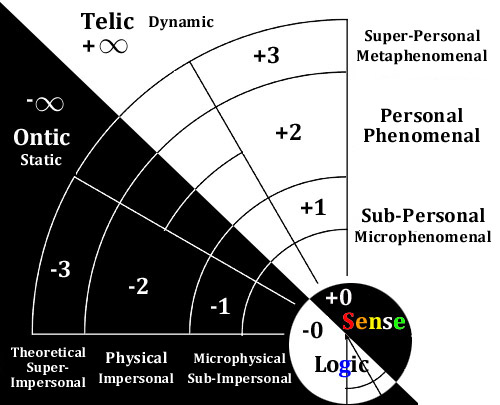
The term ‘paranormal’ is, like supernatural and metaphysical, the same kind of misnomer. If we see physics as a product of more primitive phenomenal sense, then it is consciousness itself which is doing the normalizing, so that it cannot be considered ‘normal’ itself. In another sense, since it is our consciousness which is defining normalcy, it does indeed identify its own regularity and meta-regularities and challenges those definitions as well. The metaphenomenal serves not only as an extension of the personal psyche into the collective unconscious, but also as a line in the sand beyond which sanity is not guaranteed.
Microphysical and Microphenomenal
The same thing occurs in another way, in an opposite way, on the bottom end of my chart. The sub-personal roots of microphenomenology and the sub-impersonal seeds of microphysics are the bottom up layers of causality and are more directly related than the top layers. The sub-personal (sub-conscious, id) urges and the microphysical (binary, semaphore-digital) are low level signs which are used to literally motivate and control. It is a common language of pushing things around.
To be able to exercise control it is necessary first to be able to see that which is to be controlled as separate in some sense from that which controls. There must be a way to sense them as ‘things’ or as a kind of inertial field which resists your intentions to cause a sensible effect. This experience of ‘things outside the self’ is the beginning of motivation, desire, intelligence, etc. In this way, motive and mechanism are born. The teeth in your mouth and the teeth of a gear exploit the same mechanical power to physically endure and prevail.
In the schema I propose, the fabric of the universe is tessellated or braided into these levels of nested counterpoint. The higher level objectifies the lower level into things because the higher level enjoys a more complete, but distanced panoramic view. The predator’s perspective engulfs the prey’s perspective. Biological organisms also objectify other living things and their own living body as higher than non-living things. Organisms with nervous systems take it one step beyond, seeing their own lives as a kind of meta-thing to direct as separate from the body. The human brain corresponds to a further, and perhaps ultimate mutation on the theme of self-reflection. There are physical implications for all of this but they have to do with time more than materials and structure. The expansion of time gives us more raw experiential material, more moments and more awareness of past and future within each moment. Technology and leisure make a virtuous cycle, bringing innovations which give us more things to do with our minds and bodies, and with the world.
Robert Anton Wilson wrote about the Jumping Jesus phenomenon – that it took X number of years for the first person to be born who had the impact of a Jesus or a Buddha, and how we now have several of them living at any particular moment. Buckminster Fuller and Terrence McKenna are among those who had this hyper-enthusiasm for the future which underlies today’s Singularity ethos. The ever ‘tightening gyre’, the transcendental object at the end of history, etc. It would seem, however, that at the same time, this enthusiasm is somehow perpetually deluded, and forever producing time wasting, leisure robbing coercions as well. As the acceleration increases, so does the mass, and a kind of stalemate plus or minus is maintained.
Conclusion
By shifting from the ad hoc, monolithic model of phenomenology as a kind of malfunctioning folk physics, or as physics belonging to an illusion that must be overcome spiritually, I propose a sense-based, multivalent view in which the metaphenomenal is understood to be both less than and more than physically real with high orthogonality, and the microphysical is understood to be less than and more than cosmologically meaningful with high isomrophism. The (one) mistake that David Chalmers made, in my opinion, is in accidentally introducing the idea of a zombie rather than a doll to the discussion of AI. Similar to error of the terms metaphysical and supernatural, the zombie specifies an expectation of personal level consciousness which is absent, rather than sub-personal level consciousness which is present on the microphysical levels. We can understand more clearly that a doll is not conscious on a personal level, no matter how many things it can say, or how many ways its limbs can be articulated. On the micro-physical level however, the material which makes up the doll expresses some sensory experience. It can be melted or frozen, broken or burned, etc. The material knows how to react to its environment sensibly and appropriately, and this is how material is in fact defined – by its sensible relations to material conditions. Just as we can assemble a 3D image on a 2D screen out of dumb pixels, so too can be automate a 5D human impostor on a 4D behavior stream of a doll.
By properly locating the micro-level physics beneath the personal-level phenomenology, we can see that beneath the micro-level physics there can be an even more primitive micro-phenomenology. On the top end as well, beyond the ontological truths of mathematics and logic, there are teleological apprehensions of aesthetics and meaning – without necessarily invoking a God personality (although that can work too, I just don’t see it as making as much sense as transpersonal Absolute).
*the super-impersonal is similar to the metaphenomenal in that it is difficult and esoteric, but opposite in that it is extrinsic rather than intrinsic. Where the metaphenomenal uses symbols as archetypes, loaded with metaphor and occult mystery, the superimpersonal (which would be more correct to call metaphysical) uses arcane mathematical and logical expressions. These are a kind of anti-metaphor as they relate to precisely defined, universally understood public information. The whole point is to expose the theory and completely, so that anyone is welcome to try to learn how to understand and use them, without any initiation rituals or strange pictures.
A New Final Frontier
If Dark Matter and Dark Energy represents 96% of the “known” universe, even if it paradoxically turns out that we know virtually nothing about it, what other kinds of ratios-in-ignorance lurk as shockingly in our self-significant lives? – Quora Question
There are 23% of Dark Matter and 73% of Dark Energy.
Next time that you are in room with another person, take a moment to realize what that room looks like from the other person’s perspective. Imagine being that person and seeing the room from their perspective. Now imagine that moment in which you are imagining yourself as them as a fleeting instant in their lifetime in which your presence is all but completely unnoticed. Understand that moment is, for them, only one of an eternity of moments of a life completely other than your own.
The degree to which their age, gender, cultural identity and personal experience differs from your own is the degree to which the life they have been living is different from your own – different views of history where different events are weighted differently in significance. Events which are historical to you are, for an older person, events in their own lives which have not entirely passed, but rather live on as changes which happen to no longer be present, but whose influence can be traced through their future, backwards.
Now extend this expectation of other lives to animals and plants, no matter how small, to cells, and perhaps even to genetic histories, to chemistry and physics. Histories and perspectives so alien that the smallest hydrogen nuclei have more in common with the largest stars than they have differences, and measures of time become liminocentric, with the infinitesimal moment blurring into the astronomical eternity, and the blasting of singular furnace of mass into hypercardinal intergalactic multiplicities is divided up into all-but-infinite fractals of all-but-infinite moments of multisense realism. Each moment, each perspective a holographic reflection of itself within the fisheye reflection of the whole that it embodies. Each perspective is bound to a private cache of evanescent histories, transparent and shifting in the changing light of the mood and the moment.
What we don’t see of the universe, by virtue of the limitation of our perceptual tunnels as individuals, as humans, as animals and organisms…what we don’t see of each others experience and of the experience on scales beyond that of organic life dwarfs the ratio of dark energy. What is elided from our experience and possible experience is the true final frontier.
Seeing Visibility
Given that light has many strange properties, both on our natural scale as rays and on the elementary scale as photons, there is every reason to doubt that light qualifies as something which is unambiguously physical. On the other hand, since we cannot imagine a completely new color wheel, it would seem to say that the experience of seeing light is “real”, and not, a label for certain kinds of information that is fabricated in the brain. People who become blind at an early age, for example, experience stimulation to their visual cortex as tactile stimulation rather than seeing lights or spots.The condition of blindsight shows that parts of our brain can receive optical information without our having experienced that information personally as visual sensation.
In a way, white light can be considered to be what it looks like when transparency is concentrated. White light is when the quality of visibility is so saturated that it exceeds the range of discernment . A bright light illuminates a room not with whiteness but with clarity. To shed light on something is to flood the visual field with an immediacy of aesthetic acquaintance that suggests veridical qualities of the environment being illuminated. This is why we have metaphors such as ‘seeing the light’. Because it is about being connected with the presence of what is true and sensible, rather than being passively bombarded with particles. It can be said that our experience of seeing is not a direct detection of what is true, since there are so many ways to reveal optical illusion.
By calling it an illusion, we are framing the phenomena in a way as to implicate human fallibility rather than physics. Somehow we are wrong about what our eyes report, yet it is not clear that our assumption about what our eyes are reporting is scientifically valid. In fact, if it were not for these optical illusions, science would have very little to go on in determining the nature of vision as separate from physical truth, so it is actually the gaps between our expectations and the truth which reveal more truth, both about the nature of visual awareness, optics, electromagnetism, and quantum mechanics. Optical illusions are an encyclopedia of the nature of perceptual illusion, physical reality, and the relation between the two.
The folk science explanation for light perception generally begins with the idea that we can see light hitting our retina. That may be true, but not scientifically. The part that light plays in our visual system ends with the isomerization of rhodopsin in the retina. If what we see as “light” is in the visual cortex, then obviously what the visual cortex receives is not photons from the outside world, and it is not a direct analog that shows up as a small screen of images in an MRI. To even guess at some of the content of our visual field requires a blind statistical reconstruction. There is no plain-text transmission of images in our brain to simply hack into and view.
The effect that light has on the retina is merely to trigger the geometric extension of Vitamin A molecules and stop the flow of glutamate to the bipolar cells. That is well behind the first ganglion that would lead to the optic nerve and visual cortex. I propose instead that photons are not entities that are independent of their transmitters and receivers, and that light is therefore not physical but rather inter-physical, aka, phenomenal, aka sensory. Photons are measures of the sensitivity of our mode of detection. It is neither ray, beam, particle, or wave, but rather a rhythmic phenomenalization of matter – a feeling that matter has about what is going on around it. By making inferences beyond our sensible grasp, I think that Quantum Theory has given noun and verb-like properties to what are ultimately adjectives. Bosons and fermions may not be like that at all, but rather they are opportunities for matter to re-acquaint itself. The elementary measurable features of the cosmos may not be particles or strings, but qualities which characterize the capacity of matter to measure and interact with itself. Physics is a mirror. For every action and equal and opposite reaction, because equal and opposite reaction is a perfect reflection of our mode of scientific inquiry. We are investing our coins of empiricism in nature, extracting the empirical value, and recording the profit in our scientific ledger, like good, serious 18th century gentlemen.
It seems to me that only a medium which is intrinsically filled with the sense of color, form, and intensity across the many physical scales could reliably and veridically bridge the gap between public material realism private experience.The notion of a seeing light as a Rube Goldberg patchwork of conveyance into separate effects on every level*, all transported through a one dimensional collision detection schema is not consistent with reality. There are too many examples of people who have seen things in dreams and visions, too many qualities of visual experience which cannot be decomposed sensibly to pixels or lines for the photon explanation to be satisfactory. The qualia of color alone, whose idiopathic shifts and wheel-like symmetry have no place in the smooth continuum of the electromagnetic spectrum.
I suggest that light is only one specific form of a more universal medium, and that this medium is already known to us informally by the word ‘sense’. Sense as in sensation, sensitivity, sensor, but also as in making sense, sixth sense, and ‘in the sense of’. The unity of all sense can be more precisely expressed as ‘primordial identity pansensitivity’, ‘nested sensory-motive participation’, or even something like ‘self-tesselating aesthetic re-aquaintence’, depending on how technical and pretentious we want to get. From this Absolute firmament, and I think only from this firmament, can we get the full range of private experience, public physics, symbolic information, and the capacity to compare and contrast them. Only when physics is seen as identical with sense can physics be completed.
On the elementary level, with a nested sense primitive, we get relativistic locality (so eigenmetrics rather than eigenstates). Sense is modulating its own self-transparency and reflectivity to generate eigenmetric milieus – levels of scale that foster certain kinds of aesthetic themes and activities. The micro-world with its mathematical-molecular-insectoid clarity is different from the soft, lush features of zoological-arboreal-botanical existence. On some level perhaps, sense is nearly undiluted, and so the entire history of the cosmos is as a single now – a white whole singularity in which the now cannot even be completed and the here cannot hold even the hint of a ‘there’. On that level, there is non-locality.
*optical, molecular, cellular, ocular, neurological, psychological, sociological, zoological..
 Multisense Realism
Recent Comments