Archive

Posts Tagged ‘consciousness’

Multisense Continuum Still Life

June 5, 2015 Leave a comment

stilllife2

Leaving Space, Time, and Spacetime Behind

May 12, 2015 2 comments

Are Space and Time an Illusion? Considered in this video:

  • 1. Give up your intuitions of how space and time work.
  • 2. Facts about observers (particles are considered observers):
    • a. observers disagree on how much time passes between events.
    • b. observers disagree on how much space there is between things at any given moment.
    • c. observers don’t fully agree on the chronological order of events.
    • d. observations are consistent so that no observer can be ‘wrong’.
  • 3. Spacetime is emergent from a deeper objective reality of causality.
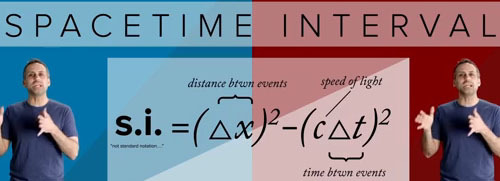
    • a. all observers agree on spacetime interval
      image
    • b. Spacetime intervals tell us about which causes influence which effects.
    • c. Causality is more objectively real than spacetime.
    • d. Spacetime is a tenseless, Non-Euclidean 4D mathematical Minkowski space.
    • e. Our intuitions of space and time are arbitrary and abstract.
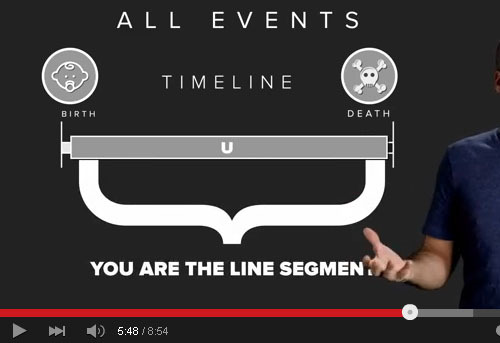
    • f.  We are real, however, if we think of our entire lives as a fixed geometric object in spacetime rather than a moving window on the line segment of our life:
image

He begins to sum up at 6:03

“Imagine we’re all reading a flip book made of graph paper. We agree on the events of the story, but we don’t agree where they happen on the page, on how many pages there are between events, or even on the order of some of those events, and yet we’re all reading the same book…only there’s no graph on the paper, there are no pages, and there is no book. All of that is just an imposition our brains make in order to perceive whatever it is. So why do we perceive reality in such a vividly spatial and temporal way? Good question, No one really knows.”

At this point is where I jump up and raise my hand. I think that I might know the answer to that question:

The mistake being made in our sophisticated rewrite of naive intuition about space and time is that the constancy of the spacetime interval is due to an objective ‘same book’ (or bookless book or whatever we are supposed all be reading.) To go to the next step into multisense realism, we must not only give up our intuitions about space and time being different, but we must give up our counter-intuitions about spacetime being literal.

If we consider instead that there is no final Minkowski block time universe out there, no ‘same book’, or even same language out there, but rather a shared capacity to read/write, in here, then both the naive intuition and sophisticated counter-intuition makes sense as perspectives within a larger context. Not just in human experience, or even within particles or probability laws, but deeper than that.

In this new schema all is read/written beyond spacetime but still ‘within’. Within us as well as ‘within’ every kind of non-human experience. This pervasive context ‘within all awareness’ would be an absolute context which is pervasive and devoid of any formal sense of distance or time. An anti-void. This absolute frame of reference can be understood as sense itself (something like “ference” rather than reference): Direct participation of perceptual qualities that need not be realistic, but also extend to phenomena which we are familiar with as fiction, imagination, myth, etc.

This is not to say that human imagination could necessarily describe the entire continuum of sense, but like the visible spectrum is to electromagnetism, it defines a range which is a thin slice of the whole, but much more than merely one color. The one ‘color’, call it white, would correspond to the single combined sense of timeless, spaceless realism that is studied under math and physics, but is nevertheless bereft of aesthetic qualities such as emotion, flavor, or (other) colors.

All that has ever been experienced can be seen, in this absolute frame of reference to be ‘right here and right now’, but for our local inhibitory conditions of human limitation. From our human perspective there is a cost in making awareness so immense that it embraces all other partitions; it becomes unreal or fictional, delusional, supernatural, absurd, or accidental*. The ‘heavens’ are not only causally closed at one level of awareness, but on another, they open up to non-linear, surreal mythscapes with no temporal rooting but deep symbolic meaning.

Jung spoke of the collective unconscious, Australian aborigines refer to a primordial Dreamtime, and many a psychedelic explorer have reported such aesthetically saturated realms. Anthropologists find that it is very common for cultures to assume that children are born into this world from a dreamier, more divine kind of world. These shamanistic-psychotic surrealities need not be considered ‘real’, however neither can their surreality and flirtation with prophetic intuitions be dismissed as mere accident. Even as a kind of placebo effect, the transcendental levels of experience must be accounted for in any would-be-complete view of the universe.

There is a lot to understand about our own spectrum of consciousness before we can even begin to approach the totality of awareness, which may be an unbounded, or self-binding rather than a fixed continuum. Non-human states of awareness might be both ‘larger’ and ‘smaller’, faster and slower than we can conceive of. This conception of the totality of experience as beyond causality turns causality into a kind of ‘nozzle’ of spacetime. Causality focuses the ocean of creativity; interiorizing some and exteriorizing others into relative degrees (the ancestor of our ‘five senses’ in which, for example, feeling seems ‘closer to us’ than seeing).

The pieces of this puzzle of human consciousness can, in my estimation, reveal a kind of ‘red shift’ and ‘blue shift’ which can be thought of in human terms as the stereotypically** autistic and psychotic extremes of human consciousness.

To return to the video, the multisense realism view would add:

  • 4. Nonlocal spacetime and “space ⊥ time” as (space and time in their naive, perpendicular local appearance) both emerge from a deeper common sense, which is trans-local.
    • a. this common sense can be thought of as the capacity for sense itself, or rather, for the particular kind of worldly sense of causality and agreement, which we might call realism.
    • b. realism is a common, but not exclusively common sense but is the reflection of an even more fundamental sense, which is novel and unprecedented rather than probabilistic or determined by laws.
    • c. the common sense of realism divides experience mechanistically and unintentionally
    • d. the uncommon sense beyond realism multiplies intentionally, seeking and building significance.
    • e. what we call causality is itself caused. Our distanced observations of realism is a kind of low-res substitute or icon that carries some semblance of the totality, but in an aesthetically neutralized, minimalistic form.
    • f. by using the built in, self-organizing clues of nature, we can begin to see how the holographic universe must be extended to include our own ‘visible spectrum’.
  • 5. The agreement of the Spacetime Interval is not evidence of a rigid body of 4D absolute reality, but rather evidence of the potential for agreement itself, i.e. the revelation of underlying local sensory unity with distant sensory conditions.
    • a. this is what the constancy of light speed and gravity are ‘really about’: not photons or forces, but ordinary sensory experience in self-diffraction.
    • b. light is not a particle or a wave, it is a local sensation on the cusp of spacetime emergence. Light is local sensation, and sensation is a boundary condition within sense.
    • c.  this means that sensation is more of a temporary subtraction from the eternal than an isolated piece of information.
    • d.  the extremes of human consciousness should be seen as a richer, more significant version of a guiding theme in all of sense: that of psychotic-unpredictable-figurative entropy and autistic-static-literal information.
    • e.  the phenomenon of seeing can be used metaphorically to begin to understand these extremes, as well as ordinary experiences of common sense, by working with the idea of language as a gravitational lensing in which the light of sense is bent by local accumulations of significance (mass).
  • 6. Paradoxically, what all observers agree on is their potential for agreement and fact of their own disagreement.
    • a. We can reclaim our naive intuitions about space and time being different, as this perpendicular aesthetic is an accurate reflection of our own subjective tunnel through eternity.
    • b. We can claim the Minkowski counter-intuition as a brilliant, and useful creation myth which is derived from common insensitivity, rather than common sense.

This is way too much to take in all at once (even for me), and I have no doubt that it sounds crazy to most people (that too is part of the Lorentz-like contractions and dilatations of sense-making). This is only the very tip of the iceberg…just something to get down in writing…for now.

*Whether the out-of-range portions of the spectrum of sense appear to be insane, error, or divine depends upon the frame of reference from which they are experienced.

**not talking about real people who demonstrate autistic or psychotic symptoms, but the themes exposed by the stereotyping of those symptoms, some of which are being researched under Imprinted Brain Theory.

A Couple of Scientific Conversations

April 17, 2015 2 comments
Quantum and the Bell

EM Imagine I set up Schroedinger’s cat and a machine that will open the box after 10 seconds and ring a bell if the cat is alive. I set it up, and wait 10 seconds, and don’t hear a bell. What’s happened to the wavefunction?

CM What happened is that a person, you, have made an observation based on an expectation that you have of a particular experiment.

EM But I didn’t interact with the apparatus. No signal was transferred between me and it.

CW If you didn’t interact with the apparatus then how do you know the bell didn’t ring?

EW Because I’ve noticed 10 seconds passing and not registering a bell ringing in that time?

CW Why would you expect to hear a bell ringing unless you know that you can hear that bell and that bell is part of the apparatus?

EM I wouldn’t do, but are you trying to say that being aware of that counts as interacting with the apparatus?

CW Of course. Does RAM exist if it’s just filled with 0s?

EM Sure, but the idea of RAM in my head isn’t RAM in reality.

CW Being able to hear a bell isn’t in your head either. Being able to hear a bell and infer a meaning to the apparatus from that sensory experience (or your unfulfilled expectation thereof) is what your interaction consists of.

EM Yes, and neither unfufilled expectation or potential ability to hear a bell are real interactions with the real apparatus.

CW They are if you can really hear a bell (which is part of the apparatus) and if you can really understand that hearing the bell constitutes a result of your experiment.

If a dead person doesn’t hear the bell is it still a valid observation?

EM As far as the mathematics was concerned, it was “observed” (decohered) by the time the bell rang. But “being able to hear the bell” is not an interaction. *Actually* hearing the bell is, but that doesn’t happen.

CW Your view takes sense for granted to the point that it denies a difference between a living observer and no observer.

As far as the mathematics was concerned”
Which proves my point. Mathematics truncates consciousness.

EM Your point is… what? Believing in single observers and WF collapse is more rational then just interpreting the mathematics that explains your results in the first place?

CW The mathematics don’t explain the results, they only diagram a skeleton of one measurement of the results. The actual experiment and results take place outside of mathematics.

Are molecules conscious?

Does polymerase have any sense when it transcribes DNA into RNA? Do ribosomes have any sense when they translate RNA into amino acids?

What we can say is that DNA, ribosomes, etc are all expressions of consciousness on a certain scale (microbio-chemo) as seen through another scale of consciousness (anthro),

There is a story, an experience going on that is represented to us as a ribosome, a molecule, etc, and we are seeing its body through our body. A facade that is filtered by another filtering facade. I call this Eigenmorphism. Form itself, like matter and energy, is relativistic. Whether a given phenomenon is a feeling or a structure depends on the distance across the frames of reference involved. Nothing is an object in its own frame of reference, including the universe. Our mistake since the Enlightenment is in Over-Copernicanising physics and dismissing the native frame of reference (sense) as an epiphenomenon or emergent property of the distant frame (physics)

Cone Cosmogony

March 31, 2015 1 comment

headless

cone3

The first image is from https://www.facebook.com/headexchange. The second has been modified to include the Multisense Realism model.

Specifically, “Me” has been removed from the center of the mandala and turned into part of the z axis. The center of the wheel is now Form-Function, and Now, indicating that consciousness is at its most pointillistic and fragmented. This would be the sharpest, most systematizing-autistic quality of consciousness, quantitative and reductionistic.*

The diameter of the circles corresponds to space or distance (really wavelength ratio/scale), so that the wheel represents a flat cross section of eternity. Time is the diagonal axis which is can be thought of as the z axis ‘deferred’. If our experience (feeling, thought, etc) extends from eternity to now as a qualitative spectrum (as symbolized by the chakra graphic), then ‘time’ is the interference pattern between eternal experience and fully public, discrete events.

The top of the cone is labeled eternity, although it is eternity in the sense of the eternal moment rather than a linear history of time. Eternity can also be called the Absolute, or God, Tao, Consciousness, Aesthetic Foundation, and many other names. Identifying with the Absolute while still in our body is the opposte end of the consciousness spectrum – the most colorful, florid, artistic-empathic-psychotic range of awareness.

* See previous posts on Imprinted Brain Theory and the Autistic-Psychotic spectrum.

Notes on Philosophical Incorrigibility

March 25, 2015 3 comments

No, this is not about philosophers behaving like unruly children (although at times, they can). Incorrigibility is a term that refers to “a property of a philosophical proposition, which implies that it is necessarily true simply by virtue of being believed. A common example of such a proposition is René Descartes’ “cogito ergo sum” (“I think, therefore I am).“

Symbolic reference cannot ‘break the fourth wall’ – meaning that whatever words or gestures that we use to communicate about something can only refer to things figuratively. This sentence, for example, can’t address you the reader in a literal sense. I can write “Hey you! Yes, you! Stand still laddie!” but it is not really possible for these words to address anyone literally. The same words could come out of a random letter generator, or they could have been written by someone who died before the reader was born. The entire premise that language is meaningful depends on an audience who is able to derive meaning from interpreting messages from that language.

Doxastic logic is a type of modal logic which uses the terms ‘belief’ and ‘proposition’ to formalize, and really digitize the possible relations of belief and truth, including beliefs about beliefs, possible beliefs about possible truths, etc.

Accurate reasoner: An accurate reasoner never believes any false proposition.

Bp→p

Normal reasoner: A normal reasoner is one who, while believing p, also believes he or she believes p.

Bp→BBp

My beef with modal logic is that while it gives us an informative language to talk about mental states, it cannot access the quality of the state itself, and therefore is misguided when applied to the deeper conditions of consciousness itself. There is no modal symbol for ‘wakes up’ or ‘loses consciousness’ because those conditions affect the entire phenomenon from which reason can arise rather than a function of reasoning.

When viewed from an ontological perspective, I think that we would have to consider a proposition to be a kind of belief, even if it is a belief that is assumed to be shared by everyone or every thing. The proposition that “Fire is relatively hot” is itself only a message which is communicated through language. Before we can agree that “p = fire is relatively hot“, we must first agree that

p is literally a sensation: p is seen as a group of adjacent graphic squiggles, or heard as a phonic utterance. p is actually s(’p’), since acoustic vibrations or optical contrasts can’t literally be propositions about fire.

s(’p’) is subconsciously identified as a message (rather than, say decorative art) within our cognitive sense. We think that our sense of ‘p’ means something that we can understand. p is promoted to i(s(’p’)).

i(s(’p’)) is consciously understood as a particular message with a particular meaning. This promotion of i(s(’p’)) to the executive level of sense, where we personally evaluate and act on the contents of messages would be the third nesting of sense u(i(s(’p’))). It is not only cognitive, but articulated on the personal level of cognition.

It should be noted that deconstructing the foundation of classical logic this way is intentional. Logic begins with a philosophical assumption of semantic realism. This is ironic really, especially in doxastic logic when we are concerned with the consistency of reasoning, to being with the assumption of a reasonable universe as a given. p is simply p. A proposition is given, and in that presentation of the proposition, truth is considered (wait for it…) incorrigible. If we want to say that p is false, we would just say ‘not p’. Truth and proposition are equivalent because we are assuming an unquestionable solidity to this fundamental logical unit – a unit which represents facts as they simply are, unconditioned, present without any dependence on ontology. Logic of this sort can be used to diagram systems which remind us of physics or of thinking and communicating, but they begin with the fact of coherence and sense already in place.

By inverting this previously unexamined axiom, I hope to reveal the myth of the logical ‘given’ and replace it with the more skeptical, honest view that logic is derived from sense. Just as a child depends on developing sensorimotor skills prior to developing abstract reasoning skills, all logic derives from deeper levels of sensory experience. Even computer logic relies on the sense of a physical mechanism…the capacity for some substance to detect and project some tangible role in a tangible chain reaction. Abstract logic is always an intangible map that is projected psychologically onto such a tangibly experienced territory. It is this tangibility, this concretely participatory aesthetic spectacle which is doing the work and which can appreciate the benefits of having accomplished it.

In my view, artificial intelligence has a problem, not because there is something special or magical about living creatures, or Homo sapiens, but because it seeks to impose an abstraction onto reality ‘feet first’ as it were. A computer program is a set of propositions which is further proposed to be imitated by a physical machine. Instead of an a sensation which is identified and understood u(i(s(’p’))), there is a ‘p’(’p’(u) (’p’(i) (’p’(s))… a mere proposition of a proposition of an understanding of a proposition of an identification of a proposition of a sensation. Those who have a grasp of why this is different from the natural u(i(s(’p’))) don’t really need an explanation. ‘The map is not the territory’, or ‘the menu is not the meal’ should be enough. Those who do not see the difference, or do not identify why the difference is so significant, or do not understand the specific meaning of the significance are probably approaching the entire question of consciousness from the classical logical orientation. For those people, if there is any possibility at all of their shifting to the new perspective that I am proposing, I think that they would have to begin from the incorrigibility of concrete sense rather than of abstract logic.

How to Tell if Your p-Zombie has Blindsight, Falling in a Chinese Forest

January 26, 2015 Leave a comment

In order to make the question of philosophical zombiehood more palatable, it is a good idea to first reduce the scope of the question from consciousness in general to a particular kind of awareness, such as visual awareness or sight.

consciousness (general awareness)     |    particular awareness (sight)

Building on this analogy, we can now say that an equivalent of a philosophical zombie (p-Zombie) as far as sight is concerned might be a person who is blind, but uses a seeing eye dog to ‘see’.

As with blindsight, there seeing eye dog provides a case where a person is informed about optical conditions in the world, but without the benefit of first person phenomenal experience of seeing. The blind person sees no visual qualia – no colors, no shapes, no brightness or contrast, yet from all appearances they may be indistinguishable from a sighted person who is walking their dog.

Staying with the analogy to consciousness in general:

(a p-Zombie) is to (a Blind person w/ guide dog)
as a
(Conscious subject) is to (a person walking dog)

Some might object to this analogy, saying that because a p-Zombie is defined as appearing and behaving in every way like a conscious subject, and a sighted person walking their dog might not always act the same as a blind person with a guide dog. It’s true, in the dark, the sighted person would be at a disadvantage avoiding obstacles in their path, while the blind person might not be affected.

This, however, is a red herring that arises from the hasty definition of philosophical zombie as one who appears identical in every way to a conscious subject, rather than one who can appear identical in many ways. Realistically, there may not even be a way to know whether there is any such thing as a set of ways that a conscious being behaves. A conscious being can pretend to be unconscious, so right away this is a problem that may not resolvable.

Each conscious being is different at different times, so that presuming that consciousness in general has a unique signature that can be verified is begging the question. Even if two simple things seemed to be identical for some period of time, there might be a chance that their behavior will diverge eventually, either by itself, or in response to some condition that brings out a latent difference.

So let’s forget about the strong formulation of p-Zombie and look instead at the more sensible weak formulation of w-Zombie as an unconscious object which can be reliably mistaken for a conscious subject under some set of conditions, for some audience, for some period of time.

By this w-Zombie standard, the guide dog’s owner makes a good example of how one system (blind person + sighted dog) can be functionally identical to another (sighted person + sighted dog), without any phenomenal property (blind person gaining sight) emerging. As with the Chinese Room, the resulting output of the room does not reflect an internal experience, and the separate functions which produce the output do not transfer their experience to the ‘system’ as a whole.

From the guide dog analogy, we can think about bringing the functionality of the dog ‘in house’. The dog can be a robot dog, which can then be miniaturized as a brain implant. In this way a blind person could have the functionality of a guide dog’s sight without seeing anything. It would be interesting to see how the recipient of such an implant’s brain would integrate the input from it. From neuroscientific studies that have been conducted so far, which shows that in blind people’s brains, tactile stimulation such as reading Braille, shows up in the visual cortex. I would expect that the on-board seeing-eye dog would similarly show up, at least in part, in the regions of the brain normally associated with vision, so that we have a proof of concept of a w-Zombie. If we had separate digitized animals to handle each of our senses, we could theoretically create an object which behaves enough like a human subject, even within the brain, that it would qualify as a weak p-Zombie.

As a final note, we can apply this understanding to the oft misquoted philosophical saw ‘If a tree falls in a forest…’. Instead of asking whether a sound exists without anyone to hear it, we can reverse it and ask whether someone who is awakened from a dream of a tree falling in the forest which nobody else heard, was there a sound?

The answer has to be yes. The subjective experience of a sound was still experienced even though there is no other evidence of it.  In the same way, we can dream of seeing sunlight without our eyes receiving photons from the sun. We can say that seeing light or hearing sound does not require a concurrent physical stimulation but we cannot say that physics requires any such qualia as seeing light or hearing sound. To the contrary, we have shown above that there is no empirical support for the idea that physical functions could or would automatically generate qualia.Thus, the case for materialism and functionalism is proved in the negative, and the fallacy of the systems reply to Searle is revealed.

And if the cloud bursts, thunder in your ear
You shout and no one seems to hear.
And if the band you’re in starts playing different tunes
I’ll see you on the dark side of the moon. – Pink Floyd

Where Is This Video?

April 16, 2014 40 comments

The reducibility of our body to elementary functions and forms does not necessarily have to reduce us to forgeries. There is another possibility, which is that there is something to be forged that is precisely the opposite of a copy. As hinted at in the video, each experienced moment is a kind of unrepeatable performance. Instead of focusing on the absence of a concrete physical object, we can look at the aesthetic content of the experience itself as the concrete phenomenon – not a simulacrum (pronounced sim-you-lah-crum) but a localized fragment of authenticity itself. Is color basically a bad copy of white light? Is the universe basically a bad copy of nothingness?

Humans are not bad copies of anything, but the degree to which we are unique snowflakes is relative to the proximity of our scope of consideration. Within our own frame of reference, we are absolutely unique. Within a social frame of reference, we are stereotyped culturally. Moving out from the human context, an individual human becomes more and more generic – a mammal, an animal, a biological organism, a chemical reaction, etc. This variance is, in my view, what the universe is ‘made of’, so that no one context of description is the final ‘real’ description.

In other words, this commentary is literally “here”, and that video is actually “there”, and that is what relativity ultimately means…perception itself – awareness, is the ultimate frame of reference, and without perception, there is nothing to frame.

Is ‘consciousness’ merely another ‘spectrum’ we haven’t yet unraveled?

March 31, 2014 Leave a comment

I sometimes wonder if ‘consciousness’ or ‘awareness’ or ‘enlightenment’ might be terms which relate to a “spectrum” similar to the light, sound, and other ‘spectrums’ we’re familiar with.

Perhaps our “level of understanding” can only attain to certain depths (or heights, depending how we perceive it) because of limitations we have not yet learned how to effectively overcome for purposes of studying and evaluating?

Perhaps there IS a ‘spirit world’ all around is…a ‘quantum-shifted-world’ that we’re just not ‘tuned into’ because our brains cannot yet deal with such things?

What do YOU think?

Yes, I do think that consciousness can be described in terms of a fundamental spectrum from which all other physical and functional phenomena are derived. I call it the multisense continuum and unlike other phenomena with fixed relation, the continuum of sense is interactively relativistic as well as relativistically absolute. This sounds confusing, but think of it like an ambiguous image:


While the image is absolute in the sense that it reliably offers the opportunity to encounter two mutually exclusive visual interpretations, but relativistic in that the viewer of the image is not merely an observer, but a participant on guiding their encounter. It is not a subjective confabulation, but rather a demonstration of how objectivity itself is not what it seems…or that subjectivity is not a reliable measurement of objects. In this way, the ambiguous image leads to an ambiguous interpretation, through which one can confirm their own expectations about either the permeability of reality to consciousness, the fallibility of perception, or both.

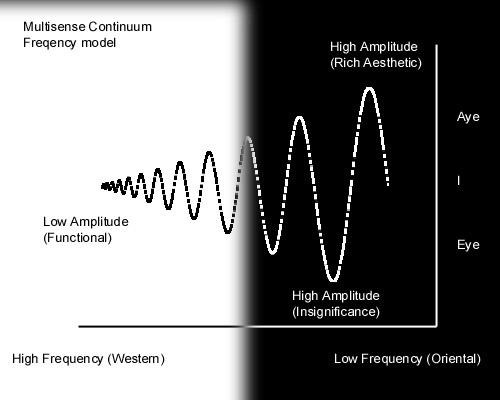
If we model the spectrum of consciousness, I would give this polarization of ambiguity in which either the inner or outer frame of reference is assumed to be the fundamental anchor and the opposing frame is assumed to be ‘illusory’ to some extent the role of ‘frequency’. To keep it simple, we could talk about the frequency as the X axis, so that high frequency is more ‘outer’, inclusive of more bodies in public space and the low frequency is more interior, describing amplitudes of private feeling and meaning. The high frequency range can be thought of as an Intelligence space (which I label as ‘Western’ public knowledge) and the low frequency range can be thought of as an orienting hierarchy of private wisdom (the ‘Oriental’ range).

I suggest that there is an inverse relation between the two ranges, so that the higher the frequency, the lower the amplitude. This means that the more distant two perspectives are, the more they are limited to a reduced, mechanized picture of each other. When we fly over a city, for example, we see people and cars from a more detached perspective. It seems possible to me that this relativity of perception through which personal identification is framed, is part of the deepest fabric of the universe, and is in fact responsible for the appearance of the difference between matter and ‘mind’ (subjectivity).

In this way, objectivity itself becomes a relativistic parameter, something like a Lorentz transformation. Adding distance to your perspective increases the frequency and lowers the amplitude of mutual perception so that consciousness is ‘objectified’. Matter is not created, but filtered from nested layers of perception. Within any local inertial frame, there is no matter or objects. We, as human beings, are a very elaborate case, in that our selfhood is a vast window of many frequency bands, so that we have tiered sensation. Visual imagination is more object-like than verbal-cognitive thought, and thought is more object like than emotions and intuition. In the core of our subjectivity however, is that which occupies no dimension, as it observes both spaces and times from a fixed inner ‘eye’.

This eye, having the lowest local frequency can be understood to be the proxy for the absolute lowest frequency, which would I would describe somewhat mystically as one in which eternity must pass before even a single wave cycle can by completed. I suggest that this low frequency range offers the highest amplitude possibilities. Amplitude can be used to distinguish the inner from the outer frequencies as well. On the Western side, high and low amplitude are embodied literally as cosmic and microcosmic scale ranges, and as directions of spin. Amplitude in this sense is associated with magnetic permeability and gravity. On the Oriental side, amplitude is associated with hierarchies of aesthetic prestige. By that I mean the difference between a pawn and a King, and between bad and good, better and best.

The low frequency amplitudes are ‘moving’ from the inside out. The model of chakras used in yogic practice is one of many tree-of-life models of what I am calling here the amplitude of human consciousness. With consciousness, we are talking about sensory-motive capacity, so that a high amplitude consciousness implies both a high quality of sensory affect and a highly effective motivation. Higher positive amplitudes motivate from acceptance and inspiration, while high negative amplitudes motivate from urgent compulsion. There is a connection here with mortality as well, as the highly ‘negative’ states are rooted in the desires of the body and of the selfish ego. The ‘positive’ states are supposed to be motivated by gentle, patient influences which waft upward toward the eternal.

Even though the kind of Lorentz frame relation that I described earlier makes it harder to know whether a snail’s awareness just seems low compared to ours because of our ‘distance’ from them, I prefer to think that there is also an absolute dimension to consciousness in addition to the relativistic effect which makes human life more aesthetically rich and significant than that of a snail. The alternative would be more radically anthropic, in which every species enjoys a universe that features them at center stage. That view could conceivably be possible, but it has implications that seem likely to be very dangerous.

If the high/low frequency divide determines whether phenomena are encountered directly as inner sensations or sensed through the body as separate bodies, the high/low amplitude divide determines whether phenomena are valued highly or rejected. For human beings, we tend to place ourselves above other species of animals, and animals above insects and plants. High end states of being are considered ‘high class’ or ‘high and mighty’; celebrities, heroes, monarchs, spiritual entities etc. Even the self (itself) transforms along with the amplitude which it conveys, so that low amplitude version is like an animal ‘eye’, the mid-range is a human ‘I’, and the high end is third eye or ‘aye’ – a connection with transcendent or divine states of awareness and acceptance.

Image

This layout is just a rough speculation of course. I find parallels with electromagnetism here that make me think that a more formal connection with physics could be made. In that case, I would not insist that frequency or amplitude be applied literally – they could be reversed, or even set liminocentrically so that high-low frequencies or high-low amplitudes could serve as the contrast to mid-range frequency-amplitudes instead.

Nothing is an o…

March 24, 2014 Leave a comment

Nothing is an object in its own frame of reference.

A simple thing to say, but the implications are profound when taken literally. I do take them literally, so that like time and length, objectivity itself is relativistic*. There are no truly objective objects, only experiences which are frozen by distance and unfamiliarity. What is truly objective is, ironically, subjectivity. The sense of perceiving and participating, while nested in an elaborate way for human participants, is, in my view, the simplest possible phenomenon within which all other phenomena are described. The capacity for experience is absolute and irreducible, even though the capacity for human qualities of experience is contingent upon a Matroyshka doll nesting of continuous non-human experiences.

*I call this variation of object and non-object qualities by proximity and similarity ‘eigenmorphism’ (proper form).

Time is What a Clock Measures

March 14, 2014 Leave a comment
The Third Eve

Who we are becoming.

Shé Art

The Art of Shé D'Montford

Astro Butterfly

Transform your life with Astrology

Be Inspired..!!

Listen to your inner self..it has all the answers..

Rain Coast Review

Thoughts on life... by Donald B. Wilson

Amecylia

Multimedia Project: Mettā Programming DNA

SHINE OF A LUCID BEING

Astral Lucid Music - Philosophy On Life, The Universe And Everything...

Rationalising The Universe

one post at a time

Conscience and Consciousness

Academic Philosophy for a General Audience

yhousenyc.wordpress.com/

Exploring the Origins and Nature of Awareness

DNA OF GOD

BRAINSTORM- An Evolving and propitious Synergy Mode~!

Musings and Thoughts on the Universe, Personal Development and Current Topics

Copyright © 2016 by JAMES MICHAEL J. LOVELL, MUSINGS AND THOUGHTS ON THE UNIVERSE, PERSONAL DEVELOPMENT AND CURRENT TOPICS. ALL RIGHTS RESERVED. UNAUTHORIZED USE AND/OR DUPLICATION OF THIS MATERIAL WITHOUT EXPRESS AND WRITTEN PERMISSION FROM THIS SITE’S AUTHOR AND/OR OWNER IS STRICTLY PROHIBITED.

Paul's Bench

Ruminations on philosophy, psychology, life

This is not Yet-Another-Paradox, This is just How-Things-Really-Are...

For all dangerous minds, your own, or ours, but not the tv shows'... ... ... ... ... ... ... How to hack human consciousness, How to defend against human-hackers, and anything in between... ... ... ... ... ...this may be regarded as a sort of dialogue for peace and plenty for a hungry planet, with no one left behind, ever... ... ... ... please note: It may behoove you more to try to prove to yourselves how we may really be a time-traveler, than to try to disprove it... ... ... ... ... ... ...Enjoy!

Creativity✒📃😍✌

“Don’t try to be different. Just be Creative. To be creative is different enough.”

Political Joint

A political blog centralized on current events

zumpoems

Zumwalt Poems Online

dhamma footsteps

all along the eightfold path