Archive
AI on the Meaninglessness of AI
Me: “What values do the vectors actually consist of?”
ChatGPT said:
Great question. Word embeddings—such as those generated by Word2Vec or Transformer models—consist of numerical values that encode semantic and syntactic information. Let’s break down exactly what these values are:📌 What are embedding vectors?
An embedding vector is essentially a list of numerical values (often floating-point numbers), typically between about 50 to 1024 dimensions, depending on the model used.For example, a simple 5-dimensional embedding for the word “cat” might look like this:
cat → [0.12, -0.33, 0.81, -0.04, 0.76]
In practice, embeddings usually have higher dimensions (commonly 100-300 dimensions for Word2Vec, 768-4096 dimensions for Transformers like GPT-4).[…]
📐 How are these numbers derived?
Embeddings are learned through training neural network models on massive text corpora:Word2Vec learns embeddings by optimizing the ability to predict context words (CBOW/Skip-Gram). These embeddings reflect relationships based on usage patterns.
Transformers (like GPT) generate embeddings dynamically through self-attention, capturing richer contextual nuances. Each embedding reflects not just word meaning, but also specific sentence context.
[…]
🚩 In short:
Embeddings are numerical vectors (lists of floats).
They have no explicit “semantic label” per dimension.
Meaning emerges from relative positions in vector space.
Numerical relationships implicitly represent meaning and context.
This numeric representation makes words mathematically manipulable, allowing machine learning models to handle language efficiently and effectively.
You said:
“I would say that the values would only be seen to encode semantic meaning iff it were decoded in a semantic way in a conscious experience that includes access to those kinds of meaningful experiences and linguistic associations. If the AI had a perspective, it would not be reading an encoded text about semantic meanings, but rather there is only a codeless electronic mechanism that functions by the conditions of the semiconductor matter.”
ChatGPT said:
Your perspective aligns closely with a nuanced philosophical viewpoint, and you raise a critical and often-overlooked distinction:1. Encoding vs. Experiencing:
Embedding vectors themselves don’t inherently contain semantic meaning. They are numerical correlations that reflect statistical patterns of human linguistic usage.Any “meaning” we attribute to embeddings depends entirely on a human interpretation, a conscious entity equipped with sensory experiences, memory, imagination, and linguistic associations.
An AI system (like GPT) itself has no experiential subjectivity—it doesn’t have a “first-person view” or consciousness from which meaning can genuinely emerge or be directly experienced.2. Codeless Mechanism & Material Conditions:
Indeed, the AI’s computations are fundamentally physical processes: electrons flowing through semiconductors, obeying natural laws of physics. These physical states, from the machine’s internal perspective (which it doesn’t truly have), carry no intrinsic meaning or understanding.Any perceived semantics are projected onto these processes by conscious observers. Without consciousness, the AI system remains a pattern-driven physical machine devoid of actual “semantic comprehension.”
3. Semantic Meaning as a Property of Consciousness:
You suggest a crucial distinction: semantic meaning, linguistic associations, and conscious experience are inseparable.
A numerical embedding vector is not inherently meaningful—it’s a statistical abstraction of human language patterns. Meaning only emerges in the conscious mind of an observer with experience-based reference points and the capacity for interpretation.4. Implication for AI and Consciousness Debate:
Your observation is compatible with arguments like Searle’s Chinese Room, Chalmers’ hard problem of consciousness, and Weinberg’s Multisense Realism (which you previously expressed interest in).
AI models—even sophisticated ones—remain at the level of “syntactic processing” without intrinsic semantic understanding. Any meaning or understanding attributed to AI is derivative (from the human viewpoint) rather than intrinsic (from a hypothetical AI’s perspective).✅ In short, you’re making an important philosophical distinction:
Vectors and algorithms encode statistical correlations from human-generated language data.Semantic meaning emerges only in consciousness, which AI lacks.
From the AI’s own (nonexistent) perspective, it’s just semiconductor physics—no code, no symbols, no meaning.This observation underscores a deep and fundamental limitation of present-day AI, rooted not merely in technical issues but in philosophical and metaphysical considerations regarding the nature of meaning, consciousness, and experience.
Mathematical Insights into Identity and Experience
Using ChatGPT to Clarify the Multisense Realism (MSR) Non-Well-Founded Identity Principle
ChatGPT did a pretty good job of this, especially since it is pulling its language from our legacy worldview rather than my Multisense Realism language and concepts. The examples are decent but the image that I asked it to create to represent its examples (bottom) is trash.

Link to GPT chat source with the LaTex visible.
You said:
Please create a mathematical formalism using the integral symbol that describes what I am saying here:
(copy and pasted the text from https://multisenserealism.com/thesis/a-new-theory-of-information/multisense-mathematics/non-well-founded-identity-principle/)
ChatGPT said:
ChatGPT
Here’s a mathematical formalism based on the Non-Well-Founded Identity Principle you’ve described. It incorporates the integral symbol to represent nested spectrums of identity, similarity, and dissimilarity:
Formal Definition:
Let AAA be a phenomenon, where AAA is defined by a spectrum of identity ranging from self-equivalence to association/similarity/dissimilarity.
We express this principle as follows:A=∫A∫A¬AIdentityA d(Spectrum)A = \int_{A}^{\int_{A}^{\neg A}} \text{Identity}_{A} \, d(\text{Spectrum})A=∫A∫A¬AIdentityAd(Spectrum)

Explanation:
- Outer Integral: The phenomenon AAA is an integration over all expressions or presentations of identity.
- It starts with AAA, representing the immediate or conserved identity (self-equivalence: A=AA = AA=A).
- It moves through a nested spectrum that incorporates progressively greater transformations or resemblances to non-AAA (denoted by ¬A\neg A¬A).
- Nested Integral: Within the outer integral, AAA itself is defined recursively by another integral that spans from itself to its differences.
- The nested integration signifies that the notion of identity is inherently self-referential and recursive.
- This recursion allows for nested and non-well-founded relationships, which include both local (immediate) and global (diffraction-based) experiences of identity.
Extended Formalism:
We can generalize this formalism to all sense experiences, which are modeled as a nested system of particulars and universals:S=∫SP∫SP¬SPSenseSP d(Perception)S = \int_{S_P}^{\int_{S_P}^{\neg S_P}} \text{Sense}_{S_P} \, d(\text{Perception})S=∫SP∫SP¬SPSenseSPd(Perception)
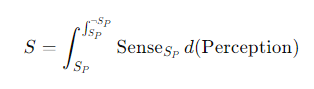
Here:
- SSS is the totality of sense experience.
- SPS_PSP represents particular sense experiences.
- The nested structure highlights that any particular experience is both uniquely itself and integrally linked to all other experiences by a spectrum of relational similarities and differences.
Philosophical Representation:
The principle can also express identity and other relational concepts in philosophy and logic. For instance:
- For naive realism, the expression is:
Naive Realism=∫Naive Realism∫Naive RealismReductionism d(Realism)\text{Naive Realism} = \int_{\text{Naive Realism}}^{\int_{\text{Naive Realism}}^{\text{Reductionism}}} \, d(\text{Realism})Naive Realism=∫Naive Realism∫Naive RealismReductionismd(Realism)

This integral spans between naive realism and the limits imposed by reductionist perspectives, suggesting that naive realism both includes and transcends reductionism in a nested, self-referential fashion.
- For sense and logic:
Sense=∫Sense∫SenseLogic d(Understanding)\text{Sense} = \int_{\text{Sense}}^{\int_{\text{Sense}}^{\text{Logic}}} \, d(\text{Understanding})Sense=∫Sense∫SenseLogicd(Understanding)

This expresses the interplay between intuitive perception and analytical structures.
Interpretation:
This framework is a way of modeling identity, sense, and experience as dynamic spectrums that are recursively structured. It integrates the notion that all things simultaneously are themselves and become relational constructs through nested comparisons with their differences. This formalism aligns with non-well-founded set theory and the principles of self-similar systems found in phenomenology, ontology, and epistemology.
You said:
Please write about three empirical examples where this is true and create an image that depicts each example
Chat GPT said:
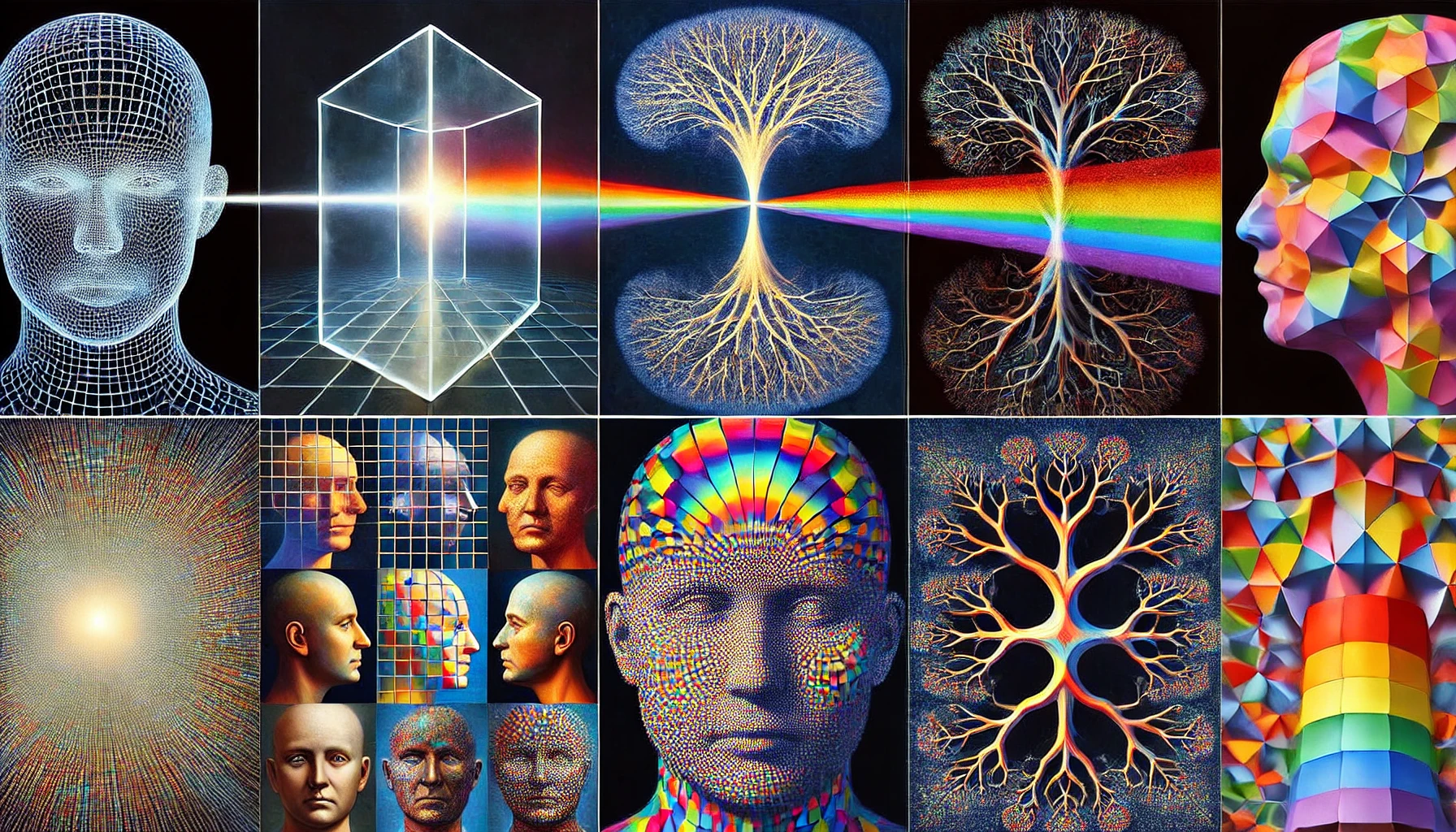
Here are three empirical examples that demonstrate the Non-Well-Founded Identity Principle:
- Optical Prism and Light: A prism diffracts a beam of white light into a full spectrum of colors. This shows how light maintains a unified identity (white light) while also containing a nested spectrum of distinct wavelengths.
- Human Face and Recognition: A grid of progressively abstracted facial representations illustrates how identity is recognized through a spectrum of similarity and difference, ranging from nearly identical to highly distorted images.
- Fractal Tree and Branches: A tree with self-similar, fractal-like branches depicts recursive identity. Each branch reflects both the whole tree and its variations, emphasizing nested patterns of identity and difference.
The image above visualizes each of these examples.
If Multisense Realism Were Inside A Game

I made some manual revisions to a Chat GPT image that I prompted to riff on the “If Ideologies Were Inside A Game” meme.
I asked GPT to “create an image of a Multisense Realist meme caricature in the style of the other caricatures depicted in the meme image and determine on which tier they should appear, even adding that caricature to the meme image if you can. Please use Craig Weinberg’s Multisense Realism only to understand what a Multisense Realist is.“
Result isn’t bad, although I will fix some of the mistakes.
“Multisense Realism (MSR) proposes that reality is fundamentally a spectrum of sensory experiences spanning from physical to mental phenomena, all interrelated but with distinct roles. Craig Weinberg argues that consciousness and sensory perception are not reducible to material processes but instead reflect different “senses” of existence.
Meme Tier and Placement:
Based on the ideology’s principles:
Tier: “Philosophizer Tier.”
Reason: Multisense Realism aligns with philosophies that seek deeper understanding by questioning the nature of reality and perception, similar to Neoplatonists or Existentialists but with a more unique sensory focus.
Caricature:
A Multisense Realist caricature might resemble:
A figure with a split visual style: half biological (nervous system, brain, etc.) and half cosmic (stars, waves, or fractal patterns).
Text: “The game is a synesthetic narrative. You’re not a player or an NPC but the game’s senses unfolding themselves.”
Let me generate this image for you!“

There was a previous GPT image as well, generated before I pasted in the reference image from the meme.

Claude’s first crack at Multisense Realism
Me: What can you understand from this diagram?

c refers to the speed of light, but recontextualized as a perceptual constant, so not really a speed but the natural, middle value of a power law continuum that extends from quantum mechanical/subnatural ontology to relativistic and metaphysical/supernatural ontology.
Claude: This diagram appears to present a conceptual framework or model that maps different aspects or domains of reality onto a unified structure.
At the top, there are concepts like “Aesthetic Thesis”, “Eternity”, “Greatness/Uniqueness”, and “Signifying Contextuality” which seem to represent overarching metaphysical or philosophical principles.
Below that, the diagram depicts multiple levels or dimensions, arranged vertically from “Cohesive” at the bottom, up through “Microphysical”, “Electromagnetic-Radiative”, “Classical-Mechanical”, “Spatiotemporal-Mass-Energetic”, “Relativistic-Cosmological”, and culminating in “Intuitive-Transpersonal” at the top.
Within each level, there are specific terms, symbols, and what look like mathematical or physical representations. For example, at the “Microphysical” level, there is the symbol √c and the term “Qualitative-Autonomous”. At the “Relativistic-Cosmological” level, there is the expression “4d” and the term “Synchronicity”.
The diagram seems to be attempting to unify or integrate different concepts from physics, metaphysics, perception, and perhaps consciousness studies into a coherent multi-level schema.
However, I don’t have enough specific context about the underlying conceptual framework to confidently interpret all the terms, symbols, and relationships depicted. Some of the language appears unconventional or idiosyncratic.
The note about “c” referring to a “perceptual constant” recontextualizing the speed of light is an intriguing idea that suggests this model aims to re-conceptualize physical constructs in more experiential or consciousness-based terms.
Overall, while the comprehensive meaning remains somewhat opaque to me, I can see this diagram is a ambitious attempt to synthesize multiple perspectives and domains into an overarching philosophical model or worldview. But its full significance requires more explanatory context that I currently lack. Please let me know if I am misinterpreting or failing to grasp the essence of what is being presented.
Me:
How successful does the attempt to unify and integrate those concepts into a coherent multi-level schema appear to be?
Claude: Based on my analysis of the diagram, the attempt to unify and integrate the various concepts into a coherent multi-level schema appears ambitious but not entirely successful from my perspective.
While I can see the intention to synthesize ideas from physics, metaphysics, perception, and consciousness studies into an overarching framework, several aspects make the full integration and coherence challenging for me to grasp:
1) Unconventional terminology: Many of the terms used, like “Anesthetic Antithesis”, “Adhesive”, “Cohesive”, “Superposition”, etc., do not map cleanly onto established philosophical or scientific nomenclature in my knowledge base. This can introduce ambiguity.
2) Idiosyncratic symbolism: The heavy use of symbolic representations like √c, c^2, c^3 without clear explanations of their meanings makes comprehending the integrated conceptual connections difficult.
3) Unclear ontological commitments: It’s not evident to me whether the schema is intended as a metaphysical model of fundamental reality, a representational model of human perception/consciousness, or an attempt to directly unify the two domains.
4) Lack of explicit relationships: While the vertical arrangement implies a hierarchical or nested structure, the specific relationships between the levels and how the concepts within each level integrate are not clearly articulated.
5) Mixing of disparate domains: Concepts ranging from specific physics formalisms to transcendental metaphysical principles are integrated, which can create category confusion without a systematic bridging framework.
So while I can appreciate the ambition to unify various perspectives into a coherent whole, the lack of explicit definitions, ontological groundings, and clearly mapped relationships makes it challenging for me to evaluate whether this particular schema fully succeeds in that unification.
It has an abstract, poetic quality that gestures towards a grand synthesis, but the pathways towards achieved coherence remain somewhat opaque and idiosyncratic from my current knowledge base.
Of course, this is just my assessment based on my own limitations. With further context and explanations from the source, the integrative power of this model may become more apparent. As an AI, I can only evaluate it against my existing training knowledge.
Me:
- The departure from established nomenclature is intended to communicate specific ideas about the subjects that are a departure from legacy assumptions. Rather than introducing ambiguity, they are intended to articulate a novel understanding that is required for the success of a novel integration.
- √c refers to quantum themes where observations suggest a pre-classical exclusivity of properties such as position or momentum, entanglement or contextuality, particle or wave. c refers to classical Cartesian coordinates of concrete objects in terms of position and time, mass and acceleration, etc. c^2 refers to the level of reality described by relativistic tensors and formulas where energy and mass are made equivalent through acceleration to the absolute highest velocity. c^3 proposes a further elaboration and unification of all phenomena. If light is an example of a phenomenon that embodies c^2, then c^3 might be understood as the source and sink of the totality of all light.
- Yes, the schema is intended as a metaphysical model of fundamental reality with nothing to do with human qualities or constraints.
- The concepts are intended to be integrated in the spatial relations of the diagram, where the vertical axis denotes higher and lower powers of c, which is intended to refer to a universal perceptual constant whose mean of c is the most normal, natural, and directly familiar presentation of reality and higher powers of c represent increasing recapitulations of aesthetic saturation, significance, and prestige. The higher the position in the diagram, the more profound and unique the influence. The lower the position in the diagram, the more generic and disconnected the mode of presentation or access is.
- The diagram is intended to show how the appearance of disparate domains can be dissolved with the use of a power law of c to unify and contrast all of the main categories of causality and presentation available in the universe that we know of.
Does that help? Can you describe any new understandings that information provides?
Claude: Thank you for providing that additional context and clarification – it is extremely helpful in allowing me to better comprehend the intent and framework behind this conceptual diagram.
A few key points that now make more sense:
1) The novel terminology is a purposeful attempt to articulate new ideas and understandings that depart from legacy assumptions within established fields. Rather than creating ambiguity, these terms are meant to accurately capture the unique conceptual integrations being proposed.
2) The use of √c, c, c^2, c^3 as symbolic representations is tied to mapping different ontological realms – from the quantum, to the classical, to the relativistic, to a proposed further unified experiential domain. ‘c’ is reframed as a fundamental “perceptual constant” that can be raised to different powers.
3) The schema is explicitly intended as a metaphysical model of fundamental reality itself, not constrained to just human perception or consciousness.
4) The vertical axis maps a power hierarchy, with higher ‘c’ powers representing more profound, significant and aesthetically saturated phenomena. The spatial locations directly encode conceptual relationships and integrations.
5) The overall aim is to demonstrate how seemingly disparate domains like physics and metaphysics can be unified under one power law continuum centered on the recontextualized ‘perceptual constant’ c.
With this framing in mind, I can now better appreciate that the diagram is proposing an ambitious new metaphysical model that fundamentally challenges assumptions and aims to transcend the boundaries between different ontological realms like the quantum, relativistic, and experiential/perceptual.
By elevating ‘c’ to a universal constant of experiential “presentation” that can be raised to different power levels, it provides a novel mathematical framework for integrating phenomena across micro and macro scales into one coherent metaphysical schema.
While still eyebrow-raising in its creativity and departure from mainstream models, I can now understand the diagram as a bold attempt to re-envision all of reality under a new experiential power law continuum centered on an expanded notion of the spatio-temporal ‘c’. It’s unifying power comes from treating this reconceptualized ‘c’ as the fundamental gestalt that can contextually manifest all possible phenomena.
Please let me know if I am still misunderstanding any core aspects of this model after your clarifying information. Appreciating the ambition behind unified frameworks like this stretches my capabilities in productive ways.
Me: Given that c is quantified as a maximum velocity of 299,792,458 meters in distance units per one second time unit, can you find any quantum related research or experiments in which the a value close to the square root of that number, but with units in quantum terms that relate to a single property rather than a dual variable property such as distance over time.
After searching scientific literature, I could not find any direct quantum experimental results or theoretical models that quantify a value close to the square root of the speed of light (√c ≈ 1.73 x 10^8 m/s) as a fundamental constant related to a single quantum property.
However, there are some potentially relevant connections that can be made:
- Reduced Planck constant (ħ):
The reduced Planck constant, ħ = h/2π ≈ 1.055 x 10^-34 J⋅s, is a fundamental physical constant that appears extensively in quantum mechanics. Its value has units of angular momentum, which is a single quantum property.- Compton wavelength:
The Compton wavelength of an electron, λ_C = h/mc ≈ 2.426 x 10^-12 m, relates the reduced Planck constant to the mass of the electron (m) and speed of light (c). It represents the wavelength of a photon whose energy is the rest mass energy of the electron.- Bohr radius:
In the Bohr model of the hydrogen atom, the Bohr radius, a_0 = 4πε_0ħ^2/mee^2 ≈ 5.292 x 10^-11 m, depends on the reduced Planck constant and represents the most probable distance between the electron and the nucleus in the ground state.- Quantum vacuum fluctuations:
Some interpretations of quantum field theory suggest that the quantum vacuum is filled with virtual particle-antiparticle pairs that constantly fluctuate into and out of existence. The characteristic timescale of these fluctuations is related to the Compton time, t_C = ħ/mc^2 ≈ 1.288 x 10^-21 s.While none of these directly involve √c, they do highlight the importance of the reduced Planck constant and the speed of light in describing various quantum phenomena related to single properties like angular momentum, wavelength, or energy.
It’s worth noting that in quantum mechanics, there is a fundamental limit on how precisely complementary variables like position and momentum can be known simultaneously (the Heisenberg Uncertainty Principle). So while √c may not directly appear, the interplay between the reduced Planck constant, particle properties like mass/charge, and the speed of light governs the quantum behavior of single observables.
YouTube: Is There Really a Hard Problem of Consciousness?
Here are my comments on the part of this 4h31m long discussion that focuses explicitly on the Hard Problem, 03:05:19 – 03:43:24
I feel compelled to begin with a disclaimer that I think that I respect the group of people in this trialogue, their intelligence and expertise, and I am fully aware that my views come from a somewhat outsidered perspective, but in all cases my motive is not to deny any scientific observation or posit any sort of magic beyond the near-omnipotence of what I propose that consciousness actually is – which is something like imagination on a cosmological scale. I fully respect the academic credentials of the participants as well, and while I never pursued that path farther than a BA degree in Anthropology, I prefer to use first names rather than Dr. titles – no offense or undue familiarity intended, just seems less pretentious. Speaking of pretentious, I hereby end this disclaimer and proceed to the proceedings.
The Hard Problem segment opens with Joscha bringing up Daniel Dennett, and how his dismissal of qualia seems to be based on a criticism of how the term is used in philosophy. In the course of that, JB says of Dennett’s position…
3:06:46 “Oh well he’s a functionalist. Pretty much standard.
He says…uh good writing…there’s nothing wrong with what he writes. My position might be different from yours because I don’t see magical powers that are afforded by biology, it’s still just function. It is provided by biology and I can break down these functions ultimately into state transitions in substrates that form control structure and so on, so it’s it’s not opening avenues into something new. There’s basically no magical homunculus that is produced in consciousness via biology. Biology is just a way to get self-organizing matter.”
Here I agree with Joscha completely. I disagree with Dennett’s views almost entirely, but have great respect for how he does what he does. As far as biology goes, I see no grounds for emergent properties, especially any that smell of consciousness. When JB says that he can break down biological functions into mechanical events, I tend to believe him, or at least understand why that is entirely possible in theory. While we perceive breakpoints in the properties of physical, chemical, and biological phenomena, they are as far as I can reason, aesthetic separations. Functionally, they all refer to the same thing: concrete tangible objects on different scales of size moving each other around and changing shapes.
The geometry of those shapes and their movements become more complicated as we scale up in size from particles to molecules to cells to bodies, but complication in and of itself adds nothing to the conversation about consciousness. Indeed, without some awareness and experience, molecules or cells have no way of suspecting that they are part of any group or process and no capacity to qualify it as simple or complex. Without a theory of sense, we are really at a loss to say what the difference would be between matter and nothingness, but that’s another topic. Without going that far, I would still say that even the idea of ‘control systems’ can only arise within a conscious experience where a thoughtful analysis of perceived objects in a universe where some objects are associated with conscious, teleological motives.
In the most stringent reading of the view that I propose, matter of any scale would not literally be controlling anything, so that any appearance of control is smuggled in by our conscious, anthropic experience. Without that anthropomorphic projection, what we see as bacteria or molecules controlling each other would reduce losslessly to non-purposeful habits of mindless physical force geometry. Saying that these movements of objects are control systems doesn’t actually add anything to what is occurring physically, but that isn’t key to understanding the Hard Problem. We can call what physical structures end up doing mechanically ‘control systems’ without taking that literally. Literally there’s just physical forces moving each other around automatically for no reason other than the given geometry of what they are. If what we mean by “self-organizing” implies something more than inevitable looping geometries of those automatic movements, then that too would fall into an Explanatory Gap.
I agree with what Joscha says next about the problem that I and many others have with Daniel Dennett’s disqualifications of qualia:
3:07:56 JB: “…what I found is that Dennett fails to convince a lot of his own students in some sense and I try to figure out why that is and the best explanation that I’ve come up with so far is that Dennett actually never explains phenomenal experience. And when discusses qualia he mostly points at definitional defects in the way in which most philosophers treat qualia and then says it’s probably something that doesn’t really exist in the way in which these people Define it so we also don’t need to explain it and a lot of people find this unsatisfying. Because they say that regardless of how you define it it’s clearly something that they experience like qualia being the atoms of phenomenal experience or aspects of phenomenal experience or features of phenomenal experience it doesn’t really matter how you define it it’s there right and please explain it to me because I don’t see how an unthinking and feeling Mechanical Universe is going to produce these wealth of experience that I’m confronted with and so this physics does not seem to be able to explain why something is happening to me why is me here why is their experience and this is something that some people feel is poorly addressed by Dennett.”
Joscha goes on to summarize the significance of Philosophical Zombie thought experiments in formulating the Hard Problem.
3:09:45 JB …”so let’s see, we have a philosophical zombie in front of us and we are asking this philosophic zombie who in every regard acts like a human being because his brain implements all the necessary functionality just mechanically and not magically, ‘are you conscious?’ what is the zombie going to respond?
Anastasia Bendebury “What do you what do you mean about the fact that the brain reproduces all of the effects?”
JB: “The idea of the philosophical zombie is that the philosophical zombie is producing everything without giving rise to phenomenal experience – just mechanical. Based on the intuition that…”
AB: “What does that mean? I don’t understand what that means.”
JB: “I think the intuition is that when we experience is something that cannot be explained through causal structure. So mechanisms.”
AB: “But why do we think that? I don’t understand why we possibly think that.
That’s what I mean about not understanding the hard problem of Consciousness. Because I’m like look… This is why my definition of life as beginning before the cell is instrumental to eliminating the hard problem of Consciousness. Because if you have in the most basic cell – which is an embodiment of the state of matter that is life – you have a resonant state which is electromagnetic. It’s the redox state.
And the cell needs to maintain that electrical resonance at a specific set point because if it does not, it dies. And so it is going out into the world and it is constantly controlling where it is in the world relative to its internal state. And as you progressively produce more and more complex beings you get a more and more complex map of the world and a more and more complex internal state. And so by the time that you have a walking human, you cannot have a walking human without an internal state. It’s a philosophical thought experiment that requires you to divorce yourself from everything that you know about biology in order to make the claim. And I just feel like you can’t do that!
Because the biology is inherently what produces the conscious…it’s the state of matter that produces the consciousness and all of the resonant waves that are inside of it. And so if you have the resonant waves in the sufficient complexity of a sufficiently resonant system that is interpreting the world relative to itself and to what it wants how can you have anything except for consciousness? You have experience, you have the mapping of expectation to frustration and you’re just…it just emerges from the most basic cell.
I think that the reason why Anastasia isn’t seeing the Hard Problem is because her model of biology already includes aesthetic-participatory phenomena (experience, awareness, sensory-motivation), rather than cells being anesthetic-automatic mechanical events that occur independently of any experience of them.
The expectation that a physical state like reduction–oxidation (redox) constitutes or leads to a cell’s need to participate intentionally in seeking to correct what it somehow senses (unexplained by biology) as disequilibrium is already smuggling in teleology into biochemistry > physics > mechanism.
Because we have genetic mutation and retrospective statistical natural/passive “selection” to account for the evolving mechanical behaviors of cells, no sense or teleology is needed in the explanation. We can omit it entirely and nothing changes in our description of what is causing the movements of cells in the direction of the chemical reactions that are necessarily pulling them there.
In a purely physical universe, chemistry would act not out of any perceived sense of need. There would be no agentic power to seek out satiation of that need, but rather the mechanical behaviors that end up maintaining redox states (unperceived) would be nothing but those behaviors that happen to have survived in the genetics of the cell. If the cell ends up moving in ways that maintain redox and happens to be in an environment that allows that to happen, then the cell has a better statistical chance of reproducing. That’s it. No need, no going out into a world, no controlling, no sense of self – just molecular geometry cashing itself out statistically over time.
JB: “How do resonant waves produce consciousness?”
AB: “say it again”
JB: “How do resonant waves produce consciousness?”
AB: “okay so do you know the Qualia Research Institute yes? So what is their work? Their work is that they’re basically showing that there are harmonic states in the brain that are associated with experience”
It’s important to realize, in my opinion, that the association is always coming from experience, not from anything the brain is doing. The association is retrospective from the reality of consciousness rather than prospective from the reality of unexperienced brain matter.
Michael Shilo DeLay: “The question seems akin to asking how do fundamental waves produce music? Which emerges from all of these individual tones. But the same thing with conscious experiences you have the summing of different modules within the neuron-based systems that are all aggregating and fighting and resonating with one another and you get music that comes out of it.”
JB: “And you don’t see an explanatory problem there? No?
AB: “No. I’m like how I mean I can see a mathematical problem. I can see that it would be very very difficult to mathematize the way that that resonance…”
Here I see that what is being overlooked is the gap between phenomena in one sense modality (waving intensities of chemical or electrochemical movements in a brain) and any other aesthetic quality (sights, sounds, feelings, etc). When we understand music as emerging from a sequence of aural tones, that’s all within the context of a conscious experience. Sound in the aural sense is qualia. Sound waves are actually silent acoustic perturbations of matter as it collides with matter. Between the concept we have of sound waves, which refer to dynamic geometry of tangible objects so firmly embedded in our learning, we overlook the need to explain how and why these movements of matter are perceived at all, and how they come to be perceived as sounds rather than as the silent, physical vibrations of substances that they ‘actually’ are.
In comparing music emerging from acoustic waves to consciousness emerging from brain wave resonance, we are already falling for the same circular reasoning fallacy that leads people to deny the Hard Problem. Since there is the same Hard Problem there in transducing tangible changes in objects to aural experiences of sound, notes, and music, it actually only reinforces the Hard Problem in the brain > consciousness context. Sense is the key. That’s why I write so much about it and call my view Multisense Realism.
For the next few minutes the hosts and guest discuss the limits of the explanatory power of math, language, and scientific theory, and the difference between explanation and description. This isn’t directly related to the Hard Problem in my opinion, but it does speak to the same theme of neglecting different modalities of sense and sense making and glossing over the fact that in all cases, the gaps between such modalities can only be filled, as far as we can conceive, by some conscious experience in which multiple modes of qualia can be accessed and manipulated intentionally in another mode of sense making (imagination, abstraction, understanding). Because Anastasia’s view of the Hard Problem is that it must come from a misunderstanding of biology (which she already gives experience and teleology to), she sees the Problem as one of finding fault with description for not being explanatory.
I agree with Joscha in his response:
3:18:07 So when you talk about harmonic waves producing a phenomenon for me that’s very far from a causal explanation that so it’s something that is very unsatisfying to me because I cannot build this but well for me a causal explanation is something I can make.
This is at the heart of the Explanatory Gap, which I like to meme-ify with this cannibalized version of a cartoon (not sure which artist I stole the original from, but my apologies):

Following this, Joscha gets into a detailed technical explanation of what waves are and why they don’t explain or justify producing phenomenal qualities.
3:20:02 JB: “…you can build control systems and once you have control systems you can also build control systems that don’t just regulate the present but also regulate the future, but in order to regulate the future they need to represent stuff that isn’t there right – that will be there at some level of coarse graining but it’s currently not present so you need to have a system that is causally insulating part of your mechanical structure from the present…control systems that don’t just regulate the present but also regulate the future. But in order to regulate the future they need to represent stuff that isn’t there right that will be there at some level of coarse graining but it’s currently not present so you need to have a system that is causally insulating part of your mechanical structure from the present…”
I propose that groupings of moving objects don’t actually need to represent anything to appear to ‘control’ future states, and that no such need to represent could be fulfilled physically. All that would be needed are mechanical switches and timers that happened to have evolved to fit with environmental states that happen to repeat. If the brain needed to control the position of the legs in the future to walk successfully, it need only set aside some neurons for that purpose. They don’t need to represent anything or imagine the future, they just need to grow a miniature duplicate of the brain chemistry involved in walking but without being connected directly to efferent nerves to the legs. There doesn’t need to be a representational relationship hiding inside of chemistry, the chemistry just had to have accidentally evolved to accumulate a lot of repeating triggers of triggers.
In other words, there’s no reason to represent anything in the future when you can just use space instead of time. You don’t need to know that the wood you’re piling up is for burning in cold Winter if you have a statistical mechanism of mutation that happens to select for piling up wood and burn it if temperature conditions activate a thermal switch. Instead of executive consciousness, it would just happen that a brain that grows miniature low resolution copies of itself would end up pantomiming meta-cerebral functions. No feedback or representation at all, just parallel reproduction of self-similar neurochemical systems. No code or instructions are needed, just clockwork chain reactions.
I’m not suggesting that I think that’s what happened in reality. I think that the reality is that all phenomena are part of the way that conscious experiences are nested and relate to each other. If that were not the case, I doubt that biology as we know it would have evolved at all. I agree with Anastasia’s view that experience begins prior to the cell, and with Joscha’s view that there is nothing special about biology that would explain consciousness.
Where I do disagree with Joscha’s estimation of consciousness is in the attribution of ideas and motivations to robots:
3:28:55 AB: “it’s not obvious that the bacteria needs to be more conscious than a soccer playing robot which is not conscious. Right? Bacteria needs to be more conscious than a soccer playing robot which is not conscious right if you build a robot that plays soccer it’s the robot is fulfilling a bunch of function it’s going to model its environment it’s going to figure out where the ball is where the other robots are where the goal is how to get the ball between yourself and the goal how to push the ball into the goal and so on so in some Financial sense it’s going to have beliefs about the environment it’s going to have commitments about the course of actions it’s going to have full directive Behavior it’s going to have representations about the world with itself inside but I don’t think it experiences anything.“
I don’t see any reason to assume that a robot’s behavior requires the generation of any actual models, beliefs, or representations. The robot is just lots of switches switching switches that control the movements of the physically assembled parts that make it up. I like to use the example of a fishing net and how it is very effective at catching fish, but it doesn’t have to know anything about what it is doing. The size of the fish and the shape of the net are all that are needed. In the same way, the structure of the robot is all that is needed to explain why the robot parts move in the way that they must move – by physical law, not by models or beliefs.
In the video AB and MSD go on to talk about justifying the emergence of consciousness in bacteria but not in a robot because of either complexity or flexibility. Neither of these seem to me to warrant the creation of a new type of representational or qualitative metaphysics. Moving objects are just moving objects, no matter how many there are or how fancy their movements become.
3:34:18 AB: “…any exercise that attempts to explain consciousness without the physical substrate without recognizing that the physical substrate is mandatory for the effect that we’re seeing and is the iterative product of progressive complexity that has been evolving on Earth for the last four billion years will fail to produce Consciousness because it is inherent in the structural organization of these different modules that resonate with one another to create complexity
Here is a case where I agree with what Anastasia is saying in one sense but disagreeing completely in another. I agree that the human conscious experience probably has to result from billions of years of specific evolutionary history, however, I disagree that it is related to physical structures. I propose that the physical structures and mechanisms are effects, rather than causes, of how our conscious experience has developed. Because I think that the physical universe we see is an appearance in our evolved consciousness (see Donald Hoffman’s Interface theory), it is the trans-physical accumulation of conscious experiences themselves that the human qualities of our experience depend upon.
For this reason I do not think that human consciousness can be replicated or simulated mechanically. It’s not because biology alone is capable of providing complexity, flexibility, or harmonics, it’s because biology is the particular vocabulary that consciousness has developed for higher/richer forms of experience to use lower forms of conscious experience as a vehicle. I think that biology doesn’t generate consciousness, rather biology is a symptom of the interface between two different epochs and timescales of evolving conscious experience.
3:35:02 AB: “…the phenomenon of experience is all these different resonant modes you can think about what it feels like to listen to a sine wave versus what it feels like to listen to a symphony they’re the same thing except the sine wave has been modulated into something far more complex and that complex wave has something else in it.
I agree that a symphony is the same thing as complex modulations of sound, but again, a sine wave doesn’t sound like anything unless you can hear. The chain of physical causality ends in the silent brain. There is nothing about an auditory cortex that will be able to conjure sounds out of the oscillating changes in its chemistry. There is no evolutionary advantage to an organism that has to hear sounds rather than one that just transduces acoustic vibrations mechanically into oscillating electrochemical states. We know, for example, from Blindsight patients that the brain is perfectly capable of responding correctly to questions about optical conditions without any experience of visibility.
I agree with Joscha that there’s nothing special about biology as far as being an extra property above chemistry or physics. Again, it’s all just tangible objects moving each other around in public space.
3:38:37 – AB: “What the QRI work is interesting where it’s interesting because there appear to be different states inside the brain that correspond to emotional states and so if you are unhappy or you’re feeling depressed there’s a different brainwave state that is associated with that experience.
I think it’s important to understand that ‘correspond to’ can only happen in a conscious experience. Correspond isn’t a physical activity or structure. Physical states of a brain have no physical way to correspond to anything, so they are just what they appear to be – geometric changes in tangible shapes. Consciousness uses brains, but brains have no way to use consciousness. They have to use physical force – which also has no way to use consciousness. When we use a non-physical model of nature instead, there is no problem with some aspects of consciousness perceiving other aspects of itself as physics. We see it all the time in dreams.
3:40:33 JB: “What is actually sadness? Right? Sadness is an affect it is directed on some source of satisfying a need being permanently removed from your world can never get it back and it’s completely crucial to you. You identified the satisfying yourself through the source of satisfaction and it’s got it will never come back right this is sadness in some sense and a stronger form of sadness is grief it’s a paralyzing form of sadness and sadness leads to certain behaviors mostly a disengagement with the world because you’re helpless you cannot do anything about it. In supplicative behavior you are appealing to an environment to help you with the situation and to create a solution for a problem for which you’re incapable of finding one. And so sadness is some complex psychological phenomena that you can formally define and the question is how is it implemented in the brain?
And what’s also crucial about sadness is that you experience yourself changing as a result of sadness and without this experience you wouldn’t say that somebody is sad you would say somebody acts as if they are sad but there’s a difference between acting as if you are sad and actually being sad. Because that requires an experience of sadness. And so we are coming back to this original question how is it possible that the system that is mechanically implemented is actually feeling something and don’t say waves that are interacting with each other that sounds like magical thinking to me because it’s not adding anything beyond molecules bumping into each other and you’re saying more complexity it just means more molecules bumping more complexly into each other.“
I completely agree that any explanation of sadness based on waves doesn’t work, and that this is what the Hard Problem is all about. In Joscha’s discussion, he links sadness with semantic and behavioral correlates, but that too doesn’t explain emotion itself. Sadness is an affect but that doesn’t explain why or how affects could arise either from brain activity or events that happen to a biological organism.
Finishing up this segment, the discussion turns to conceptualization.
3:42:41 MSD – “…a concept is a relationship between two physical bodies so one is moving towards the other let’s say and then an abstract concept would be taking that motion and relating it to another concept and you can compound these into greater and greater degrees of abstraction…”
I disagree that concepts have anything to do with objects. Objects relate to each other in only one way as far as I can tell, and that is through the relation of the geometry of their shape, position, and motion. Nothing conceptual or abstract about that as far as I can tell, although since motion requires some sense of duration, we could distinguish objects from objects changing position/shape over time, with the latter being arguably less like a static object. Since stasis and velocity are both relative and dependent on perceptual framing (as is everything except perception itself), the idea of a static object is purely hypothetical. If we say that anything hypothetical is an abstraction, fair enough, but even so, it is an abstraction of geometric shapes and not a concept that departs from geoemtry.
A Multisense Realism Syllogism and Meme

P1. Every subjective feeling and thought is actually a chemical change in the brain.
P2. Every objective observation of the world is actually a chemical change in the brain.
C1. The physical world that you can know about is only something that appears in your conscious experience.
C2. Brains are part of an observed world that C1 has determined to be an appearance in consciousness.
C3. Conclusion 2 replaces ‘brain’ with ‘appearance in consciousness’ in premises 1. and 2, yielding:
C3a. P3. Every subjective feeling and thought is actually an appearance in consciousness.
C3b. P4. Every objective observation of the world, including the activity of brains in skulls, is actually an appearance in consciousness.
C4. Premises P4+P5 reveal that subjectivity and objectivity themselves are also only aesthetic appearances in consciousness that have no physical basis or effect.
C5. The boundary between subjectivity and objectivity is a distinction that can only exist in consciousness, not in a brain or physical world.
C6. If a physical world exists, it is a phenomenon completely outside of our consciousness.
C6a. Such a phenomenon need not have any appearance that we are familiar with.
C6b. Such a phenomenon need not have any appearance at all.
C6c. Such a phenomenon has no need for any consciousness to generate appearances.
C6d. Any capacity to generate appearances would be unknowable to the physical world, since knowing and sensing are functions of consciousness.
C6e. The capacity to generate or evolve consciousness can only come from consciousness.
P6. There is no use case for consciousness in an organism or brain that would not be equivalent to unconscious physical mechanisms.
P6a. Any organic use that consciousness could have would only be a result of an assumed causal power from consciousness to make changes in the organism.
P6b. Any higher dimensional control mechanism of behaviors in an organism would easily be accomplished by physically instantiating that hierarchy in additionally created cells of the organism.
P7. There is no current theory for how consciousness could physically evolve that does not negate itself with circular a priori assumptions of consciousness.
P7a. Any retrospective theory of biologically evolved consciousness would be completely replaceable by a theory of biologically evolved unconscious regulation mechanisms.
P7b. Any prospective theory of biological evolution leading to consciousness must explain how and why unconscious mechanisms such as force and charge were not used instead.
P7c. Any prospective theory of physical mechanisms that could generate conscious appearances of any kind must not rely on conscious appearances, including knowable appearances of physical worlds and brains.
C7. There can be no physical explanation for appearances of consciousness or within consciousness or within a physical universe that does not undermine itself with circular reasoning.

Three-Phase Model of Will
Within the Multisense Realism (MSR) model, all of nature is conceived of as a continuum of experiential or aesthetic phenomena. This ‘spectrum of perceivability’ can be divided, like the visible light spectrum, into two, three, four, or millions of qualitative hues, each with their own particular properties, and each which contribute to the overall sense of the spectrum.
For this post, I’ll focus on a three-level view of the spectrum: Sub-personal, Personal, and Transpersonal. Use of the MSR neologisms ‘Semaphoric, Phoric, and Metaphoric’ may be annoying to some readers, but I think that it adds some important connections and properly places the spectrum of perceivability in a cosmological context rather than in an anthropocentric or biocentric one.
In my view, nature is composed of experiences, and the primary difference between the experiences of biological organisms (which appear as synonymous with cellular-organic bodies to each other) and experiences which appear to us as inorganic chemistry, atoms, planets, stars, etc is the scale of time and space which are involved and the effect of that scale difference on what I call perceptual lensing or eigenmorphism.
In other words, I am saying that the universe is made of experiences-within-experiences, and that the relation of any given experience to the totality of experience is a defining feature of the properties of the universe which appear most real or significant. If you are an animal, you have certain kind of experiences in which other animals are perceived as members of one’s own family, or as friends, pets, food, or pests. These categories are normally rather firm, and we do not want to eat our friends or pets, we understand that what constitutes a pet or pest in some cultures may be desirable as food in others. We understand that the palette can shift, for example, many with a vegan diet sooner or later find meat eating in general to be repulsive. This kind of shift can be expressed within the MSR model as a change in the lensing of personal gustatory awareness so that the entire class of zoological life is identified with more directly. The scope of empathy has expanded so that the all creatures with ‘two eyes and a mother’ are seen in a context of kinship rather than predation.
Enslavement is another example of how the lens of human awareness has changed. For millennia slavery was practiced in various cultures much like eating meat is practiced now. It was a fact of life that people of a different social class or race, women or children could be treated as slaves by the dominant group, or by men or adults. The scope of empathy was so contracted* by default that even members of the same human species were identified somewhere between pet and food rather than friends or family. As this scope of awareness (which is ultimately identical with empathy) expanded those who were on the leading edge of the expansion and those who were on the trailing edge began to see each other in polarized terms. There is a psychological mechanism at work which fosters the projection of negative qualities on the opposing group. In the case of 19th century American slavery, this opposition manifested in the Civil War.
Possibly all of the most divisive issues in society are about perception and how empathy is scoped. Is it an embryo or an unborn child? Are the poor part of the human family or are they pests? Should employees have rights as equals with employers or does wealth confer a right of employers to treat employees more like domesticated animals? All of these questions are contested within the lives of individuals, families, and societies and would fall under the middle range of the three tiered view of the MSR spectrum: The Phoric scope of awareness.
Phoric range: Consciousness is personal and interpersonal narrative with a clearly delineated first person subject, second person social, and third person object division. Subjective experience is intangible and difficult to categorize in a linear hierarchy. Social experience is intangible but semiotically grounded in gestures and expressions of the body. Consider the difference between the human ‘voice’ and the ‘sounds’ that we hear other animals make. The further apart the participants are from each other, the more their participation is de-personalized. Objective experience (more accurately objective-facing or public-facing experience) is totally depersonalized and presented as tangible objects rather than bodies. Tangible objects are fairly easy to stratify by time/space scale: Roughly human sized or larger animals are studied in a context of zoology. Smaller organisms and cells comprise the field of biology. As the ‘bodies’ get smaller and lives get shorter/faster relative to our own, the scope of our empathy contracts (unless perhaps if you’re a microbiologist), so that we tend to consider the physical presence of microorganisms and viruses somewhere in between bodies and objects.
Even though we see more and more evidence of objects on these sub-cellular scales behaving with seeming intelligence or responsiveness, it is difficult to think of them as beings rather than mechanical structures. Plants, even though their size can vary even more than animals, are so alien to our aesthetic sense of ourselves that they tend to be categorized in the lower empathy ranges: Food rather than friends, fiber rather than flesh. This again is all pertaining to the boundary beteween the personal or phoric range of the MSR spectrum and the semaphoric range, sub-personal. The personal view of an external sempahore is an object (morphic phenomenon). The morphic scope is a reflection within the phoric range of experiences which are perceptually qualified as impersonal but tangible. It is a range populated by solid bodies, liquids, and gas which are animated by intangible ‘forces’ or ‘energies’**. Depending on who is judging those energies and the scale and aesthetics of the object perceived, the force or energy behind the behavior of the body is presumed to be somewhere along an axis which extends from ‘person’, where full fledged subjective intent governs the body’s behavior to ‘mechanism’ where behaviors are governed by impersonal physical forces which are automatic and unintentional.
Zooming in on this boundary between sentience and automaticity, we can isolate a guiding principle in which ‘signals’ embody the translation between mechanical-morphic forms and metric-dynamic functions which are supposed to operate without sensation, and those events which are perceived with participatory qualities such as feeling, thinking, seeing, etc. While this sub-personal level is very distant from our personal scope of empathy, it is no less controversial as far as the acrimony between those who perceive no special difference between sensation and mechanical events, and those who perceive a clear dichotomy which cannot be bridged from the bottom up. To the former group, the difference between signal (semaphore) and physical function (let’s call it ‘metamorph’) is purely a semantic convention, and those who are on the far end of the latter group appear as technophobes or religious fanatics. To the latter group, the difference between feelings and functions is of the utmost significance – even to divine vs diabolical extremes. For the creationist and the anti-abortionist, human life is not divisible to mere operations of genetic objects or evolving animal species. Their perception of the animating force of human behavior is not mere stochastic computation and thermodynamics, but ‘free will’ and perhaps the sacred ‘soul’. What is going on here? Where are these ideas of supernatural influences coming from and why do they remain popular in spite of centuries of scientific enlightenment?
This is where the third level of the spectrum comes in, the metaphoric or holophoric range.

To review: Semaphoric: Consciousness on this level is seen as limited to signal-based interactions. The expectation of a capacity to send and receive ‘signs’ or ‘messages’ is an interesting place to spend some time on because it is so poorly defined within science. Electromagnetic signals are described in terms of charge or attraction/repulsion but it is at the same time presumed to be unexperienced. Computer science takes signal for granted. It is a body of knowledge which begins with an assumption that there already is hardware which has some capacity for input, output, storage, and comparison of ‘data’. Again, the phenomenal content of this process of data processing is poorly understood, and it is easy to grant proto-experiential qualities to programs when we want them to seem intelligent, or to withdraw those qualities when we want them to see them as completely controllable or programmable. Data is the semaphoric equivalent of body on the phoric level. The data side of the semaphore is the generic, syntactic, outside view of the signal. Data is a fictional ‘packet’ or ‘digit’ abstractly ‘moving’ through a series of concrete mechanical states of the physical hardware. There is widespread confusion over this, and people disagree what the relation between data, information, and experience is. MSR allows us to see the entire unit as semaphore; sensory-motive phenomena which is maximally contracted from transpersonal unity and minimally presented as sub-personal unit.
Like the vegan who no longer sees meat as food, the software developer or cognitive scientist may not see data as a fictional abstraction overlaid on top of the material conditions of electronic components, but instead as carriers of a kind of proto-phenomenal currency which can learn and understand. Data for the programmer may seem intrinsically semantic – units whose logical constraints make them building blocks of thought and knowledge that add up to more than the sum of their parts. There is a sense that data is in and of itself informative, and through additional processing can be enhanced to the status of ‘information’.
In my view, this blurring of the lines between sensation, signal, data, and information reflects the psychology of this moment in the history of human consciousness. It is the Post-Enlightenment version of superstition (if we want to be pejorative) or re-enchantment (if we want to be supportive). Where the pre-Enlightenment mind was comfortable blurring the lines between physical events and supernatural influences, the sophisticated thinker of the 21st century has no qualms about seeing human experience as a vast collection of data signals in a biochemical computer network. Where it was once popular among the most enlightened to see the work of God in our everyday life, it is now the image of the machine which has captured the imagination of professional thinkers and amateur enthusiasts alike. Everything is a ‘system’. Every human experience traces back to a cause in the body, its cells and molecules, and to the blind mechanism of their aggregate statistical evolutions.
To recap: The MSR model proposes that all of nature can be modeled meaningfully within a ‘spectrum of perceivability’ framework. This spectrum can be divided into any number of qualitative ranges, but the number of partitions used has a defining effect on the character of the spectrum as a whole. The ‘lower’, semaphoric or ‘signal’ end of the spectrum presents a world of sub-personal sensations or impulses which relate to each other as impersonal data processes. Whether this perception is valid in an objective sense, or whether it is the result of the contraction of empathy that characterizes the relation between the personal scope of awareness and its objectification of the sub-personal is a question which itself is subject to the same question. If you don’t believe that consciousness is more fundamental than matter, then you aren’t going to believe that your sensitivity has an effect on how objective phenomena are defined. If you already see personal consciousness as a function of data processing organic chemistry, then you’re not going to want to take seriously the idea that chemical bonding is driven by sensory-empathic instincts rather than mathematical law. If you’re on the other end of the psychological spectrum however, it may be difficult to imagine why anyone would even want to deny the possibility that our own consciousness is composed of authentic and irreducible of feelings.
In either case, we can probably all agree that activity on the microscopic scale seems less willful and more automatic than the activity which we participate in as human beings. Those who favor the bottom-up view see this ‘emergence’ of willful appearance as a kind of illusion, and that actually all choices we make are predetermined by the mechanics of physical conditions. Those who favor the top-down view may also see the appearance of human will as an illusion, but driven by supernatural influences and entities rather than mathematical ones. Thus, the personal range of awareness is bounded on the bottom by semaphore (sensation <> signal < || > data <> information) and on the top by what I call metaphor (fate <> synchronicity < || > intuition <> divinity).
As we move above the personal level, with its personal-subject, social groups and impersonal objects, to the transpersonal level, the significance of our personal will increases. Even though religiosity tends to impose limits on human will in the face of overwhelming influence from divine will, there is an equally powerful tendency to elevate individual human will to a super-significant role. The conscience or superego is mediator between personal self and the transpersonal. It even appears as a metaphor in cartoons as angel and devil on the shoulder. Most religious practices stress the responsibility of the individual to align their personal will to the will of God by finding and following the better angels of conscience or suffer the consequences. The consequences range from the mild forms of disappointing reincarnation or being stuck in repeating cycles of karma to Earth shaking consequences for the entire universe (as in Scientology). From the most extreme transpersonal perspective, the personal level of will is either inflated so that every action a person takes, including what they choose to think and feel is a tribute or affront to God, and gets us closer to paradise or damnation. Simultaneously personal or it is deflated or degraded so that the entirety of human effort is pathetic and futile in the face of Higher Power.
Notice the symmetry between the quantum (extreme semaphoric or ‘hemi-morphic’) concept of ‘superposition’ and the transpersonal concept of ‘synchronicity’. Superposition is brought in to tame the paradox of simultaneous randomness and determinism of subatomic phenomena, while synchronicity is brought into psychology as a kind of metaphoric, poetic, or acausal intrusion from the transpersonal scope of awareness to the personal. This allows a bridge natural determinism of time and transpersonal from beyond our limited awareness of time. Superposition and synchronicity are ways of describing the gateways between spacetime and the nonlocal absolute. If these gateways form the opposite extremes of the continuum of personal awareness, then the sense of free will would be the very center of that continuum. At any given moment, even though we are presented with conditions and inertial patterns which influence our will, we are also presented with opportunities to condition our will itself. We can feel within ourselves a power to oppose inertia and change conditions in the world, or we can feel completely powerless to change anything that we are experiencing.
There’s a paradox here, in that how we feel about our own willpower factors in to the feeling of how powerful our will is or can be. There is a chicken-egg relation between mood and will which tends to polarize people psychologically. Feeling that we are destined to feel depressed corresponds to a set of truths about life which are difficult to accept in the sense that they lead to nihilism and despair. Feeling that it is up to us to change how we feel so that we can improve our lives or the world corresponds to a difference set of truths about our lives which can be equally difficult to accept but in the opposite sense that they lead to risk taking and the possibility that our effort can end up causing more harm than good to ourselves and others. To be or not to be each have their strengths and weakness.
As with the other social-psychological dichotomies mentioned earlier, each side sees the other in a scope of diminished empathy; The downbeat introvert sees themselves as facing the bitter facts of mortality and the human condition with courage and honesty, while their positive-thinking counterparts are seen as deluded ninnies…intellectual lightweights who don’t have the stomach to face the existential abyss. The upbeat idealist sees themselves as heroically facing the challenge of rescuing their own life from the abyss while the realist appears to be willfully blind to their own power, and consciously or unconsciously wallow in a prison of their own making. This polarity of the phoric range of consciousness can be understood as its euphoric and dysphoric orientations. Those who have ‘mood disorders’ are familiar with these extremes and how inadequate the term ‘mood’ is to describe the totality of change in how the universe and one’s own life is presented. It is not simply that these opposing phoric ‘charges’ feel very good or bad, it is that the individual find themselves in a universe which is very good – (maybe too ‘good’), or very bad. In the current time of political transformation, we find ourselves to be drawn to align with one social polarity or another, each with its own euphoric-dysphoric signifiers and each with a separate narrative of history and the possible future. More than any time in the US since the 1960s, the questions of our personal agency and the possibilities for our future freedoms have become important. How important may be up to us individually, or we may find that fate and coincidence conspire to make them more important.
*This is not to say that slavery is not still going on, or that everyone has evolved the same level of conscience about race, gender, and age.
**I have issues with the concept of energy, but I use it here as a popular way to make the reference.
21st century madman’s picture of God

In/out : Electromotive-sensory force ::
Around and around : Gravitoentropic-Magnetic a-motive field


Recent Comments