Archive

Posts Tagged ‘big questions’

A Couple of Scientific Conversations

April 17, 2015 2 comments
Quantum and the Bell

EM Imagine I set up Schroedinger’s cat and a machine that will open the box after 10 seconds and ring a bell if the cat is alive. I set it up, and wait 10 seconds, and don’t hear a bell. What’s happened to the wavefunction?

CM What happened is that a person, you, have made an observation based on an expectation that you have of a particular experiment.

EM But I didn’t interact with the apparatus. No signal was transferred between me and it.

CW If you didn’t interact with the apparatus then how do you know the bell didn’t ring?

EW Because I’ve noticed 10 seconds passing and not registering a bell ringing in that time?

CW Why would you expect to hear a bell ringing unless you know that you can hear that bell and that bell is part of the apparatus?

EM I wouldn’t do, but are you trying to say that being aware of that counts as interacting with the apparatus?

CW Of course. Does RAM exist if it’s just filled with 0s?

EM Sure, but the idea of RAM in my head isn’t RAM in reality.

CW Being able to hear a bell isn’t in your head either. Being able to hear a bell and infer a meaning to the apparatus from that sensory experience (or your unfulfilled expectation thereof) is what your interaction consists of.

EM Yes, and neither unfufilled expectation or potential ability to hear a bell are real interactions with the real apparatus.

CW They are if you can really hear a bell (which is part of the apparatus) and if you can really understand that hearing the bell constitutes a result of your experiment.

If a dead person doesn’t hear the bell is it still a valid observation?

EM As far as the mathematics was concerned, it was “observed” (decohered) by the time the bell rang. But “being able to hear the bell” is not an interaction. *Actually* hearing the bell is, but that doesn’t happen.

CW Your view takes sense for granted to the point that it denies a difference between a living observer and no observer.

As far as the mathematics was concerned”
Which proves my point. Mathematics truncates consciousness.

EM Your point is… what? Believing in single observers and WF collapse is more rational then just interpreting the mathematics that explains your results in the first place?

CW The mathematics don’t explain the results, they only diagram a skeleton of one measurement of the results. The actual experiment and results take place outside of mathematics.

Are molecules conscious?

Does polymerase have any sense when it transcribes DNA into RNA? Do ribosomes have any sense when they translate RNA into amino acids?

What we can say is that DNA, ribosomes, etc are all expressions of consciousness on a certain scale (microbio-chemo) as seen through another scale of consciousness (anthro),

There is a story, an experience going on that is represented to us as a ribosome, a molecule, etc, and we are seeing its body through our body. A facade that is filtered by another filtering facade. I call this Eigenmorphism. Form itself, like matter and energy, is relativistic. Whether a given phenomenon is a feeling or a structure depends on the distance across the frames of reference involved. Nothing is an object in its own frame of reference, including the universe. Our mistake since the Enlightenment is in Over-Copernicanising physics and dismissing the native frame of reference (sense) as an epiphenomenon or emergent property of the distant frame (physics)

Cone Cosmogony

March 31, 2015 1 comment

headless

cone3

The first image is from https://www.facebook.com/headexchange. The second has been modified to include the Multisense Realism model.

Specifically, “Me” has been removed from the center of the mandala and turned into part of the z axis. The center of the wheel is now Form-Function, and Now, indicating that consciousness is at its most pointillistic and fragmented. This would be the sharpest, most systematizing-autistic quality of consciousness, quantitative and reductionistic.*

The diameter of the circles corresponds to space or distance (really wavelength ratio/scale), so that the wheel represents a flat cross section of eternity. Time is the diagonal axis which is can be thought of as the z axis ‘deferred’. If our experience (feeling, thought, etc) extends from eternity to now as a qualitative spectrum (as symbolized by the chakra graphic), then ‘time’ is the interference pattern between eternal experience and fully public, discrete events.

The top of the cone is labeled eternity, although it is eternity in the sense of the eternal moment rather than a linear history of time. Eternity can also be called the Absolute, or God, Tao, Consciousness, Aesthetic Foundation, and many other names. Identifying with the Absolute while still in our body is the opposte end of the consciousness spectrum – the most colorful, florid, artistic-empathic-psychotic range of awareness.

* See previous posts on Imprinted Brain Theory and the Autistic-Psychotic spectrum.

Notes on Philosophical Incorrigibility

March 25, 2015 3 comments

No, this is not about philosophers behaving like unruly children (although at times, they can). Incorrigibility is a term that refers to “a property of a philosophical proposition, which implies that it is necessarily true simply by virtue of being believed. A common example of such a proposition is René Descartes’ “cogito ergo sum” (“I think, therefore I am).“

Symbolic reference cannot ‘break the fourth wall’ – meaning that whatever words or gestures that we use to communicate about something can only refer to things figuratively. This sentence, for example, can’t address you the reader in a literal sense. I can write “Hey you! Yes, you! Stand still laddie!” but it is not really possible for these words to address anyone literally. The same words could come out of a random letter generator, or they could have been written by someone who died before the reader was born. The entire premise that language is meaningful depends on an audience who is able to derive meaning from interpreting messages from that language.

Doxastic logic is a type of modal logic which uses the terms ‘belief’ and ‘proposition’ to formalize, and really digitize the possible relations of belief and truth, including beliefs about beliefs, possible beliefs about possible truths, etc.

Accurate reasoner: An accurate reasoner never believes any false proposition.

Bp→p

Normal reasoner: A normal reasoner is one who, while believing p, also believes he or she believes p.

Bp→BBp

My beef with modal logic is that while it gives us an informative language to talk about mental states, it cannot access the quality of the state itself, and therefore is misguided when applied to the deeper conditions of consciousness itself. There is no modal symbol for ‘wakes up’ or ‘loses consciousness’ because those conditions affect the entire phenomenon from which reason can arise rather than a function of reasoning.

When viewed from an ontological perspective, I think that we would have to consider a proposition to be a kind of belief, even if it is a belief that is assumed to be shared by everyone or every thing. The proposition that “Fire is relatively hot” is itself only a message which is communicated through language. Before we can agree that “p = fire is relatively hot“, we must first agree that

p is literally a sensation: p is seen as a group of adjacent graphic squiggles, or heard as a phonic utterance. p is actually s(’p’), since acoustic vibrations or optical contrasts can’t literally be propositions about fire.

s(’p’) is subconsciously identified as a message (rather than, say decorative art) within our cognitive sense. We think that our sense of ‘p’ means something that we can understand. p is promoted to i(s(’p’)).

i(s(’p’)) is consciously understood as a particular message with a particular meaning. This promotion of i(s(’p’)) to the executive level of sense, where we personally evaluate and act on the contents of messages would be the third nesting of sense u(i(s(’p’))). It is not only cognitive, but articulated on the personal level of cognition.

It should be noted that deconstructing the foundation of classical logic this way is intentional. Logic begins with a philosophical assumption of semantic realism. This is ironic really, especially in doxastic logic when we are concerned with the consistency of reasoning, to being with the assumption of a reasonable universe as a given. p is simply p. A proposition is given, and in that presentation of the proposition, truth is considered (wait for it…) incorrigible. If we want to say that p is false, we would just say ‘not p’. Truth and proposition are equivalent because we are assuming an unquestionable solidity to this fundamental logical unit – a unit which represents facts as they simply are, unconditioned, present without any dependence on ontology. Logic of this sort can be used to diagram systems which remind us of physics or of thinking and communicating, but they begin with the fact of coherence and sense already in place.

By inverting this previously unexamined axiom, I hope to reveal the myth of the logical ‘given’ and replace it with the more skeptical, honest view that logic is derived from sense. Just as a child depends on developing sensorimotor skills prior to developing abstract reasoning skills, all logic derives from deeper levels of sensory experience. Even computer logic relies on the sense of a physical mechanism…the capacity for some substance to detect and project some tangible role in a tangible chain reaction. Abstract logic is always an intangible map that is projected psychologically onto such a tangibly experienced territory. It is this tangibility, this concretely participatory aesthetic spectacle which is doing the work and which can appreciate the benefits of having accomplished it.

In my view, artificial intelligence has a problem, not because there is something special or magical about living creatures, or Homo sapiens, but because it seeks to impose an abstraction onto reality ‘feet first’ as it were. A computer program is a set of propositions which is further proposed to be imitated by a physical machine. Instead of an a sensation which is identified and understood u(i(s(’p’))), there is a ‘p’(’p’(u) (’p’(i) (’p’(s))… a mere proposition of a proposition of an understanding of a proposition of an identification of a proposition of a sensation. Those who have a grasp of why this is different from the natural u(i(s(’p’))) don’t really need an explanation. ‘The map is not the territory’, or ‘the menu is not the meal’ should be enough. Those who do not see the difference, or do not identify why the difference is so significant, or do not understand the specific meaning of the significance are probably approaching the entire question of consciousness from the classical logical orientation. For those people, if there is any possibility at all of their shifting to the new perspective that I am proposing, I think that they would have to begin from the incorrigibility of concrete sense rather than of abstract logic.

The Holo-solo-meta-sema-graphic Principle

February 21, 2015 1 comment

holographic

Think of the multisense continuum as a clarification of the holographic principle. What people often mean by holographic when ascribing it to the universe as a whole is something like ‘The Universe is not really real, but is a Matrix-like projection in which the totality is reflected in each part.’ If we ignore that theory for a moment and examine the linguistic origins of the word holographic instead, there are some worthwhile tie-ins to Multisense Realism. MSR is a way of stretching out this concept of holography, so that the extent to which it seems holographic is part of the hologram. Realism is not a fixed, absolute foundation, but an aesthetic quality of orientation. Realism is not a neutral designation of that which is factual versus that which is not, but also has a set of qualities, almost a personality which opposes the fantastic qualities of imagination, dreams, and psychosis. Where the aesthetics of fantasy are typically saturated, vivid, or florid, realism is relatively bland or rigid. Realism supports rigorous logic and causality. A graph can be thought of as the essence of realism in a way – not reality itself, but the mapping of the mappable aspects of reality…a realistic approach to realism.

Notice that holos and graph are polarized. They aren’t simple opposites where graph = parts and holos = whole, although graphing does break wholes into regular parts, but there is also a sense of a graph is of a static mental resource; an object or so called rigid body which we use to index information. A graph is a chart.* By contrast, holos is the uncharted and boundless context which does not respect strict divisions.

Holos means whole, but if you look up the etymology of hologram there is something interesting:

hologram (n.)1949, coined by Hungarian-born British scientist Dennis Gabor (Gábor Dénes), 1971 Nobel prize winner in physics for his work in holography; from Greek holos “whole” (in sense of three-dimensional; see safe (adj.)) + -gram.”

So holos doubles as a term that has something to do with feeling ‘safe’:

safe (adj.) c.1300, “unscathed, unhurt, uninjured; free from danger or molestation, in safety, secure; saved spiritually, redeemed, not damned;” from Old French sauf “protected, watched-over; assured of salvation,” from Latin salvus “uninjured, in good health, safe,” related to salus “good health,” saluber “healthful,” all from PIE *solwos from root *sol- “whole” (cognates: Latin solidus “solid,” Sanskrit sarvah “uninjured, intact, whole,” Avestan haurva- “uninjured, intact,” Old Persian haruva-, Greek holos “whole”). “

This root sense of wholeness as safety, solidity, health, healing, etc is the natural anchor of anchors…the foundational aesthetic (of the aesthetic foundation). All experiences in all possible universes must begin from this un-locused locus. Un-locused because it precedes its own definition or observation. The baby at the boob has no frame of reference, no learning process to understand the importance of nutrition or survival – there is only to appreciate the experience of being re-connected to the womb’s holos in a new and disorienting context…What is this context?

-graph modern word-forming element meaning “instrument for recording; that which marks or describes; something written,” from Greek -graphos “-writing, -writer” (as in autographos “written with one’s own hand”), from graphe “writing, the art of writing, a writing,” from graphein “to write, express by written characters,” earlier “to draw, represent by lines drawn” (see -graphy). Adopted widely (Dutch -graaf, German -graph, French -graphe, Spanish -grafo). Related: -grapher; -graphic; -graphical.”

Compared with holos, -graph is a very different kind of term. Where holos is a rich and profound metaphor, -graph is a relatively prosaic and literal term about something in the real world…writing or recording. Holos is an appreciation of primordial safety; an orientation to a frame of reference which is absolute and beyond thought. Once someone is born into a human life or an animal’s life, this holos is buried in a cocoon of defenses which face the anti-holos of spacetime and physics and the sense that was formerly whole is averaged out as

“sole (adj.) “single, alone, having no husband or wife; one and only, singular, unique,” late 14c., from Old French soul “only, alone, just,” from Latin solus “alone, only, single, sole; forsaken; extraordinary,” of unknown origin, perhaps related to se “oneself,” from PIE reflexive root *swo- (see so).”

As a sole individual in a physical world, we have developed ways to re-connect with each other. Some of them are ways of reconnecting to our shared history as mammals and primates, and some, like writing are more recent human inventions. The idea of writing is to inscribe a thin stream of thought into physics, into spacetime so that others can recreate it in their local experience. It’s a bridge, a trans-fer or meta-phor, which means carrying over of feeling or meanings. What is the carrier?

semaphore (n.)”apparatus for signaling,” 1816, probably via French sémaphore, literally “a bearer of signals,” ultimately from Greek sema “sign, signal” (see semantic) + phoros “bearer,” from pherein “to carry” (see infer). Related: Semaphoric (1808).”

The sema- or sign is a recontextualized piece of the world. We use it to passively bear our sharing of communication, as an insulator would bear a conducting wire, or a conducting wire would bear an electromagnetic flux. There are layers of nesting which span the continuum from holos to solus to meta to sema to graph.

Wholeness to self to likeness to sign to signed. The distance between our human self and the ‘signed’ or ‘graphed’ physical world is what gives that physical world its gravitas…its grave realism. Mortality adds a layer of biological gravity…the signs which threaten the self of the experience of life. The closer that a given phenomenon is to the whole, the more it is metaphorical and self-referential.

Once we grasp this continuum, we can see how subjective and objective phenomena are an elaboration of a theme of awareness and degrees of alienation from the whole. We can go into more advanced areas of understanding the continuum and see that while the graph end of sense reflects in micro the holos itself, it is only a reflection and has no generative power of its own. Even though we locally experience a tension between the holos and graph which seem equal, or even overpowered by physics, that is only because of how deeply our human experience is nested within billions of sensations, feelings, and thoughts since the beginning of spacetime.

In the absolute frame of reference, all is consumed by, with, and for holos. The graph appearance, and even the holographic principle is the local view of the self’s experience of being alienated. It’s a compromise between Descartes’ substance dualism and Eastern/perennial philosophy’s holism, but it is still fixed in the Cartesian graph of spacetime and Newton’s mechanics of mass and energy. We imagine that each physical particle is a packet containing a ghost of the whole, but I think that it now makes more sense to say that it is the particle itself which is, in the absolute frame or reference, more like the ghost. It’s relativistic, but all relation traces back to the orientation of the absolute. There is no orientation derived purely from disorientation, which is why we cannot build a sign or a self or a holos from a machine (graph).

*Descartes, whose family name means ‘of the charts’, and also can be associated with the French word charteus, meaning pertaining to papyrus/paper has an interesting connection to the role of Rene Descartes in developing the digital view of space in terms of Cartesian coordinates. Cards, charts and papers refer to objects which carry meaning – blank vehicles to be used either as a container for metaphor, or as the medium of choice for a stream of digital semaphores. The critical place that Descartes holds in the development of the Early Modern Period, cannot be overstated. In his 1641 Meditations, Descartes divided the cosmos, for better or worse, into mind and matter (res cogitans and res extensa), paving the way for Newton, Leibniz and others to see physics as an expression of precise mathematical truths. The Enlightenment Era marks the Western world’s separation from perennial, Eastern philosophy and the discovery of a new, Cartesian world of purely mechanical objects. The card, or graph aspect of the cosmos is seen as the new orientation, a counter-aesthetic to one which assumes theistic holos. The Western counter-aesthetic of modernism questions the beliefs of the past, asserting instead that the natural world is innocent of religious enchantment until proven otherwise.

How to Tell if Your p-Zombie has Blindsight, Falling in a Chinese Forest

January 26, 2015 Leave a comment

In order to make the question of philosophical zombiehood more palatable, it is a good idea to first reduce the scope of the question from consciousness in general to a particular kind of awareness, such as visual awareness or sight.

consciousness (general awareness)     |    particular awareness (sight)

Building on this analogy, we can now say that an equivalent of a philosophical zombie (p-Zombie) as far as sight is concerned might be a person who is blind, but uses a seeing eye dog to ‘see’.

As with blindsight, there seeing eye dog provides a case where a person is informed about optical conditions in the world, but without the benefit of first person phenomenal experience of seeing. The blind person sees no visual qualia – no colors, no shapes, no brightness or contrast, yet from all appearances they may be indistinguishable from a sighted person who is walking their dog.

Staying with the analogy to consciousness in general:

(a p-Zombie) is to (a Blind person w/ guide dog)
as a
(Conscious subject) is to (a person walking dog)

Some might object to this analogy, saying that because a p-Zombie is defined as appearing and behaving in every way like a conscious subject, and a sighted person walking their dog might not always act the same as a blind person with a guide dog. It’s true, in the dark, the sighted person would be at a disadvantage avoiding obstacles in their path, while the blind person might not be affected.

This, however, is a red herring that arises from the hasty definition of philosophical zombie as one who appears identical in every way to a conscious subject, rather than one who can appear identical in many ways. Realistically, there may not even be a way to know whether there is any such thing as a set of ways that a conscious being behaves. A conscious being can pretend to be unconscious, so right away this is a problem that may not resolvable.

Each conscious being is different at different times, so that presuming that consciousness in general has a unique signature that can be verified is begging the question. Even if two simple things seemed to be identical for some period of time, there might be a chance that their behavior will diverge eventually, either by itself, or in response to some condition that brings out a latent difference.

So let’s forget about the strong formulation of p-Zombie and look instead at the more sensible weak formulation of w-Zombie as an unconscious object which can be reliably mistaken for a conscious subject under some set of conditions, for some audience, for some period of time.

By this w-Zombie standard, the guide dog’s owner makes a good example of how one system (blind person + sighted dog) can be functionally identical to another (sighted person + sighted dog), without any phenomenal property (blind person gaining sight) emerging. As with the Chinese Room, the resulting output of the room does not reflect an internal experience, and the separate functions which produce the output do not transfer their experience to the ‘system’ as a whole.

From the guide dog analogy, we can think about bringing the functionality of the dog ‘in house’. The dog can be a robot dog, which can then be miniaturized as a brain implant. In this way a blind person could have the functionality of a guide dog’s sight without seeing anything. It would be interesting to see how the recipient of such an implant’s brain would integrate the input from it. From neuroscientific studies that have been conducted so far, which shows that in blind people’s brains, tactile stimulation such as reading Braille, shows up in the visual cortex. I would expect that the on-board seeing-eye dog would similarly show up, at least in part, in the regions of the brain normally associated with vision, so that we have a proof of concept of a w-Zombie. If we had separate digitized animals to handle each of our senses, we could theoretically create an object which behaves enough like a human subject, even within the brain, that it would qualify as a weak p-Zombie.

As a final note, we can apply this understanding to the oft misquoted philosophical saw ‘If a tree falls in a forest…’. Instead of asking whether a sound exists without anyone to hear it, we can reverse it and ask whether someone who is awakened from a dream of a tree falling in the forest which nobody else heard, was there a sound?

The answer has to be yes. The subjective experience of a sound was still experienced even though there is no other evidence of it.  In the same way, we can dream of seeing sunlight without our eyes receiving photons from the sun. We can say that seeing light or hearing sound does not require a concurrent physical stimulation but we cannot say that physics requires any such qualia as seeing light or hearing sound. To the contrary, we have shown above that there is no empirical support for the idea that physical functions could or would automatically generate qualia.Thus, the case for materialism and functionalism is proved in the negative, and the fallacy of the systems reply to Searle is revealed.

And if the cloud bursts, thunder in your ear
You shout and no one seems to hear.
And if the band you’re in starts playing different tunes
I’ll see you on the dark side of the moon. – Pink Floyd

Why PIP (and MSR) Solves the Hard Problem of Consciousness

September 16, 2013 7 comments

The Hard Problem of consciousness asks why there is a gap between our explanation of matter, or biology, or neurology, and our experience in the first place. What is it there which even suggests to us that there should be a gap, and why should there be a such thing as experience to stand apart from the functions of that which we can explain.

Materialism only miniaturizes the gap and relies on a machina ex deus (intentionally reversed deus ex machina) of ‘complexity’ to save the day. An interesting question would be, why does dualism seem to be easier to overlook when we are imagining the body of a neuron, or a collection of molecules? I submit that it is because miniaturization and complexity challenge the limitations of our cognitive ability, we find it easy to conflate that sort of quantitative incomprehensibility with the other incomprehensibility being considered, namely aesthetic* awareness. What consciousness does with phenomena which pertain to a distantly scaled perceptual frame is to under-signify it. It becomes less important, less real, less worthy of attention.

Idealism only fictionalizes the gap. I argue that idealism makes more sense on its face than materialism for addressing the Hard Problem, since material would have no plausible excuse for becoming aware or being entitled to access an unacknowledged a priori possibility of awareness. Idealism however, fails at commanding the respect of a sophisticated perspective since it relies on naive denial of objectivity. Why so many molecules? Why so many terrible and tragic experiences? Why so much enduring of suffering and injustice? The thought of an afterlife is too seductive of a way to wish this all away. The concept of maya, that the world is a veil of illusion is too facile to satisfy our scientific curiosity.

Dualism multiplies the gap. Acknowledging the gap is a good first step, but without a bridge, the gap is diagonalized and stuck in infinite regress. In order for experience to connect in some way with physics, some kind of homunculus is invoked, some third force or function interceding on behalf of the two incommensurable substances. The third force requires a fourth and fifth force on either side, and so forth, as in a Zeno paradox. Each homunculus has its own Explanatory Gap.

Dual Aspect Monism retreats from the gap. The concept of material and experience being two aspects of a continuous whole is the best one so far – getting very close. The only problem is that it does not explain what this monism is, or where the aspects come from. It rightfully honors the importance of opposites and duality, but it does not question what they actually are. Laws? Information?

Panpsychism toys with the gap.Depending on what kind of panpsychism is employed, it can miniaturize, multiply, or retreat from the gap. At least it is committing to closing the gap in a way which does not take human exceptionalism for granted, but it still does not attempt to integrate qualia itself with quanta in a detailed way. Tononi’s IIT might be an exception in that it is detailed, but only from the quantitative end. The hard problem, which involves justifying the reason for integrated information being associated with a private ‘experience’ is still only picked at from a distance.

Primordial Identity Pansensitivity, my candidate for nomination, uses a different approach than the above. PIP solves the hard problem by putting the entire universe inside the gap. Consciousness is the Explanatory Gap. Naturally, it follows serendipitously that consciousness is also itself explanatory. The role of consciousness is to make plain – to bring into aesthetic evidence that which can be made evident. How is that different from what physics does? What does the universe do other than generate aesthetic textures and narrative fragments? It is not awareness which must fit into our physics or our science, our religion or philosophy, it is the totality of eternity which must gain meaning and evidence through sensory presentation.


*Is awareness ‘aesthetic’? That we call a substance which causes the loss of consciousness a general anesthetic might be a serendipitous clue. If so, the term local anesthetic as an agent which deadens sensation is another hint about our intuitive correlation between discrete sensations and overall capacity to be ‘awake’. Between sensations (I would call sub-private) and personal awareness (privacy) would be a spectrum of nested channels of awareness.


Charting It All

September 14, 2013 2 comments

frame_freq3

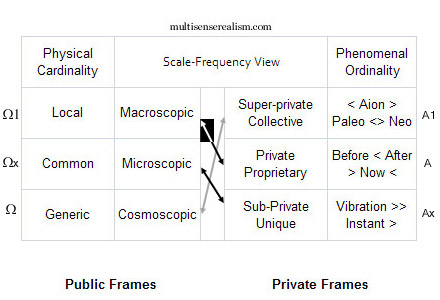
In an effort to provide a more straightforward view of pansensitivity and eigenmorphism, the chart above organizes all phenomena in the cosmos by scale of publicly extended body length and frequency range of privately experienced times. Going left to right (Metaphorically, Occident to Orient), the first and second column denote the public, physical scopes (perceptual inertial frames) according to cardinality and size.  The bottom left frames (Ω) correspond to the outermost types of physical phenomena, i.e. absolutely gigantic or absolutely infinitessimal. This reflects the aesthetic intuition by which the atom comes out having more in common morphologically and dynamically with a solar system than a tree or coral reef, despite being at opposite ends of the scale of our awareness. The Ω range of frames is the envelope of physicality, where physical and mathematical ‘laws’ meet the most universally public perceptions.

Our awareness is extended technologically, which broadens our view of the public universe, however, since the awareness being extended is primarily visual and somatic (‘tangible’-kinesthetic rather than tactile), the telescoping of our sensory awareness is also narrowing our depth of field within the private (phenomenological) side of physics. My conjecture is that because of the nature of perceptual relativity, the more we focus on the the outer contexts, not only do we not see the private experience in the universe on these distant scales, but also our entire worldview will, by default, adjust to recontextualize the local experiences of the self. The fallacy of the instrument (if you have only a hammer, everything looks like a nail) might arise through this kind of empathetic feedback loop. This is likely to extend into so-called ‘supernatural’ phenomenon, which explains the increases in magnitude, frequency, and connectedness of coincidence experienced by subjects through altered states of consciousness.  The higher up on the right hand column, the more large patterns of synchronicity, with deeper resonance (A1) are available for direct personal experience (A).

By contrast, the lower down on the Oriental, right hand scale we go, the more the needle of synchronicity tips toward mere statistical coincidence and the more top-down intuition, imagination, and eidetic narrative are collapsed into the stepped logic of bottom-up causality. The numbering schema is confusing, but intentional. The use of A in the middle row on the right side denotes that sense is always anchored centripetally. Perceptual capacity radiates as a range, often a literal circular, conic, or spherical perimeter, of awareness, but also sensitivity radiates figuratively as nested channels or layered modalities of sense.

The use of A1 and Ax above and below A respectively, implies the hierarchical pull from the superlative top, down to the personal, and the plummet from the personal middle down to the bottom. Ax would be the opposite of A1; insignificant, low status, shame and indignity. Looking at the Left side of the chart, the numbering scheme is even more confusing, but it is to emphasize the multiple levels of opposition that characterize the public and private aspects of physics-sense. The A1 range is the most universal private experience, (the ultimate being experience itself), which is meta-phorical. Experiences are associated to each other through metaphor, with the most tightly isomorphic metaphor being imitation or repetition. The higher up on the A column we go, the more latitude there is in recognizing common associations. Pareidolia and Apophenia are examples of having the aperture disproportionately dilated to the super-private, which becomes unsupportable within human society (delusions of grandeur, ideas of reference, mania, etc.)

Back to the Omega column on the left, the Ω1 is a different kind of magnificence than the private rapture of the Absolute. The public side is not centripetally oriented, but linear and circular. There is no radiant center, only jumps and slides. The Alpha/Aleph side in the East fills the gaps, it infers and elides, it puts two and two together. The Ω1 is mutation and fluke. Unintentional singularity. Its uniqueness is simply an inevitable accumulation of imperfectly repeating behaviors, so that the wonder of biology through evolution can be examined correctly in Darwinian terms. These are terms of the exteriors, however. Regardless of how complex and convoluted the patterns, they are patterns of insensitivity rather than awareness, automaticity rather than authenticity. This is individuality from the outside in – stochastic, social, generational rather than individual.

The cells of the bottom row have as much in common as the cells of the top row are polar opposites, but they are also skewed (this is what the arrows in the center are supposed to mean). This is what I call eigenmorphism. A to Ω1 has a half-black, half-white arrow, showing the relation between the human mind and its homid body. This is a maximal polarization, or so it seems to us. The black arrow from the Microscopic Ωx to the Sub-private Ax have in common the x, connoting the strong relation between mechanical appearances on the molecular level and the recursiveness of awareness in its least signifying, quantitative form. This is contrary to the idea that vibrations or energy are what we are, rather vibrate is what the various parts of our sub-private experience do – jiggling or wagging from position to disposition, from incident to co-incident.

The grey arrow from A1 to Ω points to what I call the profound edge of the continuum. This would be the level at which the Totality is an unbroken, Ouroboran monad. This is what happens ‘behind our backs’, hypnotically through evanescence. It is significance reclaimed and re-membered after having been diffracted into the entropy of spacetime. By contrast, the black and white split arrow corresponds to the ‘pedestrian fold’ – the level of the monad which appears most polarized and least evanescent – the terrestrial aesthetic of ‘ordinary’ experience.

In the top chart I have limited cardinality to the public side and ordinality to the private side to show the relation between morphic scale and phoric frequency. Privacy runs first to last (ordinal), publicity places astronomically numerous to few (cardinal).

Compare with Frame Set View:

frameset

The Third Eve

Who we are becoming.

Shé Art

The Art of Shé D'Montford

Astro Butterfly

Transform your life with Astrology

Be Inspired..!!

Listen to your inner self..it has all the answers..

Rain Coast Review

Thoughts on life... by Donald B. Wilson

Perfect Chaos

Steven Colborne's Philosophical Theology Blog

Amecylia

Multimedia Project: Mettā Programming DNA

SHINE OF A LUCID BEING

Astral Lucid Music - Philosophy On Life, The Universe And Everything...

Rationalising The Universe

one post at a time

Conscience and Consciousness

Academic Philosophy for a General Audience

yhousenyc.wordpress.com/

Exploring the Origins and Nature of Awareness

DNA OF GOD

BRAINSTORM- An Evolving and propitious Synergy Mode~!

Musings and Thoughts on the Universe, Personal Development and Current Topics

Copyright © 2016 by JAMES MICHAEL J. LOVELL, MUSINGS AND THOUGHTS ON THE UNIVERSE, PERSONAL DEVELOPMENT AND CURRENT TOPICS. ALL RIGHTS RESERVED. UNAUTHORIZED USE AND/OR DUPLICATION OF THIS MATERIAL WITHOUT EXPRESS AND WRITTEN PERMISSION FROM THIS SITE’S AUTHOR AND/OR OWNER IS STRICTLY PROHIBITED.

Paul's Bench

Ruminations on philosophy, psychology, life

This is not Yet-Another-Paradox, This is just How-Things-Really-Are...

For all dangerous minds, your own, or ours, but not the tv shows'... ... ... ... ... ... ... How to hack human consciousness, How to defend against human-hackers, and anything in between... ... ... ... ... ...this may be regarded as a sort of dialogue for peace and plenty for a hungry planet, with no one left behind, ever... ... ... ... please note: It may behoove you more to try to prove to yourselves how we may really be a time-traveler, than to try to disprove it... ... ... ... ... ... ...Enjoy!

Creativity✒📃😍✌

“Don’t try to be different. Just be Creative. To be creative is different enough.”

Political Joint

A political blog centralized on current events

zumpoems

Zumwalt Poems Online