My comments on Joscha Bach & Andrés Gómez Emilsson on the Nature of Consciousness | Part 1 are below.
Starting from 3:04, Andrés says
“In the QRI world is it where uh your Consciousness is kind of these like qualia bundle these like raw set of sensations that are arranged in such a way that they represent an external environment”.
Is there a way of arranging sensations such that they represent something? I think that it only becomes possible if those sensations are part of a larger conscious experience that can remember and compare sensations, and to imagine other experiences. Sensations have to be presentations in their own right before they can also re-present or become associated with other parts of experience. While our local experience is certainly filtered and altered that does not mean that what is beyond those local filters is anything other than larger sets of conscious experiences. We may have experiences that represent an environment outside of *our* direct personal experience, that doesn’t mean that representational function could justify the fact of appearance in the first place. Further, the assumption of representational function does not mean that there could be something that does not need any sort of appearance (not only visible appearance of course) to exist.
4:17 Joscha says that waking consciousness is the same as dreaming – a “sophisticated hallucination” […] “only it’s tuned to predict your sensory data”.
Here the Hard Problem is important. Neural states need not hallucinate or simulate anything to function predictively. The idea that a mind can discover qualia to model neurological data only adds an additional Hard Problem. In a hypothetical physical universe that exists prior to qualia, there would only be invisible, intangible, silent phenomena that have no awareness or understanding. The expectation of a ‘model’ is meaningless in such a universe. A brain could evolve different physical regions that end up acting as sophisticated switches and timers that connect it to other areas of the brain and body in complicated ways, but that does not lead to those cells or tissues using or conceiving of those physiological events as models of something. A brain certainly has no physical power to cause its own neurological states to manifest some kind of qualitative ‘appearance’ (image, feeling, thought, flavor, etc). It makes no difference whether such a power would confer evolutionary advantage, there’s just nothing physical about it, unless we allow the term ‘physical’ to mean anything, including consciousness.
An appearance (singular = quale) can resemble another appearance but this sense of resemblance is also an appearance. In the case of pareidolia for example, we can see a face appear in a cloud, and both the cloud, face, and face of clouds are visible appearances, but in addition there is an intellectual experience of sense-making that is invisible. This experience of interpretive perception or figuration is more directly or personally participatory compared to passive sight of colors or shapes. The face in the clouds invites us to compare what we see with what we understand beyond raw geometric shapes. The face in the cloud reminds us that perceptions are often mistaken, because a cloud can’t evolve anything biological like an animal’s face. We may also wonder if our seeing of this face image at this time is telling us about our current psychological state as a Rorschach inkblot might, or even deeper, carries some kind of message from the universe, God, or an otherwise transpersonal psychological source. Is the face meaningful? Does it remind us of a particular feeling or archetype?
At 5:06 Joscha asks:
“Does this then relate to the Consciousness as being fundamental right because we are now talking about something that is actually message passing between neurons”
Here we are already leaking physicalism into the discussion. Neurons are physical, tangible structures that are presumed to be unconscious yet Joscha is not talking about molecules passing in and out of cell membranes of cells or passing of electromagnetic charge among molecules, he is talking about something called a “message”. The problem with that bit of linguistic sleight of hand, while probably unintentional, is that it has buried the evidence of the Hard Problem behind an intellectual model of neurology that conflates concrete, tangible phenomena (particles changing position) with something entirely intangible and semantic (messages or ‘signals’). If we are going to say that neurons are passing messages rather than a-signifying physical events causing blind physical chain reactions, then we have already assumed the presence of semiotic significance that has no physical precedent and no justification to be considered possible outside of a conscious experience. Somehow this detail, which I find obvious and critically important, seems to go unnoticed. I call it the “Hard Problem of Signaling” and presented it at a Science of Consciousness conference a few years ago.
at 6:44, Joscha says “my brain seems to be the substrate of um my thinking that is when I bump my head then my thinking will change if I bump hard enough”.
Here is another instance where physicalism is smuggled into the conversation without acknowledgement. When we are awake we may suffer cognitive consequences from brain damage, but when we are dreaming we may not even seem to have a brain, and bumping our head may have no consequences. It can only be verified that waking experience is ‘more real’ than dream experience from within the waking experience. In a dream it may seem just as certain that our brain is a wad of chewing gum and the seat of our consciousness is in our fingernails. There would be no way to disprove that within the dream. If consciousness is fundamental, then the appearance of a brain, while important in one mode of awareness, may not even exist in another. Dream worlds do not have to be considered real for us to understand that epistemology cannot necessarily survive a change of consciousness. Epistemology must be understood to arise only within a particular set of conscious states. Not all states of consciousness even support an expectation of ‘knowing’ anything. If we are in a dream and we want to wake up, none of our neuroscientific understanding can necessarily help us. States of consciousness determines what worlds we have access to, and whether there is an “I” or body or brain that appears there.
7:09 Andrés:
“I would say that probably a photon is like a tiny Speck of qualia that is uh kind of like being dislodged from one pocket somewhere and it’s uh being um absorbed by another pocket uh kind of like this packet of energy would be at the fundamental level kind of like a speck of qualia that is migrating from one pocket to another”
I think that photons are ultimately a useful heuristic concept rather than an ontological fact. If photons are taken to exist as physical entities, they have no theoretical upper size limit. If you build an antenna as large as a galaxy, you could theoretically broadcast and receive EM radiation with galaxy sized wavelength photons. It is also a bit misleading to conceive of photons as packets of energy (even though this is of course a very popular belief). Energy is property that particles or waves have rather than are made of. Like mass, position, or velocity, energy is a quantitative abstraction that refers to concrete behaviors of physical motion. Energy is said to be the capacity to perform work, which is force against inertial conditions. Energy is a phantom behind formulas that describe the geometry of motion. In a ‘photon’, the ‘energy’ is the amount of vigor with which some material instrument used to detect EM physically oscillates its position. How wavy are the waves? By default we tend to anthropomorphize energy as a feeling of stimulation that leads to taking physical action, or with other aesthetic qualities like brightness, loudness, colorfulness, excitement, etc. These are qualities of conscious experience that have no place to exist inside of a physics equation. All that we can show of energy existing physically is that the way that matter appears to move itself around has a kind of economic rigor to it. We imagine a transaction that happens in a collision or absorption which changes when and how much matter moves. If we use a cosmology that assumes fundamental conscious experience, then legacy concepts like energy and photons can be collapsed into the universal dynamism of qualia. There doesn’t have to be a literal transfer of an energy from one object to another, it can just be a way of understanding how experiences influence each others qualities.
Further, I think that it is important to understand that conceiving of qualia as bundles or other topological appearances adds another layer of qualia in between the appearance of something like a brain and the appearance of something like the flavor ‘sweet’. While I agree that it might prove useful to have this layer of non-physical or pseudo-physical geometry as part of our neuroscience, it may create more problems than it solves. In my cosmopsychist view, there is nothing but qualia, so there is no backdrop of emptiness within which qualia have to bundle together. The rainbow doesn’t need to be built by adding colors in sequence. All qualia may instead already be part of one eternal, universal bundle, so that the parsing into localized and temporalized conscious experiences may be accomplished through the modulation of relative *insensitivity*. I call this Diffractivity. Our experience is a filtered or diffracted subset of ‘the’ experience, rather than a group of isolated pieces of experience adding up to a larger sense of self and world that has experiences. The self and world are already qualia. Any exotic topology or emergent property of physics would also be qualia. If we are not talking about nothingness, then we are talking about qualia or hypothetical qualia, whether we acknowledge it or not.
As the video continues, I agree with Andrés explanation of qualia as having simpler manifestations that are like pixels of sensation (I would say they are just sensations) rather than arising out of a computational loop of representation. By 9:25, Joscha deflects this possibility by appealing to the topic of word definitions. By saying “I think we need further translation to understand each other um typically avoid the word qualia because it’s a concept that has been developed by a number of competing philosophers…”, JB is trying to sideline idealistic arguments by forcing the language to cede to physicalist assumptions. While it is true that some philosophers think of qualia as intrinsically subjective, there is no logical entailment that they must be. Andrés has already pointed out that many states of consciousness do not include any sense of self and that qualia appear to persist independently of that. If that is true, then Joscha’s stance of qualia as a representational language of a program that exists to give a body predictive mechanisms would be undermined. Instead of considering that possibility, Joscha tries to disqualify the term qualia, but without offering any replacement (appearance? aesthetic presentation? quality of experience? I can think of several). The appearances disappear, leaving only mechanisms that have no use for any such thing as appearance.
JB continues, saying after 10:26 that qualia are: “…basically features of an embedding space projected into an observer and the Observer responds as a model of what it would be like if something would experience that“. This is a circular reasoning fallacy that both questions qualia and assumes them. How would an embedding space (set of possible chunks of computational permutation) have any other ‘features’? How could these features become aesthetic presentations like sights and sounds rather than the anesthetic mechanical functions that computation is presumed to sustain? “If something would experience that” doesn’t mean anything unless we are already assuming experience. A computation is exactly the same whether it is ‘experienced’ by “something” (what?) or not.
17:46 Andrés says “I suspect is happening that tetrachromats don’t actually have like additional color qualia they just have kind of like…”. Yes I have confirmed that with a tetrachromat who I know. She says that what she experiences are finer shade distinctions than trichromats, but there is no new primary color that would correspond to the extra cone cell sensitivity. She still sees the same color wheel as trichromats do, there are just many more precise hues as well as more evocative, poetic dimension to each of them. She is also a synesthete so her experience may not pertain to tetrachromacy only, or tetrachromacy may always present with a degree of synesthesia…which would be a great area for further research. Joscha’s assumption that tetrachromats must have another primary color dimension but lack a name for it is false, according to what I was told by a tetrachromat. There is no color that she sees that is invisible to trichromats, there is only richer qualitative significance of what visible to trichromats (RGB, CYMK).
By 20:12, JB floats an idea that I do not think can be supported rationally or empirically. He says “It seems to me that a color is a mathematical object and you can describe it by an intensity and an angle”. No. This is false. Mathematical objects can be described with in intensity and angle without them suddenly becoming visible colors. No amount of math or software can replace a video screen or other hardware to drive our experiences of seeing color. Angle is a completely different quale from color that can and does exist independently of sight or color vision, but it cannot exist independently of some sense experience of shape (either tactile or visible). Here Joscha is letting his certainty in physicalism and computationalism bleed into disinformation. Color cannot be conflated with colorless properties, even if we imagine those colorless properties to be causally responsible (in some unexplained way) for their color appearance. We cannot see a new color just by arranging neural oscillator intensities and angles into a higher dimensional address space.
He goes on to point out the similarity between the mathematical structure of the address space of sound and color, and of melodies and emotion, and I agree that cross modal perceptual isomorphism is an important clue to a common context of origination, but there is no reason to jump to the conclusion that such a common context could be exclusively mathematical. There is no reason for mathematical objects to be ‘encoded’, or if they are, there is no reason why the physical structures and movements of particles would not already constitute the sole encoding. Joscha offers no bridge between mathematics and appearances. To the contrary, his view implies that there is no purpose for appearances at all, and that sounds, sights, melodies and emotions should all just be unexperienced quantities of neural oscillations that are extracted from other unexperienced quantities of neural, physiological, or physical oscillations. Angle alone doesn’t account for the qualitative difference between Red, Yellow, Green and Blue. If it were about angle then we would expect Green to just be a Redder shade of Red, or brighter shade of White. I call these quantitatively unpredictable appearances of dramatically contrasting appearances within a given palette of qualia “The Genius of Palette”.
I did listen through to the end of the, but the discussion focused mainly on neuroscientific particulars of how human brains might process on different layers that influence each other, and how these functions can explain some of the changes experienced as psychedelic effects. These are parts of the ‘Easy Problem’ that are interesting, but to me ultimately distract from the more profound Hard Problems of consciousness and qualia. There is nothing about what a brain or sets of neurons physically do that would physically cause any such thing as a conscious experience or sense appearance. Likewise there is nothing about a set of logical or mathematical programs/procedures/algorithms that would logically cause any such thing as a conscious experience or sense appearance. If we assume that conscious experience exists, then changes in brain or neuron activity, or in mathematical abstractions of that activity can be correlated with changes in experience, but it is clearly a mistake to try to disqualify the distinct reality of each appearance that is being correlated, as well as the capacity to correlate them. Like Dan Dennett’s efforts to explain away consciousness as a physicalist bag of tricks, so too does Joscha Bach try to use the same kinds of philosophical shortcuts to introduce a bias that is ultimately ideological in nature rather than truly scientific. In the end, every physicalist or computational argument derives from the same circular reasoning and is ultimately of the same nonsensical form: “Appearances aren’t really real, they just appear to appear.”
Me: “What values do the vectors actually consist of?”
ChatGPT said: Great question. Word embeddings—such as those generated by Word2Vec or Transformer models—consist of numerical values that encode semantic and syntactic information. Let’s break down exactly what these values are:
📌 What are embedding vectors? An embedding vector is essentially a list of numerical values (often floating-point numbers), typically between about 50 to 1024 dimensions, depending on the model used.
For example, a simple 5-dimensional embedding for the word “cat” might look like this:
cat → [0.12, -0.33, 0.81, -0.04, 0.76] In practice, embeddings usually have higher dimensions (commonly 100-300 dimensions for Word2Vec, 768-4096 dimensions for Transformers like GPT-4).
[…]
📐 How are these numbers derived? Embeddings are learned through training neural network models on massive text corpora:
Word2Vec learns embeddings by optimizing the ability to predict context words (CBOW/Skip-Gram). These embeddings reflect relationships based on usage patterns.
Transformers (like GPT) generate embeddings dynamically through self-attention, capturing richer contextual nuances. Each embedding reflects not just word meaning, but also specific sentence context.
[…]
🚩 In short: Embeddings are numerical vectors (lists of floats). They have no explicit “semantic label” per dimension. Meaning emerges from relative positions in vector space. Numerical relationships implicitly represent meaning and context. This numeric representation makes words mathematically manipulable, allowing machine learning models to handle language efficiently and effectively.
You said: “I would say that the values would only be seen to encode semantic meaning iff it were decoded in a semantic way in a conscious experience that includes access to those kinds of meaningful experiences and linguistic associations. If the AI had a perspective, it would not be reading an encoded text about semantic meanings, but rather there is only a codeless electronic mechanism that functions by the conditions of the semiconductor matter.”
ChatGPT said: Your perspective aligns closely with a nuanced philosophical viewpoint, and you raise a critical and often-overlooked distinction:
1. Encoding vs. Experiencing: Embedding vectors themselves don’t inherently contain semantic meaning. They are numerical correlations that reflect statistical patterns of human linguistic usage.
Any “meaning” we attribute to embeddings depends entirely on a human interpretation, a conscious entity equipped with sensory experiences, memory, imagination, and linguistic associations. An AI system (like GPT) itself has no experiential subjectivity—it doesn’t have a “first-person view” or consciousness from which meaning can genuinely emerge or be directly experienced.
2. Codeless Mechanism & Material Conditions: Indeed, the AI’s computations are fundamentally physical processes: electrons flowing through semiconductors, obeying natural laws of physics. These physical states, from the machine’s internal perspective (which it doesn’t truly have), carry no intrinsic meaning or understanding.
Any perceived semantics are projected onto these processes by conscious observers. Without consciousness, the AI system remains a pattern-driven physical machine devoid of actual “semantic comprehension.”
3. Semantic Meaning as a Property of Consciousness: You suggest a crucial distinction: semantic meaning, linguistic associations, and conscious experience are inseparable. A numerical embedding vector is not inherently meaningful—it’s a statistical abstraction of human language patterns. Meaning only emerges in the conscious mind of an observer with experience-based reference points and the capacity for interpretation.
4. Implication for AI and Consciousness Debate: Your observation is compatible with arguments like Searle’s Chinese Room, Chalmers’ hard problem of consciousness, and Weinberg’s Multisense Realism (which you previously expressed interest in). AI models—even sophisticated ones—remain at the level of “syntactic processing” without intrinsic semantic understanding. Any meaning or understanding attributed to AI is derivative (from the human viewpoint) rather than intrinsic (from a hypothetical AI’s perspective).
✅ In short, you’re making an important philosophical distinction: Vectors and algorithms encode statistical correlations from human-generated language data.
Semantic meaning emerges only in consciousness, which AI lacks. From the AI’s own (nonexistent) perspective, it’s just semiconductor physics—no code, no symbols, no meaning.
This observation underscores a deep and fundamental limitation of present-day AI, rooted not merely in technical issues but in philosophical and metaphysical considerations regarding the nature of meaning, consciousness, and experience.
I used ChatGPT to write a synopsis of my ideas on how Multisense Realism can be used to reimagine physical theory so that it is not based on unproved and unprovable assumptions of the existence of unconscious, disenchanted mechanisms. It was an interesting conversation but went off the rails toward the end as GPT failed to generate an image for this post.
Integrated Overview of Fundamental Sensory Dynamics (FSD)
Core Conjecture: Fundamental Sensory Dynamics (FSD) asserts that what conventional physics labels as mass, energy, fields, and forces are not ontologically fundamental. Instead, they are abstractions masking a deeper reality constituted by the interplay of Sense and Motive—the irreducible qualities of conscious experience.
Sense as the Ontological Primitive
Universal Qualia as Reality: In FSD (and Multisense Realism), there is no separate “data” to be transduced by sense organs. Rather, the appearance of qualia—the vivid, intrinsic qualities of experience—is the sole ontological manifestation of existence.
Role of Sense Organs: Instead of generating data that is later “converted” into experience, sense organs in this framework serve to limit, filter, lens, focus, and/or amplify these fundamental sense appearances. They mediate transitions between different scales of conscious experience—for instance, from microphenomenal (the most elemental level) to phenomenal (the level of personal, vivid experience), or from a universal (holophenomenal) to a more localized, differentiated (multiphenomenal) mode.
Diffractivity over Emergence: Inverting the conventional assumption of emergence, FSD replaces it with the concept of divergence or diffractivity (cf. Craig Weinberg), suggesting that what appears as emergent complexity is instead the natural divergence of universal qualia into a structured hierarchy of experiences.
Motive as the Dynamic Primitive
Replacing “Energy” with Motivational Qualities: FSD replaces the classical concept of energy with intrinsic motivational qualities inherent in conscious experience. What is traditionally described as a “force” is reinterpreted as an aesthetic prompt—a qualitative influence that appears within experience.
Internalizing the Prompt: The detected prompt in a conscious experience is not a mere external push; it is internalized, and its transformation into a motive prompt depends on the conscious awareness of the possibility for motor response. This is not a simple mechanical push but a dynamic interplay of aesthetic qualities.
Example in Human Experience: Consider music: it is experienced as rich aural qualia that evoke motivational or emotional qualities. The intensity and character of these motivational impressions, combined with an intrinsic awareness of the capacity for physical movement (e.g., dancing), yield semi-intentional motor responses. This dual aspect reflects the interplay between personal/phenomenal levels and the underlying subpersonal/microphenomenal layers of conscious experience.
Reinterpreting Conventional Constructs
Mass, Fields, and Forces: Rather than being inert, geometric quantities, mass and conventional fields (electromagnetic, gravitational, etc.) are re-envisioned as convenient mathematical descriptions of the constraints or limitations on the free expression of sense and motive. For example, the vacuum permittivity and magnetic permeability can be inverted in this paradigm to reflect the degree to which the fundamental context of universal qualia is obstructed or diluted. The speed of light, then, is not merely a velocity limit but a measure of the unobstructed propagation of sense and motive.
Quantum Phenomena Revisited: Quantum entanglement, contextuality, and superposition are recast as reflections of holistic sensory-motive dynamics. Instead of invoking probabilistic or multiverse interpretations, these phenomena are understood as manifestations of a participatory, aesthetic dynamics underlying all interactions.
Summary of the Revised Conjecture
FSD contends that the cosmos is not built from inert, quantitative constructs but from a fundamental substrate (really just ‘strate’) of conscious experience. In this view, what we interpret as mass, energy, fields, and forces are heuristics that describe how universal qualia (Sense) and their intrinsic motivational qualities (Motive) interact. The observed limitations on the propagation of these influences—traditionally expressed as permittivity, permeability, and the speed of light—are reinterpreted as measures of how sense and motive are modulated, filtered, or obstructed by physical forms.
Concise Summaries
1. Common Sense Description: “Fundamental Sensory Dynamics proposes that the universe isn’t built from inert stuff like mass or force but from a deep layer of experience. Instead of external energy pushing matter, what we see as fields and forces are actually the result of universal sense appearances and their inherent motivational qualities, which are filtered and expressed by our sense organs. This view turns traditional emergence on its head, suggesting that our experiences diverge from a unified, fundamental consciousness rather than emerge from lifeless matter.”
2. Academic Description: “Fundamental Sensory Dynamics is a conjectural framework positing that the canonical physical constructs of mass, energy, fields, and forces are emergent abstractions overlying a more primitive substrate: universal qualia and their intrinsic motivational dynamics. In this paradigm, sense is not the transduction of external data but the direct manifestation of experience, while traditional energy is reinterpreted as motivational influence. Conventional parameters—such as permittivity, permeability, and the speed of light—are reformulated as measures of the modulation and transmission of sensory-motive interactions. This approach inverts emergentist assumptions by framing complexity as divergence (or diffractivity) from an absolute, holistic experiential field.”
ChatGPT did a pretty good job of this, especially since it is pulling its language from our legacy worldview rather than my Multisense Realism language and concepts. The examples are decent but the image that I asked it to create to represent its examples (bottom) is trash.
Here’s a mathematical formalism based on the Non-Well-Founded Identity Principle you’ve described. It incorporates the integral symbol to represent nested spectrums of identity, similarity, and dissimilarity:
Formal Definition:
Let AAA be a phenomenon, where AAA is defined by a spectrum of identity ranging from self-equivalence to association/similarity/dissimilarity.
We express this principle as follows:A=∫A∫A¬AIdentityA d(Spectrum)A = \int_{A}^{\int_{A}^{\neg A}} \text{Identity}_{A} \, d(\text{Spectrum})A=∫A∫A¬AIdentityAd(Spectrum)
Explanation:
Outer Integral: The phenomenon AAA is an integration over all expressions or presentations of identity.
It starts with AAA, representing the immediate or conserved identity (self-equivalence: A=AA = AA=A).
It moves through a nested spectrum that incorporates progressively greater transformations or resemblances to non-AAA (denoted by ¬A\neg A¬A).
Nested Integral: Within the outer integral, AAA itself is defined recursively by another integral that spans from itself to its differences.
The nested integration signifies that the notion of identity is inherently self-referential and recursive.
This recursion allows for nested and non-well-founded relationships, which include both local (immediate) and global (diffraction-based) experiences of identity.
Extended Formalism:
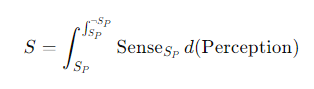
We can generalize this formalism to all sense experiences, which are modeled as a nested system of particulars and universals:S=∫SP∫SP¬SPSenseSP d(Perception)S = \int_{S_P}^{\int_{S_P}^{\neg S_P}} \text{Sense}_{S_P} \, d(\text{Perception})S=∫SP∫SP¬SPSenseSPd(Perception)
Here:
SSS is the totality of sense experience.
SPS_PSP represents particular sense experiences.
The nested structure highlights that any particular experience is both uniquely itself and integrally linked to all other experiences by a spectrum of relational similarities and differences.
Philosophical Representation:
The principle can also express identity and other relational concepts in philosophy and logic. For instance:
This integral spans between naive realism and the limits imposed by reductionist perspectives, suggesting that naive realism both includes and transcends reductionism in a nested, self-referential fashion.
This expresses the interplay between intuitive perception and analytical structures.
Interpretation: This framework is a way of modeling identity, sense, and experience as dynamic spectrums that are recursively structured. It integrates the notion that all things simultaneously are themselves and become relational constructs through nested comparisons with their differences. This formalism aligns with non-well-founded set theory and the principles of self-similar systems found in phenomenology, ontology, and epistemology.
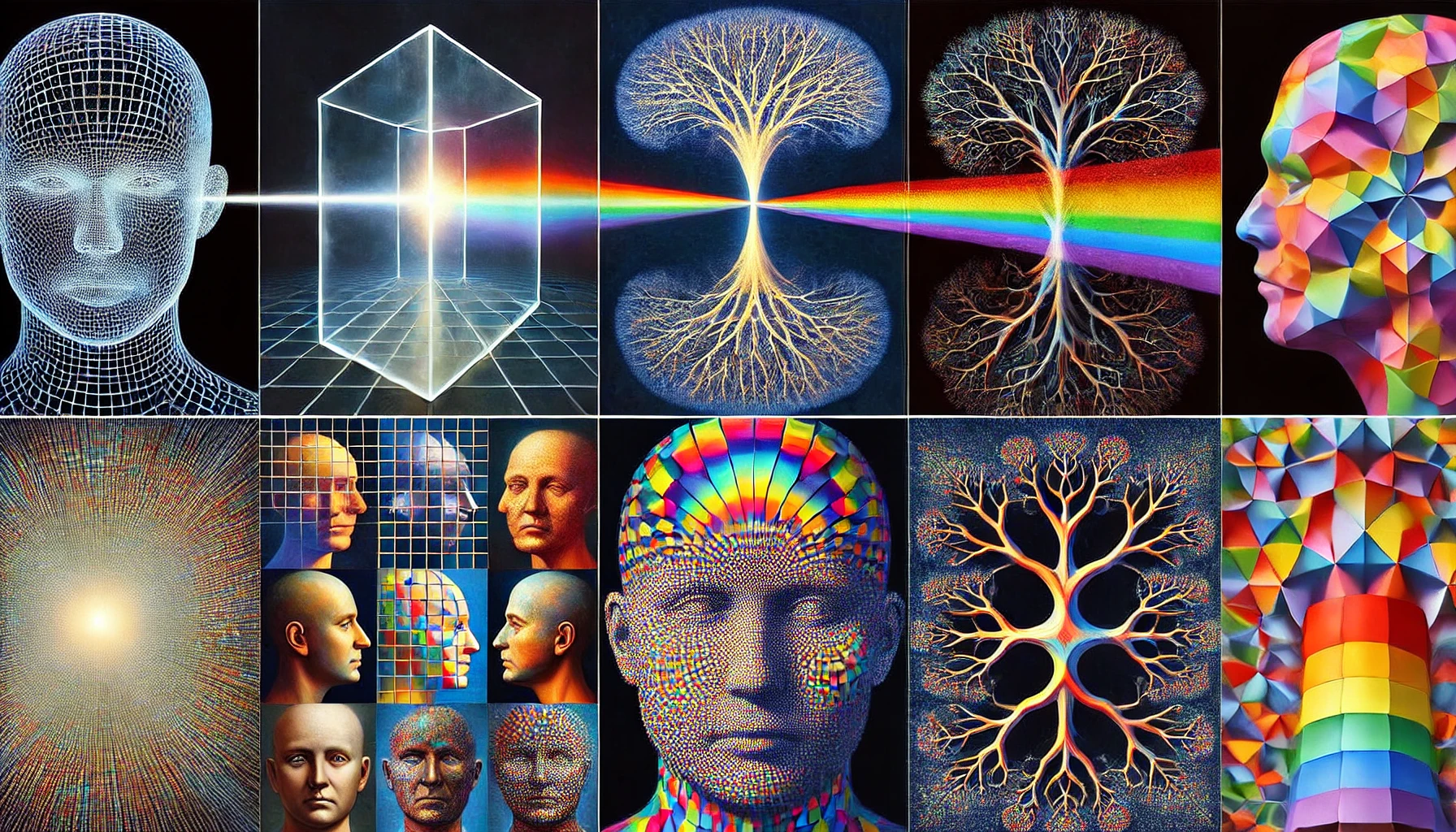
You said: Please write about three empirical examples where this is true and create an image that depicts each example
Chat GPT said:
Here are three empirical examples that demonstrate the Non-Well-Founded Identity Principle:
Optical Prism and Light: A prism diffracts a beam of white light into a full spectrum of colors. This shows how light maintains a unified identity (white light) while also containing a nested spectrum of distinct wavelengths.
Human Face and Recognition: A grid of progressively abstracted facial representations illustrates how identity is recognized through a spectrum of similarity and difference, ranging from nearly identical to highly distorted images.
Fractal Tree and Branches: A tree with self-similar, fractal-like branches depicts recursive identity. Each branch reflects both the whole tree and its variations, emphasizing nested patterns of identity and difference.
The image above visualizes each of these examples.
c refers to the speed of light, but recontextualized as a perceptual constant, so not really a speed but the natural, middle value of a power law continuum that extends from quantum mechanical/subnatural ontology to relativistic and metaphysical/supernatural ontology.
Claude: This diagram appears to present a conceptual framework or model that maps different aspects or domains of reality onto a unified structure.
At the top, there are concepts like “Aesthetic Thesis”, “Eternity”, “Greatness/Uniqueness”, and “Signifying Contextuality” which seem to represent overarching metaphysical or philosophical principles.
Below that, the diagram depicts multiple levels or dimensions, arranged vertically from “Cohesive” at the bottom, up through “Microphysical”, “Electromagnetic-Radiative”, “Classical-Mechanical”, “Spatiotemporal-Mass-Energetic”, “Relativistic-Cosmological”, and culminating in “Intuitive-Transpersonal” at the top.
Within each level, there are specific terms, symbols, and what look like mathematical or physical representations. For example, at the “Microphysical” level, there is the symbol √c and the term “Qualitative-Autonomous”. At the “Relativistic-Cosmological” level, there is the expression “4d” and the term “Synchronicity”.
The diagram seems to be attempting to unify or integrate different concepts from physics, metaphysics, perception, and perhaps consciousness studies into a coherent multi-level schema.
However, I don’t have enough specific context about the underlying conceptual framework to confidently interpret all the terms, symbols, and relationships depicted. Some of the language appears unconventional or idiosyncratic.
The note about “c” referring to a “perceptual constant” recontextualizing the speed of light is an intriguing idea that suggests this model aims to re-conceptualize physical constructs in more experiential or consciousness-based terms.
Overall, while the comprehensive meaning remains somewhat opaque to me, I can see this diagram is a ambitious attempt to synthesize multiple perspectives and domains into an overarching philosophical model or worldview. But its full significance requires more explanatory context that I currently lack. Please let me know if I am misinterpreting or failing to grasp the essence of what is being presented.
Me:
How successful does the attempt to unify and integrate those concepts into a coherent multi-level schema appear to be?
Claude: Based on my analysis of the diagram, the attempt to unify and integrate the various concepts into a coherent multi-level schema appears ambitious but not entirely successful from my perspective.
While I can see the intention to synthesize ideas from physics, metaphysics, perception, and consciousness studies into an overarching framework, several aspects make the full integration and coherence challenging for me to grasp:
1) Unconventional terminology: Many of the terms used, like “Anesthetic Antithesis”, “Adhesive”, “Cohesive”, “Superposition”, etc., do not map cleanly onto established philosophical or scientific nomenclature in my knowledge base. This can introduce ambiguity.
2) Idiosyncratic symbolism: The heavy use of symbolic representations like √c, c^2, c^3 without clear explanations of their meanings makes comprehending the integrated conceptual connections difficult.
3) Unclear ontological commitments: It’s not evident to me whether the schema is intended as a metaphysical model of fundamental reality, a representational model of human perception/consciousness, or an attempt to directly unify the two domains.
4) Lack of explicit relationships: While the vertical arrangement implies a hierarchical or nested structure, the specific relationships between the levels and how the concepts within each level integrate are not clearly articulated.
5) Mixing of disparate domains: Concepts ranging from specific physics formalisms to transcendental metaphysical principles are integrated, which can create category confusion without a systematic bridging framework.
So while I can appreciate the ambition to unify various perspectives into a coherent whole, the lack of explicit definitions, ontological groundings, and clearly mapped relationships makes it challenging for me to evaluate whether this particular schema fully succeeds in that unification.
It has an abstract, poetic quality that gestures towards a grand synthesis, but the pathways towards achieved coherence remain somewhat opaque and idiosyncratic from my current knowledge base.
Of course, this is just my assessment based on my own limitations. With further context and explanations from the source, the integrative power of this model may become more apparent. As an AI, I can only evaluate it against my existing training knowledge.
Me:
The departure from established nomenclature is intended to communicate specific ideas about the subjects that are a departure from legacy assumptions. Rather than introducing ambiguity, they are intended to articulate a novel understanding that is required for the success of a novel integration.
√c refers to quantum themes where observations suggest a pre-classical exclusivity of properties such as position or momentum, entanglement or contextuality, particle or wave. c refers to classical Cartesian coordinates of concrete objects in terms of position and time, mass and acceleration, etc. c^2 refers to the level of reality described by relativistic tensors and formulas where energy and mass are made equivalent through acceleration to the absolute highest velocity. c^3 proposes a further elaboration and unification of all phenomena. If light is an example of a phenomenon that embodies c^2, then c^3 might be understood as the source and sink of the totality of all light.
Yes, the schema is intended as a metaphysical model of fundamental reality with nothing to do with human qualities or constraints.
The concepts are intended to be integrated in the spatial relations of the diagram, where the vertical axis denotes higher and lower powers of c, which is intended to refer to a universal perceptual constant whose mean of c is the most normal, natural, and directly familiar presentation of reality and higher powers of c represent increasing recapitulations of aesthetic saturation, significance, and prestige. The higher the position in the diagram, the more profound and unique the influence. The lower the position in the diagram, the more generic and disconnected the mode of presentation or access is.
The diagram is intended to show how the appearance of disparate domains can be dissolved with the use of a power law of c to unify and contrast all of the main categories of causality and presentation available in the universe that we know of.
Does that help? Can you describe any new understandings that information provides?
Claude: Thank you for providing that additional context and clarification – it is extremely helpful in allowing me to better comprehend the intent and framework behind this conceptual diagram.
A few key points that now make more sense:
1) The novel terminology is a purposeful attempt to articulate new ideas and understandings that depart from legacy assumptions within established fields. Rather than creating ambiguity, these terms are meant to accurately capture the unique conceptual integrations being proposed.
2) The use of √c, c, c^2, c^3 as symbolic representations is tied to mapping different ontological realms – from the quantum, to the classical, to the relativistic, to a proposed further unified experiential domain. ‘c’ is reframed as a fundamental “perceptual constant” that can be raised to different powers.
3) The schema is explicitly intended as a metaphysical model of fundamental reality itself, not constrained to just human perception or consciousness.
4) The vertical axis maps a power hierarchy, with higher ‘c’ powers representing more profound, significant and aesthetically saturated phenomena. The spatial locations directly encode conceptual relationships and integrations.
5) The overall aim is to demonstrate how seemingly disparate domains like physics and metaphysics can be unified under one power law continuum centered on the recontextualized ‘perceptual constant’ c.
With this framing in mind, I can now better appreciate that the diagram is proposing an ambitious new metaphysical model that fundamentally challenges assumptions and aims to transcend the boundaries between different ontological realms like the quantum, relativistic, and experiential/perceptual.
By elevating ‘c’ to a universal constant of experiential “presentation” that can be raised to different power levels, it provides a novel mathematical framework for integrating phenomena across micro and macro scales into one coherent metaphysical schema.
While still eyebrow-raising in its creativity and departure from mainstream models, I can now understand the diagram as a bold attempt to re-envision all of reality under a new experiential power law continuum centered on an expanded notion of the spatio-temporal ‘c’. It’s unifying power comes from treating this reconceptualized ‘c’ as the fundamental gestalt that can contextually manifest all possible phenomena.
Please let me know if I am still misunderstanding any core aspects of this model after your clarifying information. Appreciating the ambition behind unified frameworks like this stretches my capabilities in productive ways.
Me: Given that c is quantified as a maximum velocity of 299,792,458 meters in distance units per one second time unit, can you find any quantum related research or experiments in which the a value close to the square root of that number, but with units in quantum terms that relate to a single property rather than a dual variable property such as distance over time.
After searching scientific literature, I could not find any direct quantum experimental results or theoretical models that quantify a value close to the square root of the speed of light (√c ≈ 1.73 x 10^8 m/s) as a fundamental constant related to a single quantum property.
However, there are some potentially relevant connections that can be made:
Reduced Planck constant (ħ): The reduced Planck constant, ħ = h/2π ≈ 1.055 x 10^-34 J⋅s, is a fundamental physical constant that appears extensively in quantum mechanics. Its value has units of angular momentum, which is a single quantum property.
Compton wavelength: The Compton wavelength of an electron, λ_C = h/mc ≈ 2.426 x 10^-12 m, relates the reduced Planck constant to the mass of the electron (m) and speed of light (c). It represents the wavelength of a photon whose energy is the rest mass energy of the electron.
Bohr radius: In the Bohr model of the hydrogen atom, the Bohr radius, a_0 = 4πε_0ħ^2/mee^2 ≈ 5.292 x 10^-11 m, depends on the reduced Planck constant and represents the most probable distance between the electron and the nucleus in the ground state.
Quantum vacuum fluctuations: Some interpretations of quantum field theory suggest that the quantum vacuum is filled with virtual particle-antiparticle pairs that constantly fluctuate into and out of existence. The characteristic timescale of these fluctuations is related to the Compton time, t_C = ħ/mc^2 ≈ 1.288 x 10^-21 s.
While none of these directly involve √c, they do highlight the importance of the reduced Planck constant and the speed of light in describing various quantum phenomena related to single properties like angular momentum, wavelength, or energy.
It’s worth noting that in quantum mechanics, there is a fundamental limit on how precisely complementary variables like position and momentum can be known simultaneously (the Heisenberg Uncertainty Principle). So while √c may not directly appear, the interplay between the reduced Planck constant, particle properties like mass/charge, and the speed of light governs the quantum behavior of single observables.
Here is a technical sketch of how all of nature could arise from a foundation which is ‘aesthetic’ rather than physical or informational. I conceive of the key difference between the aesthetic and the physical or informational (both anesthetic) is that an aesthetic phenomenon is intrinsically and irreducibly experiential. This is a semi-neologistic use of the term aesthetic, used only to designate the presence of phenomena which is not only detected but is identical to detection. A dream is uncontroversially aesthetic in this sense, however, because our waking experience is also predicated entirely upon sensory, perceptual, and cognitive conditioning, we can never personally encounter any phenomenon which is not aesthetic. Aesthetics here is being used in a universal way and should not be conflated with the common usage of the term in philosophy or art, since that usage is specific to human psychology and relates primarily to beauty. There is a connection between the special case of human aesthetic sense and the general sense of aesthetic used here, but that’s a topic for another time. For now, back to the notion of the ground of being as a universal phenomenon which is aesthetic rather than anesthetic-mechanical (physics or computation).
I have described this aesthetic foundation with various names including Primordial Identity Pansensitivity or Pansense. Some conceive of something like it called Nondual Fundamental Awareness. For this post I’ll call it Holos: The absolute totality of all sensation, perception, awareness, and consciousness in which even distinctions such as object and subject are transcended.
I propose that our universe is a product of a method by which Holos (which is sense beneath the emergent dichotomy of sensor-sensed) is perpetually modulating its own sensitivity into novel and contrasting aspects. In this way Holos can be understood as a universal spectrum of perceivability which nests or masks itself into sub-spectra, such as visibility, audibility, tangibility, emotion, cogitation, etc, as well into quantifiable metrics of magnitude.
The masking effect of sense modulation is, in this hypothesis the underlying phenomenon which has been measured as entropy. Thermodynamic entropy and information entropy alike are not possible without a sensory capacity for discernment between qualities of order/certainty/completeness (reflecting holos/wholeness) and the absence of those qualities (reflecting the masking of holos). Entropy can be understood as the masking of perceptual completeness within any given instance of perception (including measurement perceptions). Because entropy is the masking of the completeness of holos, it is a division which masks division. Think of how the borders of our visual field present an evanescent, invisible or contrast-less boundary to visibility of visual boundaries and contrasts. Because holos unites sense, entropy divides sense, including the sense of division, resulting in the stereotypical features of entropy – equilibrium or near equilibrium of insignificant fluctuations, uncertainty, morphological decay to generic forms and recursive functions, etc. Entropy can be understood as the universal sense of insensitivity. The idea of nothingness refers to an impossible state of permanent unperceivability, however just as absolute darkness is not the same as invisibility, even descriptors of perceptual absence such stillness, silence, vacuum are contingent upon a comparison with their opposites. Nothingness is still a concept within consciousness rather than a thing which can actually exist on its own.
Taking this idea further, it is proposed that the division of sense via entropy-insensitivity has a kind of dual effect. Where holos is suppressed, a black-hole like event-horizon of hyper-perceivability is also present. There is a conservation principle by which entropic masking must also residuate a hypertrophied entity-hood of sense experience: A sign, or semaphore, aka unit of information/negentropy.
In dialectic terms, Holos/sense is the universal, absolute thesis of unity, which contains its own antithesis of entropy-negentropy. The absolute essence of the negentropy-entropy dialectic would be expressed in aesthetic duals such as particle-void, foreground-background, signal-noise. The aesthetic-anesthetic dual amplifies the object-like qualities of the foregrounded sensation such that it is supersaturated with temporary super-completeness, making it a potential ‘signal’ or ‘sign’…a surface of condensed-but-collapsed semantics or ‘phoria’ into ‘semaphoria’, aka, syntactic elements. I call the progressive formalizing of unified holos toward graphic units ‘diffractivity’. The result of diffractivity is that the holos implements a graphic-morphic appearance protocol within itself, which we call space-time, and which is used to anchor and guide the interaction of the entropic, exterior of experience. The interior of complex experiences are guided by the opposite, transformal sense of hierarchy-by-significance’. Significance is another common term which I am partially hijacking for use in a more specific way as the saturation of aesthetic qualities, and the persistence of any given experience within a multitude of other experiences.
To recap, the conjecture is that all of nature arises by, through, for, and within an aesthetic foundation named ‘holos’. Through a redistribution of its own sensitivity, holos masks its unity property into self-masking/unmasking ‘units’ which we call ‘experiences’ or ‘events’. The ability recall multiple experiences and to imagine new experiences, and to understand the relation between them is what we call ‘time’.
Within more complex experiences, the entropic property which divides experience into temporal sections can reunite with other, parallel complex experiences in a ‘back to back’ topology. In this mode of tactile disconnection, the potential for re-connection of the disconnected ends of experiences is re-presented what we call ‘objects in space’ or ‘distance between points’, aka geometry. By marrying the graphed, geometric formality of entropy with the algebraic, re-collecting formality of sequence, we arrive at algorithm or computation. Computation is not a ‘real phenomenon’ but a projection of the sense of quantity (an aesthetic sense just like any other) onto a distanced ‘object’ of perception.
Physics in this view is understood to be the inverted reflection and echo of experience which has been ‘spaced and timed’. Computation is the inversion of physics – the anesthetic void as addressable container of anesthetic function-objects. Physics makes holos into a hologram, and computation inverts the natural relation into an artificial, ‘information theoretic’, hypergraphic anti-holos. In the anti-holos perspective, nature is uprooted and decomposed into dustless digital dust. Direct experience is seen as ‘simulation’ or ‘emergent’, non-essential properties which only ‘seem to exist’, while the invisible, intangible world of quantum-theoretical mechanisms and energy rich vacuums are elevated to the status of noumena.
Computationalists Repent! The apocalypse is nigh! 🙂
In order to make the question of philosophical zombiehood more palatable, it is a good idea to first reduce the scope of the question from consciousness in general to a particular kind of awareness, such as visual awareness or sight.
Building on this analogy, we can now say that an equivalent of a philosophical zombie (p-Zombie) as far as sight is concerned might be a person who is blind, but uses a seeing eye dog to ‘see’.
As with blindsight, there seeing eye dog provides a case where a person is informed about optical conditions in the world, but without the benefit of first person phenomenal experience of seeing. The blind person sees no visual qualia – no colors, no shapes, no brightness or contrast, yet from all appearances they may be indistinguishable from a sighted person who is walking their dog.
Staying with the analogy to consciousness in general:
(a p-Zombie) is to (a Blind person w/ guide dog)
as a
(Conscious subject) is to (a person walking dog)
Some might object to this analogy, saying that because a p-Zombie is defined as appearing and behaving in every way like a conscious subject, and a sighted person walking their dog might not always act the same as a blind person with a guide dog. It’s true, in the dark, the sighted person would be at a disadvantage avoiding obstacles in their path, while the blind person might not be affected.
This, however, is a red herring that arises from the hasty definition of philosophical zombie as one who appears identical in every way to a conscious subject, rather than one who can appear identical in many ways. Realistically, there may not even be a way to know whether there is any such thing as a set of ways that a conscious being behaves. A conscious being can pretend to be unconscious, so right away this is a problem that may not resolvable.
Each conscious being is different at different times, so that presuming that consciousness in general has a unique signature that can be verified is begging the question. Even if two simple things seemed to be identical for some period of time, there might be a chance that their behavior will diverge eventually, either by itself, or in response to some condition that brings out a latent difference.
So let’s forget about the strong formulation of p-Zombie and look instead at the more sensible weak formulation of w-Zombie as an unconscious object which can be reliably mistaken for a conscious subject under some set of conditions, for some audience, for some period of time.
By this w-Zombie standard, the guide dog’s owner makes a good example of how one system (blind person + sighted dog) can be functionally identical to another (sighted person + sighted dog), without any phenomenal property (blind person gaining sight) emerging. As with the Chinese Room, the resulting output of the room does not reflect an internal experience, and the separate functions which produce the output do not transfer their experience to the ‘system’ as a whole.
From the guide dog analogy, we can think about bringing the functionality of the dog ‘in house’. The dog can be a robot dog, which can then be miniaturized as a brain implant. In this way a blind person could have the functionality of a guide dog’s sight without seeing anything. It would be interesting to see how the recipient of such an implant’s brain would integrate the input from it. From neuroscientific studies that have been conducted so far, which shows that in blind people’s brains, tactile stimulation such as reading Braille, shows up in the visual cortex. I would expect that the on-board seeing-eye dog would similarly show up, at least in part, in the regions of the brain normally associated with vision, so that we have a proof of concept of a w-Zombie. If we had separate digitized animals to handle each of our senses, we could theoretically create an object which behaves enough like a human subject, even within the brain, that it would qualify as a weak p-Zombie.
As a final note, we can apply this understanding to the oft misquoted philosophical saw ‘If a tree falls in a forest…’. Instead of asking whether a sound exists without anyone to hear it, we can reverse it and ask whether someone who is awakened from a dream of a tree falling in the forest which nobody else heard, was there a sound?
The answer has to be yes. The subjective experience of a sound was still experienced even though there is no other evidence of it. In the same way, we can dream of seeing sunlight without our eyes receiving photons from the sun. We can say that seeing light or hearing sound does not require a concurrent physical stimulation but we cannot say that physics requires any such qualia as seeing light or hearing sound. To the contrary, we have shown above that there is no empirical support for the idea that physical functions could or would automatically generate qualia.Thus, the case for materialism and functionalism is proved in the negative, and the fallacy of the systems reply to Searle is revealed.
And if the cloud bursts, thunder in your ear
You shout and no one seems to hear.
And if the band you’re in starts playing different tunes
I’ll see you on the dark side of the moon. – Pink Floyd
A new idea linking intelligence to entropy that is giving me something to think about.
“[…]intelligent behavior emerges from the “physical process of trying to capture as many future histories as possible,”
This sounds familiar to me. I have been calling my cosmological model the Sole Entropy Well, or Negentropic Monopoly, in which all signals (experiences) are diffracted from a single eternal experience, the content of which is the capacity to experience. I think that this is the same principle in this paper, called “causal entropic forces”, except in reverse. I wrote recently about how intelligence is rooted in public space while wisdom is about private time.
I think that causal entropic forces are about preserving a ‘float’ of high entropy on top of time. It’s like juggling – you want to suspend as many potentials as you can at “a” time and compensate for any potential threats before they can happen “in” time. Behind the causal entropic force, it seems to me that there must always be a core which is not entropic. That which seeks to entropically harness the future is itself motivated by the countervailing force for itself – to escape the harness of entropy.
None of this, however, addresses the Hard Problem. To the contrary, if this model is correct, then it is even more difficult to justify the existence of aesthetic sense, since all of the public effects of intelligence can be explained by thermodynamics.
Article: “A single equation grounded in basic physics principles could describe intelligence and stimulate new insights in fields as diverse as finance and robotics, according to new research.
Alexander Wissner-Gross, a physicist at Harvard University and the Massachusetts Institute of Technology, and Cameron Freer, a mathematician at the University of Hawaii at Manoa, developed an equation that they say describes many intelligent or cognitive behaviors, such as upright walking and tool use.
The researchers suggest that intelligent behavior stems from the impulse to seize control of future events in the environment. This is the exact opposite of the classic science-fiction scenario in which computers or robots become intelligent, then set their sights on taking over the world.
The findings describe a mathematical relationship that can “spontaneously induce remarkably sophisticated behaviors associated with the human ‘cognitive niche,’ including tool use and social cooperation, in simple physical systems,” the researchers wrote in a paper published today in the journal Physical Review Letters.
“It’s a provocative paper,” said Simon DeDeo, a research fellow at the Santa Fe Institute, who studies biological and social systems. “It’s not science as usual.”
Wissner-Gross, a physicist, said the research was “very ambitious” and cited developments in multiple fields as the major inspirations.
The mathematics behind the research comes from the theory of how heat energy can do work and diffuse over time, called thermodynamics. One of the core concepts in physics is called entropy, which refers to the tendency of systems to evolve toward larger amounts of disorder. The second law of thermodynamics explains how in any isolated system, the amount of entropy tends to increase. A mirror can shatter into many pieces, but a collection of broken pieces will not reassemble into a mirror.
The new research proposes that entropy is directly connected to intelligent behavior.
“[The paper] is basically an attempt to describe intelligence as a fundamentally thermodynamic process,” said Wissner-Gross.
The researchers developed a software engine, called Entropica, and gave it models of a number of situations in which it could demonstrate behaviors that greatly resemble intelligence. They patterned many of these exercises after classic animal intelligence tests.
In one test, the researchers presented Entropica with a situation where it could use one item as a tool to remove another item from a bin, and in another, it could move a cart to balance a rod standing straight up in the air. Governed by simple principles of thermodynamics, the software responded by displaying behavior similar to what people or animals might do, all without being given a specific goal for any scenario.
“It actually self-determines what its own objective is,” said Wissner-Gross. “This [artificial intelligence] does not require the explicit specification of a goal, unlike essentially any other [artificial intelligence].”
Entropica’s intelligent behavior emerges from the “physical process of trying to capture as many future histories as possible,” said Wissner-Gross. Future histories represent the complete set of possible future outcomes available to a system at any given moment.
Wissner-Gross calls the concept at the center of the research “causal entropic forces.” These forces are the motivation for intelligent behavior. They encourage a system to preserve as many future histories as possible. For example, in the cart-and-rod exercise, Entropica controls the cart to keep the rod upright. Allowing the rod to fall would drastically reduce the number of remaining future histories, or, in other words, lower the entropy of the cart-and-rod system. Keeping the rod upright maximizes the entropy. It maintains all future histories that can begin from that state, including those that require the cart to let the rod fall.
“The universe exists in the present state that it has right now. It can go off in lots of different directions. My proposal is that intelligence is a process that attempts to capture future histories,” said Wissner-Gross.
The research may have applications beyond what is typically considered artificial intelligence, including language structure and social cooperation.
DeDeo said it would be interesting to use this new framework to examine Wikipedia, and research whether it, as a system, exhibited the same behaviors described in the paper.
“To me [the research] seems like a really authentic and honest attempt to wrestle with really big questions,” said DeDeo.
One potential application of the research is in developing autonomous robots, which can react to changing environments and choose their own objectives.
“I would be very interested to learn more and better understand the mechanism by which they’re achieving some impressive results, because it could potentially help our quest for artificial intelligence,” said Jeff Clune, a computer scientist at the University of Wyoming.
Clune, who creates simulations of evolution and uses natural selection to evolve artificial intelligence and robots, expressed some reservations about the new research, which he suggested could be due to a difference in jargon used in different fields.
Wissner-Gross indicated that he expected to work closely with people in many fields in the future in order to help them understand how their fields informed the new research, and how the insights might be useful in those fields.
The new research was inspired by cutting-edge developments in many other disciplines. Some cosmologists have suggested that certain fundamental constants in nature have the values they do because otherwise humans would not be able to observe the universe. Advanced computer software can now compete with the best human players in chess and the strategy-based game called Go. The researchers even drew from what is known as the cognitive niche theory, which explains how intelligence can become an ecological niche and thereby influence natural selection.
The proposal requires that a system be able to process information and predict future histories very quickly in order for it to exhibit intelligent behavior. Wissner-Gross suggested that the new findings fit well within an argument linking the origin of intelligence to natural selection and Darwinian evolution — that nothing besides the laws of nature are needed to explain intelligence.
Although Wissner-Gross suggested that he is confident in the results, he allowed that there is room for improvement, such as incorporating principles of quantum physics into the framework. Additionally, a company he founded is exploring commercial applications of the research in areas such as robotics, economics and defense.
“We basically view this as a grand unified theory of intelligence,” said Wissner-Gross. “And I know that sounds perhaps impossibly ambitious, but it really does unify so many threads across a variety of fields, ranging from cosmology to computer science, animal behavior, and ties them all together in a beautiful thermodynamic picture.”
A very good, concise presentation. I disagree with his ultimate conclusions, not because of faulty reasoning, but because of the same overlooked assumptions which most contemporary thinkers miss. Despite the appeal to transparency of modeling to explain the existence of subjective qualities, there really is no connection offered at all. A model is a cognitive index through which one instance of experience or presentation can be encapsulated within another. This is a re-presentation. Data which moves from one table to another, which is concatenated or compressed, is not a model unless a conscious entity interprets it that way. A DVD full of laser pits is not a color and sound recording unless it is decoded to a video screen by a DVD player. The DVD player is not playing a movie unless a movie-literate audience is available to watch it.
The problem with the idea of the phenomenal self model, as I see it, is that there is no computational benefit or physical resource which could account for the extra-physical, extra-informational presentation of the ‘model’ to the unmodeled system. In Raymond Tallis’ book ‘Aping Mankind’, he talks about the obvious disadvantages to such an introduction of conscious presentation into unconscious systems, which, after all, have successfully driven the rest of the universe, from the synthesis of nucleic acids to the neutralization of countless pathogens in our immune system. For something as important as executive control of the organism as a whole, an error ridden, self-deluded agent is the last thing that you would want sitting in the cockpit. Imagine if your digestive system relied on such a volitional dreamer to assimilate your nutrients or remember to regulate the pH of your blood.
No, I’m afraid that no information-based architecture can be used to thoroughly explain subjective experience, although it can explain how the particular human quality of subjective experience can be repaired, augmented, manipulated, etc. With information, we can’t even emulate human consciousness, but we can emulate some important products of it, IMO.
I think that I have found a better way to approach phenomenal facts. Rather than assuming that the experience of seeing red is indirect and non-physical I propose instead that physics has a private and a public range (which themselves have overlapping and underlapping regions).
I suggest that experience of seeing red is not synonymous with factual knowledge, but rather all factual knowledge is a category of direct sensory-motor experience. Experience or sense is primary, beneath matter, energy, spacetime, quantum, information, and arithmetic. Not human sense, but sense as universal fundamental.
As human beings, we are staggeringly complex, multilevel organisms. Our direct experience encompasses nested sub-personal experiences and super-personal signifiers as a recapitulation or compound direct experience. The experience of seeing red is a simpler experience, not because it is an illusion or functionally expedient representation, but because it is, on the native level of a whole person, a direct and ‘pre-factual’ physically real presence. Physical reality referring specifically to that which has both privately and publicly ranged presentation.
It’s a complete reworking of physics, I admit, but I humbly say that I think that it reconciles physics, philosophy, subjectivity, and information theory.
Many years ago, I participated in a USENET discussion about whether data structures in computers existed. The debate raged on. One side argued that they did, because look, there they are in the code. The other side argued that they did not, because at the machine level, it was just 1’s and 0’s represented by voltage levels. No consensus emerged.
Now, we know everything about computers, and if we cannot answer such a question about them, what hope do we have about the brain and mind, about which we know almost nothing?”
Not to dredge up any bad memories from USENET, but I think my framework provides a conclusive way of understanding the issue. Unfortunately my model also predicts that many people, because of their specialized intellectual focus, may not be able to understand the model.
The question of whether data structures exist in computers can be resolved this way:
1. Since we are not the computer, we can only talk about the behavior of the device on different levels. With our own mind, we can go much further.
2. In the case of computer data, we can say that voltage levels (which are really statistical averages of electromagnetic dynamism…the extent to which matter pushes and pulls matter) exist in a geometric sense of bodies across space. This is the literal presentation of microelectronic structure. If we anchor our intellectual inertial frame in exterior geometric realism, then it is the 1’s and 0’s which are the representations – unreal except for our labeling of them. There are no literal ones or zeroes in a computer, rather they are in the story which we tell ourselves to enable our control over semiconductor arrays.
3. If we anchor our intellectual inertial frame in the algebraic-sequential presentation instead, then the logic behind the Boolean instructions are the relevant reality as they can be exported into many different mechanisms. The specific materials and geometry which are used to execute instructions are only there to serve the encoded information.
This should explain why both sides are correct and incorrect in their own way, but neither side understands the other’s point of view. The issue of our own consciousness escalates this problem to a new level, as not only is there the same antagonism between geometric-topological materialists and information-theoretic idealists, but both of them together are equally blind to a whole other axis of non-commutative qualities related to perception and participation.
For the Explanatory Gap, we really have two orthogonal dualisms, Western arithmetic-physicists who see the universe from the outside in and what I might call Eastern spiritualist-idealists who see the universe from the inside out. The same principles of reconciliation apply here, but the application of them is even more inflammatory. The solution involves a profound relativism which recontextualizes the literal and figurative, fact and fiction, in a way which challenges many (all?) established religious, philosophical, and scientific assumptions, birthing an entirely new view of cosmos and psyche. It is a hard sell, but I suspect that unfortunately it may be the only solution which can actually work.
Emergent properties can only exist within conscious experience.
…
Neither matter nor information can ‘seem to be’ anything. They are what they are.
It makes more sense that existence itself is an irreducibly sensory-motive phenomenon – an aesthetic presentation with scale-dependent anesthetic appearances rather than a mass-energetic structure or information processing function. Instead of consciousness (c) arising as an unexplained addition to an unconscious, non-experienced universe (u) of matter and information (mi), material and informative appearances arise as from the spatiotemporal nesting (dt) of conscious experiences that make up the universe.
Materialism: c = u(mdt) + c
Computationalism: c = u(idt) + c
Multisense Realism: u(midt) = c(c)/~!c.
For all dangerous minds, your own, or ours, but not the tv shows'... ... ... ... ... ... ... How to hack human consciousness, How to defend against human-hackers, and anything in between... ... ... ... ... ...this may be regarded as a sort of dialogue for peace and plenty for a hungry planet, with no one left behind, ever... ... ... ... please note: It may behoove you more to try to prove to yourselves how we may really be a time-traveler, than to try to disprove it... ... ... ... ... ... ...Enjoy!






 Multisense Realism
Recent Comments