But Which Eye Is The Binocular One?
“He must learn that his extreme powers of discrimination do not make him weak and inferior – but rather strong and superior.” – Matthew Oliver Goodwin
“Regione caecorum rex est luscus.” (In the land of the blind, the one-eyed man is king.)
– Desiderius Erasmus
Here is a tale about the ontology of perception, or as I like to call it, the laws of private physics. It takes place not in regione caecorum, but in regione luscus – that is, it takes place in the country or land of the one-eyed rather than the blind. In this land, there was once born someone who claimed to have a second eye, and through it, they could see a kind of “depth” and experience an aesthetic of personal engulfment which could not be accessed or appreciated with only a single eye.
The wise men of the land heard these claims and set out to prove, with their one eyed instruments and one eyed reasoning, whether or not this magical experience of stereoscopic vision could exist. As they suspected, their results confirmed that there was no depth nor sense of “embeddedness” which could be felt visually. Vision, they said, was incapable of representing volume.
Two Eyed Sally protested, but to no avail. It was plain to everyone that volume cannot be communicated without touching an object with your body directly. The eye does not touch objects directly, so sensing depth by vision is a hallucination and Sally is crazy.
One day another person was born who also claimed to have a second eye and could see that Sally had two eyes also but that everyone else had one eye. To this, the wise men responded in their most scientific and rational way, doing the only thing that can be done in such a circumstance…
“Burn the witches!”, they bellowed.
Many years passed, and after many witches were burned, very few people spoke about their second eye experiences anymore. When they did it was, obliquely, through stories and metaphors, or as comedy. Increasingly, the one-eyed view of the world had become more and more successful, explaining nearly everything and producing amazing devices like the split-view monocle which allowed one to have two slightly different views of the same thing, allowing people who learned to use the monocle to become much better coordinated. Two views were better than one.
At this point, one of the wisest wise men accidentally ingested a few micrograms of a semi-synthetic fungal extract, and began to hallucinate that he had a second eye. His perceptual solitude became perforated with the legendary aesthetic depths and subjective embeddedness. He reported his amazing experience, and before he knew it, people all over the world were duplicating his unintentional experiment intentionally.
Around the same time, other wise men were playing with light. For years, they had observed an unexpected interference pattern whenever light was projected through a mask with more than one slit. This reminded some of the more unconventional thinkers of the myth of binocular vision, and for a time it seemed that stereoscopy could be a legitimate phenomenon. Strangely, social events seemed to mirror this loosening of constraint and a kind of renaissance or ‘mind opening’ seemed to be blooming on every front.
The more clear-headed of the wise men however, those whose single eyed vision was particularly sharp and acute, warned of trouble. The very thought of people with double the normal amount of eyes, idling in some kind of sickening optical illusion was revolting and they set out to figure out exactly what was the fucking problem with these patterns and slits, and with the strange reports from the fungus eaters as well.
They devised ingenious experiments in which the stereoscopic patterns could be explained. By using instruments which only could see one thing at a time, the validity of the monoscopic model could be deduced. Terms like ‘wave function collapse’ and ‘decoherence’ were a soothing balm for the anxieties of the wise men.
Gradually the rash of thinkers who took stereoscopic delusions seriously were drummed out of the wise man academy, and depth of field was discredited. Instead of being studied as a strange physical phenomenon, depth perception became something else – an ‘epiphenomenon’. Epiphenomena of this kind are an ’emergent property’ which sort of ‘un-exists’ in a never-never land hidden away in neurons…or maybe calcium ions…or radiological zappity zaps.
Even if some of the sensations of stereoscopic vision felt real to some people, it would be because of the ability of these zappings to compare and extract information about each other. Such information might be useful after all, because it allows more data to be simulated at once and more data about the environment means a better chance at survival and reproduction. It could be that the people with the two eyed delusion were not witches or criminally insane after all, they are just unfortunate mutants who have a disability.
There was still some question, however, about how the light knew which slit was the right one to go through, and about whether it was the second eye which was the defective one or whether it just corrupted the first eye. Interpretations abounded about multiple universes and entangled eyeballs. All of these interpretations had in common the same thing: they concluded by re-asserting the validity of flat vision. They could all agree on one thing – that three dimensional sight was supernatural hogwash. The details of how and why were complicated and esoteric, but they are consistent and verifiable, (as long as you use instruments and experiments which are designed to filter out anything unscientific and ignore your own corrupted judgments).
“And so, little by little, a little later
These critics set to work
To make nonsense out of the sense of what we were doing.
And they succeeded.
They destroyed our hero’s faith in himself.
He didn’t have it any more.
After a few, disappointing times
In the big auditorium.
The light gone out of him.
We all stopped going.
And the man who had once seemed so tall
And who now seemed so much smaller
Left our town
Saying no, no, no
[…]
They put us back on the narrow path.
This is the way things have been in our town
For as long as anyone cares to remember.
By the way
How are things in your town?”
Updated Introduction
3. Overview
I am always trying to sum up multisense realism in a simple way, as I think it ultimately is pretty simple, but it is hard to put it simply because it requires that we overturn some core assumptions about how we look at the self and the universe.
I consider my model to be neither dualist nor monist, but an “Ouroboran” monism, meaning that physics itself is the capacity for sensory experience and discernment and that it is involuted in a reflexive, “umbilical” relation to itself. The idea is that experience and matter are the private and public ranges of physical phenomena. The involution (like a Klein bottle or Möbius strip) refers to the orthogonal or perpendicular juxtaposition between sensorimotive-based private experience and spacetime-based public realism.
If we begin with this diagram which I have pilfered from memeengine:

and then progress, like those schizophrenic cat portraits, into the mind bending rabbit hole that is Multisense Realism…

Here, I am trying to introduce the notion of a continuum between the three ‘ism’s above, to indicate that the cosmos supports all three inherently because it is that juxtaposition/symmetry which is actually more primary than any of them. Not the symmetry itself – which is more of a mathematical relation that is somewhat abstract, but the capacity to detect and respond to patterns like symmetry – the capacity to sense and participate in the universe. What I wound up with was more of a yin yang taijutsu arrangement which maybe hints at an East side where experience is purely subjective, a West side which is all representations of what is presumed purely objective, and a midrange which is about perception as a body in the world of comparably scaled bodies.

Not content with that, I went on to try to get more of the flavor of it with nested scale bodies in a Cartesian grid of blue vector arrows representing energy and function (the disowned idealism of the West haunts the machine as ‘energy’ and ‘information’). On the East side, there is the solipsistic fisheye distortion which is all cluttered up with my conceptions of sub-personal, super-personal, and the arrow of motive power.

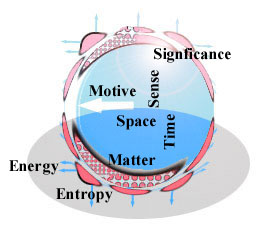
Wrapping this mess up, I put the atomic dots where they belong, on the inside surface of the experiential bubble of the Absolute. Make sense? Haha.
In Multisense Realism, all of physics is understood to relate to the capacity to discern between public and private views of phenomena. Public physics appears to us as ‘matter and energy’ on the outside and ‘perception and participation’ on the inside. The gap which makes this involution or twist possible is the modulation between the presence and absence or sensory presence, with the absence being what is called entropy or spacetime (which become essentially the same thing under this model of physics). To make things more confusing, this modulation of entropy and sensitivity is nested within many layers of itself, as a fractal. A cell encapsulates a world of molecular interaction. An organ encapsulates a world of cells, etc.
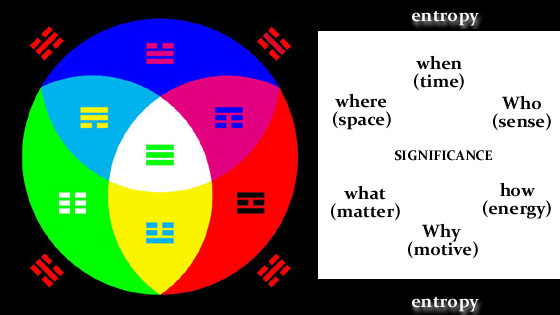
What started as an observation about the common positions that people seem to take within philosophy of mind debates became a hypothesis about the continuum of public and private sense experience, a re-interpretation of light, cosmology, consciousness, and the introduction of new concepts like significance and solitropy.
These two images try to capture the overall picture of how all major features of the cosmos can smoothly fit together.

The Future of Computing — Reuniting Bits and Atoms
A great presentation on computing with hardware and software which are homomorphic to each other. Logical automata (explained 11:51 to 15:50) is just this sort of a WYSIWYG architecture where the software is executed from a bulk raw material, i.e., not Gb of memory or number of processor cores, but square feet or pounds of programmable matter. Atoms, or groups of atoms, are here used directly as bits.
Gershenfeld compares how our current approach of computing requires multiple stages of compiling disparate formats, but that to more closely match nature, we should strive to imitate nature in the sense of having a consistent zoomable format on every scale.

In nature, the map is the same graphically regardless of the scope of magnification. Marrying these two concepts, the idea is to design shapes which are themselves instructions, i.e. physical interactions with other physical shapes, so that computation is not encoded but rather, embodied. As in biochemistry, the output is a material product, and the machine is itself is a self fabricating machine tool as opposed to a manufacturer of inert objects.
I think that he is probably right that this is the direction of the future in general, “computing aligned with nature” which brings computation into matter. It is compelling to imagine that this kind of embodied computing could be the Holy Grail of nano-engineering, giving us control over virtually anything eventually.
At the same time I can see that there is something which has been overlooked. To quote Deleuze:
“Representation fails to capture the affirmed world of difference. Representation has only a single center, a unique and receding perspective, and in the consequence a false depth. It mediates everything, but mobilizes and moves nothing.”
– Gilles Deleuze, Difference and Repetition, p56
(source http://sleepinginthegreenery.blogspot.co.uk/)
To understand why this universe of embodied computation is not the universe that we live in, Difference is the key. An overhead map is only so useful to us. Even if we can zoom down to the human scale level, we really need to switch to a first person street view to make the transition from outside-looking-down to inside-looking-around. To get further into the subjective view, we would have to have access to feelings and thoughts, so that at some level of description the model of zoomable shapes is less than useless. In our personal awareness, the appearance of neurological structures in our view would be hallucination.
The assumption then of this uniformly computational matter, while fantastic for our purposes as human beings, would be a catastrophe for the universe in general. It would be the ultimate monoculture, with everything and anything reinvented as collections of positionable nano-Legos. The problem of conformity to a generic, universal structure is not that it won’t work, but that if it does, there will be no Difference possible.
Given Deleuze’s assertion that representation moves nothing, this intention of “reuniting bits with atoms’ seems to presume that they were united to begin with but doesn’t address why they were ever separated. Indeed, if this method of embodied computation is the way of nature, how and why could it ever seem otherwise? Where have these Different perspectives on different levels emerged from, and for what purpose?
I think that on closer inspection, even though this new approach is brilliant and revolutionary in some important ways, it still is founded on a sloppy assumption. It presumes that hardware which looks and acts like the software is identical to it. If this were the case, instead of images we would see the shapes of ganglia and retinal cells, but we would see the same thing instead of smells, sounds, and feelings. We could not feel dizzy, but rather be informed of some vestibular condition by means of these same shapes – which we think of visually or tangibly, but without the Difference, there really is no reason to assume anything perceptual at all.
Once again, even though I am impressed with the futuristic thinking, it still takes us away from the missing piece in physics – the privacy and interiority and qualia. Buying into the universe as undifferentiated plenum of self-machining bubbles we are betting that there is no difference between biology, chemistry, and physics. It’s all physics, all surfaces and volumes in public spaces. Is that really what the universe is though? Could our experience be understood that way if we didn’t have our own familiarity with it already? I think if we lived in a universe that was really all about universal computation, then we would never have separated bits from atoms in the first place. We never would have approached bits as encoded abstractions because we would have been comfortable already with the universal format.
Instead, the universe appears to be the opposite. On every level, even though there are repeating themes and forms, it is never exactly the same presentation. A whirlpool would not be mistaken for a galaxy and a grain of salt is not the same thing as a cube of ice. In the universe we actually live in, the only thing which seems truly universal is Difference. More universal than mathematics and physics is the variety of sensory qualities and modalities. It is not just formations or embodied information, but direct experience.
Multisense Perception Model

Another crazy looking attempt at organizing the multisense model of perception. The top diagram emphasizes how the contemporary model assumes that all phenomenal interaction is at the particle level, effected via tangible collisions of microcosmic bodies in spacetime. Higher level experiences are imagined to be epiphenomenal abstractions tied to each other through exclusively bottom up logical mechanical functions. In this model, it must be admitted that consciousness can only be a metaphysical layer of unexplained illusion.
In the bottom diagram, the dualism of private experience in white on black, and public spacetime realism in black on white gives an idea of the involuted or ‘Ouroboran’ relation between the two aesthetics. The center region depicts the public stack of spatiotemporal scale relations from microcosm to macrocosm (particles<>cells<>tissues<>sense organs/organisms). The Caduceus like split helix implies a loose hierarchical, bidirectional overlap of interlocking forms and functions on different scales and their implicit interaction with the corresponding private experiences on corresponding levels (personal, sub-personal interiorities corresponds to macrocosmic, microcosmic exteriors).
The label ‘Sensory-Motor Experiences’ at the base designates that the totality can be understood literally as sensory motor phenomena but the label and dashed halo at the top refers to the figurative capacities for empathy, semiosis, social quorum and teleology.
In this model, all layers are phenomenal and physical and consciousness or sense is a fully enfranchised, participant in physics on every level. Interaction is multivalent and multi-directional, bottom up, top down, inside out, outside in, past forward, future back.
Chalmers – Consciousness: The Logical Geography of the Issues
The argument for my view is an inference from roughly four premises:
(1) Conscious experience exists.
(2) Conscious experience is not logically supervenient on the physical.
(3) If there are positive facts that are not logically supervenient on the physical facts, then physicalism is false.
(4) The physical domain is causally closed.
(1), (2), and (3) clearly imply the falsity of physicalism. This, taken in conjunction with
(4) and the plausible assumption that physically identical beings will have identical conscious experiences, implies the view that I have called natural supervenience: conscious experience arises from the physical according to some laws of nature, but is not itself physical.
The various alternative positions can be catalogued according to whether they deny (1), (2), (3), or (4). Of course some of these premises can be denied in more than one way.
Denying (1):
(i) Eliminativism. On this view, there are no facts about conscious experience. Nobody is conscious in the phenomenal sense.
Denying (2):
Premise (2) can be denied in various ways, depending on how the entailment in question proceeds—that is, depending on what sort of physical properties are centrally responsible for entailing consciousness. I call all of these views “reductive physicalist” views, because they suppose an analysis of the notion of consciousness that is compatible with reductive explanation.
(ii) Reductive functionalism. This view takes consciousness to be entailed by physical states in virtue of their functional properties, or their causal roles. On this view, what it means for a state to be conscious is for it to play a certain causal role. In a world physically identical to ours, all the relevant causal roles would be played, and therefore the conscious states would all be the same. The zombie world is therefore logically impossible.
(iii) Nonfunctionalist reductive physicalism. On this view, the facts about consciousness are entailed by some physical facts in virtue of their satisfaction of some nonfunctional property. Possible candidates might include biochemical and quantum properties, or properties yet to be determined.
(iv) Holding out for new physics. According to this view, we have no current idea of how physical facts could explain consciousness, but that is because our current conception of physical facts is too narrow. When one argues that a zombie world is logically possible, one is really arguing that all the fields and particles interacting in the space-time manifold, postulated by current physics, could exist in the absence of consciousness. But with a new physics, things might be different. The entities in a radically different theoretical framework might be sufficient to entail and explain consciousness.
Denying (3):
(v) Nonreductive physicalism. This is the view that although there may be no logical entailment from the physical facts to the facts about consciousness, and therefore no reductive explanation of consciousness, consciousness just is physical. The physical facts “metaphysically necessitate” the facts about consciousness. Even though the idea of a zombie world is quite coherent, such a world is metaphysically impossible.
Denying (4):
(vi) Interactionist dualism. This view accepts that consciousness is non-physical, but denies that the physical world is causally closed, so that consciousness can play an autonomous causal role.
Then there is my view, which accepts (1), (2), (3), and (4):
(vii) Property dualism. Consciousness supervenes naturally on the physical, without supervening logically or “metaphysically”.
There is also an eighth common view, which is generally underspecified:
(viii) Don’t-have-a-clue physicalism: “I don’t have a clue about consciousness. It seems utterly mysterious to me. But it must be physical, as physicalism must be true.” Such a view is held widely, but rarely in print (although see Fodor 1992).
To quickly summarize the situation as I see it: (i) seems to be manifestly false; (ii) and (iii) rely on false analyses of the notion of consciousness, and therefore change the subject; (iv) and (vi) place large and implausible bets on the way that physics will turn out, and also have fatal conceptual problems; and (vi) either makes an invalid appeal to Kripkean a posteriori necessity, or relies on a bizarre metaphysics. I have a certain amount of sympathy with (viii), but it presumably must eventually reduce to some more specific view, and none of these seem to work. This leaves (vii) as the only tenable option.
—David Chalmers, The Conscious Mind
My view would require an extra option in between vi and vii –
(vi.5) Oroborean monism. Physics supervenes reflexively on its own (proposed) capacities to experience. Interaction is not logical but self-evident, with multivalent causation to and from private intention and public extension as ordinary sensory-motor participation.
Umbilical Monism, Unfielded Physics

I consider my view of consciousness to be neither dualist nor monist, but an “involuted monism”. The idea is that experience and matter are the private and public ranges of physics. The involution (like a Klein bottle or Mobius strip) refers to the orthogonal or perpendicular juxtaposition of the two ranges. Physics is the capacity to discern between public and private experiences and we know it as ‘matter and energy’ on the outside and ‘sensory perception and motor participation’ on the inside. The gap which makes this involution or twist possible is the absence or contraction of perception, aka entropy or spacetime.
If involuted is too abstract, maybe the word ‘umbilical’ gives a more tangible sense of what I mean. As a fetus, all of us have had as our first experience as a person as being a person within a person. Suspended in a bubble of nested humanity, our cosmos was both a closed vessel of nativity and a semi-permeable observation tank. An unknown within an unknown, with nothing but our capacity to feel and sense qualia. Even then we were putting things together on some level, forming expectations and desires about the world.
After birth, rather than being stoic imprinters and learners of the logic of our surroundings, we remain largely within the psychological womb, filled with pleasures and terrors beyond ordinary description. We scream and cry. We devour fiction and fantasy and revel in sensation. Even then, our inner world was just as important to us, if not more important, than the world we shared with others.
It’s strange to imagine that before we had ever tasted food, there was a fleshy hose extending from our belly into our placenta. The placenta is more like a lung to us, as our fetal hearts pumped oxygenated blood in through a single vein in the umbilical cord, which then splits to plug in to supply our liver and then our heart.
The involution here, as in the universe as a whole, is not only of the Russian Doll kind of nesting of bodies within bodies, but also of the Lion King kind of nesting (…♫ the Circle of Life ♫). Our life story recapitulates the history of our biological evolution, and presents a repeating narrative of familial roles. Our power waxes and wanes in counterpoint with the cycles of the lives of our parents, stereotypically anyhow, with the caregivers becoming care-receivers in old age…at least before our civilization evolved to deal in more… impersonal values.
The transition between Russian Doll matters and Lion King experiences can be understood better if we allow experiences to be defined in the terms in which they are presented to us. Feeling, thoughts, images, have no field-like parameters. They have no discrete positions or portable content. All of our experiences occur “here”.
In my view, all of our efforts in understanding the mind-body relation have been biased by the compulsion to explain matter as an illusion (idealism) or mind as an illusion (materialism), or the distinction between mind and matter as an illusion (functionalism). In turning these three birds inside out, we can find a common egg – only it isn’t an egg, it is sense itself. Without reaching for phlogistons or aethers, vacuum flux energies, or other cosmic fluids, our own awareness could be understood as an un-field. Just as the space between your eyeballs and these words does not seem to be filled with any particularly charged space, the range of our visual sense is a function of our own sensitivity and the nature of what we are seeing. There is no field which is causing our sense. We are simply present with other presences.
Why do pitches separated by an octave sound “the same”?
Answer by Paul King:
This phenomenon is called “circularity of pitch.”
Once a tone has gone up one octave, it seems to be “back to where it started” but “higher”:
As others have mentioned, this effect is derived from the overtone structure of natural sounds. The “richness” of a natural sound comes from several overlaid frequencies, each of which are an integer multiple of the base frequency or “fundamental”, and the reason for this has to do with the physics of how sounds are produced by vibrating objects like strings and vocal cords.
The reason that shifting up one octave “sounds the same” is that the overtone structure of a tone and the same tone one octave higher (all frequencies doubled) is almost the same.
Here is the frequency spectrum of a violin string (the horizontal axis is frequency, and the vertical axis is”power”). The first “bump” is the fundamental and the ones to the right are the overtones:
Shifting this tone up one octave amounts to stretching this spectrum to the right by 2x. When this happens, the spectrum will be almost identical except that every other overtone will be missing. The tone thus sounds almost the same (activates the same frequency-sensitive neurons in the brain), but with a higher “average frequency” and “thinner” due to the missing overtones. This is illustrated here by stretching the above image horizontally by 2x and showing the overtones that line up:
If these two tones are played together, they reinforce each other and will merge to sound like a single note but with a different timbre (different frequency spectrum).
This circular relationship between frequency and pitch leads to the “circularity in pitch judgement” illusion called the Shepard scale in which a chromatic scale of notes seems to rise forever. Audio demo here:
The animation accompanying the audio shows how it works: The frequency spectrum is shifted to the right, increasing the perceived “pitch” (chroma), however the power envelope, and thus the average frequency (height), is held artificially fixed the tone does not actually climb higher. The net effect is this:
Perhaps the creepiest version of this illusion is the never-ending falling tone auditory illusion, here: http://asa.aip.org/sound/cd/demo…
To show just how intertwined overtones are with the perception of scale, pitch, and octaves, it turns out that when a piece of music is played on a “stretched scale” (one octave stretched from 2x frequency to 2.2x), the music sounds horribly out of tune and wrong. But if the overtone structure of the notes being played is synthetically stretched by the same amount, the music sounds oddly in tune again.
I think that this reveals a lot about the nature of sense in general. Rather than calling these perceptual surprises ‘illusions’, I would say that they are examples of how conflicts are resolved among multiple levels of sense and sense-making.
In particular, I think that the fact of overtone dominance in tone perception tells us about the Top-Down nature of sensation, where larger wholes or gestalts are interpreted at a higher priority than granular, low level sensation. I think the illusion more likely is in the confidence that we have for our expectations about what perception actually is. When we assume that physics is an observer-independent reality with pockets of privacy containing approximations of that reality, then we overlook the possibility that physics is indivisibly both private and public, universal and proximal. This is the more accurate model in my opinion.
Overtones show us the nested nature of perception where our sensitivity plays an active role on many levels. It’s not just a matter of data accumulating in structures, but of encountering our own local experience of eternity as a rolling ‘here and now’. Like the perpetual floating peak of circular pitch, our here and now is only the most obvious range of a larger phenomenon united by likeness.
Our personal range of awareness yokes together a fugue of sympathetic echoes, both from repeating pasts and the promise of novelty from possible futures. These sub-personal and super-personal ranges are bound by instantaneous space and eternal time, respectively. The more sub-personal you get, the more you are talking about the experiences of organs, tissues, cells, and molecules in spatial relation to each other as bodies, objects, or random machines. The more super-personal you get, the more we refer to timeless themes of inspiration and teleology.
Physics can teach us how to understand the mathematics of ratios and the mechanics of wave, but in its current legacy form, physics can’t explain the physics of ratios themselves, or the mechanisms which drive us to perform the production of acoustic pressure waves. We are dazzled by the perfection of the ratios, but we no longer care what they are actually ratios of.
Three Dimensions of Time?

Another way of thinking about subjectivity (as I have modeled it with the multisense continuum as sub-personal, personal, and super-personal ranges of awareness) is that time has three dimensions.
Unlike the three dimensions of space, where the dimensions are presented as converged and simultaneous, the three dimensions of time are more like parallel gears or lenses which are relativistic to the scope of the participant’s awareness rather than to the position of their body. In short, as the structure of space resembles space itself, this new model proposes that the structure of time should be understood in a progressive way, as a multi-stage evolution of structure which is smeared across the totality of interior perception.
If that were true, then my candidates would be as follows, and you can think of them as three levels of description of a clock, oscillation, progression, and orientation.

1. Oscillation. On the lowest level of accurate clocks, there is a recursive sensory-motor engine. Be it a bobbing float, a swaying pendulum, a spring, or a piezo-electric material being stimulated to vibrate, the source of momentum for a clock is the tension between release and restraint, resolved as oscillation. We don’t know that an electric current on a quartz crystal generates an experience of release and restraint, but I suspect that on it’s own molecular scale, there is such an experience, 32,768 times per (human scaled) second.
A very simple water clock could consist of just a leaky measuring cup. In that case, there would not be an oscillation, but a smooth flow. If you watch flowing water, however, it is your awareness which tends to oscillate, tracking between the recursive rushing of the flow through a fixed position and the fluidity of the total motion downstream. In a water clock, the amount of water which leaks out is abstracted quantitatively. When we say, for instance, that there are X number of gallons in a pool, we don’t mean that there are literally gallon-sized units which water comes in that are all squeezed into the pool. We mean there is enough water in the pool to fill X number of gallon jugs if we wanted to. This is a bit of a detour, but it is important because we seem to have forgotten this in physics and now routinely mistake our quantum measurements for the underlying phenomenon which drives that which we believe we are measuring as well as the measuring device itself.
The more relevant point here, is that while the lowest level of time can be either the smooth fluidity of force* or the oscillating dissipation of that force. With the oscillation we get a better sense of the recursive quality of the sub-personal experience. The sub-personal is characterized by its intolerable recursiveness. So generic and monotonous is the stream of identical passing moments of the oscillator that our attention cannot face it for long. We need hands or digits or hash marks on a ruler to help us keep track of their progress indirectly. To a human mind, the experience of the trillions of micro-organic presences which make up our body at any given moment, is recursive madness. The experiential qualities of molecular and quantum levels beneath that, can only be more insanely generic, vast, and uniformly repetitive.
3. Progression. In the middle, personal range of chonometric experience, the hands of a clock are used to denote the wheel of the sun’s progress across sky. Because of the pervasiveness of the sun’s presence, it is only necessary to capture twelve hours at a time, since it should be obvious whether an hour is am or pm by countless perceptual cues internally and externally. The sundial or mechanical clock with round face emphasize the cyclical nature of the progress of time, really a helical sense of second, minute, hour, progressive cycles and day/night oscillating cycles.
In modern time, the worldliness of the solar clock has been shattered in favor of digital time. In digital time, cycle and oscillation are pushed into the sub-personal range of awareness to yield a pure coordinate space. Time no longer passes, rather it is set and synchronized to a satellite signal.
The implications of this psychologically are a double edged sword. Digital time is precise, accurate, and uniform, but its granular nature has replaced the flow of time with dehydrated instants. The meaning of time is purely relative now, an enumerated code tied to geography and policy. Time doesn’t so much ‘march on’ anymore as it does march in place on multiple levels. Time is now an infinite commodity of finite moments, meaningless, disconnected, and interchangeable. We have, in a sense, stopped time while in another sense, we have made time more inescapable and relentless. We are pushing the personal sense of active progress and flow into an impersonal sense of fixed point geosynchronous addressing.
Fortunately we still feel our own lives personally as progress and growth. Our cycles are longer and more spacious than they were a century ago, causing strange red shifting and blue shifting in the extension of childhood, adolescence, and old age but contracting adulthood. Stripping away the superstition of the past has reduced the human life from a pageant of astrological or religious significance ordered by time to its bare bio-genetic mechanisms. Aging is nothing more than a set of symptoms to be banished through medication and cosmetics, diet, and exercise. Otherwise, one year is much the same as the next. Our window of progress has been contracted to match our pay cycle or school schedule. Groundhog Week is always beginning, ending, flying by, or dragging.
Progress is about passing significant milestones. We talk about dates A.D. or B.C. (formerly Before Christ, not secularized as Before Common Era), or characterize them in Ages, Bronze, Iron, Industrial, etc. In our own lives too we think in terms of relationships, residence changes, jobs, or other shifts in the content of our life story – a matrix of befores and afters. These markings in our personal progress are totally unlike the impersonal measures of oscillation and cycle, which are fixed recursively. The chronometry of our lived experience is not so much marked as it is ritually scarred. From the inside, the clockwork thematic and plastic. It retains the irreversible arrow of time, but hyper-extended into aching nostalgic ruins and amputated in chronic disillusion. The retelling of stories and reimprinting of memories smooths out the rough edges, compensates for the incompensible and runs out the clock on personal ages we can’t bear to revisit in their full glory. Memory is a mindfuck. Part propaganda, part revelation…which leads me to.
3. Orientation. Clocks and calendars provide us with a birds-eye view of time. Beyond flow, oscillation, and progress, the wheel or grid of time gives us a presentation of time as universal collection. A science fiction zodiac of possible futures. If oscillation begins with outward flow, then it ends with containment within. Flux and flow persist as perturbations of currency, ripples on the surface of an Akashic plenum of eternity. Finding our way to and from this ocean is perhaps the greatest mystery – one which we have tried to solve with intuition and divination. This is the scientifically despised layer of time which can be described as super-personal, or super-signifying.
Jung talked about the collective unconscious, echoing what every mystic tradition has said about a world beyond time itself – a nexus of hyper-convergence where meaning originates or terminates. Archetypes, symbols from dreams, alchemical models, all point to a kind of absent presence of a divine Totality. Campbell’s ‘hero with a thousand faces’. A bottomless well of teleology and significance – images, encounters, mythic adventures.
Perhaps as the thin trickle of water clock drips out of its vessel, so too does the trickle of possibility drip into our imagination. Unlike the despised drip-drip-dripping of the Sub-Personal level Chinese water torture, the Super-Personal drip into our Personal ‘now’ is generally welcome, if not desperately so. Novelty and variety are precious and we are fiercely proprietary about them. We want to be the first to know, to see, to feel the future for ourselves. ‘What’s next’ is the hope for release from cycles and oscillation – for transcendence and cessation. “Tis a consumation devoutly to be wish’d”.
*flowing from private sensory potentials to public motor presentations (aka thermodynamic entropy, or the arrow of time…a continuous public declaration of pure irreversibility, which is the source of all motive, all expansion, or fractal self-diffraction of the cosmos).
Who’s In Control?
About freewill, thought origination, etc. I do not claim to have the answers but share the following observations.
Our experience reflects two phenomena which can be summed up as the totality of our existence. Those two are the physical and the mental. I believe a little further contemplation reveals that the two can be reduced to one. We are aware of the separation and boundaries of the physical, this thing, that thing, etc. However, when it comes to the mental we experience no such separation. Does not the mental comprise it all? If the mental, awareness or consciousness was divided, bounded, separated or limited how could one thing have awareness of the other? If you and I are defined by our awareness, mentality, consciousness, knowing or whatever you wish to call it and are separate how can we be aware of each other and where or what defines the boundary between us? Obviously, our brain does not confine our consciousness. If it did we could not be aware of anything else. By definition there cannot be an Infinite and anything separate.
Does not the fact that I am aware of me, other people, the world and the universe mean that I AM beyond the aforementioned?We are aware of physicality changing, seemingly coming and going, etc. and in a constant state of flux. However, awareness remains changeless, invulnerable and cannot be created or destroyed. Can we not then conclude that there can be no limit, boundary or separation within Consciousness? If so, we can further conclude that there is only Consciousness because if there is no separation in Consciousness there can obviously be nothing existing separate from it. There is only, All that Is and we are IT. Many will say claiming to be God is a flagrant affront to God or a terrible sacrilege. But, in fact, the opposite is actually the case. If we claim to be separate from God we necessarily limit Him/Her/IT. God cannot be infinite or limitless and be separated by other “stuff”.
How then do we explain individuality? Since we have established by deductive reasoning that there can be no separation, we can now conclude that there is no separate you and I. Further, since nothing can exist separate from Consciousness, nothing but Consciousness exists.
Yet we are aware. Can we not now further conclude that we are all that is or the Consciousness that we have already established is all? Taking this line of reasoning a little further, while we have awareness, we are at the same time aware of not being fully aware. We seemingly are aspects of infinite intelligence but not infinite or at least not aware of it.
From here we can only speculate. I suggest that Infinite intelligence chose to express and Its only means of so doing was to project an illusion of physicality or that which we experience as this universe with inhabitants of limited awareness. They could not have full awareness or they would cease to be the projection but the Projector.
The next question then is, do we really have individual thinking, freewill and are we really capable of changing or controlling anything? I am, of course, totally aware of how we think we are and how difficult it is to give up such an idea and I’m not going to make judgment one way or the other at this point except to say I have struggled a lot with the question and will simply throw out some thoughts on the subject.
Back to the physical and the mental. We have already established that the physical does not really exist. Only the mental is capable of creating a thought. The physical is nothing but objects including our body and brain. I do not believe a brain ever created a thought. The physical cannot possibly create. The brain may very well act as some sort of filter or receiver but I do not believe it can ever be creative. Further substantiating this is the fact that we do not have much idea what our next thought will be. Nor can we control what it will be or how long or often it may reoccur. Likewise, we have many thoughts we would rather not have at times. If we were controlling them why would we have undesirable ones? You have no idea what your next thought will be but I do and you cannot possibly avoid it unless you stop reading right now. Your next thought will be visualizing a flying elephant. So, I believe it obvious that our thoughts are originating from somewhere beyond the physical brain.
About control of life otherwise. We did not control when or where we were born. We had no control of who were our parents, siblings or status, financial, fame or otherwise. We had no control of our gender, original health, inherent tendencies, etc. We had no control of our early upbringing, how we were treated, what we were exposed to, nourishment, etc. We had no control of our early education or exposure to outside influences, etc. We had no control whether we were bullied or abused sexually or otherwise.
We now do not control our bodily functions, heartbeat, digestion, respiration, etc. We have little if any control over viruses, infections, immune systems, accidents, etc.
We do not control when, where or how we die. We do not control all those little or sometimes big unexpected events occurring daily in our lives. Yet, we think we are in control of our lives.
Of What?
We think we are making decisions between multiple choices but are we really? We say we could have chosen the other option. But why didn’t we? We weighed the options, consequences, etc and made a decision. In other words it would have required different consequences or circumstances for us to have made a different decision. But only what is, IS. So, was a different decision ever in the picture? Who could deny that things would be a lot different if we were truly determining the events of our lives?
It is very obvious that our lives are being greatly influenced if not totally controlled by outside forces.
So, you ask, what then is the point in it all? Why this essay? Why make the effort to be good? Why not just live fast, love hard and die young? You are what you are and you’re not going to deviate from it. Afterall, you’re not really in control!
Does it really matter whether or not we are in control? If it makes us feel better, than fine. What difference does it really make if we get over there and realize that, hey, we weren’t really in control afterall? Will we not just laugh and say, I sure as hell thought I was.
Or could it be that within the projection, the mentality of the inhabitants really does have freedom of choice? It’s all illusion anyway but as Thomas Troward said, even though it is illusion, because it is a projection of the Almighty it is real as far as we’re concerned.
In keeping with the spirit of the question, I will answer it not in the way that I would like to ideally, but in the way that my circumstances seem to compel me. Having to get to sleep soon, I don’t have time to craft a thorough answer, (which nobody will probably bother reading) and if I leave it until tomorrow I might not remember what I was going to say. Here then is my circumstantially compromised, short order version of my contribution. I’ll be happy to go into it in further detail later on if anyone is interested.
1. Mental and physical are neither the same thing nor different things, they are opposite ends of a continuum of sensory-motor participation, which is, in my estimation, the fundamental component of the cosmos.
2. Free will and determinism are similarly not mutually exclusive but are defined by and help to define the aforementioned opposite ends of the universal continuum, which can be best understood as public and private ranges of experiential ontology. Public experiences are based on spatial extension, and private experiences are based on temporal narratives, and the two aspects are orthogonal/perpendicular in every way. They two ends also merge in another range of the continuum, which I call the profound edge, where transcendent experiences blur the boundary of private and public.
3. Physical matter actually is ‘real’ in the sense that the foundation of realism lies in the persistence of matter’s spatial extension, which acts as the single firmament of public interaction. All other interaction is biographical and private.
4. The nature of free will is complicated because our understanding of the nature of human consciousness is still very primitive, made more difficult by the seemingly irreconcilable approaches of what could be called the Oriental program, which places subjectivity as the absolute foundation and materiality as derived illusion, and the Western program which leads to the opposite and mutually exclusive conclusion. In my analysis, the opposition of these two programs to each other is a critically important revelation of the nature of consciousness itself, as the capacity to select either extreme and to dial between them mirrors the function of human culture and individual psychology in general.
In my opinion, strict adherence to either the Eastern or Western extremes tends to lead to a pathological worldview, in the sense that fanatical defensiveness and hypocrisy replace a respect for the plain truth. Moving forward to a new synthesis requires, in my opinion, that we keep the Eastern model of hierarchical levels of awareness (chakras, alchemical monochord, etc) but reconcile it with the Western model of physical scale (molecular, cellular, somatic, geological-evolutionary, astrophysical). The way that I propose arranges the sensory-motor experiences hierarchically so that our personal awareness and participation is flanked by a sub-personal or root range of qualia and a super-personal or meta range of intuition and inspiration flavored feelings, insights, and connections.
Anyhow, yes, our personal will does have a modicum of freedom, which expands in proportion to how deeply ‘within’ the context is. Within our own imagination, we have a fantastic degree of freedom, but are still limited ontologically by our human description and by the physics of privacy itself. The further we get from the immediacy of our private realm, the more that our freedom is constrained by the confluence of our own sub-personal and super-personal agendas as well as the nearly infinite impersonal agendas which surround our body in the public presentation of our world. To make things happen in the public world requires slowing our will down, ordering it strategically and persistently, matching the conditions of our environment, and making all manner of compromises. In the end, we may not see that much is left of what we thought we had intended personally, but nevertheless, we were the ones who had to pay attention and care about the outcome, so that’s something. Besides, often we find that the surprises that we discover in the public world are beyond what we could have intentionally dreamed up for ourselves, for better or worse…and that, I suspect is usually part of the larger (super-personal) agenda… if there is one.
Chalmeroff Scale Revisited
This project is based on an idea that I had during the TSC conference in Tucson last year. Named after David Chalmers and Stuart Hameroff, I tried to suggest a fundamental unit of consciousness which could encapsulate the full range of subjective experience, from the mystical or psychotic to the practical/realistic and the logical/theoretical.
This might be too ambitious of an idea to fit in with our current understanding of awareness, mired as we are at the moment in the misconception of ‘information’ independent of sensory experience. Here then is a first draft on a re-scoped effort to nail down a scale of awareness which does not amputate awareness itself by focusing only on functional considerations.
Here then is my dumbed down version of multisense realism, placing subjectivity in terms that should be familiar to a contemporary audience. I hate to leave out the most important parts – the details of sensory-motor participation, perceptual inertia, solitropy, and significance, but maybe this more modest proposal will have a better chance of gaining traction.
Chalmeroff Scale of Consciousness
In an effort to parameterize the study of consciousness, it is proposed that the approach described in Giulio Tononi’s Consciousness as Integrated Information: a Provisional Manifesto be augmented with a metric based upon the orientation of integration. Orientation specifies a range of proximity to the site of integration (self), so that a low value on the Chalmeroff scale would indicate information which pertains directly to the agency of the self. Information with a value of one on this scale would, for example, include the presence referred to by the pronoun (“I”). Information which is interior to the self (phenomenological) would be given a decimal value below one, logarithmically, so that the lower the value, the more ineffable the information is.
Ineffability is formally defined as follows:
The degree to which the integration of information which has been generated by a complex of private elements is inversely proportionate to the accessibility of meaningful integration from outside of the complex.
In other words, an experience is ineffable when the subject derives meaning from generated information which supervenes on an extensive personal history. A person who has struggled for many years to accomplish something will attach much more significance to that accomplishment than an outsider who is ignorant of the struggle. This amounts to a relativity of information entropy, which occurs privately through run-time rather than programmatically as configurations of data.
This relativity adds an orthogonal dimension to the quantitative measure of Integrated Information Theory (IIT), as it describes how realistically we can expect to approximate the internal integration of a system externally. Information which relates to public physical interactions for example would not require much of an investment by an outside observer to recognize and interpret. Social interactions are somewhat more ineffable and would generate private information which could be interpreted by an outside observer with a more substantial investment in learning to read the social narratives, as would an anthropologist.
The IIT defines Qualia space (Q) as a multi-axis space where each axis refers to a possible state of integrated relationships(Φ) among information generating elements. On top of this foundation, it is necessary to recognize the significance of the self-world orientation. It is proposed that the first person orientation actually generates the topology of the Qualia space, such that low Chalmeroff value information maps to a polar-radial-mandala geometry while higher Chalmeroff value information increasingly maps to a Cartesian grid. In this way, the essence of the transition from private phenomenology to public realism can be represented clearly, if somewhat simplistically.
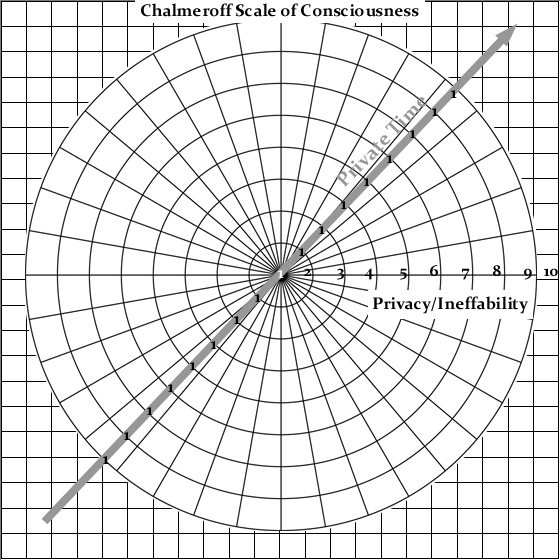
IIT provides a mathematical analysis for experience as a complex of spatial relations, to which the Chalmeroff scale adds a dimension of significance which is not merely emergent from public data, but residually implicit from all contexts, both interior and exterior to the system. In this way, the static wireframe model of information mechanisms can be understood to survive as narrative animations within a cosmological totality (eternity).


Recent Comments