How do evolutionary psychology and neuroscience compare as popular theories to “explain everything” about human nature?
“These two theories are the biggest explanatory frameworks at the current time, with neuroscience rising and evolutionary psychology looking a bit threadbare. And they are quite different.
I don’t mean, are these valid theories scientifically, but how good are they as a way for people to tell meaningful stories to each other about human nature? What do we become through that telling? What gets left out?”
Answer by Craig Weinberg:
In Raymond Tallis’ book Aping Mankind, he describes the over-reaching of neuroscience and evolutionary psychology and names them “Neuromania” and “Darwinitis”. While this assessment is likely seen as inflammatory or offensive to the many dedicated and brilliant professionals who have devoted their lives in pursuit of understanding human nature scientifically, his criticisms are quite defensible. Tallis, a neuroscientist himself, argues that both disciplines contribute to what I call de-presentation, and he calls ‘the disappearance of appearance’.
When neuroscience looks at human nature, it does so from the outside – as the behavior of cellular and molecular bodies, of organs and networks of ‘connections’. Evolutionary biology also looks at human nature from the outside, as the behavior of zoological ecosystems, species, and inherited bodies. Taken together, these super-personal systems and sub-personal systems can be de-ranged to completely subsume the personal, the private, and most significantly human aspects of human nature.
It is a bit like looking at human nature under a blacklight. With most of the frequencies in the dark, neuroscience and evolutionary psychology have done a fantastic job of illuminating some hidden aspects of ourselves – how and where we fade into subconscious and unconscious mechanisms. We have glimpsed some of our own biases and seen behind the curtain of many misperceptions. We have not yet, however dared to turn this critical lens on itself. We have not seen how neuroscience and evolutionary biology themselves are excluded from the general distrust and marginalization of awareness. Somehow, the totality of our human experience can be written off as a solipsistic simulation or ’emergent property’ of ‘information’ processing, yet the mechanisms of science are presumed immune from the politics of our species and the unreality of the brain’s twitchings in the dark. Sam Harris actually said something to the effect of “certain kinds of thinking” extend outside of the bubble of human delusion (but without saying how).
What gets left out, according to Tallis, is humanity. Arts, literature, civilization. While he goes on in the second half of his book, to argue the profound difference between human beings and other species, I would argue that does make human beings more special than others on Earth, I would not say that it makes us an exception to zoology, or physics. Instead, I would argue for a radical reinterpretation of physics in which privacy and aesthetic appreciation are seen as more fundamental cosmological influences than public, functional mechanisms.
Prime Spiral
The prime spiral, also known as Ulam’s spiral, is a plot in which the positive integers are arranged in a spiral with primes indicated in some way along the spiral. Unexpected patterns of diagonal lines are apparent in such a plot. This construction was first made by Polish-American mathematician Stanislaw Ulam (1909-1986) in 1963 while doodling during a boring talk at a scientific meeting. While drawing a grid of lines, he decided to number the intersections according to a spiral pattern, and then began circling the numbers in the spiral that were primes. Surprisingly, the circled primes appeared to fall along a number of diagonal straight lines or, in Ulam’s slightly more formal prose, it “appears to exhibit a strongly nonrandom appearance”
In the above variation of the Ulam spiral, red squares represent prime numbers and white squares represent non-primes.


I can’t decide if I care about prime numbers. On the one hand, the idea of indivisibility is interesting as it relates to consciousness. In some sense, I think that the universe, and each experience of it, is a one-hit-wonder. All appearances of repetition are local to some frame of reference. If someone is color blind, they may see alternating red and green dots as a repeating grey dot. If you listen to someone speaking a language that you can’t understand, it can seem, on some level, that they are saying the same kinds of sounds over and over again.

I wondered if any random constraint would appear to contain pattern when mapped as a spiral like that. This one above is yellow hex if the number spelled out contains the letter i. Writing these out I noticed how the language we use to name the numbers is isomorphic above ten. A trivial observation, I know, but I think that this logical version of onomatopoeia reveals some insights about recursive enumeration, and its foundation in an expectation of the absolutely generic.
To someone who is fascinated by prime numbers (often in a hypnotic, compulsive kind of way, as these spirals suggest), part of the appeal may be that the patterns that they seem to make defy this expectation of generic, interchangeability as the basis of counting. Three isn’t really supposed to be different from two or one, it’s just “the next one after two”. Finding these cosmic Easter eggs by poring over mathematics is, as the movie Pi dramatized, a weird kind of quasi-religious calling. Seeking to sleuth out a hidden intelligence where neither intelligence nor secrecy would seem possible. Numbers are supposed to be universal; publicly accessible. There shouldn’t be any proprietary codes lurking in there.
Maybe there aren’t? Without mapping primes into these spirals to look at with our eyes, the interesting sequences and ratios in mathematics would not be so interesting. Mathematics may provide the most neutral and bland medium possible for the projection of patterns. Like a supernatural oracle or Rorschach inkblot, an ideal medium for pareidolia and conjuring of simulacra from the subconscious.
Math is haunted alright, but by pattern recognition – sense making, rather than Platonic essences. Because math is an ideal conductor and insulator for sense, it does end up reflecting sense in a clear and concise way, however I think it is mainly a reflection. Math is not the heart of the universe, not the whole, but the hole in the whole – a divider which shaves off differences with the power of indifference.
Defining Consciousness, Life, Physics
One of the more popular objections to any proposal for explaining consciousness is that the term consciousness is too vague, or that any explanation depends on what way the term is used. I disagree. The nature of electricity does not depend on what people think the word means, and I don’t think that consciousness does either. When someone is knocked unconscious, there is little doubt about what it means. In general terms, it means that they are not personally present. They are not personally affected by their environment, nor can they intentionally cause any effects on their environment.
Is that an agreeable place to start for everyone?
Can we agree also, in light of the physiology of the brain-stem, which consists of sensory neural pathways and motor neural pathways, that the concept of consciousness is at least closely identified with input/output?
Can we agree that it could be possible that input/output could be sufficient to describe the fundamental nature of consciousness? Does consciousness need to be something further than that?
Here is where, in my view, the whole dependency of definition comes in. The issue is that input/output can either be conceptualized from the exterior or the interior. The Western perspective, even when it tries to model the interior perspective of i/o, does so from the outside in. It assumes that the proprietary feeling of subjectivity is fundamentally inauthentic – that a system can only be built from generic conditions, laws, processes, etc, and cannot be truly original in any sense. In this way, no neuroscientific account, or cog-sci account, can really claim an inside-looking-out perspective. The Western orientation does not allow for the possibility that person as a whole could act as an irreducibly singular receiver of experience an originator of physical cause. Taking a cue from relativity, however, I suggest that perceptual integrity is identical to inertial framing, so that the frame as a whole can drive the micro-frame conditions within it, and vice versa. This is not vertical emergence from the bottom up, but parallel emergence. Multiple levels of description.
Going back to consciousness being definable in terms of its difference from unconsciousness, we can see that the difference between the two has some similarity between life and death. Can we agree that life too differs from death in that it relates to input/output for an organism and its environment?
We understand that an animal can be unconscious without being dead, but is this a difference in degree or a difference in kind? Could input/output also be sufficient to define “life”. We might say that life includes reproduction and growth, however even a single cell organism which is not reproducing or growing at any given time is considered a form of life. Does that not seem that the quality of environmental sensitivity and the ability to cause biochemical effects in response to that sensitivity are even more essential to defining life?
To sum up then, I am asking:
1) Doesn’t being conscious really just mean the ability to receive sense and project motive?
2) Doesn’t life really mean the same thing on a lower, level?
From there, I would ask
3) Isn’t sense what we really mean by a ‘field’, and motive what we mean by a ‘force’?
4) Using relativity as a intuitive guide, can’t it be said that the concept of ‘field’ or ‘force’ are really metaphors, and that the way we contribute to human society is identical to the way that any vector of sense contributes to its context? Isn’t consciousness just a form of life which is just a form of physics…which is just a form of sensory-motive interaction?
Quora on Conscious and Subconscious
How does the conscious and subconscious speak to you at the same time?
My hypothesis is this: The conscious, subconscious, (and super-conscious) *are* you already. Simultaneity is relative and supervenes on perception. The subconscious (I call sub-personal) generally relates to a smaller, faster inertial frame. Sub-personal impulses are experienced as urges and relate generally to the reality of the body. It is a very small “now”, in the range of microseconds to minutes.
The super-personal or transpersonal feelings are meta-phoric. The root ‘phor’ as in euphoric or ‘fer’ as in ‘confer’, ‘infer’, etc means to carry – to ferry something from one place to another. Metaphor then is to carry over, to jump from one semantic context to another. Just as a symbol or fable can work on multiple levels at once, our conscious personal experience is both rooted in larger ‘nows’ which range in days, weeks, and lifetimes and the sub-personal/microphysical instant.
As human beings, we have a tall window of awareness that extends between the now that is microscopic and the now that is eternal. Confusion sets in when we try to define one in terms of the other. Our expectation that we would not be ‘spoken to’ at the same time is itself a prejudice of the conscious range of awareness.
If human beings are nothing more than matter, why are you conscious as yourself?
If human beings are nothing more than matter, why are you conscious as yourself?
Quora question:
Philosophy: If human beings are nothing more than matter, why are you conscious as yourself?
The implication of materialism is that we are in essence wet robots, without free will, just chemical reactions. But if this is true and we are conscious, then does it logically follow that all chemical reactions have “consciousness” to some degree? If the human mind is just an extremely advanced computer, then at what point does “consciousness” occur?
We don’t know that chemical reactions are unconscious, but if they were, then it makes sense that the entire universe would also be unconscious. It is very tricky to examine the issue of consciousness and to draw parallels within common experience without unintentionally smuggling in our own expectations from consciousness itself. This is the Petito principii or circular reasoning which derails most fair considerations of consciousness before they even begin in earnest.
Unlike a clock which is made up of gears, or a particular sized pile of hay, the addition of consciousness has no conceivable consequence to the physical function of a body. While we can observe a haystack burst into flames because it has grown too hot, we cannot look at the behavior of a human body see any special difference from the behavior of any other physical body. There is complexity, but complexity alone need not point to anything beyond an adjacency of simple parts and isolated chains of effects.
Just as no degree of complication within a clock’s mechanism would suddenly turn into a Shakespearean sonnet, the assumption of universal substitution is not necessarily appropriate for all phenomena, and for consciousness in particular. To get a color image, for instance, we need to print in colored dots, not black and white. Color TV programs cannot be broadcast over a monochrome display without losing their color.
Unlike chemical or mechanical transformation, the nature of awareness is not implicated in the shuffling of material particles from one place or another. Any natural force can be used to do that. We have no scientific reason to insist that conscious participation and aesthetic appreciation is derived from some simpler functioning of complex systems. To the contrary, ‘complexity’, and ‘system’ can only make sense in the context of a window of perception and attention. Without some teleological intent to see one part as part of a whole, and to compare remembered events with current perceptions, there is no such thing as ‘function’ at all.
There are several important points wrapped up in this question, which I will try to sum up.
1. The failure to consider consciousness metaphysically.
This is the most important and most intractable issue, for three reasons:
- because it is difficult for anyone to try to put their mind outside of mind. It’s annoying, and winds up feeling foolish and disoriented.
- because it is difficult in particular for the very people who need most to get past the difficulty. I have found that most people who are good with logic and scientific reasoning are not necessarily capable of doing what others can. The skillset appears to be neurological, like handedness or gender orientation.
- because those who do have difficulty with thinking this way are often not used to intellectual challenges that escape their grasp, their reaction is so defensive that they react with intolerance. It’s not their fault, but it cannot be cured it seems. Some people cannot see 3-D Magic Eye art. Some cannot program their way out of a paper bag. In this case it is the ability to consider consciousness from a prospective rather than a retrospective view which can prove so inaccessible to so many people, that frothing at the mouth and babbling about unicorns, magic, and the supernatural is considered a reasonable and scientific, skeptical response. Of course, it is none of those things, but it takes a lot of patience and courage to be able to recognize one’s own prejudices, especially when we are used to being the ones telling others about their biases.
2. The taboo against metaphysics, panpsychism, and transrationality
Long after Einstein, Gödel, and Heisenberg shattered the Humpty Dumpty certainties of classical math and physics, we are still trying to piece him back together. Regardless of how much we learn about the strange properties of matter, time, energy, biology, and neurology, there are a huge number of very intelligent people who are convinced that we will only know the truth about the universe when it all looks like a vast deterministic mechanism.
The compulsion to reduce awareness to passive mathematical or physical states is ironic, given that the defense of automaticity is often accompanied by very hands on personal intention. Even when it is pointed out that arguing against free will is futile (since someone without free will could not change their own opinion about it even if they wanted to, let alone someone else’s opinion), the mind of the determined determinist will always find a way of insist upon being in the right, even when they are ultimately sawing of the limb that they are sitting on.
When it comes to anything that suggests the possibility of non-human awareness, many people not only become personally uncomfortable, but they become socially uncomfortable as well. The taboo against unconventional views on science (even when backed by anthropological universality) is so pervasive and xenophobic that it is career suicide for a working scientist to publicly acknowledge them in any but the most condescending tones.
3. The pathetic fallacy
The pathetic fallacy is to take a metaphor in which some inanimate object is given a human quality (“The camera loves you”), and take it literally. While I count myself among those who once saw computation and pattern as being the only ingredient necessary for awareness or life, my understanding now is that no pattern can exist without a capacity for pattern recognition. The ability to receive and make sense of the real world is not a matter of generic relations of disembodied bits of “information”, but is in fact the concrete reality of the cosmos. The universe does not exist for us humans, but it cannot exist as silent, unconscious, intangible physics for billions of years and then suddenly invent the whole of sensation, emotion, intuition, cognition, etc, just for some hominids on this backwater planet. It now strikes me as profoundly anthropocentric to imagine that the entire universe could be devoid of perceptual content until life evolved.
In my view, the universe itself is nothing but a continuum of qualities of consciousness. These qualities, however, relate to experienced contexts. We cannot take the human-ness out of a human and put it into a machine. Biology has mechanisms and performs computation, but if that’s all it was doing then the inside of the brain would look like logic, not like sex and violence and musical theater.
Unintentional Symbolism: * and #

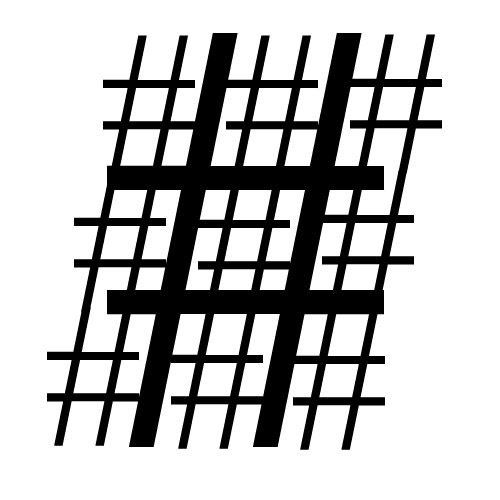
Part of my approach to making new sense of the universe involves indulging in meditations on unintentional symbolism. Any pattern that catches my attention is a potential subject for intuition voodoo. Usually it pays off eventually, even when it seems absurd at first.
In this case, I was thinking about the # and * symbols that were inserted into our visual culture obliquely, as extra buttons on the telephone which flanked the 0. Taking this as my cue to relate this to the multisense continuum, I compared the symbols graphically, etymologically, and semantically.
The pound sign (hash, hashtag, number sign) seems to me a dead ringer for the Western-mechanistic pole of the continuum, while the asterisk (star) fits quite nicely as the Oriental-animistic pole.
Here’s how it breaks down:
# – number sign, so quantitative and generic. The symbol is one of four lines crossing each other at right angles to yield nine implicit regions of space. The slant provides a suggestion of orientation – a forward lean that disambiguates spatial bias and implies, subliminally, an arrow of time.
In the age of Twitter and Instagram, the hashtag has become an important cultural influence. It is interesting with respect to mechanism in that it refers to accessing a machine’s sorting algorithms. It is a note to the network of how this term should be handled. We have appropriated this satirically so that we recapture it for our own entertainment, but also as a kind of show of affection for and familiarity with the technology.
In direct contrast, the * is am icon which is used to interrupt one level of attention to direct the reader to another level – a footnote. Instead of relating to numbers, the * is a wildcard that can be related to any string. It stands for “all that is preceded by or follows”. Contrary to the cellular modularity of #, the * is a mandala. It implies kaliedoscopic sensibility and fractal elaboration. It is a symbol of radiance, growth, life, unity, etc.
There’s some interesting threads that connect the * with mathematical terms such as Kleene closure (more commonly known as the free monoid construction). Just the words ‘free monoid construction’ ring in my ears as an echo of what I call solitrophy – the constructive progress of teleological unity…the creation and solution of problems.
Also the use of *asterisk* for heightened emphasis links it to the significance of euphoria or magnified feeling (and the euphoria that is associated with significance or magnified prestige/importance). Wikipedia mentions the use of # by editors to represent where space should be added on galley proofs. The use of * is, by contrast associated with repetition of a particular thing – a replication. This is a tenuous but deep connection to the origins of space and time in the difference between syntactic-public sense and semantic-private sense.
The name ‘pound sign’ seems to be fairly mysterious. It does not seem to be related conclusively to either the English currency or the Avoirdupois weight. Both references, however, have very tempting subliminal associations to the Western pole of empirical domination. On the other side, the name asterisk means ‘little star’, from Greek and Latin. I can read into that a reference to ‘as above, so below’, as the twinkling point of light reproduces in miniature that which is the grand solar source of life on Earth.
The Paranormal
As far as the paranormal goes, my approach is not to insist upon collapsing extraordinary experiences into binary terms of real or unreal. To the contrary, I see realism as a quality within consciousness such that its limitations reflect the nature of consciousness itself. By that I mean that our personal awareness has a sub-personal boundary and a super-personal boundary, both of which involve opposite views of coincidence. At the sub-personal bound, coincidence emerges stochastically and meaninglessly as an assertion of the instantaneous. At the super-personal bound, coincidences diverge synchronistically and teleologically as part of a ‘larger now’. The more super-personal we look, the more the real and unreal are blurred, and the more the experience reflects what I call ‘the physics of privacy’ rather than public physics.
Obstruction of Solitude: A Guide To Noise
“And then…all the noise! All the noise, noise, noise, noise!
If there’s one thing I hate…all the noise, noise, noise, noise!
And they’ll shriek, squeak, and squeal racing round on their wheels,
Then dance with jin-tinglers tied onto their heels!” – The Grinch“Karma police, arrest this man
He talks in maths
He buzzes like a fridge
He’s like a detuned radio” – Radiohead
It might be asked, “Why should we care about noise?” Two reasons come to mind.
1) To reduce, contain, or otherwise avoid it.
2) To understand what isn’t noise, and why we prefer that.
Real Noise
The general use of the word noise refers to an unpleasant sound. Even on this most literal level, there is a sense of denial about the extent to which unpleasant qualities are subjective. The stereotypical parent, upon hearing the stereotypical teenager’s musical taste being played at high volume, may yell something like “Turn off that infernal noise!”. There is a sense that the sound demands to be labeled objectively as a terrible thing to listen to, rather than as a sound which presents itself differently according to one’s state of mind or development.
At the same time, we cannot rule out all objective, or at least pseudo-objective qualities related to signal and noise. A garage recording of a metal band or a jackhammer attacking the pavement can be uncontroversially defined as being ‘noisy’, particularly in comparison to other, more gentle sounds. ‘Real noise’, then, seems to have a range of subjective and objective qualifiers. Loud, percussive sounds are inherently noisy to us humans, and we have reason to assume the same is true for animals and even plants:
“Dorothy Retallack tried experimenting with different types of music. She played rock to one group of plants and, soothing music to another. The group that heard rock turned out to be sickly and small whereas the other group grew large and healthy. What’s more surprising is that the group of plants listening to the soothing music grew bending towards the radio just as they bend towards the sunlight.” – source
Whether we enjoy loud, percussive sounds is a matter of taste and context. Even the most diehard metal fan probably does not want to hear their favorite band blasting at five o’ clock in the morning from a passing car. Being able to control what we listen to contributes to our perception of it as noise.
Obstruction, Distraction, Destruction, and Leaks
Whether a piece of music offends our personal taste, or it is simply so loud that we can’t ‘hear ourselves think’, the experience of being distracted seems central to its status as noise. In the parlance of sound engineers, and later Silicon Valley schmoozers, the ‘signal to noise ratio’ describes this feature of noise to distract or divert attention from the intended communication. Noise not only obstructs access to the signal, the disturbance that it causes also detracts from the quality of the signal itself. If the signal to noise ratio is poor enough, it may not be worth the effort for the receiver to try to interpret it, and communication is destroyed.
This sense of noise as an obstacle to communication extends beyond audio or electronic signals to any context where information is accessed, transmitted, or stored. In his influential work on telecommunications, Clause Shannon described information entropy as those features of a signal which are costly to compress. Typically it is those patterns which cannot be easily discerned as either part of the intentional signal or part of the background noise. Despite the tremendous computational resources available for mobile communication, the signal quality on mobile devices are still generally inferior to land lines. Between microphone gating that clips off conversation instead of ambient street sounds and the loss of packets due to radio broadcast conditions or network routing conditions, it is amazing that it sounds as good as it does, but it is still a relatively leaky way to transmit voices.
Neural Noise and Withdrawal
Every sense has its own particular kind of noise. Vision has glare, blur, phosphene patterns (‘seeing stars’). Touch has non-specific tingling or itching. Olfactory and gustatory senses encounter foul odors or bad aftertastes. Feelings like nausea and dizziness which are unrelated to food or balance conditions are a kind of noise (noise is etymologically related to nausea and noxious). Part of the effect of withdrawal from an addiction that the brain becomes overly sensitized to irritating stimuli in general. It’s almost like an allergic response in that the systems which would ordinarily protect us from threats is distracted by a false threat and turned on itself. Our sensitivity to the environment, having been hijacked by an external supply of pleasurable signals, has built up a tolerance for those super-saturated instructions.
With any kind of addiction, even healthy ones like exercise or washing your hands, the nature of sense is to accommodate and normalize perceptions which are present regularly. Because the addiction provides positive reinforcement regularly, there is an artificially low noise ratio which invites your senses to recalibrate to listen more closely to the noise (which would be quite adaptive evolutionarily, you would want to still hear that tiger or smell that smoke even when you enjoy a lifestyle of hedonism and decadence). When the source of positive distraction is removed, the sensitivity to negative distraction is still cranked up to 11, which of course, taps into the original motivation to escape the negative distractions of life with an addiction in the first place. We want something to soothe our nerves, to numb the sensitivity and quiet the noise.
A Recipe For Noise
There seem to be general patterns which are common to many kinds of noise. Noise can either be an obstructing presence, or a conspicuous absence (like the dropouts on a phone call). It can be a public or a private condition which clouds judgment, invites impatience, frustration, and intolerance. Noise can be that which is incoherent, irrelevant, redundant, or inappropriate. Some signals can be temporarily irrelevant or incoherent, while others are permanently so. Besides being too loud, an audio noise can also be soft, such as a hiss or other aesthetic defect that exposes leaky conditions in the recording process. The context is important, as with withdrawal from addiction, our senses are more attuned to the relativity of sensation rather than objective measurement. Grey looks darker next to black than it does next to white.
Our ability to use our attention to pivot from foreground to background is part of what defines the difference between signal and noise, or sense and nonsense. We can all relate to the Charlie Brown effect, where the words that a teacher says are reduced to unintelligible vocalizations. As you read these words now, you may be scanning over so much tedious verbiage that looks like generic wordiness more than any particular message. Any signal can be a noise if you don’t pay attention to it in the right way, and any noise can be used as a meaningful code or symbol. Perhaps there is a way to get over our addictions a little easier if we can learn to see our irritation and cravings as a sign that we are on the right path to restoring our neurological gain.
Many Cures
The destruction of information or the suppression of noise is not as simple as it may seem. Take, for example, the difference between analgesic, anesthetic, and narcotic effects. Pain can be relieved systemically, locally, or simply by being made to seem irrelevant. It can be selectively suppressed or wiped out as part of an overall deadening of sensation. There are other ways to get pain relief besides pharmaceuticals as well. Athletes or soldiers are known to perform with severe injuries, and many people have endured astonishing hardships for the sake of their family without being fully aware of the pain they were in. While there may be endogenous pharmacology going on which accounts for the specific pain suppression, it is ultimately the context which the subject is conscious of which drives the release of endorphins and other neurotransmitters.
Semiotics of Noise
Looking at noise from a Piercean perspective, it can be seen as a failure of semiosis – a broken icon, symbol, or index. A broken index would be something like tinnitus or a phantom limb. The signal we are receiving does not correspond to the referent that we expect, and in fact corresponds only to a problem with the signaling mechanism, or some deeper problem. A signal which is broken as an index but can be understood meaningfully as a symptom of something else (maybe the tinnitus is due to a sinus infection) has reverted from a teleological index to a teleonomic* index. It coincides with a condition, but does not represent it faithfully in any way. It is noise in the sense that the expected association must be overlooked intentionally to get to the unintentional association to a symptom.
A broken index would also be one which we deem irrelevant. This type of noise, which would include the proliferation of automatic alerts, false alarms, flashing lights, spam, etc. There may be nothing wrong with what what the message is saying, but considerations of redundancy, and context inappropriateness makes it clear that what a computer thinks is important and what we think is important are very different things. This type of noise fails at the pragmatic level. It’s not that we don’t understand the message, or that its not for us, it’s that we don’t want to do anything about it.
Broken icons and symbols would similarly be made incoherent, irrelevant, or inappropriate by lacking enough syntactic integrity or semantic content to justify positive attention. Fragmented texts or degenerated signs can fail to satisfy functionally or aesthetically, either on their own, or due to intrusions from outside of the intended communication channel. The overall function of noise is to decompose. Like the odor of something that has spoiled, disorder and decay are symptoms of entropy. In the schema of cosmic metabolism, entropy is the catabolic phase of forms and functions – a kind of toll exacted by space and time which ensures that whatever rises to the threshold of existence and importance, will eventually destabilize, its differences de-tuning to indifference.
What Noise Tells Us About Signals
If we begin with the premise that signal and noise are polar opposites, then it may be useful to look at the opposite of some of the terms and concepts that have just been discussed. If noise is irrelevant, inappropriate, incoherent, and redundant, then the qualities which make something significant or important should include being relevant, appropriate, coherent, and essential. Where noise obstructs, distracts, and destroys, sense instructs, attracts, and constructs. Where noise is noxious and disgusting, signals soothe and give solace.
In the larger picture of self and consciousness, it is our solitude that is threatened by noise. Solitude, like solidity and structure are related to low entropy. It is the feeling of strong continuity and coherence, a silent background from which all moments of sound and fury are foregrounded. It is what receives all signals and insulates all noise. Integrated information? Maybe. The Philosopher’s Stone? Probably.
*teleonomy describes conditions of causality which are driven by blind statistics rather than sensible function. Evolution, for example, is a teleonomy since it does not care which species live or die, it is only those who happen to have been better suited to their ecological niche which end up reproducing most successfully.


Recent Comments