Cookie Cutter Cosmologies
(With apologies to those who are more philosophically literate.)
Something In The Water: Logos and Tao
A superficial read of Pre-Socratic Greek philosophy introduces a dualism of Being and Becoming beginning with the water-based cosmology of Thales of Miletus in the 6th century BCE. Thales conceived of the universe as made of a single material substance: water**. Thales said:
“It is water that, in taking different forms, constitutes the earth, atmosphere, sky, mountains, gods and men, beasts and birds, grass and trees, and animals down to worms, flies and ants. All these are different forms of water. Meditate on water.”
On the other side of the known world, the development of Taoism at roughly the same time spoke of the primacy of water, or the metaphor of water as effortless constant change.
“Water never resists. It accepts all.
It never judges.
Therefore, to be one with Tao, be like water.”– Tao Te Ching
Heraclitus of Ephesus picks up on the theme of nature emerging from a single Logos, but expressed as fire rather than water. Many comparisons can be drawn between Heraclitus and Lao Tzu, as they both speak to a cosmos which is changeless only in its perpetual changing, and grounded in a united harmony of contrasts.*
“The one is made up of all things, and all things issue from the one.”
“It is an attunement of opposite tension (palintropos harmonie),like that of the bow and the lyre.”
(A Comparison between Heraclitus’ Logos and Lao-Tzu’s Tao pdf)
Being and Becoming
Parmenides of Elea can be seen to comprise something of a philosophical dipole, with Heraclitus seeing (centuries before Process Philosophy [1]) a universe based on change and becoming rather than on fixed forms, and Parmenides asserting that the true nature of the universe is divided between the eternal divine truths and ephemeral local appearances [2]. Parmenides speaks in terms of what-is being what cannot not-be.
“what-is is ungenerable and imperishable,
a whole of a single kind, and unshaking and complete;
nor was it nor will it be, since it is now all together
one, cohesive.”
His emphasis on the significance of what-is (really, really real) as eternal and unchanging coincides with the views of Pythagoreans, such as Philolaus of Croton who venerated the role of number in the cosmos and saw mathematics specifically as that which which joins the unlimiteds and limiters which make up everything.
Plato sharpened the Pythagorean appreciation for ideal forms (including goodness, beauty, equality, bigness, likeness, unity, being, sameness, difference, change, and changelessness) which he saw as eternal. Platonic idealism lends a Parmenidean fixation to the insubstantial Heraclitean flux, but all remain analog and abstract. Democritus, who was in a sense the antithesis of Plato (Aristoxenus said that Plato wished to burn all the writings of Democritus that he could collect), managed to reconcile the flux and fixed in a different way which incorporated the concrete and empirical.
Philosophies of Science
Democritus’ notion of unchanging, irreducible atoms in a void which constantly change configurations is an idea which reconciles both Heraclitus and Parmenides [3]. This model has cast physics in a mold which, even today, remains almost inescapable. The combination of determinism and uncertainty has gone beyond atoms into the subatomic level. Quantum mechanical events are determined to be indeterminable, but governed by formulaic probabilities which are precise and unchanging.
Aristotle had a different perspective on what is essential which seems more grounded in language and relates to the proprietary versus the generic. A horse is an essential substance, whereas the category ‘horse’ is a secondary kind of substance. His hylomorphic compounds conceive of substance as the form of things, or their matter plus essence. It is a top-down kind of holism which contradicts the bottom-up reductionism of Democritus, however Aristotle extends the binary logic of Parmenides rather than the divine flowing harmonies of Heraclitus and Plato.
Galileo applied the Classical dualism of unlimiteds and limiters in a scientific way, defining them in physical terms so that Primary qualities are conceived as being independent of any observer (shape, position, motion, contact, and number) and Secondary qualities are thought to be properties which produce sensations in observers. Galileo had a functionalist view of qualia, so that experiences like colors or feelings had a purpose in guiding our behavior toward God’s design. Locke updated Galileo’s primary and secondary qualities so that primary qualities had a dimension of realism which was not only objective but located in objects themselves; properties of solidity, extension, and figure. His secondary qualities are seen as powers of objects which mechanically produce sensation in us.
Kant’s take on unseen universals and their changing expressions was defined in terms of Noumena and Phenomena. His contrasts of ‘a priori’, ‘a posteriori’, ‘analytic’, and ‘synthetic’ clarify some of the themes of causality common to Locke, Aristotle, and Descartes. Even into the modern era, ultimate questions in philosophy and science lead back to ideal absolutes such as ‘information’ or ‘existence’ versus properties of a Phenomenal world of sensation (’emergent’ or ‘illusory’). Jung and Bateson used the words Pleuroma and Creatura to talk about the difference between the eternal totality which is beyond all experience and qualities, and the living world that is subject to perceptual difference and information.
There are of course, many other philosophers and scientists that should be mentioned. Hobbes and Newton can be said to have continued the reductionist tradition of Democritus, while dialectic and monadic themes in Hegel, Leibniz, and Spinoza recapture the pre-Socratic sense of the Absolute. Aside from this bifurcation of Transcendental Idealism and Empirical Realism, there is also also a progression from science as a discussion about ideals to a realization of empire.The chain of mentoring from Socrates to Plato to Aristotle to Alexander the Great begins with intellectual questioning and ends with the exercise of global political power, with a mastery of form, substance, causality and virtue in between.
Breaking the Mold
Thales’ hylozoism (he believed that matter was alive), and Aristotle’s essentialism fell into strong disfavor during the Early Modern period, however there were a few who challenged the primacy of so called primary qualities. For George Berkeley, all qualities were secondary, and matter was only a representation of the mind:
“The deducing therefore of causes or occasions from effects and appearances, which alone are perceived by sense, entirely relates to reason.”
Even though Berkeleyan idealism can arguably be seen to be supported by the Observer Principle interpretation of Quantum Theory, as well as Simulation Hypothesis, Holographic Universe, and Bohm’s Implicate Order, modern panpsychism has been dogged by the tendency for Idealism to be painted as Solipsism. The cliche “If a tree falls in a forest..” is often used to point out the absurdity of idealism, i.e. that the idea of linking existence to perception is beneath consideration on account of it being childish, superstitious, psychotic, and above all unfalsifiable.
In my view, this is a prejudiced characterization, in which the difference between one’s own individual perception is used to stand in for the principle of perception in general. This mistake is repeated again and again in Functionalism, Computationalism, Structured Realism, Logical Positivism, and Emergentism, among others, which demand a return to reductionist, Democritean models. A similar dismissal of Searle’s treatment of the Symbol Grounding Problem, and Chalmers Hard Problem of Consciousness underscores the commitment to the primacy of fixed, object-like rules rather than rule-making subjects.
Cutting the Cookie
Taking this philosophical evolution into perspective, it is my intent to transcend all of the particulars of the past and see all of the prior philosophical approaches as blind men overlapping in their examination of the proverbial elephant. I side with Berkeley on the primacy of experience, as I see the publicly measurable aspects of the world as a reduced vocabulary which cannot add up to the rich aesthetics which we experience. I would compare qualia as an endless supply of cookie dough, in which cookie cutters could be made from the dough itself. The idea is that the edible can be made hard and inedible, but no amount of cookie-cutting utensils can render an edible cookie.
Going beyond cookies and cutters, however, requires a combination of Berkeley’s best arguments, Einstein’s Relativity, and Quantum Mechanical observations. The notion of perspective itself, of inertial frames and the importance of measurement in determining the nature of nature is repudiation of Berkeley. It is perception after all which serves as the master metaphor for all possible “relation”. It is from perception that all phenomena “emerge” and to perception that all phenomena become “evident”. I see no scientific reason not to extend this principle of perception beyond human experience and even beyond biology, so that physics itself is understood to be identical to “sense”. Sensing and sense-making provide a cookie and cutter autopoiesis, within which experience can both return ephemeral Creatura to the Pleroma, and draw eternal forms and fictions into the empirical realm. The cookie and cutter are themselves aesthetic contrasts within the same cookie batter/cook.
*The Tao translates as ‘the way’, and logos “Originally a word meaning “a ground”, “a plea”, “an opinion”, “an expectation”, “word”, “speech”, “account”, “reason”, it became a technical term in philosophy, beginning with Heraclitus (ca. 535–475 BC), who used the term for a principle of order and knowledge”.
In my own etymological forays, I have come across a theme which relates a lot of terms having to do with consciousness with the Proto-IndoEuorpean roots “wag” and “wegh”. The combined sense is that of a way of weaving or wagging. Tending to wander or wave, and attending: to wake, watch, and weigh.
**In the 5th c,, Xenophanes linked all physical phenomena with clouds and the sea.
“The sea is the source of water and of wind…
The stars come into being from burning clouds…
The sun consists of burning clouds…
The moon is compressed cloud…
All things of this sort [comets, shooting stars, meteors] are either groups or movements of clouds.”
- “Modern philosophers who appeal to process rather than substance include Nietzsche, Heidegger, Charles Peirce, Alfred North Whitehead, Robert M. Pirsig, Charles Hartshorne, Arran Gare and Nicholas Rescher. In physics Ilya Prigogine distinguishes between the “physics of being” and the “physics of becoming”. Process philosophy covers not just scientific intuitions and experiences, but can be used as a conceptual bridge to facilitate discussions among religion, philosophy, and science.” – Wiki
- Parmenides prefigures Plato, Galileo, Descartes, Locke, Kant, Hegel, Spinoza and many others who invoke a Heaven-and-Earth type dualism.
- “Democritus managed to reconcile the Heraclitean theory of flux with the theory of perfect immutability of Parmenides and demonstrate that both theories are truly complimentary for each one explains a different level of reality and do not contradict each other. It is true that, essentially, things do not change (as Parmenides claims), for they are composed of eternal and indivisible particles (atoms), but it is also true that the arrangement of this atoms could be altered resulting in apparent changes (as Heraclitus argued).” – Substantia Primordium: Parmenides and Heraclitus reconciled
The Opportunity Principle
A better way to model photons, and other elementary particles would be as opportunities for discernment. Instead of seeing them as entities whose measurement presents uncertainty to us, think of the uncertainty as the entity itself. The photon is like a cursor – it is present where the action is at the moment – it points to the moment, and to the opportunity for interpretation of the moment. Bosons and Fermions are not like forcers and forcees, but more like trails left behind from motivation etching sensation into sense.
Our experience of light is of that which enables visual sense. Vision is a mode of sensory presentation and representation based on aesthetic distinctions. Foreground/background, contrasting color qualities and intensities. Each photon should not be considered a physical phenomenon in its own right, but rather as a fragment of vision or sensation. It is not like a pixel, since the pixel requires an observer to be seen. The photon should not be thought of as a particle or a wave, but as a chance to detect and interpret. Whether we see a light or feel heat, whether it is part of an interference pattern or a collection of wholes composed of no parts, whether it is within our experience or beyond our understanding…all of these possibilities are presented at the elemental level. Each ‘particle’ is a window not just on the Totality, but on the self-masking, self-reflecting, transparency-augmenting nature of nature. The fabric of the universe is both certain, uncertain, and a participation in self-definition.
Logical Positivism and White Light
“Can you link? Perhaps quickly explain?”
Sure. This post relates most directly to transcending Logical Positivism,
Wittgenstein in Wonderland, Einstein under Glass
there are a lot of pages and posts on the site that refer back to how physical and metaphysical assumptions can both be transcended.
Briefly, what I suggest is that rather than assuming physical and mental isolation as objectively true, we should assume the opposite and see isolation as a localization of totality, in the same way that ‘green’ is a localization of white, and white is really transparency or visual sensitivity itself which is too bright for us to see through*.
The universe, consciousness, physics, mathematics, are all understandable as parts of the whole through triangulation of symmetric relations. Rather than spurning the thin air of the metaphysical or the mess of the anthropological, we should understand that their lack of sterile certainty reflects our own proximity to it, and that certainty itself is a function of distance – an illusion of monolithic realism to play against a reality of layered fiction. Physics is not realism, but the capacity to modulate realistic fiction against itself. Physics is participatory sense, and sense has understandable features which cut across all layers and scales of experience.
*This thought deserves to be developed in more depth. What is the color white? We know from basic science that white is a kind of jumble of all of the wavelengths of visible light. If we think about how we encounter white light in nature, however, it is often as a reflection in something transparent or shiny like water or glass. If you have ever tried to paint water, you know that it is about carefully placed contrasts of bright/white and dark paint.

Likewise, the brilliance of a white diamond is a reflection of its high refractive index – its just soo transparent from so many different angles than your eye can’t handle it. Given some level of ambient illumination, the visual sense is opened up beyond the human spec, and there’s too much to see through. It’s meta-transparent. As with all media, when the spec limit is exceeded, the guts of the medium itself begins to be exposed. What happens when there’s too much data on your internet connection? Freezing, pixelation. The digital substrate is exposed. Same thing with lens flares, records skipping, static on the radio, etc. The fabric which is carrying the message bleeds into the message. Light is the same way – too much potential clarity is blinding. Too much positivity and logic obscures the reality of the consciousness which creates it.
Emergent Noumena
Noumenon, plural Noumena, in the philosophy of Immanuel Kant, the thing-in-itself (das Ding an sich) as opposed to what Kant called the phenomenon—the thing as it appears to an observer. Though the noumenal holds the contents of the intelligible world, Kant claimed that man’s speculative reason can only know phenomena and can never penetrate to the noumenon. Man, however, is not altogether excluded from the noumenal because practical reason—i.e., the capacity for acting as a moral agent—makes no sense unless a noumenal world is postulated in which freedom, God, and immortality abide.
The relationship of noumenon to phenomenon in Kant’s philosophy has engaged philosophers for nearly two centuries, and some have judged his passages on these topics to be irreconcilable. Kant’s immediate successors in German Idealism in fact rejected the noumenal as having no existence for man’s intelligence. Kant, however, felt that he had precluded this rejection by his refutation of Idealism, and he persisted in defending the absolute reality of the noumenal, arguing that the phenomenal world is an expression of power and that the source from which this power comes can only be the noumenal world beyond.
A central thesis of my approach is that the assumption of noumena should also be assumed to be a ‘thing as it appears to an observer’. In the case of our own experience, we are the observer – really the participant. Even the term observer smuggles in a way of framing ontology to imply non-phenomenal facts.
In my view, Locke’s assumption of qualities like color and feeling as Secondary, while properties like position and shape are Primary, while true from the local perspective, should be (like the image on our retina) considered inverted from an absolute perspective. It’s easy to turn colors or feelings into numbers and points on a graph, just by counting them and arranging what has been counted. It’s impossible, however, to derive colors from structures or information alone.
What this means is that the capacity to discern noumena from phenomena is itself a phenomenal property. It varies by both degree and kind. This quality is often known by names like ‘sanity’ and ‘common sense’, and while our access to it as individuals depends on local neurological conditions, local neurological conditions probably depend on an even lower level of sanity on the microphenomenal scale to maintain the integrity of the microphysical world which cells and neurons inhabit.
If that’s true, and what we call sanity, a kind of preservative inertia of sensory and meta-sensory interpretation goes all the way down, then physics itself should be described as the modulation of that sanity. A superposition of superpositions if you will, as locality which generalizes and re-localizes what it has generalized. If we think of the Newtonian-Cartesian universe as made of ideal particles in a void, the Einsteinian universe idealized the void, and the Quantum universe turned the particles into bubbles un-disappearing in that void. What I propose is to put see bubbling itself as a property of reflection and contrast. Drill down into the surface of the bubble and see that it is nothing but aesthetics derived from some perspective and mode of detection. It is the possibility of phenomena that matters. Noumena without phenomena is identical to nothingness, but phenomena without noumena changes nothing, provided that phenomena diverges from its own sensory-motive properties, rather than emerges from abstract non-phenomena.

Chthonic Tree
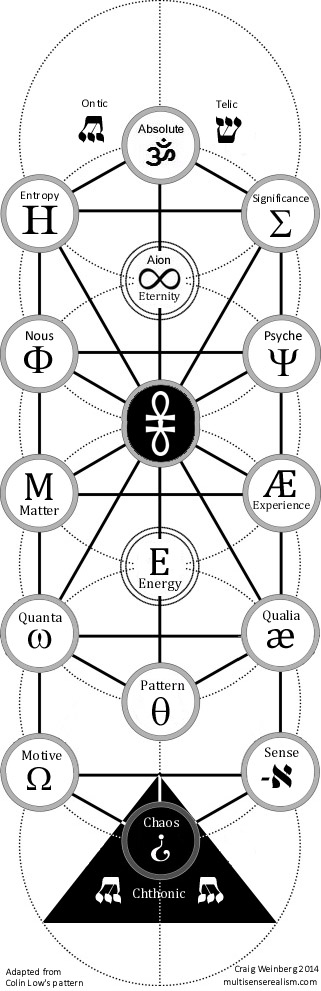
(Double Ankh = “Illumination” or “Deeply Examined Life”).
Electricity and Magnetism

Animated diagram showing the operation of a tuned circuit (LC circuit). The capacitor stores energy in its electric field E and the inductor stores energy in its magnetic field B (green). This jerky animation shows “snapshots” of the circuit at progressive points in the oscillation. The oscillations are slowed down; in an actual tuned circuit the charge oscillates back and forth tens of thousands to billions of times per second.
In electronics an LC circuit, also called a resonant circuit, tank circuit, or tuned circuit, consists of two electronic components connected together; an inductor, represented by the letter L, and a capacitor, represented by the letter C. The circuit can act as an electrical resonator, an electrical analogue of a tuning fork, storing energy oscillating at the circuit’s resonant frequency.
This is one of the clearest ways that I have come across to visualize the relationship between electricity and magnetism. On the right, the capacitor plates emphasize the polar nature of EM, so that electric force is a metaphor for binary switching – a bridging across a gap which inverts and imitates.
On the left, the induction coil emphasizes the ‘tropic’ nature of EM. The magnetic field arises as a summary of the turns, like a squaring of all of the possible orientations and angles. The turningness is juxtaposed against the flowing-ness, which are both juxtaposed against the separation and ratio-ness of the Electric side.
Of course, through Relativity, we can understand (or try to) that both the Electric and Magnetic fields are identical except that they are observed through perpendicular frames of reference. If you are synchronized to the current flow, then it is an electric circuit of positive and negative charge interactions. If you are synchronized to the resistance of the flow, then it is a magnetic field of North/South attraction-repulsion.
The deeper issue for me is really what is happening underneath all of the arrows and theory. What was actually being observed to oscillate when we first measured the frequency of a beam of light? Is it a needle of a magnetic meter? Unlike sound waves which can be said to be collisions of molecules, the energy of electromagnetic waves seems to be more like a propensity for matter to glow, spark, and change direction. It is the Promethean vibration into sensory awareness and motive expression. Matter becomes more transparent to itself, more able to ignore gaps, resistance, and gravity. What electromagnetism seems to really be is something like ‘the phenomenalization of matter’, or the twisting/stretching of inertial frames.
Chess, Media, and Art
I was listening to Brian Regan’s comedy bit about chess, and how a checkmate is such an unsatisfying ending compared to other games and sports. This is interesting from the standpoint of the insufficiency of information to account for all of reality. Because chess is a game that is entirely defined by logical rules, the ending is a mathematical certainty, given a certain number of moves. That number of moves depends on the computational resources which can be brought to bear on the game, so that a sufficiently powerful calculator will always beat a human player, since human computation is slower and buggier than semiconductors. The large-but-finite number of moves and games* will be parsed much more rapidly and thoroughly by a computer than a person could.
This deterministic structure is very different (as Brian Regan points out) from something like football, where the satisfaction of game play is derived explicitly from the consummation of the play. It is not enough to be able to claim that statistically an opponent’s win is impossible, because in reality statistics are only theoretical. A game played in reality rather than in theory depends on things like the weather and can require a referee. Computers are great at games which depend only on information, but have no sense of satisfaction in aesthetic realism.
In contrast to mechanical determinism, the appearance of clichés presents a softer kind of determinism. Even though there are countless ways that a fictional story could end, the tropes of storytelling provide a feedback loop between audiences and authors which can be as deterministic -in theory- as the literal determinism of chess. By switching the orientation from digital/binary rules to metaphorical/ideal themes, it is the determinism itself which becomes probabilistic. The penalty of making a movie which deviates too far from the expectations of the audience is that it will not be well received by enough people to make it worth producing. Indeed, most of what is produced in film, TV, and even gaming is little more than a skeleton of clichés dressed up in more clichés.
The pull of the cliché is a kind of moral gravity – a social conditioning in which normative thoughts and feelings are reinforced and rewarded. Art and life do not reflect each other so much as they reflect a common sense of shared reassurance in the face of uncertainty. Fine art plays with breaking boundaries, but playfully – it pretends to confront the status quo, but it does so within a culturally sanctioned space. I think that satire is tolerated in Western-objective society because of its departure from the subjective (“Eastern”) worldview, in which meaning and matter are not clearly divided. Satire is seen as both not as threatening to the material-commercial machine, which does not depend on human sentiments to run, and also the controversy that satire produces can be used to drive consumer demands. Something like The Simpsons can be both a genuinely subversive comedy, as well as a fully merchandized, commercial meme-generating partner of FOX.
What lies between the literally closed world of logical rules and the figuratively open world of surreal ideals is what I would call reality. The games that are played in fact rather than just in theory, which share timeless themes but also embody a specific theme of their own are the true source of physical sustenance. Reality emerges from the center out, and from the peripheries in.
*“A guesstimate is that the maximum logical possible positions are somewhere in the region of +-140,100,033, including trans-positional positions, giving the approximation of 4,670,033 maximum logical possible games”
Consciousness and The Interface Theory of Perception, Donald Hoffman
A very good presentation with lot of overlap on my views. He proposes similar ideas about a sensory-motive primitive and the nature of the world as experience rather than “objective”. What is not factored in is the relation between local and remote experiences and how that relation actually defines the appearance of that relation. Instead of seeing agents as isolated mechanisms, I think they should be seen as more like breaches in the fabric of insensitivity.
It is a little misleading to say (near the end) that a spoon is no more public than a headache. In my view what makes a spoon different from a headache is precisely that the metal is more public than the private experience of a headache. If we make the mistake of assuming an Absolutely public perspective*, then yes, the spoon is not in it, because the spoon is different things depending on how small, large, fast, or slow you are. For the same reason, however, nothing can be said to be in such a perspective. There is no experience of the world which does not originate through the relativity of experience itself. Of course the spoon is more public than a headache, in our experience. To think otherwise as a literal truth would be psychotic or solipsistic. In the Absolute sense, sure, the spoon is a sensory phenomena and nothing else, it is not purely public (nothing is), but locally, is certainly is ‘more’ public.
Something that he mentioned in the presentation had to do with linear algebra and using a matrix of columns which add up to be one. To really jump off into a new level of understanding consciousness, I would think of the totality of experience as something like a matrix of columns which add up, not to 1, but to “=1”. Adding up to 1 is a good enough starting point, as it allows us to think of agents as holes which feel separate on one side and united on the other. Thinking of it as “=1” instead makes it into a portable unity that does something. Each hole recapitulates the totality as well as its own relation to that recapitulation: ‘just like’ unity. From there, the door is open to universal metaphor and local contrasts of degree and kind.
*mathematics invites to do this, because it inverts the naming function of language. Instead of describing a phenomenon in our experience through a common sense of language, math enumerates relationships between theories about experience. The difference is that language can either project itself publicly or integrate public-facing experiences privately, but math is a language which can only face itself. Through math, reflections of experience are fragmented and re-assembled into an ideal rationality – the ideal rationality which reflects the very ideal of rationality that it embodies.


Recent Comments