Maxwell and Faraday on Fields
How the magnetic force is transferred through bodies or through space we know not: – whether the result is merely action at a distance, as in the case of gravity; or by some intermediate agency, as in the cases of light. heat, the electric current, and (as I believe) static electric action. –
Michael Faraday, 1851
The electromagnetic field is that part of space which contains and surrounds bodies in electric or magnetic conditions,
“lt appears therefore that in the space surrounding a wire transmitting an electric current a magnet is acted on by forces dependent on the position of the wire and on the strength of the current, The space in ‘which these forces act may therefore be considered as a magnetic field…”
James Clerk Maxwell, 1864
Having both died before the 20th century began, neither of these scientists had the benefit of Relativity or Quantum Theory to point toward a participatory universe. Had they known how profoundly permeable the boundaries of space, time, mass and energy were, and how quantum particles can become entangled at a distance, I imagine that the ether-like concept of the electromagnetic field would be very different.
Faraday and Maxwell were reluctant to hypothesize on what electromagnetic fields were, other than simply regions near magnets or electrified wires in which electromagnetic effects could be encountered. Such encounters, then as now, consist only of changes in the behavior of material objects which we use as instruments. We can imagine that there are particles radiating out in space, but we can’t ever know that is really true, since we have to capture the presumed particles with some kind of material which is more substantial than a vacuum.
We could say ‘if it looks like a particle, and quacks like a particle, then it is probably a particle’, however given Heisenberg’s uncertainty and Bell’s inequality, it is questionable whether it is the target of the experiment or the method of the experiment which is doing the quacking. In the 20th century, I think that we began to glimpse a new frontier of physics which brought us full circle from Newton and Descartes, to find that objectivity itself is no less of a model-making process than subjectivity. What we observe is that just as our own perception fills itself in with seamless continuity, so too does measurement on the microphysical and astrophysical scales defy our expectations of objective realism.
For me, the key could be in the re-thinking the 19th century idea of a field. Forces and fields are purely exterior mechanisms – apparitions which are nothing but ‘that which makes things happen to things’. Turning that inside out, and adding an ‘outside-in’ dynamic, I think we should think of all forces and fields as sensory-motive experiences. Because electromagnetism is a fundamental force of physics, we may not only dealing with physical interactions through space and time, but perhaps rhythms and amplitudes of felt experience through which the relational abstractions of space and time are localized. This is different from saying that the universe is made of energy, or that everything is relative. Instead what I propose is that relation is intrinsically sensible and that every location within the cosmos lies at the inflection point of certainty and uncertainty in which both appear to be winning. It’s not *only* certainty though, not a quantifiable skeleton of logical states, it is the appreciation of sensory experience that leads to certainty. Certainty itself is ultimately just another feeling; another way of measuring our sense of progress.


Trial Epilogue on MSR
In the course of writing about Multisense Realism, I have had the unusual experience of discovering what my influences have been without having ever been directly influenced by them. As a whole, MSR seems to unintentionally brings together concepts common to Relativity, Semiotics, Depth Psychology and Hermetic Philosophy and applying them to the problems of consciousness. In these ideas I have found breadcrumb trails leading back to Whitehead, Leibniz, Deleuze, and Spinoza among many others all the way back to the Axial age. I have been accused of being Aristotelian, Hegelian, postmodernist, Creationist, solipsist, Chalmers-ite, and a Chopran, but in truth, my view can find strong agreement and strong disagreement with almost every slant on physics, philosophy, and phenomenology. MSR points to a tessellated monism of relative absolutes and relative relatives. Here then is an attempt to encapsulate a more objective view of this view and how it fits in to the larger perspective of current models.
Privilege and Privacy
The concept of ‘frames of reference’ is used in Relativity for making objective predictions about the physical universe, but it hinges on the assumption of perspectives which, as far as I can imagine, are possible only when defined by subjective awareness of some kind. How can there be a perspective without some experience in which that perspective is presented?
In physics, the observer is a one dimensional vector, whose only function is as a fixed-point receiver of various coordinated conditions. The Berkeleyan in me calls a foul on that, since we have no evidence that any such abstract receiver can exist without some form of perception – some mode of sensory relation is assumed for the observer but it is not acknowledged. The mode of observation itself is unrecognized and overlooked except for a generic, and typically pseudo-optical fact of a means of relating factual data from a distance. What has been proposed here is that without some specific modality of concrete aesthetic experience, the notion of relativity quickly becomes incoherent. Contemporary physics assume properties and positions, but overlooks the necessity for a method of detection and comparison in the absence of sensory awareness. The question is how, if not through some form of conscious appreciation, some multiple of ‘sense’, can a frame of reference come to privilege itself as ‘here’ rather than ‘there’ or ‘now’ rather than ‘then’? What, in physical or functional terms, accounts for ‘privilege’, and it’s more familiar human expression ‘privacy’?
To answer that question, one approach that I have stumbled upon is to conceptually reverse existing models. Instead of particles in a void, think of dynamic bubbles in a plenum, or ‘whorlicles’. Instead of a literal plenum or field, think of a range of sensory acquaintance – a figurative anti-field in which the entropy of spacetime disentanglement is collapsed..
Applying this inside-out cosmology to mathematics, the number zero can only be a local temporary condition which can only exist between disconnection from and reconnection with the whole. Zero is the idea that something has about the absence of everything. If that’s true, then the underlying default-state of all nature that is not ‘nothingness’ a centering self-attraction. The Cartesian grid of spacetime becomes a polar graph which dissolves substance dualism.
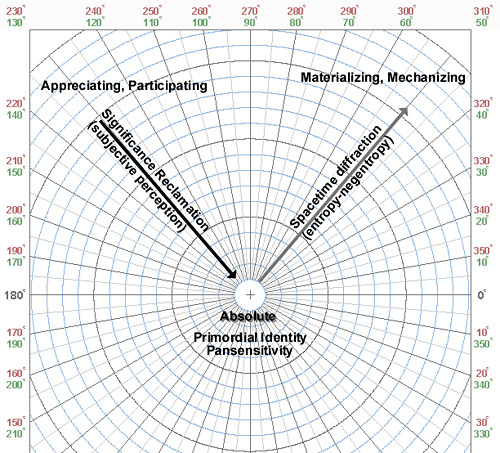
From this trick of turning math and physics assumptions on their head, a primordial identity which I call ‘pansensitivity’ can be imagined. Pansensitivity is neither a physical form nor mathematical function, not an immaterial process, but a capacity through which forms and functions are aesthetically appreciated. It is the foundational possibility for sanity as a sole reality through which all other continuations can possibly arise.
Both physics and math overlook the role of aesthetics/participation. If we ask why, it could be because they are about answering questions within the world or beyond the world, rather than questioning worldliness itself. Math-physics begins with the axioms given that there simply must be a such thing as a force or quantities. It is never seriously asked whether these givens can exist independently of some context of sensitivity.
This perspective is not wrong, and is entirely sensible given the purpose of math and physics to bring certainty and order to our understanding and control of the world. ‘Shut up and calculate’ works for physics because it never has to deal with conditions that are outside of sense. If we can’t get ever get away from consciousness, then consciousness is zeroed out. It is only when we want to question what it is that we can’t get away from that the axioms of objectivity must be challenged. Also we must consider that if it were possible that computations and physical interactions could occur entirely as objects, without awareness of any kind, then it begs the question of why it would ever be the case that awareness would or could arise at all.
While the human intellect presents an aesthetic context which feels Platonically ‘pure’ to us in the forms of logic and language, there is nevertheless an experience of what it is like to think and figure out calculations. Despite our enthusiasm for the transparency of the medium of scientific thought, we can understand that this purity is ultimately an illusion as well. If our consciousness is nothing but deterministic physical activity being shaped by evolutionary selection, then our scientific axioms can be no better. Either we have to admit that our scientific objectivity is predicated on our sense capacity and those of the instruments which we employ, or we have to admit that our sense capacity has some access to a world which genuine and not a solipsistic simulation.
Oppositivism
Pivoting from logical positivism to aesthetic ‘oppositivism’ may seem absurd, but it is not without precedent. The appeal of opposites and symmetry, especially in association with consciousness and cosmos is widespread.
The opposite of a great truth is also true – Niels Bohr
That which is below is like that which is above & that which is above is like that which is below to do the miracles of one only thing – Isaac Newton’s translation of the Tabula Smaragdina.
It would seem an unlikely coincidence that so many foundational concepts have to do with opposites. From the periodic table (proton v electron) to parts of speech (nouns v verbs), we see the same expression of aesthetic contrast. It is no surprise that within Philosophy of Mind too there is a core opposition that the idealist has against the materialist and vice versa. Taking my cue from Bohr, I sought to turn the dichotomy of subject and object inside out. Instead of a seeing either an illusory subject in an objective world or a transcendental subject in an illusory world, I propose a Multisense Continuum in which subjectivity and objectivity are co-variant qualities which rise, fall, and find elaboration in nested frequencies of participatory sense. I found that there are simple relations between scale and speed that point to a possible way of scientifically accessing top-down diffraction as well as bottom-up combination.
The technique of aesthetic reversal is shown here being applied to some current science-based theories about consciousness:
IIT
Giulio Tononi’s IIT (Integrated Information Theory) posits consciousness as integrated information. Flipping that to the opposite, we can come up with something like Disintegrated Qualia, assuming my definition of information as the antithesis of qualia. I see ‘information’ as the interqualitative protocols which pansensitivity has developed to separate and reunite itself.
At first, the notion of disintegrated qualia might seem incoherent, however, when we look to the experience of how consciousness is instantiated, there does seem to be something interestingl. Waking up, or being startled into attention is an arresting begins by breaking off of a previous state of awareness (or unawareness). Before we can receive new information about what has captured our attention, the capturing itself occurs as an incoherent encounter; a brief reduction of sanity and control. Integration may be an accurate description of how consciousness functions from an outside perspective, but the subjective experience of disintegrating or dissolving qualia is an interesting way to describe the other half of the story – the subjective half. When we meditate we try to minimize the amount of information and qualia, and we feel intuitively that this is what opens us up to be *more* conscious rather than less.
Infancy and dementia are characterized by delirious qualia which do not merely lack the power to inform truthfully, but take on an otherworldly aesthetic. Insanity is feared not only for the consequences of rational malfunction, but for the fear of losing the sense of self and the world upon which all value depends. Psychosis is a profound dislocation of the frame of reference, but rather than dismissing the fact of mental illness as off-limits to a rational inquiry into consciousness, we should see the extreme alteration of consciousness as the supercollider or telescope of phenomenology.
The disintegration of qualia describes what it is like to experience the beginning and ending of awareness, where a frame of reference is raised to become privileged. Part of the privilege of private consciousness is to control this raising to some extent, or at least to participate in developing that control. As a complex organism, we have multiple levels of privacy and publicity. The human envelope of awareness extends from irresistible urges to relatively free-form imagination, with a whole spectrum in between. There is indeed an integration of information going on, but it can also be seen as the breakdown of a gestalt sense experience into multiple dimensions and modalities.
The measure used by IIT for the quality of consciousness is Φ (phi), which is a measure of qualia space in which probabilities of system states can be mapped as positions. Turning that upside down could add an anti-phi (-Φ) in which qualia is conceived of as improbable or unprecedented dispositions…gestalt phenomena which are both novel and irreducible. Rather than qualities which are emergent from local connections and system states, the anti-phi qualities are divergent from the interference pattern between that which is eternal and that which is unrepeatable.
A song is both an integration of notes, and a reflection of the zeitgeist or collective experience. Where phi is measured in the context of qualia space, anti-phi measures qualia as a spaceless, timeless ‘pinching’ of the totality into a focal presence. The anti-phi is a measure of the degree of aesthetic prestige and significance for the sake of its own appreciation. It is through this aspect of qualia, this ‘dark math’ value which the non-local can be encountered and re-encountered in some likeable likeness. Instead of being built up from scratch, the anti-phi of qualia is diffracted or sculpted out of disintegrated/unbound pansensitivity. Spacetime serves to freeze the dreamtime of the totality, make it real, and use it to build richer qualia upon.
Orch OR, Penrose, and Fermat’s Last Theorem
Adding the reversal technique onto Stuart Hameroff and Sir Roger Penrose’s Orchestrated Objective Reduction can yield similarly interesting results. The opposite of an Orch OR could be described as a “Subjective Inflation” which is “de-orchestrated”. What the hell does that mean? I’ll tell you. A subjective inflation can be thought of as the stretching of the fabric of the sense of the universe so that there can exist a difference between ‘here and there’, and ‘now and then’, a difference which physics does not seem to be able to locate. What happens during a wave-function collapse is, in addition to being felt as a Bing! of awareness, can also be described from the subjective end as a dilation of privilege which is aesthetic and qualitative. De-ORchestration can be thought of as free will – the individuation of proprietary time against a backdrop frame of generic-universal spacetime. The Orch OR explains what role subjectivity plays in the world from an outside perspective, but the De-Orch SI explains what role the creation of realism plays for the interior perspective.
In Penrose’s interpretations of Gödel’s incompleteness he says:
The inescapable conclusion seems to be: Mathematicians are not using a knowably sound calculation procedure in order to ascertain mathematical truth. We deduce that mathematical understanding – the means whereby mathematicians arrive at their conclusions with respect to mathematical truth – cannot be reduced to blind calculation!
This was echoed in the poster presentation at the TSC conference from James Tagg, in which he made the point of non-computability concrete by applying the spirit of Penrose’s conclusions to compose music based on Sir Andrew Wiles’ proof of Fermat’s Last theorem. Because Hilbert’s 10th problem was answered negatively (by Yuri Matiyasevich in 1970), there is a discrepancy between the proof that no general algorithm can exist to solve Fermat’s last theorem and the fact that a human mathematician was in fact able to resolve it. To resolve that discrepancy, it seems reasonable to conclude that Wiles solved the theorem using methods that go beyond a general algorithm. To quote Tagg:
The existence of creativity within our Universe leads to important consequences for the structure of that Universe. To be creative we must process information within our brains using non-computable and therefore non-deterministic ‘software’. Such ‘software’ must run on non-deterministic ‘hardware’ through all the layers of abstraction, otherwise you could simply examine the more abstract model and determine what the lower layers are going to do. If humans run creative ‘software’ within their brains, the ‘hardware’ of the Universe must be non-deterministic.
Geoffery LaForte’s criticism of the Penrose-Lucas interpretation typifies the reaction against non-computational arguments. In his conclusion, he writes:
Theorems of the Gödel and Turing kind are not at odds with the computationalist vision, but with a kind of grandiose self-confidence that human thought has some kind of magical quality which resists rational description. The picture of the human mind sketched by the computationalist thesis accepts the limitations placed on us by Gödel, and predicts that human abilities are limited by computational restrictions of the kind that Penrose and others find so unacceptable.
I think that the language here exposes, ironically, an agenda in the service of impersonality in science which is highly emotional and personal (and unscientific). The essence of the objections found in LaForte’s paper are that we cannot prove our own consistency mathematically, so that somehow Penrose’s authority to affirm itself is more objectionable than his own authority to attack itself. What is mistaken for a ‘grandiose self-confidence’ is, in my view, no more than a minimum level of self-trust.
To say that all that resists rational description is magical is itself a petito principii fallacy, in which a foregone conclusion of universal determinism is itself used as the only support for a deterministic view of Gödel. What is overlooked is the fact that any argument against the consistency of human intuition is also an argument against that argument itself. It is to say, “I know with certainty that I cannot know anything with certainty”. That statement is a Gödel sentence whose absurdity oddly never occurs to LaForte as far as I can tell. What results is a straw man of the Penrose position in which human consciousness is reduced to a toy model.
In this toy model of determinsm-mechanism, the myriad of different aesthetic layers and modalities of human awareness are conflated into a single, unreliable process of computation rather than a fundamental creative context in which all notions of reliability are conceived in the first place. Daniel Dennett and others commit a similar mistake when they point out the limitations of perception (optical illusions, change blindness, etc) rather than the overwhelmingly consistent baseline of verdical perception from which we form such expectations. This rather aggressive approach forces line of demarcation such that all perceptions must be either true data from the outside world or solipsistic confabulations. My interpretation is precisely the opposite and can be understood through that opposition. MSR proposes the idea that consciousness and cosmos are a continuum of aesthetic presentation which range between high-amplitude metaphors (semi-local/semi-dual) and low-amplitude semaphores which have strictly contained meaning (thermodynamically irreversible, binary dualism, absolutely local or non-local axiomatic).
Early on in the paper, LaForte asks rhetorically “Now, why does this theorem seem so significant to anti-computationalists like Penrose and Lucas?” To insinuate that anti-computationalists have some kind of special fixation on this theorem is ironic, and representative of a whole class of similar accusations from the mechanistic camp. Mechanism asserts that human thought is reducible to computation, but it invariably carries a shadow assertion that some human thought is inherently corrupted by emotional rather than mathematical content. If we are all really machines, then Penrose is a machine, and if he finds incompleteness to be significant, then that can only mean that his mental process is determined to find it significant. The whole question of where error comes from in a mechanistic universe is recursive. If there is error, then mechanism is failing, and it therefore cannot be perfect. There must be a difference between the ideal of mechanism and the empirical fact of its expression…but how can that difference be generated by ideal mechanism?
The answer to that question is part of what the concept of subjective inflation might provide. De-Orchestrated Subjective Inflation (De-Orch SI*) amounts to the birth of privilege. The privilege to separate from the totality for some period to develop preferences and to care about those preferences. Subjectivity is a proprietary sense of dominion which allows the opportunity for extension – extension of feeling, knowing, doing, and being. This is felt as a kind of radius of involvement, or perhaps a tunnel of experiential inertia. For biological creatures, this inflation may be tied directly to cytoskeletal structure of microtubules. The tunnel is one of orientation and presence, like a cursor, which separates aesthetic dipoles such as here and there, now and then, self and other, etc. The greater the privilege, the more rich and intricate the appreciation of the contrasts can become. Each inflation builds on histories of previous inflations (which ties into a Morphic Resonance or Akashic Record kind of schema) as well as projecting inspirational images into the future.
Global Workspace Theory
Continuing with the theme of reversal, the complement to Bernard J. Baars Global Workspace Theory might be something like “Specialized Instrument Theory”. There is a lot of truth to the GWT idea of consciousness as a receiver/distributor for information, however there is an equal case to be made for consciousness as tool which is used to creatively shape itself into various images and ideas, and to impose those aesthetic forms outwardly. GWT conceives of consciousness as working memory and sensation appearing in an empty/dark theater, but I would extend the metaphor to see the theater also as a structure which protects the local awareness from the outside world. The theater of consciousness can only provide a movie if it first temporarily encloses the audience and screen in sensory isolation. Our phenomenal stream of consciousness connects the dots of sentience, but I suggest that the dots themselves are the tips of icebergs which float on an ocean of amnesia…an amnesia which hides the deeper connection of all dots to the universal history of experience. We have come full circle back to the ‘whorlicle’ model.
Unlike a theater, consciousness does not only lull us into a spectacular solipsism, but connects us directly to a potentially eternal realism and to the capacity to tell the difference. In addition to being a screen for interior simulation, the Mercurial screen of consciousness can be a mirror or a window onto truth. The truth can be fashioned through a pen or weapon, through an idea, image, or symbol. Consciousness is a meta-linguistic, meta-semiotic agency which reports on itself as well as its view of its ‘others’.
What’s Next?
It seems like this project is at a crossroads. It could be the end, or the end of Part I, but it feels like the stage of adding profusely to the MSR thesis is winding down, and in its wake, some clarity about how it might fit in with other theories. I have tried to give a few examples here of what makes MSR different from theories which focus on outside-in views of consciousness, and how they might be married with their opposites to provide a more complete and meaningful picture. I will consider it successful if everyone can find something in it to piss them off and if at least one person is inspired to re-evaluate the totality of existence in some tormented insomniac revelation. I apologize for the density and the high level of noise in what I have been writing, but at least its out here in some form. In the spirit of Robert Anton Wilson and Timothy Leary, I say to my critics that I am even stupider and crazier than you think, and that you should spend your time elsewhere. Everyone gets the Multisense Realism that they deserve!
*This sounds like I’m being satirical in calling it that, but I’m trying to show the syzygy.
TSC Notes
TSC Comments
Attending TSC this year and in 2012 has played a critical role, and continues to play a role in inspiring me to develop Multisense Realism. David Chalmers work in particular, with his elucidation of the various forms of panpsychism in his recent papers Panpsychism and Panprotopsychism and The Combination Problem for Panpsychism has been invaluable.
From the former paper :
“Panpsychism is sometimes dismissed as a crazy view, but this reaction on its own is not a serious objection. While the view is counterintuitive to some, there is good reason to think that any view of consciousness must embrace some counterintuitive conclusions. Furthermore, intuitions about panpsychism seem to vary heavily with culture and with historical period. The view has a long history in both Eastern and Western philosophy, and many of the greatest philosophers have taken it seriously. It is true that we do not have much direct evidence for panpsychism, but we also do not have much direct evidence against it, given the difficulties of detecting the presence or absence of consciousness in other systems. And there are indirect reasons, of a broadly theoretical character, for taking the view seriously.”
In the latter paper, Chalmers offers a rigorous account of The Combination Problem. Multisense Realism begins as a proposed solution to the Combination Problem in which the explanatory gap between physical and phenomenal states are bridged by a continuum/spectrum of relativistic qualities of sensitivity.
From the macro to the micro, physical to phenomenal, under MSR, every perspective contributes its own frame of reference to what could be considered a totality of reference. Through this super-monad, not only are physics and phenomenology reconciled, but ontology itself. ‘Isness’ and ‘Aboutness’ are reconsidered as ‘Seems’ and ‘Seems like’.
It is the aim of MSR to begin to characterize and document this spectrum of meta-ontology, in which definition itself is created, preserved, and dissolved…even while, in another sense, not creating, preserving, or dissolving anything. Amidst all of this relativism and paraconsistent logic, it is proposed that within every frame of reference there is also the potential to access unambiguous clarity, simplicity, and wholeness. At the center of every center, there is a default experience – a reflection of the totality; home, safe, within or ‘in here’. This anchoring should not be presumed to be the exclusive province of human consciousness or even zoology or biology. All of physics and mathematics contains implicit vantage points from which objects are defined. In this way at least, sense should be seen to pre-figure all figures and forms, all objects and subjects.
What PIP suggests is that even relativity is relative. There “is” an Absolute frame of reference, consisting of the capacity to orient sensibly. From that foundation, it becomes possible to ‘make sense’. Existence is suggested, not as a facile axiom, but as a concrete presentation of here and now that is a‘living’ coordination of aesthetic encounters. This view of the cosmos is one in which divergence and disentanglement of privacies precedes an emergence of spacetime, nucleated in the now.
The work of Stuart Hameroff and Sir Roger Penrose have also inspired my thinking as well. MSR introduces a kind of perceptual relativity at every level of scale (named Eigenmorphism), and a Lorentz-style complementarity to the Orchestrated Objective Reduction called Subjective Inflation (i.e. Orch OR+SI). The publicity of quantum mechanics finds a kind of twin realization in the privacy of qualitative gestalts. Wave-function collapse is reflected as a figurative bolt of lightning from the totality into locality.
Like a lightning bolt, a uniquely jagged path traces its route from vector to vector, describing not only a generic/recombinatory state change, but a proprietary and unrepeatable address. This path can be imagined to strike through what might be described as an ‘improbability space’ – a top-down complement to the bottom-up view of quantum theory.
Through this influx of novelty, the present moment of here and now is inflated to superlative significance which recapitulates the inflation as well, so that eternity is reflected in each moment. This idea owes a lot to Eastern concepts such as the Net of Indra and Akashic Records. The idea is that each moment’s route to the present from the Absolute is preserved within it. This is quite an abstruse concept, and requires much deeper consideration than can be expressed here, but let this be at least a premonition of the potential for a productive if not testable form of ‘private physics’.
I have very much appreciated the contributions of Deepak Chopra, Giulio Tononi, and Donald Hoffman as well, each of whom present important pieces to the puzzle. Where I diverge from their views is only in particular details that arise from my premises. I do not see the world as a simulation or illusion, but rather, in any given frame of reference, the exterior world is as real as anything could possibly be…more ‘real’ in a way, than individual subjectivity. In my view, it is only from the Absolute frame of reference that matter is ‘unreal’ and subjective-like phenomena are the firmament. I see our subjective experience as both more-than-real and less-than-real, but not as the only arbiter of realism. MSR is not solipsism, but perhaps more of a holopsism.
Where Tononi’s IIT models a topological qualia space, I imagine a stratified but contiguous medium of sedimented experience from which qualia is carved out subtractively. There is simply no space in the universe that is not qualia already, nowhere to build it up from scratch. Instead, qualia is etched out of the local surface to the depths toward its source in the Absolute frame (beneath and beyond).
The flavor of strawberries for example, under MSR, is a kind of gestalt which traces a likeness of all the experience of animals eating fruit, of all fruit bearing plants, etc going back to indefinitely. Qualia is *not* a simple translation from molecular code to phenomenal effect. As humans, we are highly elaborated, so our divided senses can conflict, but this does not mean, in my view, that it is evidence of a faulty and solipsistic simulation. Illusions and misperceptions reveal more, not less, about the full reality of objective and subjective relation, even if the content is incompatible with the local frame of reference. The flavor of strawberries really is the flavor of the actual fruit, not simply a computation of indirectly generated data. One does not cause the other, they reflect different perceptual frame of reference. For this reason I reject all contemporary Strong AI approaches as implausible, since producing a mechanism capable of simulating expected outputs from a given input would be doing so based on mathematical contingencies rather than the kind of hyper-physics of sedimented experience that I suggest.
Donald Hoffman’s Conscious Realism seems to overlap with MSR very closely however here too I propose that even the idea of conscious agents are figments of the interface. If we drop the requirement of ‘agents’ to consciousness, the notion of panpsychism becomes more palatable, and the Combination Problem is eased if not completely transcended. If we see self-ness as the ‘king of qualia’ rather than the price of entry to consciousness, then we open the door to a profoundly interesting universe of ‘dark qualia’ which would, (as it contains the content of both past and future relative to any nested frame) dwarf the scale of dark energy. It seems possible that dark energy is the local footprint of this eternal continuity of experience.
Thanks also to my ideological adversaries in this as well. Susan Blackmore’s no-nonsense approach and commitment to empirical evidence is a welcome influence, as well as Daniel Dennett’s humor and uncompromising cynicism. In many ways, my own view is informed by turning the tables on doubt so that in addition to being skeptical of our interior experience, in favor of exterior scientific evidence, I would add that we must introduce a new skepticism of the presumption of the universality and completeness of even those scientific descriptions. What is true on one level may not be true on another, and each level has its own fundamental truth independent of every other.
Thanks to Jody Weiss and everyone else that I have met here at the conference too, who have also contributed to this ongoing development, both directly and indirectly.
Yours in Consciousness,
Craig Weinberg, @s33light
Multisenserealism.com
Where Is This Video?
The reducibility of our body to elementary functions and forms does not necessarily have to reduce us to forgeries. There is another possibility, which is that there is something to be forged that is precisely the opposite of a copy. As hinted at in the video, each experienced moment is a kind of unrepeatable performance. Instead of focusing on the absence of a concrete physical object, we can look at the aesthetic content of the experience itself as the concrete phenomenon – not a simulacrum (pronounced sim-you-lah-crum) but a localized fragment of authenticity itself. Is color basically a bad copy of white light? Is the universe basically a bad copy of nothingness?
Humans are not bad copies of anything, but the degree to which we are unique snowflakes is relative to the proximity of our scope of consideration. Within our own frame of reference, we are absolutely unique. Within a social frame of reference, we are stereotyped culturally. Moving out from the human context, an individual human becomes more and more generic – a mammal, an animal, a biological organism, a chemical reaction, etc. This variance is, in my view, what the universe is ‘made of’, so that no one context of description is the final ‘real’ description.
In other words, this commentary is literally “here”, and that video is actually “there”, and that is what relativity ultimately means…perception itself – awareness, is the ultimate frame of reference, and without perception, there is nothing to frame.

The 99.999%
There is something about the narrowness of consciousness that makes the relativity of all experience necessary. In some way, the universe can only experience all of itself if each episode of awareness has its own kind of zero-gravity bubble of perceptual bias. Every frame of reference is screening out shades of so many others, but fills in the gaps with its own connectivity to events and phenomena which are local. We are walking around in a predominantly human life in a human context, only barely noticing the other 99.999..% of the universe as a cartoonish/mechanical caricature.
1+1=2
The question that I pose is whether 1+1=2 because it makes sense, or whether our minds make sense because truths like 1+1=2 exist independently of all experience.
If it is the latter, then 1+1=2 stands in for a fundamental set of rules and relations for which consciousness serves to glorify, either accidentally or inevitably.
If it is the former, then that which ‘makes sense’ stands in for a perceptual acquaintance with qualities of undeniable coherence.
It is significant to notice that when we get down to elementary statements such as 1+1=2, we have slipped beneath the realm of logic and numbers without even realizing it. To say that one can be ‘added’ to one and that they are now equal to a group of two is entirely a matter of naming perceptions. There is no real arithmetic going on, we are saying only that when something is to be considered individually we call its individuality “one”, and when we want to consider the presence of one as being adjacent to one other, we call that adjacency “two”. The underlying properties which are being named are conceptually abstracted perceptions. There is no actual “information” named one or two, rather there is a language through which we generalize stereotypical features of our perception – particularly visual and tangible perception. Trying to apply mathematical models to perceptions like flavors and odors is less ‘informative’. They don’t really add up to be enumerable flavors as much as they involve us in a sensory experience in which flavors are both merged and independent.
Lemon + Lime does not necessarily equal two flavors, but can be just as easily thought of as Lemon-lime. Either lemon or lime could be broken down each into multiple flavors including sweet, sour, and citrus, but there remains an idiosyncratic note as well which identifies lemon as one flavor and lime as a different single flavor. Even if we isolate the compounds associated with these flavors, or synthesize artificial compounds with entirely different molecular profiles, there is a huge variation in our perception of any ‘one’ flavor. Lime jelly bean flavor is not the same as key lime pie flavor, yet in another sense, the similarity is self-evident, especially once we give it the name of ‘lime’. It is not a name that is arrived at through a computation or reasoning. Like ‘one’ and ‘equals’, lime is a subjective experience which we can point to but cannot define through a mathematical function.
Does it make more sense, given that the axioms of mathematics as well as physics are defined by subjective expectations (about objective conditions), that we should rule out the idea that all axioms are intrinsically perceptual? We might also ask, if mathematics and information were truly axiomatic, would it be possible to make errors? If our entire conscious experience were made of trillions of precise mathematical reflexes, why is the subject of mathematics even necessary to teach? Wouldn’t it make more sense that we would be able to perform comparatively simple algebras more easily than we can identify whether the flavor of a lime is natural or artificial?
Is ‘consciousness’ merely another ‘spectrum’ we haven’t yet unraveled?
I sometimes wonder if ‘consciousness’ or ‘awareness’ or ‘enlightenment’ might be terms which relate to a “spectrum” similar to the light, sound, and other ‘spectrums’ we’re familiar with.
Perhaps our “level of understanding” can only attain to certain depths (or heights, depending how we perceive it) because of limitations we have not yet learned how to effectively overcome for purposes of studying and evaluating?
Perhaps there IS a ‘spirit world’ all around is…a ‘quantum-shifted-world’ that we’re just not ‘tuned into’ because our brains cannot yet deal with such things?
What do YOU think?
Yes, I do think that consciousness can be described in terms of a fundamental spectrum from which all other physical and functional phenomena are derived. I call it the multisense continuum and unlike other phenomena with fixed relation, the continuum of sense is interactively relativistic as well as relativistically absolute. This sounds confusing, but think of it like an ambiguous image:
While the image is absolute in the sense that it reliably offers the opportunity to encounter two mutually exclusive visual interpretations, but relativistic in that the viewer of the image is not merely an observer, but a participant on guiding their encounter. It is not a subjective confabulation, but rather a demonstration of how objectivity itself is not what it seems…or that subjectivity is not a reliable measurement of objects. In this way, the ambiguous image leads to an ambiguous interpretation, through which one can confirm their own expectations about either the permeability of reality to consciousness, the fallibility of perception, or both.
If we model the spectrum of consciousness, I would give this polarization of ambiguity in which either the inner or outer frame of reference is assumed to be the fundamental anchor and the opposing frame is assumed to be ‘illusory’ to some extent the role of ‘frequency’. To keep it simple, we could talk about the frequency as the X axis, so that high frequency is more ‘outer’, inclusive of more bodies in public space and the low frequency is more interior, describing amplitudes of private feeling and meaning. The high frequency range can be thought of as an Intelligence space (which I label as ‘Western’ public knowledge) and the low frequency range can be thought of as an orienting hierarchy of private wisdom (the ‘Oriental’ range).
I suggest that there is an inverse relation between the two ranges, so that the higher the frequency, the lower the amplitude. This means that the more distant two perspectives are, the more they are limited to a reduced, mechanized picture of each other. When we fly over a city, for example, we see people and cars from a more detached perspective. It seems possible to me that this relativity of perception through which personal identification is framed, is part of the deepest fabric of the universe, and is in fact responsible for the appearance of the difference between matter and ‘mind’ (subjectivity).
In this way, objectivity itself becomes a relativistic parameter, something like a Lorentz transformation. Adding distance to your perspective increases the frequency and lowers the amplitude of mutual perception so that consciousness is ‘objectified’. Matter is not created, but filtered from nested layers of perception. Within any local inertial frame, there is no matter or objects. We, as human beings, are a very elaborate case, in that our selfhood is a vast window of many frequency bands, so that we have tiered sensation. Visual imagination is more object-like than verbal-cognitive thought, and thought is more object like than emotions and intuition. In the core of our subjectivity however, is that which occupies no dimension, as it observes both spaces and times from a fixed inner ‘eye’.
This eye, having the lowest local frequency can be understood to be the proxy for the absolute lowest frequency, which would I would describe somewhat mystically as one in which eternity must pass before even a single wave cycle can by completed. I suggest that this low frequency range offers the highest amplitude possibilities. Amplitude can be used to distinguish the inner from the outer frequencies as well. On the Western side, high and low amplitude are embodied literally as cosmic and microcosmic scale ranges, and as directions of spin. Amplitude in this sense is associated with magnetic permeability and gravity. On the Oriental side, amplitude is associated with hierarchies of aesthetic prestige. By that I mean the difference between a pawn and a King, and between bad and good, better and best.
The low frequency amplitudes are ‘moving’ from the inside out. The model of chakras used in yogic practice is one of many tree-of-life models of what I am calling here the amplitude of human consciousness. With consciousness, we are talking about sensory-motive capacity, so that a high amplitude consciousness implies both a high quality of sensory affect and a highly effective motivation. Higher positive amplitudes motivate from acceptance and inspiration, while high negative amplitudes motivate from urgent compulsion. There is a connection here with mortality as well, as the highly ‘negative’ states are rooted in the desires of the body and of the selfish ego. The ‘positive’ states are supposed to be motivated by gentle, patient influences which waft upward toward the eternal.
Even though the kind of Lorentz frame relation that I described earlier makes it harder to know whether a snail’s awareness just seems low compared to ours because of our ‘distance’ from them, I prefer to think that there is also an absolute dimension to consciousness in addition to the relativistic effect which makes human life more aesthetically rich and significant than that of a snail. The alternative would be more radically anthropic, in which every species enjoys a universe that features them at center stage. That view could conceivably be possible, but it has implications that seem likely to be very dangerous.
If the high/low frequency divide determines whether phenomena are encountered directly as inner sensations or sensed through the body as separate bodies, the high/low amplitude divide determines whether phenomena are valued highly or rejected. For human beings, we tend to place ourselves above other species of animals, and animals above insects and plants. High end states of being are considered ‘high class’ or ‘high and mighty’; celebrities, heroes, monarchs, spiritual entities etc. Even the self (itself) transforms along with the amplitude which it conveys, so that low amplitude version is like an animal ‘eye’, the mid-range is a human ‘I’, and the high end is third eye or ‘aye’ – a connection with transcendent or divine states of awareness and acceptance.
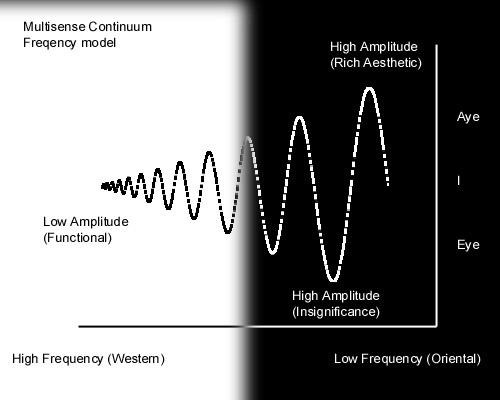
This layout is just a rough speculation of course. I find parallels with electromagnetism here that make me think that a more formal connection with physics could be made. In that case, I would not insist that frequency or amplitude be applied literally – they could be reversed, or even set liminocentrically so that high-low frequencies or high-low amplitudes could serve as the contrast to mid-range frequency-amplitudes instead.
Misrepresentation of “Reality”?
//consciousness /is/ a misrepresentation of reality.//
In order for consciousness to mis-represent reality, there would have to be a possibility of a proper representation to exist /without/ consciousness. If that is true then you have unconscious representation, which means philosophical zombies eat Strong AI.
If that is not true, and reality can only be found within consciousness and never beyond it, then we must accept that reality and consciousness are either the same thing, or that reality is a subset of consciousness rather than the other way around (since we know that we can imagine immaterial alternatives to reality at will). Just from that alone I think common sense would lead us in the direction of idealism and panpsychism.
There really seems to be no good case for material realism to produce consciousness, except for the case which we build from the unshakable conviction of the objectively real appearance of the contents of a neurological simulation which is known to be defective in rendering even itself. Ironically, it is those who so mistrust direct perception who have absolute faith in indirect perception.


Recent Comments