Prismandala
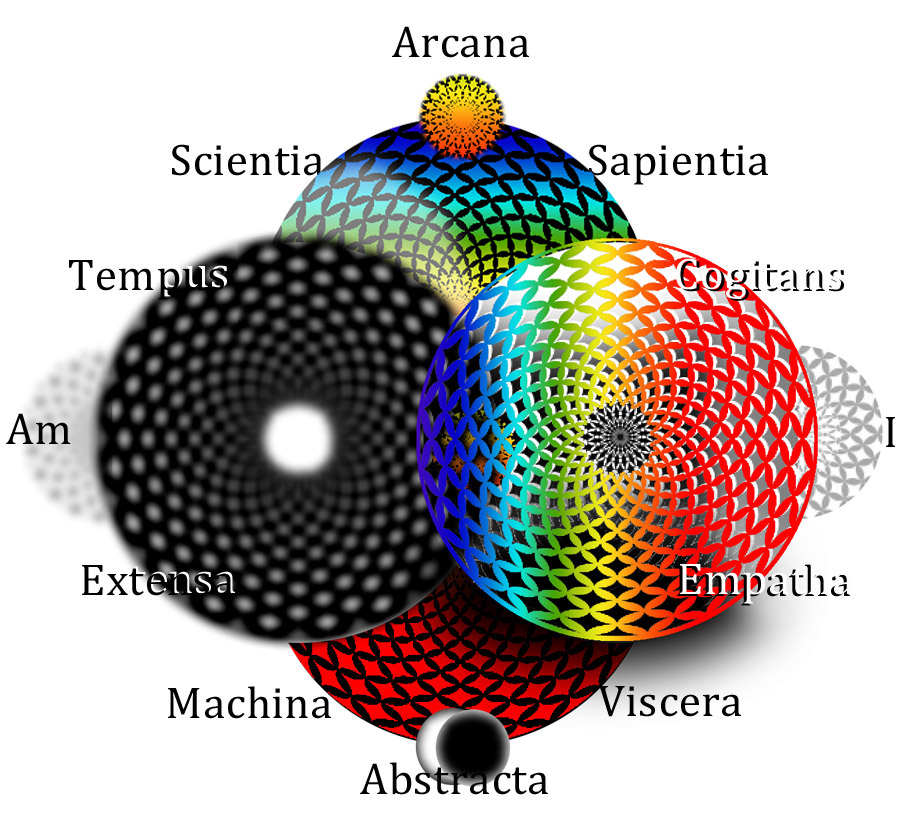
A quick and dirty key:
it’s an attempt at map of everything (a cosmogony?)
Starting with the I (right hand or far Eastern side). I is just regular old I. The local, personal self.
Above and below the I are Cogitans and Empatha, so thinking and feeling.
Above Cogitans is Sapientia: Wisdom. I could have gone with “Ari” or transpersonal, or mytho-poetic, psyche, etc. It’s reaching toward the zenith (Arcana) – the truth, the secret mysteries, God/Tao/Absolute, etc.
Below Empatha is Viscera: Visceral Sub-Personal urges and impulses. Freud called the Id. Cthonic influences.
Abstracta is pure, but meaningless logic. Quantitative relations. The unnatural.
Machina is the collapse into automaticity. It’s computation and mechanism.
Extensa is intended in more or less the same sense as the Cartesian Res Extensa – extended things, classical mechanics, Newtonian physics of matter and chemistry. It’s about 3D structures and their relations (space)
The Far Western/Left hand point is “Am”
This is the realm of the object perspective. When read left to right you get “Am I?” and from right to left “I am”.
Tempus is time as frequency of experienced events…their rise and fall and partial recycling. The machine’s fuel.
Scientia is Science, or Knowledge. The Western gnosis from the outside in. Theory and progress of civilization. The Eastern version, the Sapientia, is life wisdom…the wisdom of direct experience accumulated as inspiring ideas.
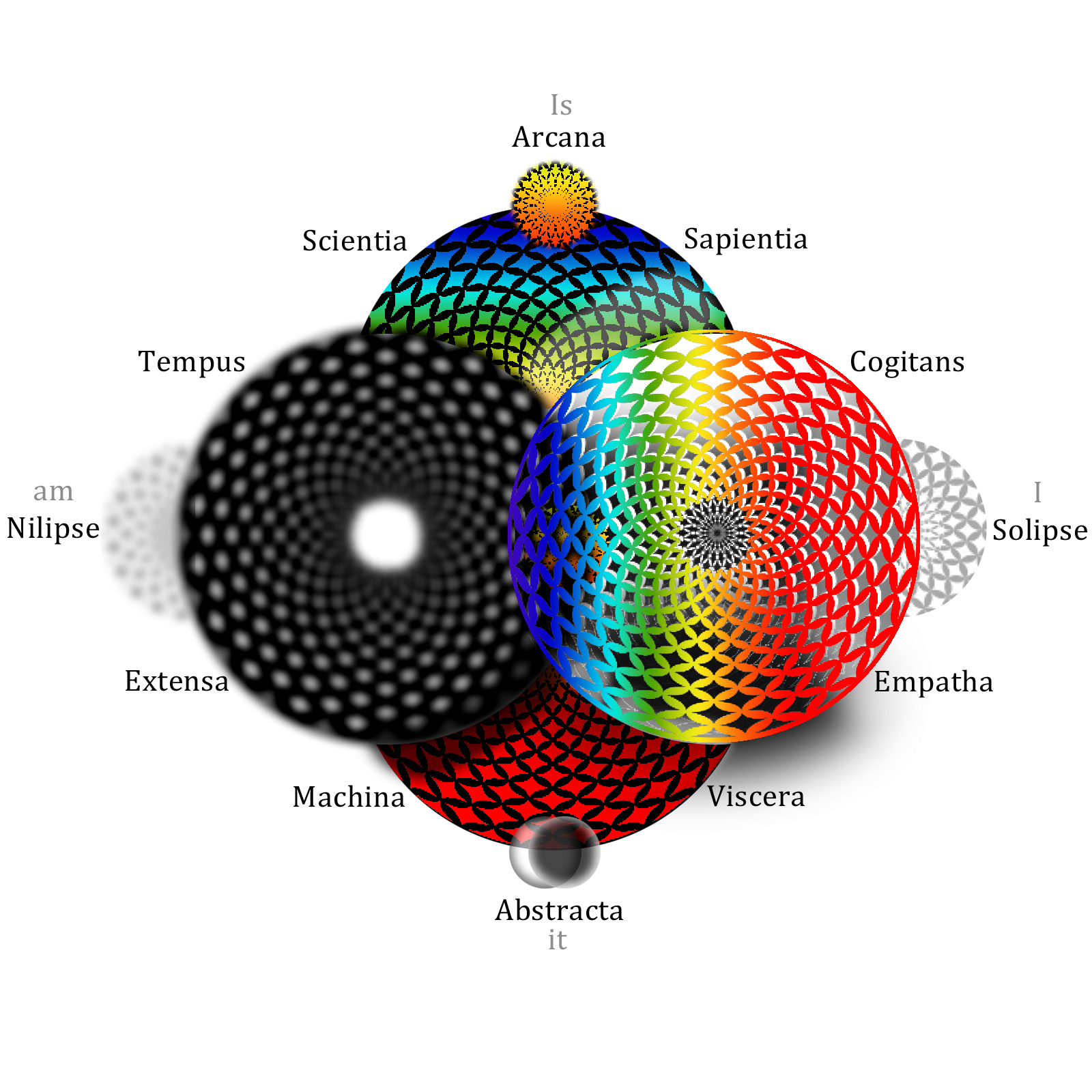
Final image tweak:
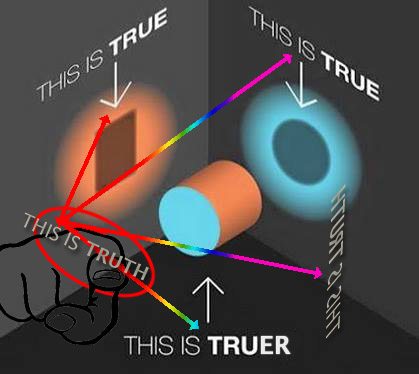
I Think Therefore I Am?
The only thing that can be verified 100% to exist is your own consciousness (“I think, therefore I am”) does this effect/change your own beliefs in any way and how so?
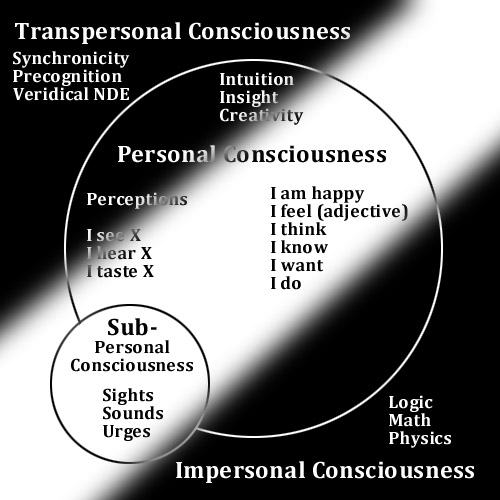
In a way it is true that our consciousness is the only thing that we can verify 100%, however, that way of looking at it may itself not be 100% verifiable. Since cognition is only one aspect of our consciousness, we don’t know if the way that ‘our’ consciousness seems to that part of ‘us’ is truly limited to personal experience or whether it is only the tip of the iceberg of consciousness.
The nature of consciousness may be such that it supplies a sense of limitation and personhood which is itself permeable under different states of consciousness. We may be able to use our consciousness to verify conditions beyond its own self-represented limits, and to do so without knowing how we are able to do it. If we imagine that our consciousness when we are awake is like one finger on a hand, there may be other ‘fingers’ parallel to our own which we might call our intuition or subconscious mind. All of the fingers could have different ways of relating to each other as separate pieces while at the same time all being part of the same ‘hand’ (or hand > arm >body).
With this in mind, Descartes’ cogito “I think therefore I am” could be re-phrased in the negative to some extent. The thought that it is only “I” who is thinking may not be quite true, and all of our thoughts may be pieces to a larger puzzle which the “I” cannot recognize ordinarily. It still cannot be denied that there is a thought, or an experience of thinking, but it is not as undeniable that we are the “I” that “we” think we are.
The modern world view is, in many ways, the legacy of Cartesian doubt. Descartes has gotten a bad rap, ironically due in part to the success of his opening the door to purely materialistic science. Now, after 400 years of transforming the world with technology, it seems prehistoric to many to think in terms of a separate realm of thoughts which is not physical. Descartes does not have the opportunity to defend himself, so his view is an easy target – a straw man even. When we update the information that Descartes had, however, we might see that Cartesian skepticism can still be effective.
Some things which Descartes didn’t have to draw upon in constructing his view include:
1) Quantum Mechanics – QM shifted microphysics from a corpuscular model of atoms to one of quantitative abstractions. Philosophically, quantum theory is ambiguous in both its realism/anti-realism and nominalism/anti-nominalism. Realism starts from the assumption that there are things which exist independently of our awareness of them, while nominalism considers abstract entities to be unreal.
- Because quantum theory is the base of our physics, and physics precedes our biology, quantum mechanics can be thought of as a realist view. Nature existed long before human consciousness did, and nature is composed of quantum functions. Quantum goes on within us and without us.
- Because quantum has been interpreted as being at least partially dependent on acts of detection (e.g. “Experiment confirms quantum theory weirdness”), it can be considered an anti-realist view. Unlike classical objects, quantum phenomena are subject to states like entanglement and superposition, making them more like sensory events than projectiles. Many physicists have emphatically stated that the fabric of the universe is intrinsically participatory rather than strictly ‘real’.
- Quantum theory is nominalist in the sense that it removes the expectation of purpose or meaning in arithmetic. “Shut up and calculate.” is a phrase* which illustrates the nominalist aspects of QM to me; the view is that it doesn’t matter whether these abstract entities are real or not, just so long as they work.
- Quantum theory is anti-nominalist because it shares the Platonic view of a world which is made up of perfect essences – phenomena which are ideal rather than grossly material. The quantum realm is one which can be considered closer to Kant’s ‘noumena’ – the unexperienced truth behind all phenomenal experience. The twist in our modern view is that our fundamental abstractions have become anti-teleogical. Because quantum theory relies on probability to make up the world, instead of a soul as a ghost in the material machine, we have a machine of ghostly appearances without any ghost.
To some, these characteristics when taken together seem contradictory or incomprehensible…mindless mind-stuff or matterless matter. To others, the philosophical content of QM is irrelevant or merely counter-intuitive. What matters is that it makes accurate predictions, which makes makes it a pragmatic, empirical view of nature.
2) Information Theory and Computers
The advent of information processing would have given Descartes something to think about. Being neither mind nor matter, or both, the concept of ‘information’ is often considered a third substance or ‘neutral monism’. Is information real though, or is it the mind treating itself like matter?
Hardware/software relation
This metaphor gets used so often that it is now a cliche, but the underlying analogy has some truth. Hardware exists independently of all software, but the same software can be used to manipulate many different kinds of hardware. We could say that software is merely our use of hardware functions, or we could say that hardware is just nature’s software. Either way there is still no connection to sensory participation. Neither hardware nor software has any plausible support for qualia.
Absent qualia
Information, by virtue of its universality, has no sensory qualities or conscious intentions. It makes no difference whether a program is executed on an electronic computer or a mechanical computer of gears and springs, or a room full of people doing math with pencil and paper. Information reduces all descriptions of forms and functions to interchangeable bits, so the same information processes would have to be the same regardless of whether there were any emergent qualities associated with them. There is no place in math for emergent properties which are not mathematical. Instead of a ‘res cogitans’ grounded in mental experience, information theory amounts to a ‘res machina’…a realm of abstract causes and effects which is both unextended and uninhabited.
The receding horizon of strong AI
If Descartes were around today, he might notice that computer systems which have been developed to work like minds lack the aesthetic qualities of natural people. They make bizarre mistakes in communication which remind us that there is nobody there to understand or care about what is being communicated. Even though there have been improvements in the sophistication of ‘intelligent’ programs, we still seem to be no closer to producing a program which feels anything. To the contrary, when we engage with AI systems or even CGI games, there is an uncanny quality which indicates a sterile and unnatural emptiness.
Incompleteness, fractals, and entropy
Gödel’s incompleteness theorem formalized a paradox which underlies all formal systems – that there are always true statements which cannot be proved within that system. This introduces a kind of nominalism into logic – a reason to doubt that logical propositions can be complete and whole entities. Douglas Hofstadter wrote about strange loops as a possible source of consciousness, citing complexity of self-reference as a key to the self. Fractal mathematics were used to graphically illustrate some aspects of self-similarity or self-reference and some, like Wai H Tsang have proposed that the brain is a fractal.
The work of Turing, Boltzmann, and Shannon treat information in an anti-nominalist way. Abstract data units are considered to be real, with potentially measurable effects in physics via statistical mechanics and through the concept of entropy. The ‘It from Bit’ view described by Wheeler is an immaterialist view that might be summed up as “It computes, therefore it is.”
3) Simulation Triumphalism
Disneyland
When Walt Disney produced full length animated features, he employed the techniques of fine art realism to bring completely simulated worlds to life in movie theaters. For the first time, audiences experienced immersive fantasy which featured no ‘real’ actors or sets. Disney later extended his imaginary worlds across the Cartesian divide to become “real” places, physical parks which are constructed around imaginary themes, turning the tables on realism. In Disneyland, nature is made artificial and artifice is made natural. Audioanimatronic robots populate indoor ‘dark rides’ where time can seem to stop at midnight even in the middle of a Summer day.
Video games
The next step in the development of simulacra culture took us beyond Hollywood theatrics and naturalistic fantasy. Arcade games featured simulated environments which were graphically minimalist. The simulation was freed from having to be grounded in the real world at all and players could identify with avatars that were little more than a group of pixels.
Video, holographic, and VR technologies have set the stage for acceptance of two previously far-fetched possibilities. The first possibility is that of building artificial worlds which are constructed of nothing but electronically rendered data. The second possibility is that the natural world is itself such an illusion or simulation. This echoes Eastern philosophical views of the world as illusion (maya) as well as being a self-reflexive pattern (Jeweled Net of Indra). Both of these are suggested by the title of the movie The Matrix, which asks whether being able to control someone’s experience of the world means that they can be controlled completely.
The Eastern and Western religious concepts overlap in their view of the world as a Matrix-like deception against a backdrop of eternal life. The Eastern view identifies self-awareness as the way to control our experience and transcend illusion, while the Abrahamic religions promise that remaining devoted to the principles laid down by God will reveal the true kingdom in the afterlife. The ancients saw the world as unreal because the true reality can only be God or universal consciousness. In modern simulation theories, everything is unreal except for the logic of the programs which are running to generate it all.
4) Relativity
Einstein’s Theory of Relativity went a long way toward mending the Cartesian split by showing how the description of the world changes depending upon the frame of reference. Previously fixed notions of space, time, mass, and energy were replaced by dynamic interactions between perspectives. The straight, uniform axes of x,y,z, and t were traded for a ‘reference-mollusk’ with new constants, such as the spacetime interval and the speed of light (c). The familiar constants of Newtonian mechanics, and Cartesian coordinates were warped and animated against a tenseless, Non-Euclidean space with no preferred frame of reference.
Even before quantum mechanics introduced a universe built on participation, Relativity had punched a hole in the ”view from nowhere’ sense of objectivity which had been at the heart of the scientific method since the 17th century. Now the universe required us to pick a point within spacetime and a context of physical states to determine the appearance of ‘objective’ conditions. Descartes extended substance had become transparent in some sense, mimicking the plasticity and multiplicity of the subjective ‘thinking substance’.
5) Neuroscience
Descartes would have been interested to know that his hypothesis of the seat of consciousness being the pineal gland had been disproved. People have had their pineal glands surgically removed without losing consciousness or becoming zombies. The advent of MRI technology and other imaging also has given us a view of the brain as having no central place which acts as a miniature version of ourselves. There’s no homunculus in a theater looking out on a complete image stored within the brain. There is also no hint of dualism in the brain as far as a separation between how and where fantasy is processed. To the contrary, all of our waking experiences seamlessly fuse internal expectations with external stimuli.
Neuroscience has conclusively shattered our naive realism about how much control we have over our own mind. Benjamin Libet’s showed that by the time we think that we are making a decision, prior brain activity could be used to predict what the decision would be. With perceptual tests we have shown that our experience of the real world not only contains glaring blind spots and distortions but that those distortions are masked from our direct inspection. Perception is incomplete, however that is no reason to conclude that it is an illusion. We still cannot doubt the fact of perception, only that in a complex kind of perception that a human being has, there are opportunities for conflicts between levels.
Neuroscientific knowledge has also opened up new appreciation for the mystery of consciousness. Some doctors have studied Near Death Experiences and Reincarnation reports. Others have talked about their own experiences in terms which suggest a more mystical presence of universal consciousness than we have imagined. Slowly the old certainties about consciousness in medicine are being challenged.
6) Psychology
Psychology has developed a model of mental illness which is natural rather than supernatural. Conditions such as schizophrenia and even depression are diagnosed and treated as neurological disorders. The use of brain-change drugs, both medically and recreationally has given us new insights into the specificity of brain function. Modern psychology has questioned earlier ideas such as Freud’s Id, Ego, and Superego, and the monolithic “I” before that so that there are many neurochemical roles and systems which contribute to making “us”.
To Decartes’ Cogito, the contemporary psychologist might ask whether the I refers to the sense of an inner voice who is verbalizing the statement, or to the sense of identification with the meaning of the concept behind the words, etc.
In all of the excitement of mapping mental symptoms to brain states, some of the most interesting work in psychology have languished. William James, Carl Jung, Piaget, and others presented models of the psyche which were more sympathetic to views of consciousness as a continuum or spectrum of conscious states. By shifting the focus away from first hand accounts and toward medical observation, some have criticized the neuroscientific influence on psychology as a pseudoscience like phrenology. The most important part of the psyche is overlooked, and patients are reduced to sets of correctable symptoms.
7) Semiotics
Perhaps the most underappreciated contribution on this list is that of semioticians such as C.S. Peirce and de Saussure. Before electronic computing was even imagined, they had begun to formalize ideas about the relation between signs and what is signified. Instead of a substance dualism of mind and matter, semiotic theories introduced triadic formulations such as between signs, objects, and concepts.
Baudrillard wrote about levels of simulation or simulacra, in which a basic reality is first altered or degraded, then that alteration is masked, then finally separated from any reality whatsoever. Together, these notions of semiotic triads and levels of simulation can help guide us away from the insolubility of substance dualism. Reality can be understood as a signifying medium which spans mind-like media and matter-like media. Sense and sense-making can be reconciled without inverting it as disconnected ‘information’.
8) Positivism & Post-Modernism
The certainty which Descartes expressed as a thinker of thoughts can be seen to dissolve when considered in the light of 20th century critics. Heavily criticized by some, philosophers such as Wittgenstein, Derrida, and Rorty continue to be relevant to undermining the incorrigibility of consciousness. The Cogito can be deconstructed linguistically until it is meaningless or nothing but the product of the bias of language or culture. Under Wittgenstein’s Tractatus, the Cogito can be seen as a failure of philosophy’s purpose in clarifying facts, thereby deflating it to an empty affirmation of the unknowable. Since, in his words “Whereof one cannot speak, thereof one must be silent.” we may be compelled to eliminate it altogether.
What logical positivism and deconstructivism does with language to our idea of consciousness is like what neuroscience does through medicine; it demands that we question even the most basic identities and undermines our confidence in the impartiality of our thoughts. In a sense, it is an invitation for a cross-examination of ourselves as our own prosecution witness.
Wilfrid Sellars attack on the Myth of the Given sees statements such as the Cogito as forcing us to accept a contradiction where sense-datum (such as “I think”) are accepted as a priori facts, but justified beliefs (“therefore I am”) have to be acquired. How can consciousness be ‘given’ if understanding is not? This would seem to point to consciousness as a process rather than a state or property. This however, fails to account for lower levels of consciousness which might be responsible for even the micro level processing.
In my view , logic and language based arguments against the incorrigibility fail because they overlook their own false ‘given’, which is that symbols can literally signify reality. In fact, symbols have no authority or power to provide meaning, but instead act as a record for those who intend to preserve or communicate meaning.
An updated Cogito
“I think, therefore I am at least what a thinker thinks is a thinker.”
Rather than seeing Cartesian doubt as only a primitive beginning to science, I think it makes sense to try to pick up where he left off. By adding the puzzle pieces which have been acquired since then, we might find new respect for the approach. Relativism itself may be relative, so that we need not be compelled to deconstruct everything. We can consider that our sense of deconstruction and solipsism as absurd may be well founded, and that just because our personal intuition is often flawed does not mean that kneejerk counter-intuition is any better.
With that in mind, is the existence of the “I” really any more dubious than a quark or a rainbow? Does it serve us to insist upon rigid designations of ‘real’ vs ‘illusion’ in a universe which has demonstrated that its reality is more like illusion? At the same time, does it serve us to deny that all experiences are in some sense ‘real’, regardless of their being ineffable to us now?
*attributed to David Mermin, Richard Feynman, or Paul Dirac (depending on who you ask)
How Does Human Consciousness Work?
How Does Human Consciousness Work? (Quora)
I have given up trying to explain why consciousness is not an emergent property and why emergence is incoherent when applied to consciousness, so this answer is only for readers who already understand that the eliminativist/materialist account of consciousness fails. This means that you understand that awareness cannot be something that physical objects do, or a quality that they have (panpsychism), or even that mind and matter are two parts of the same coin (dual aspect monism), but that all forms and functions, physical or logical, can only exist within a context of what might be called pansensitivity, or sensation-that-makes-sense. This is not to say that human consciousness is the center of the universe and that all phenomena must make sense to us, but that all phenomena must be present in some modality of detection and interaction. This can be understood rationally with no need of any empirical testing. All that is required is for us to play out the null hypothesis: If there is no possibility of any detection or interaction with phenomenon X, then phenomenon X is indiscernible from nothing at all.
The OP then, asking how human consciousness works, should be broken down into two separate parts:
1) How does awareness in general work?
2) How does human consciousness differ from awareness in general?
1) In consideration of the above, the ‘how’ of awareness becomes a metaphysical issue – it could be said even a meta-ontological issue. If awareness-in-general (or use my term pansensitivity) is the most primitive prerequisite for all phenomena in all possible universes, then we must retrain ourselves to stop looking for more primitive phenomena which compose awareness.
I think that we can say awareness is sensory-motive in nature. That is, there is a quality of passive perceiving and active participating which cannot be rationally done without. Even an atom or subatomic particle requires a context where its identity is made coherent in some way, where its presence is detected or can be inferred from some detection of its effects. In the absence of such a detection, again, there is no difference between such a particle and nothing at all. There is no context from which to derive that difference.
That doesn’t mean solipsism – it doesn’t mean that particles don’t exist unless we see them, but it does mean that the concept of ‘existence’ is incompatible with the existence of our own consciousness unless it is identical to detection/participation in some modality or context.
We need not posit a universal mind or God (although there is nothing that I am proposing which rules that out), only that existence itself in the absence of all perception is fantastically implausible given that 100% of what we know of the universe comes to us exclusively through perception. If the universe doesn’t need perception, then there would be no rational explanation for why some parts of the universe could evolve such a redundant and irrational feature to depend upon exclusively.
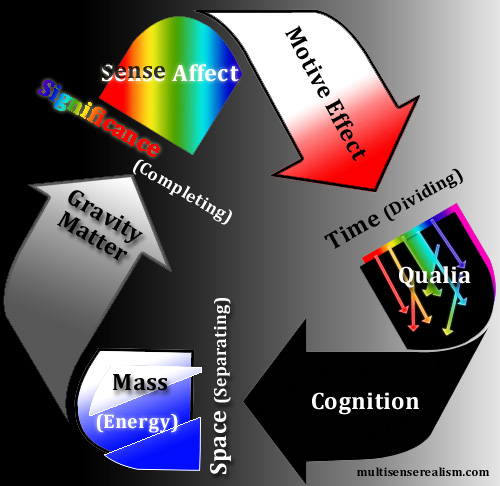
From this sensory-motive awareness-in-general, we can develop a hypothesis about how it divides and multiplies itself into different perceived forms and participatory functions. This entails performing a kind of Copernican inversion on our early 21st century* worldview, turning the outside (<matter>mass>energy>entropy>space) in, and the inside (pansense>sense<motive>significance>time) out. I don’t expect anyone to really understand that right away…it has taken me several years to put it together in those terms, but hopefully the general idea of the role that symmetry plays comes through. Suffice it to say, I think that how awareness works is that it plays with variations on itself using separation and reconnection on many levels at once. It’s very much like the view that has been a part of Eastern philosophy and Western mysticism for centuries, but with the important difference of plugging directly into modern models of physics and information.
As far as information goes, the sensory-motive primitive can be plugged into the medium-signal relation. Physics gives us a lot of these kinds of conjugates: surface-depth, electro-magnetism, space-time, mass-energy, etc, but when we are working with information and semiotics, we lose the concrete reality of sensation and substitute automatic, ideal abstractions of theoretical mechanics. Computer science and math do not concern themselves with how one number is able to add itself to another, only that there is a reliable result. Physics does focus on how phenomena interact, but not what those interactions actually are or what it is that is actually doing the interacting.
The Medium-Signal Relation
In a simple case of communication, two people might hold a string tight on opposite sides of a room and pull on the string once to indicate ‘yes/true/1’ and twice for ‘no/false/0’. In this case the string pulling, along with the tactile sensitivity of each person to detect the state of the string with their hands would be the medium. We can argue that behind that sensitivity is a lot of other cellular and molecular interaction, but that only pushes the medium down into the microphysical level of description. Even at the bottom, we still need some quantum-atomic sensitivity for any kind of basis of interaction to emerge (or diverge).
The combination of string pulling and any schema which is applied to the interpretation of those pulls would be the signal or sign. Many if not most people confuse ‘signals’ with the physical conditions (string pulling, neurons ‘firing’, semiconductors polarizing, etc), but a better understanding is that the signal is a semiotic interpretation; a conscious consideration of changing conditions within a sensory-motive medium.
Another metaphor that I like is brightness vs contrast. Brightness is the medium – if you have zero brightness there is nothing to see. Light, brightness, and the ability to see are, in the absolute sense, the same thing: a condition of awareness. Contrast stands in here for information or signal, which is a second-order relation of brightness and darkness. If you have no brightness, contrast doesn’t help, but if you do have brightness, then contrast allows many degrees of brightness and frequencies of its absorption to be presented simultaneously.
2) The difference between awareness in general and human consciousness is the incredible degree of elaboration, and the specific experiences which have shaped Homo sapiens. The degree of elaboration I’m referring to would be the number of steps from raw pansensitivity to particular subjective sense vs objectively distanced sense (matter-space), to organic molecules, to cells, to tissues, organs, animals, and vertebrates. The corresponding consciousness of such an elaborate chain of continuous world-crafting seems likely to be be appropriately rich and deep aesthetically. The base level sense and motive is enhanced by orders of magnitude to a heart wrenching, visceral level of participation.
I propose that the specific experiences which have shaped us individually and as a species lend our human consciousness its particular qualities. We share many qualities with other species – perhaps tender emotions with mammals, coarse emotions with reptiles, playful trickery with primates, etc. It’s all sourced in real experience over hundreds of millions of years. It is, in my view, very much like our individual psychology is shaped by our experience, and our families and societies are shaped by their histories. This is what makes human consciousness human, and this is why an AI cannot simulate who we are. A computer may copy the signals from the medium of our communications, or from the medium of neuroscience, but without the medium of the totality of human experience going all the way back to before the first life form, it will only be a kind of doll – an imitation of who we are cobbled together from what our brains are and how they behave.
*really legacy 20th century

Post-particle Light Model
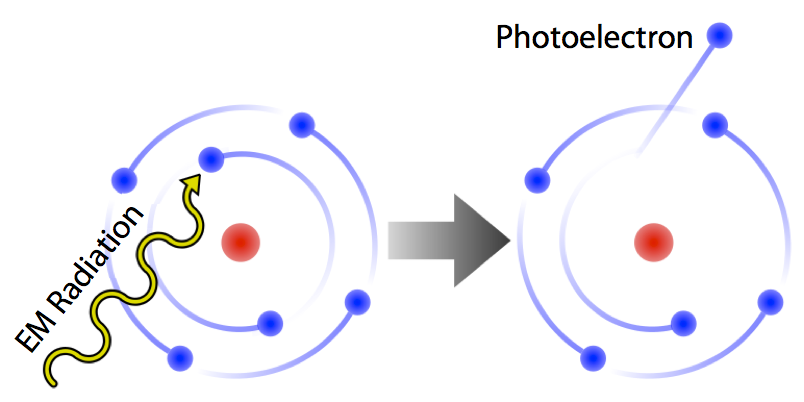

Diagram of conventional photon model vs MSR qualitative model.
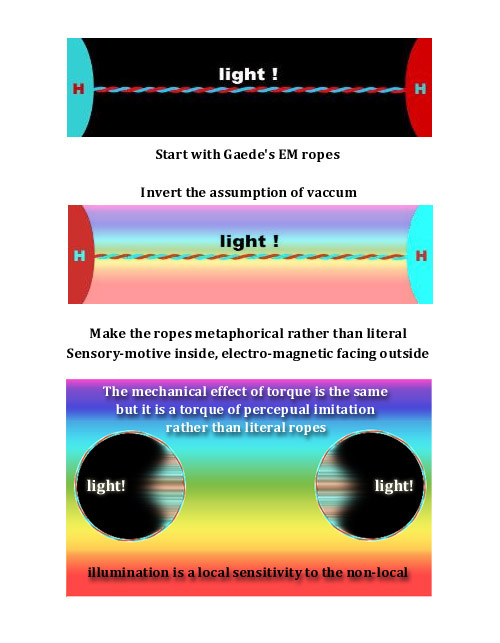
In the MSR model, photons are figurative rather than literal. The two atoms are presented not as literal particles in space but as vectors of sharable experience.
The mode of signaling is not a literal waving of particles (as depicted in the gif) but a state of empathic/emotive stimulation.
The intent here is not to provide a finished model of electrodynamics. The idea is to give more of a general direction of how hypotheses might be developed using particle-free, aesthetic-empathic signaling.
The signal, or text is a shared quality of interiority which is generated by a masking and unmasking of context, which is the cosmological constant – an aesthetic-participatory ground symbolized here by the rainbow stripes. The black ovals symbolize a masking of the ground awareness which is localized. That masking should be understood to be a temporal, temporary localization…of locality. Spacetime is emergent from masking of the aesthetic ground. The masking can be understood to be entropy or insensitivity, the counter-aesthetic which makes it possible to confine and elaborate experience.
Gaede’s EM Ropes
According to Bill Gaede’s hypothesis, light is “a torque signal propagating from one atom to another along a rope”. MSR defines the universe as being the totality of sensory presence, so that atoms are a localizing partial masking of that presence. Electromagnetism is a torque-like effect in which that masking is partially released or made permeable-permissive so that empathic-imitative sharing arises.
Nesting Spinor

“A spinor visualized as a vector pointing along the Möbius band, exhibiting a sign inversion when the circle (the “physical system”) is rotated through a full turn of 360°” – Wiki
Here is an adaptation of a spinor topology to show the relations within aesthetic phenomena that give rise to realism. Note the adjacent red and blue arrows in opposite directions make an ideal place for the sensory-motive locus, where input/output is experienced directly. The opposite side of the band is the ‘object’ side, where inertia and determinism present a united front against the subjective perspective.
If we set consciousness aside for a moment, this view of the spinor can be used to conceptualize electromagnetism as the source of spacetime rather than an effect occurring within spacetime:

The conventional understanding frequency and wavelength are here inverted, so that we are thinking about them from the inside rather than as objects of study. A wave is an outsider’s view of an occurrence which is only metaphorically wave-like: a surge of changing phenomenal quality.
Inflection Point
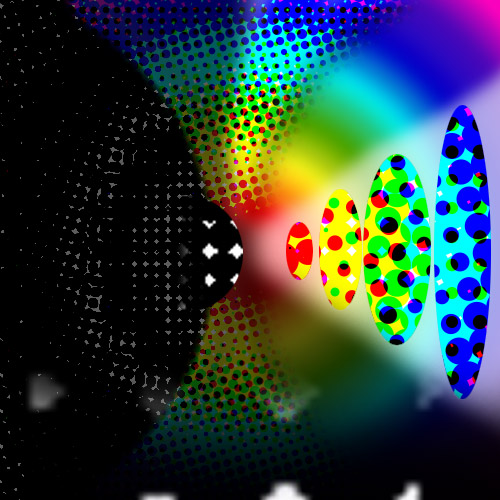
An illustration based on the finer points of multisense realism. The combination of monochrome, spectral color, multiple scales of halftone, and the nested lensing of scales suggest the primacy of sense. It’s about the relation between different features of consciousness and how they diverge rather than emerge from the totality. The totality is masked into personal and impersonal levels of description, instead of assembled from simple parts.


Recent Comments