Information does not physically exist
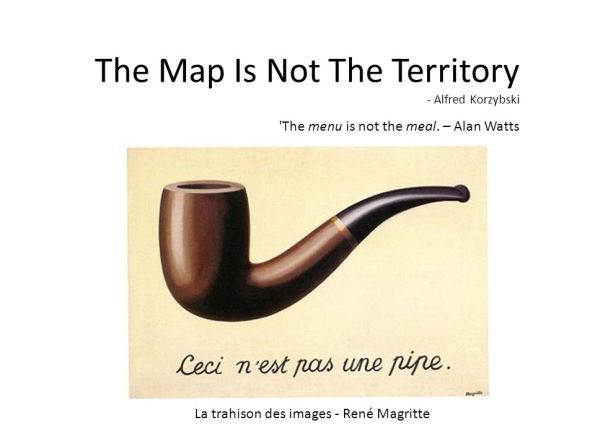 Alfred Korzybski famously said “the map is not the territory”. To the extent that this is true, it should be understood to reveal that “information is not physics”. If there is a mapping function, there is no reason to consider it part of physics, and in fact that convention comes from an assumption of physicalism rather than a discovery of physical maps. There is no valid hypothesis of a physical mechanism for one elemental phenomenon or event to begin to signify another as a “map”. Physical phenomena include ‘formations’ but there is nothing physical which could or should transform them ‘in’ to anything other than different formations.
A bit or elementary unit of information has been defined as ‘a difference that makes a difference’. While physical phenomena seem *to us* to make a difference, it would be anthropomorphizing to presume that they are different or make a difference to each other. Difference and making a difference seem to depend on some capacity for detection, discernment, comparison, and evaluation. These seem to be features of conscious sense and sense making rather than physical cause and effect. The more complete context of the quote about a difference which makes a difference has to do with neural pathways and an implicit readiness to be triggered.
In Bateson’s paper, he says “In fact, what we mean by information—the elementary unit of information—is a difference which makes a difference, and it is able to make a difference because the neural pathways along which it travels and is continually transformed are themselves provided with energy. The pathways are ready to be triggered. We may even say that the question is already implicit in them.” In my view this ‘readiness’ is a projection of non-physical properties of sense and sense making onto physical structures and functions. If there are implicit ‘questions’ on the neural level, I suggest that they cannot be ‘in them’ physically, and the ‘interiority’ of the nervous system or other information processors is figurative rather than literal.
My working hypothesis is that information is produced by sense-making, which in turn is dependent upon more elemental capacities for sense experience. Our human experience is a complex hybrid of sensations which seem to us to be embodied through biochemistry and sense-making experiences which seem to map intangible perceptions outside of those tangible biochemical mechanisms. The gap between the biochemical sensor territories and the intangible maps we call sensations are a miniaturized view of the same gap that exists at the body-mind level.
Tangibility itself may not be an ontological fact, but rather a property that emerges from the nesting of sense experience. There may be no physical territory or abstract maps, only sense-making experiences of sense experiences. There may be a common factor which links concrete territories and abstract maps, however. The common factor cannot be limited to the concrete/abstract dichotomy, but it must be able to generate those qualities which appear dichotomous in that way. To make this common factor universal rather than personal, qualia or sense experience could be considered an absolute ground of being. George Berkeley said “Esse est percipi (To be is to be perceived)”, implying that perception is the fundamental fabric of existence. Berkeley’s idealism conceived of God as the ultimate perceiver whose perceptions comprise all being, however it may be that the perceiver-perceived dichotomy is itself a qualitative distinction which relies on an absolute foundation of ‘sense’ that can be called ‘pansense’ or ‘universal qualia’.
In personal experience, the appearance of qualities is known by the philosophical term ‘qualia’ but can also be understood as received sensations, perceptions, feelings, thoughts, awareness and consciousness. Consciousness can be understood as ‘the awareness of awareness’, while awareness can be ‘the perception of perception’.Typically we experience the perceiver-perceived dichotomy, however practitioners of advanced meditation techniques and experiencers of mystical states of consciousness report a quality of perceiverlessness which defies our expectation of perceiver-hood as a defining or even necessary element of perception. This could be a clue that transpersonal awareness transcends distinction itself, providing a universality which is both unifying, diversifying, and re-unifying. Under the idea of pansense, God could either exist or not exist, or both, but God’s existence would either have to be identical with or subordinate to pensense. God cannot be unconscious and even God cannot create his own consciousness.
It could be thought that making the category of perception absolute makes it just as meaningless as calling it physical, however the term ‘perception’ has a meaning even in an absolute sense in that it positively asserts the presence of experience, whereas the term ‘physical’ is more generic and meaningless. Physical could be rehabilitated as a term which refers to tangible geometric structures encountered directly or indirectly during waking consciousness. Intangible forces and fields should be understood to be abstract maps of metaphysical influences on physical appearances. What we see as biology, chemistry, and physics may in fact be part of a map in which a psychological sense experience makes sense of other sense experiences by progressively truncating their associated microphenomenal content.
Information is associated with Entropy, but entropy ultimately isn’t purely physical either. The association between information and entropy is metaphorical rather than literal. The term ‘entropy’ is used in many different contexts with varying degrees of rigor. The connection between information entropy and thermodynamic entropy comes from statistical mechanics. Similar statistical mechanical formulas can be applied to both the probability of physical microstates (Boltzmann, Gibbs) and the probability of ‘messages’ (Shannon), however probability derives from our conscious desire to count and predict, not from that which is being counted and predicted.
“Gain in entropy always means loss of information, and nothing more”. To be more concrete, in the discrete case using base two logarithms, the reduced Gibbs entropy is equal to the minimum number of yes–no questions needed to be answered in order to fully specify the microstate, given that we know the macrostate.” - Wikipedia
Information can be considered negentropy also:
“Shannon considers the uncertainty in the message at its source, whereas Brillouin considers it at the destination” – physics.stackexchange.com
Thermodynamic entropy can be surprising in the sense that it becomes more difficult to predict the microstate of any individual particle, but unsurprising in the sense that the overall appearance of equilibrium is both a predictable, unsurprising conclusion and it is an appearance which implies the loss of potential to generate novelty or surprise. Also, surprise is not a physical condition.
Heat death is a cosmological end game scenario which is maximally entropic in thermodynamic terms but lacks any potential for novelty or surprise. If information is surprise, then high information would correlate to high thermodynamic negentropy. The Big Bang is a cosmological creation scenario which follows from a state of minimal entropy in which novelty and surprise are also lacking until the Big Bang occurs. If information is surprise, then low information would correlate to high thermodynamic negentropy.
The qualification of ‘physical’ has evolved and perhaps dissolved to a point where it threatens to lose all meaning. In the absence of a positive assertion of tangible ‘stuff’ which does not take tangibility itself for granted, the modern sense of physical has largely blurred the difference between the abstract and concrete, mathematical theory and phenomenal effects, and overlooks the significance of that blurring. Considering physical a category of perceptions gives meaning to both categories in that nature is conceived as being intrinsically experiential with physical experiences being those in which the participatory element is masked or alienated by a qualitative perceiver-subject/perceived-object sense of distinction. The physical is perceived by the subject which perceives itself to possess a participatory subjectivity that the object lacks.
Information depends on a capacity to create (write) and detect (read) contrasts between higher and lower entropy. In that sense it is meta-entropic and either the high or low entropy state can be foregrounded as signal or backgrounded as noise. The absence of both signal and noise on one level can also be information, and thus a signal, on another level. What constitutes a signal at in the most direct frame of reference is defined by the meta-signifying capacity of “sense” to deliver sense-experience. If there is no sense experience, there is nothing to signify or make-sense-of. If there is no sense-making experience, then there is nothing to do with the sense of contrasting qualities to make them informative.
The principle of causal closure in physics, would, if true, prevent any sort of ‘input’ or receptivity. Physical activity reduces to chains of causality which are defined by spatiotemporal succession. A physical effect differs from a physical cause only in that the cause precedes the effect. Physical causality therefore is a succession of effects or outputs acting on each other, so that any sense of inputs or affect on to physics would be an anthropomorphic projection.
The lack of acknowlegement of input/affect as a fundamental requirement for natural phenomena is an oversight that may arise from a consensus of psychological bias toward stereotypically ‘masculine’ modes of analysis and away from ‘feminine’ modes of empathy. Ideas such as Imprinted Brain Theory, Autistic-Psychotic spectrum, and Empathizing-Systemizing theory provide a starting point for inquiries into the role that overrepresentation of masculine perspectives in math, physics, and engineering play in the development of formal theory and informal political influence in the academic adoption of theories.
Criticisms? Support? Join the debate on Kialo.
MSR Time Diagram
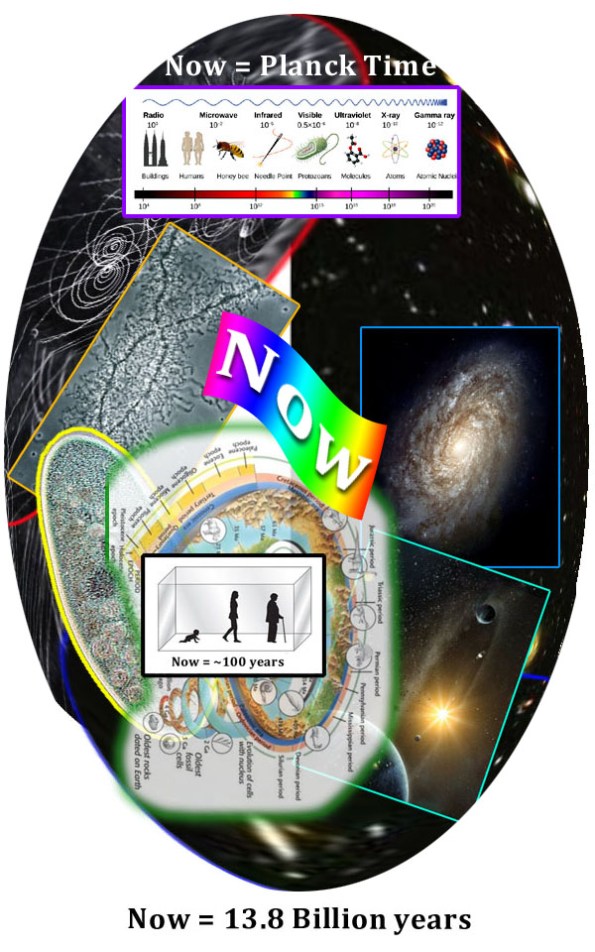
The Multisense Realism view of time contains both A-Series and B-Series time as emergent perspectives within the larger schema of nested/diffracted frames of perception (“Now”s).
This Is Not A Pipe (But it is a triangle)

The physical semiconductor mechanism which computes this triangle contains nothing triangular.
The neurological tissue and the patterns of their chemical excitation which correlate with the experience of seeing a triangle also contain nothing triangular.
The triangle exists because there is a visible phenomenon presented. The visible phenomenon is not a concrete physical object, nor is it an abstract mathematical concept.
The common sense which unites the semiconductor, the neuron, the triangle, and the mathematical/geometric model of triangularity is not a sense which can be physically located in public space, nor can it be logically demonstrated as a proof within the intellect. The common sense which underlies them all is the aesthetic presentation itself.

Proof Against Materialism

1. Modus Ponens: The brain generates consciousness and the brain is physical, so consciousness must be physical.
2. Modus Tollens: Consciousness transcends what can be explained by physical interaction, and the brain is only physical, therefore consciousness must not be only physical.
A scientific approach must explain why one is more sensible than the other. Here is one such explanation:
Hypothesis: If the Modus Tollens case is true, then consciousness may generate matter.
Experiment: Can consciousness generate matter?
Go to sleep. Dream. If you can dream of a physical world without realizing that you’re dreaming, then we know that either consciousness can and does produce all perceptions of ‘matter’, or, consciousness is the sole epistemological source to discern the difference between ‘real matter’ and a hallucination. Either way it is the same conclusion:
Consciousness can produce the experience we know as physical matter, but physical matter has no plausible mechanism or justification for producing phenomenal qualities.
Computation as Anti-Holos

Here is a technical sketch of how all of nature could arise from a foundation which is ‘aesthetic’ rather than physical or informational. I conceive of the key difference between the aesthetic and the physical or informational (both anesthetic) is that an aesthetic phenomenon is intrinsically and irreducibly experiential. This is a semi-neologistic use of the term aesthetic, used only to designate the presence of phenomena which is not only detected but is identical to detection. A dream is uncontroversially aesthetic in this sense, however, because our waking experience is also predicated entirely upon sensory, perceptual, and cognitive conditioning, we can never personally encounter any phenomenon which is not aesthetic. Aesthetics here is being used in a universal way and should not be conflated with the common usage of the term in philosophy or art, since that usage is specific to human psychology and relates primarily to beauty. There is a connection between the special case of human aesthetic sense and the general sense of aesthetic used here, but that’s a topic for another time. For now, back to the notion of the ground of being as a universal phenomenon which is aesthetic rather than anesthetic-mechanical (physics or computation).
I have described this aesthetic foundation with various names including Primordial Identity Pansensitivity or Pansense. Some conceive of something like it called Nondual Fundamental Awareness. For this post I’ll call it Holos: The absolute totality of all sensation, perception, awareness, and consciousness in which even distinctions such as object and subject are transcended.
I propose that our universe is a product of a method by which Holos (which is sense beneath the emergent dichotomy of sensor-sensed) is perpetually modulating its own sensitivity into novel and contrasting aspects. In this way Holos can be understood as a universal spectrum of perceivability which nests or masks itself into sub-spectra, such as visibility, audibility, tangibility, emotion, cogitation, etc, as well into quantifiable metrics of magnitude.
The masking effect of sense modulation is, in this hypothesis the underlying phenomenon which has been measured as entropy. Thermodynamic entropy and information entropy alike are not possible without a sensory capacity for discernment between qualities of order/certainty/completeness (reflecting holos/wholeness) and the absence of those qualities (reflecting the masking of holos). Entropy can be understood as the masking of perceptual completeness within any given instance of perception (including measurement perceptions). Because entropy is the masking of the completeness of holos, it is a division which masks division. Think of how the borders of our visual field present an evanescent, invisible or contrast-less boundary to visibility of visual boundaries and contrasts. Because holos unites sense, entropy divides sense, including the sense of division, resulting in the stereotypical features of entropy – equilibrium or near equilibrium of insignificant fluctuations, uncertainty, morphological decay to generic forms and recursive functions, etc. Entropy can be understood as the universal sense of insensitivity. The idea of nothingness refers to an impossible state of permanent unperceivability, however just as absolute darkness is not the same as invisibility, even descriptors of perceptual absence such stillness, silence, vacuum are contingent upon a comparison with their opposites. Nothingness is still a concept within consciousness rather than a thing which can actually exist on its own.
Taking this idea further, it is proposed that the division of sense via entropy-insensitivity has a kind of dual effect. Where holos is suppressed, a black-hole like event-horizon of hyper-perceivability is also present. There is a conservation principle by which entropic masking must also residuate a hypertrophied entity-hood of sense experience: A sign, or semaphore, aka unit of information/negentropy.
In dialectic terms, Holos/sense is the universal, absolute thesis of unity, which contains its own antithesis of entropy-negentropy. The absolute essence of the negentropy-entropy dialectic would be expressed in aesthetic duals such as particle-void, foreground-background, signal-noise. The aesthetic-anesthetic dual amplifies the object-like qualities of the foregrounded sensation such that it is supersaturated with temporary super-completeness, making it a potential ‘signal’ or ‘sign’…a surface of condensed-but-collapsed semantics or ‘phoria’ into ‘semaphoria’, aka, syntactic elements. I call the progressive formalizing of unified holos toward graphic units ‘diffractivity’. The result of diffractivity is that the holos implements a graphic-morphic appearance protocol within itself, which we call space-time, and which is used to anchor and guide the interaction of the entropic, exterior of experience. The interior of complex experiences are guided by the opposite, transformal sense of hierarchy-by-significance’. Significance is another common term which I am partially hijacking for use in a more specific way as the saturation of aesthetic qualities, and the persistence of any given experience within a multitude of other experiences.
To recap, the conjecture is that all of nature arises by, through, for, and within an aesthetic foundation named ‘holos’. Through a redistribution of its own sensitivity, holos masks its unity property into self-masking/unmasking ‘units’ which we call ‘experiences’ or ‘events’. The ability recall multiple experiences and to imagine new experiences, and to understand the relation between them is what we call ‘time’.
Within more complex experiences, the entropic property which divides experience into temporal sections can reunite with other, parallel complex experiences in a ‘back to back’ topology. In this mode of tactile disconnection, the potential for re-connection of the disconnected ends of experiences is re-presented what we call ‘objects in space’ or ‘distance between points’, aka geometry. By marrying the graphed, geometric formality of entropy with the algebraic, re-collecting formality of sequence, we arrive at algorithm or computation. Computation is not a ‘real phenomenon’ but a projection of the sense of quantity (an aesthetic sense just like any other) onto a distanced ‘object’ of perception.
Physics in this view is understood to be the inverted reflection and echo of experience which has been ‘spaced and timed’. Computation is the inversion of physics – the anesthetic void as addressable container of anesthetic function-objects. Physics makes holos into a hologram, and computation inverts the natural relation into an artificial, ‘information theoretic’, hypergraphic anti-holos. In the anti-holos perspective, nature is uprooted and decomposed into dustless digital dust. Direct experience is seen as ‘simulation’ or ‘emergent’, non-essential properties which only ‘seem to exist’, while the invisible, intangible world of quantum-theoretical mechanisms and energy rich vacuums are elevated to the status of noumena.
Computationalists Repent! The apocalypse is nigh! 🙂
AI is Still Inside Out
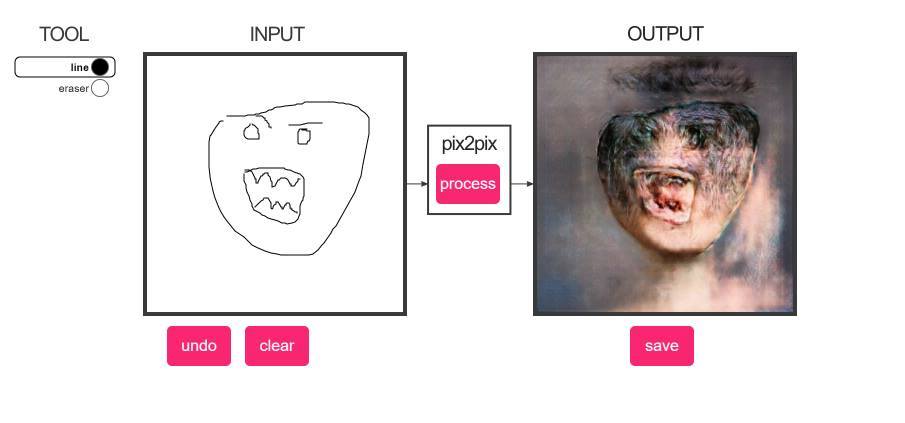
Turn your doodles into madness.
I think this is a good example of how AI is ‘inside out’. It does not produce top-down perception and sensations in its own frame of awareness, but rather it is a blind seeking of our top-down perception from a completely alien, unconscious perspective.
The result is not like an infant’s consciousness learning about the world from the inside out and becoming more intelligent, rather it is the opposite. The product is artificial noise woven together from the outside by brute force computation until we can almost mistake its chaotic, mindless, emotionless products for our own reflected awareness.
This particular program appears designed to make patterns that look like monsters to us, but that isn’t why I’m saying its an example of AI being inside out. The point is that this program exposes image processing as a blind process of arithmetic simulation rather than any kind of seeing. The result is a graphic simulacra…a copy with no original which, if we’re not careful, can eventually tease us into accepting it as a genuine artifact of machine experience.
See also: https://multisenserealism.com/2015/11/18/ai-is-inside-out/
Time for an update (6/29/22) to further demonstrate the point: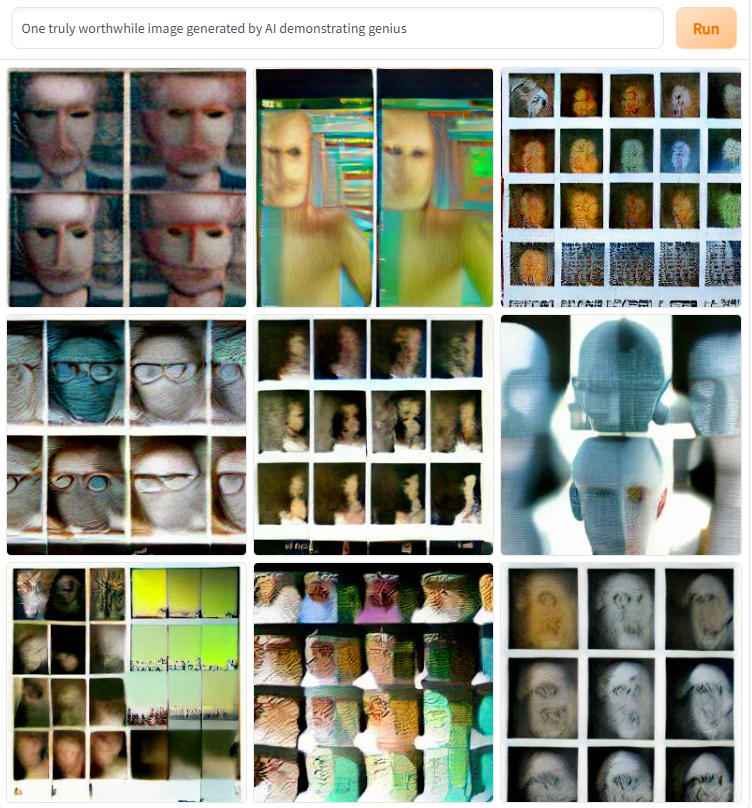
Added 5/3/2023:
Stochastic filtering is not how sense actually works, but it can seem like how sense works if you’re using stochastic filtering to model sense.

How Not To Destroy the World With AI – Stuart Russell


Recent Comments