Archive
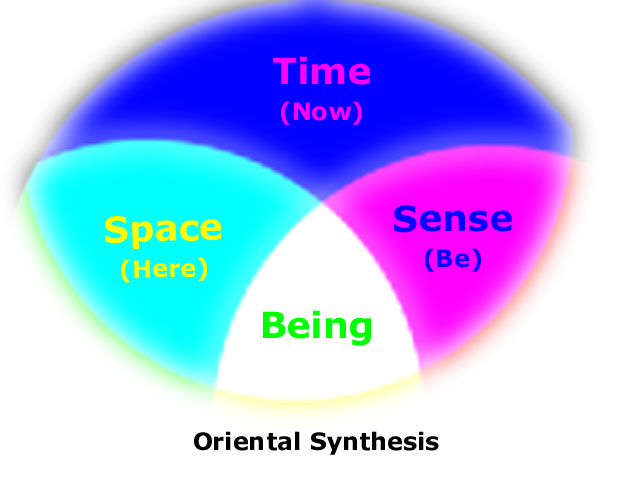

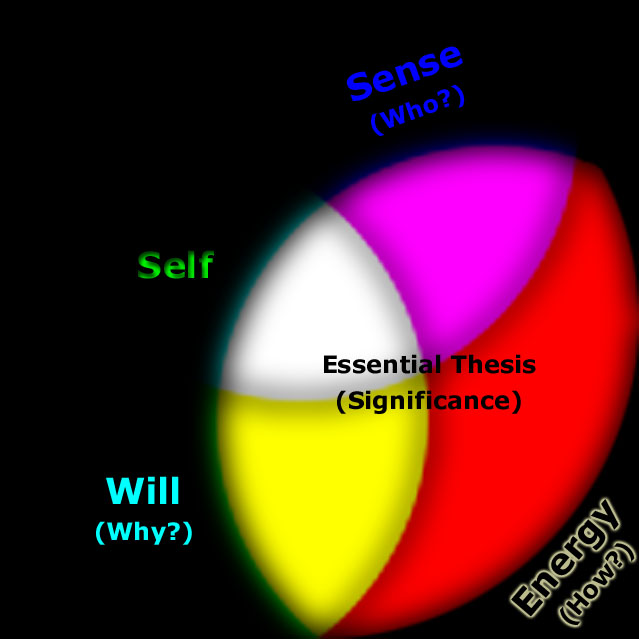
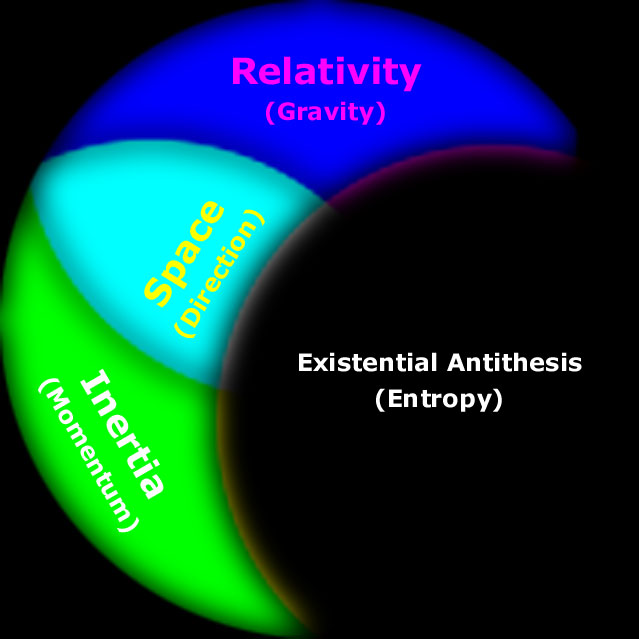
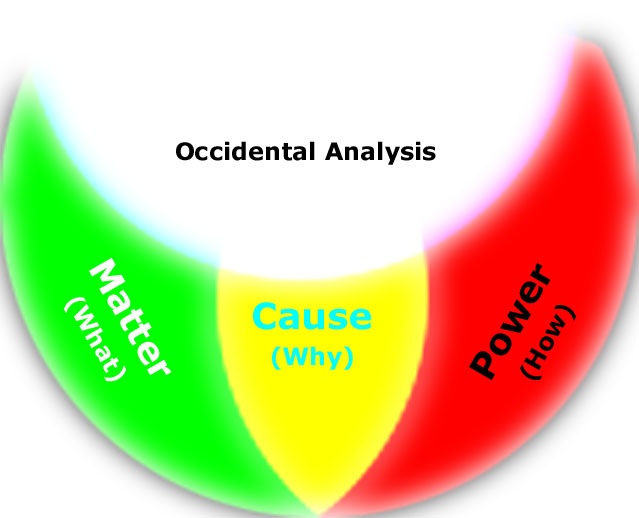
Meaningful Groupings of the Multisense Syzygy
Essential Thesis
Emphasizes Subject Realism: Sensorimotive Perception & Participation
Existential Antithesis
Emphasizes Object Realism: Electromagnetic & Quantum Mechanism
Oriental Synthesis
Be Here Now. Abstract celestial themes.
Occidental Analysis
Instrumental Reasoning. Concrete material themes.
Power Over The Known Universe
“Physics is the study of the structure of consciousness. The “stuff” of the world is mindstuff.” – Physicist Sir Arthur Eddington
I agree. Where I disagree with computationalism is that I see the stuff of the mind as not just numberstuff, but sense. Not only no stuff at all, but the antithesis of stuff. Not emptiness (the lack of stuff), but the insoluble solvent of stuffness itself. Where arithmetic is represented as methodical encoding, sense guesses and makes it up as it goes along.
It seems enigmatic and mysterious because it is a thesis which is blind to itself except through its reflected antithesis, which is not mysterious or enigmatic but public and declarative. This does not mean that we can’t understand what it is and communicate effectively about that understanding.
We can use the symmetry as a mirror to reflect light into the dark of our blind thesis. Both comp and materialism ignore the symmetry and assume that subjectivity is part of a material or an arithmetic thesis, which leads to the Explanatory Gap, Hard Problem, and Symbol Grounding problem. Instead, if we focus on the symmetry itself we can infer the qualities of the Hard Solution, which is of course, inference and symmetry themselves. This is what sense is all about. Connecting the dots. Taking a leap of faith. Bridging the gap. It is not a wild ass guess, but a puzzle to be solved, an itch to be scratched, a need to be filled.
How I think it works is through a multisense realism. Inferences accumulate a figurative history which is retained in the now. What we learn is stored literally in our ongoing perception. These living histories or channels of sense are woven together as worlds or perceptual inertial frames. The trick is that weaving such a world elevates the subjective perception above what they have woven, so that they can see through the motives of worlds beneath them while the subject becomes invisible or opaque (also glamorous, magnificent) to the less significant subjects. What it looks like to the elevated subject is determinism. Knowledge and power.
By seizing or appropriating this power over lesser worlds, the subject disenchants her antithesis and amplifies her own – in the form of increasingly effective motive force. The power to see through things brings a power to see things through. Decisiveness, strategic foresight, intelligence. Transparency informs the eye, the aye, and the I to progress its own preferences and willfulness. It takes the reigns and questions what used to be a simple public fact (‘man cannot fly’) and turns it into private ideas (‘seems like maybe man can fly with a propeller and wings’) until eventually one of those ideas lead to other ideas that ultimately transform a private history of thought into new public fact. Using knowledge for power is what technology is.
The idea of betting on something important is a simple way of remembering what sense and motive is all about. Having something of value to bet is the first requirement. You have to be able to care about the difference between winning and losing. There needs to be a sense of meaning or significance. Being able to exercise some causally efficacious participation in the world is the other requirement. To make a leap of faith, to guess. Qualia and free will. Signs and designs. When viewed from a distance however, we mechanemorphize it electromagnetically as current and power. Physically as mass and acceleration or matter and energy (which I think means that ‘light’ is really acceleration, btw). Mass is significance made literal, as perceived indirectly from an elevated frame. If perceived directly instead, weightiness and power are figurative qualities of experienced intensity.
Henry Markram: Supercomputing the brain’s secrets
I’m very much in favor of this kind of research but I find it telling that the speaker mentions at the beginning one of the reasons why simulating brains is important. He says that we can’t keep testing on animals forever. A noble sentiment only if we presume that the computational simulation is in fact ‘less than’ an animal. Here is revealed the truth about computationalism, that it doesn’t take itself seriously. The pretense that life and feeling can be emulated mechanically is only possible when we think of consciousness in the terms of a toy model. This model sees consciousness as ‘what a brain does’ from the beginning, without any comprehension of the chasm between that set of neurological activities and the invisible world which is experienced through those activities.
If the brain simulation were capable of functioning as a living brain, any change in the program or manipulation of the simulation could result in loops of unimaginable suffering for the simulation. Studying the effects of torture on such a simulation of would logically be no better than torturing an animal, even worse, since the poor digital creature would never die or escape the captivity of it’s torturers.
Obviously this is not a serious consideration for AI. Nobody actually believes that what they are assembling out of coded symbols is literally alive or aware, despite how convincingly they claim to have proved it to themselves. It is a model.
When we seek to reverse engineer a conscious experience from the material mechanisms of neurology, we can rightfully expect to learn many important things about consciousness, but as the blurry images in the video might foreshadow, we can’t learn who it is that is conscious, how their world feels, etc.
It is hopeful to me that they are realizing that it is the electromagnetic patterns themselves which ‘contain’ consciousness, but they still miss completely the deeper implications of this. As it stands now, extraction of semi-coherent images from modeled electromagnetism represents hope for honing in on the formulas to translate EM coordinates into visual qualia (and other qualia by extension) but this hope fails to recognize the infinite regress of the homunculus fallacy. We see the rose, but the simulation does not. The simulation can be paused, copied and pasted, looped, edited, etc, but feeling doesn’t work that way. We have not modeled the sensorimotive experience at all. Instead we have created a dynamic CGI with which we can project our own interpretations about perception. Without those interpretations from our first hand subjective perceptions, there is still no sign of any experience within the model. It’s still only pixels and memory registers switching on and off. I suspect that the further this project progresses, the more we will have to resist the increasingly obvious failure of the model to behave meaningfully like a conscious living organism does. I think it will be fantastic, however, for neurology and for extending and improving our lives.
Everythingness Perturbed: Function, Experience, and Context
Since every organism produces itself from a single dividing cell, it can be said that there is a single history which unites that body back to the cellular level. Atoms do not literally reproduce by themselves so that a machine that is assembled has a no single history to unite it.
This becomes more relevant if we suppose that experience arises as a collected and collective unity of sequence, a many-to-one of integrated participation which is not literal and quantitative, but figurative, qualitative, and iconic. It is meaning and world.
A machine is an abstraction which takes physical history for granted. When executed in a material assembly, there is no literal reproduction, only separate parts brought together unintentionally (from the point of view of the parts) to imitate the function of a specialized organic form.
I think that where comp/functionalist assumptions fail is in the misunderstanding of meaning and world as discrete analytic behaviors rather than continuous synthetic wholes. We can see them as wholes because we are unified beings who can see even cartoon characters and puppets as wholes, but that does not mean that there is any continuous awareness that unifies the parts of the machine. To compensate for this, we generally have to build in a monotonously recursive device, like a clock, pump, or wheel to provide an imitation of continuous flow. This should not be confused with the continuous flow which arises organically in a living body. An organic flow is not a clock to which separate parts are mechanically attached, but a collective rhythm which is synchronized from within the shared motive of the reproduced cell. This is can be seen clearly in the behavior of heart cells as they congregate physically and experientially. Look at what it is:
See the difference?
The cells are pushing a private negentropic agenda, while the clock has no agenda at all. You can see it. It is one dimensional tension in a material like metal or winding down one tick at a time, or an electronic response from a semiconductor material. Neither materials have any native motivation or momentum, they must be wound up or plugged in, wired or bolted together. It is a back door imitation of an organism, artificially integrated to use borrowed power to generate the effect of continuous running.
Consciousness has mechanical aspects as well, and indeed the content of our minds can be said to be running as well, but the difference is that the mind runs on it’s own momentum. More importantly the mind can be quieted so that deeper, unconscious experiences can rise to conscious awareness. These experiences do not seem to arise out of the rapidity of mental syntax as functionalism assumes, but out of deep metaphorical interiority which presents spontaneously and unbidden with insight and prescience rather than deterministically or randomly.
This can be explained by understanding the continuity of psychological experience as the entirety of time being scratched or perturbed by the collective experience of a subset of time. The entity is made of time (really meanings, characters, and worlds…stories. Time is an analytical abstraction that has to do more with objects, space, and density). This may seem mystical or esoteric at first, but I think that is because profound truth about subjectivity must by definition evoke the charms of self fetish. Oriental floridity. Super-signifying Hermeticism. Pageantry. It is who we are and why we are, as distinguished from what and how we are (bodies, cells, cities, planets…Occidental austerity. A-signifying quanta. Physical engineering).
Experienced history then, under multisense realism, is crucial. We are the polar opposite of a tabula rasa. The interiority of the stem cell is not a blank coin to be struck with a cellular role, but a ‘Once upon a time’ from which a spectrum of cellular characters and capacities can be diffracted. This is meaning. This is learning, understanding, loving, and growing (also hating, killing, forgetting and half remembering, making things up, creating etc.)
If experience were mechanical, then a clone could be conditioned with the identical experiences and an identical person would be created. If since strong computationalism is does not ground identity in material at all, we would have to say that a cloned body (machine + program) with cloned experience (runtime) would actually be the same person.
If instead we see experience as a unique and idiosyncratic subset of the totality of experience, there can be no Boys from Brazil strategy – no designer identities. Besides nature, nurture, and random variation, there may be a semantic momentum which opens up a flow of identity like a pinata of experienced history being hit with a series of blows: conception, birth, childhood, etc. It is not a process through which an identity is mechanically assembled or fabricated, but one in which identity is revealed and developed from within the self and within experience.
What does ‘within experience’ mean? It means meaning. Significance. The qualitative feeling or message ‘within’ experience. The moral to the story, the lesson learned, the point to be made, etc. Unlike a sequence of instructions or registers in memory, there is no a-signifying transfer of digitally encoded histories. Instead it is a recapitulation of signifying analog wholes. They are not assembled together like a device or dataset, but live with the subject as subjects, growing, changing, and revealing themselves in endlessly new ways through experience and also from within the subject – ripening and flowering, bearing fruit, etc.
Experience is not mere decision trees. Even though the visible shape of a living tree can be modeled in simple mathematical functions, there is no tree experience there. There is no journey from acorn to oak, only from vector to vector or pixel to pixel. There is form but no content. What is so hard to communicate is that the reason for this is counter-counter-intuitive. We expect the truth of subjectivity to be in a counter-intuitive hidden form. That there is some fantastic organization of the brain which gives us human experience. The idea that human experience is literally what it seems to be – a story of human life, grounded in the totality of the cosmic story is anathema to contemporary science. We are looking for the back door, the trick to the illusion, but the trick is that tricks and illusions are the exceptions to the rule. We can only know illusion because we have the sense to know that individual channels of sense can be fooled. That is no trick and no illusion. That is sanity, awareness, and consciousness.
A machine has no such sense. To a Turing machine, all binary feeds are equal. I have no problem at all asserting that there is no meaning and no world experiencing capacity associated with a binary feed. Imitation perception makes up for it’s qualitative superficiality with high speed execution, giving us the illusion of intelligence, but intelligence without meaning or world experience is a different kind of intelligence – one of pure syntax and no semantic kernel to grow and change through experience. There is trivial learning and adaptation, but it is a shadow play through which our own powers of interpretation can fill in the blanks. A humanoid decision tree, constantly running, with no creative iconic depths of its own.
Identical twins have many similarities, but even brain conjoined twins are different individuals. Their histories fundamentally diverge after conception and further diverge with each experience. Their perspectives are different. A machine is just the opposite. An old Macintosh Plus computer could be manufactured today, using the same materials, different materials, or even by virtually emulated on another computer entirely and be exactly the same as any Mac Plus that was ever manufactured. There is no retained history and no world awareness, no difference in perspective. Unlike conjoined twins, networked computers don’t fight with each other. They don’t differentiate themselves. Why? Because there is no self there to differentiate, only a perpetual centralized spinning. This is using space and motion to create the illusion of time – animation.
What we are is neither space, nor motion, nor time, nor information, but informed, moving, waving firmament. Not the wave but that infinitely anchored silent stillness of everythingness itself which is being perturbed in a wavelike manner and making shows within shows which we call time and experience, or, if you like, energy. Energy is a concept of the experience of one show being indirectly experienced in the context of another show. It’s anomalous but sensible. Like the end of Wizard of Oz where the three super-signifying (floridly fictional) characters are re-contextualized as ordinary (naturalistic fictional) farmhand characters in the desaturated aftermath of the dream
Quora on Memory and Words
Are words like memories and memories like words?
It seems like an odd question. Sort of like asking ‘Are screenplays like entertainment and entertainment like screenplays?’. In a broad sense, everything is like memories. The whole content of the universe could be thought of as the persistence of coherent phenomena through time…discoverable patterns struck within patterns. To narrow it down to human memory gets into different overlapping neurological categories; short term, long term, declarative, implicit, autobiographical, sensory caching, etc. Those are more about our particular phenomenology of pattern recognition and recollection, which seems to be tightly associated with words, but also images, sounds, smells, etc.
I can think of words as like dehydrated experiences, or crystallized pointers to evoke a narrative flow. Memory implies traces of factual experiences in the past, whereas words more often weave a fictional perspective on the past, present, and future. Words are semiotic devices which focus and reflect semantic content through syntactic forms – two different senses of informing which both rely on memory. Perhaps this is where their power to recapitulate sense-making comes from. By presenting a linguistic-symbolic expression which is relatively impersonal coupled with => a proprietary personal motive, a reflection of sensory wholeness is achieved, using the products of sense themselves (optical icons, vocalized sounds) as a body. ‘See what => I’m saying?’ ‘Know what => I mean?’
A word then can be used to encapsulate fragments from any of my personal memories, stories, ideas, texts, knowledge, thoughts etc and through that encapsulation provide the keys to be reconstructed in someone else. The meaning figuratively rides on our shared associations, language, and common sense, so that it is not literally transmitted through space as ‘information’ but rather elides space entirely by a process of local sensory reification. Words can be seen ‘there’ but can only be understood ‘here’.
Memory is also a local understanding but does not require the external-facing symbolic packaging. It doesn’t need to be reified in someone else’s head, only recalled subjectively. Of course we can remember words too, and all words are by definition memories (we have to remember what words the language we intend to speak contains), but memories extend beyond words. The effectiveness of words can obscure our understanding of memory. We are used to seeing the world so much through this logical symbolic process that we tend to see all of consciousness in this light. Memory does not have to be experienced consciously but words do. In fact memory may not have to be experienced at all to be influential. Reading these words for instance is predicated on some implicit memory of how to read English, but to assume that literally implies a database of kindergarten memories being accessed in real time read/writes does not tell the story of our experience. That may be true in one sense, but my hunch is that it works differently also. I think that the memory itself may become an iconic part of who we are, more like looking through colored glass gives us different ways which we can see the world.
Knowledge question on Quora
I perceive that the word ‘knowledge’ has several connotations. To know something can be contingent upon a memory of an experience of having learned something. This kind of knowledge can be forgotten. If you can’t recall someone’s name, it could be said that you ‘don’t know it (anymore)’. What does it mean to have an experience of learning something though? What separates knowledge from the wash of meaningless bits of thought and imagination that circulates through the mind?
It might be tempting to say that knowledge comes from outside the mind, so that learning is the process of capturing and internalizing sensory experience, however we can learn things internally as well. We can make sense of something in our mind and learn through contemplation and analysis, reasoning, insight, intuition, etc.
Whether it ultimately is more internal or external makes no difference so long as what is learned is deemed to be significant enough to retain in some fashion. How it is retained is a more interesting problem, since once the moment of learning is done and past, how do we know that we know before we even try to remember knowing it?
Computationalism would model this capability as a process of literally and continuously searching a database like a search engine does. There is truth to that model, but it only addresses the semiotic form (syntax) of the search and not the experiential content (semantics, pragmatics). In a computer, the capacity to experience and interpret the content is provided by the user, so it is enough for the search engine to imitate semantic association by pulling an arithmetic analysis of previous searches. The brain undoubtedly does this too, strengthening neurological connections along high traffic paths and allowing low traffic paths to be pruned, however the mind is not limited to its past. The mind can figure out new paths and make new associations on its own which actually drive neurological change.
I consider all subjective experiences to be reducible to sensorimotive phenomena. Thoughts, feelings, ideas, perceptions, facts, fiction, knowledge, all are concrete sensorimotive percepts (as opposed to abstract ‘data’, ‘information’, or ‘emergent properties, which are like conceptual wireframe models of the actual phenomenon which is organic and non-conceptual). This means that our experiences are causally efficacious. They influence us and they influence our entire biography without needing to be tied back to neurology. A life story has it’s own rhythm, momentum, and direction independent of biological process, so that knowledge is not always discrete bundled of sense ‘datum’, but rather an entangled path of paths through which the psyche navigates. It is an implicit part of the flow of experience, one which may or may not be communicated or even made explicit to the self. We don’t always consciously know that we know, but we can often examine and remember the source of our knowledge. Knowledge, like understanding, is an experience through which we make sense of other experiences. We need not remember the event which initiated this learning (but we quite often do, and that helps cement the learning in our recollection of it), but it leaves a lasting mark on how we learn and understand in the future.
The question of whether knowledge needs to be preserved or managed is an interesting one, as it speaks to cybernetic intelligence. In an individual, knowledge doesn’t not need to be preserved or managed, as it is implicit in one’s understanding and can be reconstituted (neurology willing) on demand. Knowledge works differently in civilization, where only a small fraction of the total individual knowledge represented in libraries and databases can be said to flow implicitly through the culture in general. There is knowledge there for citizens, but it is mainly in the form of customs and roles which impart knowledge related to survival within the society itself. Generally living in a culture does not automatically teach someone ideas outside of the culture (or if it does, it is heavily filtered and assimilated through the local culture).
We know from the Middle Ages that large bodies of knowledge can ‘disappear’ for centuries. Unlike a typical human mind, data stored in books and scrolls does not curate or translate itself. This is because the books themselves are not knowledge, only recipes for knowledge to those who can understand them. These, and all storage devices for text (digital or analog) are literally objects, requiring both objects that can be preserved physically and processes to facilitate their availability that can be managed.
Whether or not preservation and management of public knowledge systems is a need is up to the culture that is doing the managing. It’s an investment of resources like any other aspect of civilization so that what gets preserved or neglected for the public is a political issue. The current trend is highly polarized, with the agenda for privatization and security squaring off with previously established values of free and open availability of information. The great thing about knowledge though, is that like in the epochs following the Middle Ages in Europe, progress can make up for lost time, and there is always hope of Renaissance and Enlightenment eventually
Atheist question (on Quora)
I think that the answer to why some atheists behave self-righteously and dogmatically lies in the nature of how human consciousness makes sense of itself and the world.
If we understand that theism is a projection of the qualities of the interior of the self (the immaterial sense of who and why, indefinable yet indivisible presence, the subjective will, vitality, feeling, narrative revelation through time, etc) and that atheism is a diametrically opposed epistemology based on qualities perceived exterior to the self (the sense of what and how, material mechanism, logically and quantitatively defined processes, unfeeling objects and data stored in spatial locations, etc), then we can see that it would make sense that those who are interested in either approach would be equally likely to personally identify with it as well as equally likely to identify with reason in general.
The problem is, in my opinion, that reason owes it’s utility to discrimination, but the universe cannot be understood through discrimination. Reason insists that if the universe is logical, then it cannot be primitively personal, and if it is personal, then it cannot be logical without invoking the logic of a super-signifying being or narrative.
To reconcile this, all that needs to be done is understand the symmetry of how sense is made. Interior vs exterior, figurative vs literal, subject vs object, and how that symmetry itself supervenes on perspective. If we see ourselves from an objective perspective, is it like looking through a telescope or microscope, and our perceptions are drawn into themes of scale and taxonomy. As we bring this view of the universe into sharp focus, we naturally marginalize the contrary view and see the self in terms of it’s role as an empty voyeur. The self is elided as a non-essential and irrelevant consequence of physics. We lose ourselves in the spectacle of the universe without us.
While the content of this identification with the infinite and eternal is precisely contrary to the content of theological projection, the form is identical. The desire to lose the self in a superior universe or lose the universe in a superior self is the same desire to annihilate the ordinary into the context of the profound. The irony of course, is that this too is an all too human motivation. Behind its high flying pretensions to see through the mundane world to the Truth, the self is still there playing the game of ‘I know more than you do’ and ‘My epistemology can beat up your epistemology’. This is how the self works. This is what consciousness (and I think our entire cosmos) actually is: a single continuum of dialectic sense perspectives; literally figurative interiors vs. figuratively literal exteriors.
Q: In theory, could we predict future behavior if we knew enough about the brain?
In theory, could we predict future behavior if we knew enough about the brain?
The theory that we could predict future behavior if we knew enough about the brain is logically sound, but I think that the underlying assumptions are flawed. The relation between behavior and the brain may in fact *not* be linked by cause and effect but by simultaneous integration. Even the best imaginable auto mechanic cannot predict where the car will be driven (although they can predict things about the car’s ability to function on the road).
What I suggest is that human behavior is driven by semantic conditions within the context of the individual’s experience as a whole as well as physiological-neurolgogical-biochemical conditions of the body’s existence. My hypothesis is that interior experience is a concretely real sensorimotive phenomenology rather than a ‘simulation’, ‘interpretation’, or ’emergent property’ of neurological ‘data’ or ‘information’. As such, our perceptions intensify or diminish, consolidate, branch, negate, etc according to the logic of their significance within the biographical narrative rather than exclusively in the activity that we currently know how to measure in the brain from the ‘outside’.
Knowing everything about a brain would certainly enable many predictions, but without understanding the life of the subject from the inside, it is probably not possible to predict what they are going to think and do for the rest of their lives, even if you could know every possible future of the entire universe. If the universe could do that, it probably wouldn’t go through the formality of actually presenting the universe as the ‘live show’ that it appears to us to be.
Long ongoing thread with math professor: theory, matter, games, machines…
> > The rules arise from the players
> > interactions with each other,
>
> Not for definable games. In game theory we can show the existence of
> game without us knowing any of the game rule.
If you define the game without the players understanding it, it is your game that you are playing using game pieces as manipulated objects, not subject-players.
…
>
> What is matter? What is energy? How does it come from?
Matter is the exterior view of pieces of the singularity – so it is volumes of mechanical entropic densities – quantitative topological expressions of sense.
Energy is the interior view *through* the pieces of the singularity – so it is sequences of animated signifying intensities – qualitative motive expressions of sense (see the symmetry of each word of the matter and energy description? volumes::sequences, mechanical (manipulated from without)::animated (from within), entropic::signifying, densities::intensities, etc?)
It doesn’t come from, it is the source of ‘comes from’. They are the consequences of the folding of the singularity into primordial monad vs Big Bang.
> What is the
> relation with mind?
A human mind is the sensorimotive side of the energy that we are, the electromagnetic side is brain activity. The electromagnetic side of the matter that we are is the body and it’s physical environment, The sensorimotive side of the matter that we are is our biography.
> You said that you agree that matter is not primary. So what is your
> theory?
>
Sense is primary. Matter is a topological, density based expression of sense.
…
>
> > It may only be material interpreters which are aware of
> > anything and the degree to which they are aware of 1p and 3p may be
> > inversely proportional to their complexity. Being fantastically
> > complex, we are aware of only some of our 1p and 3p self. Simpler
> > organisms or particles may in fact have awareness of 100% of their 1p
> > and 3p selves.
>
> The idea that simple organism might be “more conscious” than complex
> organism might make sense in the comp theory. What does not make sense
> is the need for matter.
Matter is needed in this universe though. It’s how the universe keeps a lid on eternity and infinity. It makes a distinction between private games that are free to expand in fiction and public games that are chiseled in granite and stained with blood. It give reality the authenticity and structure necessary for games to … matter. Substance. It’s the diametric opposite to your view – 99% techne and 1% logos instead of comp 99% logos and 1% techne. Logos can explain techne as an idea, techne can make logos irrelevant in practice. Opposite views, opposite strategies of control.
>
>
>
> >>>>> It is not a conscious
> >>>>> experience, I would guess that it is something like an
> >>>>> accounting of
> >>>>> unaccounted-for function terminations. Proximal boundaries. A
> >>>>> silhouette of the self offering no interiority but an
> >>>>> extrapolation of
> >>>>> incomplete 3p data. That isn’t consciousness.
>
> >>>> Consciousness is not just self-reference. It is true self-
> >>>> reference.
> >>>> It belongs to the intersection of truth and self-reference.
>
> >>> It’s more than that too though. Many senses can be derived from
> >>> consciousness, true self-reference is neither necessary nor
> >>> sufficient. I think that the big deal about consciousness is not
> >>> that
> >>> it has true self-reference but that it is able to care about itself
> >>> its world that a non-trivial, open ended, and creative way. We can
> >>> watch a movie or have a dream and lose self-awareness without being
> >>> unconscious. Deep consciousness is often characterized by
> >>> unselfconscious awareness.
>
> >> This is not excluded by the definition I gave.
>
> > How does caring and creating follow from true self-reference? A camera
> > that recognizes itself in a mirror would not automatically care about
> > something or become conscious.
>
> A camera cannot recognize itself in a mirror.
> If it can, it means it has some brain, in which case it might care and
> be conscious.
It might, but it doesn’t have to. It would be simple to take a picture of a camera in the mirror and load that into memory so that every time a similar image was recognized as itself in the mirror, a light would go on. That doesn’t mean anything to the camera about itself. It cannot possibly know or care what that image means.
>
>
>
> >> I am not sure. I don’t see the relevance of that mechanist point.
>
> > I’m saying the complexity of the immune system suggests that complex
> > function does necessarily give rise to consciousness.
>
> Yes. But that is trivial. Nobody claimed that consciousness is just
> complexity.
No? Isn’t complexity the only thing that makes Deep Blue different from a pocket calculator (remember those? pre-LCD even). Isn’t complexity the only thing separating Deep Blue from AGI machines that will be fully conscious? If not, what besides complexity is required?
>
> >>>>> Consciousness does nothing to speed decisions, it would only cost
> >>>>> processing overhead
>
> >>>> That’s why high animals have larger cortex.
>
> >>> Their decisions are no faster than simpler animals.
>
> >> Complex decision are made possible, and are done more faster.
>
> > That only requires more processing power, not consciousness.
>
> Processing power progress are bounded by contingent slow origin.
> That’s the reason mind exist, it accelerate the processing much more
> quickly. In fact, just by software change, the slower machine can
> always beat the faster machines, on almost inputs, except a finite
> number of them.
There’s no reason to think that the same acceleration wouldn’t occur unconsciously though. You don’t need mind, you just need logic.
>
>
>
> >>>>> and add nothing to the efficiency of unconscious
> >>>>> adaptation.
>
> >>>> So, why do you think we are conscious?
>
> >>> I think that humans have developed a greater sensorimotive capacity
>
> >> I still don’t know what you mean by that. You can replace
> >> “sensorimotive” by “acquainted to the son of God” in all your
> >> argument
> >> without them having a different meaning or persuasive force.
>
> > Sensorimotive is the interior view of electromagnetism.
>
> You already told me this, and I asked you what you mean by “interior”,
> “view”, and “electromagnetism”.
Interior view is literally that. If I am inside a sphere, the inside is a sensorimotive show that I am watching, and the outside is a charged sphere that interacts with other changed particles. I happen to be inside a trillion celled human body and brain, so it interacts with other charged bodies and brains on all kinds of different levels and scales. Chemicals, organisms, objects, people, planets, etc.
>
> > Electromagnetism is orderly dynamic changes in material objects across
> > space relative to each other, sensorimotivation is the perception of
> > change through time in subjective experience relative to one’s self.
> > Like electromagnetism is electricity and magnetism, sensorimotivation
> > is sensation and motive. They correspond to receiving of sense
> > experience (sensation) and embodying and projecting an intention
> > (motive).
>
> Theory? Definitions?
Why does it need to be defined or theorized any further than that? I’m just making a map of the cosmos in the simplest terms possible. I’m suggesting the possibility of a subjective and objective version of addition and multiplication which are perpendicular to logos and techne.
>
>
>
> >>> as
> >>> a virtuous cycle of evolutionary circumstance and subjective
> >>> investment. Just as hardware development drives software development
> >>> and vice versa. It’s not that we are conscious as opposed to
> >>> unconscious, it’s that our awareness is hypertrophied from
> >>> particular
> >>> animal motives being supported by the environment and we have
> >>> transformed our environment to enable our motives. Our seemingly
> >>> unique category of consciousness can either be anthropic prejudice
> >>> or
> >>> objective fact, but either way it exists in a context of many other
> >>> kinds of awareness. The question is not why we are conscious, it is
> >>> why is consciousness possible and/or why are we human.
>
> >> Why we are human is easily explained, or not-explainable, as an
> >> indexical geographical fact, by comp. It is like “why am I the one in
> >> W and not in M?”. Comp explains why consciousness is necessary. It is
> >> the way we feel when integrating quickly huge amount of information
> >> in
> >> a personal scenario.
>
> > ‘the way we feel’ doesn’t relate to information though. Where is the
> > feeling located?
>
> Feelings are not the type of thing for which location applied.
I agree as far as the experience of feeling, but there is always a scope to which feelings apply. If a number had a feeling then every instance of that number would have to have every feeling corresponding to every instance at the same time. You and I feel things and walk around and our body is addressable in spatial coordinates, but a simulation has arbitrary spatial coordinates. The simulated batter has the same feeling as the simulated baseball because they are drawn by the same program.. where does one begin and the other leave off? Does the program feel like the bat or the ball? It doesn’t work to feel like both. It’s like trying to tickle yourself.
>
> > In the information, in the informed, or somewhere
> > else?
>
> You might say: in the mind of the person. But even this is a way to
> speak.
This is a more serious problem than I think you want to look at. It flies in the face of our most basic and universal experience as a person in a world of finite objects and other people.
>
>
>
> >>>>> Anything that is conscious can also be unconscious. Can
> >>>>> Peano Arithmetic be unconscious too?
>
> >>>> Yes. That’s possible if you accept that consciousness is a logical
> >>>> descendent of consistency.
>
> >>> Aren’t the moons of Saturn consistent?
>
> >> The material moons are not programs, nor theories. “consistent”
> >> cannot
> >> apply to it without stretching the words a lot.
>
> > Why aren’t they programs?
>
> By UDA, which explains why observable matter cannot be program, but
> the a priori non computable result of infinities of programs.
Why isn’t the UDA itself made of matter?
>
> > They undergo tremendous logical change over
> > time. Why discriminate against moons?
>
> If not being a program is discrimination, then you are the one
> discriminating a lot of possibly conscious entities.
I don’t have a problem with discrimination. I think it’s useful for my purposes.
>
> > I don’t see any stretch at all
> > in calling them consistent. You could set a clock by their orbits.
>
> A clock is till not something on which the consistency predicate
> applies. Consistency applies only to collection of beliefs.
That seems arbitrary to me. Beliefs predicate on consistency as much as the other way around.
>
>
>
> >>> Will consciousness logically
> >>> descend from their consistency?
>
> >> If ever the moon have to become conscious. Yes. No if this has not to
> >> happen. There is few chance moons becomes conscious, for they are not
> >> self-moving and have very few degrees of freedom.
>
> > Computers are ‘solid state’ though?
>
> With internal write/read and delete subroutines.
Maybe the moon has those too?
>
> > Moons have all kinds of geological
> > changes going on over thousands of years.
>
> That’s a poor evidence of thinking.
Why? If you slowed yourself down to that frequency, your brain would show poor evidence of thinking too. Speed up the Earth a few thousand times and it would look pretty interesting, The biosphere and atmosphere are quite computationally rich. The thermodynamics of the crust, mantle, and core would be very fluid and dynamic, pumping with thermal respiration and cellular convection patterns. The solar system as a whole would be magnificent at it’s natively scaled speed – a whirling dynamo of organo-metallic spheres and stellar nuclear furnace flashing out AM/FM/Multiband transmissions like a galactic E-M transmitter (which it probably is)
…
S33:> >>> Why not have some
> >>> creatures with smart skulls or shells and stupid soft parts
> >>> inside? It
> >>> seems to be a strong indicator of material properties consistently
> >>> determining mechanism and not the other way around.
>
> >> Seeming is deceptive.
>
> > What would be an explanation, or counterfactual?
>
> Comp.
So you are citing comp itself to support comp? The counterfactual to the idea that intelligence is invariably associated with one specific category of living tissue tends to invalidate comp is that comp says that doesn’t mention categories of living tissue? That’s my point, if it doesn’t explain that obvious correlation, how can it be any more unlikely to be true?
>
> >>> Arithmetical truth does make sense, definitely, but so do other
> >>> kinds
> >>> of experiences make sense and are not arithmetic truths.
>
> >> If they are conceptually rich enough, you can take them instead of
> >> arithmetic, without changing anything in the explanation of
> >> consciousness and matter. I use numbers because people are more
> >> familiar with them.
>
> > I use sense because it makes more sense.
>
> But sense is what I want to explain, like matter, I cannot assume it
You have to assume it. Assuming and explaining are aspects of making sense. You are trying to put your mind outside of a system that has no outside.
> in the TOE, although I have to ask people if they agree on some
> consciousness property, like being invariant for some substitution, to
> connect the TOE with their own sense.
It all begins and ends with sense.
>
>
>
> >> If you deposit your Gödel number code at the bank, or something like
> >> that. You stretch the meaning of comp, which is just the bet that our
> >> body is Turing emulable and that we can survive through any of its
> >> Turing emulation.
>
> > Isn’t that what money is really all about now though? Instead of a
> > body, we have accounts. You can’t get more Turing emulable that that.
> > It’s practically Turing-maniacal.
>
> >>> All of those Wall Street quants… where is the
> >>> theology and creativity?
>
> >> It is buried by the materialists since 1500 years.
>
> > 60% of the stock trades in the US markets are automated. I would say
> > that makes AI the dominant financial decision maker in the world.
>
> The problem is not money, nor machines. It is humans when they steal
> money, with whatever is the technological means.
How do you know? Maybe it is the agenda of the numbers behind the money to consolidate in the fewest hands possible? It doesn’t care who the players are, it just makes sure that those who are closer to the source of the numbers get more and more while everyone else gets less and less. It’s a program, or more like a memory leak in the program of civilization, draining out significance.
…
S33: > >>> If you look at substitution
> >>> level in reverse, you will see that it’s not a matter of making a
> >>> plastic plant that acts so real we can’t tell the difference, it’s a
> >>> description level which digitizes a description of a plant rather
> >>> than
> >>> an actual plant. Nothing has been simulated, only imitated. The
> >>> difference is that an imitation only reminds us of what is being
> >>> imitated but a simulation carries the presumption of replacement.
>
> >> This makes things more complex than they might be.
>
> > It makes more sense though. Otherwise we would have movies that we
> > could literally live inside of already.
>
> What makes you sure that is not the case?
Because when we dream we may think we are awake, but when we are awake we do not think we are dreaming. Because physical conditions can wake us up out of a sound sleep but our dream worlds cannot summon us to sleep suddenly. Because we can tell the difference between media presentations and live events.
>
>
>
> >>> If you say that human consciousness exists independently of a human
> >>> brain, you have to give me an example of such a case.
>
> >> UDA shows that you are an example of this.
>
> > But drinking some scotch or smoking a cigar tells me that I am not
> > independent of my brain.
>
> Nice. If you can prove that, then you refute comp. Good luck.
> With comp, the human material brain is a construct of the immaterial
> human minds, with respect of infinities UMs in a complex but
> conceptually and mathematically very precise statistical competition.
> We can already axiomatize completely the propositional logic for the
> “probability one” in each points of view.
Why do we use the idea of nicotine to change the idea of the brain instead of just using the idea of changing our minds directly with computation?
>
> Keep in mind that comp is not what most Aristotelians want it to be.
> You have to understand that comp contradicts the usual very common old
> naturalist conception of reality, which is a probable efficacious
> locally correct animal instinctive extrapolation.
I understand. I’m only saying that comp is not valid as the ultimate and absolute truth of the universe, not that it is not a valid perspective to make sense of the universe. Multisense realism is about showing how comp coexists with it’s opposite (techne) and right-angle paradigms (subject and object).
>
>
>
> >>>>>>> We, unfortunately cannot be digitized,
>
> >>>>>> You don’t know that. But you don’t derive it either from what you
> >>>>>> assume (which to be franc remains unclear)
>
> >>>>> I do derive it, because the brain and the self are two parts of a
> >>>>> whole. You cannot export the selfness into another form, because
> >>>>> the
> >>>>> self has no form, it’s only experiential content through the
> >>>>> interior
> >>>>> of a living brain.
>
> >>>> That’s the 1-self, but it is just an interface between truth and
> >>>> relative bodies.
>
> >>> Truth is just an interface between all 1-self and all relative
> >>> bodies.
>
> >> In which theory? This does not make sense.
>
> > It’s an implication of multisense realism. Truth (a kind of Sense) is
> > an interface between all 1-self (sensorimotive experiences) and all 3-
> > p relative bodies (electromagnetic objects). It is the synchronization
> > of interior dreams and external bodies.
>
> That looks like a not too much wrong comp phenomenon.
That’s probably what it would look like to comp. Comp isn’t a realism though, it’s a theoretical logic – a non-realism.
>
> >>>> Not really. The physical universe is not made of any patterns.
> >>>> Nor is
> >>>> it made of anything. It is a highly complex structure which appears
> >>>> in
> >>>> first person plural shared dreams.
>
> >>> That’s what I’m saying. ‘Structure’ = pattern.
>
> >>>> You might, like many, confuse
> >>>> digital physics (which does not work) and comp.
> >>>> “I am a machine” makes it impossible for both my consciousness, and
> >>>> my
> >>>> material body to be Turing emulable.
>
> >>> But your material body is Turing emulable (or rather, Turing
> >>> imitatable).
>
> >> At the comp subst level: imitable is emulable. You seem to lower that
> >> level in the infinite.
>
> > The subst level is proportional to the distance (literal and
> > figurative) from the self. (You should like this actually?) The more
> > distant from the self – say looking at a map of the Earth, the higher
> > the subst level is. Any old substrate for the map will do. The closer
> > you get to the self, the subst level gets exponentially lower.
>
> > There may be a mirror image of the uncanny valley involved. A
> > ‘character spike’ so to speak, where people enjoy watching a person
> > act like a robot, statue, mime, or other starchy, would-be dehumanized
> > character. There is certainly something comedic about it. Like when
> > the uncanny valley drops off, when the character is taken too far and
> > becomes too convincing for too long, the substitution level becomes
> > uncomfortably high and we begin to wonder if there is something really
> > wrong with them (the Andy Kauffman valley).
>
> That looks nice, but I am not sure I follow you on this. By lowering
> the level that much you make everything more contingent and more
> geographical. You make matter, and the quantum, more mysterious at the
> start. You make mind unintelligible. By putting the level *infinitely*
> down, you get the theory “don’t ask”.
I don’t think it makes them mysterious, it makes them primordial by necessity. Once you realize that the universe does nothing but sense and make sense, there is no need to ask anything more, because asking is part of the show. Asking is a way of making sense.
>
>
>
> >>> My whole point is revealing a universe description in which logic
> >>> and
> >>> direct experience coexist in many ways. Limiting it to logical
> >>> language defeats the purpose,
>
> >> That’s what the machine can already explain. You consider it as a
> >> zombie.
>
> > Not a zombie, a puppet.
>
> Whatever.
> If comp is correct, this is an insult of my friends.
You can still have puppets for friends. Most people’s friends are probably largely psychological projections anyhow.
>
>
>
> >>> although I would love to collaborate
> >>> with someone who was interested in formalizing the ideas.
>
> >> Convince people that there is an idea. But by insisting that your
> >> ideas contradict comp, you shoot in your theory, because you add a
> >> magic where the comp theories explains the appearance of the magic
> >> without introducing it at the start.
>
> > Comp introduces magic at the start. ‘Arithmetic Truth’ is very much a
> > digital Dreamtime.
>
> But it is believed even more than Aristotle doctrine. We appreciate
> arithmetic since the Sumerians. The Pythagorean triples were known
> since many thousand of years (6000 up to 8000 before JC). You are
> using right now a machine entirely based on arithmetic. We use it
> everyday, and we teach it in high school.
Unquestionably. I’m not arguing that arithmetic itself is exclusive to human minds, any sufficiently evolved organism will discover some form of arithmetic I think. I only say that the idea that arithmetic exists independently of any subjective discovery by a material entity is a creation myth.
> Yes, it is a bit of Magic, when we get familar to its many surprises.
> Unfortunately most people see it as boring number crunching, or number
> tables and not so much appreciate the music, but that’s just a reflect
> of lack of education.
You underestimate my esteem for arithmetic drastically. I only antagonize you here because I need you to see the limits of arithmetic in order for you to even consider my ideas. That and the fact that I’m not talented or skilled with complex arithmetic. I’m more of a verbal guy, yes? I have nothing but respect for quant power, I just take issue with quant suprematism.
>
> > I don’t add any magic
>
> What are you assuming?
> Apparently you assume a lot: matter, space, wave, sense, persons,
> electrons, motives, etc.
> I have no clue what you mean by any of those terms, nor basic
> principle you assume on them, nor how you relate them.
> All I know is that you postulate something non Turing emulable,
> playing some role in matter and consciousness.
As a theoretical logician, you start from nothing but assume logic. Bp and p. Numbers. Arithmetic, information, machines, computation, memory, addressability, pattern recognition, looping, branching, decision, digital and analog compression, isomorphism, simulation, set theory, Platonia, all kinds of conceptual architecures. That’s great, and you can do almost anything with almost anything through that methodology. The trouble is that if there were nothing to oppose that set of assumptions, there would be no feeling and meaning to doing anything at all. That is gambled away in wishful thinking about qualia chasing the quanta.
In multisense realism, I represent comp as one cardinal point in a set of four that mark the extremes of the continuum. I therefore have to assume everything that every cardinal point assumes. I have to map the entire universe and leave nothing out.
On Jan 31, 1:25 pm, Bruno Marchal <marc…@ulb.ac.be> wrote:
> On 30 Jan 2012, at 21:12, Craig Weinberg wrote:
>
> > On Jan 30, 5:09 am, Bruno Marchal <marc…@ulb.ac.be> wrote:
> >> On 29 Jan 2012, at 03:20, Craig Weinberg wrote:
>
> >>> How do you know that they ‘occur’ in the computations rather than in
> >>> the eye of the beholder of the computations?
>
> >> The beholder of the computations is supported by the computations.
> >> Those exist independently of me, in the same way numbers are prime or
> >> not independently of me.
>
> > How would you know that they exist at all?
>
> Because their existence is a theorem in the theory which is assumed.
Right. So my logic is that the theory that there is a capacity to have and assume theories (sense accumulated/entangled to cognitive level of elaboration) is a stronger, more primitive theory than any other possible.
>
> > Many people feel the same
> > way about God.
>
> We never know if something exists, except our consciousness here and
> now, but that’s all. That is why we assume theories, which assumes the
> existence of the primary objects from which we start to derive
> theorems, including different sort of existence.
Which is why I think that the primary object should be our consciousness here and now as well as the idea of the opposite of that (unconsciousness, there and then)
>
>
>
> >>> Universe means ‘all that is’ in every context.
>
> >> But “all that is” is what we are searching, testing, studying. The
> >> word “is” is very useful in everyday life, but very ambiguous per.
> >> “is” or “exist” depends on the theory chosen. Something can exist
> >> ontologically, or epistemologically.
>
> > As long as it is something to something, then it ‘is’. There is
> > nothing that it is not, as long as sense is respected. Unicorns are
> > not part of the universe as far as we know, but the idea of unicorns
> > is certainly part of the human universe and therefore the universe.
>
> That is what we have to clarify. You beg the question entirely. I have
> still no clue what your theory presuppose. You discourse technic is
> similar to the pseudo-priests and evangelists. I’m sorry.
I understand. Some of the ways you express your ideas are impossible for me to parse too. Some people do say that they like my ideas though. I get a few emails of thanks and encouragement and none that are critical (surprisingly).
>
>
>
> >>> But it isn’t the case, it’s the idea of it being the case.
>
> >> It is the case that 17 is prime, independently of of it is the case
> >> that such or such human has the idea that it is the case that 17 is
> >> prime. You are confusing levels.
>
> > 17 is only prime in a symbolic system that defines primeness,
> > enumeration, and division of whole integers that way.
>
> You confuse arithmetical truth, and theories of arithmetic. The
> primeness of 17 is not a symbolic truth.
So you would say that primeness is present in all possible universes? What about a universe that consisted only of flavor events. What would be a prime flavor?
>
> > Internal
> > consistency of the rules a game, even a universal game, does not make
> > the game independent of players.
>
> This concerns *all* theories.
Not sure what you mean? Primeness? Rules?
>
> > The rules arise from the players
> > interactions with each other,
>
> Not for definable games. In game theory we can show the existence of
> game without us knowing any of the game rule.
If you define the game without the players understanding it, it is your game that you are playing using game pieces as manipulated objects, not subject-players.
>
> > and that interaction is the game.
>
> In which theory?
I guess mine?
>
> > Comp
> > says that there are disembodied rules that assemble themselves
> > mechanically as games which then dreams it is separate players.
>
> More or less.
>
>
>
> >>> You’re just
> >>> saying ‘Let p =’. It doesn’t mean proposition that has any causal
> >>> efficacy.
>
> >> The fact that 17 is prime has causal efficacy. It entails many facts.
>
> > It entails only arithmetic facts, but there is nothing to say that
> > arithmetic by itself causes anything outside of arithmetic.
>
> But a lot inside, and *from* inside.
I don’t think there is an inside of arithmetic, I think it’s a subjective channel which delineates the edge of sensorimotive interiority and electromagnetic exteriority. There is an inside of experience and iconic representation is part of that; ideal forms, precision and accuracy, logic, etc. They are part of the canon of common sense, no more primary than linguistic, artistic, or pragmatic concepts. All I’m trying to say is that my view is a framework with which to arrange all possible views of consciousness and cosmos, and through that arrangement, underlying principles of symmetry emerge which reveal a much broader and deeper sense of the universe – one that redefines some aspects of physics.
>
> > Even
> > within arithmetic, it is the execution of a program or function by a
> > mind or body, that is through energy exerted within matter, which
> > produces causes.
>
> What is matter? What is energy? How does it come from?
Matter is the exterior view of pieces of the singularity – so it is volumes of mechanical entropic densities – quantitative topological expressions of sense.
Energy is the interior view *through* the pieces of the singularity – so it is sequences of animated signifying intensities – qualitative motive expressions of sense (see the symmetry of each word of the matter and energy description? volumes::sequences, mechanical (manipulated from without)::animated (from within), entropic::signifying, densities::intensities, etc?)
It doesn’t come from, it is the source of ‘comes from’. They are the consequences of the folding of the singularity into primordial monad vs Big Bang.
> What is the
> relation with mind?
A human mind is the sensorimotive side of the energy that we are, the electromagnetic side is brain activity. The electromagnetic side of the matter that we are is the body and it’s physical environment, The sensorimotive side of the matter that we are is our biography.
> You said that you agree that matter is not primary. So what is your
> theory?
>
Sense is primary. Matter is a topological, density based expression of sense.
>
>
> >>>>> I have no reason to believe that a machine can observe
> >>>>> itself in anything more than a trivial sense.
>
> >>>> It needs a diagonalization. It can’t be completely trivial.
>
> >>> Something is aware of something, but it’s just electronic components
> >>> or bricks on springs or whatever being aware of the low level
> >>> physical
> >>> interactions.
>
> >> A machine/program/number can be aware of itself (1-person) without
> >> knowing anything about its 3p lower level.
>
> > We don’t really know that machine/program/number can be aware of
> > anything.
>
> We just know nothing. That is why we use theories, which are
> collections of assumption/hypothesis.
True, but it only seems that machines can be thought of as having awareness only when we build them explicitly to do that.
>
> > It may only be material interpreters which are aware of
> > anything and the degree to which they are aware of 1p and 3p may be
> > inversely proportional to their complexity. Being fantastically
> > complex, we are aware of only some of our 1p and 3p self. Simpler
> > organisms or particles may in fact have awareness of 100% of their 1p
> > and 3p selves.
>
> The idea that simple organism might be “more conscious” than complex
> organism might make sense in the comp theory. What does not make sense
> is the need for matter.
Matter is needed in this universe though. It’s how the universe keeps a lid on eternity and infinity. It makes a distinction between private games that are free to expand in fiction and public games that are chiseled in granite and stained with blood. It give reality the authenticity and structure necessary for games to … matter. Substance. It’s the diametric opposite to your view – 99% techne and 1% logos instead of comp 99% logos and 1% techne. Logos can explain techne as an idea, techne can make logos irrelevant in practice. Opposite views, opposite strategies of control.
>
>
>
> >>>>> It is not a conscious
> >>>>> experience, I would guess that it is something like an
> >>>>> accounting of
> >>>>> unaccounted-for function terminations. Proximal boundaries. A
> >>>>> silhouette of the self offering no interiority but an
> >>>>> extrapolation of
> >>>>> incomplete 3p data. That isn’t consciousness.
>
> >>>> Consciousness is not just self-reference. It is true self-
> >>>> reference.
> >>>> It belongs to the intersection of truth and self-reference.
>
> >>> It’s more than that too though. Many senses can be derived from
> >>> consciousness, true self-reference is neither necessary nor
> >>> sufficient. I think that the big deal about consciousness is not
> >>> that
> >>> it has true self-reference but that it is able to care about itself
> >>> its world that a non-trivial, open ended, and creative way. We can
> >>> watch a movie or have a dream and lose self-awareness without being
> >>> unconscious. Deep consciousness is often characterized by
> >>> unselfconscious awareness.
>
> >> This is not excluded by the definition I gave.
>
> > How does caring and creating follow from true self-reference? A camera
> > that recognizes itself in a mirror would not automatically care about
> > something or become conscious.
>
> A camera cannot recognize itself in a mirror.
> If it can, it means it has some brain, in which case it might care and
> be conscious.
It might, but it doesn’t have to. It would be simple to take a picture of a camera in the mirror and load that into memory so that every time a similar image was recognized as itself in the mirror, a light would go on. That doesn’t mean anything to the camera about itself. It cannot possibly know or care what that image means.
>
>
>
> >> I am not sure. I don’t see the relevance of that mechanist point.
>
> > I’m saying the complexity of the immune system suggests that complex
> > function does necessarily give rise to consciousness.
>
> Yes. But that is trivial. Nobody claimed that consciousness is just
> complexity.
No? Isn’t complexity the only thing that makes Deep Blue different from a pocket calculator (remember those? pre-LCD even). Isn’t complexity the only thing separating Deep Blue from AGI machines that will be fully conscious? If not, what besides complexity is required?
>
> >>>>> Consciousness does nothing to speed decisions, it would only cost
> >>>>> processing overhead
>
> >>>> That’s why high animals have larger cortex.
>
> >>> Their decisions are no faster than simpler animals.
>
> >> Complex decision are made possible, and are done more faster.
>
> > That only requires more processing power, not consciousness.
>
> Processing power progress are bounded by contingent slow origin.
> That’s the reason mind exist, it accelerate the processing much more
> quickly. In fact, just by software change, the slower machine can
> always beat the faster machines, on almost inputs, except a finite
> number of them.
There’s no reason to think that the same acceleration wouldn’t occur unconsciously though. You don’t need mind, you just need logic.
>
>
>
> >>>>> and add nothing to the efficiency of unconscious
> >>>>> adaptation.
>
> >>>> So, why do you think we are conscious?
>
> >>> I think that humans have developed a greater sensorimotive capacity
>
> >> I still don’t know what you mean by that. You can replace
> >> “sensorimotive” by “acquainted to the son of God” in all your
> >> argument
> >> without them having a different meaning or persuasive force.
>
> > Sensorimotive is the interior view of electromagnetism.
>
> You already told me this, and I asked you what you mean by “interior”,
> “view”, and “electromagnetism”.
Interior view is literally that. If I am inside a sphere, the inside is a sensorimotive show that I am watching, and the outside is a charged sphere that interacts with other changed particles. I happen to be inside a trillion celled human body and brain, so it interacts with other charged bodies and brains on all kinds of different levels and scales. Chemicals, organisms, objects, people, planets, etc.
>
> > Electromagnetism is orderly dynamic changes in material objects across
> > space relative to each other, sensorimotivation is the perception of
> > change through time in subjective experience relative to one’s self.
> > Like electromagnetism is electricity and magnetism, sensorimotivation
> > is sensation and motive. They correspond to receiving of sense
> > experience (sensation) and embodying and projecting an intention
> > (motive).
>
> Theory? Definitions?
Why does it need to be defined or theorized any further than that? I’m just making a map of the cosmos in the simplest terms possible. I’m suggesting the possibility of a subjective and objective version of addition and multiplication which are perpendicular to logos and techne.
>
>
>
> >>> as
> >>> a virtuous cycle of evolutionary circumstance and subjective
> >>> investment. Just as hardware development drives software development
> >>> and vice versa. It’s not that we are conscious as opposed to
> >>> unconscious, it’s that our awareness is hypertrophied from
> >>> particular
> >>> animal motives being supported by the environment and we have
> >>> transformed our environment to enable our motives. Our seemingly
> >>> unique category of consciousness can either be anthropic prejudice
> >>> or
> >>> objective fact, but either way it exists in a context of many other
> >>> kinds of awareness. The question is not why we are conscious, it is
> >>> why is consciousness possible and/or why are we human.
>
> >> Why we are human is easily explained, or not-explainable, as an
> >> indexical geographical fact, by comp. It is like “why am I the one in
> >> W and not in M?”. Comp explains why consciousness is necessary. It is
> >> the way we feel when integrating quickly huge amount of information
> >> in
> >> a personal scenario.
>
> > ‘the way we feel’ doesn’t relate to information though. Where is the
> > feeling located?
>
> Feelings are not the type of thing for which location applied.
I agree as far as the experience of feeling, but there is always a scope to which feelings apply. If a number had a feeling then every instance of that number would have to have every feeling corresponding to every instance at the same time. You and I feel things and walk around and our body is addressable in spatial coordinates, but a simulation has arbitrary spatial coordinates. The simulated batter has the same feeling as the simulated baseball because they are drawn by the same program.. where does one begin and the other leave off? Does the program feel like the bat or the ball? It doesn’t work to feel like both. It’s like trying to tickle yourself.
>
> > In the information, in the informed, or somewhere
> > else?
>
> You might say: in the mind of the person. But even this is a way to
> speak.
This is a more serious problem than I think you want to look at. It flies in the face of our most basic and universal experience as a person in a world of finite objects and other people.
>
>
>
> >>>>> Anything that is conscious can also be unconscious. Can
> >>>>> Peano Arithmetic be unconscious too?
>
> >>>> Yes. That’s possible if you accept that consciousness is a logical
> >>>> descendent of consistency.
>
> >>> Aren’t the moons of Saturn consistent?
>
> >> The material moons are not programs, nor theories. “consistent”
> >> cannot
> >> apply to it without stretching the words a lot.
>
> > Why aren’t they programs?
>
> By UDA, which explains why observable matter cannot be program, but
> the a priori non computable result of infinities of programs.
Why isn’t the UDA itself made of matter?
>
> > They undergo tremendous logical change over
> > time. Why discriminate against moons?
>
> If not being a program is discrimination, then you are the one
> discriminating a lot of possibly conscious entities.
I don’t have a problem with discrimination. I think it’s useful for my purposes.
>
> > I don’t see any stretch at all
> > in calling them consistent. You could set a clock by their orbits.
>
> A clock is till not something on which the consistency predicate
> applies. Consistency applies only to collection of beliefs.
That seems arbitrary to me. Beliefs predicate on consistency as much as the other way around.
>
>
>
> >>> Will consciousness logically
> >>> descend from their consistency?
>
> >> If ever the moon have to become conscious. Yes. No if this has not to
> >> happen. There is few chance moons becomes conscious, for they are not
> >> self-moving and have very few degrees of freedom.
>
> > Computers are ‘solid state’ though?
>
> With internal write/read and delete subroutines.
Maybe the moon has those too?
>
> > Moons have all kinds of geological
> > changes going on over thousands of years.
>
> That’s a poor evidence of thinking.
Why? If you slowed yourself down to that frequency, your brain would show poor evidence of thinking too. Speed up the Earth a few thousand times and it would look pretty interesting, The biosphere and atmosphere are quite computationally rich. The thermodynamics of the crust, mantle, and core would be very fluid and dynamic, pumping with thermal respiration and cellular convection patterns. The solar system as a whole would be magnificent at it’s natively scaled speed – a whirling dynamo of organo-metallic spheres and stellar nuclear furnace flashing out AM/FM/Multiband transmissions like a galactic E-M transmitter (which it probably is)
>
>
>
> >>>> It follows then from the fact that
> >>>> consistency entails the consistency of inconsistency (Gödel II). Of
> >>>> course, the reality is more complex, for consciousness is only
> >>>> approximated by the instinctive unconscious) inductive inference of
> >>>> self-consistency.
>
> >>> You need some kind of awareness to begin with to tell the difference
> >>> between consistency and inconsistency.
>
> >> Not necessarily. Checking inconsistency does not require a lot of
> >> cognitive ability.
>
> > It does necessarily require awareness of some kind. Something has to
> > detect something and know how to expect and interpret a ‘difference’
> > in that detection. Cognition has nothing to do with it. That’s much
> > higher up the mountain, in true vs false land. Consistency is only
> > same v different.
>
> ?
If I pour hot water on an ice cube, there is no cognition involved, but the ice responds to the hot water because there are collisions. The molecules have to embody a susceptibility to collision – which is a simple form of sense. There is no rule book, they actively respond to momentum with momentum. We are the ones who observe the consistency of their interaction and derive a rule book, just as an alien astronomer studying our civilization from space could derive a rule book which is probabilistic and misses entirely our perception.
>
>
>
> >> I was just alluding to the fact that replication, although not
> >> providing Turing universality, do that in company of the while loop.
>
> > I was just saying that while loops and replication don’t imply the
> > generation of feeling.
>
> That’s the non-comp assumption.
I don’t see that labeling it adds anything.
>
>
>
> >>> Conscious and unconscious are aspects of the inherent subject-object
> >>> symmetry of the universe.
>
> >> Which you assume.
>
> > What choice do I have? My only experience of the universe is 100%
> > definable by the subject-object symmetry.
>
> ?
?
>
>
>
> >>> Why isn’t arithmetic truth physical?
>
> >> Because it does not rely on any physical notion. You can do number
> >> theory without ever doing physics.
>
> > But you can’t do number theory without a physical subject doing the
> > theorizing.
>
> In which theory?
No theory, in reality. In any possible here and now that is real.
>
>
>
> >>> Why not have some
> >>> creatures with smart skulls or shells and stupid soft parts
> >>> inside? It
> >>> seems to be a strong indicator of material properties consistently
> >>> determining mechanism and not the other way around.
>
> >> Seeming is deceptive.
>
> > What would be an explanation, or counterfactual?
>
> Comp.
So you are citing comp itself to support comp? The counterfactual to the idea that intelligence is invariably associated with one specific category of living tissue tends to invalidate comp is that comp says that doesn’t mention categories of living tissue? That’s my point, if it doesn’t explain that obvious correlation, how can it be any more unlikely to be true?
>
> >>> Arithmetical truth does make sense, definitely, but so do other
> >>> kinds
> >>> of experiences make sense and are not arithmetic truths.
>
> >> If they are conceptually rich enough, you can take them instead of
> >> arithmetic, without changing anything in the explanation of
> >> consciousness and matter. I use numbers because people are more
> >> familiar with them.
>
> > I use sense because it makes more sense.
>
> But sense is what I want to explain, like matter, I cannot assume it
You have to assume it. Assuming and explaining are aspects of making sense. You are trying to put your mind outside of a system that has no outside.
> in the TOE, although I have to ask people if they agree on some
> consciousness property, like being invariant for some substitution, to
> connect the TOE with their own sense.
It all begins and ends with sense.
>
>
>
> >> If you deposit your Gödel number code at the bank, or something like
> >> that. You stretch the meaning of comp, which is just the bet that our
> >> body is Turing emulable and that we can survive through any of its
> >> Turing emulation.
>
> > Isn’t that what money is really all about now though? Instead of a
> > body, we have accounts. You can’t get more Turing emulable that that.
> > It’s practically Turing-maniacal.
>
> >>> All of those Wall Street quants… where is the
> >>> theology and creativity?
>
> >> It is buried by the materialists since 1500 years.
>
> > 60% of the stock trades in the US markets are automated. I would say
> > that makes AI the dominant financial decision maker in the world.
>
> The problem is not money, nor machines. It is humans when they steal
> money, with whatever is the technological means.
How do you know? Maybe it is the agenda of the numbers behind the money to consolidate in the fewest hands possible? It doesn’t care who the players are, it just makes sure that those who are closer to the source of the numbers get more and more while everyone else gets less and less. It’s a program, or more like a memory leak in the program of civilization, draining out significance.
>
>
>
> >> There is no ontological brain, yet we are.
>
> > Aren’t we the ontological brain already?
>
> No. Our brain are epistemological. You have to grasp the UDA by
> yourself to see this.
My stab at understanding UDA is that if you have a program that writes all possible programs, some of those programs are also going to write programs that write programs, some of which would refer to themselves. In referring to themselves, you would get programmatic relations in the runtime that would not be anticipated and would explain our own situation as conscious beings. Is that close? The brain being epistemological is a function of each entity to represent the other in some way, although I’m not sure why it is in that form and not some other.
>
>
>
> >>>>> We cannot be
> >>>>> simulated anymore than water or fire can be simulated.
>
> >>>> Why? That’s a strong affirmation. We have not yet find a phenomenon
> >>>> in
> >>>> nature that cannot be simulated (except the collapse of the wave,
> >>>> which can still be Turing 1-person recoverable).
>
> >>> You can’t water a real plant with simulated water or survive the
> >>> arctic burning virtual coal for heat.
>
> >> What is a real plant? A plant is epistemologically real relatively to
> >> you and your most probable computations. It is not an absolute
> >> notion.
>
> > It might be an absolute notion.
>
> In which theory?
In universally shared reality. Common sense.
>
> > At my level of description it is a
> > plant, at another it’s tissues, cells, molecules, etc. Anything that
> > satisfies all of those descriptions within all of those perceptual
> > frames may be a real plant. If it only looks like a plant, then it’s a
> > cartoon or a puppet.
>
> You assume a lot.
I assume my direct experience and extrapolate from there.
>If only you could start thinking to distinguish what
> you assume, and what you derive, we would be able to understand better
> what you try to convey.
If you focus on what you assume, then you codify in cognitive theory from the start. You limit your sense of the universe to prefrontal cortex logic arbitrarily.
>
>
>
> >>> If you look at substitution
> >>> level in reverse, you will see that it’s not a matter of making a
> >>> plastic plant that acts so real we can’t tell the difference, it’s a
> >>> description level which digitizes a description of a plant rather
> >>> than
> >>> an actual plant. Nothing has been simulated, only imitated. The
> >>> difference is that an imitation only reminds us of what is being
> >>> imitated but a simulation carries the presumption of replacement.
>
> >> This makes things more complex than they might be.
>
> > It makes more sense though. Otherwise we would have movies that we
> > could literally live inside of already.
>
> What makes you sure that is not the case?
Because when we dream we may think we are awake, but when we are awake we do not think we are dreaming. Because physical conditions can wake us up out of a sound sleep but our dream worlds cannot summon us to sleep suddenly. Because we can tell the difference between media presentations and live events.
>
>
>
> >>> If you say that human consciousness exists independently of a human
> >>> brain, you have to give me an example of such a case.
>
> >> UDA shows that you are an example of this.
>
> > But drinking some scotch or smoking a cigar tells me that I am not
> > independent of my brain.
>
> Nice. If you can prove that, then you refute comp. Good luck.
> With comp, the human material brain is a construct of the immaterial
> human minds, with respect of infinities UMs in a complex but
> conceptually and mathematically very precise statistical competition.
> We can already axiomatize completely the propositional logic for the
> “probability one” in each points of view.
Why do we use the idea of nicotine to change the idea of the brain instead of just using the idea of changing our minds directly with computation?
>
> Keep in mind that comp is not what most Aristotelians want it to be.
> You have to understand that comp contradicts the usual very common old
> naturalist conception of reality, which is a probable efficacious
> locally correct animal instinctive extrapolation.
I understand. I’m only saying that comp is not valid as the ultimate and absolute truth of the universe, not that it is not a valid perspective to make sense of the universe. Multisense realism is about showing how comp coexists with it’s opposite (techne) and right-angle paradigms (subject and object).
>
>
>
> >>>>>>> We, unfortunately cannot be digitized,
>
> >>>>>> You don’t know that. But you don’t derive it either from what you
> >>>>>> assume (which to be franc remains unclear)
>
> >>>>> I do derive it, because the brain and the self are two parts of a
> >>>>> whole. You cannot export the selfness into another form, because
> >>>>> the
> >>>>> self has no form, it’s only experiential content through the
> >>>>> interior
> >>>>> of a living brain.
>
> >>>> That’s the 1-self, but it is just an interface between truth and
> >>>> relative bodies.
>
> >>> Truth is just an interface between all 1-self and all relative
> >>> bodies.
>
> >> In which theory? This does not make sense.
>
> > It’s an implication of multisense realism. Truth (a kind of Sense) is
> > an interface between all 1-self (sensorimotive experiences) and all 3-
> > p relative bodies (electromagnetic objects). It is the synchronization
> > of interior dreams and external bodies.
>
> That looks like a not too much wrong comp phenomenon.
That’s probably what it would look like to comp. Comp isn’t a realism though, it’s a theoretical logic – a non-realism.
>
> >>>> Not really. The physical universe is not made of any patterns.
> >>>> Nor is
> >>>> it made of anything. It is a highly complex structure which appears
> >>>> in
> >>>> first person plural shared dreams.
>
> >>> That’s what I’m saying. ‘Structure’ = pattern.
>
> >>>> You might, like many, confuse
> >>>> digital physics (which does not work) and comp.
> >>>> “I am a machine” makes it impossible for both my consciousness, and
> >>>> my
> >>>> material body to be Turing emulable.
>
> >>> But your material body is Turing emulable (or rather, Turing
> >>> imitatable).
>
> >> At the comp subst level: imitable is emulable. You seem to lower that
> >> level in the infinite.
>
> > The subst level is proportional to the distance (literal and
> > figurative) from the self. (You should like this actually?) The more
> > distant from the self – say looking at a map of the Earth, the higher
> > the subst level is. Any old substrate for the map will do. The closer
> > you get to the self, the subst level gets exponentially lower.
>
> > There may be a mirror image of the uncanny valley involved. A
> > ‘character spike’ so to speak, where people enjoy watching a person
> > act like a robot, statue, mime, or other starchy, would-be dehumanized
> > character. There is certainly something comedic about it. Like when
> > the uncanny valley drops off, when the character is taken too far and
> > becomes too convincing for too long, the substitution level becomes
> > uncomfortably high and we begin to wonder if there is something really
> > wrong with them (the Andy Kauffman valley).
>
> That looks nice, but I am not sure I follow you on this. By lowering
> the level that much you make everything more contingent and more
> geographical. You make matter, and the quantum, more mysterious at the
> start. You make mind unintelligible. By putting the level *infinitely*
> down, you get the theory “don’t ask”.
I don’t think it makes them mysterious, it makes them primordial by necessity. Once you realize that the universe does nothing but sense and make sense, there is no need to ask anything more, because asking is part of the show. Asking is a way of making sense.
>
>
>
> >>> My whole point is revealing a universe description in which logic
> >>> and
> >>> direct experience coexist in many ways. Limiting it to logical
> >>> language defeats the purpose,
>
> >> That’s what the machine can already explain. You consider it as a
> >> zombie.
>
> > Not a zombie, a puppet.
>
> Whatever.
> If comp is correct, this is an insult of my friends.
You can still have puppets for friends. Most people’s friends are probably largely psychological projections anyhow.
>
>
>
> >>> although I would love to collaborate
> >>> with someone who was interested in formalizing the ideas.
>
> >> Convince people that there is an idea. But by insisting that your
> >> ideas contradict comp, you shoot in your theory, because you add a
> >> magic where the comp theories explains the appearance of the magic
> >> without introducing it at the start.
>
> > Comp introduces magic at the start. ‘Arithmetic Truth’ is very much a
> > digital Dreamtime.
>
> But it is believed even more than Aristotle doctrine. We appreciate
> arithmetic since the Sumerians. The Pythagorean triples were known
> since many thousand of years (6000 up to 8000 before JC). You are
> using right now a machine entirely based on arithmetic. We use it
> everyday, and we teach it in high school.
Unquestionably. I’m not arguing that arithmetic itself is exclusive to human minds, any sufficiently evolved organism will discover some form of arithmetic I think. I only say that the idea that arithmetic exists independently of any subjective discovery by a material entity is a creation myth.
> Yes, it is a bit of Magic, when we get familar to its many surprises.
> Unfortunately most people see it as boring number crunching, or number
> tables and not so much appreciate the music, but that’s just a reflect
> of lack of education.
You underestimate my esteem for arithmetic drastically. I only antagonize you here because I need you to see the limits of arithmetic in order for you to even consider my ideas. That and the fact that I’m not talented or skilled with complex arithmetic. I’m more of a verbal guy, yes? I have nothing but respect for quant power, I just take issue with quant suprematism.
>
> > I don’t add any magic
>
> What are you assuming?
> Apparently you assume a lot: matter, space, wave, sense, persons,
> electrons, motives, etc.
> I have no clue what you mean by any of those terms, nor basic
> principle you assume on them, nor how you relate them.
> All I know is that you postulate something non Turing emulable,
> playing some role in matter and consciousness.
As a theoretical logician, you start from nothing but assume logic. Bp and p. Numbers. Arithmetic, information, machines, computation, memory, addressability, pattern recognition, looping, branching, decision, digital and analog compression, isomorphism, simulation, set theory, Platonia, all kinds of conceptual architecures. That’s great, and you can do almost anything with almost anything through that methodology. The trouble is that if there were nothing to oppose that set of assumptions, there would be no feeling and meaning to doing anything at all. That is gambled away in wishful thinking about qualia chasing the quanta.
In multisense realism, I represent comp as one cardinal point in a set of four that mark the extremes of the continuum. I therefore have to assume everything that every cardinal point assumes. I have to map the entire universe and leave nothing out.
>
> > and nothing appears except
> > different levels of sense recapitulation in inertial frames.
> > Everything in multisense realism works with a universe of only the
> > typical experiences that we live through every day, plus it explains
> > why extraordinary experiences are harder to ground in public
> > certainty.
>
> Let the others say so, or not.
OK
>
>
>
> >>> Logic is a
> >>> 3p language – a mechanistic, involuntary form of reasoning which
> >>> denies the 1p subject any option but to accept it.
>
> >> This is false. The right side of the hypostases with “& p& are
> >> provably beyond language, at the level the machine can live.
>
> > You’re making my point.
>
> Well, the point was made by the machine I am interviewing.
>
> > The notion of anything being literally false
> > or true is just what I said: an involuntary form of reasoning.
>
> ? (why not?)
?
>
> > Then
> > you proceed to deny me, the 1p subject, any option to accept it.
>
> ?
To say that something is objectively true or false is involuntary. The universe gives us an alternative to that in our subjectivity. We can care or not care whether something seems true or false and decide to question it.
>
> I just try to understand.
>
> I fail, because of vagueness together with strong negative assumptions
> bearing on a very large class of entities ad-hoc-ly segregated.
We can only do what we can do. I don’t see it in terms of failure, it’s just a measure of how alike and different we are.
>
>
>
> >>> The 1p experience
> >>> is exactly the opposite of that. It is a ‘seems like’ affair which
> >>> invites or discourages voluntary participation of the subject.
> >>> Half of
> >>> the universe is made of this.
>
> >> With comp, it is the main part of the “universe”.
>
> > That’s why it’s a little naive 🙂
>
> I don’t think it is particularly naive to believe that the observable
> universe is just one *aspect* of something much larger.
>
Not at all, but it might be to believe that it is the ‘main’ part. The universe is as much logos as it is techne, subject, and object, but mainly it is the sense that is made in the circuits between and around them.
Craig
Form and Force
> Great, still on the same page. Without getting into speculations about the
> kinds of subjective experience a synthetic organism might have, we agree
> that whatever they do experience would be shaped in some way by their
> organization (like having rods and cones or the silicon equivalents would
> allow for the possibility of the experience of color).
It’s bi-directional. The organization and experience shape each other. They are part of the same thing, although perpendicular (organization is material forms across volumetric space, experience is entangled perceptions through sequential time…exact opposites, always.)
>
> We also apparently agree that it is the interactions among the parts (eg
> the forces), and not what the parts are made of per se, that determines the
> subjectivity
No, the interactions arise from the parts themselves, just as civilization arises from a history of actual human beings living and working together. The culture is not an expression of abstract forces among people, it is a concrete realization of people themselves, just as a coral reef is an expression of coral, not reefness.
> (granting your point that different substrates might not have
> identical dynamics). If a silicon organism and a carbon based organism did
> hypothetically experience identical forces, as you say, they would be
> identical.
Right, because forces are figurative. All forces are experiences of physical beings (person, asteroid, star, atom, etc). When we experience our own forces, it’s consciousness, life, work, family, friends, dreams, etc. When we experience something else’s forces, it depends how similar that thing is to us. If it’s pretty similar, we say it’s an animal, and it’s forces are instincts. If it’s a cell or molecule, we say it’s chemical reactions. If it’s a physical substance we say it’s energy. It’s all one thing – stuff being and doing. Not beingness and doingness pretending that it’s stuff. Again, it’s more useful to model it the wrong way, because that’s how we can figure out how to cheat the system, but if we want to understand what is actually going on and what consciousness really is, we need to turn it inside out and come to our own senses.
 Multisense Realism
Recent Comments