Archive
The Field, Part I
I’m about halfway through Lynne McTaggart’s “The Field”, which is worthwhile even if a little New Agey in style for my current tastes. She does a good job of telling the stories of scientists who have been studying consciousness, and painting a picture of a universe of quantum coherence that consciousness can tune like a radio. In many ways I agree. If I had to flatten my model of the universe, it would probably look just like The Field. I can almost accept a universe of vacuums full of energy and matter as charged space, but I think with a simple inversion, we can find ourselves in a universe of sense and reality, rather than simulation and holography.
I feel that Multisense Realism picks up where The Field leaves off. The notion of zero-point field and holographic transformation of wave interference patterns through microtubule quantum superposition being responsible for human consciousness is visionary, and I think almost true, but it still doesn’t jump from the easy problem to the hard problem. This view doesn’t explain why, if you have holographic interference patterns that contain tremendous amounts of information, why would it get transformed into anything other than what it is? Why does the transmission and reception of zero-point light feel like something?
If we turn this model inside out however, we might say that it is not wave interference patterns that are transformed holographically into experience, but multidimensional experience casting a 3-D shadow as holographically interrelated waving objects. It’s not wave patterns being reconstituted as a simulation or projection, but fantastically rich experiential realism that is being stepped down into flat quantitative mechanisms across space.
In the same way, the observation that “Consciousness at it’s most basic, was coherent light” would make more sense as “Light, at it’s most basic, is coherence (sense)”. Instead of this metaphysical notion of matter being eddies in a cosmic sea of light, we should ask why it is that our naive realism always seems to show us the opposite – a universe of objects in space, islands of light and coherence in a field of emptiness. We should ask why it is that tiny bits of substance can profoundly impact our minds and bodies, but rhythms and frequencies don’t seem to have much of a universal semiotic consistency. Seeing a graphic visualization of music has only vaguely consistent association with the aural experience of it. I’m not advocating naive realism, but rather than a counterintuitive metaphysics of quantum mechanical waves in space time creating a holographic consciousness, I suggest a counterintuitive physics of matter creating time and space by waving at itself. We are who is waving. Hollow, boundary-less, and eternal, but concrete and real – local temporal confinements of a timeless experiential firmament. There is no ‘light’ in space, only in our experience. Our ability to sense visually is activated through illumination of the sense organs themselves.
Where we are now, most of us can only conceive of an exteriorized universe. Even though our every moment of life is clearly spent as an interior narrative of an exterior circumstance, we assume that this is limited to living creatures. If we extend the possibility of interiority to all matter, we find that the external symptoms of consciousness – energy, coherent light, patterns, zero point field, etc is only the surface layer that is available to us through the stepped down architectures of our body and the instruments we have made for it. In a universe where matter is literally experience, the temporal distortions of General Relativity can give us a clue as to how different kinds of perception might co-exist, nested within each other, not just holographically but holotemporally. Time within time that can be modeled as inertial frames of scale from microcosm to macrocosm, confined to particular ranges of experience by frequency and wavelength. Not energy in space pretending to be matter, pretending to feel, but feeling through time re-presenting itself as energized matter across space.
Panpsychism, Synchronicity Reinterpreted
I think like most people, the idea of inanimate objects having consciousness to be a prospect that at best seems hard to swallow. I don’t rule it out as impossible, but I think that something else is going on.
Objects in the Anthrocosm – In the last century, physics has been whittling away at naive realism to an almost perverse degree. For most sane adults during waking hours, the conditions of our experience are defined to a great degree by moving our body around in the context of solid objects, yet after the revelations of quantum mechanics, we are increasingly being put upon to accept that not only is this not exactly as it seems, it is exactly the opposite. Rather than solid bodies separated by a void of space, science sees a universe where the void is filled with staggering amounts of energy. Vacuum fluctuation. Virtual particles. Not to mention dark matter and dark energy, black holes, and a host of wave-particles that challenge the notion of existence.
Likewise, contemporary physics assures that solid matter itself is almost completely empty space (99.999999999999%), and that any residual substance is really more of charged, spinning tendencies to exist that tend to occur probabilistically. Despite many good theories and interpretations, the transformation from this microcosmic un-world of overflowing vacuums and particles spun out of nothing but charge into the familiar human scale world remains an open question. The hard problem of matter is the same as the hard problem of consciousness. Why should there be any experience or events or wavefunction collapse at all?
This is where panpsychism comes in as well. The puzzle of the extent to which we, as human beings are qualified to pass judgment on what is or is not a being is questionable. Indeed, the human race has had an abysmal record of recognizing its own common humanity even within its own species, let alone other organisms. When it comes to understanding inorganic systems, some of which are quite complex (imagine some of these growing in time-lapse over thousands of years), our intuitions about them may be no more accurate than our view of our own world is in matching the underlying physical reality.
Sample Rate – As with most things in physics and in consciousness, frequency and scale are critical. A crystal looks static to our naked eye, but we know they grow over time. A rock looks like a generic non-entity, but we know that it is part of vast mineral deposits that have accumulated in the Earth’s crust over geological spans of time. What we see as human beings would be like an instantaneous snap shot in the ‘life’ of the Earth as a whole, which itself might appear even more majestically Gaian at 1000 human year frames per second. By the same token, to something on a bacterial scale, our body might appear as a vast ancient landscape of somatic canyons and cellular rivers.
I would stop short of claiming any kind of ‘Horton Hears A Who’ full-scale anthropomorphism though. I would not discount our sense that despite the recurring themes of isomorphism in nature, we never encounter an exact re-run. Ants and bees have their sophisticated civil colonies and perform many human-like functions, but they don’t appear to be building any satellite dishes or microwave ovens. There are differences that seem to go beyond aesthetics or phylogenetic prejudice. It seems absurd and it seems like there is a good reason that it seems that way. That isn’t a logical argument, but it is the argument that makes sense to us nonetheless. It isn’t so clear cut when we get into deciding what or who we should feel comfortable eating, but there too, individual sense seems to have a way of guiding us eventually to more sane practices.
One of the most fundamental metrics that we use to determine what is ok to eat vs pet vs makes friends with has to do with size and frequency. People have generally liked to eat animals with four legs that are smaller than an elephant and larger than a rat, which are also slower than a hummingbird. Things that are very large and change slowly, like a mountain, are hard to relate to as a subject. With our complex, fast organic nervous system, very few things in the natural world could probably relate to us as a subject.
Our native conscious awareness sampling rate probably ranges between 10 Hz and 0.001 Hz, but if I’m right, it is perception which ultimately defines time and not the other way around. This is not to say that if we feel time is slowing down that other things will act like they are slowing down too compared to each other, but that our lives are made up of moments of our conscious attention which expand and contract the now as they relate to our inner narrative. Significance distorts the density of experienced time, not only in the moment but in the recollections and reverberations, the retelling and rehearsing. To signify is to present in figurative deceleration (increasing metaphorical mass or import with more cycles per second to saturate qualia more deeply), and to re-present with reflected luminosity (longevity, intensity, and recursiveness in memory).
Top Down Influence – My conjecture is that sense-motive experience may originate not only through ordinary feed-forward causation from the past to the present, but that awareness is also drawing us forward from outside of time (or outside of our time). If we think of the cosmos one level as a single gigantic moment, (and there is nothing to make us suppose that it doesn’t exist as that outside of our human frame of reference), then our being embedded in that moment requires that our lives be shaped in some way by the larger agendas as well as the smaller ones. Just as our bodies are enveloped by the biosphere, atmosphere, solar system, and galaxy, so too our ~100 yr lives are nested within larger cycles which correspond not only to astrophysical frequencies, but cultural, social, and personal frequencies.
We are enmeshed in a multi-speed anthrocosm, which extends internally as the personality, mind, subconscious, and unconscious psyche. The deep unconscious seems to merge with the transpersonal, foreshadowing with intuition, apprehension, enthusiasm, etc. Luck. In this way, panpsychism follows not as a kind of charge in matter but as a charge in experience. That charge is significance, working, as mentioned above, by saturating qualitative depth using apparent temporal deceleration (giving you more time to prevaricate before getting on the doomed plane, etc), figurative luminosity (spiritual ‘glow’, ‘shine’, ‘light’, etc), and other signifiers which ring out with earvurm-like reverberation.
Synchronicity – What all this means to me about synchronicity is that what you might interpret as fate or God communicating with you (known as ideas of reference as a symptom of schizophrenia or delusional mania) is actually about the gears of your life, so to speak, meshing with the gears of all other beings on all other scales of time – some of which are, relative to your conscious mind, insisting from ‘the future’. This is not so much a communication as a sensitivity to the rhythms of sentience pushed into overdrive. Not to say that synchronicity, as a meaningful coincidence, can’t be a valid persuasion to the conscious mind, but that it isn’t necessarily a sign that you are on the right track or are being guided intentionally. It can often be just the opposite, leading to many catastrophic decisions which defy common sense.
How I think it might work is that the relation between repetition, variation, and augmentation are what make signalling and significance possible. From reproductive success in biology to things like celebrity (the etymology of celebrate links notions of praise, popularity, and frequency) and beauty, we are programmed to pay attention to superlative sense experiences. We concentrate on what is concentrated already. For us to allow novelty into our awareness, as when a long term cycle of our life is ending or beginning, it tends to happen through synchronous foreshadowing. No just coincidence that you notice but coincidences that you notice that you notice more than usual.
We can still think of this as God whispering in our ear if we like, or angels protecting us, or meaningless noise, but if I’m on the right track, we can also look at it as the chime of an inner clock striking a new hour. If we listen for every chime, every tick of the clock, we court madness. If we dismiss it altogether, we won’t know what time it is and may not appreciate the full richness of our own narrative and its connection with the events of the world.
A deja vu experience, even as a neurologically caused event, has the phenomenological experience that is the same thing as synchronicity. Like an acoustic vibration that surrounds us, the larger inertial frames of our perception (our lifetime, family history, evolution, etc) can resonate through resonance from either the future or the past. Like an earthquake, the changes which have accumulated may shift under our feet, erupting in perceptions which expose some distant strata of our psyche.
Taken together, the ideas of panspychism and synchronicity can both be seen as different aspects of the how subjectivity may propagate through spatio-temporal echo. A universe of worlds within worlds which nonetheless presents the wholeness of the totality within each world must have some bleed-through among the various forms and layers. I suggest that significance and entropy act as conductor and insulator respectively, of this capacity to experience wholeness. The experience itself can be modeled in terms of a continuum between literal (flat signal) objectivity and metaphorical (deep signal) subjectivity. In a human psyche, too much crosstalk or bleed through of this sensitivity can result in naive or magical thinking, while too much insulation can result in a lack of compassion and a dogmatic approach. At one extreme, the panpsychism of the cosmos and the synchronicity of one’s own life become too literally real, while at the other, all vitality and meaning are sequestered and compulsively denied.
Philosophy of Mind Reblog
Reblogging a post on consciousness that I like, and trying to chart a course from it’s logical conclusion to one which I think makes more sense.
omegaphilosophia: Utilize Philosophy: On Consciousness
Our method for perceiving objects is to look upon them from the outside of them, though granted we may perceive the innards of an object, but even then we are outside the innards looking upon them. However, for ourselves, we appear to be an object inside our bodies looking outwards at phenomena….
Ah, so close. I love what he has done with explaining how even the innards of objects are really still just the outside of smaller objects. The snag comes toward the end, and this is the snag that I think most people encounter with consciousness, and that is taking awareness or sense for granted. The OP writes:
Let us return to the basic description of consciousness, which is “awareness of one’s own existence.”
I disagree here, and it is a subtle but critically important point. Consciousness is awareness period. ‘One’s own existence’ is part of the contents of experience. I can dream without the existence of a self or a dreamer. I can watch movies and be immersed in the story and world of the movie without being conscious of my own existence.
If the consciousness is an object that looks upon other objects from the inside of some object, how is it aware of its own existence?
It’s not an object. It’s the opposite. I would say that it is a subject but it’s not even that…consciousness is the source of subjectivity – the capacity for awareness itself. It is the non-object which contains (metaphorically) all subjects.
How is it aware of it’s existence? Through sense. Our sense ‘insists’ that we be made aware of influences which are potentially significant to ourselves, our body, our social group, our species, etc. Sense is the bridge between the self and the universe, but sense is also the continuum which manifests as self, universe, and the anomalous symmetrical continuum between them.
For consciousness appears to be aware of many objects, but none of them can firmly be considered consciousness. And consciousness doesn’t seem to possess the ability to look upon itself, and if it has, how will we know?
“How will we know?”, again, through sense. Truth makes sense. That’s how we can know anything, and there is no other way that anything has ever known anything. Knowledge is nothing but an agreement of multiple sense-making channels which convinces or fails to convince the executive senses (self) to internalize that agreement.
We become aware of the existence of other objects, physical or mental, by a perception of them. However, we claim such a thing as consciousness exist, without having any perception of such a phenomena;
If it helps, don’t think of consciousness as something that exists, but something that insists. Existence is a subset of insistence. We are a mind in a brain, but the only way we know what a brain is and how it might work are through the mind. It’s a Mobius loop of involuted, self-referential, redundantly redundant ontology (see also).
for we can not perceive consciousness physically nor mentally.
This is the trap of disorientation. It is overthinking it to try to perceive perception. Sense is the bottom layer, there is no description level beyond that as consciousness contains description itself. It is to say ‘I can’t move my arm because I can’t perceive how exactly I do that’. Right. That’s because it’s actually your arm. You just move it directly. No mechanism is required subjectively for you to move it – it’s like The Force…”reeach out with your feelings Luke”.
how can we claim to know the information we are receiving is true?
We don’t have to. We can say with absolute certainty that is seems true, and that is the epistemological standard for subjectivity, because subjectivity is not an object. It doesn’t work that way. Fact is actually a type of fiction, and fiction is the only fact (ie, existence is a function of perspective, which is a function of detection and response).
My personal fix to this dilemma is to be rid of the concept of consciousness completely.
This is the same solution offered by Daniel Dennett and others as well. It’s sort of setting yourself on fire to make it easier to find wood for the fireplace. How does one have a “personal fix” to “dilemmas” without being conscious?
This, however, would require some alteration to one’s model of reality, particularly a will caused solely by the brain. For we would no longer be able to claim we were in control of our bodies unless when we use the term “we” or “I”, we are referring to our brain.
Not so fast. My interpretation requires a bit more alteration to one’s (now nonexistent?) model of reality. Just because the mind and the brain are the same thing doesn’t mean that the brain is real and the mind isn’t. We command our brain consciously, and our brain commands us as well. We can’t claim that we can no longer claim something if that which we disclaim is the ability to claim anything at all in the first place. We don’t have the power to deny our awareness. It is not an option.
It all comes back to the initial assumptions:
Our method for perceiving objects is to look upon them from the outside of them, though granted we may perceive the innards of an object, but even then we are outside the innards looking upon them.
So far so good…
However, for ourselves, we appear to be an object inside our bodies
No, non, nein, nay, negative…. We have no appearance inside our bodies. We appear to be looking outside of our body, to feel things inside of our bodies with special personal significance that seems close to us, but at no time do we appear to ourselves natively as an object. We can embody objects or characters, or we could try to objectify who we are with terms like soul or essence, but ultimately we are not even that. We are the subject. We insist through time, but do not exist across space. Unsettling, yes, but this is how reality works. If you had to make the universe from scratch, you could not leave this most important feature out – how it feels to participate in a world, how narrative experiences work.
looking outwards at phenomena. This is not only the case for physical phenomena, but also for mental phenomena; for when we utilize the mechanics of imagination, we still appear to be an internal object looking upon some external phenomena (inside ourselves)
Same for dreams and imagination. We aren’t an internal object until we try to label ourselves as such. This is the ‘elephant in every room‘ phenomenon. All you have to do is understand that sense is what allows us to look through the mirror rather than look at just the silvered glass. It allows our subjectivity to extend through matter on many different scales simultaneously, providing discrete access with selective attention even as it condenses all of the meaning in a generalized presentation (I call a perceptual inertial frame, or you might say niche or world).
Once you see how this extension might work, from the figurative through the literal to the figurative, you can perhaps see how the literal and figurative nature of things can only be considered qualities of perception or qualia. What is solid rock for a human being is like a thin fog for a flying neutrino (if there even is such a thing). In the same way, our human thoughts and experiences may seem like evanescent puffs of nothingness fading through ‘time’, on some more inclusive inertial frame may seem like concrete crystalline towers of juicy, aromatic human suffering and joy. Musical monuments of lives being lived in visible 3-D terrain.
Consciousness is a real as a brick or a donkey’s ears. It’s also more than real and less than real, in its super-signifying projections of heroic perfection and fantastic delusions. The contents aren’t always consistent with every other inertial frame we live through. Not everything makes sense on every level. Some shows are just for us personally, and have no value for others or the world at large. Some shows are unreal but we can make them more substantial over time with attention and effort.
Micro and Macro

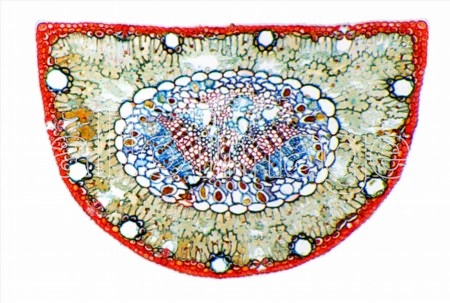




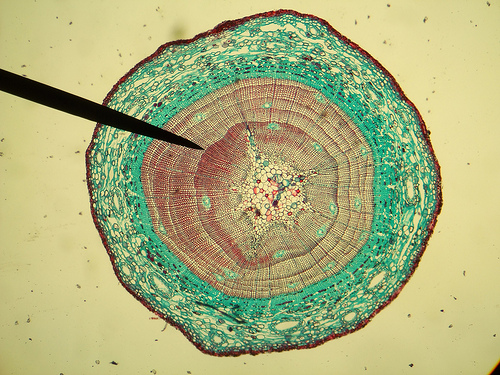
Pine needle. Light micrograph of a transverse section through a leaf (needle) of a pine tree (Pinus sp.). The leaves are needle-like in order to present a large surface area for photosynthesis but prevent too much water loss (transpiration). They have an epidermis (orange) of thick walled cells covered with a thick layer of cuticle. The mesophyll layer (green) under the epidermis is made up of parenchyma cells with in-folded walls, in-between these are resin canals (white circles). The vascular cylinder (centre) is surrounded by the endodermis (blue) which regulates water and mineral movement. Under the endodermis are two vascular bundles made up of phloem sieve cells (blue) and xylem tracheids (red). Magnification: x46 when printed 10 centimetres wide.
Dead Stars
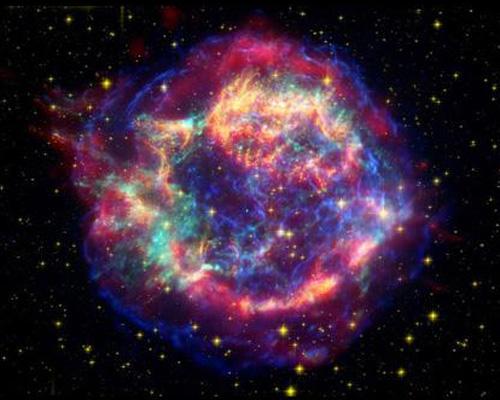
This image from NASA’s Spitzer Space Telescope shows the scattered remains of an exploded star named Cassiopeia A. Spitzer’s infrared detectors “picked” through these remains and found that much of the star’s original layering had been preserved.
In this false-color image, the faint, blue glow surrounding the dead star is material that was energized by a shock wave, called the forward shock, which was created when the star blew up. The forward shock is now located at the outer edge of the blue glow. Stars are also seen in blue. Green, yellow and red primarily represent material that was ejected in the explosion and heated by a slower shock wave, called the reverse shock wave.
The picture was taken by Spitzer’s infrared array camera and is a composite of 3.6-micron light (blue); 4.5-micron light (green); and 8.0-micron light (red).
Image credit: NASA/JPL-Caltech/Univ. of Minn.
A good visual representation of my hyperconjecture that the development of significance is an accumulation through time and entropy is a dispersal across space. In the case of significance, I think that it originates both at the ‘beginning’ of time and feeds forward (standard causation) as well as originating at the ‘end’ of time and draws backward (retrocausation). I suspect that standard causation is literal and factual, and that retrocausation is actually figurative and ‘fictional’ (both more and less real than fact – foreshadowing, memory, etc).
From these two anchor points of singularity/totality, everythingness is divided and multiplied by nothingness, which can be seen in the division of nuclear-isomorphic/radial symmetric patterns. Multiplicity tends to propagate outward from unity.
Note that these patterns only suggest significance to us because we are conscious human beings who can see them. They may not be very significant to a cat. I would say that is because humans are further up the chain, working with a larger curd of significance that gives us access to the thinner air of esoteric mysteries and technical precision which exist (really insist) higher up the food chain toward the singularity.
In contrast, dead stars, even though they take time to die, could not explode if they were confined to a single space. An explosion occurs in an instant (in star time – ie a single moment in a star’s inertial frame, a scale I’m saying ticks off in terms of events that matter to the experiencer rather than a universal indexical scale like seconds or millenia).
With the pine needle cross section, even though we are only seeing a relatively meaningless moment in time, we can infer something of a biological narrative, building this idiosyncratic, private history which is purposeful-teleological and negentropic. With the pine needle, it seems to us that something cares about what it is doing, while the images of exhausted stars blasting into an oblivion of infinitesimal fragments has more of the sense of release and randomness – a scattering into the void. This is a pattern which seeks the perpendicular axis to the singularity-everythingness. It seeks a-signifying, generic, nullification.
Quanta are Flat Qualia
Quanta are Flat Qualia
> We don’t attribute qualia to gadgets that are
> smarter than us at specific tasks such as playing chess. We also don’t
> expect sci fi AIs such as Mr Data
> to have emotions or qualia…in fact we seem to have the intuition
> that they are qualialess *because* they
> are so one sidedly logical. Why would qualia help with intelligence
> anyway? If our AIs showed aesthetic flair,
> empathy, artistic creativity etc, that would be another matter. How
> could you be a great painter without colour
> qualia? But that’s not exactly intelligence.
Right! Think of intelligence as a motivation to flatten (mechanize, formulate, automate, determine, quantify) qualia. If we suppose that the depth and richness of qualia is directly proportional to its degree of proprietary privacy, and indirectly proportional to its degree of public generality, then intelligence is a feeling that wants to access objective truth without subjective feeling. The flatter the qualia, the more mileage you get out of it in terms of public application or universality. Qualia is not merely unjustifiable in functional terms, it is the polar opposite of deterministic function. This is why the correlation between logic and feeling is stereotypically antagonistic.
The problem with AI is that we are trying to accomplish intelligence from the outside in. We want to start with the flattest possible qualia (binary computation) and build understanding from the bottom up. What you wind up with is a robot that excels at pretending to understand*. It’s a reverse engineering project for something that inherently cannot be reversed.
*based on our scripted theory (computational, flat qualia skeleton) of the functional consequences of understanding rather than the full experience of understanding.
On Color Perception
Color Perception Is Not in the Eye of the Beholder: It’s in the Brain
Images of living human retinas showing the wide diversity of number of cones sensitive to different colors. (Photo credit: University of Rochester) High-resolution photo for download
(please include photo credit)First-ever images of living human retinas have yielded a surprise about how we perceive our world. Researchers at the University of Rochester have found that the number of color-sensitive cones in the human retina differs dramatically among people—by up to 40 times—yet people appear to perceive colors the same way. The findings, on the cover of this week’s journal Neuroscience, strongly suggest that our perception of color is controlled much more by our brains than by our eyes.
“We were able to precisely image and count the color-receptive cones in a living human eye for the first time, and we were astonished at the results,” says David Williams, Allyn Professor of Medical Optics and director of the Center for Visual Science. “We’ve shown that color perception goes far beyond the hardware of the eye, and that leads to a lot of interesting questions about how and why we perceive color.”
Williams and his research team, led by postdoctoral student Heidi Hofer, now an assistant professor at the University of Houston, used a laser-based system developed by Williams that maps out the topography of the inner eye in exquisite detail. The technology, known as adaptive optics, was originally used by astronomers in telescopes to compensate for the blurring of starlight caused by the atmosphere.
Williams turned the technique from the heavens back toward the eye to compensate for common aberrations. The technique allows researchers to study the living retina in ways that were never before possible. The pigment that allows each cone in the human eye to react to different colors is very fragile and normal microscope light bleaches it away. This means that looking at the retina from a cadaver yields almost no information on the arrangement of their cones, and there is certainly no ability to test for color perception. Likewise, the amino acids that make up two of the three different-colored cones are so similar that there are no stains that can bind to some and not others, a process often used by researchers to differentiate cell types under a microscope.
Imaging the living retina allowed Williams to shine light directly into the eye to see what wavelengths each cone reflects and absorbs, and thus to which color each is responsive. In addition, the technique allows scientists to image more than a thousand cones at once, giving an unprecedented look at the composition and distribution of color cones in the eyes of living humans with varied retinal structure.
Each subject was asked to tune the color of a disk of light to produce a pure yellow light that was neither reddish yellow nor greenish yellow. Everyone selected nearly the same wavelength of yellow, showing an obvious consensus over what color they perceived yellow to be. Once Williams looked into their eyes, however, he was surprised to see that the number of long- and middle-wavelength cones—the cones that detect red, green, and yellow—were sometimes profusely scattered throughout the retina, and sometimes barely evident. The discrepancy was more than a 40:1 ratio, yet all the volunteers were apparently seeing the same color yellow.
“Those early experiments showed that everyone we tested has the same color experience despite this really profound difference in the front-end of their visual system,” says Hofer. “That points to some kind of normalization or auto-calibration mechanism—some kind of circuit in the brain that balances the colors for you no matter what the hardware is.”
In a related experiment, Williams and a postdoctoral fellow Yasuki Yamauchi, working with other collaborators from the Medical College of Wisconsin, gave several people colored contacts to wear for four hours a day. While wearing the contacts, people tended to eventually feel as if they were not wearing the contacts, just as people who wear colored sunglasses tend to see colors “correctly” after a few minutes with the sunglasses. The volunteers’ normal color vision, however, began to shift after several weeks of contact use. Even when not wearing the contacts, they all began to select a pure yellow that was a different wavelength than they had before wearing the contacts.
“Over time, we were able to shift their natural perception of yellow in one direction, and then the other,” says Williams. “This is direct evidence for an internal, automatic calibrator of color perception. These experiments show that color is defined by our experience in the world, and since we all share the same world, we arrive at the same definition of colors.”
Williams’ team is now looking to identify the genetic basis for this large variation between retinas. Early tests on the original volunteers showed no simple connection among certain genes and the number and diversity of color cones, but Williams is continuing to search for the responsible combination of genes.

I interpret this study as supporting multisense realism in the following two ways:
1) It opens the possibility that perception is not a machine that simulates an external factual reality but rather an interactive sensitivity on many levels of material organization.
2) It suggests that we see though our retina rather than retina being responsible for what we see. Our cone cells, like antennae, faithfully amplify their photosensitivity for us, like a radio antenna can facilitate our access to radio programs, but do not dictate the content of them.
While I don’t claim to know the origin of our color qualia, I have a conjecture that what we see is color of microbiological origin – specifically an inheritance from our earliest photosynthesizing single cell ancestors. Our eyeballs seem to recapitulate in microcosm the warm saline marine environment of the Pre-Cambrian Era. Metalloproteins such as hemoglobin, chlorophyll, and hemocyanin (red, green, and blue respectively) perhaps can give us clues which link eukaryotic metabolism with our qualitative presentation of their sensitivity to oxygen, heat, and light.
For a billion years, life on Earth probably consisted of oceans full of blue-green algae, blooming and shrinking together in enormous communities. The photosynthetic impact of circadian rhythms and the seasonal cycles over those hundreds of millions of years are a primordial heartbeat or alphabet of optical sensitivity. Chlorophyll, with it’s room temperature quantum mechanical properties, may very well have a sophisticated palette for light frequencies and incident angles which is passed on to the cell as a whole through DNA or microtubules or both.
This kind of a scenario makes more sense to me than the rather disjointed story of visual perception we have now. Colorless wavelengths of light magically turning into colors through a pinball machine of cells and signals. An arbitrary yet immutable palette of hues and hue combinations. Qualia which represents with a nothing-like something that which is presented as a something-like nothing. A universe devoid of sense coming into sensation for no explainable purpose through no explainable mechanism.
I say that sooner or later, something has to sense something. Whether it is microtubules, neurons, retina cells, or some larger clump of neural tissue, something has to be us having a visual sensory experience. It really makes no difference at what level this matter to mind transduction occurs, as it is equally improbable on any level. Sweeping it under the rug of microcosm or emergence only makes it more obvious to me that we are missing the big picture. The fact that we see means that matter sees. I don’t even know that matter sees light, I think it may be more accurate to say that matter sees itself feel things when it is separated by space, and that ability to see is what we call light.
Qualia and Attention (Sense and Motive)
Color, Qualia, and Attention: A Non-standard Interpretation
Austen Clark, University of Connecticut.
Abstract. A standard view in philosophy of mind is that qualia and phenomenal character require consciousness. This paper argues that various experimental and clinical phenomena can be better explained if we reject this assumption. States found in early visual processing can possess qualitative character even though they are not in any sense conscious mental states. This non-standard interpretation bears the burden of explaining what must be added to states that have qualitative character in order to yield states of sensory awareness or sensory experience. I argue that the study of selective attention reveals resources that can be useful in that project. Two traditional objects are briefly considered.
An interesting line of thought on the role of selective awareness or paying attention in defining what we mean by qualia. The author brings up blindsight and describes the difference between the Standard Interpretation (quoting David Chalmers “‘To be conscious’ in this sense is roughly synonymous with ‘to have qualia’…”) and his Non-Standard interpretation which allows for a measure of ‘liquidity’ in sensation as modulated by attention. In this way, Clark explains how phenomena like blindsight can give us functional sight capacities without the phenomenological experience of seeing.
I suggest another Non-Standard interpretation, different from both mentioned views, in which it is not a question of whether it is qualia or not but whose qualia it is. In blindsight, I would say that the subject is not consciously aware of the optical stimuli at all, so there is no qualia for them, but that doesn’t mean that there are not experiences at the sub-conscious, or sub-personal level which have qualia.
What has been damaged is the connection between one area of the brain and another, but rather than a monolithic model of consciousness that sees a short-circuit preventing all access to identifying signals, I suggest a model of human consciousness that uses many overlapping channels of perception and meta-perception. Just as we may know something but have difficulty recalling it into conscious awareness, we feel the connection tantalizingly ‘on the tip of our tongue’. A quick Googling or mention by someone else can yield an instant positive match. There is a continuum of possible extents to which we are aware of what we are aware or not aware of. What falls outside of our direct awareness in one sense modality can manifest in other sense channels or even cached in general intuitive potential sense which does not present itself unless prompted.
Where Clark gets into attending to or directing focus, he says “to ‘pay attention to’ x is to alter the configuration of gates and channels inside one’s head so that representations of x, and not of other things, receive the benefit of further central processing.”. I like the direction he is going with pointing out the inhibitory function of attention and compare it with my own ideas about subtractive mechanics. I would model paying attention as a manipulation of your own ‘tolerance aperture’. The more you pay attention to something, the more tolerant you become to changes outside of your focus so that intense changes can still get your attention but the threshold for it is directly proportional to the intensity of your focus.
In addition to a higher threshold for distraction, I would say that there is a contraction of proprietary investment. We can sit on our leg in a funny way for a long time, vaguely aware of our discomfort, but for that time when we are otherwise mentally occupied, the discomfort is somewhat disowned. We may in fact be passively dissociating our entire leg on a temporary basis.
Besides the nuanced tug of war between personal level or executive processing level of awareness and the subconscious levels, I would have to say that even our top level awareness is part of a larger schema of consciousness than we can empirically test. Just as we may sense that a word is on the tip of our tongue, we may feel that something feels off about the whole day but we don’t know what. We may not even be aware that we feel that way until something happens that crystallizes the foreshadowed event.
These kinds of passive constellations of unfelt feelings or unknown intuitions I include in the concept of inertial frames of perception. Rather than redrawing our life anew every moment, I think that we retain our experiences like a tapestry, we are the embodiment of it in fact, so that when something changes us the part which is changed feels it directly. The memory of who we were and are is addressed directly, as if pulling on the thread that runs through many areas of the weave.
Tying these concepts of selective attention and perception, I turn to my concept of sense-motive dynamics. Clark says “In the guard caught unawares the channels between the receipt of sensory information and the engagement of selective attention, are, unfortunately, closed, or at least attenuated”. The receipt of sensory information corresponds to afferent (incoming) sensation or ‘sense’ while the outbound ‘engagement of selective attention’ is what I call ‘motive’. The transition from passive receipt to active engagement can be understood when we see that the notion of mere receipt of sense data is not adequate. That kind of description only accounts for ‘information’ and not who it is that is being informed. It presumes a modular-fragmented information processing model rather than an integral-gestalt significance model. Experience is not generic ‘input’, it is participatory theater on many levels of simultaneous interpretation.
Where he talks about perceptual representations having a figurative liquidity, I say let it be concrete. What we pay attention to are not representations but presentations in their own right – human scale presentations with anthropological caliber significance. What is increased through the intensity, exclusivity, and proprietary investment of our attention is the motive power of those presentations. This is the interior correlate to energy. I have referred to energy as ‘the show’ – how the vast latent potential of all events is actualized as a ‘here and now’ live show. We do the same thing with our awareness, converting one form of attention to another, concentrating our oceanic sense passivity into a narrow motive sequence.
Antonio Damasio: The quest to understand consciousness
In this TED Video, about two thirds of the way through, he mentions something I didn’t know about the brain stem which I think supports both the idea of a sense-motive primitive in consciousness, and the idea that consciousness scales relativistically from being to being. He says:
“This is so specific that, for example, if you look at the part that is covered in red in the upper part of the brain stem, if you damage that as a result of a stroke, for example, what you get is coma or vegetative state, which is a state, of course, in which your mind disappears, your consciousness disappears. What happens then actually is that you lose the grounding of the self, you have no longer access to any feeling of your own existence, and, in fact, there can be images going on, being formed in the cerebral cortex, except you don’t know they’re there. You have, in effect, lost consciousness when you have damage to that red section of the brain stem.
But if you consider the green part of the brain stem, nothing like that happens. It is that specific. So in that green component of the brain stem, if you damage it, and often it happens, what you get is complete paralysis, but your conscious mind is maintained.”

I had previously posted this image which correlates the brain-spine morphology with head-tail morphology and implies an underlying isomorphism of concentric-polar or radial symmetry being related to afferent (inbound) perception and linear-projective or Cartesian x,y,z+t sequential relations being associated with outbound, efferent motives.

Even though we are so much larger and more sophisticated than mammalian gametes, this pattern of an active emitter and a passive collector remains surprisingly simple. The upper part of your brain stem gives you access to sense, the lower part lets your motives access your body (and by extension, the world).
As good as Damasio is at revealing the consequences of brain architecture, I think that he, and really everyone else that I have been paying attention to, are still unintentionally sweeping the hard problem under the carpet. In every case, possibility of awareness itself is taken for granted. Patterns have only to be present in the brain for us to assume that there would be some sort of ‘awareness’ of them as patterns and a capacity to ground that awareness somewhere else besides within the tissue of the brain. Sure, once you have a such thing as experience, we can understand how the brain can modulate, suppress, and organize that experience, but there is still no sign of anything that converts such quantitative neurological functions into anything other than what they seem to be in an MRI – groups of cells signalling each other. No different really than any organ except perhaps in sophistication.
To think about consciousness clearly, it is important to recognize the difference between the afferent-efferent (inbound-outbound) form of the communication and the sense-motive (qualia of afferent-efferent) content of experience. It is difficult to break the habit we have been acculturated to of seeing the world outside of our body as being the container of the self rather than the other way around, but with practice, we can begin to see how perception and experience have produced not just one world, but many worlds within worlds.
Chalmeroff Conjectures
Chalmeroff Scale Conjectures
Unity of variables: Degree of figurativeness in qualia equates to privacy of qualia.
- Subjects necessarily have access to more qualia which applies to their autobiographical experience than qualia which refers to external, publicly accessible experience.
- It is proposed that the more strictly personal a quale is, the greater the set of interconnected psychological associations that exists for the individual and the richer and more imaginative those associations can be.
- Mathematically, the more personal an experience is to us, the more ways we can shift its meaning, making qualitative floridity and associative fluidity directly proportional to privacy.
Correlation of figurative phenomenology with signal intensity:
Biological experiences such as satiation of hunger, sexual release, bladder/bowel containment and nausea, are inarguably marked by a stimulation-excitement-climax-refractory period sequence. This pattern seems simple , and is commonly expressed quantitatively in graphs such as these:
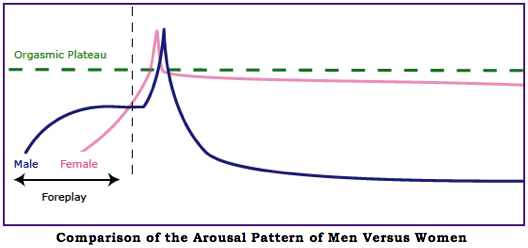
In each of these cases; hunger, sex, excretion, nausea, It is proposed that the amplitude of intensity of affect corresponds with an increase of floridity, fluidity, and privacy of qualia. Feeling is not merely intensified along a one dimensional axis of signal augmentation, but it seems that feelings which build and climax tend to build narrative exaggeration along at the same time, to the point that divinity or vulgarity is stereotypically invoked.
The elevation of affect is experienced increasingly as attraction to a super-signifying apotheosis – presentations of superlative or hyper-aesthetic figures which re-present a relief of the desire in question on the literal level. Our wants and needs are mythologized as archetypal content when gratification is delayed. Our emotions are increasingly accompanied by tantalizing stories we are compelled to tell ourselves in the moment which consume our attention with expectation of satisfaction.
The idea of delaying gratification to amplify appetite for and therefore satisfaction of pleasure is culturally and psychologically ubiquitous. From Tantric yoga to strip tease, appetizers and hyper-aesthetic description writing in menus, musical preludes and introductions, building of suspense in stories, etc the role of temporal extension in all qualitative facets of consciousness is central. The centrality of time rather than space in heightening aesthetic or affect-effect (sense-motive) charge is important to understand the contrasting relation between the private nature of time and the public nature of space.
Prolonging the time for appetite to build makes sense, also in consideration after climax, desire plummets or gradually tapers off. As this happens, our awareness returns from drama filled timeless* states to one of a pedestrian sense of the world (i.e. public spaces/ literal ‘place’), dominated by ordinary literal facts rather than tantalizing images. Counterfactuals to this pattern seem hard to come by. The idea of an experience of climax itself cannot be separated from significance, as deviation from the norm is inherent in the definition of climax. Can you have a condition of climax which is also the norm?
Suggested conclusion: Imagination or plasticity of figurative association may be ontologically bound to both privacy and signal intensity. Within this simple, yet unnoticed commonality can be found the roots of myth and drama. The hero personifies the solitary superlative; a psychopomp who guides the audience through a poetic journey towards a climax, followed by a happy ever after endind that often produces a practical take-away. Call it the Wizard of Oz effect. Whether we see the point of the story as just a lot of colorful fantasy fluff to help us remember that ‘there’s no place like home’ or that the story itself is the point depends on whether we personally favor subjective meaning or objective fact as the more privileged authority
If we consider that consciousness in general can be considered an aggregate of sense-motives, it makes sense that fatigue culminates in involuntary drifting of attention, hypnagogic imagery, and delusional states if prolonged. Dreams themselves are appropriate in sleep as the maximally figurative private detachment from the place where the body literally resides and waking from sleep represents a return to public, literal sensibilities. It is difficult to think of a reason for the metaphorical nature of dreams in terms of evolutionary biology. The understanding of how sense-motive significance builds into intensified private narrative can help bridge the gap between neurological circuits and perceptual realism.
On the outermost cycle of human experience, the human lifetime is marked typically by a reversal of this pattern. ‘Growing up’ is nearly synonymous with a tapering or rapid falling off of subjective ideation to be replaced by adult senses and motives of relating to practical circumstance in the world of the body. Childhood is understood to be a time of solipsistic fantasy, high sensitivity, high kinetic activity; like dreams or desires, childhood seems to hint at paradoxical reconciliation of fleeting time and timeless eternity. Old age in some ways mirrors this progress with retreat into the self.
*Subjective experience of time during peak stimulation seems to push toward the paradoxical: an instant that feels like eternity
First Cause thread
The only certainly true thing we can say on this subject, at least at this time, is “we don’t know”. All hypothetical models proposed to date have fatal flaws (including cyclical models), which is why there is no accepted model.The primary tools theoretical physicists and cosmologists are using to probe the question are through the spectrum of String and Loop quantum gravity models (there are many others as well).
I very much hesitate to give the Aristotelian dichotomies much credence because they are based on “common sense” notions that have repeatedly shown to be almost irrelevant when we speak about the nature of reality beyond the human scale (namely Quantum Mechanics and Relativity).
Just one example, what if there are multiple dimensions of time? http://en.wikipedia.org/wiki/Mul…
“because they are based on “common sense” notions that have repeatedly shown to be almost irrelevant”
The idea that a meaningful pattern might be based on what has been repeatedly shown is itself nothing but common sense. Can we cite common sense to invalidate itself?
To me the likely answer is that causality itself is an aspect of sense-making, which is contingent upon time-space expansion (ultimately an inward diffracting experienced internally as time and externally as space). Causality doesn’t need a cause, so that the universe never ‘came into existence’ – rather existence continuously fragments, projecting a figurative inference of unity behind it and heat death ahead of it
 Multisense Realism
Recent Comments