Archive
Die Enge des Bewusstseins, ‘the narrowness of consciousness’
To invent, I have said, is to choose; but the word is perhaps not wholly exact. It makes one think of a purchaser before whom are displayed a large number of samples, and who examines them, one after the other, to make a choice. Here the samples would be so numerous that a whole lifetime would not suffice to examine them. This is not the actual state of things. The sterile combinations do not even present themselves to the mind of the inventor. – Henri Poincaré
As part of his response, Albert Einstein writes:
… It is also clear that the desire to arrive finally at logically connected concepts is the emotional basis of this rather vague play with the above-mentioned elements. But taken from a psychological viewpoint, this combinatory play seems to be the essential feature in productive thought — before there is any connection with logical construction in words or other kinds of signs which can be communicated to others.
…It seems to me that what you call full consciousness is a limit case which can never be fully accomplished. This seems to me connected with the fact called the narrowness of consciousness (Enge des Bewußtseins)*.
Here Poincaré and Einstein are discussing the nature of creativity and the particular issue of how our personal awareness both does and does not generate novelty. Like the debate over free will, I see this as largely about the hierarchical flow of subjectivity. The personal level of awareness, as noted by Freud and Jung among others, is sandwiched between what could be called a sub-personal or sub-conscious range (Id) and a super-personal or metaphenomenal range (Collective Unconscious). Jung picked up where Freud left off, seeing that Super-Ego was not necessarily just a facade of social pressures against which the Ego cowers, but a living, trans-personal terrain of archetypal influences. The Jungian view looked at this terrain as being tied up in his idea of synchronicity – meaningful coincidence which can be decoded through a language of cross-cultural metaphor. Joseph Campbell wrote and spoke extensively on this language (‘The Power of Myth, ‘The Hero With A Thousand Faces’, etc.).
What I have not seen is a physical theory which takes the synchronicity and myth seriously. When we do take it seriously, I think that it meshes perfectly with the implications of the Theory of Relativity, and with what Poincaré and Einstein are talking about with the narrowness of consciousness. All that needs to be done is to relocate the concept of literal inertial frames of reference with a more figurative notion of phenomenal inertial framing. The idea of levels of consciousness is probably one of the most ancient and enduring concepts in mysticism. Whether they are seen as levels which can only be attained through a proscribed path or as introspective potentials which we can all access by ourselves, the desire to partition human experience as a hierarchy seems to be irresistible. Irresistible, that is, until recently. Contemporary psychology has largely moved away from hierarchies and grand schemas, focusing instead (with debatable success) on more modular, pharmacologically addressable functions.
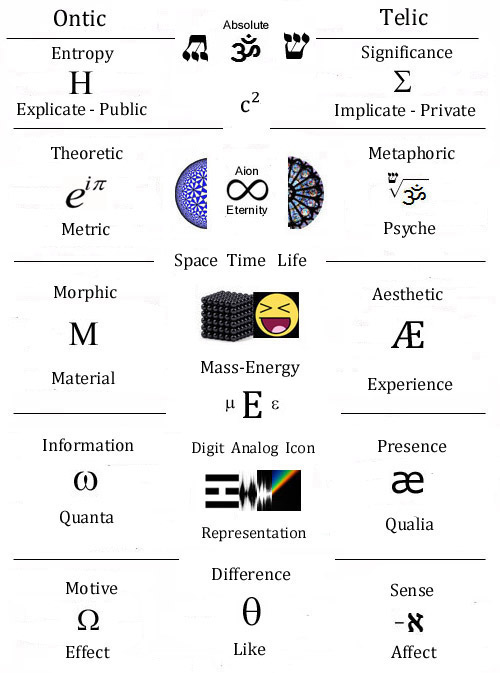
While I appreciate many of the hierarchical maps of consciousness, like those so diligently compiled by Ken Wilber, I suggest that we begin from scratch, with an eye toward simplicity and correlation with general systems. In addition, the foundation for this view should be sensory-motive rather than information-theoretic or material-energetic. By sensory-motive, I refer to what Einstein talks about above. While the effect of creativity is teleological and communicative, the process itself is driven by what he calls combinatory play: ‘the essential feature in productive thought — before there is any connection with logical construction in words’.
Just as this sub-cognitive sensible engagement is overlooked in modern, computational theories of mind, so too is the possibility of microsensory phenomena overlooked in modern physics. I see this not as an accident, but rather the same oversight on a different scale. The idea that our own sensations emerge from a different source than the sensations which are telegraphed from the source to instrument of detection to scientific observer is not necessary if we generalize Einstein’s ‘combinatory play’ to the outer-shell of all of physics.
The MSR hypothesis is called Eigenmorphism. It is that what separates our body from our sub-conscious experience, and our sub-conscious from our personal experience can be understood in terms of a psychophysically extended narrowness of consciousness. There aren’t any inertial frames which simply exist, but only those which can be inferred through the combination of sensed perspectives. Modes of description, whether in the aesthetic of substances, quantities, or qualities are all ultimately narrowed channels of fundamental sense-making, which must be absolutely primordial. The various forms and functions which can be measured publicly are comparable to what Einstein meant about what is logically motivated and communicable, but what the deeper participation cannot be seen as the object of sight. Light, as a the most pervasive version of sense, is not a thing or an energy, but a participation multiplier – a way of being simultaneously here, there, and not literally here or there. I project my narrow attention through a mind which is already narrowed by a hierarchy of sub-personal and super-personal filters, each of which are also narrowed from scales of sensory participation so vast and unfamiliar that I read them only by the mechanical, impersonal traces that they leave. The universe that we live in is not a solipsistic narrowing of consciousness, but a nested universality of aesthetics – a combinatory play.
*The narrowness of consciousness which Einstein mentions is from William James:
“The sum total of our impressions never enters into our experience, consciously so called, which runs through this sum total like a tiny rill through a flowery mead. Yet the physical impressions which do not count are there as much as those that do, and affect our sense-organs just as energetically. Why they fail to pierce the mind is a mystery which is only named and not explained when we invoke die Enge des Bewusstseins, the narrowness of consciousness’ as its grounds.”.
Seeing Visibility
Given that light has many strange properties, both on our natural scale as rays and on the elementary scale as photons, there is every reason to doubt that light qualifies as something which is unambiguously physical. On the other hand, since we cannot imagine a completely new color wheel, it would seem to say that the experience of seeing light is “real”, and not, a label for certain kinds of information that is fabricated in the brain. People who become blind at an early age, for example, experience stimulation to their visual cortex as tactile stimulation rather than seeing lights or spots.The condition of blindsight shows that parts of our brain can receive optical information without our having experienced that information personally as visual sensation.
In a way, white light can be considered to be what it looks like when transparency is concentrated. White light is when the quality of visibility is so saturated that it exceeds the range of discernment . A bright light illuminates a room not with whiteness but with clarity. To shed light on something is to flood the visual field with an immediacy of aesthetic acquaintance that suggests veridical qualities of the environment being illuminated. This is why we have metaphors such as ‘seeing the light’. Because it is about being connected with the presence of what is true and sensible, rather than being passively bombarded with particles. It can be said that our experience of seeing is not a direct detection of what is true, since there are so many ways to reveal optical illusion.
By calling it an illusion, we are framing the phenomena in a way as to implicate human fallibility rather than physics. Somehow we are wrong about what our eyes report, yet it is not clear that our assumption about what our eyes are reporting is scientifically valid. In fact, if it were not for these optical illusions, science would have very little to go on in determining the nature of vision as separate from physical truth, so it is actually the gaps between our expectations and the truth which reveal more truth, both about the nature of visual awareness, optics, electromagnetism, and quantum mechanics. Optical illusions are an encyclopedia of the nature of perceptual illusion, physical reality, and the relation between the two.
The folk science explanation for light perception generally begins with the idea that we can see light hitting our retina. That may be true, but not scientifically. The part that light plays in our visual system ends with the isomerization of rhodopsin in the retina. If what we see as “light” is in the visual cortex, then obviously what the visual cortex receives is not photons from the outside world, and it is not a direct analog that shows up as a small screen of images in an MRI. To even guess at some of the content of our visual field requires a blind statistical reconstruction. There is no plain-text transmission of images in our brain to simply hack into and view.
The effect that light has on the retina is merely to trigger the geometric extension of Vitamin A molecules and stop the flow of glutamate to the bipolar cells. That is well behind the first ganglion that would lead to the optic nerve and visual cortex. I propose instead that photons are not entities that are independent of their transmitters and receivers, and that light is therefore not physical but rather inter-physical, aka, phenomenal, aka sensory. Photons are measures of the sensitivity of our mode of detection. It is neither ray, beam, particle, or wave, but rather a rhythmic phenomenalization of matter – a feeling that matter has about what is going on around it. By making inferences beyond our sensible grasp, I think that Quantum Theory has given noun and verb-like properties to what are ultimately adjectives. Bosons and fermions may not be like that at all, but rather they are opportunities for matter to re-acquaint itself. The elementary measurable features of the cosmos may not be particles or strings, but qualities which characterize the capacity of matter to measure and interact with itself. Physics is a mirror. For every action and equal and opposite reaction, because equal and opposite reaction is a perfect reflection of our mode of scientific inquiry. We are investing our coins of empiricism in nature, extracting the empirical value, and recording the profit in our scientific ledger, like good, serious 18th century gentlemen.
It seems to me that only a medium which is intrinsically filled with the sense of color, form, and intensity across the many physical scales could reliably and veridically bridge the gap between public material realism private experience.The notion of a seeing light as a Rube Goldberg patchwork of conveyance into separate effects on every level*, all transported through a one dimensional collision detection schema is not consistent with reality. There are too many examples of people who have seen things in dreams and visions, too many qualities of visual experience which cannot be decomposed sensibly to pixels or lines for the photon explanation to be satisfactory. The qualia of color alone, whose idiopathic shifts and wheel-like symmetry have no place in the smooth continuum of the electromagnetic spectrum.
I suggest that light is only one specific form of a more universal medium, and that this medium is already known to us informally by the word ‘sense’. Sense as in sensation, sensitivity, sensor, but also as in making sense, sixth sense, and ‘in the sense of’. The unity of all sense can be more precisely expressed as ‘primordial identity pansensitivity’, ‘nested sensory-motive participation’, or even something like ‘self-tesselating aesthetic re-aquaintence’, depending on how technical and pretentious we want to get. From this Absolute firmament, and I think only from this firmament, can we get the full range of private experience, public physics, symbolic information, and the capacity to compare and contrast them. Only when physics is seen as identical with sense can physics be completed.
On the elementary level, with a nested sense primitive, we get relativistic locality (so eigenmetrics rather than eigenstates). Sense is modulating its own self-transparency and reflectivity to generate eigenmetric milieus – levels of scale that foster certain kinds of aesthetic themes and activities. The micro-world with its mathematical-molecular-insectoid clarity is different from the soft, lush features of zoological-arboreal-botanical existence. On some level perhaps, sense is nearly undiluted, and so the entire history of the cosmos is as a single now – a white whole singularity in which the now cannot even be completed and the here cannot hold even the hint of a ‘there’. On that level, there is non-locality.
*optical, molecular, cellular, ocular, neurological, psychological, sociological, zoological..

The Opportunity Principle
A better way to model photons, and other elementary particles would be as opportunities for discernment. Instead of seeing them as entities whose measurement presents uncertainty to us, think of the uncertainty as the entity itself. The photon is like a cursor – it is present where the action is at the moment – it points to the moment, and to the opportunity for interpretation of the moment. Bosons and Fermions are not like forcers and forcees, but more like trails left behind from motivation etching sensation into sense.
Our experience of light is of that which enables visual sense. Vision is a mode of sensory presentation and representation based on aesthetic distinctions. Foreground/background, contrasting color qualities and intensities. Each photon should not be considered a physical phenomenon in its own right, but rather as a fragment of vision or sensation. It is not like a pixel, since the pixel requires an observer to be seen. The photon should not be thought of as a particle or a wave, but as a chance to detect and interpret. Whether we see a light or feel heat, whether it is part of an interference pattern or a collection of wholes composed of no parts, whether it is within our experience or beyond our understanding…all of these possibilities are presented at the elemental level. Each ‘particle’ is a window not just on the Totality, but on the self-masking, self-reflecting, transparency-augmenting nature of nature. The fabric of the universe is both certain, uncertain, and a participation in self-definition.
Emergent Noumena
Noumenon, plural Noumena, in the philosophy of Immanuel Kant, the thing-in-itself (das Ding an sich) as opposed to what Kant called the phenomenon—the thing as it appears to an observer. Though the noumenal holds the contents of the intelligible world, Kant claimed that man’s speculative reason can only know phenomena and can never penetrate to the noumenon. Man, however, is not altogether excluded from the noumenal because practical reason—i.e., the capacity for acting as a moral agent—makes no sense unless a noumenal world is postulated in which freedom, God, and immortality abide.
The relationship of noumenon to phenomenon in Kant’s philosophy has engaged philosophers for nearly two centuries, and some have judged his passages on these topics to be irreconcilable. Kant’s immediate successors in German Idealism in fact rejected the noumenal as having no existence for man’s intelligence. Kant, however, felt that he had precluded this rejection by his refutation of Idealism, and he persisted in defending the absolute reality of the noumenal, arguing that the phenomenal world is an expression of power and that the source from which this power comes can only be the noumenal world beyond.
A central thesis of my approach is that the assumption of noumena should also be assumed to be a ‘thing as it appears to an observer’. In the case of our own experience, we are the observer – really the participant. Even the term observer smuggles in a way of framing ontology to imply non-phenomenal facts.
In my view, Locke’s assumption of qualities like color and feeling as Secondary, while properties like position and shape are Primary, while true from the local perspective, should be (like the image on our retina) considered inverted from an absolute perspective. It’s easy to turn colors or feelings into numbers and points on a graph, just by counting them and arranging what has been counted. It’s impossible, however, to derive colors from structures or information alone.
What this means is that the capacity to discern noumena from phenomena is itself a phenomenal property. It varies by both degree and kind. This quality is often known by names like ‘sanity’ and ‘common sense’, and while our access to it as individuals depends on local neurological conditions, local neurological conditions probably depend on an even lower level of sanity on the microphenomenal scale to maintain the integrity of the microphysical world which cells and neurons inhabit.
If that’s true, and what we call sanity, a kind of preservative inertia of sensory and meta-sensory interpretation goes all the way down, then physics itself should be described as the modulation of that sanity. A superposition of superpositions if you will, as locality which generalizes and re-localizes what it has generalized. If we think of the Newtonian-Cartesian universe as made of ideal particles in a void, the Einsteinian universe idealized the void, and the Quantum universe turned the particles into bubbles un-disappearing in that void. What I propose is to put see bubbling itself as a property of reflection and contrast. Drill down into the surface of the bubble and see that it is nothing but aesthetics derived from some perspective and mode of detection. It is the possibility of phenomena that matters. Noumena without phenomena is identical to nothingness, but phenomena without noumena changes nothing, provided that phenomena diverges from its own sensory-motive properties, rather than emerges from abstract non-phenomena.
Electricity and Magnetism

Animated diagram showing the operation of a tuned circuit (LC circuit). The capacitor stores energy in its electric field E and the inductor stores energy in its magnetic field B (green). This jerky animation shows “snapshots” of the circuit at progressive points in the oscillation. The oscillations are slowed down; in an actual tuned circuit the charge oscillates back and forth tens of thousands to billions of times per second.
In electronics an LC circuit, also called a resonant circuit, tank circuit, or tuned circuit, consists of two electronic components connected together; an inductor, represented by the letter L, and a capacitor, represented by the letter C. The circuit can act as an electrical resonator, an electrical analogue of a tuning fork, storing energy oscillating at the circuit’s resonant frequency.
This is one of the clearest ways that I have come across to visualize the relationship between electricity and magnetism. On the right, the capacitor plates emphasize the polar nature of EM, so that electric force is a metaphor for binary switching – a bridging across a gap which inverts and imitates.
On the left, the induction coil emphasizes the ‘tropic’ nature of EM. The magnetic field arises as a summary of the turns, like a squaring of all of the possible orientations and angles. The turningness is juxtaposed against the flowing-ness, which are both juxtaposed against the separation and ratio-ness of the Electric side.
Of course, through Relativity, we can understand (or try to) that both the Electric and Magnetic fields are identical except that they are observed through perpendicular frames of reference. If you are synchronized to the current flow, then it is an electric circuit of positive and negative charge interactions. If you are synchronized to the resistance of the flow, then it is a magnetic field of North/South attraction-repulsion.
The deeper issue for me is really what is happening underneath all of the arrows and theory. What was actually being observed to oscillate when we first measured the frequency of a beam of light? Is it a needle of a magnetic meter? Unlike sound waves which can be said to be collisions of molecules, the energy of electromagnetic waves seems to be more like a propensity for matter to glow, spark, and change direction. It is the Promethean vibration into sensory awareness and motive expression. Matter becomes more transparent to itself, more able to ignore gaps, resistance, and gravity. What electromagnetism seems to really be is something like ‘the phenomenalization of matter’, or the twisting/stretching of inertial frames.
Chess, Media, and Art
I was listening to Brian Regan’s comedy bit about chess, and how a checkmate is such an unsatisfying ending compared to other games and sports. This is interesting from the standpoint of the insufficiency of information to account for all of reality. Because chess is a game that is entirely defined by logical rules, the ending is a mathematical certainty, given a certain number of moves. That number of moves depends on the computational resources which can be brought to bear on the game, so that a sufficiently powerful calculator will always beat a human player, since human computation is slower and buggier than semiconductors. The large-but-finite number of moves and games* will be parsed much more rapidly and thoroughly by a computer than a person could.
This deterministic structure is very different (as Brian Regan points out) from something like football, where the satisfaction of game play is derived explicitly from the consummation of the play. It is not enough to be able to claim that statistically an opponent’s win is impossible, because in reality statistics are only theoretical. A game played in reality rather than in theory depends on things like the weather and can require a referee. Computers are great at games which depend only on information, but have no sense of satisfaction in aesthetic realism.
In contrast to mechanical determinism, the appearance of clichés presents a softer kind of determinism. Even though there are countless ways that a fictional story could end, the tropes of storytelling provide a feedback loop between audiences and authors which can be as deterministic -in theory- as the literal determinism of chess. By switching the orientation from digital/binary rules to metaphorical/ideal themes, it is the determinism itself which becomes probabilistic. The penalty of making a movie which deviates too far from the expectations of the audience is that it will not be well received by enough people to make it worth producing. Indeed, most of what is produced in film, TV, and even gaming is little more than a skeleton of clichés dressed up in more clichés.
The pull of the cliché is a kind of moral gravity – a social conditioning in which normative thoughts and feelings are reinforced and rewarded. Art and life do not reflect each other so much as they reflect a common sense of shared reassurance in the face of uncertainty. Fine art plays with breaking boundaries, but playfully – it pretends to confront the status quo, but it does so within a culturally sanctioned space. I think that satire is tolerated in Western-objective society because of its departure from the subjective (“Eastern”) worldview, in which meaning and matter are not clearly divided. Satire is seen as both not as threatening to the material-commercial machine, which does not depend on human sentiments to run, and also the controversy that satire produces can be used to drive consumer demands. Something like The Simpsons can be both a genuinely subversive comedy, as well as a fully merchandized, commercial meme-generating partner of FOX.
What lies between the literally closed world of logical rules and the figuratively open world of surreal ideals is what I would call reality. The games that are played in fact rather than just in theory, which share timeless themes but also embody a specific theme of their own are the true source of physical sustenance. Reality emerges from the center out, and from the peripheries in.
*“A guesstimate is that the maximum logical possible positions are somewhere in the region of +-140,100,033, including trans-positional positions, giving the approximation of 4,670,033 maximum logical possible games”
Consciousness and The Interface Theory of Perception, Donald Hoffman
A very good presentation with lot of overlap on my views. He proposes similar ideas about a sensory-motive primitive and the nature of the world as experience rather than “objective”. What is not factored in is the relation between local and remote experiences and how that relation actually defines the appearance of that relation. Instead of seeing agents as isolated mechanisms, I think they should be seen as more like breaches in the fabric of insensitivity.
It is a little misleading to say (near the end) that a spoon is no more public than a headache. In my view what makes a spoon different from a headache is precisely that the metal is more public than the private experience of a headache. If we make the mistake of assuming an Absolutely public perspective*, then yes, the spoon is not in it, because the spoon is different things depending on how small, large, fast, or slow you are. For the same reason, however, nothing can be said to be in such a perspective. There is no experience of the world which does not originate through the relativity of experience itself. Of course the spoon is more public than a headache, in our experience. To think otherwise as a literal truth would be psychotic or solipsistic. In the Absolute sense, sure, the spoon is a sensory phenomena and nothing else, it is not purely public (nothing is), but locally, is certainly is ‘more’ public.
Something that he mentioned in the presentation had to do with linear algebra and using a matrix of columns which add up to be one. To really jump off into a new level of understanding consciousness, I would think of the totality of experience as something like a matrix of columns which add up, not to 1, but to “=1”. Adding up to 1 is a good enough starting point, as it allows us to think of agents as holes which feel separate on one side and united on the other. Thinking of it as “=1” instead makes it into a portable unity that does something. Each hole recapitulates the totality as well as its own relation to that recapitulation: ‘just like’ unity. From there, the door is open to universal metaphor and local contrasts of degree and kind.
*mathematics invites to do this, because it inverts the naming function of language. Instead of describing a phenomenon in our experience through a common sense of language, math enumerates relationships between theories about experience. The difference is that language can either project itself publicly or integrate public-facing experiences privately, but math is a language which can only face itself. Through math, reflections of experience are fragmented and re-assembled into an ideal rationality – the ideal rationality which reflects the very ideal of rationality that it embodies.
Epistemology and Ontology
“I think you’re conflating with Ontology/Metaphysics with Epistemology.”
Epistemology only becomes possible with a degree of ontological distance. Within our own most immediate experience, there can be no question of anything hidden or unhidden. “Here and now” is self-evident – it is maximally predictable and maximally unpredictable. It is only when we have the space of “There and then” that we can speculate on what and how knowledge/information differs from chaos/entropy. It is insensitivity which opens a breach of possibility and theory.
 Multisense Realism


Recent Comments