Archive
Why do people believe in the mind body problem?
“Why do people believe in the mind body problem?
Here are a few reasons I can think of:
- Our imagination seems immaterial.
There is no imaginary stone, for example that is too heavy for us to lift. We can imagine ice cubes melting the sun or a new state of matter that is liquid gravity. Dreams are surreal, and provide evidence that fully realistic worlds can be rendered without there being the expected physics presented. If dreams were not realistic, it would be easier to swallow materialism. As it is, it is very tough to justify how it would be that brains would be able to instantly conjure up fantasy worlds without having access to the same creative resources that physics itself has. - Mental representation is not physical.
Our thoughts do not appear to break down into chemical compounds which can be transferred from brain to brain in an eyedropper. Instead, they can be communicated through representational signs across many different material substrates. Right now my thoughts are becoming part of your thoughts by means of electronic devices, but it could instead be communicated by voice, gesture, pen and paper, etc. Physical substances and forces cannot be transmitted as signs. We cannot send a text to someone dying of thirst which they can drink. - We cannot access the brain through introspection.
The greatest minds in history have never, through meditation alone discovered the details of neurology, biochemistry, etc. Common sense might suggest that since, for example, we can touch our body with our body, and see our eyes with our eyes, that we should be able to think of our brain with our brain, but that is not the case. It also goes the other way, where we can correlate data that we find in brain imaging to *known* ‘neural correlates’ like feelings or tasting flavors, but there is nothing in the brain images themselves which would or could ever suggest any such thing as a flavor or feeling. - There is no logical connection between physical phenomena and subjective experience.
Physics involves measurable forms which can be described using geometry and whose functions can be described through logical, arithmetic steps. Physics is intended to be done without any subjective experience (other than a zero dimensional ‘observer’). Subjectivity is the opposite kind of phenomena on every count from physics. It involves immeasurable qualities of aesthetic appreciation and participation which do not owe their significance to complex universal processes. Instead, subjectivity is comprised of a personalized richness of presentation which eliminates the need for complexity. There is no logical way that a certain wavelength of light could become ‘blue’, and no mathematical transformation which would make it more logical, yet blue is a quality which we cannot deny exists in the universe. - Life is weirder than it seems like it should be.
The fact that we have never come across any culture that does not have a concept of spirits and the afterlife does not have to mean that there are spirits and an afterlife, but it is certainly an odd thing to have as an anthropological universal if there were nothing funny going on between mind and body. Physics and mathematics in the 20th century only adds to the weirdness, since, after all, if there were nothing but bodies colliding into each other, then we would have no need for concepts like uncertainty, and if logic were nothing but objective facts, then we would have no need for the idea of incompleteness. Also there are so many fishy things that people report all of the time…Near Death Experiences, Out of Body Experiences, psychedelic revelations, paranormal capabilities, synchronicity, etc. If you think that these can be easily swept aside by insisting that they are just anomalies and fraud then you have not looked at the research fairly. - It is the default/naive truth of human experience.
The sense of being ‘in’ our body, looking out of our eyes is something that we take for granted, but has no basis in physics. Your screen doesn’t have to feel like it is sitting in front of a computer to work, so the fact that there is any sense of being ‘inside’ of ‘our’ body is already a hint at our relation to space and time. Our body is more like a window or a filter than it is a robot. We can say that the Earth is not flat, but if that were literally and completely true, it would be hard to explain why carpenters use a level. Indeed, the roundness of the Earth is not especially useful most of the time for those of us who actually live on the surface of it and experience it as flat. Any description of the universe which fails to mention that planets seem flat when you walk on them and only seem round from a distance is not complete. - Because they have considered the issue deeply.
While the last few centuries have seen the rise of scientific worldviews which describe our experience from the outside in, some people have noticed that there is a problem with this. Since subjective experience is private to begin with, there is no reason to expect that a worldview which is bound exclusively to public inspection would not be grossly misleading. In fact, the failure of behaviorism in psychology and artificial intelligence in computer science to demonstrate satisfying results should have steered us away from these kinds of approaches already. Fortunately some of the leading scientists and philosophers in the field of consciousness, like Tononi, Koch, and Chalmers have been pointing in a new direction, one which involves consciousness rather than matter as a fundamental property. There is a long tradition within philosophy, particularly in Eastern thought which holds that awareness is the fundamental reality and that matter, bodies, and brains are borrowed from a universal pool of ideas and experiences. The universe may be made of stories rather than things, and things are just part of the story. - Because they have natural insight into the issue
A recent study suggest to me that not everyone has an equal chance at understanding the mind/body problem. For people whose minds are very logical, they may identify exclusively with the process of their own intellect rather than the qualities of experience from which the intellect arises. I wrote a post about this: Asperger’s, Autism, and the Hard Problem of Consciousness For others, the fact of subjectivity is quite plain and ordinary. We move our hand by moving it directly out of our own intention. Whatever biochemical description accompanies that movement is not enough to even define why it is occurring in the first place. - Because simulation theories and emergence are misguided.
Most theories which collapse subjectivity into physics rely on the kind of GUI model. We look at the computer screen and see pictures and words, and it is natural to think that this relationship would be part of a physical mechanism. A brain would simply produce computations that look like something or taste a certain way because looks and tastes are a way of labeling information and organizing it. What this view fails to recognize is that labeling information would only mean that it would be processed differently, not that those differences would suddenly become a flavor or a sound. Emergence is a way of chasing our tail and fooling ourselves that we have explained consciousness, but in reality, emergence itself cannot be explained without awareness. The parts of an airplane can be individually thrown in the air, so that even though to our understanding the property of a plane flying by itself seems new, it is not at all surprising to the universe. Consciousness is not like that, since there is no configuration of physical objects that would result in a subjective experience, even as an extension of some physical force or field to become self-sustaining or consolidated, etc. The raw ontology of privacy isn’t there to begin with in our model of physics or information.
Science, Serendipity, and Synchronicity
It seems to me that at the heart of science is the scientific method, and that the essence of the scientific method is the elimination of chance. Experimental control is designed expressly to isolate the single line of inquiry from all extraneous factors. If science has a ‘soul’, it would be in the delight of illuminating the darkness of superstition and irrationality – to replace fear with knowledge.
The scientist is firm in the knowledge that while ‘everything happens for a reason’, it is almost never for the reason that we might assume. In fact, ‘everything happens for a reason’ is a kind of fault line between science and spirituality. West of that line, there is only one reason that things happen – because natural forces have conspired unintentionally to make them happen. East of that line, there is a different reason that things happen: Because it is the will of God or Spirit. West of the line, the view of the East is superstition and wishful thinking. The Western scientist is repelled by the Eastern mind, seeing grave danger, rightfully, in naive denial of physical fact. The Eastern-facing mind is likewise disenchanted with Western certainties. The belief that all things can be reduced to mechanical function seems cynical and out of touch with the reality of human experience.
Given that science is so focused on eliminating magical thinking, it seems more than ironic that serendipity plays such a prominent role in the history of science. Even if the events are apocryphal, the mythology of science is a heroes journey that often pivots on some fortuitous coincidence which constellates a new discovery. It is not a miraculous gift bestowed upon the hero from grace, but a kind of winking reward from nature, revealing its wonders at last after much hard earned work.
“Many of the things discovered by accident are important in our everyday lives:Teflon, Velcro, nylon, x-rays, penicillin, safety glass, sugar substitutes, and polyethylene and other plastics. And we owe a debt to accident for some of our deepest scientific knowledge, including Newton’s theory of gravitation, the Big Bang theory of Creation, and the discovery of DNA. Even the Rosetta Stone, the Dead Sea Scrolls, and the ruins of Pompeii came to light through chance. ” – source
“Discovery needs luck, invention, intellect – none can do without, the other.” -Johann Wolfgang Goethe
At a deeper level, the message that serendipity communicates is the virtue of curiosity. The hard work of science is the justification for the reward of discovery, but the treasure map which leads to that work is the gift of curiosity. The hero’s journey begins there, and through an alchemical process of purification and futile struggle, the hero is made deserving. The scientific hero’s struggle is even more noble than the mythic hero, since they must eschew supernatural luck and make their own good fortune through commitment to precision, methodical thoroughness, and accuracy. It seems strange then, after all of that, we still find that the role of intuition and surprise are so…curiously…prominent in our storytelling of science. Watching shows like Tyson’s recent Cosmos (and Sagan’s as well), it is really all about serendipity. Most every episode features stories of scientific heroes struggling against fate, only to be fatefully assisted in the end.
For being such a forbidden concept in the scientific method, it appears that fate is still alive and well in the folk psychology of science itself. More than in many other fields, the culture of science seems to have a greater tolerance for whimsical language and Murphy’s Law type skepticism. There is a kind of suppressed romanticism that comes out as eccentricity and non-conformity…symptoms of all that is suppressed by the scientific method, where quirky outliers are discarded.
The twentieth century marked explosive shifts in science. Multiple discoveries in everything from physics, to biology, to psychology, combined in a synchronistic way which exposed synchronicity itself. Special Relativity and quantum mechanics dissolved classical materialism, just as art, music, and politics were radicalized. Now, in the twenty first century, there appears to be a backlash. Physics and information science have resurrected a realism which is structured and non-relativistic. The stunning revelations of Heisenberg’s uncertainty and Godel’s incompleteness are being interpreted now as supporting a worldview forever outside of human understanding, rather than a reality which is deeper and richer than measurement itself. Possibly the next sea change is beginning to swell, and we will see some of the old, new ideas come back to displace the new, old ideas. What will the future of science have to say about this chapter of its development? Will science get over its love hate relationship with its own hunches, luck, and curiosity?
Video Debate on God and Consciousness
Can consciousness be best explained by God’s existence?
Hamza Tzrotzis section:
Very nice presentation, and I can find agreement with much of it. I do find a problem with the idea that theism explains ‘where consciousness comes from’, since God cannot be said to exist prior to God’s consciousness. Can God be unconscious? If not, can we say for sure that consciousness does not create God instead of the other way around?
This goes along with the sentiment expressed earlier in examining the shortcomings of panpsychism, when he asks ‘what is thought without a thinker?’ While this is certainly difficult to imagine in a normal state of mind, I have experienced dream states in which there was a dream, but it was more like a film, and I woke up specifically noticing that I did not find myself in the movie or in the audience. The experience of the movie simply was. In light of this, and the fact that human beings occupy such a minute and idiosyncratic position within the biosphere of this planet, I would not rule out the possibility that our waking experience of human ego might be limited to animals or certain animals, owing to their autonomy of movement. The vast majority of phenomena in the universe may indeed be felt experiences without an experiencer per se.
Even if this is true, the idea that the universe is composed of consciousness (awareness, or to be more technical, aesthetic participation/sensory-motive re-acquaintance), even proprietary qualities of awareness, but without an overriding executive, there could still be God-like influences within or through the larger potential of our human consciousness. Retrocausality, synchronicity, intuition, and other exotic metaphenomenal conditions may indeed flirt with the boundary between reality and surreality to produce veridical insights and delusional obsessions alike. God may be no more than a figment of consciousness, just as we are, but that doesn’t mean that human consciousness does not include some kind of meta-human guidance for some people at some time, although such guidance may be indistinguishable from mental illness.
Professor Simons section:
Opens well, setting the stage for a criterial of success for explanation in science. I hadn’t heard before the origin of the word melancholia before (black-bile). He goes on to look at intentionality and awareness and asserts that there is nothing that it is like to be a stone. I agree superficially, that what we see of a stone does not express any intention, but given the vastly different scale of time between ourselves and geological time, it is conceivable that what we encounter as static minerals are, within another frame of reference, some unfamiliar kind of experience. Rocks don’t have feelings, but they may *be* feelings – slow, or intermittent feelings which perhaps only awaken when there is a significant change in physical state. When rocks collide, something may feel something, even if it is not the rock itself as we experience it.
I like that he embraces being honest about the shortcomings of science in explaining phenomenality (the Hard Problem). His examples of evolved body parts which have been repurposed could apply to consciousness in theory, but I submit that would have to be a very superficial theory that overlooks the completely anti-physical nature of consciousness. Unlike an ear, awareness is not a plausible feature of some unrelated physical system.
I appreciate Professor Simons call for modesty in consideration of supernatural explanation, but I’m not sure that alone constitutes a refutation. It may be more reckless to insist upon a naturalistic explanation to the exclusion of all explanations which happen to transcend the spatiotemporal aspects of nature.
It seems to me that rather than presuming God as a literal being, we should try thinking of the various theological concepts as a metaphor for being itself – for consciousness. We can learn about consciousness by our own intuitive accounts, written in the native mytho-poetic language of what I call the ‘metaphenomenal’ layer of awareness. God is something like the local, human-shaped shadow of the infinite potential of the future of consciousness. By itself, the universe is only theological and meaningful on the inside. It is up to consciousness, to conscious beings, to imbue the exterior world with divine shades of care and attention. God is not for being, but for becoming.
I liked Simons parting comments about Spinoza and dual-aspect theory. He says, (as most would agree) that consciousness is a process, not a thing. I suggest that consciousness is neither, rather it is the eternal firmament from which processes and things are ‘carved out’ (by time and space…types of entropy or reduced sense). Locally, our human experience is very elaborately enfolded multiple times into spacetime, so that it does actually take on nested process-like characteristics as well. Just as the entire life of our body is the story of a single cell in self-replication/modification, the story of our lives is a single moment stretched out into innumerable sub-moments.
Both critiques of panpsychism I think are ultimately rejections of a straw man. Nobody, Leibniz included I’m sure, thinks that electrons ‘have’ human-like consciousness, but that is completely beside the point, IMO, in considering whether the fabric of nature is more likely sensitive vs physical, information-theoretic, or theological. In those terms, I find it easy to account for physical, informational, and spiritual phenomena as elaborations of sensory experience, but I find no real way to justify any of the others existence in the absence of sense.
Bang!
If Big Bang was a singular event that created space, time and matter, then one must view the universe as a rapidly expanding billiards table of N dimensions with all events pre-determined. There can be no intervening force or new element of causality possible. There can be no uncertainty, and any notions of either free will or divine intervention are illusory.
If the Big Bang created time, then I think that it should not be thought of as an event (in time), but rather as the hub that all events have in common. The Big Bang never happened, it did happen, it is still happening, it hasn’t happened yet. Because we are measuring it from inside of spacetime, and using instruments that are limited to only the most generic spatial-quantitative measurements, our results reflect a narrowly defined model of the origin of causality itself. It is the fallacy of the instrument – we have a hammer of physics so everything that physics measures looks like a nail. What I propose instead is a Big Diffraction, where the birth of spacetime is an influx of dissociation into countless semi-permeable perceptual frames of reference that are united beyond spacetime.
If we place ourselves in the moment of the Big Bang, we cannot judge it on a human scale of time, since that scale of time had not been invented yet. If the universe itself is awareness, the first trillionths of a second of the invention of time are no less likely to feel like five minutes than they are an eternity. As the singularity breaks into multiplicity (Tzimtzum for fans of the Kabbalah), it is inventing the possibility of multiplicity for the first time. Eternity is spawning micro-eternities in which each micro-view is stretching out eternity so that it seems both ever longer and slower and seems to have originated in an ever more brief instant. Time is all about comparing frequencies of awareness – beats per measure. Time is relativistic because time is relativity itself – the framing of perceptual reference.
What we see through a telescope is an objectified version of the story of objectification that serves as a creation myth for the anti-mythology of functionalism. Free will was never inside of spacetime to begin with. It was not created, it creates. If free will is illusory, then it is that which is illusory which gives birth to realism and physics, not the other way around. The universe is a single thread of singing, signaling, significance-building experience,weaving and winding through a maze of its own self-imposed alienation. Divinity is optional, and free will is scarce, but the universe is only a billiard table if you limit the vocabulary of inquiry to that of billiard balls.
Why Light is Sight (not photons)
A case against photons being necessary and sufficient to explain the experience of light:
There are many examples of scientific studies and first hand experience which implicate human visual perception as the result of neurological and phenomenological states, rather than a direct mapping of photons striking the retina of the eye.
1. What we see cannot be explained by the presence of photons alone.
From this paper, On the Neural Correlates of Visual Perception:
“Neurological findings suggest that the human striate cortex (V1) is an indispensable component of a neural substratum subserving static achromatic form perception in its own right and not simply as a central distributor of retinally derived information to extrastriate visual areas.
[…] elemental visual experiences of punctate white or colored lights called ‘phosphenes’ can be evoked in man by direct electrical stimulation of densely hemianopic striate cortex after severance of its connections to and from the LGN.”
The paper goes on to describe many neurological conditions arising from specific damage to the brain which reveal that the visual conditions which we take for granted, such as identification of shapes and motion, have their neural correlates in diverse areas of the brain. There is no video screen equivalent in the brain which which reconstructs an image from the outside world made of photons.
“Crick and Koch also proposed that explicit representations of visual features, coarse-coded neural representations that correlate with percepts or objects, are a necessary but not sufficient condition for visual experience. I find no reason to disagree with this premise.
[…]figure–ground segregation and object recognition cannot progress in a simple bottom-up serial fashion, but have to occur concurrently and interactively within recursive loops”
[…]In summary, the present model is based on the primacy of phenomenal experience (Humphrey, 1992; Nelkin, 1995; Raffman, 1995) and supports views that any possible explanation of phenomenal experience cannot be formulated solely in terms of its reportability (Chalmers, 1995).”
2. Stimulation of the visual cortex in the congenitally blind results in tactile rather than visual perception (Changes in visual cortex excitability in blind subjects as demonstrated by transcranial magnetic stimulation).
“…phosphenes could be induced in only 60% of subjects in Group 2 (blind subjects with a low degree of residual vision) and in only 20% of subjects in Group 3 (blind subjects without residual vision).
[…] Studies of the functional consequences of visual deprivation in humans have disclosed correlates of cross‐modal plasticity, with a role for the visual cortex in tactile processes (Uhlet al., 1991; Sadatoet al., 1996; Cohenet al., 1997; Büchelet al., 1998).”
“In a PET study we demonstrate that congenitally blind subjects show task- specific activation of extrastriate visual areas and parietal association areas during Braille reading, compared with auditory word processing. In contrast, blind subjects who lost their sight after puberty show additional activation in the primary visual cortex with the same tasks. Studies in blind-raised monkeys show that crossmodal responses in extrastriate areas can be elicited by somatosensory stimulation. This is consistent with the crossmodal extrastriate activations elicited by tactile processing in our congenitally blind subjects. ” – Different activation patterns in the visual cortex of late and congenitally blind subjects.
3. Visual experiences can be produced internally, and outside of the primary visual cortex.
“A phosphene is a phenomenon characterized by the experience of seeing light without light actually entering the eye.”
“this phenomenon of “seeing” without seeing in the traditional sense leads one to believe the ability to receive light is not entirely necessary. In addition, this is not a foreign concept, as when most people close the eyes, they are able to visualize images.” – Dreams: Seeing without seeing
“The results by Knauff and colleagues, also with fMRI, do not support the hypothesis that primary visual cortex is involved in visual mental imagery, but rather that a network of spatial subsystems and higher visual areas appears to be involved (Knauff, Kassubek, Mulack, & Greenlee, 2000). The results support the hypothesis that visual imagery is a function of the visual association cortex.” – Visual imagery without visual perception (Bértolo 2005).
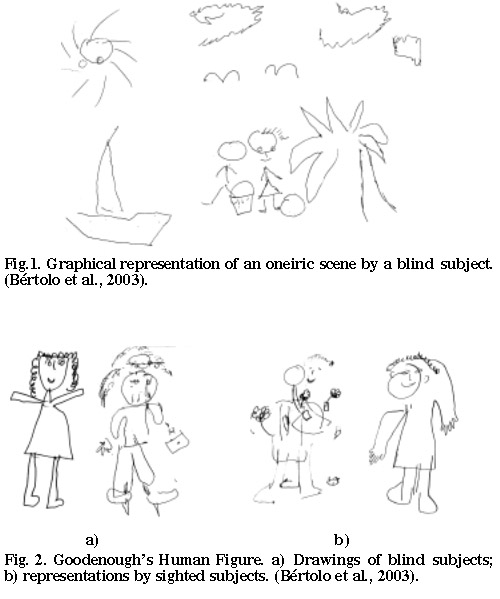
4. Congenitally blind people can interpret experience graphically.
[…]In conclusion, the congenitally blind are not only able to describe what may be the visual content of their dreams verbally, but they can provide, through drawing, a graphical representation of such content, and a significant negative correlation between the Visual Content of the dreams and the alpha power was found in both groups.” (Bértolo 2005).
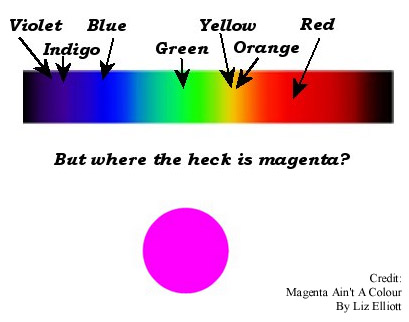
5. Color mappings are not entirely caused either by electromagnetic frequency or stimulation of the retina’s cone cells.
a. Some colors are not part of the visible spectrum
Pink and purple are combinations of red with blue or violet. Brown and beige are low intensity orange, olive is low dim green, grays and black are dark whites. – source
“This means that colours only really exist within the brain – light is indeed traveling from objects to our eyes, and each object may well be transmitting/reflecting a different set of wavelengths of light; but what essentially defines a ‘colour’ as opposed to a ‘wavelength’ is created within the brain. ” – Magenta Ain’t A Colour.
b. Color perception can change independently of the retina.
“…the number of color-sensitive cones in the human retina differs dramatically among people—by up to 40 times—yet people appear to perceive colors the same way. The findings, on the cover of this week’s journal Neuroscience, strongly suggest that our perception of color is controlled much more by our brains than by our eyes.
[… That points to some kind of normalization or auto-calibration mechanism—some kind of circuit in the brain that balances the colors for you no matter what the hardware is.” – Color Perception Is Not in the Eye of the Beholder: It’s in the Brain
6. Blindsight shows that optical information can be communicated subconsciously without a conscious experience of seeing.
A rare, but much studied condition, blindsight, along with synesthesia and anosognosia reveal that the pairing of visual qualities of experience with optical conditions is not automatic. The functions of information processing, physics, and the qualities conscious experience can all be teased out separately.
Blindsight – the ability to respond appropriately to visual inputs while lacking the feeling of having seen them – might be something which only occurs in cases of brain damage, but seems much more likely to be a significant phenomenon of intact brain function as well. Indeed, it seems likely that blindsight (and similar phenomena in other spheres) is an important ingredient of of a variety of activities where one wants to move quickly and appropriately, without “thinking about it”. – Seeing What You Don’t See
7. Photon interaction begins and ends with the isomerization of rhodopsin.
Optical processing a vast chain of mechanical reactions on multiple levels of description of the nervous system; molecular, cellular, organ, and somatic. From the indications of neurology alone, what our visual cortex would ‘see’ should really be nothing more than interruptions in the flows of glutamate from rod cells, not an array of photons. There is something called ‘dark current‘ which refers to “the depolarizing current, carried by Na+ ions, that flows into a photoreceptor cell when unstimulated” and suggests that our access to optical conditions is triggered by a silencing of ‘off’ signals rather than an instantiation of ‘on’. It might be supposed that photons are not what we see, but rather they are a measure of the initial molecular triggers which stop us from not seeing.
8. Photons with frequencies in the infra-red range are felt as heat rather than seen.
A rather obvious example, but one which reveals that photons themselves need not be seen to be detected. Ultraviolet and infrared radiation are referred to as ‘light’, but they are no more or less ‘illuminating’ than radio waves or gamma rays. Generally when we refer to light and lighting we are specifying a capacity to illuminate our visual perception, not thermal conditions. The use of light to refer to invisible phenomena is not entirely untrue, as it can be stepped down into a visible range using photographic equipment, however, unless the target of such a process is ultimately a visual experience, it is hard to justify the connection to the term, and the word ‘light’ should be considered somewhat figurative. If we refer to brain activity associated with conscious experience to be ‘neural correlates’, then we should likewise refer to physical activity associated with perceptual experience to be ‘electrodynamic correlates’ of light rather than light itself.
9. If light is sight and not photons, what is sight?
Philosophers would call it qualia, neuroscientists might call it ‘sense data’, phenomenal visual experience, or ‘static achromatic form perception’. In short, seeing light is irreducibly experiential. All light is only that which is seen, and photons do not necessarily have any visible qualities.
Quora Question on Entropy
Help me understand this. If entropy is about signal transmission, and is measured by “how much information is missing,” it implies a transmitter and receiver – in other words, a relationship. Entropy is an appealing notion because at first glance the receiver of the information cannot suddenly know more than what is transmitted. But the amount of information the receiver can receive seems to be highly relative and transformable.This is if I understand correctly that entropy is not a measurement of a system’s physical properties, but of how much information is missing when that system is observed. For sure, a system will emit is information, and there will be a less than 100% reception of that signal for any system observing it. That number cannot be 101%…. But there are two sides to a relationship, and a system’s entropy is not related to some total “information” it “contains”… So there are simple workarounds to that 100% threshold.
For example, if I look at a blade of grass that I hold in my hand, I can only receive so much information about it, and I cannot get more information than what it is transmitting to me… Unless I then look at it under a microscope and now the information loss (entropy) has decreased. If entropy were a law of the universe, my act of changing my receptor would be “impossible.”
It seems to me that labeling entropy as an unbreakable law is a naive notion, and instead I see it as a useful property of observation. Does entropy deserve the status of “law of the universe”?
The subject of entropy is, appropriately highly entropic. There are a lot of different ways that the word is used, some more figuratively than others. Thermodynamic entropy is not the same as information entropy, in the sense that if we make an MPEG compressed video of a glass of ice melting into room temperature water, the first half of the movie would take more resources to compress than the last half, given that the last half would feature only a glass of still water. As the thermodynamic entropy of the actual ice increases, the information entropy of the content of the video decreases. The sensitivity of the video camera is limited, so it can’t detect the microstates of the water molecules.
I think this speaks to the question of perception, and how our designation of what constitutes a ‘system’ is more arbitrary than it may seem. All of our instruments and all of our sensing and sense-making capabilities are potentially as limited as the video camera. Our attention is squeezed into an anthropocentric range, so that our window on ourselves and the universe does not allow us to discern ultimately what is ‘a law of the universe, or simply an assumption based on our perceptions’. Everything that we can understand about the universe is furnished to us only by our perceptions, intuitions, and understanding.
Our perception leads us to expect a universe of laws and realities beyond itself, but these too are either ultimately subjective conditions, or else subjectivity itself must include the possibility of transcending itself. The difference between what we presume to be our private perceptions and what we presume to be something more is…. entropy. There is no way to obtain 100% of the information about anything. Even given omniscient access to the entire history of the universe, the nature of the universe may be intrinsically open ended within any given inertial frame.
What I am suggesting is that just as entropy is the gap between what we experience and what we think could be experienced (‘objectively’), what we consider information may only appear to be finite because of the gap between our native perceptual frame of reference and the target frame of reference. Rather than being a true description of what a phenomenon is, ‘information’ may be as fictional in its amputation of subjective qualities as perception is in its failure to pick up on physical properties. The definition of entropy itself can be thought of as gradually reversing or flipping in proportion to the distance (literal and figurative) between two perceptual frames. Take these words for example. If you read English, then your absorption of their meaning is rather loose and general. You get the idea of what I am saying, and even sort of ‘hear’ an inner narrator voice that stands in for me. It’s all rather fuzzy, but it works really well. Entropy is actually what allows you to get the gist of what I am saying or even what I am not saying (reading between the lines).
By comparison, someone who cannot read English at all may have a much clearer view of what these characters ‘actually’ look like (without as much fuzzy interpretive conditioning). In the same way, some people find it easier to draw realistically if they are copying an image upside down. Entropy and significance, subjectivity and objectivity are not functional properties, they are aesthetic ranges. The universe as a whole can, in the same way, be considered primarily an aesthetic phenomenon as a whole, in which any part can reduce another to a functional stereotype using variations on the theme of distance or insensitivity.
Time for Nested Causality
What do you about the simultaneity of cause and effect?
“The greater part of operating causes in nature are simultaneous with their effects, and the succession in time of the latter is produced only because the cause cannot achieve the total of its effect in one moment. But at the moment when the effect first arises, it is always simultaneous with the causality of its cause, because, if the cause had but a moment before ceased to be, the effect could not have arisen…. The time between the causality of the cause and its immediate effect may entirely vanish, and the cause and effect be thus simultaneous, but the relation of the one to the other remains always determinable according to time.” (Kant, 1787, The Critique of Pure Reason)

As the crickets’ soft autumn hum
is to us
so are we to the trees
as are they
to the rocks and the hills.– Gary Snyder
Tip of the Iceberg
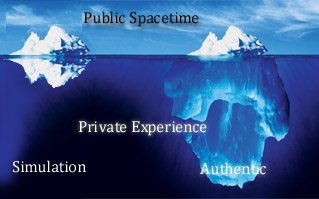
Another look at how the uncanny valley relates to the explanatory gap.
Attack and Redemption of Computational Theory of Mind
- 1. There is nothing at all which cannot be reduced to an encounter*, and that encounters can be presented directly (phenomenally) or re-presented indirectly (physically or semiotically).
- 2. That the nature of encounters can be described as aesthetic re-acquaintance, nested sensory-motive participation, or simply sense.**
- 3. In consideration of 1, sense is understood in all cases to be pre-mechanical, pre-arithmetic, and inescapably fundamental.
My challenge then, is for CTM to provide a functional account of how numbers encounter each other, and how they came to be separated from the whole of arithmetic truth in the first place. We know that an actual machine must encounter data through physical input to a hardware substrate, but how does an ideal machine (e.g. Turing machine, Universal Machine or program) encounter data? How does it insulate itself from data which is not relevant to the machine?
Failing a satisfactory explanation of the fundamental mechanism behind computation, I conclude that:
- 4. The logic which compels us to seek a computational or mechanical theory of mind is rooted in an expectation of functional necessity.
- 5. This logic is directly contradicted by the absence of critical inquiry to the mechanisms which provide arithmetic function.
- 6. CTM should be understood to be compromised by petito principii fallacy, as it begs its own question by feigning to explain macro level mental phenomena through brute inflation of its own micro level mental phenomena which is overlooked entirely within CTM.
- 7. In consideration of 1-6, it must be seen that CTM is invalid, and should possibly be replaced by an approach which addresses the fallacy directly.
The next three points have to do with my own hypothesis (Multisense Realism), submitted here only for those who might ne interested.
- 8. PIP (Primordial Identity Pansensitivity) offers a trans-theoretical explanation in which the capacity for sense encounters is the sole axiom.
PIP is the conjecture that sensitivity is the sole capability that is required for all phenomena. If we wanted to conceptualize a ‘unit’ of this pansensitivity, I suggest the aforementioned terms ‘aesthetic encounter’, ‘sensory-motive participation’, ‘re-acquaintance’, etc, or any other neologism which suggests a pre-monadic generator of pre-self and self-like perspectives.
My conjecture is that self is a type of symmetry within sense. There is no self except for self vs not-self. What is distributed by pansensitivity is not solipsism, but opportunities to modulate self-like symmetries. Selfhood is a particular form of sense distribution in which the symmetry between the absolute and the conditional is recapitulated twice. From the absolute perspective, the self becomes a branch toward isolated locality, while from the conditioned perspective, the self (the condition) stands in for the absolute.
- 9. CTM can be rehabilitated, and all of its mathematical science can be redeemed by translating into PIP terms, which amounts to reversing the foundations of number theory so that they are sense-subordinate.
Here I am talking about turning the assumptions of mathematical theory on its head. Platonic forms, for instance, would be conceived of as superficial emblems of sense rather than profound and perfect absolutes. Sacred geometry, while imbued with numinous meaning locally to a self (as it reflects the symmetry to which it owes its elaboration), but from the absolute perspective, sacred geometry is akin to a test pattern – crystallized reflections of aesthetic depth, but containing no depths themselves.
- 10. This effectively renders CTM a theory of mind-like simulation, rather than simulating macro level minds, however, mind-simulation proceeds from PIP as a perfectly viable cosmological inquiry, albeit from an impersonal, theoretical platform of sense.
All that I mean here is that because CTM trades in symbols of reflected sense-making rather than sense encounters, it doesn’t ever have a chance of capturing the important features of consciousness. It can, however, capture important features of how consciousness is distributed.
EDIT: Details added for clarity –
*Encounter can be thought of as ‘stimuli’, but need not include any information. It can be thought of as ‘qualia’ but it need not include any subject or object. The intention here is to reduce all phenomena to its absolute minimum – an opportunity for modes and motives for discernment to arise.
**This sounds jargony, for sure, but I’m inventing a precise vocabulary here, so as to avoid being misconstrued as a standard argument for what might be called ‘pseudo-subtance idealism’ (everything is made of energy, love, vibration, fields, etc) or information panpsychism (conscious experiences are produced by complex systems, functional states, etc).
 Multisense Realism
Recent Comments