Archive

Archive for the ‘Relativity’ Category

Nesting Spinor

July 5, 2015 Leave a comment

msr_spinor

“A spinor visualized as a vector pointing along the Möbius band, exhibiting a sign inversion when the circle (the “physical system”) is rotated through a full turn of 360°” – Wiki

Here is an adaptation of a spinor topology to show the relations within aesthetic phenomena that give rise to realism. Note the adjacent red and blue arrows in opposite directions make an ideal place for the sensory-motive locus, where input/output is experienced directly. The opposite side of the band is the ‘object’ side, where inertia and determinism present a united front against the subjective perspective.

If we set consciousness aside for a moment, this view of the spinor can be used to conceptualize electromagnetism as the source of spacetime rather than an effect occurring within spacetime:

EM-spinor

The conventional understanding frequency and wavelength are here inverted, so that we are thinking about them from the inside rather than as objects of study. A wave is an outsider’s view of an occurrence which is only metaphorically wave-like: a surge of changing phenomenal quality.

Light Speed, Space and Time

April 11, 2015 Leave a comment

I think that the speed of light is constant not because that is the nature of light, but because that is the nature of velocity itself. Velocity isn’t a simple, open ended quantity, it is a range between stillness and c…between absolute spacetime locality and absolute non-locality.

Light is nowhere and everywhere until it hits something…wavefunctions are in non-local ‘superposition’ until they ‘collapse’.

My view is that this is almost true, but inside out. Light is within awareness which reflects awareness. Light is the event horizon between the public and the private aesthetics. Light is only ‘here’ and ‘there’, never in between…never moving in space.

We don’t know anything about space, because we can’t use space to measure itself. All measurements are done with instruments made of matter. All measurements occur within conscious awareness, and all measurements of space occur by the extension of conscious awareness through matter. Space is the absence of matter(as detected by consciousness of matter). The math doesn’t change, only the interpretation gets post-Copernicanized.

“The body is to space what consciousness is to time. The world is to the body what the unconscious is to consciousness.“ – JS

Space = geometry, time = algebra…but then space/geometry is to time/algebra what measurement (quanta) is to the trans-measurable (qualia).


About Naive Realism and the Limitation of Models

April 7, 2015 Leave a comment

Nature is not what it naively seems to us to be only to the extent that we are a limited part of nature. Nature as a whole is exactly what it seems, and also, in its most essential sense, nature is seeming, or sense itself.

In the process of enlightening civilization, the scientific worldview has had some casualties, one of which is the authority of our naive sense of reality. Many people feel entirely justified in thinking that all human intuition and instinct is grounded only in evolved fictions that must be overcome in order to understand the truth of anything. This now extends to understanding phenomena such as consciousness and free will, so that even the Cartesian cogito is to be taken with a grain of salt. “I think therefore I am.” no longer is persuasive to the modern cybernetic intellect, which might instead say “You’re programmed to think that you think and that you are, but really there is only organic chemistry playing itself out in your brain.”

Part of what Multisense Realism is about is to reclaim the validity of introspection and understanding, so as to avoid the extremism of either the pre-scientific worldview of anthropomorphic solipsism, or the current reductionist worldview of mechanemorphic nilipsism*. The MSR view is that our naive perspective is not an illusion, it is that our variation on reality exists within a much larger context of interacting variations on reality. The weight of the aggregate of all of these other perspectives are honored within our own sanity as a sense of realism. The depth of scientific knowledge serves to disillusion our naive worldview, but what I propose is that this disillusionment is not an indication of an objective reality of nature, only a hint that the expectation of objectivity is quality of relationship within subjectivity. Realism is a kind of perceptual gravity, anchoring and orienting as well as crushing possibilities into dust. It is a filter on consciousness, and the more public or universal an experience is to be, the more constrained it is to the accumulated history of public facing experience.

Altered states of consciousness can show us that like Neanderthals and other extinct branches of our evolutionary tree, our contemporary state of mind is only one of many which have achieved some stability over time. Ken Wilber’s spectrum of consciousness gets into the different modes of human awareness, linking individual development stages to the stages of anthropological development. Leary’s 8-Circuit Model and the many models of Eastern mysticism echo this idea of stable chakras or umwelt levels within an accelerating gyre of consciousness improving itself. We may be able to achieve spectacular results individually or in small groups, but find that the resistance of the outside world is overwhelming. In the cold light of day, the most moving insights flatten out into goofy platitudes.

Speaking of flattening things out, it is interesting to note that when we try to flatten a sphere, such as when we want a map the Earth onto a page, we have to use projections that approximate the relations on the sphere. There are clever ways of doing it which minimize the distortion, but it occurs to me that traveling around the surface of the world in a complete circle remains the best way I can think of retaining both the flatness and the roundness of the world. Our first person perspective remains the most elegant way of harmonizing opposing perspectives. Flying or sailing around the world gives us an apprehension of that harmony that doesn’t carry over to a model. The scale of the Earth, likewise, is presented in a more impressive, realistic way than any model could also.

The physical model which we have inherited contributes to the nilipsistic worldview mentioned above. If I’m being uncharitable, I might characterize this contemporary phase of cosmology as ‘vacuum worship’. I’m referring to quantum mechanical models through which we infer “A Universe From Nothing”, where “nothing” is a superposition of quantum wavefunctions…statistical tendencies to oscillate into existence for longer than no time at all. Here I suggest a cure for this useful, but fundamentally inverted worldview: Put the vacuum into the vacuum. Get rid of the idea of ‘nothing’ altogether.

Instead of a universe of particles or potential particles in a void, I propose turning it inside out, so that spacetime is an illusion of separation. Quantum events are not grounded in non-locality so much as they are semaphores – signs which define the sense of locality itself. Entanglement should be thought of as ‘pinging locality’ rather than a non-local connection between two real ‘particles’.

*neologisms

Strawson on the Primacy of Panpsychism

March 1, 2015 Leave a comment

My apologies to Galen Strawson for this article, which is based on my thoughts on his 2015 essay “Mind and being: the primacy of panpsychism“. I am not so much critiquing his position as using it to launch my own variations of its principles. I am getting into conjectures that are intended to pick up where Strawson leaves off in this paper. Having the utmost respect for Strawson and his pioneering contribution to modern panpsychism, I would encourage anyone who is serious about this subject to take the time to understand his views first and not to leapfrog from physicalism to the pansensitive view that I’m proposing. It is critical to have a solid understanding of exactly why panpsychism is an improvement on physicalism before entertaining the question of how panpsychism can be improved.

In the paper, Strawson lays out some propositions in support of panpsychism:

  1. Matter is force or energy
  2. Being is becoming
  3. Being is quality
  4. Being is mind

These four points are explained in the paper in detail, and I agree with them…in a sense. I agree with them as a better alternative to the physicalist model, which might go something like this:

  1. Matter is physics
  2. Being is merely the function of physics
  3. Physics is quantity
  4. Physics is structure

If we put these two together, and then add to that total set the inversion of their difference, I think we get closer to my view (Multisense Realism or Aesthetic Foundationalism) in which matter, energy, spacetime, being, becoming, are all defined qualitatively. Being is quality, but mind and structure are also quality.

Proposition 1: Stoff ist Kraft (matter is energy)

Strawson begins by writing that ‘Leibniz, too, declared: “quod non agit, non existit”’ […] What doesn’t act doesn’t exist.” He equates force (Kraft in German) with Aristotelian energeia or energy and Matter (Stoff) with spacetime. He says “substance is that which acts: ‘activity … is of the essence of substance“, and supports it with the footnote “See also, strikingly, Faraday 1844: 140ff, Bohm 1957: §1.6; and many others. I’m inclined to include Plato, who holds that ‘being is nothing other than dunamis’, i.e. potency, power, force.” He’s making a case for action being the fabric of reality. But can action exist in the absence of some perception of action? Can there be movement without some capacity to detect spatial relations? Can movement be separated from a narrative sense of where X was and where X went, and how those positional states S and S’ are related?

The concept of energy is poorly understood, even within physics. Gravity is typically referred to as a fundamental force but not as an energy. A planet orbiting a star in circular motion doesn’t expend energy to do it, yet orbiting can be considered an action or force. Planets fall rather then force their way around the sun. If energy is the capacity to do work, then work would imply the generation of one force against another, such as the force of lifting an object up off of the ground against gravity. There’s potential energy as well as kinetic, so a boulder on top of a cliff or a drum of oil can be said to have energy of a sort without acting. The term energy could instead be used in a more informal sense which combines force and energy as a general ‘immaterial agent of material transformation’.

That which doesn’t act publicly may still feel or sense privately.

That matter is actually caused by immaterial agents makes a lot of sense and is held as undeniable by many people who have done a lot of thinking about it – and it made sense to me also – except when we factor in consciousness. Is receptivity an action? Is it a force? It would seem to make more sense that receptivity is the capacity required prior to force being presented or defined.  If we look at our most naive evidence of immaterial agents, we have to admit that all immaterial phenomena are inferred directly as sensations of our own body or indirectly as the changes we can detect in other bodies . We don’t experience energy per se, we experience feelings like warmth or motion, or we see or hear effects which are associated with excitation and change. An explosion, for example, is an event in which some object is violently dispersed across space. We see debris scattering, brightening both the surrounding objects and our own field of vision. A flash, for example is either air molecules becoming ionized, as a flame or spark, or it is an interior event which reflects a sudden change in the brain (stroke), eye (pressing on the eyeball until you see stars), or the retina (the reflection of a distant illumination source fills our field of vision, like a flash bulb). Our conscious experience does not consider these sources to make a difference in one sense, but there are aesthetic cues which can be used to gain some epistemological traction.

I have developed some tinnitus in one ear in recent years, probably from spending too much time working in large data centers where the whir of thousands of server fans and souped up air conditioning is all but deafening. The noise is white noise in that it is constant and hypnotic, but there are multiple layers in which some tones or screeches can be heard to oscillate in a wandering, unpredictable way. Well, that’s what my ringing ear sounds like now when it’s quiet and I’m trying to sleep. The thing is, I can pick out at least two distinct types of ringing going on simultaneously. The ring that I have been describing which oscillates irregularly seems to be coming from an outside source. I had to get up out of bed on several occasions to satisfy myself that it was actually in my head rather than a ventilation fan in the attic. It *really* sounds like a ‘real’ thing in the world which I’m hearing. I can contrast that with the other type of ringing which is very high pitched and ‘close’ feeling. That high whine that you may be familiar with after attending a loud concert. Even though I understand that both sounds are not coming from the outside world, the second sound feels unmistakably closer to me than the first sound.

All of that was to make the point that reality is a continuum which includes both subjective-seeming perceptions and objective-seeming perceptions, but that does not mean that any of them are perceptions of something else, such as matter in the physicalist sense; some ‘thing’ out ‘there’ which simply exists independently of all aesthetic quality. The physicalist foundation is built on trust in the stuffness of stuff, whereas I am proposing that the only true and absolute stuff is the not like the physical stuff at all, but rather is like Wheeler’s participatory stuff – a capacity to directly experience and to embody an experience (indirectly).

If the universe has an aesthetic foundation rather than a ‘stuffy’ physical one, the idea that matter is energy is not necessarily true in the most important sense. The capacity to discern an aesthetic difference between material qualities and energetic qualities would be the more fundamental pillar upon which realism is built. The unity of matter and energy is never seen by us directly as an experienced reality, it can only ever be inferred intellectually as an equation. Even as an equation, E=mc² refers to the equivalence of mass and energy, not matter, with its three dimensional lattice structures and four dimensional algebraic functions. Mass is not a material, it is a measure of resistance to change. It’s worthwhile to note also that most of the energy released by nuclear reactions is not from particles turning into energy, but rather particles being rent from their nuclear configurations. Fusion is small numbers of particles moving in together, while fission is large collectives of particles breaking into smaller groups. The change is a chain reaction of particles which is energetic because it does material work on other particles, not because protons and nucleons are being annihilated into pure workfulness.

There is something called the Law of Conservation of Nucleon Number which says that “In a nuclear reaction total number of nucleons before and after the reaction remains the same, i.e. nucleons cannot be created nor destroyed during a nuclear reacton” (Introduction to Nuclear and Particle Physics Mittal V. K., verma R. C., gupta S. C., 4.4.4). This means that a proton might become a neutron, but it doesn’t become energy. There may be a better case to say that energy is what matter does in space than to say that matter is energy. If we interpret matter as energy, we can better explain some of our reality, but we are doing it by invoking a model of the universe which is in a sense unreal/anti-real and inconceivable aesthetically. A bowling ball is conceivable, a balling of bowl is not. What makes the universe real is not that matter is energy are united, but that matter and energy seem aesthetically opposite. Without that asymmetry, I can only imagine a universe of hallucination or abstract magic. To take that asymmetry one final step further, I propose that we should see the foundation of realism in the way that matter and energy seem opposite and in the way that both matter and energy together seem opposite to ‘seeming’ itself – to sense.

Matter, energy, and sense.

Sense or what I call pansensitivity is not a stuff but rather the inter-stuff within which all appearances of stuff should be thought of as occlusions or bubbles. To talk about matter being bubbles is not literal here, because the medium that these bubbles exist in is not spatially extended. The medium is ordinary experience, but without the assumption of a necessary thing-which-is-experienced.  Like the Aboriginal dreamtime, perhaps, I conceive of sense like a primordial dreaming through which all dimensions and descriptions are conceived, encountered, hidden and appreciated. Beneath force, action or energy there is sensitivity to what is going on, and sensitivity need not act or react publicly as far as I know. Sensitivity defines all: What action is, what it is that acts and what action does to the actor. Please do not mistake this to refer only to human sensation, or sense organs, or even living organisms. This notion is about the ontology of sense itself as a concept, as a legitimate and final context within which all of physics and psychology (human or otherwise) exists. As Strawson points out brilliantly, panpsychism should not be considered a Neutral Monism, but a doubly committed, ‘Experiential-Hylal’ monism. Awareness does not stand aloof from material and abstract reality, it is what is reflected and embodied by material and abstract reality.

Must we say that this E-H monism is action though? If we want to say that what doesn’t act doesn’t exist, that can still be true, if we take existence literally as an external or public presence rather than the universal notion of existence as that-which-is-not-nothing. With an aesthetic foundation, it is the interior sense of excitement which would logically be the more fundamental resource of existence, the insistence which arises privately as an intention to exist publicly in spacetime. Action occurs so that its accomplishment can be admired in some sense. We write because we read, not because there is writing. Action then is always a reaction to some deeper quality of expectation – an affect that insists on an effect. Sense is not only being and becoming, subject and object, space and time, but the sensory-motive significance of participation. Sense is the aesthetic totality through which the ‘versing’ of the Universe continues.

Proposition 2: Wesen ist Werden (being is becoming)

Strawson writes “All concrete being is essentially timebeing—whatever exactly time is. Being is being.” I would counter that by saying that being is not only be-ing, but been, has been, and may be. All of the past-tense and future-tense influences on the now should not be pushed out into another category. As unreal as past and future may seem in some sense, the influence of past and future makes up a tremendous portion of the present. We are permeated by our past, we embody it, and that embodiment often seems to foreshadow possible futures. Being should be understood to extend beyond time, beyond stasis and beyond change. Stasis and change are qualities of perception, and relativistic ones at that. The faster we are, the slower our world appears. Speeding up or slowing down our rate of awareness reveals new phenomena that extend our world. Instead of saying everything is process, we might say ‘everything is project’. Not merely a doing and going but of placing and replacing.

Under this heading Strawson also writes

“To say this is not to ‘desubstantialize’ matter in any way, and it is most emphatically not to suggest that matter is really only what we can possibly observe (as per the fatal modern tendency to epistemologize metaphysics). It’s simply to express in a certain way the point that the nature of concrete being is energy”

To this I agree that matter should not be desubstantialized in any way. Rocks are as real as anything ever could be. It is only that what is a rock to our body may be more like a sponge or even a cloud to something which is faster, smaller, or less solid that we are. I would agree also that matter is not only what we can possibly observe,  however I would disagree with any implication that this means that matter can be anything other than that which can be perceived. The nature of concrete being may not be energy, but the sense which preserves unity and differences across all qualities, including suites of qualities that we call energy.

Proposition 3: Sein ist Sosein (being is quality)

Here I am in complete agreement with Strawson and Lewis, whom he quotes about concrete reality being ‘an arrangement of qualities. And that is all’. I would add that even arrangement is a quality. As he writes “In the case of any concrete entity, again, its Sosein (its being the way it is) is identical to its Sein (its being).” I am reminded of Kant’s understanding that Existence is an empty predicate. There is no quality of existing without some without some aesthetic qualities which can be appreciated through sensory-motive participation. In short, there is no input or output in the absence of some concrete experience. There is no such thing as ‘input’ in and of itself – no ‘sense data’ without sense itself.

This is of course a major complaint of mine against both eliminativism, and computational theory of mind/Strong AI – that the map is not only mistaken for the territory, but the territory…the concrete power of sensation is demoted to an emergent abstraction of epiphenomenal status. Because physics and computer science arise out of mathematical sensibilities that objectify and systemize, they are intrinsically biased against the opponent channels of awareness, namely empathy and intention. While there is great beauty in numbers in the Platonic-Pythagorean sense, the idea of a cosmos that is purely arithmetic and formal leaves us with a worldview of a computer which lacks a screen, keyboard, or user.

Proposition 4: Ansichsein ist Fürsichsein (being is mind)

In this passage, Strawson affirms the notion of Kant and William James that in order for something to exist, there must be ‘something it is like to be it, experientially’. I would challenge his assertion that ‘We can’t hope to prove that the notion of nonexperiential
(or inert) concrete being is incoherent’, by looking at the alternative. If there were a such thing as nonexperiential being, there would have to be some difference between it and nonexperiential nonbeing other than the empty predicate of being…so it’s a non sequitur. Even if it weren’t a logical impossibility, in practical terms a universe which is devoid of awareness or in which awareness is shared with non-awareness, the non-experiential has no capacity to define itself as existing. Indeed, the moment in which experience begins to exist is the only meaningful beginning of time. Whether there is timeless non-experience or not is only something which can be debated within experience.

Where I take issue is in presuming that experience is always an experience of being some thing. Just because human experience is dominated by that kind of individuality doesn’t necessarily mean that there are not more exotic kinds of mindless experience which is non-human, or even inorganic. If Strawson’s creed is an identity metaphysics, I might say that mine is a trans-identity meta-ontology. Even the most fundamental concepts of energy, process, quality, and mind are still concepts – still roots in the garden of sense. Sense should be understood to contain all of reality and sanity, but to extend far beyond both.

Moving on, I applaud his assertion against radical or brute emergence:

“it’s metaphysically far more extravagant and anti-naturalistic to reject the No Jumps thesis and postulate radical emergence of the experiential from the nonexperiential, than it is to postulate non-radical emergence of the human experiential from the non-human experiential—whatever difficulties the second idea may also seem to raise.”

My sentiments exactly. Applying emergence to consciousness is like applying the Pythagorean theorem to Pythagoras. Likewise I concur with his thoughts on naturalism and experience:

“experience is the most certainly known concretely existing general natural phenomenon, and is indeed the first thing any scientist encounters when they try to do science.”

He follows this by reclaiming, as I do, the sovereignty of materialism and naturalism from the forces of reduction to physical structure. Physics is silent on the non-structural, intrinsic nature of concrete reality, so it should not be allowed to frame the definition of nature and material in immaterial, structural terms.

After some discussion of the incoherence of Neutral Monism and the incompatibility of non-experience with experience, which I will leave to those who have not yet understood the superiority of ultra-strong panpsychism, I come to the section:

Experience entails an experiencer

He writes

“I’m aware that experience entails an experiencer so I’m going to have to allow that there are as many experiencers as there are genuinely ontologically distinct portions of experience—even though this may appear to make things more difficult for me as a fledgling panpsychist.”

That seems straightforward enough…but wait. Is being aware that experience entails an experiencer really a solid assumption. Sure, *our* experience entails an experiencer, but we are a very specific kind of thing – an evolved experience which encounters itself as a living body in a world of other bodies, living and otherwise. Our experience of being an experiencer may be local to zoology or biology – an artifact of being enveloped in skin yet able to move around using our intention. If we are serious about existence being aesthetic, then the unbounded aesthetic which transcends even ontology would dissolve even is-ness in a continuum of seems-ness. Seeming is not less than being, it is more. On the absolute level, fact is a type of fiction and fiction or pretending is the ultimate tendency.

This is a controversial concept to entertain, especially as it could be construed as an attack on theism. If we say that an experiencer is a kind of experience of experiences, and not ontologically primitive, then do we do away with God as a kind of giant experiencer in a realm where no experiencer logically needs to define itself that way.

On the other hand, tying our own subjectivity to the morphology of our body may be a Just-so story, and the dichotomy of experiencer and experience may simply be how it is. In that case, monotheism is a natural enough way to frame the totality of experiencers – as a super-experiencer.

A third option is what I call ambi-theism, or a superposition of the absolute, in which both experiencer and non-experiencer qualities are merely colors on the palette of sense. The grand movie contains dramas with characters and plots as well as austere documentaries with only the pristine admiration of nature for itself as an it.

Neurosupremacy

Next I find an issue where I do disagree:

“We know the experiential is real and we also know—about as well as we know anything in science—that it’s literally located in the brain: human experience is neural activity. This is by now far beyond reasonable doubt.

I’m a little surprised at this, given that Strawson is sincere about the primacy of consciousness. Maybe I’ve just been arguing with others about this issue for so long that I now assume that people who are focused on consciousness are aware that there are studies of NDE’s, embodied cognition, and many other exotic issues which do provide doubt of complete mind-brain identity. Whether that doubt is ‘reasonable’ is debatable to some, but given what we’ve already discussed about matter being energy and energy being mind, it seems regressive to me to then turn around and say that human experience *is* neural activity. No, human experience is irreducible, and neural activity is (an admittedly important and directly correlative) part of that experience.

In his point about fungibility, “all physical stuff is fungible in the sense that any form of it can in principle be transformed into any other—so that if for example one broke hydrogen down into leptons and quarks one could reassemble it as gold” I would agree, however I would not agree that all experience is physical in that sense. We cannot reassemble World War II. Not only because of thermodynamic irreversibility/entropy/the arrow of time, but because consciousness is not an isolated ‘now’ but rather the view from within a bubble of eternity. The view cannot be copied or assembled from simpler forms, it has to be a unique and in some sense unrepeatable part of the totality. In my view, the fungibility of physics, or public-spatial physics is an inversion of the deeper anti-fungibility of awareness. That which is perceived to happen over and over, or to be put together from parts is witnessed by that which has never happened and will never happen again, and which is irreducible to parts.

I agree with his points about consciousness not being a mystery at all, but would add that because consciousness is absolute, it is at once the most mysterious and least mysterious phenomenon. If you don’t think that consciousness is mysterious at all, talk to some people who have ingested Ayahuasca. There is discussion of the combination problem, which is a serious issue for panpsychism, or it would seem to until you commit to absolute panpsychism or pansensitivity as I propose. After that, mereological worries of sums and parts disappear as the multiplicity of conscious states which define reality are nested in ways that we may not even be able to imagine. States of ‘mind’ in which all of history is a single moment, spatialized perhaps from a God’s eye view. The premise of multisense realism and aesthetic foundationalism opens the door to a whole other hemisphere, at least, of the universe.

Finally Strawson ties it all up in a world knot:

“The notion of being self-sprung is metaphorical. But I think that something about it smells right—the idea that the ‘self-sprungness’ or ‘self-intimation’ of experience is the fundamental form or self-sustaining structure of the energy which is concrete reality. Self-sprungness makes—constitutes—force, and Stoff ist Kraft. Matter—more generally, the physical, all concrete being—is force or activity or power or energy. Matter-force is essentially dynamic, being is essentially becoming: Wesen ist Werden. We travel smoothly down the chain of terms which—it now appears—forms a circle: a panpsychist circle.

I think he’s on the right track, and the metaphor of the circle and Schopenhauer’s world-knot (mind-body problem) that he mentions relate to a more literal twisting of the continuum of sense, which I have named ‘Ouroboran Monism’ after Ouroboros. Even as mind and body confront itself as opposite ends of the snake in one sense, like the inflection point of head eating tail, they are also mere points in a circuit which gradually evolves through mind-like and body-like coils, spiraling around and within itself. A non-orientable surface like a Klein bottle or Mobius strip is a good metaphor of how these aesthetic extremes can be reconciled, but of course, these are only metaphors. The continuum of sense is not a structure or manifold, but the phenomenon of feeling, of drama and coherence.

Orosnake

My reworking of the paper’s propositions then are:

  1. Mind is the sensible relation of aesthetic qualities.
  2. Sense is the intervention of becoming upon what has become.
  3. Sense is a continuum of ‘minding’ and relatively mindless perspectives.
  4. Sense precedes being, existence, or matter.
Sun, Earth, and Understanding Idealism

January 16, 2015 Leave a comment

No description of the relation between the Sun and Earth is complete without including the geocentric view as well as the heliocentric view. This is not to suggest that the archaic views of astronomy should be considered the equal of the modern view, but that there was ever an alternative to the modern view in the first place makes the universe impossible to describe accurately by leaving it out.

Even without suggesting that we might someday find a third alternative to both geocentric and heliocentric astronomy which we can scarcely imagine now, we can still appreciate that the fact that it took thousands of years for heliocentricism to be widely accepted is a testament to how relative relativity really is. Physics makes us feel brilliant for understanding that the relation between Sun and Earth is conserved regardless of which way we choose to interpret it locally, but that brilliant feeling distracts us from the mystery of why there could be or should be any interpretation at all. What is a frame of reference, and what is doing the framing?

Another thought experiment to consider, in the vein of ‘What is it like to be a bat?’…what is it like to be the Sun? The world from a star’s point of view would be one in which everything that could be detected would already be illuminated – but without any apparent connection that you are the source of the illumination. So it is with consciousness. Everything that we see is reflecting the capacity that we have to see. It cannot be seen on its own, or else we would not need eyes (holes in our head would suffice).

The novice philosopher will say that it is a case of “If a tree falls in a forest…does it make a sound?”, but this is not about epistemology, it’s about ontology. The epistemological realm is concerned with verification. “Does it make a sound or not?”. The ontological question is much deeper…it asks, what is a sound and is it even true to assume that a tree falling ‘makes’ one.

In light of the many clues that we have, from Heisenberg’s uncertainty, to relativity, to incompleteness, we can begin to see how perception is not only a passive receiving of objective truth, but a participation across multiple frames of perceptual reference. In an ironic twist, the scientific project that has brought us to a weltanschauung which values only objective facts has found only facts with no objects and objects with no facts. Meanwhile, the one incontestable fact, our own perception, has been overlooked completely, like the Sun losing touch with it’s light completely and accepting that it is part of the empty space and surrounded by planets that must light themselves.

The Autistic-Psychotic Spectrum of Metaphysical Ontology

August 31, 2014 4 comments

My recent interest in the autism theories of Simon Baron-Cohen, Crespi and Badcock has given me a new way of describing what I call the Multisense Continuum. My interest in the autism work is not so much in the literal interpretation of these theories, but in the themes that the theories tie into. Whether or not autism is caused by high fetal testosterone or selection pressure for ‘maternal resources’ is not my interest personally, and my instinct is that these are ultimately regressive approaches that can be too easily politicized.

What I am interested in, however, is the continuum itself. The concept of autism, not as it really is; a complex set of possible traits related to social development, language, interests, etc, but as a stereotype. The themes of autism and the way those themes can be juxtaposed against the themes of psychosis diametrically are, in my view, the keys to understanding consciousness, and by extension, all of nature. This may sound like an idea which is both psychotic and autistic…and that would make perfect sense.

What I am saying is that the entire universe and the fabric of every part of the universe are fundamentally rooted in the same thematic spectrum as these theories. Physics is the autistic spectrum of the universe, and subjectivity is its psychotic spectrum.

Here are some other ways to look at it:

Unnatural > Natural < Supernatural

In this simple version, the left side would be the autistic side, called ‘unnatural’ to reflect the atomized, mechanical aesthetic of the cosmos. Repetition and isolation are highlighted. Each part a discrete object connected to other objects through highly systemized, literal links.

The right side (and I always put the subjective side on the right or “East” side as it is the “orienting” side) would be the psychotic side, called ‘supernatural’ to reflect the irrational, mystical, and divine connotations of delusional and psychedelic states. I think that people who have experienced bipolar shifts from mania to depression might agree that they correspond to a transition from personal identification with the divine to a divine disillusionment or abandonment. Psychedelic trips also famously follow this supernatural ‘Heaven and Hell’ amplification of what would ordinarily be the simple highs and lows of mood. Moods swing up and down, but they also swing left and right, from saturated, floridly supernatural hallucinations to flat, utilitarian execution on the left.
This is not to say that all supernatural experiences are ‘hallucinations’ or that all unnatural influences are devoid of empathy, only that this is what the universe is doing with itself…oscillating and tessellating through this spectrum, expanding it in ever more elaborate ways.

A semiotic way of expressing it might be:

Semaphoric > Morphic || Phoric < Metaphoric

On the left*, I am using a neologism “semaphoric” to make the connection with deflating the broad, poetic sensibility of loose metaphorical association to the precisely defined, mathematical sensibility of codes and logic. Semaphores are flags, like digits or cards** which are used for making compressing information and making it unambiguous. Semaphoric sensibility is bottom up, building complex communication from binary or quantized alphabets.

The center (Natural) section is bifurcated here into the Morphic and Phoric, referring to form and feeling respectively. Form could be geometric objects in space or functional steps in time while feeling would be the appreciation of and participation in sensory experience which may or may not be attached to logical objects/functions. The double pipe (“||”) emphasizes a fold in the continuum, since the inflection point at which the morphological counter-aesthetic of bodies in spacetime and the native, ‘phoric’ aesthetic of experiences-qualia within itself is one of diametric opposition. The flavor of apple pie is not only nothing like the structure of organic chemistry, it is the opposite ontological expression

On the right, ‘metaphoric’ refers to the sensibility which is anchored in the firmament of collective experience. Just as the semaphoric bumps up against a minimum limit of binary logic, the metaphoric branches out into a kind of unification of infinity…a maximum holism. Here, the logic of space and quantity breaks down entirely, as all of history is fused into pool of potential inspiration and meaning. Fantasy is intrinsic to all experience, including the fantasy of escaping fantasy entirely.

Autism > Systemizing || Empathizing < Psychosis

So yeah, this is the human personal version of the Multisense continuum in my view. The extremes of autism would map to my category of OMMM (Only Material Matters Matter) and ACME (Anything Can Mean Everything) would map to the Bipolar/Schizophrenia category. There are endless other ways of expressing this, and I did not even get into how the spectrum ‘wraps around’ so that left and right ends can be seen as the center, but that works also (instead of a diametric “||” there would be an evanescent …… linkage for the ‘Ouroboran’ wrap around).

My hunch is that this spectrum can be formalized for scientific purposes, and that the systemizing and empathizing functions can be understood in ontological terms. The pound sign # and the asterisk * can even be a clue, or perhaps 🙂  < *

* left is also Western-Occidental, counter to default orientation.

**Descartes, interestingly, was so named because of ‘cartes’, or charts that he used to explain his theories, theories which ushered in the Enlightenment era of Cartesian coordinates, through which space and time were digitally quantified.

Speculating on Time as Nested Experience

June 27, 2014 Leave a comment

If we compare two sense modalities, such as seeing vs hearing, we can get a hint of what it might mean for spacetime to be orthogonal to experiential time. Think of the primordial nature of time not as a coherent parameter to be measured, but instead we can see the possibility of time as emerging from experience. A temporal sense which is driven by tempo. Fugues of dream-like, non-orientable perceptual gestalts, with sequential qualities emerging from semantic intensities. If this kind of time were a tent, the tent poles would be significant moments – aesthetically saturated occurrences which resonate into re-occurrence through their cosmological nobility.

For human beings, with a relatively huge psychological bandwidth, we we would experience this prototype to spatialized-time as chronologically ambiguous. Call it a mytho-poetic Dreamtime, collective unconscious, or primordial qualia; a condition where characters and their stories are fused together. The hero makes the journey, and the journey makes the hero. Splitting this atavistic tempo into space and time is the mirroring of unseen perspectives. The hero and journey are polarized into subjects and objects. I would imagine on a pre-biological level, this would be more like position and momentum – less metaphor and more semaphore.

Once the primitive experience takes on a divided perspective there would be opportunities for a sense of hierarchy. Simpler, semaphoric ‘times’ and more developed, metaphorical times are residuated within a densely realized middle ‘place’ as repeating cliches or themes. To broker between these experiential threads, an intermediary sense is used to define boundaries and relations in simple, literal terms. Spacetime, or spatialized time serves to reign in a worldly epoch, and segregate it from the quasi-timeless and quasi-spaceless epoch. The division of fact from fantasy recapitulates the division of space and time, object and subject, body and mind. The reality of space, body and mind is, in the absolute sense, the child of pansensitivity or transrealism. In the local sense, that relation is flipped, and the body is presented as the parent of the subjective mind.

With spacetime, the tent of pansensitive experience is normalized on one end, so that even though the ‘tent poles’ of significance and memory remain as defining the contours of the tent on top, all are now evened out on the bottom. The more primitive, ‘physical’ types of experience have lower amplitudes of significance compared to our experiences, so their variations are collapsed into mere statistical anomalies from our perspective. Our view of their physical time is a mechanical average, generic and lacking any tent-pole significance. Reducing experience to a single quantitative dimension of repetition and duration is the ultimate spatialization of time. With all privacy flattened to be available for public inspection, subjectivity is disenchanted and nomenalized. The figurative and the literal switch roles and the heroes journey is reduced to mere coordinates in a phase space.

The mistake we make is to import this bottom-level generic time into our own high-level proprietary frame. In the most ‘objective’, absolute sense, time radiates from experiential significance as memory and foreshadowing. Time circulates within experience like rhyme does through a poem. Substituting that raw animation for the expectation of rigorous clock-time is not a neutral act. It is an assumption about the universe which cascades through the psyche and civilization, improving and automating our exteriors while our interiority languishes in perpetual angst. Liberation from spacetime literalism might help us find a new way of tapping into larger, more intuitive senses of place and time.

Maxwell and Faraday on Fields

May 12, 2014 2 comments

How the magnetic force is transferred through bodies or through space we know not: – whether the result is merely action at a distance, as in the case of gravity; or by some intermediate agency, as in the cases of light. heat, the electric current, and (as I believe) static electric action. –

Michael Faraday, 1851

The electromagnetic field is that part of space which contains and surrounds bodies in electric or magnetic conditions,

“lt appears therefore that in the space surrounding a wire transmitting an electric current a magnet is acted on by forces dependent on the position of the wire and on the strength of the current, The space in ‘which these forces act may therefore be considered as a magnetic field…”

James Clerk Maxwell, 1864

source

Having both died before the 20th century began, neither of these scientists had the benefit of Relativity or Quantum Theory to point toward a participatory universe. Had they known how profoundly permeable the boundaries of space, time, mass and energy were, and how quantum particles can become entangled at a distance, I imagine that the ether-like concept of the electromagnetic field would be very different.

Faraday and Maxwell were reluctant to hypothesize on what electromagnetic fields were, other than simply regions near magnets or electrified wires in which electromagnetic effects could be encountered. Such encounters, then as now, consist only of changes in the behavior of material objects which we use as instruments. We can imagine that there are particles radiating out in space, but we can’t ever know that is really true, since we have to capture the presumed particles with some kind of material which is more substantial than a vacuum.

We could say ‘if it looks like a particle, and quacks like a particle, then it is probably a particle’, however given Heisenberg’s uncertainty and Bell’s inequality, it is questionable whether it is the target of the experiment or the method of the experiment which is doing the quacking. In the 20th century, I think that we began to glimpse a new frontier of physics which brought us full circle from Newton and Descartes, to find that objectivity itself is no less of a model-making process than subjectivity. What we observe is that just as our own perception fills itself in with seamless continuity, so too does measurement on the microphysical and astrophysical scales defy our expectations of objective realism.

For me, the key could be in the re-thinking the 19th century idea of a field. Forces and fields are purely exterior mechanisms – apparitions which are nothing but ‘that which makes things happen to things’. Turning that inside out, and adding an ‘outside-in’ dynamic, I think we should think of all forces and fields as sensory-motive experiences. Because electromagnetism is a fundamental force of physics, we may not only dealing with physical interactions through space and time, but perhaps rhythms and amplitudes of felt experience through which the relational abstractions of space and time are localized. This is different from saying that the universe is made of energy, or that everything is relative. Instead what I propose is that relation is intrinsically sensible and that every location within the cosmos lies at the inflection point of certainty and uncertainty in which both appear to be winning. It’s not *only* certainty though, not a quantifiable skeleton of logical states, it is the appreciation of sensory experience that leads to certainty. Certainty itself is ultimately just another feeling; another way of measuring our sense of progress.

Trial Epilogue on MSR

May 10, 2014 2 comments

In the course of writing about Multisense Realism, I have had the unusual experience of discovering what my influences have been without having ever been directly influenced by them. As a whole, MSR seems to unintentionally brings together concepts common to Relativity, Semiotics, Depth Psychology and Hermetic Philosophy and applying them to the problems of consciousness. In these ideas I have found breadcrumb trails leading back to Whitehead, Leibniz, Deleuze, and Spinoza among many others all the way back to the Axial age. I have been accused of being Aristotelian, Hegelian, postmodernist, Creationist, solipsist, Chalmers-ite, and a Chopran, but in truth, my view can find strong agreement and strong disagreement with almost every slant on physics, philosophy, and phenomenology.  MSR points to a tessellated monism of relative absolutes and relative relatives. Here then is an attempt to encapsulate a more objective view of this view and how it fits in to the larger perspective of current models.

Privilege and Privacy

The concept of ‘frames of reference’ is used in Relativity for making objective predictions about the physical universe, but it hinges on the assumption of perspectives which, as far as I can imagine, are possible only when defined by subjective awareness of some kind. How can there be a perspective without some experience in which that perspective is presented?

In physics, the observer is a one dimensional vector, whose only function is as a fixed-point receiver of various coordinated conditions. The Berkeleyan in me calls a foul on that, since we have no evidence that any such abstract receiver can exist without some form of perception – some mode of sensory relation is assumed for the observer but it is not acknowledged. The mode of observation itself is unrecognized and overlooked except for a generic, and typically pseudo-optical fact of a means of relating factual data from a distance. What has been proposed here is that without some specific modality of concrete aesthetic experience, the notion of relativity quickly becomes incoherent. Contemporary physics assume properties and positions, but overlooks the necessity for a method of detection and comparison in the absence of sensory awareness. The question is how, if not through some form of conscious appreciation, some multiple of ‘sense’, can a frame of reference come to privilege itself as ‘here’ rather than ‘there’ or ‘now’ rather than ‘then’? What, in physical or functional terms, accounts for ‘privilege’, and it’s more familiar human expression ‘privacy’?

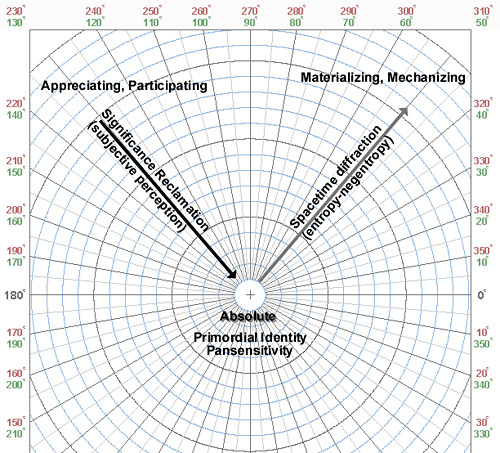
To answer that question, one approach that I have stumbled upon is to conceptually reverse existing models. Instead of particles in a void, think of dynamic bubbles in a plenum, or ‘whorlicles’. Instead of a literal plenum or field, think of a range of sensory acquaintance – a figurative anti-field in which the entropy of spacetime disentanglement is collapsed..

Applying this inside-out cosmology to mathematics, the number zero can only be a local temporary condition which can only exist between disconnection from and reconnection with the whole. Zero is the idea that something has about the absence of everything. If that’s true, then the underlying default-state of all nature that is not ‘nothingness’ a centering self-attraction. The Cartesian grid of spacetime becomes a polar graph which dissolves substance dualism.

polargraph

From this trick of turning math and physics assumptions on their head, a primordial identity which I call ‘pansensitivity’ can be imagined. Pansensitivity is neither a physical form nor mathematical function, not an immaterial process, but a capacity through which forms and functions are aesthetically appreciated. It is the foundational possibility for sanity as a sole reality through which all other continuations can possibly arise.

Both physics and math overlook the role of aesthetics/participation. If we ask why, it could be because they are about answering questions within the world or beyond the world, rather than questioning worldliness itself. Math-physics begins with the axioms given that there simply must be a such thing as a force or quantities. It is never seriously asked whether these givens can exist independently of some context of sensitivity.

This perspective is not wrong, and is entirely sensible given the purpose of math and physics to bring certainty and order to our understanding and control of the world. ‘Shut up and calculate’ works for physics because it never has to deal with conditions that are outside of sense. If we can’t get ever get away from consciousness, then consciousness is zeroed out. It is only when we want to question what it is that we can’t get away from that the axioms of objectivity must be challenged. Also we must consider that if it were possible that computations and physical interactions could occur entirely as objects, without awareness of any kind, then it begs the question of why it would ever be the case that awareness would or could arise at all.

While the human intellect presents an aesthetic context which feels Platonically ‘pure’ to us in the forms of logic and language, there is nevertheless an experience of what it is like to think and figure out calculations. Despite our enthusiasm for the transparency of the medium of scientific thought, we can understand that this purity is ultimately an illusion as well. If our consciousness is nothing but deterministic physical activity being shaped by evolutionary selection, then our scientific axioms can be no better. Either we have to admit that our scientific objectivity is predicated on our sense capacity and those of the instruments which we employ, or we have to admit that our sense capacity has some access to a world which genuine and not a solipsistic simulation.

Oppositivism

Pivoting from logical positivism to aesthetic ‘oppositivism’ may seem absurd, but it is not without precedent. The appeal of opposites and symmetry, especially in association with consciousness and cosmos is widespread.

The opposite of a great truth is also true – Niels Bohr

That which is below is like that which is above & that which is above is like that which is below to do the miracles of one only thing – Isaac Newton’s translation of the Tabula Smaragdina.

It would seem an unlikely coincidence that so many foundational concepts have to do with opposites. From the periodic table (proton v electron) to parts of speech (nouns v verbs), we see the same expression of aesthetic contrast. It is no surprise that within Philosophy of Mind too there is a core opposition that the idealist has against the materialist and vice versa. Taking my cue from Bohr, I sought to turn the dichotomy of subject and object inside out. Instead of a seeing either an illusory subject in an objective world or a transcendental subject in an illusory world, I propose a Multisense Continuum in which subjectivity and objectivity are co-variant qualities which rise, fall, and find elaboration in nested frequencies of participatory sense. I found that there are simple relations between scale and speed that point to a possible way of scientifically accessing top-down diffraction as well as bottom-up combination.

The technique of aesthetic reversal is shown here being applied to some current science-based theories about consciousness:

IIT

Giulio Tononi’s IIT (Integrated Information Theory) posits consciousness as integrated information. Flipping that to the opposite, we can come up with something like Disintegrated Qualia, assuming my definition of information as the antithesis of qualia. I see ‘information’ as the interqualitative protocols which pansensitivity has developed to separate and reunite itself.

At first, the notion of disintegrated qualia might seem incoherent, however, when we look to the experience of how consciousness is instantiated, there does seem to be something interestingl. Waking up, or being startled into attention is an arresting begins by breaking off of a previous state of awareness (or unawareness). Before we can receive new information about what has captured our attention, the capturing itself occurs as an incoherent encounter; a brief reduction of sanity and control. Integration may be an accurate description of how consciousness functions from an outside perspective, but the subjective experience of disintegrating or dissolving qualia is an interesting way to describe the other half of the story – the subjective half. When we meditate we try to minimize the amount of information and qualia, and we feel intuitively that this is what opens us up to be *more* conscious rather than less.

Infancy and dementia are characterized by delirious qualia which do not merely lack the power to inform truthfully, but take on an otherworldly aesthetic. Insanity is feared not only for the consequences of rational malfunction, but for the fear of losing the sense of self and the world upon which all value depends. Psychosis is a profound dislocation of the frame of reference, but rather than dismissing the fact of mental illness as off-limits to a rational inquiry into consciousness, we should see the extreme alteration of consciousness as the supercollider or telescope of phenomenology.

The disintegration of qualia describes what it is like to experience the beginning and ending of awareness, where a frame of reference is raised to become privileged. Part of the privilege of private consciousness is to control this raising to some extent, or at least to participate in developing that control. As a complex organism, we have multiple levels of privacy and publicity. The human envelope of awareness extends from irresistible urges to relatively free-form imagination, with a whole spectrum in between. There is indeed an integration of information going on, but it can also be seen as the breakdown of a gestalt sense experience into multiple dimensions and modalities.

The measure used by IIT for the quality of consciousness is Φ (phi), which is a measure of qualia space in which probabilities of system states can be mapped as positions. Turning that upside down could add an anti-phi () in which qualia is conceived of as improbable or unprecedented dispositions…gestalt phenomena which are both novel and irreducible. Rather than qualities which are emergent from local connections and system states, the anti-phi qualities are divergent from the interference pattern between that which is eternal and that which is unrepeatable.

A song is both an integration of notes, and a reflection of the zeitgeist or collective experience.  Where phi is measured in the context of qualia space, anti-phi measures qualia as a spaceless, timeless ‘pinching’ of the totality into a focal presence. The anti-phi is a measure of the degree of aesthetic prestige and significance for the sake of its own appreciation.  It is through this aspect of qualia, this ‘dark math’ value which the non-local can be encountered and re-encountered in some likeable likeness. Instead of being built up from scratch, the anti-phi of qualia is diffracted or sculpted out of disintegrated/unbound pansensitivity. Spacetime serves to freeze the dreamtime of the totality, make it real, and use it to build richer qualia upon.


Orch OR, Penrose, and Fermat’s Last Theorem

Adding the reversal technique onto Stuart Hameroff and Sir Roger Penrose’s Orchestrated Objective Reduction can yield similarly interesting results. The opposite of an Orch OR could be described as a “Subjective Inflation” which is “de-orchestrated”. What the hell does that mean? I’ll tell you. A subjective inflation can be thought of as the stretching of the fabric of the sense of the universe so that there can exist a difference between ‘here and there’, and ‘now and then’, a difference which physics does not seem to be able to locate. What happens during a wave-function collapse is, in addition to being felt as a Bing! of awareness, can also be described from the subjective end as a dilation of privilege which is aesthetic and qualitative. De-ORchestration can be thought of as free will – the individuation of proprietary time against a backdrop frame of generic-universal spacetime. The Orch OR explains what role subjectivity plays in the world from an outside perspective, but the De-Orch SI explains what role the creation of realism plays for the interior perspective.

In Penrose’s interpretations of Gödel’s incompleteness he says:

The inescapable conclusion seems to be: Mathematicians are not using a knowably sound calculation procedure in order to ascertain mathematical truth. We deduce that mathematical understanding – the means whereby mathematicians arrive at their conclusions with respect to mathematical truth – cannot be reduced to blind calculation!

This was echoed in the poster presentation at the TSC conference from James Tagg, in which he made the point of non-computability concrete by applying the spirit of Penrose’s conclusions to compose music based on Sir Andrew Wiles’ proof of Fermat’s Last theorem.  Because Hilbert’s 10th problem was answered negatively (by Yuri Matiyasevich in 1970), there is a discrepancy between the proof that no general algorithm can exist to solve Fermat’s last theorem and the fact that a human mathematician was in fact able to resolve it. To resolve that discrepancy, it seems reasonable to conclude that Wiles solved the theorem using methods that go beyond a general algorithm. To quote Tagg:

The existence of creativity within our Universe leads to important consequences for the structure of that Universe. To be creative we must process information within our brains using non-computable and therefore non-deterministic ‘software’. Such ‘software’ must run on non-deterministic ‘hardware’ through all the layers of abstraction, otherwise you could simply examine the more abstract model and determine what the lower layers are going to do. If humans run creative ‘software’ within their brains, the ‘hardware’ of the Universe must be non-deterministic.

Geoffery LaForte’s criticism of the Penrose-Lucas interpretation typifies the reaction against non-computational arguments. In his conclusion, he writes:

Theorems of the Gödel and Turing kind are not at odds with the computationalist vision, but with a kind of grandiose self-confidence that human thought has some kind of magical quality which resists rational description. The picture of the human mind sketched by the computationalist thesis accepts the limitations placed on us by Gödel, and predicts that human abilities are limited by computational restrictions of the kind that Penrose and others find so unacceptable.

I think that the language here exposes, ironically, an agenda in the service of impersonality in science which is highly emotional and personal (and unscientific). The essence of the objections found in LaForte’s paper are that we cannot prove our own consistency mathematically, so that somehow Penrose’s authority to affirm itself is more objectionable than his own authority to attack itself. What is mistaken for a ‘grandiose self-confidence’ is, in my view, no more than a minimum level of self-trust.

To say that all that resists rational description is magical is itself a petito principii fallacy, in which a foregone conclusion of universal determinism is itself used as the only support for a deterministic view of Gödel. What is overlooked is the fact that any argument against the consistency of human intuition is also an argument against that argument itself. It is to say, “I know with certainty that I cannot know anything with certainty”. That statement is a Gödel sentence whose absurdity oddly never occurs to LaForte as far as I can tell. What results is a straw man of the Penrose position in which human consciousness is reduced to a toy model.

In this toy model of determinsm-mechanism, the myriad of different aesthetic layers and modalities of human awareness are conflated into a single, unreliable process of computation rather than a fundamental creative context in which all notions of reliability are conceived in the first place. Daniel Dennett and others commit a similar mistake when they point out the limitations of perception (optical illusions, change blindness, etc) rather than the overwhelmingly consistent baseline of verdical perception from which we form such expectations. This rather aggressive approach forces line of demarcation such that all perceptions must be either true data from the outside world or solipsistic confabulations. My interpretation is precisely the opposite and can be understood through that opposition. MSR proposes the idea that consciousness and cosmos are a continuum of aesthetic presentation which range between high-amplitude metaphors (semi-local/semi-dual) and low-amplitude semaphores which have strictly contained meaning (thermodynamically irreversible, binary dualism, absolutely local or non-local axiomatic).

Early on in the paper, LaForte asks rhetorically “Now, why does this theorem seem so significant to anti-computationalists like Penrose and Lucas?” To insinuate that anti-computationalists have some kind of special fixation on this theorem is ironic, and representative of a whole class of similar accusations from the mechanistic camp. Mechanism asserts that human thought is reducible to computation, but it invariably carries a shadow assertion that some human thought is inherently corrupted by emotional rather than mathematical content. If we are all really machines, then Penrose is a machine, and if he finds incompleteness to be significant, then that can only mean that his mental process is determined to find it significant. The whole question of where error comes from in a mechanistic universe is recursive. If there is error, then mechanism is failing, and it therefore cannot be perfect. There must be a difference between the ideal of mechanism and the empirical fact of its expression…but how can that difference be generated by ideal mechanism?

The answer to that question is part of what the concept of subjective inflation might provide. De-Orchestrated Subjective Inflation (De-Orch SI*) amounts to the birth of privilege. The privilege to separate from the totality for some period to develop preferences and to care about those preferences. Subjectivity is a proprietary sense of dominion which allows the opportunity for extension – extension of feeling, knowing, doing, and being. This is felt as a kind of radius of involvement, or perhaps a tunnel of experiential inertia. For biological creatures, this inflation may be tied directly to cytoskeletal structure of microtubules. The tunnel is one of orientation and presence, like a cursor, which separates aesthetic dipoles such as here and there, now and then, self and other, etc. The greater the privilege, the more rich and intricate the appreciation of the contrasts can become. Each inflation builds on histories of previous inflations (which ties into a Morphic Resonance or Akashic Record kind of schema) as well as projecting inspirational images into the future.


Global Workspace Theory

Continuing with the theme of reversal, the complement to Bernard J. Baars Global Workspace Theory might be something like “Specialized Instrument Theory”. There is a lot of truth to the GWT idea of consciousness as a receiver/distributor for information, however there is an equal case to be made for consciousness as tool which is used to creatively shape itself into various images and ideas, and to impose those aesthetic forms outwardly. GWT conceives of consciousness as working memory and sensation appearing in an empty/dark theater, but I would extend the metaphor to see the theater also as a structure which protects the local awareness from the outside world. The theater of consciousness can only provide a movie if it first temporarily encloses the audience and screen in sensory isolation. Our phenomenal stream of consciousness connects the dots of sentience, but I suggest that the dots themselves are the tips of icebergs which float on an ocean of amnesia…an amnesia which hides the deeper connection of all dots to the universal history of experience. We have come full circle back to the ‘whorlicle’ model.

Unlike a theater, consciousness does not only lull us into a spectacular solipsism, but connects us directly to a potentially eternal realism and to the capacity to tell the difference. In addition to being a screen for interior simulation, the Mercurial screen of consciousness can be a mirror or a window onto truth. The truth can be fashioned through a pen or weapon, through an idea, image, or symbol. Consciousness is a meta-linguistic, meta-semiotic agency which reports on itself as well as its view of its ‘others’.


What’s Next?

It seems like this project is at a crossroads. It could be the end, or the end of Part I, but it feels like the stage of adding profusely to the MSR thesis is winding down, and in its wake, some clarity about how it might fit in with other theories. I have tried to give a few examples here of what makes MSR different from theories which focus on outside-in views of consciousness, and how they might be married with their opposites to provide a more complete and meaningful picture. I will consider it successful if everyone can find something in it to piss them off and if at least one person is inspired to re-evaluate the totality of existence in some tormented insomniac revelation. I apologize for the density and the high level of noise in what I have been writing, but at least its out here in some form. In the spirit of Robert Anton Wilson and Timothy Leary, I say to my critics that I am even stupider and crazier than you think, and that you should spend your time elsewhere.  Everyone gets the Multisense Realism that they deserve!


*This sounds like I’m being satirical in calling it that, but I’m trying to show the syzygy.

TSC Notes

April 23, 2014 5 comments

TSC Comments


Attending TSC this year and in 2012 has played a critical role, and continues to play a role in inspiring me to develop Multisense Realism. David Chalmers work in particular, with his elucidation of the various forms of panpsychism in his recent papers Panpsychism and Panprotopsychism and The Combination Problem for Panpsychism has been invaluable.

From the former paper :

“Panpsychism is sometimes dismissed as a crazy view, but this reaction on its own is not a serious objection. While the view is counterintuitive to some, there is good reason to think that any view of consciousness must embrace some counterintuitive conclusions. Furthermore, intuitions about panpsychism seem to vary heavily with culture and with historical period. The view has a long history in both Eastern and Western philosophy, and many of the greatest philosophers have taken it seriously. It is true that we do not have much direct evidence for panpsychism, but we also do not have much direct evidence against it, given the difficulties of detecting the presence or absence of consciousness in other systems. And there are indirect reasons, of a broadly theoretical character, for taking the view seriously.”

In the latter paper, Chalmers offers a rigorous account of The Combination Problem. Multisense Realism begins as a proposed solution to the Combination Problem in which the explanatory gap between physical and phenomenal states are bridged by a continuum/spectrum of relativistic qualities of sensitivity.

From the macro to the micro, physical to phenomenal, under MSR, every perspective contributes its own frame of reference to what could be considered a totality of reference. Through this super-monad, not only are physics and phenomenology reconciled, but ontology itself. ‘Isness’ and ‘Aboutness’ are reconsidered as ‘Seems’ and ‘Seems like’.

It is the aim of MSR to begin to characterize and document this spectrum of meta-ontology, in which definition itself is created, preserved, and dissolved…even while, in another sense, not creating, preserving, or dissolving anything. Amidst all of this relativism and paraconsistent logic, it is proposed that within every frame of reference there is also the potential to access unambiguous clarity, simplicity, and wholeness. At the center of every center, there is a default experience – a reflection of the totality; home, safe, within or ‘in here’. This anchoring should not be presumed to be the exclusive province of human consciousness or even zoology or biology. All of physics and mathematics contains implicit vantage points from which objects are defined. In this way at least, sense should be seen to pre-figure all figures and forms, all objects and subjects.

What PIP suggests is that even relativity is relative. There “is” an Absolute frame of reference, consisting of the capacity to orient sensibly. From that foundation, it becomes possible to ‘make sense’. Existence is suggested, not as a facile axiom, but as a concrete presentation of here and now that is a‘living’ coordination of aesthetic encounters. This view of the cosmos is one in which divergence and disentanglement of privacies precedes an emergence of spacetime, nucleated in the now.

The work of Stuart Hameroff and Sir Roger Penrose have also inspired my thinking as well. MSR introduces a kind of perceptual relativity at every level of scale (named Eigenmorphism), and a Lorentz-style complementarity to the Orchestrated Objective Reduction called Subjective Inflation (i.e. Orch OR+SI). The publicity of quantum mechanics finds a kind of twin realization in the privacy of qualitative gestalts. Wave-function collapse is reflected as a figurative bolt of lightning from the totality into locality.

Like a lightning bolt, a uniquely jagged path traces its route from vector to vector, describing not only a generic/recombinatory state change, but a proprietary and unrepeatable address. This path can be imagined to strike through what might be described as an ‘improbability space’ – a top-down complement to the bottom-up view of quantum theory.

Through this influx of novelty, the present moment of here and now is inflated to superlative significance which recapitulates the inflation as well, so that eternity is reflected in each moment. This idea owes a lot to Eastern concepts such as the Net of Indra and Akashic Records. The idea is that each moment’s route to the present from the Absolute is preserved within it. This is quite an abstruse concept, and requires much deeper consideration than can be expressed here, but let this be at least a premonition of the potential for a productive if not testable form of ‘private physics’.

I have very much appreciated the contributions of Deepak Chopra, Giulio Tononi, and Donald Hoffman as well, each of whom present important pieces to the puzzle. Where I diverge from their views is only in particular details that arise from my premises. I do not see the world as a simulation or illusion, but rather, in any given frame of reference, the exterior world is as real as anything could possibly be…more ‘real’ in a way, than individual subjectivity. In my view, it is only from the Absolute frame of reference that matter is ‘unreal’ and subjective-like phenomena are the firmament. I see our subjective experience as both more-than-real and less-than-real, but not as the only arbiter of realism. MSR is not solipsism, but perhaps more of a holopsism.

Where Tononi’s IIT models a topological qualia space, I imagine a stratified but contiguous medium of sedimented experience from which qualia is carved out subtractively. There is simply no space in the universe that is not qualia already, nowhere to build it up from scratch. Instead, qualia is etched out of the local surface to the depths toward its source in the Absolute frame (beneath and beyond).

The flavor of strawberries for example, under MSR, is a kind of gestalt which traces a likeness of all the experience of animals eating fruit, of all fruit bearing plants, etc going back to indefinitely. Qualia is *not* a simple translation from molecular code to phenomenal effect. As humans, we are highly elaborated, so our divided senses can conflict, but this does not mean, in my view, that it is evidence of a faulty and solipsistic simulation. Illusions and misperceptions reveal more, not less, about the full reality of objective and subjective relation, even if the content is incompatible with the local frame of reference. The flavor of strawberries really is the flavor of the actual fruit, not simply a computation of indirectly generated data. One does not cause the other, they reflect different perceptual frame of reference. For this reason I reject all contemporary Strong AI approaches as implausible, since producing a mechanism capable of simulating expected outputs from a given input would be doing so based on mathematical contingencies rather than the kind of hyper-physics of sedimented experience that I suggest.

Donald Hoffman’s Conscious Realism seems to overlap with MSR very closely however here too I propose that even the idea of conscious agents are figments of the interface. If we drop the requirement of ‘agents’ to consciousness, the notion of panpsychism becomes more palatable, and the Combination Problem is eased if not completely transcended. If we see self-ness as the ‘king of qualia’ rather than the price of entry to consciousness, then we open the door to a profoundly interesting universe of ‘dark qualia’ which would, (as it contains the content of both past and future relative to any nested frame) dwarf the scale of dark energy. It seems possible that dark energy is the local footprint of this eternal continuity of experience.

Thanks also to my ideological adversaries in this as well. Susan Blackmore’s no-nonsense approach and commitment to empirical evidence is a welcome influence, as well as Daniel Dennett’s humor and uncompromising cynicism. In many ways, my own view is informed by turning the tables on doubt so that in addition to being skeptical of our interior experience, in favor of exterior scientific evidence, I would add that we must introduce a new skepticism of the presumption of the universality and completeness of even those scientific descriptions. What is true on one level may not be true on another, and each level has its own fundamental truth independent of every other.


Thanks to Jody Weiss and everyone else that I have met here at the conference too, who have also contributed to this ongoing development, both directly and indirectly.


Yours in Consciousness,
Craig Weinberg, @s33light
Multisenserealism.com

The Third Eve

Who we are becoming.

Shé Art

The Art of Shé D'Montford

Astro Butterfly

Transform your life with Astrology

Be Inspired..!!

Listen to your inner self..it has all the answers..

Rain Coast Review

Thoughts on life... by Donald B. Wilson

Perfect Chaos

Steven Colborne's Philosophical Theology Blog

Amecylia

Multimedia Project: Mettā Programming DNA

SHINE OF A LUCID BEING

Astral Lucid Music - Philosophy On Life, The Universe And Everything...

Rationalising The Universe

one post at a time

Conscience and Consciousness

Academic Philosophy for a General Audience

yhousenyc.wordpress.com/

Exploring the Origins and Nature of Awareness

DNA OF GOD

BRAINSTORM- An Evolving and propitious Synergy Mode~!

Musings and Thoughts on the Universe, Personal Development and Current Topics

Copyright © 2016 by JAMES MICHAEL J. LOVELL, MUSINGS AND THOUGHTS ON THE UNIVERSE, PERSONAL DEVELOPMENT AND CURRENT TOPICS. ALL RIGHTS RESERVED. UNAUTHORIZED USE AND/OR DUPLICATION OF THIS MATERIAL WITHOUT EXPRESS AND WRITTEN PERMISSION FROM THIS SITE’S AUTHOR AND/OR OWNER IS STRICTLY PROHIBITED.

Paul's Bench

Ruminations on philosophy, psychology, life

This is not Yet-Another-Paradox, This is just How-Things-Really-Are...

For all dangerous minds, your own, or ours, but not the tv shows'... ... ... ... ... ... ... How to hack human consciousness, How to defend against human-hackers, and anything in between... ... ... ... ... ...this may be regarded as a sort of dialogue for peace and plenty for a hungry planet, with no one left behind, ever... ... ... ... please note: It may behoove you more to try to prove to yourselves how we may really be a time-traveler, than to try to disprove it... ... ... ... ... ... ...Enjoy!

Creativity✒📃😍✌

“Don’t try to be different. Just be Creative. To be creative is different enough.”

Political Joint

A political blog centralized on current events

zumpoems

Zumwalt Poems Online