Archive
Questioning the Sufficiency of Information
Searle’s “Chinese Room” thought experiment tends to be despised by strong AI enthusiasts, who seem to take issue with Searle personally because of it. Accusing both the allegory and the author of being stupid, the Systems Reply is the one offered most often. The man in the room may not understand Chinese, but surely the whole system, including book of translation, must be considered to understand Chinese.
Here then is simpler and more familiar example of how computation can differ from natural understanding which is not susceptible to any mereological Systems argument.
If any of you have use passwords which are based on a pattern of keystrokes rather than the letters on the keys, you know that you can enter your password every day without ever knowing what it is you are typing (something with a #r5f^ in it…?).
I think this is a good analogy for machine intelligence. By storing and copying procedures, a pseudo-semantic analysis can be performed, but it is an instrumental logic that has no way to access the letters of the ‘human keyboard’. The universal machine’s keyboard is blank and consists only of theoretical x,y coordinates where keys would be. No matter how good or sophisticated the machine is, it will still have no way to understand what the particular keystrokes “mean” to a person, only how they fit in with whatever set of fixed possibilities has been defined.
Taking the analogy further, the human keyboard only applies to public communication. Privately, we have no keys to strike, and entire paragraphs or books can be represented by a single thought. Unlike computers, we do not have to build our ideas up from syntactic digits. Instead the public-facing computation follows from the experienced sense of what is to be communicated in general, from the top down, and the inside out.
How large does a digital circle have to be before the circumference seems like a straight line?
Digital information has no scale or sense of relation. Code is code. Any rendering of that code into a visual experience of lines and curves is a question of graphic formatting and human optical interaction. With a universe that assumes information as fundamental, the proximity-dependent flatness or roundness of the Earth would have to be defined programmatically. Otherwise, it is simply “the case” that a person is standing on the round surface of the round Earth. Proximity is simply a value with no inherent geometric relevance.
When we resize a circle in Photoshop, for instance, the program is not transforming a real shape, it is erasing the old digital circle and creating a new, unrelated digital circle. Like a cartoon, the relation between the before and after, between one frame and the “next” is within our own interpretation, not within the information.
A Formula for Qualia
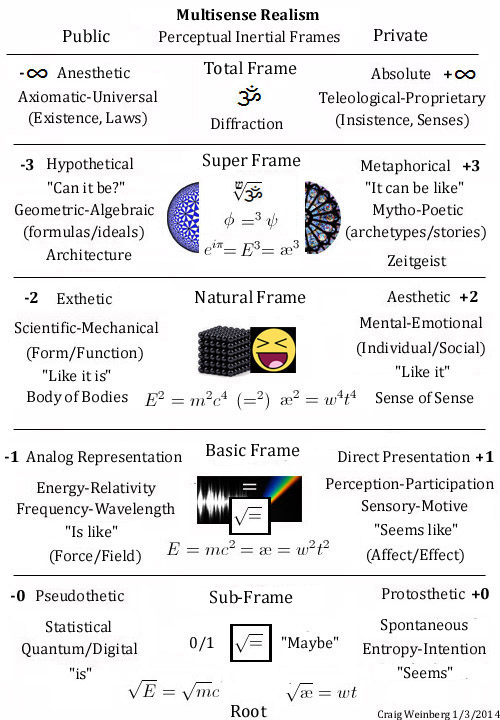
To derive the formula for qualia or sensory affect, solve the Hard Problem of Consciousness, and bridge the Explanatory gap, I suggest that we try converting the mass-energy equivalence E=mc² from the public orientation and transpose it inward to the private orientation.
Energy (E) becomes w² which is “was and will be” (w = was or will be)
The Speed of light (c) becomes t = time = (still or never) = now or realism
Light* (c²) becomes t² “still and never again” or “stereo realism of now”
Mass (M) becomes æ = qualia = “like it”
Qualia = “like it was and will be, still and never again” =

another wording
Qualia = “Eternally signifies its past and future now”
This is about what Milan Kundera called The Unbearable Lightness of Being. That our experience of the universe is either perpetually suspended above the paradox of an existence which is both perpetually vanishing forever in some sense and repeating forever in another. If c is the still ‘speed’ of here and now, then c² is the acceleration of here and now, the enrichment of the local now through the collective presence and absence of eternity
- Motive effect or will:
To derive will or motive: 
If qualia is “like it”, then square root of æ is what joins and divides the ‘like’ and the ‘it’. It is the dipole charge of ‘liking’ and ‘it-ing’ which we call desire or preference. The greater the liking, the more significance is projected onto the object, which is the imagined realization of a goal in time. Intention projects into the future, builds, and guides qualia.
Will = “(Maybe, or maybe not)(now or never)” = w = √æ t
Turning the private translation outward to Public/Western psychology so that interiority is undersignified as emergent epiphenomena, we get:
= Experience is simply what may and may not be happening for some time.
and
= Choosing = Right or wrong this time
The public-facing view of privacy reduces it to information processing. To those who have a private-facing view this is a flat and inadequate characterization. The former view is optimized for realizing spatial intelligence while the latter is optimized for appreciating timeless wisdom.
- Quality and Equality
Since qualia is about likeness and local equivalents, it can be said that qualia equals the differential between equality and all inequalities... æ = ‘d=’.

The kicker is that since equality is itself a quale (the spelling of e-quality is a clue), we can conceive of ‘=’ as quality which is externalized**, i.e. the differential is collapsed and the entire range of what it “is like” is interpreted as what “it actually is”. The Western-facing mind naturally prefers that which only tells it ‘like it is‘, so that public physics and information science will filter out as noise all that tries to tell ‘what it is like‘ (paging Ludwig Wittgenstein…). This commercialization of residential qualities has had many benefits, but it is a philosophy which has blinded itself, and intimidated many into ignoring the true nature of consciousness. It’s not anyone’s fault, it’s how private physics works. It’s how sense is made.
*The speed of light is c, but c², if taken literally, can be understood as light itself, reality, or making sense: producing stereo (solid) realism.
**Physically publicized, cropped, framed, stereotyped, commercialized, hardened to endure against the changing feelings that make up private time.
Reverse Fallacies for Considerations of Consciousness
Special pleading is a formal logical fallacy where a participant demands special considerations for a particular premise of theirs. Usually this is because in order for their argument to work, they need to provide some way to get out of a logical inconsistency – in a lot of cases, this will be the fact that their argument contradicts past arguments or actions. Therefore, they introduce a “special case” or an exception to their rules.
While this is acceptable in genuine special cases, it becomes a formal fallacy when a person doesn’t adequately justify why the case is special.
[…] the “naturalistic fallacy” is close to but not identical with the fallacious appeal to nature, the claim that what is natural is inherently good or right, and that what is unnatural is inherently bad or wrong.
The Normative Fallacy occurs, rather, when someone attempts to argue that something is not the case or is the case based on a set of ideological, ethical, moral, political, or other normative commitments.
Cargo Cult: The speech is reproduced in the book Surely You’re Joking, Mr. Feynman! and on many websites. Feynman based the phrase on a concept in anthropology, the cargo cult, which describes how some pre-scientific cultures interpreted technologically advanced visitors as religious or supernatural figures who brought boons of cargo. Later, in an effort to call for a second visit the natives would develop and engage in complex religious rituals, mirroring the previously observed behavior of the visitors manipulating their machines but without understanding the true nature of those tasks. Just as cargo cultists create mock airports that fail to produce airplanes, cargo cult scientists conduct flawed research that superficially resembles the scientific method, but which fails to produce scientifically useful results.
Here is an excerpt from the book.
In the South Seas there is a cargo cult of people. During the war they saw airplanes land with lots of good materials, and they want the same thing to happen now. So they’ve arranged to imitate things like runways, to put fires along the sides of the runways, to make a wooden hut for a man to sit in, with two wooden pieces on his head like headphones and bars of bamboo sticking out like antennas—he’s the controller—and they wait for the airplanes to land. They’re doing everything right. The form is perfect. It looks exactly the way it looked before. But it doesn’t work. No airplanes land. So I call these things cargo cult science, because they follow all the apparent precepts and forms of scientific investigation, but they’re missing something essential, because the planes don’t land.
Feynman cautioned that to avoid becoming cargo cult scientists, researchers must avoid fooling themselves, be willing to question and doubt their own theories and their own results, and investigate possible flaws in a theory or an experiment. He recommended that researchers adopt an unusually high level of honesty which is rarely encountered in everyday life, and gives examples from advertising, politics, and behavioral psychology to illustrate the everyday dishonesty which should be unacceptable in science.
I’m posting this because it should be pointed out that fallacies can run in both directions. The entire array of Western philosophical argumentation is rooted in the deepest assumption of all – that what we feel and think is unreliable, therefore suspicious, but what happens outside of ourselves, or what we agree that we perceive happening outside of ourselves is above suspicion, by definition. Since there can never be a case where we are right and physics is wrong, all who seek to make a hypothesis about the fundamental nature of subjectivity are put in the awkward position of being judged in their own power to participate in conscious experience by the normative expectations of a system of knowledge which specifically and exhaustively removes all possible traces of subjectivity.
Because the expectation of science itself, as it is currently practiced, obstructs its own view of consciousness with ideology that is assumed to be inescapable and natural, the logical fallacies which are designed protect science are operating in reverse. Any model which suggests phenomenal awareness is a phenomenon being more primitive than objective structures and laws is rejected out of hand as having no evidence. There is no way to put forth the observation that consciousness cannot be under suspicion when it seems entirely likely that no evidence of consciousness outside of its own reports of itself can ever exist. We must instead examine why, if our own delusion and fallacious reasoning is ultimately a product of neurochemistry and evolutionary biology, should we be able to trust our brain’s folk epistemology called science? We might say, well, we know science works because of the evidence – the technology. True, but where but in our own shared experience can evidence be understood? If nature was making the same kind of mistakes that we do, how would we know? Especially given the nature of recent science, where dark matter and energy can suddenly appear and swallow the known universe, and quantum theory has, in some sense, suspended the rule of non-contradiction.
When it comes to consciousness, the Strong AI project has become a Cargo Cult. By imitating the architecture of the brain or of the logical syntax of its behavior, we hope that the consciousness cargo will show up. Instead of an appeal to nature, we now have a bold and unchallenged appeal to science – The claim that what is testable is inherently real, and that what has not yet been made testable and may not be testable is inherently irrelevant. I propose a new logical fallacy – the Abnormative fallacy, which occurs when someone attempts to argue that something is not the case or is the case based on a set of commitments to doctrines which are cynical, robotic, formalistic and held above suspicion by popular inertia. Finally I propose the fallacy of General Pleading, to expose this normative bias stemming from the privilege and power of the dominant perspective which denies the possibility that consciousness is a special case, or THE special case, by definition.
Breaking the Nth Wall
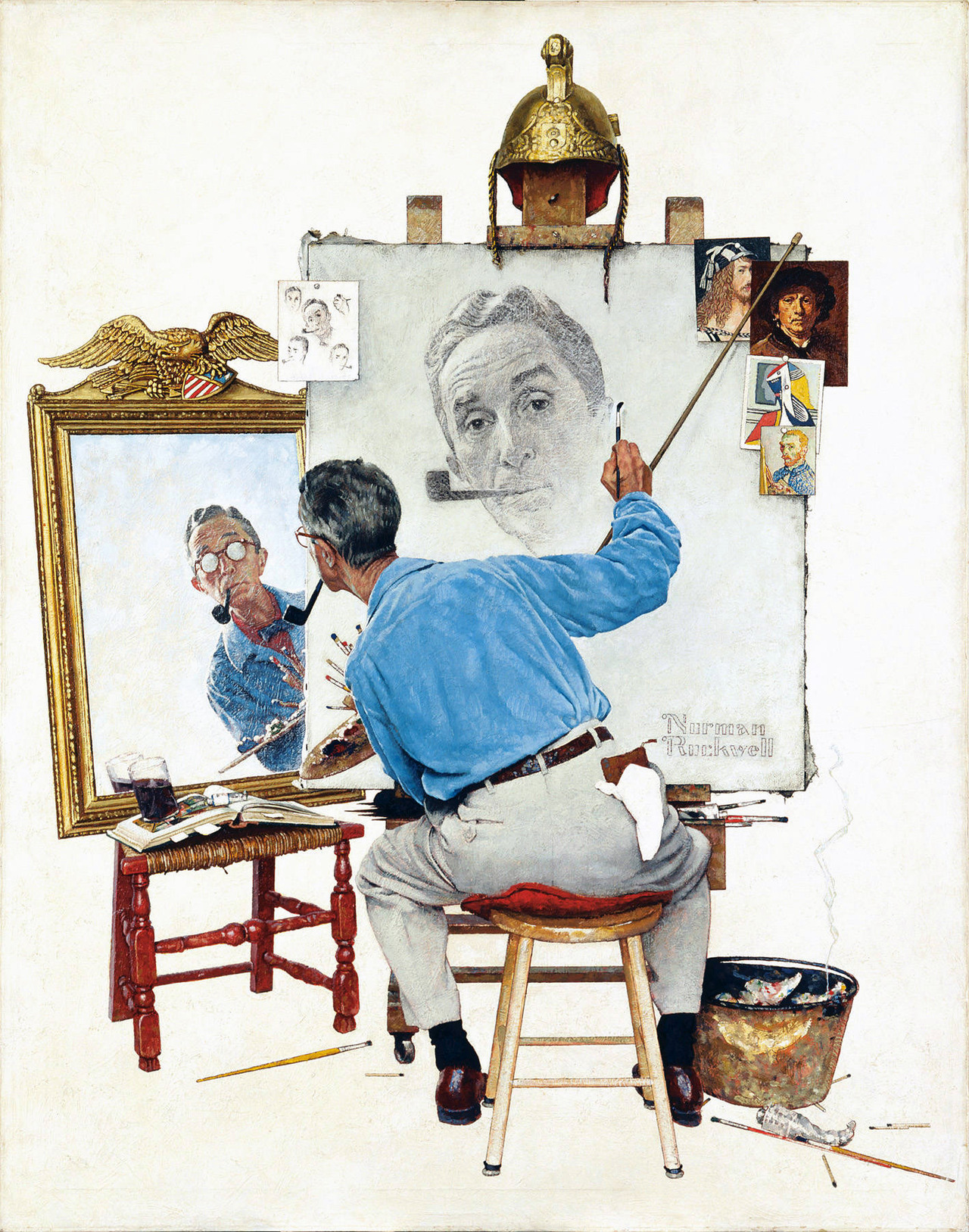
- Eliminative Materialism: The picture is the only reality, so the artist is an illusion.
- Idealism: The artist is real and the picture is an illusion.
- Dual Aspect: The artist and the painting are two halves of the whole.
- Monotheism: Norman Rockwell is omnipotent and immortal.
- Computationalism: Norman Rockwell is an emergent property of jpeg compression. Any sufficiently complex compression becomes Norman Rockwell.
- Multisense Realism: The picture, artist, audience, illusion, Norman Rockwell, and computation are all sensory experiences which make sense in different but sensibly related ways.
Free Will Isn’t a Predictive Statistical Model
Free will is a program guessing what could happen if resources were spent executing code before having to execute it.
I suggest that Free Will is not merely the feeling of predicting effects, but is the power to dictate effects. It gets complicated because when we introspect on our own introspection, our personal awareness unravels into a hall of sub-personal mirrors. When we ask ourselves ‘why did I eat that pizza’, we can trace back a chain of ‘because…I wanted to. Because I was hungry…Because I saw a pizza on TV…’ and we are tempted to conclude that our own involvement was just to passively rubber stamp a course of multiple-choice actions that were already in motion.
If instead, we look at the entire ensemble of our responses to the influences, from TV image, to the body’s hunger, to the preference for pizza, etc as more of a kaleidoscope gestalt of ‘me’, then we can understand will on a personal level rather than a mechanical level. On the sub-personal level, where there is processing of information in the brain and competing drives in the mind, we, as individuals do not exist. This is the mistake of the neuroscientific experiments thus far. They assume a bottom-up production of consciousness from unconscious microphysical processes, rather than seeing a bi-directional relation between many levels of description and multiple kinds of relation between micro and macro, physical and phenomenal.
My big interest is in how intention causes action
I think that intention is already an action, and in a human being that action takes place on the neurochemical level if we look at it from the outside. For the motive effect of the brain to translate into the motor effect of the rest of the body involves the sub-personal imitation of the personal motive, or you could say the diffraction of the personal motive as it is made increasingly impersonal, slower, larger, and more public-facing (mechanical) process.
Residential Proprietors and Commercial Pirates
Another metaphor to add to the list of private vs public, experience vs structure, etc. It’s a stretch, but has interesting implications as far as the Westernization of society. Referring generally to categories of real estate, residential and commercial also reflect a broad dialectic of civilization. Early cities were often walled, but even after walls became obsolete, the social context of insiders and outsiders continues under the cosmopolitan aesthetic vs rural aesthetic. Rural inhabitants have long been considered inferior by urbanites. With the exception of projection of their own lost innocence into a noble savage/salt of the Earth archetype, people who live outside of cities or inside of nature are considered rubes and recluses by those who live inside of cities and outside of ‘nature’.
It’s notable that to live or work ‘inside’ of a city is to be immersed in a world of commercial exteriors. The word commerce denotes a coming together (com-) to trade; market; merchant; merchandise. Commerce is inter-national and inter-cultural. To conduct trade is to travel to a location which is well regulated and protected, yet free from undue political influence. The neutrality and publicity of the milieu makes it a kind of anti-residence. The towering structures which define the skylines of modern cities are largely devoid of personal contents. Even during the hours which they are occupied, the residing (etymologically re-siding is like re-sedentary, a reference to sitting-again (and again)) in an office building is by contract. Sitting around when you are contracted to work standing, or standing around when you are contracted to work sitting, is not permitted. By and large, what happens in an office building is comings and goings. The office building itself is a structure, a monument to the generic and unnatural state of the industry that it unintentionally represents.

The word industry contains the same root as structure, which ties back to the realization of public-facing private agendas rather than private or experiential values. Similarly, the word enterprise contains the prefix enter for within or between, and prise is about taking and reaching (prehensile, apprehend, comprehend). Industry, commerce, and trade are all active motivations. The word trade shares etymology with tread, as in to tread a path. They are literally outgoing and extroverted. It is unsurprising then, that the conquest of the New World and rise of mercantilism are tied together with the dawn of the Enlightenment Era and explosive progress in physics and the physical sciences.
What has happened since the latter half of the 20th century, is that the wheel of progress has turned so as to eclipse the residential values entirely with the commercial. In the last 30 years in particular, we have seen a trend away from public spaces which are hospitable to individual people and toward public facing real estate as a hardened asset. Office ‘parks’ leverage landscaping and architectural techniques to minimize loitering or curious visitors. Pleasant looking bushes and flowers are manicured to disguise as well as subtly amplify the artless emptiness of the place. James Howard Kuntsler has called them ‘nature band-aids‘:
the little juniper shrubs in the universal bark-mulch bed deployed in front of a building so depressing and inept that it would dismay even the criminal class of great-granddads’ day. I call these little landscape fantasias nature band-aids.
Everywhere that we look, change seems to come in the form of increasing inconvenience. Packaging that requires special tools to open. Homes built with features that require industrial equipment to perform basic maintenance. Technology which has no user serviceable parts. Where the 19th and 20th century oversaw the obsolescence of hand made and hand repairable objects, the 21st century has brought a level of commercialization which is mandatory and impenetrable. The future of social interaction suggests a menu-driven, pre-fabricated extension of commercial enterprise into the private ‘space’. Ontologically, it is privacy itself which is been spatialized, auctioned off like the broadband spectrum and privatized like the DNA of designer organisms.
The choices being offered thus far have been to either join in a futile resistance, or to embrace the Borg of commercial domination. Some try to effect a Bartleby-like passive protest, hoping that perhaps their preferences in consuming or slacking will contribute to a wave of imitation. It’s probably not going to be that easy. Unlike the revolutionary crucibles of the past, the Western colonization of mind is so thorough that people no longer recognize their own significance. We have accepted the evidence of our own irrelevance, and of the cheap currency of our lives in exchange for the magic beans of structured realism. Any call to progress beyond commercialism are rejected out of hand as both politically naive and unscientific.
While religious fundamentalism thrives, perhaps the popularity of Pope Francis signals the possibility of a future cavalry to the rescue in the form of rehabilitated spiritual traditions? If the Western Imperial drive can yang so far that it has eaten the yin, maybe the yin can flow into the public mind through the back door? Sit-ins and occupations were one way of reclaiming the Residential, but with a deeper understanding of the physics of privacy, it may be that a revolution of enlightened non-doing is already underway within us.
Free Will and the Unconscious
The key oversight, in my opinion, in the approach taken by neuroscientific research into free will (Libet et al) is in the presumption that all that is not available to us personally is ‘unconscious’ rather than conscious sub-personally. When we read these words, we are not conscious of their translation from pixels to patches of contrasting optical conditions, to loops and lines, to letters and words. From the perspective of our personal awareness, the words are presented as a priori readable and meaningful. We are not reminded of learning to read in kindergarten and have no feeling for what the gibberish that we are decoding would look like to someone who could not read English. The presentation of our world is materially altered at the sub-personal, but not ‘unconscious’ level. If it were unconscious, then we would be shocked to find that words were made of lines and loops or pixels.
In the same way, a robotic task is quickly anticipated, even 10 seconds ahead of time, without our personality getting involved. This does not mean that it is not ‘us’ making the choice, only that there is no need for such an easy and insignificant choice to be recognized by another layer of ‘us’, and reported by a third layer of ‘us’ to the personal layer of us.
When we work on the sub-personal level of neurons, we are addressing a layer of reality in which we, as persons, do not exist. Because we have not yet factored in perceptual relativity as a defining existential influence, we are making the mistake of treating a human being as if they were made of generic Legos instead of a single unique and unrepeatable living cell which has intentionally reproduced itself a trillion times over – each carrying the potential for intention and self-modifying teleology.
 Multisense Realism
Recent Comments