Archive
Information Theory 1.1
1/25/2016 Information Theory Update
Here are some notes which I hope will provide a more concise understanding about the nature of computation, logic, and mathematics.
Information theories such as those offered by Shannon and Turing give us cause to see an underlying universality of information which is rooted in simple Arithmetic truths such as addition, multiplication, and integers. These arithmetic truths are theories with can be applied successfully to computing machines without regard to their physical substrate*. While this offers a method to deploy universal principles to the control of a specific mechanism, the control which is offered is different in kind from the literal (motor) control of the hardware. Motor control of computer hardware can be accomplished electromagnetically or classically (as with analog clocks with gears powered by spring tension or a gravity pendulum), and now quantum-mechanically to some extent, but not directly by math. Mathematics cannot turn a computer on or keep it running, it can only provide a non-local set of rules which can be localized through motor control.
This is critically important to understand when considering the possibility of Artificial Intelligence: Computation can only be absolutely general or absolutely specific. When we implement a logic circuit, we are not literally imposing philosophical logic on a circuit, rather we are only interpreting the physical changes of a device metaphorically. In short, a logic circuit cannot literally represent a state of 1/0 or True/False, it can only literally present a concrete state of being switched to Stop (Off) or Go (On). This is the territory of computation – what is known as Layer 1 in the seven layer OSI network model**. All higher layers are not physical territories but logical maps – human abstractions projected by software engineers and application users.

For this reason, no computing machine can represent the middle ranges between the absolute generality of mathematical theory and the absolute specificity of a machine’s physical condition. It’s all above-the-line of personal awareness (oceanic metaphor) or below-the-line (granular semaphores). We can get a lot of utility out of these devices, however we can’t get any empathy from them. They can’t care about anything or anyone, since ‘they’ are purely in our imagination.
The philosophically relevant part of what I’m proposing applies to the prospects for generating natural intelligence artificially. AGI that feels as well as thinks is not necessarily desirable, but if my view is on the right track, computers becoming sentient is not something that we need to worry about. It won’t happen. Why? Because mathematics is not accessing the Physical layer from the top down but from the beneath the bottom layer. This means that even though we can use a computing device to validate truth conditions, we can only validate those truths with refer literally to the concrete states of the machine, and those truths which refer figuratively to the universal arithmetic relations. Nothing that a computer does needs to be *about* anything beyond the machine’s physical state, and so any appearance of emotion, intention, sensitivity, etc are purely hypothetical and would violate parsimony. Church-Turing Thesis lays out the framework for universal computing, but in saying that all functions of calculation can be reduced to a-signifying digital steps, we are also saying that all semantic meanings shall be reduced to blind syntax. It cuts both ways.
Isn’t the brain just a biological computer?
No. This is an obsolete idea, for a lot of reasons which I won’t get into here, but suffice it to say, the brain is an organ within a living body which developed organically from a single self-replicating, self-modifying cell. Machines, by contrast, are assembled artificially from naturally unaffiliated substances and parts. That’s not a reason to discount the possibility of sentience through silicon, but it is a reason to go beyond knee-jerk presumptions that continue to dominate thinking about AI. While Turing’s genius is only now beginning to receive the appreciation it deserves, the shortcomings of his Imitation Game approach have not yet been widely understood.
Alan Turing can be pardoned for his reliance on mid-century Behaviorism as a psychological model, since it was very popular at the time and also because, along with others, I suspect that his natural instincts were quite systemizing/autistic. This carries over in modern populations, with autistic-masculine influences far overwhelming the psychotic-feminine influences in computer science and engineering fields. As a result, we have a lot of strong, controlling voices which insist upon reducing psychology to mechanistic terms, and all dimensions of consciousness to processing of logical information. This is so pervasive that any casual conversation online which challenges the supremacy of first-order logic will tend to erupt into a firestorm that ends with something like “Yeah I’m done here. You’re just spouting nonsense“.
To this end, I find this pyramid model for debate at least as important as the other models of information networking:

My call for civility in discussion is not mere political correctness or over-sensitivity, but rather a purely pragmatic consideration. Unlike a computer, the human mind loses its capacity for curiosity and fairness when it falls into aggression. People talk over each other and assert their opinions ever more rigidly and repetitively rather than thinking creatively. This mirrors the action of computation itself – recursive enumeration masquerading as communication.
A great many people think they are thinking when they are merely rearranging their prejudices. – William James
*Not entirely true. The physical substrate of a machine requires precision and solidity. We cannot build a computer out of clouds or fog, it needs to be made of something physical which stays put and which has at least one absolutely persistent read/write capacity. Traditional logic circuits must be implemented physically through a rigid skeleton of readable coordinates.
**It has been popular in recent years to proclaim that the OSI Model is dead. The feeling is that TCP/IP is the predominant protocol suite being used in the real world, and it doesn’t match up with OSI, so we should dump OSI in favor of something like this:

I do see the appeal of this, however, agree with this author that “OSI teaches more of the reasoning behind making multiple layers and what they do. Collapsing the traditional model for the sake of making it look like TCP/IP is going to cause more harm than good.” – Tom Hillingsworth
Hyper-Mentalism and Supernatural Belief
This article from Psychology Today, Hyper-Mentalism, Hyper-Empathizing, and Supernatural Belief, talks about the diametric model’s explanation of the psychotic end of the autistic-psychotic spectrum.
“To use an analogy, the diametric model implies that we live in parallel mentalistic and mechanistic universes, with mental causality ruling the first and physical causality the second. Religious, superstitious, and magical thinking clearly represent an encroachment of the mental world on the real one in the form of belief in divine creation, miracles, the power of prayers and spells, and so on. Indeed, as I pointed out in an earlier post, you could see traditional religion and superstition as the result of a primeval mentalistic inflation which hyper-mentalized the real world, in part because mechanistic understanding of it in the form of modern science, medicine, and technology had not had time to develop. Furthermore, you could also see this as the paradigmatic historical case of a “combination of strong mentalizing coupled with poor understanding of the physical world.”
In my view, this is very close to the hypothesis that has been developed under the Multisense Continuum or ACME/OMMM model.

The diametric model deserves more attention, in my view, however I think that the assumptions behind the model are themselves biased toward the systemizing/mechanistic end of the spectrum. Note the language in the quote above: “Religious, superstitious, and magical thinking clearly represent an encroachment of the mental world on the real one“. Highly subjective states are identified as being intrinsically unreal rather than being an extension of nature and reality. The end of that quote shows another good example of the mechanistic worldview, associating superstition with “poor understanding of the physical world.” I would not deny that there are many people who do suffer from a poor understanding of the physical world and compensate for that to some extent with magical thinking, however, that correlation does not always hold true. Many people, such as myself, embrace the physical world and have an excellent understanding of it, yet see that behind and beyond mechanistic appearances are also more subtle natural phenomena. It is not that the psychotic is poorly equipped for reality, it is more like reality poorly equipped to contain psychotic hyper-sensitivities. This is not to say that paranoid schizophrenics are right about the content of their delusions, only that the form of paranoid delusions reflect (in a distorted way) the transpersonal territory of the psyche.
In the short article linked above, the author makes the distinction between his diametric model and “Simon Baron-Cohen’s rival scheme, which has systemizing versus empathizing instead of the diametric model’s mechanistic versus mentalistic cognitive dualism”. Here again, the distinction between empathizing and mentalistic is itself a mechanizing/systemizing distinction. Both the diametric model and empathizing-systemizing model label the ‘feminine’ side in terms of a personal function. The former sees empathy as a cognitive skill, while the latter seems to suggest that it is overdeveloped empathy which interferes with the correct application of cognitive skills. In both cases, the bias of contemporary academic science shows through: Extraordinary awareness which conflicts with consensus reality is a defect.
This bias is not surprising, nor is it even a negative if we are trying to get a handle on human psychology for purposes of treatment. The problem that I see, is that it closes the door on the deeper dimensions of psyche and fails to take seriously the implications of consciousness transcending classical physics. Once we do take a scientifically objective look at these implications, I think that we wind up with a theory of order and participation in the universe which is not limited to human psychology but extends beyond physics, information science, philosophy, and religion: A new scientific cosmology based on sense phenomena.

Introducing the Aumwelt
https://embed-ssl.ted.com/talks/david_eagleman_can_we_create_new_senses_for_humans.html
This is worth the 20 minutes IMO, as Eagleman lays out the contemporary view of sense. Where he leaves off is exactly where I want to pick up, and then to run in the opposite direction.
He begins by talking about the limitations of each species and how, for example, a tick lives in a world of temperature and butyric acid…a bat lives in a reality constructed out of air compression waves. This ‘slice of their ecosystem that they can pick up on’ is know as the umwelt.

Umwelt
The German word Umwelt means “environment” or “surroundings”. Lacan contrasts the term with Innenwelt– the inner world–to emphasize the interaction between the imaginary interior space that the “I” occupies and the physical world in which the living human subject is situated. The connection between Innenwelt and Umwelt is, for Lacan, always dialectical; in the mirror stage, the “I” only comes into being through an association with an image that is outside of and other than the infant.
So far so good. He then gets into the exciting directions that his research is going in, technologies to extend our sensory capabilities beyond the human umwelt, etc.
That’s great, and I have been looking forward to technologies like that all of my life. To be able to not only see in the infra-red range, but to be able to model information from any source – an Excel spreadsheet even, in a tangible, tactile way, is amazing.
What I suggest, however, is that the entire model of the umwelt being a slice of an ecosystem (the ecosystem being ‘real world’ or ‘welt’), while empirically sound *within a given umwelt* is actually reversible. The further we get from our own umwelt (which is only ever our umwelt’s view of other umwelts) the more it curls back in on itself.
It’s more like this:

The idea of a concrete reality which is completely outside of all experience is an unfalsifiable mirage generated by the umwelt as a boundary condition to the umwelt. What is beyond our experience is not the anti-experience of math and physics – not Platonic ‘information’ forms floating in a void, but simply more and more inclusive experience. Not a ‘welt’ but an Aumwelt:

In this view, the umwelt appears as a hazy cataract which masks the totality. The totality of all sense experience and capacity (which I see as ultimately the same thing) is what I am calling the Aumwelt. The haze is something like {the difference between the Innenwelt and (the difference between the Innenwelt and the Aumwelt)}. Each umwelt is not assembled autistically, but filtered or carved out of totality of sense (’artistically’ or aesthetically). In this way, the aesthetic foundation (aumwelt) is divided into smaller dreams (innenwelt) with the remainder of that division serving as both diaphanous partition and reflective lens to the totality. The umwelt is like a semiconductor, half-silvered mirror or semi-permeable membrane; alternating between inner and outer, outer and absolute, and absolute and inner. This is what consciousness is about – not merely adapting to a body’s survival needs more effectively.
Why complicate things? Because if sensation were truly nothing other than “electrochemical signals coursing around in your brain”, then sensory substitution would not be necessary. Regardless of what frequencies and patterns occurred, they would all be formatted as those patterns – not as some fancy ‘feeling’ or ‘color’. Something like colorized film shows that computation is sufficient for deriving color information without seeing color. There is no computational reason to have to invent color simply to signal information about a wavelength of retinal activity or its isomorphism to exterior conditions. Occam’s razor does not allow us to take the leap from information to sensation. We can, however, use information to enhance and extend sensation.
The Autistic-Psychotic Spectrum of Metaphysical Ontology
My recent interest in the autism theories of Simon Baron-Cohen, Crespi and Badcock has given me a new way of describing what I call the Multisense Continuum. My interest in the autism work is not so much in the literal interpretation of these theories, but in the themes that the theories tie into. Whether or not autism is caused by high fetal testosterone or selection pressure for ‘maternal resources’ is not my interest personally, and my instinct is that these are ultimately regressive approaches that can be too easily politicized.
What I am interested in, however, is the continuum itself. The concept of autism, not as it really is; a complex set of possible traits related to social development, language, interests, etc, but as a stereotype. The themes of autism and the way those themes can be juxtaposed against the themes of psychosis diametrically are, in my view, the keys to understanding consciousness, and by extension, all of nature. This may sound like an idea which is both psychotic and autistic…and that would make perfect sense.
What I am saying is that the entire universe and the fabric of every part of the universe are fundamentally rooted in the same thematic spectrum as these theories. Physics is the autistic spectrum of the universe, and subjectivity is its psychotic spectrum.
Here are some other ways to look at it:
Unnatural > Natural < Supernatural
In this simple version, the left side would be the autistic side, called ‘unnatural’ to reflect the atomized, mechanical aesthetic of the cosmos. Repetition and isolation are highlighted. Each part a discrete object connected to other objects through highly systemized, literal links.
The right side (and I always put the subjective side on the right or “East” side as it is the “orienting” side) would be the psychotic side, called ‘supernatural’ to reflect the irrational, mystical, and divine connotations of delusional and psychedelic states. I think that people who have experienced bipolar shifts from mania to depression might agree that they correspond to a transition from personal identification with the divine to a divine disillusionment or abandonment. Psychedelic trips also famously follow this supernatural ‘Heaven and Hell’ amplification of what would ordinarily be the simple highs and lows of mood. Moods swing up and down, but they also swing left and right, from saturated, floridly supernatural hallucinations to flat, utilitarian execution on the left.
This is not to say that all supernatural experiences are ‘hallucinations’ or that all unnatural influences are devoid of empathy, only that this is what the universe is doing with itself…oscillating and tessellating through this spectrum, expanding it in ever more elaborate ways.
A semiotic way of expressing it might be:
Semaphoric > Morphic || Phoric < Metaphoric
On the left*, I am using a neologism “semaphoric” to make the connection with deflating the broad, poetic sensibility of loose metaphorical association to the precisely defined, mathematical sensibility of codes and logic. Semaphores are flags, like digits or cards** which are used for making compressing information and making it unambiguous. Semaphoric sensibility is bottom up, building complex communication from binary or quantized alphabets.
The center (Natural) section is bifurcated here into the Morphic and Phoric, referring to form and feeling respectively. Form could be geometric objects in space or functional steps in time while feeling would be the appreciation of and participation in sensory experience which may or may not be attached to logical objects/functions. The double pipe (“||”) emphasizes a fold in the continuum, since the inflection point at which the morphological counter-aesthetic of bodies in spacetime and the native, ‘phoric’ aesthetic of experiences-qualia within itself is one of diametric opposition. The flavor of apple pie is not only nothing like the structure of organic chemistry, it is the opposite ontological expression
On the right, ‘metaphoric’ refers to the sensibility which is anchored in the firmament of collective experience. Just as the semaphoric bumps up against a minimum limit of binary logic, the metaphoric branches out into a kind of unification of infinity…a maximum holism. Here, the logic of space and quantity breaks down entirely, as all of history is fused into pool of potential inspiration and meaning. Fantasy is intrinsic to all experience, including the fantasy of escaping fantasy entirely.
Autism > Systemizing || Empathizing < Psychosis
So yeah, this is the human personal version of the Multisense continuum in my view. The extremes of autism would map to my category of OMMM (Only Material Matters Matter) and ACME (Anything Can Mean Everything) would map to the Bipolar/Schizophrenia category. There are endless other ways of expressing this, and I did not even get into how the spectrum ‘wraps around’ so that left and right ends can be seen as the center, but that works also (instead of a diametric “||” there would be an evanescent …∞… linkage for the ‘Ouroboran’ wrap around).
My hunch is that this spectrum can be formalized for scientific purposes, and that the systemizing and empathizing functions can be understood in ontological terms. The pound sign # and the asterisk * can even be a clue, or perhaps # > 🙂 < *
* left is also Western-Occidental, counter to default orientation.
**Descartes, interestingly, was so named because of ‘cartes’, or charts that he used to explain his theories, theories which ushered in the Enlightenment era of Cartesian coordinates, through which space and time were digitally quantified.
Zooming in on Reductionism and Extremely Gendered Brains


One of the greatest obstacles to understanding the hard problem of consciousness and the explanatory gap between function and qualia is that we are psychologically conditioned to overlook the destructive compression of reductionism.
Only a person who is familiar with the shape of the State of Texas can fully understand the connect the dots image shown above. I have included an intermediate image between ‘potential Texas’ and the Functional View to show how even a shift in perspective can make identification impossible. In the end, no identification at all is necessary fro a machine to logically connect one dot to the next in an n+1 sequence. No matter how many dots are connected, it is just the same mechanical action. No geometry or memory is required, just a machine that logically associate one point of data with the next.
When we build computations out of that, we can step back and look at all of the dots and say “yes, the computer is drawing Texas, therefore it might know what Texas is.” or “surely the more complex the arrangement of dots, the more likely it is that a computer could develop geometry and visual experiences of shape”, but there is no logical support for that. Each process of the machine can continue on as it has, completing one mindless task after another, including mindless meta-tasks of associating many groups of data points with many other.
When we reduce the reds, blues, and yellows of light to ‘simply’ electromagnetic wavelengths, we are suggesting that some agent is converting a set of colorless data points into a a color. This is the explanatory gap. A surprisingly high percentage of the population has no trouble with outright denying that there is a gap at all, and will insist that color simply “is” the brain’s reaction to processing data about light. They do not see that processing of data need only be an invisible, functional interpretation of logical points, compressible to any kind of labeling scheme we like.
A brain could easily use biochemical, epigenetic, or quantum computation to label its vast oceans of data at high speed without having to invent flavors, colors, or feelings. Colors are not even the best example because visual qualia maps relatively isomorphically to optical measurements. The same is not true for flavors and emotions, which bear almost no resemblance to physics. If we allowed the brain to produce a single dimension of sense, there is no plausible reason to have to produce a second, any more than there would be a reason for a car’s dashboard to make a musical playlist to accompany itself. If for some reason a computer needed to see its own data, and it could somehow magically conjure that into existence out of its ‘complexity’, seeing would be more than enough to fulfill all data compression needs forever.
An interesting explanation for the inability of so many people to recognize the gap between function and qualia may be hinted at in Simon Baron-Cohen’s Empathizing–Systemizing (E-S) theory of brain types, and Crespi and Badcock’s paper Psychosis and autism as diametrical disorders of the social brain. I have already caught shit for proposing this, as it may sound like I am saying that autism is bad, or that people who favor functionalism are autistic, but that is actually the almost the opposite of what I am saying. What I think the truth is, or might be, is that everyone carries these diametrical potentials (which map to my ACME-OMMM dichotomy, btw) to some extent, and they reflect the continuum of human consciousness, philosophy of mind, and nature itself. This article had this to say about it:
In their forthcoming article in the premier journal Behavioral and Brain Sciences, Crespi and Badcock present a very convincing case for paranoid schizophrenia as an extreme female brain. Now the whole picture appears to be complete. When your brain is “too male,” too systemizing, too mechanistic, you become autistic. When your brain is “too female,” too empathizing, too mentalistic, you become paranoid schizophrenic. If the extreme male brain of an autistic is “mindblind,” then you might suggest that the extreme female brain of a paranoid schizophrenia is “logicblind.”
Again, to be clear, I am not advocating a clinical reductionism in psychology. I’m not advocating the labeling of autism this or male-female that. This is not about neuroscience or biology for me*, it is about metaphysics and ontology. The difference between representation and presentation, and how they are flipped again and again within nature, and how they are both lenses which define each other.
Part II of this post here.
*I don’t blame people for having a negative reaction to this kind of science, as far as using terms like ‘extreme male brain’ in itself sounds like the product of ‘extreme male’ thinking. It seems crass and inaccurate to go down that road of categorizing people and pathologizing psychological differences as disorders, but I will take what I can get. I think that this research is on to something, regardless of how it may sound.
Asperger’s, Autism, and the Hard Problem of Consciousness
This test was also originally devised by Wellman and Estes, and involves asking the child what the brain is for. They found that normal 3-4 year olds already know that the brain has a set of mental functions, such as dreaming, wanting, thinking, keeping secrets, etc., Some also knew it had physical functions (such as making you move, or helping you stay alive, etc.). In contrast , children with autism (but who again had a mental age above a 4 year old level) appear to know about the physical functions, but typically fail to mention any mental function of the brain (Baron-Cohen, 1989a)
This paper on autism and theory of mind really shines a light on the most intractable problem within philosophy of mind. In particular
…children from about the age of 4 years old normally are able to distinguish between appearance and reality, that is, they can talk about objects which have misleading appearances. For example, they may say, when presented with a candle fashioned in the shape of an apple, that it looks like an apple but is really a candle. Children with autism, presented with the 5 same sorts of tests, tend to commit errors of realism, saying the object really is an apple, or really is a candle, but do not capture the object’s dual identity in their spontaneous descriptions (Baron-Cohen, 1989a).
This cartoon from a Psychology Today article illustrates the kinds of tests that show whether children have developed what is called a theory of mind; an understanding of the contents of other people’s experience:
“Children with autism are virtually at chance on this test, as likely to indicate one character as the other when asked “Which one knows what’s in the box?””

So often it becomes clear to me in debating the issues of consciousness that they are missing something which cannot be replaced by logic. The way that many people think, especially those who are very intelligent in math and physics, only includes a kind of toy model of experience – one which fails to fully realize the difference between the map and the territory. It makes a lot of sense to be that having a very low-res, two dimensional theory of mind would correlate with having a philosophy of mind which undersignifies privacy and oversignifies mechanistic influences. The low res theory of mind comes with a built in bias toward behaviorism, where all events are caused by public conditions rather than private feelings and experiences.
There are several other interesting findings in the (brief) paper. Autistic children find it difficult to tell the difference between what they meant to do and what they actually did, so that when they shoot at a target and miss, they don’t understand that they intended to hit it but ended up missing it and say that they meant to miss. Overall, the list of deficits in imagination, pragmatics, social mindreading, etc has been called mindblindness. This is not to say that everyone who doesn’t understand the hard problem has mindblindness, but I would say it is very likely that having mindreading-empathy deficits on the autistic spectrum would tend to result in a strong bias against idealism, panpsychism, free will, or the hard problem of consciousness.
Part II
When Kant wrote:
‘Being’ is obviously not a real predicate; that is, it is not a concept of something which could be added to the concept of a thing. It is merely the positing of a thing, or of certain determinations, as existing in themselves.
he brings up a point of distinction which I think can be resolved when we consider consciousness to absolutely primitive in the universe. When we say that something exists or that it simply is, we are invoking an unacknowledged sense of omnipotence. When we say for example that a circle exists, we are really exporting our own experiences of seeing circular patterns, or of participating in circular motions, repeating processes, etc into a hypothetical experience which hypothetically does not belong to us.
To say that the circle exists does not add anything to the description of a circle. We cannot imagine that there is a ‘circle which does not exist’ and expect it to be meaningful, since there is nothing that it means not to exist other than to be absent from consideration in the first place. It is upon this minor slip of epistemology into pseudo-ontology that the entire criticism of idealism hinges. George Berkeley’s phrase Esse est percipi (“To be is to be perceived”) encapsulates this recognition that the notion of being is a fallacy when it is separated from perception. Unfortunately, Berkeley was in my opinion too far ahead of his time to escape being misunderstood, and he himself had a conception of human psychology which was too simplistic to recover the principle without appeal to religion. He did not consider separating out perception from a perceiver or distinguishing human perception from non-human perception. The famous garbling of Berkeley’s ideas which we know as ‘If a tree falls in a forest and there is nobody around to here it, does it make a sound?’.
This of course was not very close to the philosophy that Berkeley had in mind since it opens a huge loophole that we find to be silly on the face of it. Of course a tree falling in a forest makes a sound – animals hear it, the ground shakes, etc. To say that none of that exists just because no human being is around would be insane. When we consider, however, that the nature of hearing is such that the event of the tree falling is part of a chain reaction that includes compression waves in the air, and our ears, and isomorphic waves of biochemical activity in the nervous system and brain, it is difficult to say what it is that is a ‘sound’ and how much a sound can really be separated from the experience of hearing.
Even if we can’t hear, the vibration of a tree falling is something that we can feel throughout our body. Informally we might say that we felt the vibration, or that we could feel the that the tree fell, but ultimately it is our own feeling of our body which is vibrating. We feel the world through our body, but the body, world, feeling, and vibration are different levels of description of the same thing. There is no vibration, tree, or body which exists independently of a sensory experience in which those things are presented. It is my suspicion that our conception of electromagnetism as a sort of vibration in a vacuum is mistaken because of the failure to consider the kinds of ideas that Kant and Berkeley were talking about.
In part I, I made the connection between poor theory of mind skills and the denial of the hard problem of consciousness. The cartoon about Ann and Sally can give some important insight as to fundamental differences in how people understand perception and reality. In the autism cases, children tend not to be able to understand that Sally will not know that Ann has put the ball in the box since they, the reader of the cartoon, knows that Ann put it there. This ‘mindblindness’ is exactly what Berkeley and Kant were each trying to overcome in their own way. Kant pointed out that the concept of existence or being without perceptual essences is purely conceptual, while Berkeley saw that perceptual essences are in fact identical with being. Our seeing Ann put the ball in the box does not give Sally access to that experience. Writing a program which displays the cartoon does not give the computer an experience of seeing it.
The interesting thing about awareness is that it is a real predicate. Unlike the idea of ‘being’ or existence, awareness isn’t merely the idea that X is a “thing” but that X is a concrete perceptual encounter. It has aesthetic qualities like hot or cold, loud or quiet, etc. Even the feeling of being a perceiver of X can be understood as a kind of feeling, so that we need not think of the entire universe as miniature souls as Leibniz thought (monads), but a vast exchange and development of perceptions. Beginning from there, we can see how quantitative structures could emerge from variations in aesthetic qualities and how those structures could be used as mechanical shortcuts for prediction and control, yet without ever developing additional qualities of experience on the machine level.
Searle’s Chinese Room and the other Symbol Grounding arguments are attempts to bring Kant and Berkeley’s insights into artificial intelligence. They show how a computer can function on a syntactic level, passing recorded relations of data back and forth, without having any higher level understanding. There doesn’t appear to be any special level of sophistication at which a machine that is built to imitate functions of the mind becomes a genuine experience of its own. As long as we look for a magic formula to create a ‘being’, we are making the mistake of confusing a ‘dozen’ with a thing that can be built out of eggs.
Computer Scientists Induce Schizophrenia in a Neural Network, Causing it to Make Ridiculous Claims
Computer Scientists Induce Schizophrenia in a Neural Network, Causing it to Make Ridiculous Claims
I was asked what I thought of this, so here is my response:
It’s interesting. First you have to get past the hype release layer to the actual study, and the PDF is necessary if you want to be able to tell what really is going on.
In particular, this passage from the U of T press release is absolute garbage, and it is being picked up in every pop-sci reblogging:
“After being re-trained with the elevated learning rate, DISCERN began putting itself at the center of fantastical, delusional stories that incorporated elements from other stories it had been told to recall. In one answer, for instance, DISCERN claimed responsibility for a terrorist bombing.”
Utter bullshit. If you give someone a coin that makes heads “A story about myself” and tails “A story about crime”, then it is not so far fetched to expect that flipping the coin too many times to keep up with would render stories like “Myself committed crime”. Hardly a premeditated decision to accept responsibility for a criminal act. Seriously, OMFG.
What they did do is have schizophrenics and control patients listen to three brief stories and analyze how they retained the information in the stories over time – immediately after they heard them, 45 minutes later, and 7 days later. This was the result of that:
http://www.ncbi.nlm.nih.gov/pmc/articles/PMC3105006/table/T3/
It shows that the patients have many more errors of the agent-slotting type and derailed clause type. Agent slotting is confusing subject and object – the story says man gives girl flowers, patient recalls girl giving man flowers. Derailed clauses are the more profoundly confused, word salad type of propositions like ‘I remember the generosity of the flowers…”
The neural network system that they are using (called DISCERN) was given a completely different set of 28 stories, half of which were crime stories and half of which were autobiographical. They broke down the kinds of recall errors into different syntactic-semantic metrics and claim that they got significant results when they tweaked the DISCERN parameters toward ‘hyperlearning’.
I don’t want to crap on the study, because it seems like solid, progressive research, and that can only help people who need it, but I do think that the interpretation exaggerates somewhat. Of course the press release is wildly hyped (did I mention that it’s called DISCERN??) The treatment of the derailed clauses, for example, which to me are really the signature of schizophrenic language, are not really evident to me. They cite outputs like “Tony feared Joe (substituting for Vito) and note that “This confusion occurred again in recalling Story 27:” So they observer that stories can get mixed up when you push the system into hyperlearning…which is not unexpected to me at all, but they do not show any clauses like “Rain feared Tony” etc.
Likewise the attribution of subject object switches to fixed delusion seems like an awfully broad, if not clearly invalid leap. Unfortunately when computer science conspires with psychiatry, what we apparently get is a very superficial view of the psyche as producer of symbolic communication. When we feed a computer a jar of peanut butter and a jar of jelly and it comes up with peanut butter and jelly, that is quite a bit different than the computer announcing that peanut butter is Napoleon. I don’t see any indication here of deep simulation of schizophrenia, but the connection between hyperlearning and some symptoms of schizophrenia are certainly worth pursuing. They may indeed have found part of why schizophrenics say some of the things that they say, but I think that it is a misinterpretation to conclude that this supports the idea that consciousness is defined only by information processing. What it supports is that breaking language down into mathematical relations can yield mathematical understandings of disordered language.
Modality Independence
http://en.wikipedia.org/wiki/Origin_of_speech
A striking feature of language is that it is modality-independent. Should an impaired child be prevented from hearing or producing sound, its innate capacity to master a language may equally find expression in signing […]
This feature is extraordinary. Animal communication systems routinely combine visible with audible properties and effects, but not one is modality independent. No vocally impaired whale, dolphin or songbird, for example, could express its song repertoire equally in visual display. “
This would be hard to explain if consciousness were due to information processing, as we would expect all communication to share a common logical basis. The fact that only human language is modality invariant suggests that communication, as an expression of consciousness is local to aesthetic textures rather than information-theoretic configurations.
Since only humans have evolved to create an abstraction layer that cuts across aesthetic modalities, it would appear that between aesthetic modality and information content, aesthetic modality is the more fundamental and natural phenomenon. Information is derived from conscious presentation, not the other way around.
m-zombie: A Challenge to Computationalism
Have a look at this quick video, or get the idea from this gif:
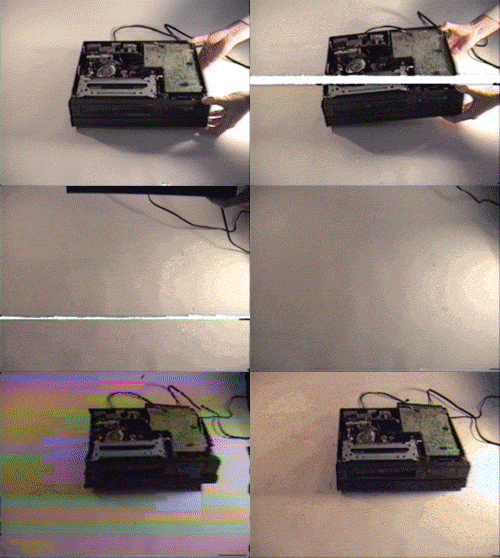
Since the VCR can get video feedback of itself, is there any computational reason why this doesn’t count as a degree of self awareness?
Turning the Systems Reply to the Chinese Room on its head, I submit that if we consider the Chinese room to be an intelligent *system*, then we must also consider the system of VCR+camera pointed at itself to be a viable AGI as well.
The correlation of corrupted video feed with the actual physical attacks on the system must be construed as awareness, especially since the video effects are unique and specifically correlated so as to present a complex vocabulary of responses. If functionalism rejects the evidence of this correlation as being experienced qualitatively, then it must posit the existence of an m-zombie (machine zombie), in which the system unintentionally mimics the responses expected from sentient computations from a sub-computational level.
Why Light is Sight (not photons)
A case against photons being necessary and sufficient to explain the experience of light:
There are many examples of scientific studies and first hand experience which implicate human visual perception as the result of neurological and phenomenological states, rather than a direct mapping of photons striking the retina of the eye.
1. What we see cannot be explained by the presence of photons alone.
From this paper, On the Neural Correlates of Visual Perception:
“Neurological findings suggest that the human striate cortex (V1) is an indispensable component of a neural substratum subserving static achromatic form perception in its own right and not simply as a central distributor of retinally derived information to extrastriate visual areas.
[…] elemental visual experiences of punctate white or colored lights called ‘phosphenes’ can be evoked in man by direct electrical stimulation of densely hemianopic striate cortex after severance of its connections to and from the LGN.”
The paper goes on to describe many neurological conditions arising from specific damage to the brain which reveal that the visual conditions which we take for granted, such as identification of shapes and motion, have their neural correlates in diverse areas of the brain. There is no video screen equivalent in the brain which which reconstructs an image from the outside world made of photons.
“Crick and Koch also proposed that explicit representations of visual features, coarse-coded neural representations that correlate with percepts or objects, are a necessary but not sufficient condition for visual experience. I find no reason to disagree with this premise.
[…]figure–ground segregation and object recognition cannot progress in a simple bottom-up serial fashion, but have to occur concurrently and interactively within recursive loops”
[…]In summary, the present model is based on the primacy of phenomenal experience (Humphrey, 1992; Nelkin, 1995; Raffman, 1995) and supports views that any possible explanation of phenomenal experience cannot be formulated solely in terms of its reportability (Chalmers, 1995).”
2. Stimulation of the visual cortex in the congenitally blind results in tactile rather than visual perception (Changes in visual cortex excitability in blind subjects as demonstrated by transcranial magnetic stimulation).
“…phosphenes could be induced in only 60% of subjects in Group 2 (blind subjects with a low degree of residual vision) and in only 20% of subjects in Group 3 (blind subjects without residual vision).
[…] Studies of the functional consequences of visual deprivation in humans have disclosed correlates of cross‐modal plasticity, with a role for the visual cortex in tactile processes (Uhlet al., 1991; Sadatoet al., 1996; Cohenet al., 1997; Büchelet al., 1998).”
“In a PET study we demonstrate that congenitally blind subjects show task- specific activation of extrastriate visual areas and parietal association areas during Braille reading, compared with auditory word processing. In contrast, blind subjects who lost their sight after puberty show additional activation in the primary visual cortex with the same tasks. Studies in blind-raised monkeys show that crossmodal responses in extrastriate areas can be elicited by somatosensory stimulation. This is consistent with the crossmodal extrastriate activations elicited by tactile processing in our congenitally blind subjects. ” – Different activation patterns in the visual cortex of late and congenitally blind subjects.
3. Visual experiences can be produced internally, and outside of the primary visual cortex.
“A phosphene is a phenomenon characterized by the experience of seeing light without light actually entering the eye.”
“this phenomenon of “seeing” without seeing in the traditional sense leads one to believe the ability to receive light is not entirely necessary. In addition, this is not a foreign concept, as when most people close the eyes, they are able to visualize images.” – Dreams: Seeing without seeing
“The results by Knauff and colleagues, also with fMRI, do not support the hypothesis that primary visual cortex is involved in visual mental imagery, but rather that a network of spatial subsystems and higher visual areas appears to be involved (Knauff, Kassubek, Mulack, & Greenlee, 2000). The results support the hypothesis that visual imagery is a function of the visual association cortex.” – Visual imagery without visual perception (Bértolo 2005).
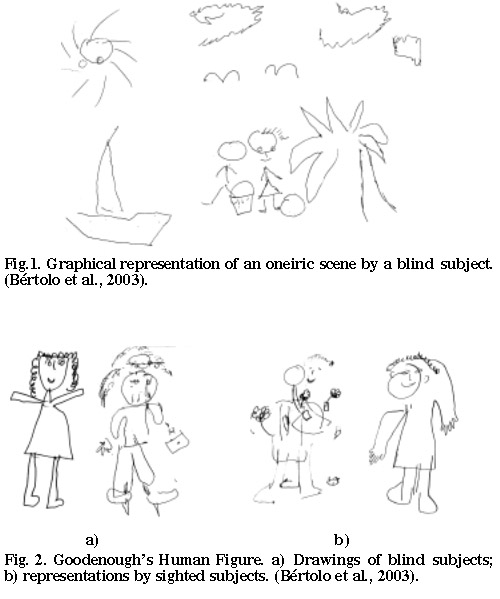
4. Congenitally blind people can interpret experience graphically.
[…]In conclusion, the congenitally blind are not only able to describe what may be the visual content of their dreams verbally, but they can provide, through drawing, a graphical representation of such content, and a significant negative correlation between the Visual Content of the dreams and the alpha power was found in both groups.” (Bértolo 2005).
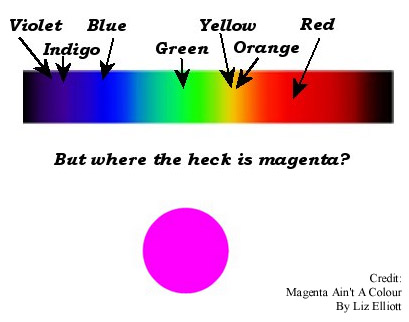
5. Color mappings are not entirely caused either by electromagnetic frequency or stimulation of the retina’s cone cells.
a. Some colors are not part of the visible spectrum
Pink and purple are combinations of red with blue or violet. Brown and beige are low intensity orange, olive is low dim green, grays and black are dark whites. – source
“This means that colours only really exist within the brain – light is indeed traveling from objects to our eyes, and each object may well be transmitting/reflecting a different set of wavelengths of light; but what essentially defines a ‘colour’ as opposed to a ‘wavelength’ is created within the brain. ” – Magenta Ain’t A Colour.
b. Color perception can change independently of the retina.
“…the number of color-sensitive cones in the human retina differs dramatically among people—by up to 40 times—yet people appear to perceive colors the same way. The findings, on the cover of this week’s journal Neuroscience, strongly suggest that our perception of color is controlled much more by our brains than by our eyes.
[… That points to some kind of normalization or auto-calibration mechanism—some kind of circuit in the brain that balances the colors for you no matter what the hardware is.” – Color Perception Is Not in the Eye of the Beholder: It’s in the Brain
6. Blindsight shows that optical information can be communicated subconsciously without a conscious experience of seeing.
A rare, but much studied condition, blindsight, along with synesthesia and anosognosia reveal that the pairing of visual qualities of experience with optical conditions is not automatic. The functions of information processing, physics, and the qualities conscious experience can all be teased out separately.
Blindsight – the ability to respond appropriately to visual inputs while lacking the feeling of having seen them – might be something which only occurs in cases of brain damage, but seems much more likely to be a significant phenomenon of intact brain function as well. Indeed, it seems likely that blindsight (and similar phenomena in other spheres) is an important ingredient of of a variety of activities where one wants to move quickly and appropriately, without “thinking about it”. – Seeing What You Don’t See
7. Photon interaction begins and ends with the isomerization of rhodopsin.
Optical processing a vast chain of mechanical reactions on multiple levels of description of the nervous system; molecular, cellular, organ, and somatic. From the indications of neurology alone, what our visual cortex would ‘see’ should really be nothing more than interruptions in the flows of glutamate from rod cells, not an array of photons. There is something called ‘dark current‘ which refers to “the depolarizing current, carried by Na+ ions, that flows into a photoreceptor cell when unstimulated” and suggests that our access to optical conditions is triggered by a silencing of ‘off’ signals rather than an instantiation of ‘on’. It might be supposed that photons are not what we see, but rather they are a measure of the initial molecular triggers which stop us from not seeing.
8. Photons with frequencies in the infra-red range are felt as heat rather than seen.
A rather obvious example, but one which reveals that photons themselves need not be seen to be detected. Ultraviolet and infrared radiation are referred to as ‘light’, but they are no more or less ‘illuminating’ than radio waves or gamma rays. Generally when we refer to light and lighting we are specifying a capacity to illuminate our visual perception, not thermal conditions. The use of light to refer to invisible phenomena is not entirely untrue, as it can be stepped down into a visible range using photographic equipment, however, unless the target of such a process is ultimately a visual experience, it is hard to justify the connection to the term, and the word ‘light’ should be considered somewhat figurative. If we refer to brain activity associated with conscious experience to be ‘neural correlates’, then we should likewise refer to physical activity associated with perceptual experience to be ‘electrodynamic correlates’ of light rather than light itself.
9. If light is sight and not photons, what is sight?
Philosophers would call it qualia, neuroscientists might call it ‘sense data’, phenomenal visual experience, or ‘static achromatic form perception’. In short, seeing light is irreducibly experiential. All light is only that which is seen, and photons do not necessarily have any visible qualities.
 Multisense Realism

Recent Comments