Archive
Continuum of Sense
I have been writing for a long time now about what I call the Multisense Continuum, or the ACME-OMMM duality. In the course of developing this hypothesis, I have learned about other such efforts, detailed below, including a recent paper:
Rigidity-chaos semantic continuum
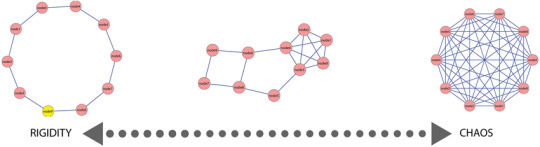
Drawing on network models, this is a promising approach, however the irony was apparent to me in the choice of terms. To see the opposite of psychological rigidity as chaos may be trivially true, however, it may also be that the chaos is a projection of the rigid, systemizing approach.
The model that I propose sees chaos as only one aspect, and not the most important aspect of the opposite of rigidity. This continuum is so universal, that I think it extends beyond ‘reality’ to embrace all of nature.
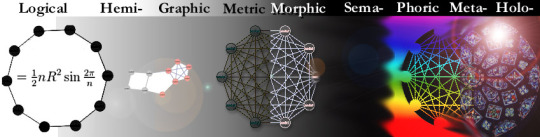
Here are some other variations:
Tough-Minded vs. Tender-Minded (William James)
interpreted the European divide between empiricists/positivists on the
one hand and German idealists/rationalist on the other hand in a
psychological way. He talked of the “tender-minded” and the
“tough-minded.” The tender-minded are the German idealists and
rationalists. (this linked source is gone, see new link for James’ original work)
The Divided Brain (Iain McGilchrist)
Psychiatrist Iain McGilchrist describes the real differences between the
left and right halves of the human brain. It’s not simply “emotion on
the right, reason on the left,” but something far more complex and
interesting.
Autistic-Psychotic Spectrum (PDF)
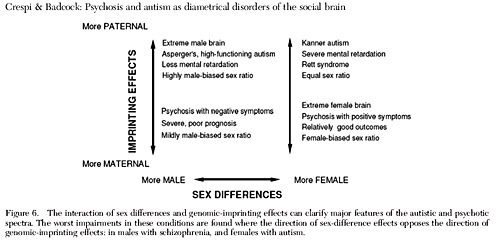
‘Thin-boundares” and “Thick-boundaries”
Significantly thinner boundaries compared to control groups have been
found in art students (Beal, 1989, Hartmann, 1991), music students, and
mixed groups of creative persons (Beal, 1989), frequent dream recallers
(Hartmann, 1991, Hartmann Elkin, & Garg 1991), adults with
nightmares (Hartmann, 1991, Levin, Galin, & Zywiak 1991; Galvin,
1993), adolescents with nightmares (Cowen and Levin, 1995), “lucid
dreamers” (Galvin, 1993), male as well as female fashion models (Ryan
2000), persons with unusual mystical experiences (Krippner,,
Wickramasekera, Wickramasekera, & Winstead, 1998), and persons with a
diagnosis of Borderline Personality Disorder, Schizoid Personality
Disorder or Schizotypal Personality Disorder (Hartmann, 1991).
Interestingly, although art students have much thinner boundaries than
average, this is not true of established artists, who have boundary
scores in the normal range (Beal, 1989).Groups that score significantly “thicker” than average
on the BQ include naval officers, salespersons, lawyers, patients with a
diagnosis of Obsessive-compulsive Personality Disorder, persons
suffering from “Alexythymia” (Hartmann, 1991), and patients (from two
different sleep disorders centers) with a diagnosis of Sleep Apnea
(Hartmann, 1992).
Empathizing-Systemizing Continuum
Empathizing and systemizing traits were independent in women, but
largely dependent in men. In men, level of systemizing skill required by
field of study was directly related to social interactive and
mindreading deficits; men’s social impairments correlated with prolonged
go/no-go response times, and men tended to apply systemizing strategies
to solve problems of empathizing or global processing: rapid perceptual
disembedding predicted heightened sensitivity to facial emotion. In
women, level of systemizing in field was related to male-typical digit
ratios and autistic superiorities in detail orientation, but not to
autistic social and communicative impairments; and perceptual
disembedding was related to social interactive skills but independent of
facial emotion and visual motion perception.
…and my own bloggings:
Zooming in on Reductionism and Extremely Gendered Brains
Ironically, but unsurprisingly, the idea of the continuum of sense itself may only be coherent when approached from the ‘East side’ of the spectrum. This has to do with what is known as Theory of Mind.
What Is Really Real?
If everything we hear, touch, smell, see are electrical impulses interpreted by our brain, then what is real out there?
“founded a new school in which he taught fallibilism, namely that every object of human knowledge involves uncertainty. Thus, he argued, it is impossible ever to arrive at the knowledge of truth. It is related that he acted on his own principles, and carried his skepticism to such an extreme, that his friends were obliged to accompany him wherever he went, so he might not be run over by carriages or fall down precipices. It is likely, though, that these reports were invented by the Dogmatists whom he opposed. ” Internet Encyclopedia of Philosophy
Does Neuroscience Crush Dualism?
Is dualism no more than philosophical debris given the advances in neuroscience?
Dualism perhaps, but so too are Physicalism and Positivism obsolete philosophies given advances in neuroscience, physics, and psychology. Idealism, Panpsychism, and Non-Dualism are, in my view, still far ahead of neuroscience and cognitive science as far as being on the right track philosophically.It is very common for people who have a Physicalist view to confuse Non-Physicalist views with Dualism, Solipsism, Anthropocentrism, Theism and Naive Realism. In some cases there is cause for this confusion, but it is more common in my experience that it is a psychological projection or Straw Man argument against the view which is diametrically opposed to their own.There is a psychological dimension to this which is important. Jung’s identification of the Shadow projection, “the thing a person has no wish to be” provides a model for how hostility and prejudice can arise, even in the most scientific mind. Other very useful concepts include the Empathizing-Systemizing Continuum or Psychotic-Autistic Spectrum.
In short, the mind which is extremely Systemizing by default tends to suppress its potentials for Empathizing, resulting in a rigid, combative cynicism against anything which is perceive as anti-scientific (really Anti-Systemizing). Extremely Empathizing minds have identical response to what they perceive as Anti-Empathizing so that neither side can actually listen to the other’s perspective and both parties argue past each other. I call these reactionary and radical extremes OMMM and ACME respectively (Only Material Mechanisms Matter and Anything Can Mean Everything) War of the Worldviews.

Even neuroscience itself can be used to understand the limits of the current Neuroscientific approach. Brain lateralization, though held in disfavor after being overly hyped for several years, still has profound neuroscientific value (as explained in the video The divided brain). Animals with brains seem to split their consciousness between narrow, logical focus on the most immediate details of perception and broad environmental sensitivity.William James talked about ‘Tough-Minded’ vs ‘Tender-Minded’ philosophies.
[…]he interpreted the European divide between empiricists/positivists on the one hand and German idealists/rationalist on the other hand in a psychological way. He talked of the “tender-minded” and the “tough-minded.” The tender-minded are the German idealists and rationalists. Tough-Minded vs. Tender-Minded: William James’ Pragmatism and the Empiricist-Rationalist Divide
More recently Ernest Hartmann expanded it to a more general notion of ‘thin-boundares” and “thick-boundaries” in his book Boundaries: A New Way to Look at the World.
In my own understanding, I reconcile both ends of the spectrum to try to understand the underlying unity, which I identify as ordinary ‘Sense’. The qualities of thick/tough and thin/tender are seen as a consequence of direct Sensing and indirect Sense-Making modes of Sense which have evolved, and continue to evolve novelty and self-enrichment on many levels simultaneously.
This turns out to be along the lines of what many schools of Western Mysticism and Eastern Philosophy have taught, except where they used Spiritual terms, my approach draws on semiotics and general systems theory. What many traditions identify as God or Spirit, I see as an Aesthetic Foundation or Pansensitivity which accounts for both Theistic and Atheistic appearances without collapsing into relativism. Sense is Absolute, and Relative-but-not-Absolutely Relative.For those Systemizing readers whose blood pressure is already climbing at reading this, you might want to stop while you’re ahead, before I add more fuel to the fire. Warning, silly sounding neologisms ahead…
Materialist Monism is actually Crypto-Cartesianism.
In other words, the conventional scientific worldview treats consciousness as an ’emergent property’ or ‘information processing’ without grounding those terms in physics itself. Since Physicalism and Functionalism reduce nature to unconscious, automatic interaction of forces and probabilities, all appeals to emergence or integration are really metaphysical appeals to panpsychism. The OMMM answer to Dualism, Solipsism, Anthropocentrism, Theism and Naive Realism are the diametrically pathological exaggerations: Nihilism, Nilipsism, Mechanemorphism, Anti-Theism, and Anti-Realist Sophism.
In the perpetual argument between the two extremes, the Superstitious Charlatan archetype is projected by its antagonist, the Substitutious Inquisitor. For every ACME appeal to God or Spirit, the OMMM counter-appeals to a mechanical substitute. Nothing can be considered ‘special’ except the negation of the ‘special’ through compulsive debunking. Words like ‘merely’, and ‘simply’ are thrown around liberally, as are epithets of ‘nonsense’, ‘rubbish’, ‘postmodernism’, and ‘word-salad’. Feelings and thoughts are merely electrochemical patterns in a brain. For everything imaginative or mysterious there is condescension and venomous hostility. For everything personal or subjective there is an impersonal object to substitute.
The final irony of course is that in seeking to nullify the personal self*, the denier of human specialness paints a mental picture of a universe of radical anthropocentrism. In this universe where all phenomena, even evanescent neutrinos and dark matter are absolutely real, there is only one phenomenon, one delusion conjured** by the brain function of Homo sapiens, which is absolutely unreal, and which contains all of the direct experience of Reality we can ever have. Instead of perception, we have deception† and instead of a phenomenal, sensible universe, we have a dualism consisting of two nihilverses – one devoid of life and consciousness, the other devoid of reality and truth.
*or Science forbid, “Soul”!
**Emergently, and Naturally of course
†with one ‘scientific’ exception
Are Ideas Physically Manifested in the Brain?
I don’t think that ideas can be said to be physically manifested, unless we extend physics to include phenomenology. Neurons, brains, and bodies* can all be reduced to the behavior of three dimensional structures in space. In this context, behavior is really the function of those 3D structures over time, and function is a chronological sequence (so a fourth dimension or 3D+1D) of changes in those structures. All such changes can be described in terms of movements of structural units, typically atoms or molecules, as they are rearranged according to deterministic and random-seeming chain reactions. The existence of ‘ideas’ or consciousness within such a system is, to paraphrase William James, “an illegitimate birth in any philosophy that starts without it, and yet professes to explain all facts by continuous evolution.
This is to say that there is no logical entailment which can explain how we get from a phenomenon which can be imagined to be composed of countless particle collisions that look like like this:
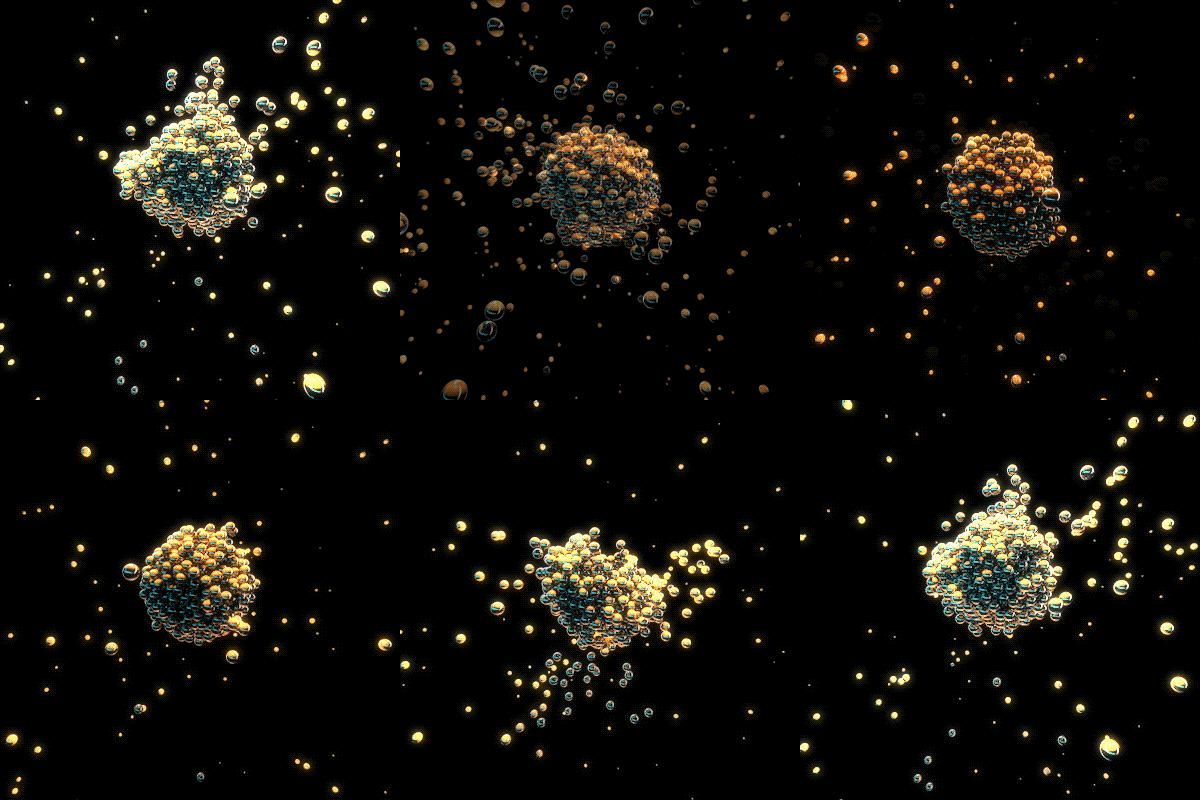
to something else. This gap, known in Philosophy of Mind as the Explanatory Gap, and the existence of that something else in the first place (known as the Hard Problem of Consciousness) are the two insurmountable obstacles for anti-idealistic worldviews**.
What many computer scientists may not appreciate is that while the theoretical underpinnings of information science point to brains being reducible to simple arithmetic functions, this reduction cuts both ways. If we can reduce everything that a brain does to a computation which can be embodied on any material substrate, that also means that no semantic content is required, other than low level digital logic. Just as all of the content of the internet can be routed by dumb devices which have no appreciation of images or dialogue, so too can the entire content of the brain be reproduced without any thoughts, feelings, or ideas.
Once we have used a mathematical or physical schema to encode our communication, there is no functional benefit to be gained by decoding it into any form other than computation. The computation alone – invisible, intangible, silent facts about the parts of a calculating machine in relation to each other (3D+1) is all that is necessary or sufficient to execute whatever behaviors will allow an animal’s body to survive and reproduce. Once we have converted conscious experience to localized machine signals, the signals alone are enough to generate any physical effect, without signifying any non-local content. This is what Searle was talking about with the Chinese Room, and is known as the symbol grounding problem.
In consideration of the above, the answer to the question is “no”. What is present in the brain can only be a-signifying material relations, not ideas. The connection between matter and ideas cannot be accessed in terms of physics or information, but only in the direct aesthetic participation which we call ‘consciousness’. In my view, it is not consciousness which is emergent from information or mechanisms, but information and mechanisms which are ‘diffracted’ or alienated from consciousness.
*not to mention windmills, computers, and rooms with people translating messages that they don’t understand from a book.
**These would include materialism, eliminativism, logical positivism, behaviorism, empiricism, verificationism, functionalism, computationalism, and emergentism.
Information Theory 1.1
1/25/2016 Information Theory Update
Here are some notes which I hope will provide a more concise understanding about the nature of computation, logic, and mathematics.
Information theories such as those offered by Shannon and Turing give us cause to see an underlying universality of information which is rooted in simple Arithmetic truths such as addition, multiplication, and integers. These arithmetic truths are theories with can be applied successfully to computing machines without regard to their physical substrate*. While this offers a method to deploy universal principles to the control of a specific mechanism, the control which is offered is different in kind from the literal (motor) control of the hardware. Motor control of computer hardware can be accomplished electromagnetically or classically (as with analog clocks with gears powered by spring tension or a gravity pendulum), and now quantum-mechanically to some extent, but not directly by math. Mathematics cannot turn a computer on or keep it running, it can only provide a non-local set of rules which can be localized through motor control.
This is critically important to understand when considering the possibility of Artificial Intelligence: Computation can only be absolutely general or absolutely specific. When we implement a logic circuit, we are not literally imposing philosophical logic on a circuit, rather we are only interpreting the physical changes of a device metaphorically. In short, a logic circuit cannot literally represent a state of 1/0 or True/False, it can only literally present a concrete state of being switched to Stop (Off) or Go (On). This is the territory of computation – what is known as Layer 1 in the seven layer OSI network model**. All higher layers are not physical territories but logical maps – human abstractions projected by software engineers and application users.

For this reason, no computing machine can represent the middle ranges between the absolute generality of mathematical theory and the absolute specificity of a machine’s physical condition. It’s all above-the-line of personal awareness (oceanic metaphor) or below-the-line (granular semaphores). We can get a lot of utility out of these devices, however we can’t get any empathy from them. They can’t care about anything or anyone, since ‘they’ are purely in our imagination.
The philosophically relevant part of what I’m proposing applies to the prospects for generating natural intelligence artificially. AGI that feels as well as thinks is not necessarily desirable, but if my view is on the right track, computers becoming sentient is not something that we need to worry about. It won’t happen. Why? Because mathematics is not accessing the Physical layer from the top down but from the beneath the bottom layer. This means that even though we can use a computing device to validate truth conditions, we can only validate those truths with refer literally to the concrete states of the machine, and those truths which refer figuratively to the universal arithmetic relations. Nothing that a computer does needs to be *about* anything beyond the machine’s physical state, and so any appearance of emotion, intention, sensitivity, etc are purely hypothetical and would violate parsimony. Church-Turing Thesis lays out the framework for universal computing, but in saying that all functions of calculation can be reduced to a-signifying digital steps, we are also saying that all semantic meanings shall be reduced to blind syntax. It cuts both ways.
Isn’t the brain just a biological computer?
No. This is an obsolete idea, for a lot of reasons which I won’t get into here, but suffice it to say, the brain is an organ within a living body which developed organically from a single self-replicating, self-modifying cell. Machines, by contrast, are assembled artificially from naturally unaffiliated substances and parts. That’s not a reason to discount the possibility of sentience through silicon, but it is a reason to go beyond knee-jerk presumptions that continue to dominate thinking about AI. While Turing’s genius is only now beginning to receive the appreciation it deserves, the shortcomings of his Imitation Game approach have not yet been widely understood.
Alan Turing can be pardoned for his reliance on mid-century Behaviorism as a psychological model, since it was very popular at the time and also because, along with others, I suspect that his natural instincts were quite systemizing/autistic. This carries over in modern populations, with autistic-masculine influences far overwhelming the psychotic-feminine influences in computer science and engineering fields. As a result, we have a lot of strong, controlling voices which insist upon reducing psychology to mechanistic terms, and all dimensions of consciousness to processing of logical information. This is so pervasive that any casual conversation online which challenges the supremacy of first-order logic will tend to erupt into a firestorm that ends with something like “Yeah I’m done here. You’re just spouting nonsense“.
To this end, I find this pyramid model for debate at least as important as the other models of information networking:

My call for civility in discussion is not mere political correctness or over-sensitivity, but rather a purely pragmatic consideration. Unlike a computer, the human mind loses its capacity for curiosity and fairness when it falls into aggression. People talk over each other and assert their opinions ever more rigidly and repetitively rather than thinking creatively. This mirrors the action of computation itself – recursive enumeration masquerading as communication.
A great many people think they are thinking when they are merely rearranging their prejudices. – William James
*Not entirely true. The physical substrate of a machine requires precision and solidity. We cannot build a computer out of clouds or fog, it needs to be made of something physical which stays put and which has at least one absolutely persistent read/write capacity. Traditional logic circuits must be implemented physically through a rigid skeleton of readable coordinates.
**It has been popular in recent years to proclaim that the OSI Model is dead. The feeling is that TCP/IP is the predominant protocol suite being used in the real world, and it doesn’t match up with OSI, so we should dump OSI in favor of something like this:

I do see the appeal of this, however, agree with this author that “OSI teaches more of the reasoning behind making multiple layers and what they do. Collapsing the traditional model for the sake of making it look like TCP/IP is going to cause more harm than good.” – Tom Hillingsworth
A Theory of Aesthetic Diffraction

“If we split the atom cloud into two parts and recombine them after some time, a wave pattern forms” – source article
Yesterday I was looking at the sun on the water and thinking about how it is an analogy for consciousness and the brain and quantum entanglement. Each point of light reflects an image of the same sun, even though it appears disconnected and changing chaotically on the surface waves. At the same time, we can see a larger group coherence and intermediate scale, waves-of-waves coherence.
In the top image we understand that the coherence reflects a single light source onto a changing surface, in the brain we speculate on biochemical mechanisms within the surfaces which are connecting to each other. In the bottom image, we conflate the wave pattern with the surface itself, but then eliminate the surface altogether. What is being reflected or experienced is obscured altogether in the bottom up QM model.
By thinking of the sunlight as a metaphor for the mind-body problem, we can see how the explanatory gap can be closed. Using physics to look for consciousness is the same as looking at the surface of the water to look for the sun. In this case, the ‘sun’ isn’t a distant star, but the immediately present aesthetic experience of conscious.
Ready for some neologisms? Okay, this gets ugly.
A Theory of Aesthetic Diffraction
In my Multisense Realism project, I have tried to piece together some ideas about consciousness and physics. These include:
- Light as sight. Photons are reflected incidents of ‘seeing’ or some other aesthetic acquaintance on the micro-level.
- Aesthetic participation or sense as the root of consciousness, rather than an evolution of survival based intellect, information integration, or biophysics.
- Local aesthetic phenomena (sense modalities as well as sense content) are like puzzle pieces of universal Pansense or Multisense Continuum which includes physics.
- Sense as the absolute frame of reference or ‘Sole Entropy Well’.*
- Space time are the mulitplication/diffraction of sense.
- Sense is aesthetic content, like universal qualia, rather than a subject-object relation.
- Significance is the saturation of sense, and its teleological function.
To these I would now add:
The brain is a Polysynchronizing Aesthetic Diffraction Engine.
(Composed of smaller, neuronal PADEs, which are in turn composed of smaller molecular PADEs.)
If we really wanted to see if this is true, I think that there might be a way to begin to find out. A couple of clues:
On the physics side, try turning Permittivity (ε) and Permeability (μ) ‘inside out’, so that we are thinking in terms of electromagnetic effects as reflections of sensory-motive affects rather than causal “fields”. The affect is not itself a field but a spatio-temporal or quantized diffraction…a temporalized, and then spatially dislocated disentanglement from the otherwise boundaryless, absolute context of Pansense.
Looking at the etymology of permit and permeate, we can get another clue in the original sense of the Latin root mittere ‘to send, let go.’ By contrast, permeate is to ‘go through’, from the root meare ‘pass, go’. The expectation of electric and magnetic fields is that they are different ways of looking at the same thing, but the difference is hard to define other than mathematically. I think that as long as we are take the concepts of force and field literally, we will be missing a critical opportunity for understanding nature.
When we turn permittivity and permeability inside out, we go from a Western concept of isolated material objects separated by a vacuum, to an Eastern-like concept of trans-material experiences which are temporarily fragmented from the totality of experience. This fragmentation or diffraction looks like distance or scale and the disappearance of the past, when viewed through the brain.
The Western model conceives of matter as complex nested fields which permit and are permeated by radiant forces. Inverting that takes us from a world of external waves oscillating meaninglessly to a world of felt affects and semi-intentional effects. Behind electromagnetic effects observed within local body frames of reference are phenomenal experiences of ‘going’ and ‘letting go’** in relation to the eternal and trans-local.
The per-mitting of ‘electricity’ translates to the fracturing or branching (think of lightning or a spark) of chaotic motive impulses to release across external frames of reference. The per-meating of ‘magnetism’ translates to a re-cycling or reabsorbing of motive impulses into what Leibniz might have called pre-established harmonies and Sheldrake might call morphic resonance. The difference in what I’m talking about is that what is resonating is not a vacuum or an aether – not a physicalized medium, but ordinary feelings, sensations, and experiences. In this way, relativistic models can be reconciled with quantum models through aesthetic participation as the final transceiving/transducting hyposurface†. This is literally ‘emergence’…the inflection point between these two extremes:
1. The information-based electrodynamic microcosm, which is reflected back to sense as its shadow. The shadow appears to its originator as polarized in terms of automaticity vs chaos-probability. The appearance of the originator can be inferred by inverting the qualities of the shadow, so that rather than crests and troughs of determinism, we can understand ourselves as that which appreciates and creatively determines the shadow.
2. The anchoring frame-based (gravitostatic?) astrocosm derived from the constancy of light speed and gravity. This is the sense of holarchy of scale as well as a hierarchy of importance. Physics can have no preferred frame of reference, so the preferring has to come from:
3. The participation-based mesocosm. Between the two extremes of mindless subatomic computation and mindless block space-time geometry is perception itself. An angle or ray of participation, illuminating and isolating ‘attentions’ while presenting the opportunity to create ‘intentions’.
For us, the mesocosm is reflected back to itself as an elaborate organic chemical hypersurface, nested within another zoological hypersurface. I think that the appearance of neurochemistry as we encounter it objectively is only a single surface or layer of aesthetic presentation which anchors the representation of the larger history of our particular experience as it grew from the physical to the chemical, genetic, biological, zoological, and anthropological frames.
On the perception side, I think that there are clues to be found in researching cross-modal perception and what I might call trans-modal perception. Cross-modal perception is an innate sense of isomorphism across sense modalities such as visual to verbal (Kiki-Bobo effect), onomatopoeia (phonetic to verbal). Trans-modal perception is a term that I propose could be used to talk about such phenomena as sounds which can be felt tangibly (i.e. high pitch sounds are highly localized and penetrating to the ear, while low, booming sounds envelope the entire room, drawing attention to the micro-personal or the oceanic shared transpersonal respectively.)
Conditions such as tinnitis, vertigo, epileptic halos, and synesthesia also seem to promise deeper understanding of sense as they point to the possibility of sense modalities as divergent categories of pansense rather than emergent properties of the functioning of sense organs. Just as physics requires instruments to push the limits of speed and detection into super-human ranges, a true study of consciousness requires examples or methods which transcend normal ranges of human experience. Autistic and psychotic spectrum conditions are especially important as a guide for the underlying axis of human sense-making, and I suspect that they can be meaningfully defined in terms of high and low permeability/permittivity (branching out of electricalimpulses, and recycling back to magnetic ground-state).
*This could be thought of as the sole/absolute ‘surface’ of aesthetic diffraction.
**This maps back to a language theme that I come back to frequently from the PIE root words ‘wag’ and ‘wegh’, like yin and yang…a universal oscillation or tessellation between push-pull (electric or sense-mitting phase) and relax-reflect (magnetic or sense-mearing phase) qualities of experience. Magnetic effects can be thought of as in between electric flux and gravitational grounding. Gravity shows us the orientation of mass toward massive frames of reference, while magnetism shows how local disorientation of mass can be accomplished through electric fluctuation (effort or kinetic energy).
† I say hyposurface to say that sense is both the larger context which contains all levels or planes of description as well as transcendent to the idea of planes and surfaces themselves. Sense is trans-spatiotemporal. Space, time, planes, frames, etc are carved out of the totality as a diffraction rather than as an emanation from fore-fields in a vacuum.
Is Time an Infinite Set of Moments?
…or is the whole notion of an infinite set a paradox?
Since a set is by definition a defining of a boundary, whenever we talk about sets which are infinite we are talking about a boundary containing unbounded contents. Such a boundary makes it necessary that boundary-making itself is presumed to be outside of things being bound, i.e. it is taken as axiomatic that boundary making is part of a theory which does not change anything except our own understanding.
Things get murky however, when we consider time an infinite set. In Zeno’s Paradox of the Tortoise and Achilles, for example, the idea of an infinite set is used to trick us into thinking that motion is impossible. The logic is that for something to move one unit of distance, it must first move an infinite number of smaller distances. We can reverse this logic, however, and say that to divide one distance into an infinite number of smaller distances in the first place would take an infinitely long time if we had to actually make those measurements in some way, provided each measurement takes a non-zero amount of time.
Here is the difference between the map and the territory. Actually moving across a distance is a ‘territory’; a concrete reality. The idea that there is some number of points in which could be measured along that distance is a theoretical abstraction. When we apply the abstraction of infinity to the reality of concrete phenomena, we get paradox. The tortoise’s lead appears to always be getting smaller and smaller, but is still a nonzero fraction of the total distance ahead of Achilles, no matter how much faster Achilles is. What distracts us is that we are taking our own measurement for granted. Yes, it’s true that each measurement at time t will find the tortoise ahead of Achilles if we keep giving the tortoise a fraction of his original head start after calculating Achilles position, but infinity doesn’t end at that measurement. Infinity means not only that there will always be a measurement where the tortoise is ahead, it also means that there will always be an interval after the measurement where Achilles overtakes the velocity challenged reptile. In short, an infinite set means that the set always will extend beyond itself.
The physical allegory of the infinite set is a universe of stars and galaxies which expands into an infinity of empty space. But can emptiness really envelope things or is it the expansion of things which exists on its own without any envelope? Is the assumption of empty space really a projection of our own intellectual expectations of set-making? I think that it is important to see that Einsteinian spacetime calculations would work the same either way. Spacetime need not be a literal container of mass-energy, if mass-energy is already entangled at superliminal rates. It makes it easy to think of General Relativity as referring to a spatiotemporal entity (a ‘reference mollusk’ as Einstein called it, or a Minkowski space), but the reality may be that spacetime is nothing more than the influence that the entangled consensus of mass-energetic relations has on itself. This way, no envelope of infinite emptiness is required around the Big Bang, and the vacuum can leave its quantum contents behind to revert to a true void. The vacuum energy gets turned inside out…it’s not inside of spacetime, it’s inside of relativity, i.e. universal perceptual entanglement.
Eastern and Western Eternity
If the Western view of time is an unlimited set of (limited) moments, then eternity is purely conceptual – the perpetually incomplete ‘set-hood’ of that set. The Western sense of eternity is also of perpetually filling itself with more and more clock ticks. Eastern mystics have promised instead that the fundamental truth of nature is the antithesis of that: A timeless connectedness of all things, or a universal connectability (The Force, Field, Love*, God) from which all ‘things’ are seemingly detached. Such a detachment is described as an illusion or temporary masking of underlying unity which remains eternal and pervasive. From the Eastern view, it is not space and time which contain all phenomena, but rather times and spaces are emergent dissociations within the grand phenomenality.
With the advent of General Relativity, the pendulum of Western thought began unknowingly to swing Eastward. Eternity came to be seen as a universal 4D manifold which distorts rates and lengths of physical processes. The distortions are understood to be relative to frames of reference; they are the ‘appearances’ of each frame to any other rather than a fixed physical property common to all frames. Frames themselves are, like the tortoise, given an unfair advantage of inheriting our ignorance of the nature of perception. Physics has attributed a frame-making capacity from a purely theoretical warrant, a warrant which magically acquires real powers of perceptual transformation (Lorentz contraction/dilation) which define the universe.
Some will complain that inertial or Galilean frames have nothing to do with perception, that they are tied only to linear velocity, however this takes velocity relations for granted in the same way that infinite sets take sets for granted. Here is where Relativity and QM completely agree. They both hinge on the concrete physical fact of measurement as the relation between properties such as space, time, position, and momentum. The measurement is a thing that separates the uncollapsed theoretical wave from the concrete wave-effects which are common to matter.
I submit that measurement itself is only the superficial way of understanding what is going on behind SR, GR, and QM. What makes measurement possible – all measurement – is an intrinsic relatability or sense which pervades all of physics. It is only parsimonious to assume at this point that this relatability is identical to the awareness which underlies our own conscious experience.
As it stands now, theoretical physics must resort to a kind of dualism where the idea of an ‘observer’ is somehow presumed separate from conscious observation. Any deviation from this premise is taboo and treated with antipathy. The Western imagination has been captured by positivism, so that all legitimate phenomena begin with an assumption of being separable from phenomenology. This unfortunately leaves phenomenology itself orphaned from physics, and the purest contents of conscious experience orphaned from legitimacy. We turn to the idea of “emergence” to reclaim some semblance of coherence, but emergence itself is no more physical or derivable from logic than consciousness itself.
Relativity applies to instantaneity as well as simultaneity.
To further bridge the Einsteinian notion of eternity with the Eastern one, I suggest a relativity of instantaneity. We can see from time lapse photography, for example, that different rates of exposure present nature at speeds of time. If we had nanobots we could surely step down our own body motions so that we could interact remotely with nanoscale objects at scales and speeds which would not be possible to us on the macro scale.
We can also see how the ocean appears to slow to a crawl when seen from the air. Interestingly, the trails that boats make in their wake appear to flow against a solid background of standing ocean waves.

In this photo you can’t see it, but next time you are flying over the water, notice how the narrow wake tracks which cross-cross the static ocean shimmer with movement. I’m curious about the physics of this – is it the distance of the plane or the speed which averages out the speed of water, and then the motion of the boat which makes some of the speed visible? Some kind of phase-cancellation?
It is this kind of transformation which I’m referring to as the relativity of instantaneity. The scope of the instant depends on perspective, and physics, having no preferred perspective, can have no way to define any separation between instants or any set which unites them. In this way, emergent properties themselves emerge from perception.
East vs West
I suspect that both views of time are reflections of the perspective from which they emerge. Eastern or Empathizing psychologies focus on the unity of categories in the category-making mind itself while Western, Systemizing modes focus on impersonal categories, the origin of which is seen as irrelevant. As the two modes have grown apart, they are no longer able to locate each other without distorting them into a straw man. The Western mind sees the Eastern view as an overestimation of our own presence (including the present moment) while the Eastern mind sees the fatal flaw of the Western effort to deflate the presence of the now and its presenter. Interestingly, the antipathy flips in the assignment of blame, with the Western skeptic taking personal umbrage at the individuals who they see as peddlers of ‘woo-woo’ superstition and postmodern ‘word salad’. By contrast, the Eastern mystic sees the Western resistance as a function of impersonal forces of spiritual immaturity. This dynamic of projection and inversion is a good place to study the lensing of consciousness. The model which I propose suggests that studying how people argue will show that fundamentalist positions on either side will have more in common with each other neurologically than there will be differences. From there we can begin to map the blind spot of the Western approach as it cascades down through academic policies, experiment design, and finally economics, and politics.
The Western approach is intrinsically bottom up in that it begins with a collection of external particulars and then extrapolates generalities and universal laws. Scientific thought is an analytic introspection which is intended to generate a synthetic ‘extraspection’. Our naive, introspective sense of the present time is as Edwin Schrodinger and Ken Wilber point out is “the only thing that has no end”. Meaning that we literally cannot locate within the present any beginning or ending. Only memories within the present which seem to explain things outside of the present can be found:
“We dissipate our energies in fantasy mists of memories and expectations, and thus deprive the living present of its fundamental reality and reduce it to a “specious present”, a slender present that endures a mere one or two seconds, a pale shadow of the eternal Present.”
-Ken Wilber, No Boundary
It seems clear to me that the Western view is dominated by the specific function of the intellect, which is to isolate problems and analyze them sequentially. Using the intellect to analyze itself, we conflate mental kinds of functions with nature in general and have learned to mistake this map of our own map-making for the territory. Because the Western mind identifies with itself rather than with the consciousness behind thought, it inverts our own existence into a ‘specious presence’. First an orphaned soul in an Enlightened machine, then a self-modeling semantic mechanism, the personal presence has now been so aggressively deflated that many insist that it has no existence at all.
If the Western view overlooks the magnitude of significance of the present in its modeling of time, the Eastern view overlooks the overwhelming influence of non-human scales of the present in the universe. The human scale of ‘now’ is overly preferred, so that the Western half of the universe, with its bottom up chains of causality, can be discounted irrationally (hence the woo-woo). This means that the vital and important contributions of science and technology can be dismissed by the Eastern approach, thus losing all credibility with Western thinkers. The sentiment that thoughts create reality is straw-manned to imply that human thoughts create all reality, when the truth is that human influence may be both more powerful and less powerful than we imagine.
Coming Together Over Time
I propose that the way to transcend the problematic notions of time in both the Western and Eastern modes is to see time as the “most common sense” through which eternity ‘pretends’ to be each moment, and how the eternal moment pretends to its own eachness. Time is what limits the unlimited and opens the limited to the possibility of the infinite.
Because the Western view of time has resulted in an all-but-insignificant present, it has contrived an all-but insignificant subjective conscious presence to act as an almost-disposable timekeeper. The ‘observer’ in physics is naught but a convergence of particular coordinates…coordinates which themselves are only defined by there own axiomatic coordination. The cosmos appears as an unorchestrated orchestration…an autoverse rather than universe.
The Eastern view inflates the present and the subjective presence to the absolute extreme, so that the cosmos appears as an unfalsifiably teleological monolith. This infuriates the Western mind, hearing soft-headed homilies of ‘There are no coincidences’ and ‘Everything happens for a reason’ to justify pre-scientific superstition. This would be a solipseverse rather than a universe – a universe which fits into single self. Monotheism splits the difference, with a Unisolipse – a single God self who is not us, but who is like us and can help us and care about us.
What I propose is that each of these models fall out naturally as reflections from a sense-based foundation. The true universe is an orchestration of (orchestration-unorchestration) of perceived qualities and conditions. A paratheistic or ambitheistic society of self-elaborating experiences.
*Love to me seems more human-centric or mammal-centric to me, but I think that Love could be better understood in this context as the most recent form of empathy or sense. Sense allows wholes and parts to partially disconnect and reconnect with the whole.
 Multisense Realism
Recent Comments