Archive
Updated Introduction
3. Overview
I am always trying to sum up multisense realism in a simple way, as I think it ultimately is pretty simple, but it is hard to put it simply because it requires that we overturn some core assumptions about how we look at the self and the universe.
I consider my model to be neither dualist nor monist, but an “Ouroboran” monism, meaning that physics itself is the capacity for sensory experience and discernment and that it is involuted in a reflexive, “umbilical” relation to itself. The idea is that experience and matter are the private and public ranges of physical phenomena. The involution (like a Klein bottle or Möbius strip) refers to the orthogonal or perpendicular juxtaposition between sensorimotive-based private experience and spacetime-based public realism.
If we begin with this diagram which I have pilfered from memeengine:

and then progress, like those schizophrenic cat portraits, into the mind bending rabbit hole that is Multisense Realism…

Here, I am trying to introduce the notion of a continuum between the three ‘ism’s above, to indicate that the cosmos supports all three inherently because it is that juxtaposition/symmetry which is actually more primary than any of them. Not the symmetry itself – which is more of a mathematical relation that is somewhat abstract, but the capacity to detect and respond to patterns like symmetry – the capacity to sense and participate in the universe. What I wound up with was more of a yin yang taijutsu arrangement which maybe hints at an East side where experience is purely subjective, a West side which is all representations of what is presumed purely objective, and a midrange which is about perception as a body in the world of comparably scaled bodies.

Not content with that, I went on to try to get more of the flavor of it with nested scale bodies in a Cartesian grid of blue vector arrows representing energy and function (the disowned idealism of the West haunts the machine as ‘energy’ and ‘information’). On the East side, there is the solipsistic fisheye distortion which is all cluttered up with my conceptions of sub-personal, super-personal, and the arrow of motive power.

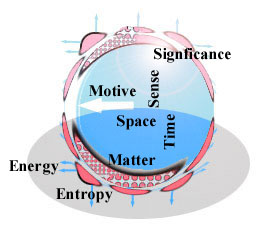
Wrapping this mess up, I put the atomic dots where they belong, on the inside surface of the experiential bubble of the Absolute. Make sense? Haha.
In Multisense Realism, all of physics is understood to relate to the capacity to discern between public and private views of phenomena. Public physics appears to us as ‘matter and energy’ on the outside and ‘perception and participation’ on the inside. The gap which makes this involution or twist possible is the modulation between the presence and absence or sensory presence, with the absence being what is called entropy or spacetime (which become essentially the same thing under this model of physics). To make things more confusing, this modulation of entropy and sensitivity is nested within many layers of itself, as a fractal. A cell encapsulates a world of molecular interaction. An organ encapsulates a world of cells, etc.
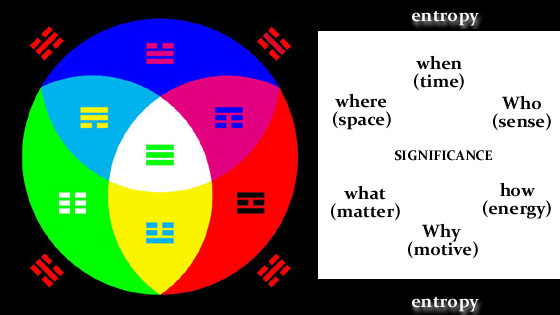
What started as an observation about the common positions that people seem to take within philosophy of mind debates became a hypothesis about the continuum of public and private sense experience, a re-interpretation of light, cosmology, consciousness, and the introduction of new concepts like significance and solitropy.
These two images try to capture the overall picture of how all major features of the cosmos can smoothly fit together.

The Future of Computing — Reuniting Bits and Atoms
A great presentation on computing with hardware and software which are homomorphic to each other. Logical automata (explained 11:51 to 15:50) is just this sort of a WYSIWYG architecture where the software is executed from a bulk raw material, i.e., not Gb of memory or number of processor cores, but square feet or pounds of programmable matter. Atoms, or groups of atoms, are here used directly as bits.
Gershenfeld compares how our current approach of computing requires multiple stages of compiling disparate formats, but that to more closely match nature, we should strive to imitate nature in the sense of having a consistent zoomable format on every scale.

In nature, the map is the same graphically regardless of the scope of magnification. Marrying these two concepts, the idea is to design shapes which are themselves instructions, i.e. physical interactions with other physical shapes, so that computation is not encoded but rather, embodied. As in biochemistry, the output is a material product, and the machine is itself is a self fabricating machine tool as opposed to a manufacturer of inert objects.
I think that he is probably right that this is the direction of the future in general, “computing aligned with nature” which brings computation into matter. It is compelling to imagine that this kind of embodied computing could be the Holy Grail of nano-engineering, giving us control over virtually anything eventually.
At the same time I can see that there is something which has been overlooked. To quote Deleuze:
“Representation fails to capture the affirmed world of difference. Representation has only a single center, a unique and receding perspective, and in the consequence a false depth. It mediates everything, but mobilizes and moves nothing.”
– Gilles Deleuze, Difference and Repetition, p56
(source http://sleepinginthegreenery.blogspot.co.uk/)
To understand why this universe of embodied computation is not the universe that we live in, Difference is the key. An overhead map is only so useful to us. Even if we can zoom down to the human scale level, we really need to switch to a first person street view to make the transition from outside-looking-down to inside-looking-around. To get further into the subjective view, we would have to have access to feelings and thoughts, so that at some level of description the model of zoomable shapes is less than useless. In our personal awareness, the appearance of neurological structures in our view would be hallucination.
The assumption then of this uniformly computational matter, while fantastic for our purposes as human beings, would be a catastrophe for the universe in general. It would be the ultimate monoculture, with everything and anything reinvented as collections of positionable nano-Legos. The problem of conformity to a generic, universal structure is not that it won’t work, but that if it does, there will be no Difference possible.
Given Deleuze’s assertion that representation moves nothing, this intention of “reuniting bits with atoms’ seems to presume that they were united to begin with but doesn’t address why they were ever separated. Indeed, if this method of embodied computation is the way of nature, how and why could it ever seem otherwise? Where have these Different perspectives on different levels emerged from, and for what purpose?
I think that on closer inspection, even though this new approach is brilliant and revolutionary in some important ways, it still is founded on a sloppy assumption. It presumes that hardware which looks and acts like the software is identical to it. If this were the case, instead of images we would see the shapes of ganglia and retinal cells, but we would see the same thing instead of smells, sounds, and feelings. We could not feel dizzy, but rather be informed of some vestibular condition by means of these same shapes – which we think of visually or tangibly, but without the Difference, there really is no reason to assume anything perceptual at all.
Once again, even though I am impressed with the futuristic thinking, it still takes us away from the missing piece in physics – the privacy and interiority and qualia. Buying into the universe as undifferentiated plenum of self-machining bubbles we are betting that there is no difference between biology, chemistry, and physics. It’s all physics, all surfaces and volumes in public spaces. Is that really what the universe is though? Could our experience be understood that way if we didn’t have our own familiarity with it already? I think if we lived in a universe that was really all about universal computation, then we would never have separated bits from atoms in the first place. We never would have approached bits as encoded abstractions because we would have been comfortable already with the universal format.
Instead, the universe appears to be the opposite. On every level, even though there are repeating themes and forms, it is never exactly the same presentation. A whirlpool would not be mistaken for a galaxy and a grain of salt is not the same thing as a cube of ice. In the universe we actually live in, the only thing which seems truly universal is Difference. More universal than mathematics and physics is the variety of sensory qualities and modalities. It is not just formations or embodied information, but direct experience.
Multisense Perception Model

Another crazy looking attempt at organizing the multisense model of perception. The top diagram emphasizes how the contemporary model assumes that all phenomenal interaction is at the particle level, effected via tangible collisions of microcosmic bodies in spacetime. Higher level experiences are imagined to be epiphenomenal abstractions tied to each other through exclusively bottom up logical mechanical functions. In this model, it must be admitted that consciousness can only be a metaphysical layer of unexplained illusion.
In the bottom diagram, the dualism of private experience in white on black, and public spacetime realism in black on white gives an idea of the involuted or ‘Ouroboran’ relation between the two aesthetics. The center region depicts the public stack of spatiotemporal scale relations from microcosm to macrocosm (particles<>cells<>tissues<>sense organs/organisms). The Caduceus like split helix implies a loose hierarchical, bidirectional overlap of interlocking forms and functions on different scales and their implicit interaction with the corresponding private experiences on corresponding levels (personal, sub-personal interiorities corresponds to macrocosmic, microcosmic exteriors).
The label ‘Sensory-Motor Experiences’ at the base designates that the totality can be understood literally as sensory motor phenomena but the label and dashed halo at the top refers to the figurative capacities for empathy, semiosis, social quorum and teleology.
In this model, all layers are phenomenal and physical and consciousness or sense is a fully enfranchised, participant in physics on every level. Interaction is multivalent and multi-directional, bottom up, top down, inside out, outside in, past forward, future back.
Umbilical Monism, Unfielded Physics

I consider my view of consciousness to be neither dualist nor monist, but an “involuted monism”. The idea is that experience and matter are the private and public ranges of physics. The involution (like a Klein bottle or Mobius strip) refers to the orthogonal or perpendicular juxtaposition of the two ranges. Physics is the capacity to discern between public and private experiences and we know it as ‘matter and energy’ on the outside and ‘sensory perception and motor participation’ on the inside. The gap which makes this involution or twist possible is the absence or contraction of perception, aka entropy or spacetime.
If involuted is too abstract, maybe the word ‘umbilical’ gives a more tangible sense of what I mean. As a fetus, all of us have had as our first experience as a person as being a person within a person. Suspended in a bubble of nested humanity, our cosmos was both a closed vessel of nativity and a semi-permeable observation tank. An unknown within an unknown, with nothing but our capacity to feel and sense qualia. Even then we were putting things together on some level, forming expectations and desires about the world.
After birth, rather than being stoic imprinters and learners of the logic of our surroundings, we remain largely within the psychological womb, filled with pleasures and terrors beyond ordinary description. We scream and cry. We devour fiction and fantasy and revel in sensation. Even then, our inner world was just as important to us, if not more important, than the world we shared with others.
It’s strange to imagine that before we had ever tasted food, there was a fleshy hose extending from our belly into our placenta. The placenta is more like a lung to us, as our fetal hearts pumped oxygenated blood in through a single vein in the umbilical cord, which then splits to plug in to supply our liver and then our heart.
The involution here, as in the universe as a whole, is not only of the Russian Doll kind of nesting of bodies within bodies, but also of the Lion King kind of nesting (…♫ the Circle of Life ♫). Our life story recapitulates the history of our biological evolution, and presents a repeating narrative of familial roles. Our power waxes and wanes in counterpoint with the cycles of the lives of our parents, stereotypically anyhow, with the caregivers becoming care-receivers in old age…at least before our civilization evolved to deal in more… impersonal values.
The transition between Russian Doll matters and Lion King experiences can be understood better if we allow experiences to be defined in the terms in which they are presented to us. Feeling, thoughts, images, have no field-like parameters. They have no discrete positions or portable content. All of our experiences occur “here”.
In my view, all of our efforts in understanding the mind-body relation have been biased by the compulsion to explain matter as an illusion (idealism) or mind as an illusion (materialism), or the distinction between mind and matter as an illusion (functionalism). In turning these three birds inside out, we can find a common egg – only it isn’t an egg, it is sense itself. Without reaching for phlogistons or aethers, vacuum flux energies, or other cosmic fluids, our own awareness could be understood as an un-field. Just as the space between your eyeballs and these words does not seem to be filled with any particularly charged space, the range of our visual sense is a function of our own sensitivity and the nature of what we are seeing. There is no field which is causing our sense. We are simply present with other presences.
Why do pitches separated by an octave sound “the same”?
Answer by Paul King:
This phenomenon is called “circularity of pitch.”
Once a tone has gone up one octave, it seems to be “back to where it started” but “higher”:
As others have mentioned, this effect is derived from the overtone structure of natural sounds. The “richness” of a natural sound comes from several overlaid frequencies, each of which are an integer multiple of the base frequency or “fundamental”, and the reason for this has to do with the physics of how sounds are produced by vibrating objects like strings and vocal cords.
The reason that shifting up one octave “sounds the same” is that the overtone structure of a tone and the same tone one octave higher (all frequencies doubled) is almost the same.
Here is the frequency spectrum of a violin string (the horizontal axis is frequency, and the vertical axis is”power”). The first “bump” is the fundamental and the ones to the right are the overtones:
Shifting this tone up one octave amounts to stretching this spectrum to the right by 2x. When this happens, the spectrum will be almost identical except that every other overtone will be missing. The tone thus sounds almost the same (activates the same frequency-sensitive neurons in the brain), but with a higher “average frequency” and “thinner” due to the missing overtones. This is illustrated here by stretching the above image horizontally by 2x and showing the overtones that line up:
If these two tones are played together, they reinforce each other and will merge to sound like a single note but with a different timbre (different frequency spectrum).
This circular relationship between frequency and pitch leads to the “circularity in pitch judgement” illusion called the Shepard scale in which a chromatic scale of notes seems to rise forever. Audio demo here:
The animation accompanying the audio shows how it works: The frequency spectrum is shifted to the right, increasing the perceived “pitch” (chroma), however the power envelope, and thus the average frequency (height), is held artificially fixed the tone does not actually climb higher. The net effect is this:
Perhaps the creepiest version of this illusion is the never-ending falling tone auditory illusion, here: http://asa.aip.org/sound/cd/demo…
To show just how intertwined overtones are with the perception of scale, pitch, and octaves, it turns out that when a piece of music is played on a “stretched scale” (one octave stretched from 2x frequency to 2.2x), the music sounds horribly out of tune and wrong. But if the overtone structure of the notes being played is synthetically stretched by the same amount, the music sounds oddly in tune again.
I think that this reveals a lot about the nature of sense in general. Rather than calling these perceptual surprises ‘illusions’, I would say that they are examples of how conflicts are resolved among multiple levels of sense and sense-making.
In particular, I think that the fact of overtone dominance in tone perception tells us about the Top-Down nature of sensation, where larger wholes or gestalts are interpreted at a higher priority than granular, low level sensation. I think the illusion more likely is in the confidence that we have for our expectations about what perception actually is. When we assume that physics is an observer-independent reality with pockets of privacy containing approximations of that reality, then we overlook the possibility that physics is indivisibly both private and public, universal and proximal. This is the more accurate model in my opinion.
Overtones show us the nested nature of perception where our sensitivity plays an active role on many levels. It’s not just a matter of data accumulating in structures, but of encountering our own local experience of eternity as a rolling ‘here and now’. Like the perpetual floating peak of circular pitch, our here and now is only the most obvious range of a larger phenomenon united by likeness.
Our personal range of awareness yokes together a fugue of sympathetic echoes, both from repeating pasts and the promise of novelty from possible futures. These sub-personal and super-personal ranges are bound by instantaneous space and eternal time, respectively. The more sub-personal you get, the more you are talking about the experiences of organs, tissues, cells, and molecules in spatial relation to each other as bodies, objects, or random machines. The more super-personal you get, the more we refer to timeless themes of inspiration and teleology.
Physics can teach us how to understand the mathematics of ratios and the mechanics of wave, but in its current legacy form, physics can’t explain the physics of ratios themselves, or the mechanisms which drive us to perform the production of acoustic pressure waves. We are dazzled by the perfection of the ratios, but we no longer care what they are actually ratios of.
Three Dimensions of Time?

Another way of thinking about subjectivity (as I have modeled it with the multisense continuum as sub-personal, personal, and super-personal ranges of awareness) is that time has three dimensions.
Unlike the three dimensions of space, where the dimensions are presented as converged and simultaneous, the three dimensions of time are more like parallel gears or lenses which are relativistic to the scope of the participant’s awareness rather than to the position of their body. In short, as the structure of space resembles space itself, this new model proposes that the structure of time should be understood in a progressive way, as a multi-stage evolution of structure which is smeared across the totality of interior perception.
If that were true, then my candidates would be as follows, and you can think of them as three levels of description of a clock, oscillation, progression, and orientation.

1. Oscillation. On the lowest level of accurate clocks, there is a recursive sensory-motor engine. Be it a bobbing float, a swaying pendulum, a spring, or a piezo-electric material being stimulated to vibrate, the source of momentum for a clock is the tension between release and restraint, resolved as oscillation. We don’t know that an electric current on a quartz crystal generates an experience of release and restraint, but I suspect that on it’s own molecular scale, there is such an experience, 32,768 times per (human scaled) second.
A very simple water clock could consist of just a leaky measuring cup. In that case, there would not be an oscillation, but a smooth flow. If you watch flowing water, however, it is your awareness which tends to oscillate, tracking between the recursive rushing of the flow through a fixed position and the fluidity of the total motion downstream. In a water clock, the amount of water which leaks out is abstracted quantitatively. When we say, for instance, that there are X number of gallons in a pool, we don’t mean that there are literally gallon-sized units which water comes in that are all squeezed into the pool. We mean there is enough water in the pool to fill X number of gallon jugs if we wanted to. This is a bit of a detour, but it is important because we seem to have forgotten this in physics and now routinely mistake our quantum measurements for the underlying phenomenon which drives that which we believe we are measuring as well as the measuring device itself.
The more relevant point here, is that while the lowest level of time can be either the smooth fluidity of force* or the oscillating dissipation of that force. With the oscillation we get a better sense of the recursive quality of the sub-personal experience. The sub-personal is characterized by its intolerable recursiveness. So generic and monotonous is the stream of identical passing moments of the oscillator that our attention cannot face it for long. We need hands or digits or hash marks on a ruler to help us keep track of their progress indirectly. To a human mind, the experience of the trillions of micro-organic presences which make up our body at any given moment, is recursive madness. The experiential qualities of molecular and quantum levels beneath that, can only be more insanely generic, vast, and uniformly repetitive.
3. Progression. In the middle, personal range of chonometric experience, the hands of a clock are used to denote the wheel of the sun’s progress across sky. Because of the pervasiveness of the sun’s presence, it is only necessary to capture twelve hours at a time, since it should be obvious whether an hour is am or pm by countless perceptual cues internally and externally. The sundial or mechanical clock with round face emphasize the cyclical nature of the progress of time, really a helical sense of second, minute, hour, progressive cycles and day/night oscillating cycles.
In modern time, the worldliness of the solar clock has been shattered in favor of digital time. In digital time, cycle and oscillation are pushed into the sub-personal range of awareness to yield a pure coordinate space. Time no longer passes, rather it is set and synchronized to a satellite signal.
The implications of this psychologically are a double edged sword. Digital time is precise, accurate, and uniform, but its granular nature has replaced the flow of time with dehydrated instants. The meaning of time is purely relative now, an enumerated code tied to geography and policy. Time doesn’t so much ‘march on’ anymore as it does march in place on multiple levels. Time is now an infinite commodity of finite moments, meaningless, disconnected, and interchangeable. We have, in a sense, stopped time while in another sense, we have made time more inescapable and relentless. We are pushing the personal sense of active progress and flow into an impersonal sense of fixed point geosynchronous addressing.
Fortunately we still feel our own lives personally as progress and growth. Our cycles are longer and more spacious than they were a century ago, causing strange red shifting and blue shifting in the extension of childhood, adolescence, and old age but contracting adulthood. Stripping away the superstition of the past has reduced the human life from a pageant of astrological or religious significance ordered by time to its bare bio-genetic mechanisms. Aging is nothing more than a set of symptoms to be banished through medication and cosmetics, diet, and exercise. Otherwise, one year is much the same as the next. Our window of progress has been contracted to match our pay cycle or school schedule. Groundhog Week is always beginning, ending, flying by, or dragging.
Progress is about passing significant milestones. We talk about dates A.D. or B.C. (formerly Before Christ, not secularized as Before Common Era), or characterize them in Ages, Bronze, Iron, Industrial, etc. In our own lives too we think in terms of relationships, residence changes, jobs, or other shifts in the content of our life story – a matrix of befores and afters. These markings in our personal progress are totally unlike the impersonal measures of oscillation and cycle, which are fixed recursively. The chronometry of our lived experience is not so much marked as it is ritually scarred. From the inside, the clockwork thematic and plastic. It retains the irreversible arrow of time, but hyper-extended into aching nostalgic ruins and amputated in chronic disillusion. The retelling of stories and reimprinting of memories smooths out the rough edges, compensates for the incompensible and runs out the clock on personal ages we can’t bear to revisit in their full glory. Memory is a mindfuck. Part propaganda, part revelation…which leads me to.
3. Orientation. Clocks and calendars provide us with a birds-eye view of time. Beyond flow, oscillation, and progress, the wheel or grid of time gives us a presentation of time as universal collection. A science fiction zodiac of possible futures. If oscillation begins with outward flow, then it ends with containment within. Flux and flow persist as perturbations of currency, ripples on the surface of an Akashic plenum of eternity. Finding our way to and from this ocean is perhaps the greatest mystery – one which we have tried to solve with intuition and divination. This is the scientifically despised layer of time which can be described as super-personal, or super-signifying.
Jung talked about the collective unconscious, echoing what every mystic tradition has said about a world beyond time itself – a nexus of hyper-convergence where meaning originates or terminates. Archetypes, symbols from dreams, alchemical models, all point to a kind of absent presence of a divine Totality. Campbell’s ‘hero with a thousand faces’. A bottomless well of teleology and significance – images, encounters, mythic adventures.
Perhaps as the thin trickle of water clock drips out of its vessel, so too does the trickle of possibility drip into our imagination. Unlike the despised drip-drip-dripping of the Sub-Personal level Chinese water torture, the Super-Personal drip into our Personal ‘now’ is generally welcome, if not desperately so. Novelty and variety are precious and we are fiercely proprietary about them. We want to be the first to know, to see, to feel the future for ourselves. ‘What’s next’ is the hope for release from cycles and oscillation – for transcendence and cessation. “Tis a consumation devoutly to be wish’d”.
*flowing from private sensory potentials to public motor presentations (aka thermodynamic entropy, or the arrow of time…a continuous public declaration of pure irreversibility, which is the source of all motive, all expansion, or fractal self-diffraction of the cosmos).
Being No One – Thomas Metzinger
A very good, concise presentation. I disagree with his ultimate conclusions, not because of faulty reasoning, but because of the same overlooked assumptions which most contemporary thinkers miss. Despite the appeal to transparency of modeling to explain the existence of subjective qualities, there really is no connection offered at all. A model is a cognitive index through which one instance of experience or presentation can be encapsulated within another. This is a re-presentation. Data which moves from one table to another, which is concatenated or compressed, is not a model unless a conscious entity interprets it that way. A DVD full of laser pits is not a color and sound recording unless it is decoded to a video screen by a DVD player. The DVD player is not playing a movie unless a movie-literate audience is available to watch it.
The problem with the idea of the phenomenal self model, as I see it, is that there is no computational benefit or physical resource which could account for the extra-physical, extra-informational presentation of the ‘model’ to the unmodeled system. In Raymond Tallis’ book ‘Aping Mankind’, he talks about the obvious disadvantages to such an introduction of conscious presentation into unconscious systems, which, after all, have successfully driven the rest of the universe, from the synthesis of nucleic acids to the neutralization of countless pathogens in our immune system. For something as important as executive control of the organism as a whole, an error ridden, self-deluded agent is the last thing that you would want sitting in the cockpit. Imagine if your digestive system relied on such a volitional dreamer to assimilate your nutrients or remember to regulate the pH of your blood.
No, I’m afraid that no information-based architecture can be used to thoroughly explain subjective experience, although it can explain how the particular human quality of subjective experience can be repaired, augmented, manipulated, etc. With information, we can’t even emulate human consciousness, but we can emulate some important products of it, IMO.
I think that I have found a better way to approach phenomenal facts. Rather than assuming that the experience of seeing red is indirect and non-physical I propose instead that physics has a private and a public range (which themselves have overlapping and underlapping regions).
I suggest that experience of seeing red is not synonymous with factual knowledge, but rather all factual knowledge is a category of direct sensory-motor experience. Experience or sense is primary, beneath matter, energy, spacetime, quantum, information, and arithmetic. Not human sense, but sense as universal fundamental.
As human beings, we are staggeringly complex, multilevel organisms. Our direct experience encompasses nested sub-personal experiences and super-personal signifiers as a recapitulation or compound direct experience. The experience of seeing red is a simpler experience, not because it is an illusion or functionally expedient representation, but because it is, on the native level of a whole person, a direct and ‘pre-factual’ physically real presence. Physical reality referring specifically to that which has both privately and publicly ranged presentation.
It’s a complete reworking of physics, I admit, but I humbly say that I think that it reconciles physics, philosophy, subjectivity, and information theory.
Morphoria and The Deconstruction of Arithmetic
isomorphism:
1. Biology Similarity in form, as in organisms of different ancestry.2. Mathematics A one-to-one correspondence between the elements of two sets such that the result of an operation on elements of one set corresponds to the result of the analogous operation on their images in the other set.3. A close similarity in the crystalline structure of two or more substances of similar chemical composition.“Homology, then, is the relation between abstract objects (descriptions, or representations of real world objects) where the formal description allows a mapping function between them.”
“Analogous relations are still a kind of isomorphism, but the mapping is not between sets of objects, but between the form of the objects themselves”
“If I discover that Raptor X has enzyme E, then I can infer that all other members of the Raptor group have E as well! That’s an enormous amount of inductive warrant. Interestingly, if I tell you that a raptor is a predator, you cannot infer that all raptors are (some are scavengers). Homology does not license analogical claims. But it may bracket them, as I will later argue. We can summarize the difference here by saying that classifications by homology are inductively projectible, while classifications by analogy are deductive only. Moreover, analogies are generally model-based. The choice of what properties to represent usually depend upon some set of “pertinent” properties, and this is not derived from an ignorance of what matters, or some unobtainable theory-neutrality. In order to measure similarity, you need to know what counts.”


Anamorphic drawings are distorted pictures requiring the viewer to use a special, often reflective device to reconstitute the image.
-phore: Bearer or carrier of.
Semaphore: Borrowed in 1816 from French sémaphore, coined in French from Ancient Greek σῆμα (sêma, “sign”), and -φωρος (-phoros), from φέρω (férō, “to bear, carry”
Euphoria: An excited state of joy, a good feeling, a state of intense happiness.
Metaphor:
- A figure of speech in which a word or phrase is applied to an object or action to which it is not literally applicable.
- A thing regarded as representative or symbolic of something else, esp. something abstract.
anaphor: 1. a word (such as a pronoun) used to avoid repetition; the referent of an anaphor is determined by its antecedent. 2. An expression refering to another expression. In stricter uses, an expression referring to something earlier in the discourse or, even more strictly, only reflexive and reciprocal pronouns.

The difference between morphic (shape) and phoric (carrier) is a good way of grabbing on to the essential difference between public and private phenomena. Metaphors or other ‘figures of speech’ can have a wide gap between one reference and another. Similarity, as the blog quoted above mentions, is notoriously hard to pin down. The author mentions “Hamming Distance, Edge Number and Tversky Similarity” but these approaches to defining similarity rely on lower level methods of pattern recognition. In all cases, similarity requires some capacity to detect, compare, discern criteria from the comparison, and cause an action which can be detected publicly. In other words, similarity requires that something can generate sensory-motive participation.
The infocentric definitions of similarity do not adequately address the private sense of similarity at all, rather they confine the consequences of theoretical object interactions to demonstrable sets of criteria. Edge number does not apply to something such as whether a feeling is like another feeling or not. To me all of this really highlights the bias of the Western approach of reducing science to the taxonomy of rigid public bodies. The experience even of fluid, gaseous, or plasma phenomena are virtually inaccessible unless reduced to a microcosmic level at which only rigid object properties are considered and all smoothness is abstracted into ’emergent properties’.
This relates back to the analog and mathematics. If we look at a basic arithmetic operation like 4 x 5 = 20, and get beneath the surface, I think what we might find something like “If four things were just like one thing, then five of those four-ish things would be just like ten two-ish things, or two ten-ish things, which would be one twenty-ish thing”. In a previous post, I got into ratio as the root of reason, and how the radius can be adjusted between tighter and looser rationality. How figurative do you want to get is the question which determines how universal, public, and ‘Western-scientific’ you want to get. Quantitative analysis of course, is the ultimate rationalization, the ultimate reduction of ‘just like’ to ‘exactly the same as’. The ‘=’ condenses all subjectivity into a single semaphore, a flag which refers to precise equivalence, or absolute universal similarity. Similar in all ways that count. What counts is presumed in advance by the Western mind, to be reliable public function, aka objective realism.
Numbers therefore, could be called isophors. Carriers of one to one correspondence. The caliper of the drafting compass of reason is set to minimum tolerance – to the point of points; digital-Boolean logic. At this point, even geometry is superfluous, and computation is revealed to be a spaceless function of connection and disconnection. Whether electronic or mechanical, computers are based on contact and detection first and foremost. Contact (a connection of ranged position) influences physical change (thermodynamic disposition). Despite the assumptions of both AI and QM, I am confident that this is a property of matter, not of vacuum space or ‘information’.
Moving from numbers to geometry and algebra is a matter of making isophors into meta-isophors. We understand that just as a twenty is four fives or five fours, or two tens, so does any number enumerating itself twice is a square, and a squared hypotenuse relates to the square of the sides of a triangle as the squared radius of a circle times pi is its area. The transfer of integers into variables is a squaring of the isomorphic function, making all of mathematics a psychological model of modeling itself. It is no surprise then, that at this point of maximum Western influence over science, we should mistake our own concretely physical experiences of conscious life for a ‘model’ and the world in which we live for a Matrix.
Of course, when all of the logical analysis and quantitative analogs are stripped away, it is only the morphic, the phoric, and the sense to tell the difference which are genuinely real. Logic is not the isophor of sense however, or even a homophor. I would say that maybe logic is the public facing hemisphor of sense. It is the half of sense which can be generalized externally.
All You Touch and All You See
“All you touch and all you see is all your life will ever be.” – Pink Floyd
Beginnings
Option 1: In the beginning, there was X. At some point, some iteration of X(X) bridged the presumably senseless world of X to the real world which we know.
Option 2: In the beginning, there was X and X was sentient.
Option 3: In the beginning, there was sense.
Option 4: The idea of beginning is a function of sense, so that sense is more fundamental than beginnings and sequences.
Option 5: The universe could be a perpetual collection of conditions without any fundamental capacities or beginnings.
Sense from the senseless
To see a universe as brought into being by senseless effects such as the spontaneous appearance of physical ‘forces’ or as a permanent physical fact leaves sense itself unexplained. How do several things operate as a ‘group’, simply by spatial proximity? What makes a pattern or signal different from noise? What really is a ‘beginning’ other than a distinction made from an expectation of sequence?
This may seem to be a silly issue, but I think that whether or not we take sense for granted guides the entire future of science. From physics to neuroscience to computer science, our assumptions about the capacity to sense and makes sense lead us either to discover a fundamental physical principle of orientation uniting subjectivity and objectivity, or drives us further into alienation. Without sense, we are forced to double down on either the primacy of object-hood or the primacy of disembodied simulation, either route leading inevitably to an orphaning of the self – a ghost-machine within a machine-ghost.
Digital Oblivion
Understanding the relation between symbols and reality is notoriously difficult, partly because our experience of reality is overrun symbols to the extent that the vast majority of what we consider real has been mediated through symbolic description rather than direct experience. Our appreciation for direct experience has naturally tended to atrophy in adaptation to this environment so that we no longer consider ourselves to be an authoritative source on any subject. We define our own presence in terms of learned knowledge to the extent that many people find it impossible to separate their actual sensory-motor experience from the understanding of neurology. The former is relegated to the trash heap of ‘illusion’ or ‘models’ and the latter is elevated to the status of objective reality.
Giulio Tononi’s recent Integrated Information Theory, (covered in a SciAm article by Christof Koch) takes a good first step at measuring consciousness by quantifying in formulas the degree to which information is integrated, but by working from the outside in, it fails to grasp the absolute authenticity of awareness itself, and the role that it plays in putting the ‘in’ into ‘in-formation’.
For example, from the Wiki, the diagram showing how to decompose systems into overlapping complexes assumes some primitive level of association that just comes built in with math, or physics, or reality.

Unfortunately this oversight really makes the question of what consciousness is fade out completely, as we have already assumed some sort of discernment and attachment among digits, bytes, or other theoretical ensembles of data.
Philosophers seem to have an advantage over many scientists in being able to question pattern recognition itself and to see semiotic relations between minds and matter rather than data as objective facts. Almost without exception, information science and quantum physics theories seem fuzzy on the difference, and often staunchly deny map-territory distinctions at all. Cognitive science and neurology both seem to be unaware or dismissive of the depth of the Explanatory Gap and Hard Problem of Consciousness, which are seen to be purely philosophical indulgences. In fact, the location of meaning in subjective sense capacities rather than objects is an essential key to understanding the relation of consciousness and physics.
Divorced from physics, computational theories posit a Platonic universe of digital perfection, unhampered by tangible resources. Neglecting the fact that all computation we know of occurs as the result of physical interaction, modern information-centric theories have little to bring numbers down to Earth. Rather than seeing numbers as a counting of static, memorable, locatable, digitally addressable objects, the enthusiasm for Boolean logic seems to have transcended materiality altogether and replaced consciousness itself. Every week there seems to be a new article proclaiming the possibility of digital simulation, each one more cavalier than the last in its dismissal of concrete realism. It is as if to say ‘With our simulated awareness of simulated logic, we simulate understanding that the only reality of sense stems from the unreality of senseless imitation (whatever that is).’
Truth or Consequences
My point in all of this is that our straying from realism has been a fruitful excursion this far, but that we are now seem to be approaching a fork in the road where we will have to place our bets on the authenticity of ourselves or that of objects or information. If we continue to define the self in terms of unrelated bits and pieces of not-self, we will have successfully disappeared our opportunity to thrive and explore the universe in favor of an automatic cataloging and curating of emptiness. What difference does it make what we choose for our supreme X, as we have already determined its nature in advance.
For all possible X, be it genetic, quantum-universal, information-theoretic, we can be sure that they will share the same curious quality of not resembling ourselves in any way. Where we are irrational, indecisive, sentimental, X is inevitable, automatic, and without need for aesthetic presence. We envision an endless web of digital patterns, racing around each other, working out probabilistic games by necessity rather than choice. Yet somehow, we remain the ones who see and touch this world – still unexplained perceiving participants; translators between one meaningless ensemble of data and another.
 Multisense Realism
Recent Comments