Archive
Destroying the “World”

Borrowing this nice diagram (above) from a post by Ethan Hein, I have cannibalized it to show how the concept of the “world” can be transcended.

John Locke’s decision to make properties of bodies in space “primary” and properties of experience “secondary” reveals the Western bias toward the public and away from the private. In this way, all bodies are assumed to have an independent presence outside of any perspective from which they might be viewed, and experiences are assumed to be entirely dependent upon the interaction of physical bodies.
The twentieth century should have given us a clue. With Freud and Jung revealing that the depths of human psychology transcended our conscious expectations, and Einstein proving the relativity of mass, energy, time, and space, the surprises of Quantum Mechanics very nearly opened the door to a fully integrated worldview in the 20th century. As if mirroring the turning of the political tide, the 1980s began to turn progressive relativity on its head, and restore a kind of digital absolute. Instead of profound principles of contextual aesthetics, the revolution in physics championed a model of blind probability and computation.
The model that I propose does not contain a “world” which is independent of concrete aesthetics. What we see and feel is not the entirety of what can be seen and felt, but neither is it a “model” of an unfelt, unseen “world.” It is easy to think of parts of our brain as mapping to a model of our body. Different regions of the brain correspond to particular regions of the body. The same is true, however, of our emotions and thoughts. To be consistent, our emotions and thoughts would also have to be models, not of the brain (because the brain is part of the body, which is only a model), but just models period.
There is a double standard that leaks in with the Western-Lockean model. If we say that the body we experience is a model of the body in the world, then we are stuck with the consequence that the mind we experience is also a model of part of that same body in the world. Except that it clearly isn’t. What we think about is not modeled isomorphically in the activity of the brain. There is no computation that looks like cranberry sauce tastes, certainly not without one of these imaginative/imaginary “minds” to make the connection.
If we instead take the unreality of our model seriously, it makes more sense to turn the whole configuration inside out. If our experience models the brain’s activities, then so too must our experience of the world be a model. Since it is in that modeled world that we find the brain in the first place, we now have no reason to believe that the primary properties of bodies in space are really primary. In fact, the whole notion of primary and secondary, interior and exterior, could only be part of the modeling process. There is no indication of any kind of noumenal ‘world’ other than the inferences which we make through phenomenal experience.
To the contrary, all reports from explorers of consciousness report a deep unity of awareness – a vastness of united presence or absence which underlies all phenomena. We do not see a Platonic factory of disembodied mathematics behind the curtain of secondary forms. In fact, forms themselves are completely irrelevant to mathematics. Geometry as we know it, shapes and angles and lines, is entirely superfluous to a quantum-digital universe. Geometry is the stuff of visual presentation and tactile, tangible manipulation. There is no geometry in a vacuum, no visible ‘bits’ or digital bodies which must draw these characters as you see them on the screen. What point could there be of modeling the invisible with the visible? What computer needs to see itself compute?
It works much better if we flip the model over, and see that the glue which holds mathematics together is consciousness. When we infer that a quantity is diminishing toward zero, we are inferring that intellectually. It is a practice of intuition or telepathy – a logical feeling that we have about patterns and what they imply. Bohm’s implicate order, I would say, can be understood more clearly as private physics. Not a disembodied order, but the precipitation of lower order sense within higher order sense. The emergence of cymatic patterns, for instance, in a layer of salt on a vibrating drum, is not a higher geometry which unites the salt, it is an exposure of more primitive logics – repetitive, dumb representations. Cosmic wallpaper.
Higher intelligence requires not only adding ‘complexity’ to such dumb representations, or increasing the computing resources, but an increase in sensitivity to implicit depths. The multiplexing of sensory contexts is subtractive to the point of simplicity. Something like pain or red is not a complex representation, but just the opposite, a simple and direct presence. These qualities could not be any more primary, from our perspective. It is through this primordial simplicity that true novelty ‘diverges’ from the absolute. Unrepeatable moments made of unrepeatable moments which are made to seem to repeat when viewed from a distance. The “world” is a creation of distancing, of the alienated perspective of elaborately nested subjectivity.
Off the Descartes
It’s funny that the last name of Rene Descartes was used to refer to his Cartesian coordinate system, which in turn has became the basis for much of our sense of creating charts.

The word card as well as playing cards themselves appear to have been introduced to Europe by way of Egypt, and China and the Indus Valley before that.*
Latin charta “leaf of paper, tablet,” from Greek khartes “layer of papyrus,” probably from Egyptian


The root of ‘cartoon’ refers to the cardboard (carton) sketches that artists used in the 19th century. This is a bit different from the sense that I get from playing cards and charting coordinates, which is strongly quantitative and digital, like dominoes and dice. The word dice may be related to ‘datum’ (“given”), but the word origins of both domino and dice are hazy. Dice also have a roundabout connection with Descartes and philosophy in general, by way of Platonic solids and three dimensional (x, y, z) geometry.

Ancient Greece, 5th-3rd century BC. The earliest dice! Made from the knuckle-bone of an animal, drilled and filled with lead for weighting.
Cartoons are now rendered directly in coordinate geometry, using domino-like computers, which are displayed on card or chart-like screens. The object, symbol, paper and calculation – to plan, like an artist, in hypothesis and rehearsal in advance of the fact. The strategic panopticon of the scientific approach marks and defines before the final will is executed. All possibilities are accounted for beforehand as a Hilbert or configuration space – a containment of physical permutations given an assumption of generic recombination, like hands dealt from a finite deck. This is not the anima, not the giver or the taker, but an animation of the given, data about giving and taking.

When we insist upon looking only at the given ‘data’, we are limited to an outward-facing perspective on public spaces. In this mode, time is fragmented into instants of measurement rather than fluid memories. From binary code to the I Ching, quantum to DNA, our notions of Turing emulation and quantum mechanics hinge on this methodical charting of possible positions and dispositions. This world of information is not our world, it is a world that is perpetually out there, but only ephemerally in here. To join the world out there requires bodies and death. The butterfly must be pinned and dried to be displayed and recorded.
*”The earliest authentic references to playing-cards in Europe date from 1377, but, despite their long history, it is only in recent decades that clues about their origins have begun to be understood. Cards must have been invented in China, where paper was invented. Even today some of the packs used in China have suits of coins and strings of coins – which Mah Jong players know as circles and bamboos (i.e. sticks). Cards entered Europe from the Islamic empire, where cups and swords were added as suit-symbols, as well as (non-figurative) court cards. It was in Europe that these were replaced by representations of courtly human beings: kings and their attendants – knights (on horseback) and foot-servants. To this day, packs of Italian playing-cards do not have queens – nor do packs in Spain, Germany and Switzerland (among others). There is evidence that Islamic cards also entered Spain, but it now seems likely that the modern cards which we call Spanish originated in France, ousting the early Arab-influenced designs.” – source
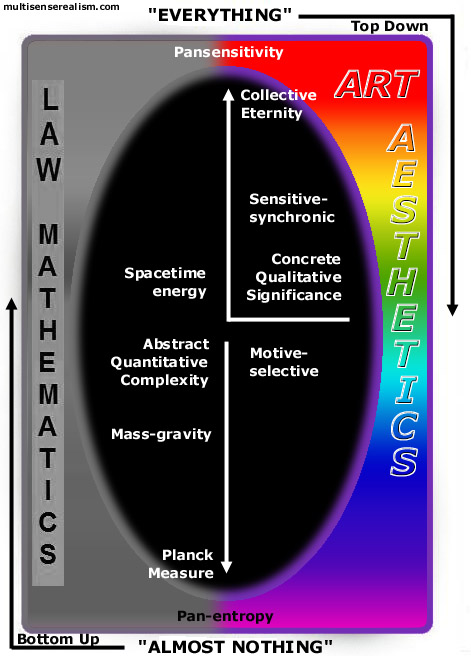
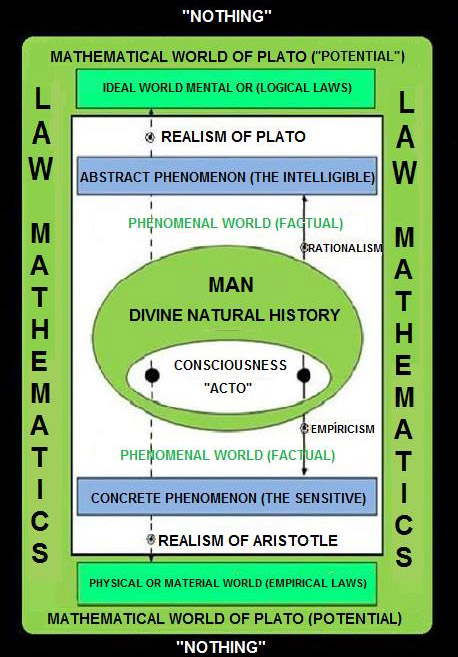
My response (top) to a diagram that I came across (lower). Some differences include:
- Outer edge is a continuum between “Everything” and “Almost Nothing” rather than “Nothing”
This reflects the idea that nothing cannot exist except as an expectation that something has about the absence of everything. It is therefore presence, rather than absence which is the primordial identity, and all phenomena are defined by substitutable gaps in pansensitivity. Awareness is localized by entropic masking or insensitivity rather than mechanical projection on top of “nothing”.
- Art – Aesthetics shares equal if not slightly greater prominence with Law – Mathematics
This overturns the Western assumption that appreciation of phenomena is a side effect of functionality. While locally true, for example, that humans like sugar because of its evolutionary value, the specific pleasure of sweet flavor is not itself describable by function, nor can it be assembled mechanically. That the universe is fundamentally an aesthetic agenda which works in order to play rather than the other way around is one of the major consequences of Primordial Identity Pansensitivity. The universe is a feeler of experiences, not just a producer of unfelt mechanisms.
- Color vs Greyscale connotes the relation between the concrete-experiential and the abstract-measured as one of reductionism rather then essentialism.
The idea here is that the rational is only a higher octave of the empirical, and the empirical is only an objectified reduction of the subjective-aesthetic. There is one continuous spectrum of sensitivity which reflects itself as desaturated forms and functions.
The top down and bottom up arrows show the circulation of intentional sequence and unintentional consequence throughout the continuum. From the pansensitivity pole on the top, where all substitutable gaps of sensitivity have been filled in and sense is total, to the pan-entropy pole on the bottom, where the ratio of gap to connection is almost infinitely great, a picture of cosmos emerges as a hyperplasticity of perspective.
- Synchronic and selective are new additions to the sensory-motive side. I think that it might work to call them electro-synchronic and magneto-selective. Electric force would seem to embody the gap-jumping, meta-phoric principle of sense-making, while magnetic fields are about orientation and masses moving themselves in relation to each other.
Speed of Light: Why is the speed of light not infinite?
Speed of Light: Why is the speed of light not infinite?
Speed of Light: Why is the speed of light not infinite?
The speed of light in a vacuum, 299792458 m/s, is a finite, discrete value. Nothing else can achieve this speed, because it would need infinite energy to propel actual mass. But a photon does not have mass.What is the limiting factor that prevents a photon from exceeding 299792458 m/s?
It’s like asking, “what is the limiting factor that prevents something which is absolutely still from being even more still?” Whether or not something can exceed the velocity of light or c (recently there was an unsuccessful challenge to light’s absolute status), the concept of c itself should not be considered a velocity, but rather, the physical and ontological limit of velocity itself as it is defined in the universe.
Personally, and this is just my own hypothesis, I think that the coincidence with light and c, along with light’s lack of resting mass gives us reason to question whether photons “exist” as independent entities traveling through a vacuum. I see no reason why it could not be the case that photons, and all radiant energy is actually more like what energy is on the macrophysical level. Our naive experience of classical physics shows us very clearly that energy is merely “what matter does”, rather than a substance of its own.
Energy is a verb which modifies a noun – it moves, heats up, changes, some-thing. Without a thing to move and an experience in which that moving thing can be compared to a memory of its previous position or status, there is no energy. My prediction is that all of the current interpretation in physics which relies on vacuum energy will ultimately have to be re-interpreted. Once we are able to understand that matter and awareness are identical, then energy can be understood as communication within matter which generates space and time. Space and time in turn, will have to be redefined as a property of awareness, or rather, of awareness to gaps in awareness.
The speed of light then is really about the speed of measurement. It is not a measurement of literal particles or waves traveling through a void, it is a measure of the scale of dislocation among multiple inertial frames. It is about the scale of bodies relative to each other, so that c defines both the largest and smallest ratio between frequencies of what these bodies are doing.
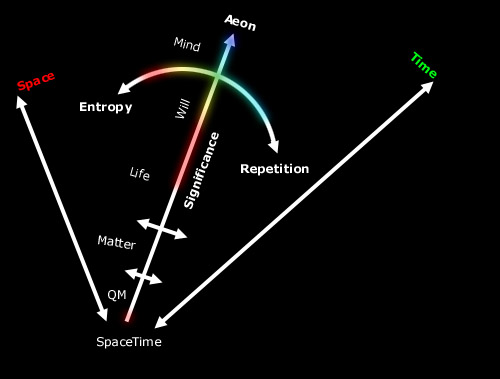
Adding on to the previous post Sketch for a New Physics…
At the bottom, lines converge as SpaceTime. In this case, SpaceTime refers to the sense of eternity which is empty of all significance except for the sense of measureability. This would be the Western conception of a universe from “nothing” – mathematics of a pure void. Having no depth of observation, no memory or context, it is a single frame of reference in isolation which is at once instantaneous and perpetual. Time is reversible and space itself is generated through signal attenuation.
Moving up the center line (ladder) of Significance, The Entropy-Repetition range begins to expand as QM gives way to matter, then biology, then “mind”, gaining degrees of freedom and intensity of will. The higher up on the ladder we go, the wider and more bowed its rungs become. This reflects the increasing value that is placed on defying repetition of function and entropic degradation of form. The spectrum near the top (Aeon) end of the ladder represents the fullness of aesthetic potential through higher consciousness. Really the curved arrows of entropy and repetition could be a spiral, as the cycle of creativity builds on the ruins of the past.
Aion is the opposite of SpaceTime in that it represents the sense of eternity that is full and whole – an absolute of aesthetic prestige and generosity rather than the austerity of quantitative measure. On the high end, space (space in red) represents a vast difference between the microphysical and astrophysical scopes. Since this difference can only be sustained by a consensus of orientable experiences of size, it should not be expected at the lower (SpaceTime) levels. Without an experience in which both galaxy and atom can be conceptualized as wholes, they would both be as data in a database – merely more or less contiguous fields of information.
Likewise, the green Time label on the top represents the equivalent stretching of time to reflect the broad gap between a single moment and eternity. The top rungs on the ladder are broad, so broad, that they bend back and circle around like a corkscrew/caduceus.
Sketch for a New Physics
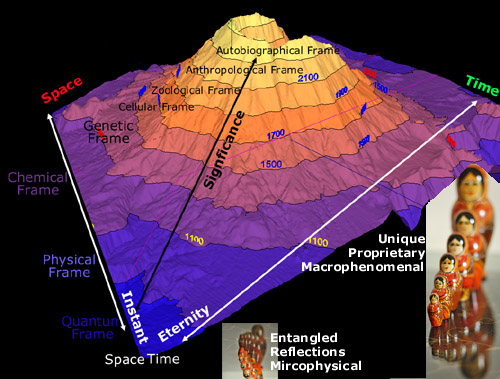
Using a topographical metaphor, this diagram shows the relation of significance in direct proportion to the dimorphism of space and time. I call this eigenmorphism. For example, as human beings, our native frame is the Autobiographical level (top). Our experience has a high significance, which means
1) rich qualia – larger nows and more nesting of personal, sub-personal, and super-personal frames allow for deeper sensory vocabularies.
2) a highly divergent space-time presentation (space and time are opposite for us, but identical for quantum phenomena or astrophysical phenomena).
3) a highly divergent spectrum of realism. The Matroyshka dolls with reflection underneath represent this range of clear/real, vs blurred/intuitive, and reflective/fiction. By contrast, the entangled reflections of the microphysical level of physics are neither real nor fictional. With space and time fused, matter and energy become interchangeable foregrounds for information processing.
Beyond Probability
What is the probability that “pattern” can exist at all?
Can’t be calculated.
Because we cannot empirically calculate it, or because it is ontologically incalculable? Are there other comparably incalculable examples, or do all incalculables share a common ‘absolute’ quality (relating to primordial origins, consciousness, etc)
Ontologically incalculable. There is no way to measure the total possible outcomes.
In another way, it is super-calculable. Only one outcome results in the possibility of measurement. The probability of pattern existing in a universe in which the question of probability can be asked would be 100%…or even “infinitely greater” than 100%, as there is no possibility at all of measurement in a context that is devoid of pattern.
In another sense, the possibility of pattern is the most improbable condition in the sense that no ‘probability’ can precede pattern. Probability is an expectation of a particular type of pattern so by definition, pattern is not just incalculable, but pre-calculation (calculations are also pattern recognition).
Fair enough…
How do evolutionary psychology and neuroscience compare as popular theories to “explain everything” about human nature?
“These two theories are the biggest explanatory frameworks at the current time, with neuroscience rising and evolutionary psychology looking a bit threadbare. And they are quite different.
I don’t mean, are these valid theories scientifically, but how good are they as a way for people to tell meaningful stories to each other about human nature? What do we become through that telling? What gets left out?”
Answer by Craig Weinberg:
In Raymond Tallis’ book Aping Mankind, he describes the over-reaching of neuroscience and evolutionary psychology and names them “Neuromania” and “Darwinitis”. While this assessment is likely seen as inflammatory or offensive to the many dedicated and brilliant professionals who have devoted their lives in pursuit of understanding human nature scientifically, his criticisms are quite defensible. Tallis, a neuroscientist himself, argues that both disciplines contribute to what I call de-presentation, and he calls ‘the disappearance of appearance’.
When neuroscience looks at human nature, it does so from the outside – as the behavior of cellular and molecular bodies, of organs and networks of ‘connections’. Evolutionary biology also looks at human nature from the outside, as the behavior of zoological ecosystems, species, and inherited bodies. Taken together, these super-personal systems and sub-personal systems can be de-ranged to completely subsume the personal, the private, and most significantly human aspects of human nature.
It is a bit like looking at human nature under a blacklight. With most of the frequencies in the dark, neuroscience and evolutionary psychology have done a fantastic job of illuminating some hidden aspects of ourselves – how and where we fade into subconscious and unconscious mechanisms. We have glimpsed some of our own biases and seen behind the curtain of many misperceptions. We have not yet, however dared to turn this critical lens on itself. We have not seen how neuroscience and evolutionary biology themselves are excluded from the general distrust and marginalization of awareness. Somehow, the totality of our human experience can be written off as a solipsistic simulation or ’emergent property’ of ‘information’ processing, yet the mechanisms of science are presumed immune from the politics of our species and the unreality of the brain’s twitchings in the dark. Sam Harris actually said something to the effect of “certain kinds of thinking” extend outside of the bubble of human delusion (but without saying how).
What gets left out, according to Tallis, is humanity. Arts, literature, civilization. While he goes on in the second half of his book, to argue the profound difference between human beings and other species, I would argue that does make human beings more special than others on Earth, I would not say that it makes us an exception to zoology, or physics. Instead, I would argue for a radical reinterpretation of physics in which privacy and aesthetic appreciation are seen as more fundamental cosmological influences than public, functional mechanisms.
Defining Consciousness, Life, Physics
One of the more popular objections to any proposal for explaining consciousness is that the term consciousness is too vague, or that any explanation depends on what way the term is used. I disagree. The nature of electricity does not depend on what people think the word means, and I don’t think that consciousness does either. When someone is knocked unconscious, there is little doubt about what it means. In general terms, it means that they are not personally present. They are not personally affected by their environment, nor can they intentionally cause any effects on their environment.
Is that an agreeable place to start for everyone?
Can we agree also, in light of the physiology of the brain-stem, which consists of sensory neural pathways and motor neural pathways, that the concept of consciousness is at least closely identified with input/output?
Can we agree that it could be possible that input/output could be sufficient to describe the fundamental nature of consciousness? Does consciousness need to be something further than that?
Here is where, in my view, the whole dependency of definition comes in. The issue is that input/output can either be conceptualized from the exterior or the interior. The Western perspective, even when it tries to model the interior perspective of i/o, does so from the outside in. It assumes that the proprietary feeling of subjectivity is fundamentally inauthentic – that a system can only be built from generic conditions, laws, processes, etc, and cannot be truly original in any sense. In this way, no neuroscientific account, or cog-sci account, can really claim an inside-looking-out perspective. The Western orientation does not allow for the possibility that person as a whole could act as an irreducibly singular receiver of experience an originator of physical cause. Taking a cue from relativity, however, I suggest that perceptual integrity is identical to inertial framing, so that the frame as a whole can drive the micro-frame conditions within it, and vice versa. This is not vertical emergence from the bottom up, but parallel emergence. Multiple levels of description.
Going back to consciousness being definable in terms of its difference from unconsciousness, we can see that the difference between the two has some similarity between life and death. Can we agree that life too differs from death in that it relates to input/output for an organism and its environment?
We understand that an animal can be unconscious without being dead, but is this a difference in degree or a difference in kind? Could input/output also be sufficient to define “life”. We might say that life includes reproduction and growth, however even a single cell organism which is not reproducing or growing at any given time is considered a form of life. Does that not seem that the quality of environmental sensitivity and the ability to cause biochemical effects in response to that sensitivity are even more essential to defining life?
To sum up then, I am asking:
1) Doesn’t being conscious really just mean the ability to receive sense and project motive?
2) Doesn’t life really mean the same thing on a lower, level?
From there, I would ask
3) Isn’t sense what we really mean by a ‘field’, and motive what we mean by a ‘force’?
4) Using relativity as a intuitive guide, can’t it be said that the concept of ‘field’ or ‘force’ are really metaphors, and that the way we contribute to human society is identical to the way that any vector of sense contributes to its context? Isn’t consciousness just a form of life which is just a form of physics…which is just a form of sensory-motive interaction?
Quora on Conscious and Subconscious
How does the conscious and subconscious speak to you at the same time?
My hypothesis is this: The conscious, subconscious, (and super-conscious) *are* you already. Simultaneity is relative and supervenes on perception. The subconscious (I call sub-personal) generally relates to a smaller, faster inertial frame. Sub-personal impulses are experienced as urges and relate generally to the reality of the body. It is a very small “now”, in the range of microseconds to minutes.
The super-personal or transpersonal feelings are meta-phoric. The root ‘phor’ as in euphoric or ‘fer’ as in ‘confer’, ‘infer’, etc means to carry – to ferry something from one place to another. Metaphor then is to carry over, to jump from one semantic context to another. Just as a symbol or fable can work on multiple levels at once, our conscious personal experience is both rooted in larger ‘nows’ which range in days, weeks, and lifetimes and the sub-personal/microphysical instant.
As human beings, we have a tall window of awareness that extends between the now that is microscopic and the now that is eternal. Confusion sets in when we try to define one in terms of the other. Our expectation that we would not be ‘spoken to’ at the same time is itself a prejudice of the conscious range of awareness.
 Multisense Realism
Recent Comments