Archive

Proof Against Materialism

1. Modus Ponens: The brain generates consciousness and the brain is physical, so consciousness must be physical.
2. Modus Tollens: Consciousness transcends what can be explained by physical interaction, and the brain is only physical, therefore consciousness must not be only physical.
A scientific approach must explain why one is more sensible than the other. Here is one such explanation:
Hypothesis: If the Modus Tollens case is true, then consciousness may generate matter.
Experiment: Can consciousness generate matter?
Go to sleep. Dream. If you can dream of a physical world without realizing that you’re dreaming, then we know that either consciousness can and does produce all perceptions of ‘matter’, or, consciousness is the sole epistemological source to discern the difference between ‘real matter’ and a hallucination. Either way it is the same conclusion:
Consciousness can produce the experience we know as physical matter, but physical matter has no plausible mechanism or justification for producing phenomenal qualities.
Three-Phase Model of Will
Within the Multisense Realism (MSR) model, all of nature is conceived of as a continuum of experiential or aesthetic phenomena. This ‘spectrum of perceivability’ can be divided, like the visible light spectrum, into two, three, four, or millions of qualitative hues, each with their own particular properties, and each which contribute to the overall sense of the spectrum.
For this post, I’ll focus on a three-level view of the spectrum: Sub-personal, Personal, and Transpersonal. Use of the MSR neologisms ‘Semaphoric, Phoric, and Metaphoric’ may be annoying to some readers, but I think that it adds some important connections and properly places the spectrum of perceivability in a cosmological context rather than in an anthropocentric or biocentric one.
In my view, nature is composed of experiences, and the primary difference between the experiences of biological organisms (which appear as synonymous with cellular-organic bodies to each other) and experiences which appear to us as inorganic chemistry, atoms, planets, stars, etc is the scale of time and space which are involved and the effect of that scale difference on what I call perceptual lensing or eigenmorphism.
In other words, I am saying that the universe is made of experiences-within-experiences, and that the relation of any given experience to the totality of experience is a defining feature of the properties of the universe which appear most real or significant. If you are an animal, you have certain kind of experiences in which other animals are perceived as members of one’s own family, or as friends, pets, food, or pests. These categories are normally rather firm, and we do not want to eat our friends or pets, we understand that what constitutes a pet or pest in some cultures may be desirable as food in others. We understand that the palette can shift, for example, many with a vegan diet sooner or later find meat eating in general to be repulsive. This kind of shift can be expressed within the MSR model as a change in the lensing of personal gustatory awareness so that the entire class of zoological life is identified with more directly. The scope of empathy has expanded so that the all creatures with ‘two eyes and a mother’ are seen in a context of kinship rather than predation.
Enslavement is another example of how the lens of human awareness has changed. For millennia slavery was practiced in various cultures much like eating meat is practiced now. It was a fact of life that people of a different social class or race, women or children could be treated as slaves by the dominant group, or by men or adults. The scope of empathy was so contracted* by default that even members of the same human species were identified somewhere between pet and food rather than friends or family. As this scope of awareness (which is ultimately identical with empathy) expanded those who were on the leading edge of the expansion and those who were on the trailing edge began to see each other in polarized terms. There is a psychological mechanism at work which fosters the projection of negative qualities on the opposing group. In the case of 19th century American slavery, this opposition manifested in the Civil War.
Possibly all of the most divisive issues in society are about perception and how empathy is scoped. Is it an embryo or an unborn child? Are the poor part of the human family or are they pests? Should employees have rights as equals with employers or does wealth confer a right of employers to treat employees more like domesticated animals? All of these questions are contested within the lives of individuals, families, and societies and would fall under the middle range of the three tiered view of the MSR spectrum: The Phoric scope of awareness.
Phoric range: Consciousness is personal and interpersonal narrative with a clearly delineated first person subject, second person social, and third person object division. Subjective experience is intangible and difficult to categorize in a linear hierarchy. Social experience is intangible but semiotically grounded in gestures and expressions of the body. Consider the difference between the human ‘voice’ and the ‘sounds’ that we hear other animals make. The further apart the participants are from each other, the more their participation is de-personalized. Objective experience (more accurately objective-facing or public-facing experience) is totally depersonalized and presented as tangible objects rather than bodies. Tangible objects are fairly easy to stratify by time/space scale: Roughly human sized or larger animals are studied in a context of zoology. Smaller organisms and cells comprise the field of biology. As the ‘bodies’ get smaller and lives get shorter/faster relative to our own, the scope of our empathy contracts (unless perhaps if you’re a microbiologist), so that we tend to consider the physical presence of microorganisms and viruses somewhere in between bodies and objects.
Even though we see more and more evidence of objects on these sub-cellular scales behaving with seeming intelligence or responsiveness, it is difficult to think of them as beings rather than mechanical structures. Plants, even though their size can vary even more than animals, are so alien to our aesthetic sense of ourselves that they tend to be categorized in the lower empathy ranges: Food rather than friends, fiber rather than flesh. This again is all pertaining to the boundary beteween the personal or phoric range of the MSR spectrum and the semaphoric range, sub-personal. The personal view of an external sempahore is an object (morphic phenomenon). The morphic scope is a reflection within the phoric range of experiences which are perceptually qualified as impersonal but tangible. It is a range populated by solid bodies, liquids, and gas which are animated by intangible ‘forces’ or ‘energies’**. Depending on who is judging those energies and the scale and aesthetics of the object perceived, the force or energy behind the behavior of the body is presumed to be somewhere along an axis which extends from ‘person’, where full fledged subjective intent governs the body’s behavior to ‘mechanism’ where behaviors are governed by impersonal physical forces which are automatic and unintentional.
Zooming in on this boundary between sentience and automaticity, we can isolate a guiding principle in which ‘signals’ embody the translation between mechanical-morphic forms and metric-dynamic functions which are supposed to operate without sensation, and those events which are perceived with participatory qualities such as feeling, thinking, seeing, etc. While this sub-personal level is very distant from our personal scope of empathy, it is no less controversial as far as the acrimony between those who perceive no special difference between sensation and mechanical events, and those who perceive a clear dichotomy which cannot be bridged from the bottom up. To the former group, the difference between signal (semaphore) and physical function (let’s call it ‘metamorph’) is purely a semantic convention, and those who are on the far end of the latter group appear as technophobes or religious fanatics. To the latter group, the difference between feelings and functions is of the utmost significance – even to divine vs diabolical extremes. For the creationist and the anti-abortionist, human life is not divisible to mere operations of genetic objects or evolving animal species. Their perception of the animating force of human behavior is not mere stochastic computation and thermodynamics, but ‘free will’ and perhaps the sacred ‘soul’. What is going on here? Where are these ideas of supernatural influences coming from and why do they remain popular in spite of centuries of scientific enlightenment?
This is where the third level of the spectrum comes in, the metaphoric or holophoric range.
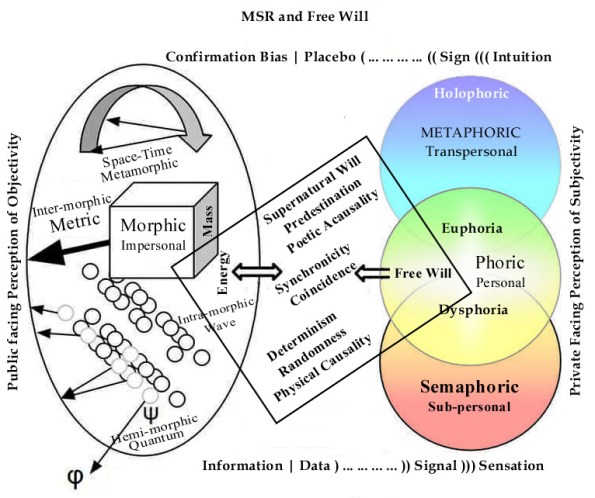
To review: Semaphoric: Consciousness on this level is seen as limited to signal-based interactions. The expectation of a capacity to send and receive ‘signs’ or ‘messages’ is an interesting place to spend some time on because it is so poorly defined within science. Electromagnetic signals are described in terms of charge or attraction/repulsion but it is at the same time presumed to be unexperienced. Computer science takes signal for granted. It is a body of knowledge which begins with an assumption that there already is hardware which has some capacity for input, output, storage, and comparison of ‘data’. Again, the phenomenal content of this process of data processing is poorly understood, and it is easy to grant proto-experiential qualities to programs when we want them to seem intelligent, or to withdraw those qualities when we want them to see them as completely controllable or programmable. Data is the semaphoric equivalent of body on the phoric level. The data side of the semaphore is the generic, syntactic, outside view of the signal. Data is a fictional ‘packet’ or ‘digit’ abstractly ‘moving’ through a series of concrete mechanical states of the physical hardware. There is widespread confusion over this, and people disagree what the relation between data, information, and experience is. MSR allows us to see the entire unit as semaphore; sensory-motive phenomena which is maximally contracted from transpersonal unity and minimally presented as sub-personal unit.
Like the vegan who no longer sees meat as food, the software developer or cognitive scientist may not see data as a fictional abstraction overlaid on top of the material conditions of electronic components, but instead as carriers of a kind of proto-phenomenal currency which can learn and understand. Data for the programmer may seem intrinsically semantic – units whose logical constraints make them building blocks of thought and knowledge that add up to more than the sum of their parts. There is a sense that data is in and of itself informative, and through additional processing can be enhanced to the status of ‘information’.
In my view, this blurring of the lines between sensation, signal, data, and information reflects the psychology of this moment in the history of human consciousness. It is the Post-Enlightenment version of superstition (if we want to be pejorative) or re-enchantment (if we want to be supportive). Where the pre-Enlightenment mind was comfortable blurring the lines between physical events and supernatural influences, the sophisticated thinker of the 21st century has no qualms about seeing human experience as a vast collection of data signals in a biochemical computer network. Where it was once popular among the most enlightened to see the work of God in our everyday life, it is now the image of the machine which has captured the imagination of professional thinkers and amateur enthusiasts alike. Everything is a ‘system’. Every human experience traces back to a cause in the body, its cells and molecules, and to the blind mechanism of their aggregate statistical evolutions.
To recap: The MSR model proposes that all of nature can be modeled meaningfully within a ‘spectrum of perceivability’ framework. This spectrum can be divided into any number of qualitative ranges, but the number of partitions used has a defining effect on the character of the spectrum as a whole. The ‘lower’, semaphoric or ‘signal’ end of the spectrum presents a world of sub-personal sensations or impulses which relate to each other as impersonal data processes. Whether this perception is valid in an objective sense, or whether it is the result of the contraction of empathy that characterizes the relation between the personal scope of awareness and its objectification of the sub-personal is a question which itself is subject to the same question. If you don’t believe that consciousness is more fundamental than matter, then you aren’t going to believe that your sensitivity has an effect on how objective phenomena are defined. If you already see personal consciousness as a function of data processing organic chemistry, then you’re not going to want to take seriously the idea that chemical bonding is driven by sensory-empathic instincts rather than mathematical law. If you’re on the other end of the psychological spectrum however, it may be difficult to imagine why anyone would even want to deny the possibility that our own consciousness is composed of authentic and irreducible of feelings.
In either case, we can probably all agree that activity on the microscopic scale seems less willful and more automatic than the activity which we participate in as human beings. Those who favor the bottom-up view see this ‘emergence’ of willful appearance as a kind of illusion, and that actually all choices we make are predetermined by the mechanics of physical conditions. Those who favor the top-down view may also see the appearance of human will as an illusion, but driven by supernatural influences and entities rather than mathematical ones. Thus, the personal range of awareness is bounded on the bottom by semaphore (sensation <> signal < || > data <> information) and on the top by what I call metaphor (fate <> synchronicity < || > intuition <> divinity).
As we move above the personal level, with its personal-subject, social groups and impersonal objects, to the transpersonal level, the significance of our personal will increases. Even though religiosity tends to impose limits on human will in the face of overwhelming influence from divine will, there is an equally powerful tendency to elevate individual human will to a super-significant role. The conscience or superego is mediator between personal self and the transpersonal. It even appears as a metaphor in cartoons as angel and devil on the shoulder. Most religious practices stress the responsibility of the individual to align their personal will to the will of God by finding and following the better angels of conscience or suffer the consequences. The consequences range from the mild forms of disappointing reincarnation or being stuck in repeating cycles of karma to Earth shaking consequences for the entire universe (as in Scientology). From the most extreme transpersonal perspective, the personal level of will is either inflated so that every action a person takes, including what they choose to think and feel is a tribute or affront to God, and gets us closer to paradise or damnation. Simultaneously personal or it is deflated or degraded so that the entirety of human effort is pathetic and futile in the face of Higher Power.
Notice the symmetry between the quantum (extreme semaphoric or ‘hemi-morphic’) concept of ‘superposition’ and the transpersonal concept of ‘synchronicity’. Superposition is brought in to tame the paradox of simultaneous randomness and determinism of subatomic phenomena, while synchronicity is brought into psychology as a kind of metaphoric, poetic, or acausal intrusion from the transpersonal scope of awareness to the personal. This allows a bridge natural determinism of time and transpersonal from beyond our limited awareness of time. Superposition and synchronicity are ways of describing the gateways between spacetime and the nonlocal absolute. If these gateways form the opposite extremes of the continuum of personal awareness, then the sense of free will would be the very center of that continuum. At any given moment, even though we are presented with conditions and inertial patterns which influence our will, we are also presented with opportunities to condition our will itself. We can feel within ourselves a power to oppose inertia and change conditions in the world, or we can feel completely powerless to change anything that we are experiencing.
There’s a paradox here, in that how we feel about our own willpower factors in to the feeling of how powerful our will is or can be. There is a chicken-egg relation between mood and will which tends to polarize people psychologically. Feeling that we are destined to feel depressed corresponds to a set of truths about life which are difficult to accept in the sense that they lead to nihilism and despair. Feeling that it is up to us to change how we feel so that we can improve our lives or the world corresponds to a difference set of truths about our lives which can be equally difficult to accept but in the opposite sense that they lead to risk taking and the possibility that our effort can end up causing more harm than good to ourselves and others. To be or not to be each have their strengths and weakness.
As with the other social-psychological dichotomies mentioned earlier, each side sees the other in a scope of diminished empathy; The downbeat introvert sees themselves as facing the bitter facts of mortality and the human condition with courage and honesty, while their positive-thinking counterparts are seen as deluded ninnies…intellectual lightweights who don’t have the stomach to face the existential abyss. The upbeat idealist sees themselves as heroically facing the challenge of rescuing their own life from the abyss while the realist appears to be willfully blind to their own power, and consciously or unconsciously wallow in a prison of their own making. This polarity of the phoric range of consciousness can be understood as its euphoric and dysphoric orientations. Those who have ‘mood disorders’ are familiar with these extremes and how inadequate the term ‘mood’ is to describe the totality of change in how the universe and one’s own life is presented. It is not simply that these opposing phoric ‘charges’ feel very good or bad, it is that the individual find themselves in a universe which is very good – (maybe too ‘good’), or very bad. In the current time of political transformation, we find ourselves to be drawn to align with one social polarity or another, each with its own euphoric-dysphoric signifiers and each with a separate narrative of history and the possible future. More than any time in the US since the 1960s, the questions of our personal agency and the possibilities for our future freedoms have become important. How important may be up to us individually, or we may find that fate and coincidence conspire to make them more important.
*This is not to say that slavery is not still going on, or that everyone has evolved the same level of conscience about race, gender, and age.
**I have issues with the concept of energy, but I use it here as a popular way to make the reference.
Fooling Computer Image Recognition is Easier Than it Should Be
This 2016 study, Universal Adversarial Perturbations, demonstrates how the introduction of specially designed low level noise into image data makes state of the art neural networks misclassify natural images with high probability. Because the noise is almost imperceptible to the human eye, I think it should be a clue that image processing technology is not ‘seeing’ images.

It is not only the fact that it is possible to throw off the technology so easily that is significant, but that the kinds of miscalculations that are made are so broad and unnatural. Had the program had any real sense of an image, adding some digital grit to a picture of a coffee pot or plant should not cause a ‘macaw’ hit, but rather some other visually similar object or plant.
While many will choose to see this paper as a suggestion for a need to improve recognition methods, I see it as supporting a shift away from outside-in, bottom-up models of perception altogether. As I have suggested in other posts, all of out current AI models are inside out.
3/16/17 – see also http://www.popsci.com/byzantine-science-deceiving-artificial-intelligence
Are We Wrong About The Universe?

Are we today as wrong about any scientific fact that is widely accepted as the belief that the earth was the center of the universe and the like?
It’s not so much a particular scientific fact that we are currently wrong about, but rather the interpretation of those facts which is ultimately incomplete and inverted. In my view, the cosmological picture that we have inherited is as wrong as geocentric astronomy was, in that we presume a physical universe of forces, fields, particles, and mechanisms; forms and functions which act in the complete absence of any kind of experience or awareness. I expect that we will eventually come to understand that unconscious forms and functions cannot generate any such thing as a sensation or feeling, and that it is actually forms and functions which are presentations within a deeper context of universal perceivability.
Because we have made great use of the tools of science to objectify the universe by factoring out our own subjectivity, we have fallen under a kind of spell of amnesia in which we exclude the process of objectification itself from our picture of the universe. In the effort to dispel the ghost-in-the-machine legacy of Cartesian Dualism, we have succumbed to a more insidious dualism, which is that of “illusion” vs reality, or “emergent properties” vs physical systems. From this vantage point, we are susceptible to any kind of theory which satisfies our empirical measurements, regardless of how incompatible they are with our direct experience. As long as a legitimate scientific authority stands behind it, the educated public happily swallows up anti-realisms in the service of realism…multi world interpretations, superposition, vacuums filled with energy. There is nothing wrong with entertaining these very legitimate possibilities, but there is a deep irony which is being overlooked.
The problem is that we have taken ourselves out of the picture of the universe, but we haven’t gone far enough. We have over-estimated our objectivity in one sense and under-estimated it in another so that the universe we imagine as objectively present looks, sounds, tastes, and feels just as it would to a highly culturally conditioned Homo sapien of the early 21st century. We have failed to appreciate the profound truths revealed by Relativity, quantum uncertainty, incompleteness, the placebo effect, and the vast pool of insight provided by centuries of direct consciousness exploration. Had we been willing to connect the dots, I think that we would see the common denominator is that nature is subject to perceptual participation for its fundamental definitions. In other words, what both the empirical and rational methods of inquiry have shown is that nature is inseparable from perceivability. It is a multitude of changing types of awareness which produces and preserves all forms.
We are used to thinking that consciousness is a special ability of Homo sapiens, and perhaps a few other species, but this is as naive and egocentric as Ptolemaic astronomy now seems. Just as biology has found no hard line separating living cells from genetic machinery, the study of consciousness has revealed signs of sensation and awareness in everything from ants, single celled plants, even a ball of dough. There seems to be no good reason to automatically consider the activities performed by any natural structure strictly unconscious. Indeed, we may be projecting our own complex human experience of layers of consciousness, semi-consciousness, and seeming unconsciousness onto nature at large.
The reality may be that every frame of reference is actually a frame of afference… a trans-spatial, trans-temporal platform for developing temporalizing and spatializing aesthetic experiences. Afference is a neologism adapted from the function of afferent nerves. In this case I am generalizing that function of bringing signals in from the outside. Afference is conceived as a fundamental receptivity to experience which allows for the appearance of all phenomena including space (a sense of distance between tangible or visual presentations) and time (a sense of memory and evaluation of causality) within any given frame. Afference is a hypothetical sub-set or diffraction from the overall Perceivability Spectrum (pansensitivity, pan-afference, or even ‘ference’).
This doesn’t mean that every ‘thing’ is conscious. That sort of ‘promiscuous’ panpsychism is only the first step away from the pseudo-dualism of contemporary science. It can help us to begin to break through our anthropocentrism and consider other scales of time and body size, however it can also lead to misguided expectations about inanimate objects ‘having’ experiences rather than their objecthood ‘being’ an experience within our body’s perceptual scales and limits. The experience of a computer for example, may be limited to the hardware level where natural sensory acquaintance and motor engagement is felt on the microphysical scale and has no emergence to genuine high level humanlike intelligence.
By considering consciousness (not human consciousness, but universal perceivability) to be the source of all qualities and properties of nature, the Hard Problem of materialism solves itself. Physical forces and fields need not be sought out to explain the creation of bodies-with-awareness, which are impossible by definition in my view. In my view there is no room for any kind of sensation or participation as a mechanical product of geometry or computation. Instead, we should recognize that it is experiential phenomena alone which present themselves as bodies, images, thoughts, feelings, etc. Every appearance of mechanical or random force in our frame of perception is ultimately a feeling of participation and sense in a distant and alienated frame of perception.
Every appearance of a ‘field’ (gravitational, electromagnetic, or otherwise) is in the same way only a range of sensitivity projected into another range of sensitivity that uses spatial terms (rather than non-spatial or trans-spatial like olfactory or emotional sense). It is the sense modality of tangibility which deals in spaces and geometries: visible and/or touchable forms. With the ‘field’ model, we are presuming regions of space as domains within which effects simply found to be present by definition. By using the afference model instead, locality is understood to be a symptom of how extra-local phenomena are translated into locality-constrained sensory modes. Afference opens the door to understanding how not to take presence for granted and to see it as a relativistic, aesthetically driven universal phenomenon (or the absolute meta-phenomenon).
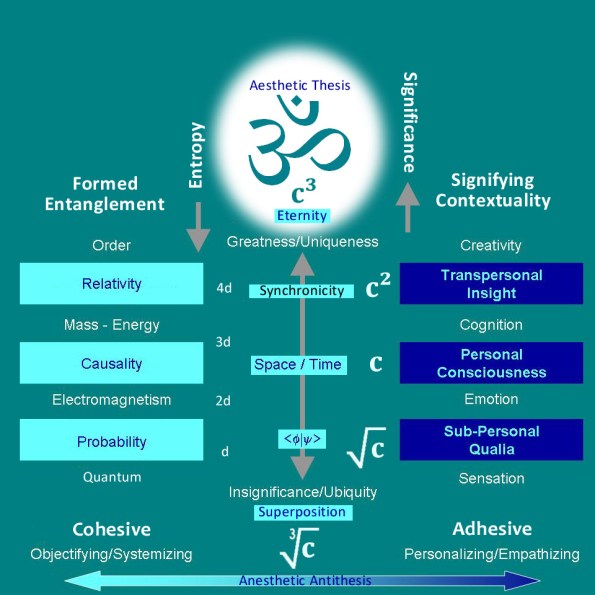
 Multisense Realism
Recent Comments