Archive
Multisense Taoism
I’ll take a crack at translating the gist of the translations of Chapter 14 of the Tao Te Ching into the terms of my theory of Multisense Realism.
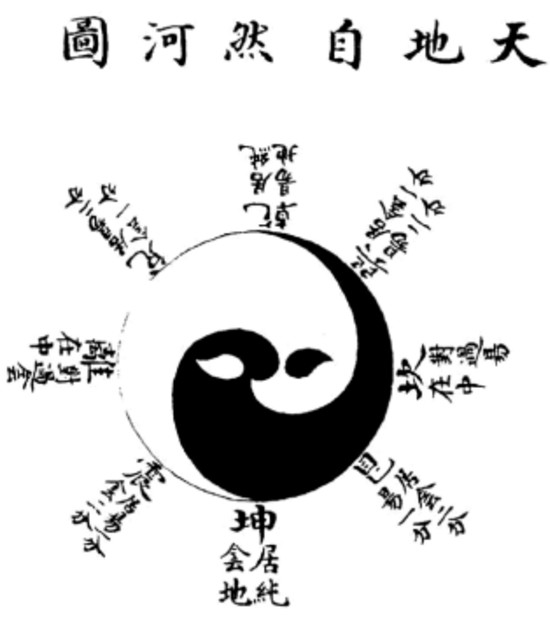
Awareness of seeing is invisible.
Awareness of hearing is silent.
Awareness of touching is intangible.
These three awarenesses are part of one indivisible personal awareness.
Personal awareness exists beyond both entropy and negentropy, it cannot seek itself or avoid itself by trying with direct personal effort.
To succeed in harmonizing mortal personal awareness with eternal transpersonal awareness, remain sensitive to sensitivity and aware of awareness, divesting from seeking or avoiding direct personal effort.
Commentary:
I didn’t want to jargon up my translation too much, but it’s worth mentioning that the passage begins by talking about how sights, sounds, and objects are being provided to us invisibly, silently, and intangibly. Here I think “Lao Tzu” (老子) is telling us how to tease out sense itself from what is being sensed. It goes on to explain that because sense cannot sense itself through the very same modality that it uses to render a sense appearance of other things, personal awareness has no appearance in subpersonal terms (sights, sounds, etc) or in intrapersonal and interpersonal terms (the personal self is beyond emotion and communication).
Here I think that Taoism makes a decision to conflate the absence of subpersonal qualities of personal consciousness with an assumed absence of sensed qualities in sense itself. While I think this is false in an absolute or scientific sense, it is true enough locally that it is quite profound and leads to a useful philosophy for living our personal lives. This is the “Eastern Way” toward the attainment of a fully satisfied selfless self, in diametric opposition to the “Western Way” toward material attainment by a forever unsatisfied self that is selfishly ‘full of itself’.
Going back to the re-interpreted text, I think that the advice given is that to follow the Tao, aka seek ‘flow states’, one should, seemingly paradoxically, neither try nor avoid trying to take personal action. Perhaps it is the opposite of the Western sentiment attributed to Thomas Paine and George Patton “Lead, follow, or get out of the way.” The Eastern sentiment could be read as “Do not seek to lead or follow. Get out of the way.” The idea is to use personal motivation to integrate itself with transpersonal sense and motives rather than to assert its personal agenda onto the rest of the (interpersonal, subpersonal, impersonal, transpersonal) universe.
In MSR (MultiSense Realism) terms, I see my above new translation of Chapter 14 of the Tao Te Ching (道德经) text as alluding to the relationship between subpersonal aesthetics (sights, sounds, objects), and their source in awareness itself, which has no appearance. I think that while the Tao Te Ching is correct in its identification of the disappearance of sense modalities within their own scope of sensitivity, I think that this is actually an artifact of the way that our local human scopes of awareness are nested relative to each other rather than the whole truth about consciousness. I propose that a more complete understanding of consciousness identifies that the appearance of nothingness is actually a local condition. It is the ‘game of mortality’ that conjures the illusion of absence to stand in for that of which we have no direct access to at any given moment. For example, if I were to try to see through the back of my head, there is nothing that I can see. Rather than seeing a field of blackness behind my eyes all of the time, I don’t see anything at all.
MSR proposes that while it is true that our personal cocoon of insensitivity causes a disconnection with all other conscious experiences, this disappearance of consciousness is no enigmatic ‘non-existence’ or ‘suchness’ as Taoism suggests. MSR suggests that beyond the sensory cataract of personal experience is not a grand nothingness to which all sense returns, but one lone Holos or totality within which all experience is preserved forever in some sense (similar to the concept of the Akashic Records).
The Totality of experiences are eternally present and experience-able in an Absolute sense, but all component experiences are diffracted through complex nested modulations of relative insensitivity. This diffraction temporarily limits the totality of sense experience to a single timeline of experience that senses itself in terms that echo the very condition of that temporary limitation. Each diffracted partition of the Holos is a temporarily temporalized version of eternal experience into an episodic stream of memory-laden feelings and thoughts. This is the the binding of our subjective qualities of experience, including the sense of being a subject.
In the diffracted experience, the undiffracted remainder of the Holos is left to appear in each moment as a memory-free snapshot of phenomena that are seen but not touched and touched but not experienced. Objects that are not appearing and disappearing into intangible memory ‘in here’ but are spread out as a domain of separate but simultaneously present tangible objects ‘out there’. The subjectified aspect is inflated within while the objectified aspect is diminished without. Subjective inflation involves a super-signification owing to the entropy of missing formation and information, while objective reduction involves de-signification, owing the negentropy of concretely presented formations and logical information about them. In the MSR view, the undiscovered country beyond this mortal coil is only temporarily hidden by the curtain of spatio-temporal entropy-negentropy; orthogonal forms of insensitivity that keep us orphaned in the ephemeral Graphos rather than back home in eternal Holos.
Getting back to what the Tao Te Ching is getting at, yes it’s true that we can’t objectify our entire personal experience as an image or a body-object. A living body-object with all of its countless physiological details shows no sign of the people we experience every day as ourselves and others who we meet. A movie about our life starring ourselves as the main character would not be the same as the experience of living it, as watching that movie requires an audience that is able to lend their personal experience to the images and voices they are seeing and hearing. A cat can’t watch that movie and get anything out of it.
Do Cats (or other similar mammals) Have Personal Experience?
As the center of a person’s experience is personal, the center of a cat’s experience is equally primary, but it would be awkward to call it personal since we don’t usually think of a cat as a literal person (at least other people don’t think of your cat that way). In MSR, I use the neologism “phoric” to refer to the center-range of any experience, be it associated with the body of a person, cat, amoeba, etc. My hypothesis is that the center of a cat’s experience – their phoric range of awareness correlates typically to our emphoric experience. The relationship we share with pets is emotional and intrapersonal rather than fully personal. Cats don’t care who we are in our personal life. They don’t know what we do for a living, etc.
Our personal aesthetics cannot be deconstructed into subpersonal appearances (i.e. sights, sounds, objects), but I disagree with the Tao Te Ching that they are ineffable mysteries that come from nothingness and return to it. Our own personhood is not visible or tangible to us, but our visible countenance and voice, our body, as they change over our lifetime do point to some of our personhood if they are perceived by another person. Our personal experience has its own irreducible qualities such as character, personality, identity and will. That qualia can be represented to some degree subpersonally as a biographical film or novel for example, but it takes a person to begin to sense and make sense of a person, even themselves.
In the Western consensus view, stuck as it is in legacy physicalism, the idea that a person can be separate from their brain functions is anathema. Although the most cutting edge scientific research assures us that the body and its brain are not objectively real, the shadow cast by the traumatic birth of science from the womb of religion steers us away from moving backward into what is now seen to be superstition. If you want to end your career as a scientist, start talking publicly about immaterial souls or psychic phenomena. Because of that overreaction, we are now stuck with a weird, crypto-dualistic cosmology where only some of what is sensed is considered real and the rest is unexplainably illusory or “emergent”…including the very capacity to sense in the first place.


As the title of Philip Goff’s book “Galileo’s Error: Foundations for a New Science of Consciousness” implies, we must now begin to replace this outdated view of physicalism that secretly depends on unexplained non-physical appearances with a new science of consciousness that honors the whole of nature, including the consciousness that allows it to have any appearance at all. The Western objectification of sensory-motive experiences into unexperienced units of ‘information’ or wave-particles of mass-energy is an echo of the Ptolemaic/geocentric view of astronomy. We were on the right track, but mistook the local limits of subjectivity for absolute limits of consciousness-in-general. The Western consensus has sought to amputate the universal ‘yin’ of connection to the totality of conscious experience, while at the same time taking it for granted.
In MSR, I critique physical entities like mass and energy as reductionist quantitative abstractions that accidentally deny the underlying universal fabric of qualitative sense affect and motive effect. Primordial sensory affect and motive effect replace mass and energy as the local modes of participation. The physical universe of anesthetic-mechanical appearances is understood to be a kind of shadow of the Aesthetic Holos that reflects the ability of consciousness to partially divide and alienate itself for purposes of multiplying and enriching itself. The physical world is not an illusion, simulation or maya, it is just that reality in the local sense is an inverted reflection of reality in the absolute sense.
In both the local and absolute reality, we are not a program running on the hardware of a brain. The MSR hypothesis is that brain activity is the motive-to-motor inflection point between personal conscious experience and its subpersonal appearance as living matter. Tangible changes in the 3d structures of the physical brain do not cause a simulation in some kind of computational never-never land where we only think that we live. A neuro-computationalist fantasy of that kind undermines itself since such a simulation would have to include the appearance of the brain, its neurons, and any mechanical changes thereof. Hardware and software would both have to be simulated by an unknowable Ur-hardware that has no reason to favor hardware or software appearances. Representing itself in the simulation through cameo appearances, the grand simulator would be just as likely to manifest what seems like magic as it would to run on what seem like computer code.
With the advent of electronic computing, the materialistic view that flowered in the wake of the Early Modern Period (~15th century) has now been souped up with an abstract reincarnation of itself. Computationalism and its ideas of simulation as emergent from logical processes and graphic rendering is a brilliant but misguided journey into surreal reflections of our own alienation from the Holos.
Everything from social media to the Metaverse to AGI is expanding our connection to disconnection. I think that because of that grounding in disconnection, all of these projects are ultimately doomed to failure in the ways that truly matter to us, despite promising exponential success in the ways that Western-Materialist model and its virally expanding institutions have conditioned us to think that we should want. We dreamed of extraterrestrial conquest, and instead we are conquering ourselves with anti-terrestrial nauseas. We have mistaken the uncanny for the sublime.
Escaping the Matrix and the Metaverse
The Taoist approach goes a long way toward the goal of a new science of consciousness if we can integrate it into a view that embraces and transcends its Western-materialistic opposite. I think that this can be done by correcting Lao Tzu’s error of choosing nothingness rather than everythingness as the source of sense and consciousness. The taijitu or symbol of yin and yang in balanced juxtaposition should be understood as representing the wholeness of aesthetic opposites rather than their mutual negation. Nondualism is not the absence of monism or dualism but a synthesis and transcendence of those opposites. Our cosmos is not a physical machine struggling pointlessly against entropy, rather, entropy and negentropy are the yin and yang appearances of our local sense of sensitivity and insensitivity.
In other words, appearances of entropy and negentropy are signals that a given mode of awareness is facing away from its most direct access to the Aesthetic Holos and toward the appearance of disappearance into Anesthetic Graphos. In the MSR view as opposed to the Taoist view, consciousness is trans-tangible not intangible, absolutely everything not absolutely nothing.

In between the subpersonal (MSR term: semaphoric) and the personal (phoric when centered in a personal experience) are appearances that I see as intrapersonal or emphoric. These would be feelings and emotions, perceptions and figurations of selected sensations into coherent perceptions. These emphoric modes of perception connect the phoric or personal range of perception to semaphoric range of perception, which in turn, connects subpersonal experience to the impersonal ‘bottom’ or generic end of the universe. I have called this Graphos in MSR, and it represents the Totality when seen in its most fragmented, isolated, meaningless sense of least empathy.
Graphos is the inverted image of Holos, replacing unity with the proprietary and unrepeatable with a shadow unity of interchangable cohesive units, strung together according to abstract rules of recursive cardinality and ordinality – the essence of spatial negentropy and temporal entropy. The quantized or maximally graphed end of the cosmic experience divides the infinitely rich creativity and novelty of the Holos into nearly absolute insensitivity. If the Graphos end of the Holos of existed literally, it would be a sea of digital monads, stochastic phantoms animated by nothing but their own mathematical inevitability.
This is what MSR calls the extreme OMMM end of the continuum of sense. If Holos is the Absolute thesis, Graphos is the Absolute’s thesis of its own anti-thesis. The Holos is the appearance of the totality of aesthetic phenomena, uniting sensed qualities with sense modalities. Graphos is the appearance of the disappearance of Holos, separating sensed qualities from each other and from Holos as autonomous units of automaticity.
Flanking the personal or phoric modalities of sense/appearance on the other side (moving in the ACME direction toward Holos from personal awareness rather than toward Graphos) are the apophoric, metaphoric, and holophoric scales of consciousness. Roughly; thinking, insight, and inspiration. So interpersonal thinking (learning, communicating, understanding), transpersonal intuition (psychic experience that extends beyond subjectivity and physics), and what might be called mystical union with the divine or Absolute.
Taking this back to the Tao Te Ching, I propose that Lao Tzu’s error is only an error in the absolute sense, not in a personal sense. While we are alive, the transpersonal conscious experience that envelopes our personal conscious experience is silent, invisible and intangible. We can only get glimpses of it when we’re not looking and our envelope of limited personal awareness is slightly breached such as noticing synchronicity or completely opened up in a life altering event. When those larger breaches occur and the personal intellect is flooded with its version of transpersonal awareness, some contents are necessarily distorted and omitted. Personal awareness correctly identifies its contact with transpersonal awareness as more significant than ordinary experience but without any means to ground it in its ordinary sense-making terms. Hence, to the outside observer, the psychedelic or mystical experience is seen charitably as visionary or uncharitably as psychotic.
To temper that extreme, chaotic end of the spectrum of consciousness, MSR should be seen as only an outer framework of philosophy to point toward the possibility of a new synthesis between the systemizing and empathizing modes of awareness. That possibility would be fulfilled when people free themselves from pathological extremes and find common sense closer to the terrestrial center of our universe and the fully individual and human center of ourselves.


Sensation, Realism, and Consciousness
The sense of image fits into the larger picture between the Subjectively Objectified and Subjectively Subjectified groupings.
Holos (Transpersonal
(Interpersonal (Personal
(Intrapersonal (Perception
(Subpersonal (Subjectified sensation) | Impersonal (Subjectively objectified sensation)
Graphos)
A Sound by any Other Name
What is the difference between thinking that consciousness requires a living body and thinking that sounds have to be made by acoustic instruments?
It seems like the same common sense intuition, and I think in both cases, it happens to be false. From audio recording we learned that we did not need to have someone play a horn to hear a horn sound. We could actually use the sound that a needle makes when scratching over a grooved surface to make a nearly identical sound, as long as the grooves matched the grooves made when the horn was played in the first place.
As audio technology progressed, people discovered that purely electronic changes in semiconductors could be used to drive speakers to drive eardrums. We didn’t need to begin with a horn being played, or acoustic vibrations to propagate from brass to air to a steel needle to a cooling disc of resin. All we needed was electronic switches to rapidly change the flow of current through a speaker in the same pattern that the needle used to make going up and down in the groove. The up and down analog became digital stop and go, all the way up to the point where you have to jiggle people’s eardrums. That could not be done electronically but required a membrane to mechanically push air into the ears.
It seems now that we are getting closer to cutting out the acoustic middleman entirely with the possibility of Neuralink type technology and broadcast music directly into your brain without any physical sound at all. No speakers, no ears…but you still need something that senses something, and you need something that senses that something as sound. Even if we play music and record our dreams electronically, it still doesn’t solve the Hard Problem of consciousness. There remains an explanatory gap between the silent operation of electrical current and the experience of sounds, sights, feelings, thoughts, and the entire material universe of objects…including brains and electronic instruments.
That last sentence is the tricky part that physicalist thinkers can’t seem to stop overlooking. Yes, the entire physical universe that you know, that you read about, that scientists experiment on, can only exist under physicalism as a ‘model’ or ‘simulation’ that simply, um, ’emerges’ from either electromagnetism itself, or electromagnetism in various brain structures, or from the ‘information’ that we imagine is being communicated by any or all of these processes.
Of course, it’s all circular. To say ‘the brain’ is to say ‘my qualitative and cognitive experiences that I call ‘brain”. To say ‘the world’ is to say ‘my’ or ‘our’ qualitative experiences that seem like a world. There is no getting around this. The last mile of any cosmological theory always has to cash out in some experience-of-a-cosmos, with or without a theory of a cosmos-outside-of-some-experience. Noumena are optional and hypothetical. Experiential phenomena, as Decscartes almost said, cannot be deined.
I argue with a lot of people about information and qualia, because it is glaringly obvious to me that this technology based idea of information conflates the purely intellectual and abstract process of learning or communicating with the concrete aesthetics of what it is being communicated. Information or simulation theory says nothing about what is ultimately doing the communicating and what literally happens when a communication is decoded, from the billions of quantifiable microphysical stop/go events in an engineered device or neurological organ to unquantifiable and irreducibly aesthetic sight/sound/objects/feelings/thoughts.
The idea of simulation only pushes the explanatory gap down further in scale, but it is the same gap. It’s not enough that a change in a computing device or brain coincides with a change in direct experience, we have to ask what is doing the correlation in the first place, and how, and why. It’s not just “what breathes fire into the equations?”, but what the hell is fire doing in equations in the first place? Why wouldn’t it make sense to ask what breathes equations into every form of ‘fire’? What could it be other than conscious experience itself? Anything we try to put in between conscious experience and nature always has that same last-mile problem. In the end, you need something eternal that can make sense – some capacity not only to run programs on hardware to manipulate hardware but for either programs or hardware to exist as something aesthetic rather than just invisible facts in an arithmetic void.
Evan Thompson Live! Consciousness Live! S4 E12 CW comments, part 2
At 57:15 Richard is posing the question of why objects in a simulated world aren’t real objects in a real digital world. To this I say what is being overlooked is sense modality. We have to be as literal as we possibly can be when discussing these topics. Objects, in the most literal sense, are not images or numbers, they are tangible shapes. Solid, liquid, and gaseous volumes in public spacetime. Real objects are composed of molecules that are made up of atoms on the periodic table. Sense experience is the only thing that can generate realism. When we think of a simulation, we are thinking of some artificially stimulated sense experience – a GUI image that *we* see (birds don’t see it, hamsters don’t see it) on screen hardware. Without this, there is nothing begin simulated.
The interface hardware cannot be simulated. There is no software that can be written that will generate colors for the color blind in the way that software could be written to solve math problems for people who aren’t able to do math. No amount of computation or complexity will yield a new primary color. Eventually we will likely have hardware that is wired into the visual cortex directly but we still don’t know how or why changes in the states of cells would ‘seem like’ or ‘appear’ as anything other than what they physically are. If any data is being processed, the changes in the cellular states already ARE the data processing events. If an organ evolved to have a higher, meta-level governance of its own processes, then that too would only be and could only be more cells that are performing cellular functions which only happen to mirror a sampling of the lower level processes. There can be a functional link – for every 100 neurons that fire on a lower level, 2 neurons fire on the meta-level, and that would accomplish the result that our experience of ‘modeling’ allows us to accomplish functionally, but without any such thing as modeling. The relation of the “model” plane and the “actual” plane is metaphorical. They are both physical objects of different size and composition. It is only in human perception and association that one could seem to ‘model’ the other. There are no models in physics, chemistry, or biology, unless we understand those domains (as I do) to be scales of conscious interaction.
I very much agree with what Evan is saying around 1:05 about bits not existing apart from our practices of imposing maps and schemes. This gets us close to the big revelation that I’m pushing all of the time – It’s SENSE that matters. Matter doesn’t sense. Or it wouldn’t, if matter were primitive and real, but matter itself is just a lower rung of sense and motive engagement. That’s why QM and relativity describe the scale limits of physicality, rather than Cartesian coordinate objects. That’s why quantum contextuality and entanglement. The common denominator is always ultimately sense. Not even the sense-of-being-a-sensor or using a sensory, but sense experience itself: qualia. Matter can be qualia, information can be qualia, but neither information or matter can turn themselves into qualia materially or logically, nor can they turn themselves into each other. That’s perhaps the more important clue.
Software cannot find hardware and vice versa. When we ‘compile’ ‘code’, we are performing a physical task that just pushes physical changes in physical circuits. There isn’t a literal ‘conversion’ from ideas to physics, it’s just that the way that we set up the machine seems *to us* (and to the sense and sense making modalities we can access) to be isomorphic. There is no ‘code’ in physics – no concepts, only tangible shapes or regions where tangible shapes move in certain ways.
Electromagnetism can be reduced to that – to changes in the motion of particles. We can undo all notion of fields and forces, undo the intuitions of Maxwell and Faraday, and replace them all with sensory-motive engagements. These are the phenomena from which all laws and forces emerge. Something has to sense something before a change – any change – can be present. Present where? How? What is changing is always and only some sensed quality or property, like position of a tangible shape relative to another shape and to a memory or perception of that position quality being altered. We can look at it the other way around also, with stasis in the background and motion in the foreground. We can think of stillness as an artificial appearance that our sense filtering is presenting, and that without that filter, everything is motion on some timescale. Without sense, no present or presences can be accessed.
I don’t have much to add about the rest of the talk. I think it gets close to where my view begins to take shape, as far as Kant, Husserl, and Whitehead questioning the distinction of subjective and objective categories, etc. I agree that is the right direction to go in. Where I end up with it is that objectivity and noumenality are relative rather than absolute, and that existence itself is phenomenological, without being subjective or objective. The appearance of subjective and objective seeming qualities are artifacts of a particular scope of awareness, typically is divided and nested by timescale and distinction of modality. Scope of awareness lens each other to appear in these kinds of aesthetic categories. What we understand as the geological timescale is so slow compared to our own that we can’t empathize with it or directly access its flow. It seems static. The laws of physics, hold forever as far as we are concerned, but in an absolute sense, they may be more of a set of useful habits from which the longest and shortest timescale events are built.
Here’s a terrible hack set of images to try to illustrate what I mean:
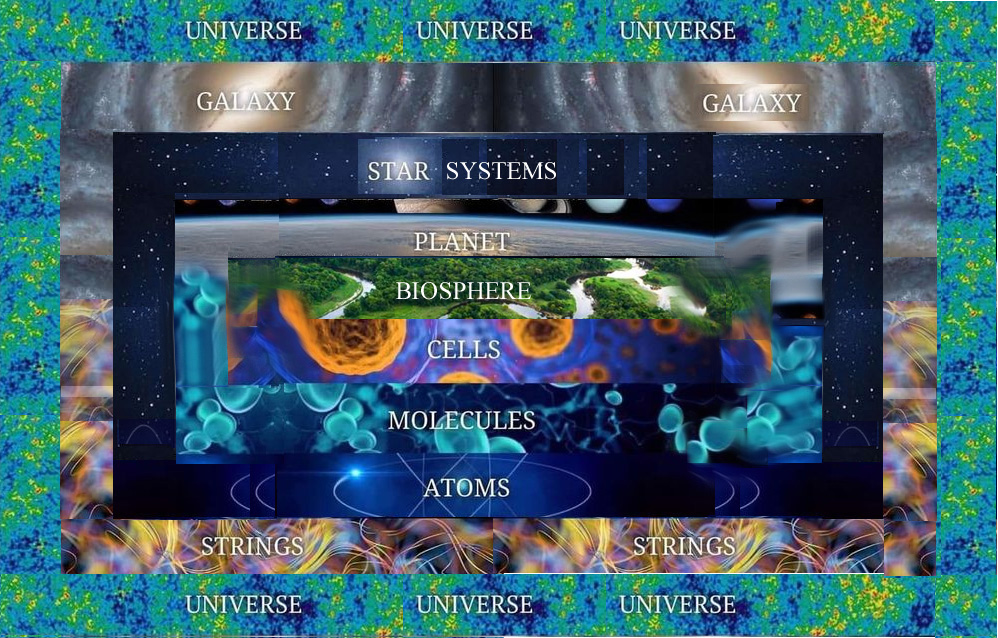

Got it? Spacetime scales are nested inward so that astropysical timescales (longest and shortest duration, largest and smallest size) envelope geo-molecular (next longest and next shortest duration and next largest and smallest size), which envelope the most medium scaled durations and size (eco-cellular).
Now think of that in an orthogonal relation to the other half of the universe, which correlates to size and duration, but is defined by intensity of aesthetic-participatory richness, aka Significance.
The main takeaway that I can offer as a response to the video, if nothing else, is the idea that
1. The distinction between anesthetic-participatory and anesthetic-mechanical is more fundamental than phenomenal/noumenal or subjective/objective.
2. Anesthetic mechanisms are either concrete (geometric mass-energetic force-field operations) or abstract (algebraic information-processing functions)3. Anesthetic mechanisms do not exist on their own and are in all cases a reduced, exteriorized reflection between two disparately scaled modes of aesthetic-participation.
Evan Thompson Live! Consciousness Live! S4 E12
From Richard Brown’s YouTube channel.
A great conversation so far. As usual, I have extensive comments…
> 13:32 Richard Brown “…in terms of phenomenal consciousness, there’s something that it’s like to be a cell?
“Evan Thompson “We can put it that way if we want. I mean, that locution sometimes bears more burden than it should, but for our purposes we can feel free to use it I think, sure.
> RB “OK, good. Alright…and there’s something that it’s like to be me, and I am composed of billions of cells”Notice that the assumption made here closes the explanatory gap without any explanation. I would say that I am experiences: Thoughts, feelings, ideas, memories, sensations…some of those sensations include a body, which I understand to be composed of billions of cells.
We do not know that the cell or the body of cells is the being that is conscious. Just as my face only reveals a tiny fraction of my conscious experience, so too does the structure and function of a cell reveal only a tiny fraction (maybe a greater fraction) of the content of any conscious experience that might be associated with it.
As far as we can tell, the interior of cells or bodies are just more objects – organelles and fluid made of organic molecules. None of that would reasonably entail anything like felt experience, and if it did, we should reasonably only expect those experience to correlate to certain specific types to physiological conditions. What we feel through our body does tend to be about the body and the world of the body, but we also have conscious experiences that would require extremely tortured reasoning and Just-So Stories to rationalize as an extension of physiology. Rather than projecting the appearance of the cellular world as geometry and chemistry, those structures and functions may, like our own face, be a kind of avatar/mask/lensing that summarizes only certain features related to the sharing of experience. If someone were somehow born without any sense of touch or sight, they could not conceive of objects or bodies. They could in theory live a full life of thoughts, feelings, flavors, sounds, etc all without ever suspecting that they could be connected to any such thing as a body. In the same way, the world of cell processes may not relate to us personally any more than the grammatical and syntactic features of this sentence are generating the meaning that I am trying to express personally.
The paragraphs of this post did not evolve from characters in the Latin alphabet. Its contents are not explained by the psychology of how language evolved to serve brains or bodies. In the same way, the microbiological world does not, in my view, exist to support a macro scale experience at all, and it may be much more like our own conscious experience than we would guess – a world of sensations and response that are largely unrelated to our own.
> 19:42 ET “…whereas the Panpsychist arguments, at least in the case of someone like Philip Goff, they’re based on intuitions like phenomenal transparency, which you know, I don’t want to start an argument there. By that I mean I don’t want to make that a premise of an argument. I think, it’s not obvious to me that there is any such thing as phenomenal transparency.”
I think it this is an example of what Raymond Tallis described as “cutting off the branch that you are sitting on”, that is, it is a perception, based on an intuitive sense of phenomenal transparency that intuition and phenomenal transparency cannot be trusted. I think that needs to be reversed. We should understand that we are always relying on some degree of assumed phenomenal transparency to conduct any sort of reasoning. Our only contact with truth, including truths about phenomenal transparency, begins and ends with an implicit assumption of phenomenal transparency. Of course, truth and phenomenal consciousness are, for humans, very complex, so there are many overlapping and contrasting dimensions of truth and sense, so it is not enough to unquestioningly follow our first intuitive, but neither is it enough to unquestioningly follow our first counter-intuitive impulse.
I think that modern science and philosophy have evolved through a dialectic shift in the Early Modern Period in which the idea of the primacy of super-subjective (theological) properties under Scholasticism was eclipsed by the antithesis idea of the primacy of super-objective (materialistic) properties of nature. I strongly suspect that now, a few centuries after that shift in the era of Descartes, Copernicus, Galileo, and Locke, we are now meeting ourselves at the other end of the fork in the path and encountering a similar but antithetical crisis in our understanding of the universe and our place in it. I think that the current crisis ultimately calls for a synthesis of subjectifying and objectifying modalities of sense and sense making that takes us beyond the previous approaches. The fear that questioning materialism will lead us into a pathological repetition of theological fundamentalism is so powerful that we are blinded and dragged into the opposite pathology, where the limits of objectifying sense appearances are denied to the point of anti-realism (MWI, simulation theory, Interface theory). That’s where I intend my ideas (Multisense Realism) to come in. Once we have understood why panpsychism is an imperfect but meaningful improvement over physicalism, then we can begin to develop some hypotheses that pick up where panpsychism leaves off. In my understanding, the inflection point of the future of that synthesis is sense. Sensation. Detection. Aesthetic presentation. Qualia. At this point, it does not seem that many thinkers share this view and the fact of qualia is constantly overlooked in favor of theories that stress the role that qualia may play for an organism or a system of computation. To me, this oversight is astonishing. It is comparable to saying that magic wands could grow on trees, since a tree with a magic wand would have a survival advantage.
There’s a great part around 24:00 where RB and ET disagree about the difference between biological cells and the types of technologies that we have developed so far. ET says that he thinks there is a fundamental qualitative difference between the organization of something like a bacterial cell and that of any artifact we have ever engineered. I agree with ET at 24:49 that we have glimmers of how we can synthesize aspects of the self production and self regulation of a living cell in a lab, but that we are nowhere near being able to generate autonomous, freely interacting, free standing self-productive entities. I do not, however see that as the cause of the difference between consciousness and unconsciousness.
I think that, pre-biological interactions are, in their own frame of reference as irreducibly aesthetic and participatory as those of our own conscious interactions, and that the appearance of those interactions as anesthetic-mechanical events is an artifact of how the universe of conscious experience segregates itself for maximum development of aesthetic novelty. I think that segregation includes a logarithmic recapitulation of biology from organic chemistry and organic chemistry to physics such that both of those steps are tantamount to a second and third Big Bang, but I think that the cosmological fabric in which those Bangs arise is sensory-motive from the start, rather than unexperienced forces and fields.
Like Evan, I think it is an illusion that we could engineer a biological cell or organism from the bottom up, and that we will have better results trying to condition, constrain, and hybridize existing cells. I don’t think we’re going to achieve a duplication of biology inorganically, only a production of recombinations and prostheses for existing cell processes. I don’t think we’re going to create a new first living organism.
In suggesting a cosmological hierarchy of recapitulation that parallels the teachings of many mystical traditions and echoed in more modern efforts such as Integral theory, I understand that there is a lot of resistance. I think that Recapitulation theory got a bad rep from how it was conceived by Haeckel and his association with it, but I think that rejecting the entire theme of encapsulating previous conditions in developing a cosmogony, and is a mistake. Our eyeball is strikingly similar to an aquarium of the conditions of the Precambrian Era. Vertebrates do share a common morphology during gestation that seems to reflect the phylogenetic history of the final organism. That’s not how we make machines. We don’t grow computers from manual typewriters. We don’t create conditions where they grow by themselves. When we build machines, we assemble fully formed parts that have no other relation to each other than the one we provide by forcing their temporary attachment to each other. Left to their own devices, machines fall apart. What we see in cell division may be not be fully explained in 3d + 1 spacetime terms. We may only be seeing/touching one surface of an event that envelopes and permeates visbility/tangiblity in the same sort of way that our personal awareness envelopes and permeates all of our subpersonal modes of awareness (sight, sound, touch, etc)
While the seeming mystery of biological life is amazing and important to us as conscious experiences with biological bodies, I think that it is a red herring distraction to understanding what qualia is, and the relation of qualia to concrete formation and abstract information. The relation that I propose is that the category of aesthetic-participatory perception is the universal parent to all anesthetic-mechanical processes of objects and concepts. I propose that objects and concepts are always and only appearances derived from a relativistic lensing of universal sensitivity/permittivity/empathy that goes all the way down. Consider the astrophysical-atomic world as a first playground for panaesthetic primordial experience, upon which a geological-molecular world evolves as a second recapitulation superimposed on the first. The eco-organic-genetic world is a third. The biological-cellular is a fourth. The zoological-somatic is a fifth. The vertebrate-neurological is a sixth. The antropological-technological is a seventh. These are all nested scales of size and frequency of events from which our concepts of space and time emerge. They are vehicles that consciousness inhabits for pleasure and for pain. It is not only for the cosmos to ‘know itself’ but to feel, see, do, and redo itself.
Around 32:00 Evan talks about rejecting the idea of zombies or consciousness as epiphenomenal/irrelevant to the function of the system based on the idea that the body is able to do what it does in relationship to the environment because it “feels itself in doing so”. I disagree with this justification as I think that it is a post hoc or retrospective justification that smuggles our conscious experience into an explanation of itself. In other words, if we use modus tollens, prospective logic instead of modus ponens retrospective logic, there would be no entailment for feeling. The physical functions of an animal’s body could evolve statistically over immense time spans by random mutation, just as we might expect geological chemistry to develop. The reproduction of simple bacteria is not much of a stretch from inorganic crystal growth in which organic molecules are incorporated that enable more types of similar crystals to persist for longer periods under more environmental conditions.
I like to point out a hole in the ‘zombie’ terminology for it’s implication of an ‘undead’ status of a randomly mutating reproductive structure rather than the more parsimonious ‘never alive in the first place’ status. A universe of molecules that evolve automatically and unconsciously would yield a world of reproducing organizations that are more like dolls than zombies. The Homo sapiens equivalent in an unconscious universe would be a species of sculptures that move each other around in repeating cycles – unwitnessed, unfelt, unseen. Behind these uexperienced tangible events would be equally unexperienced intangible mathematical relations. I would argue that even tangible shapes and intangible math require an aesthetic-participatory engagement to appear in any sense, but for argument’s sake, let’s say that shapes can “exist” and collide without any rendering by a sense of touch-feel. I can’t imagine how that would really be possible or why a functionally redundant sense rendering would develop parallel to that, but that’s getting ahead of ourselves.
All of this to say, Evan, don’t think of zombies that seem exactly like living people, think of dolls that “talk” and “cry”, not out of emotion or feeling their environment, but out of mechanisms to control bodies operating physically in space – lubricating eyelids, vibrating neural actuators, etc. The things that consciousness and sensation do for US are not functionally necessary to explain what a body would do and how it would evolve in a universe where sense and consciousness were replaced by automatic force and field.
The fact that we do feel ourselves in the world as a body does not stop us from looking at much more complex protein interactions and saying that they would not need to feel themselves in the world to be able to do that. Since I do think that all fields and forces are actually ranges of sensory-motive interaction on the pre-physical level, I do think that chemistry is a primitive scale or appearance of conscious experience, but if we want to try to hold on to physicalism and deny consciousness, then there’s no reason why the activities of human bodies are any different from the activities of molecular or cellular bodies. None of them functionally require awareness to exist if any of them don’t require it.
I completely agree with Evan when he says, around 33:25, that there is no reason to think that life could look like it does if it weren’t driven by consciousness. The difference is in the modus ponens/tollens flip. I think that zombies can’t exist because physics is actually a form of consciousness, whereas he, like many others, think that zombies can’t exist because consciousness is obviously so pervasive and useful in biology, zoology, and anthropology. He’s asking “why should consciousness be any different from biology?” and I’m asking “why should chemistry and physics be any different from consciousness?”.
At 34:00 Richard brings up the subject of the discovery of the unconscious and unconscious processing. From my perspective, the key is to understand that just because our personal consciousness receives guidance or can be overridden by processes that are beyond our personal scope of awareness, does not mean that those processes are not themselves subpersonal conscious experiences. Just because those experiences are rendered to us as brain activity does not mean that the structure and function of that activity is the cause rather than the symptom of the processing.
The shapes of these letters and the order that they are in are not creating the English language, and the English language is not creating this conversation, but rather the appearances are symptoms of other layers of sense and sense-making that happen to be under the hood of our personal awareness and experience. English has developed through idiosyncratic and unprecedented conditions of lived conscious experience – as an accumulation of consequences not as a cause of thinking and communication but as an effect of physiology and socially shared feelings about experiences.
At 39:55 Richard lays out an example of the hypothalamus monitoring the salt content of the blood and asks Evan if he thinks there is “something that it is like” to undergo that process. First, I point out that by conceiving of the process as something that the hypothalamus does, we have already loaded the question with a physicalist bias. The hypothalamus is a rendering in our sense of touch and sight, and our cogitative sense of understanding. I suggest instead that the actual process and monitoring (sensing and motivating effects) is not physically tangible. It is subpersonal awareness. It is an experience that is not being had by an organ or cell, just as our personal experience is not being had by a body, rather the body and cell are experiences that “we” are having. It makes sense to me that what cells and organs are doing is a result of experiences that we are not normally able to access directly, but instead are approximated in our personal awareness as feelings, sensations, urges, etc that identify themselves as closely coupled with our animal level experience. The fact that we can’t access it directly in our personal consciousness doesn’t mean the process is literally unconscious in its own frame of perception, only that our frame’s rendering of that frame’s rendering of itself is limited to the sight and feel of tangible shapes moving around under a microscope.
I’m going to stop there for now and take a break before listening to the second half.
“Is Consciousness a Controlled Hallucination?” part 2
Picking up again* for the second hour of this new video from 8/25/2021, where philosophers Philip Goff and Keith Frankish discuss consciousness with neuroscientist Anil Seth, whose new book is Being You: A New Science of Consciousness
Just after 1:00:00 Anil is talking about voluntary action as a freedom from immediacy, which I think carries a bit of misdirection or burying the lead. Freedom from immediacy, fine, there can be complicated clocks and timed systems in the brain, etc, but what is the feeling of will, how can it exist, and why? In addition, I don’t think many people question what is meant by ‘immediacy’. Isn’t that determined by some informal average of sensory sample rates? How is it not anthropocentric to project our arbitrary sense of now onto the universe as a whole? Timescale is one of the great keys to resolving the hard problem IMO.
I understand what Anil is saying about the sense of will or redness not needing to be real to be experienced, and not being part of the causal structure of the universe (I used to see it that way also for many years), but it fails to consider that by its own logic, asserting consciousness as something that isn’t completely real (a controlled or controlling hallucination) necessarily means that any idea we have about a universe or experiment that we can perform can be no more real. With physical science experiments, we can learn more about the physical-seeming end of our shared hallucination, but that is not to say its causal closure is anything more than the tautological limits of the very sense and sense making modalities we are using to locate this part of the universe in the first place. If redness can arise from a history of evolutionary utility then so can our sense of physicality. If, however, we can be right about anything, then at least some part of consciousness cannot be less real than physics.
Around 1:04:28 it starts getting a little animated, with Anil insisting that neuroscientific studies are not neutral with regard to free will. In the next minute, he steps back from that slightly to say that there’s merely no evidence of anything like free will. It’s hard to imagine how the lack of physical evidence wouldn’t be neutral, since Dualism would hold that of course there’s not going to be material evidence of non-material qualia. There no olfactory evidence for sight or colors either. I’m sure that Anil would agree that our sense of will is part of the universe that we model in our conscious experience as ‘physical’ or material, but I don’t think that he has considered that materiality itself may simply be conscious experience that has been rendered in a truncated form through our local interface/filter. The difference is that with the latter, our will can be both immaterial or transmaterial and have concrete material effects, because both subjective will and objective forms share the same common context of origin – there’s just no good reason to assume that context is more like our sense of physicality than our sense of mentality. To the contrary, with relativity and quantum mechanics, it seems clear that even the most physical of phenomena originate from a substrate that is more mind-like than it is matter-like. I see them both as categories of sensory-motive, aesthetic-participatory phenomena (universal qualia).
Around 1:12 they get into the inaccessibility of consciousness, with Anil saying that we will gradually have access to more data and Keith saying that science is irreducibly third person. My contribution to that is that if we study brain conjoined twins we can develop tech that will get us closer to sharing first person experience (or rather, those aspects of conscious experience that qualifies itself to itself as first person). There may be other ways to get around privacy also (which would unfortunately interest a lot of dangerous organizations as well). Maybe we can technologies to extend natural sensitivities and empathy to a degree that they produce rigorous science…maybe that’s a long way off but probably less invasive than brain sharing tech.
Seth goes on to say that he wants to see how far we can get pursuing the materialist project in science before considering other possibilities. I don’t think that anyone is suggesting on giving up on that, but I don’t see any advantage in presuming it is metaphysically accurate or waiting before exploring other possibilities. Around 1:18 Philip makes an excellent case for rejecting Anil’s approach of setting aside the hard problem, citing the somewhat unscientific decisions of Galileo, Descartes, and others to put non-material qualia outside of the domain of science.
At 1:22 the conversation gets slightly heated again as Anil suddenly gets personal by saying “Now you’re making a mistake you said you don’t make, and I’m a bit disappointed. You say you don’t make this mistake, but you just did!” Those of us who have debated at length about the Hard Problem recognize this pivot very well. The conversation has gone from a cordial sharing of perspectives to one of accusation and condescension. I wish that we had fMRI visualizations on everyone in the conversation and could see the frontal cortex activity getting hijacked by limbic activity. There is more going on here than just science – there is something that Anil, and most everyone that I have come across that subscribes to a physicalist view perceives as a threat, and one that demands an offensive response.
Both Anil and Philip agree here that there is something that a color blind person misses out on if they cannot see red – Philip says it is information (or knowledge from Frank Jackson’s Knowledge Argument/Mary’s Room), Anil isn’t really willing to formalize it though, saying only that the topic is a separate issue, a different thing for him and that it is irrelevant.
My Multisense Realism view defines qualia as the sole fundamental phenomenon, and one that includes a capacity to divide or limit (entropy-negentropy/insensitivity) access (sense/sense-making/empathy) to parts of itself. Qualia is what exists eternally – the Holos, insensitivity is what Graphs the Holos into local sub-holarchies of experience, and sense or consciousness is what reunites the latter with the former (making it holographic rather than hallucinatory). Sense is access to the totality. Entropy, including temporalization and spatialization, are functions of dynamically gating or limiting that access.
At 1:25 Anil and Keith affirm each other’s view that we should ignore the hard problem (the standard ‘shut up and calculate’ response, or non-response). Keith at least acknowledges this position as Illusionism, which he advocates, but Anil stops short of subscribing to it, saying at 1:26:07 “It doesn’t change what I would do very much.”
I think this attitude ironically supports Dualism. It’s a crytpo-dualism in which Res Cogitans is understood not to have an effect on Res Extensa (the doing that Anil cares about exclusively), and therefore doesn’t matter. Philip is correct when he says around 1:27 that the private/subjective phenomena are part of a totally different explanatory project from physical explanation, but I would go further and say that the project of physical explanation can be subsumed within the other project, as long as we don’t make the assumption that privacy/subjectivity is something other than (universal) qualia. With a universal qualia model like MSR, all physical forces and structures can be understood in sensory-motive terms.
Good job all around. I agree most with Philip, then Keith, and least with Anil, but I respect the nuance of his positions (not functionalism, not IIT, pragmatic, etc). Still, I think that Seth’s pragmatism is more biased than the wants to believe it is. Part of that seems like an unwillingness to care about the difference between pursuing materialistic methods (I think everyone agrees that we should) and the validity of the prospect of extending reality to the non-material. Anil seems to conflate the two positions, as if the former justifies the latter.
*My comments on the first hour are here.
 Multisense Realism
Recent Comments