Archive
Othello
“Othello” is a code that exists in a variety of forms, including ink on paper and binary digits on electronic storage. When this code is processed by human minds, it evokes some specific sensations. For instance, it causes our mirror neurons (and other brain modules) to run simulations of characters and situations.
The sensations “Othello” evokes in two different brains will usually be similar enough that the owners of those brains will be able to have a meaningful discussion about the play.
What I propose is that you turn your description of Othello as a code inside out. The code idea is a good one, and one that makes a lot of sense, but I have found that it makes more sense to view it this way:
“Othello” is many different but related phenomena:
0) Elementary level
- +0) a human experience that can be accessed through particular states of conscious and subconscious attention (proto-sensory)
- -0) a symbolic code that can be modulated and demodulated through a variety of communication channels (logical-quantitative or pseudo-sensory)
1) Sub-Personal level
- +1) a series of audio-phonetic and psycho-acoustic sensations which are fragments of aesthetically richer experiences. (sensory-qualitative*)
- -1) a series of electro-magnetic and neuro-chemical state changes which through which a computational isomorphism arises between syntactic structures and functional semantics. (microphysical)
2) Personal Level
- +2) a production of subjective feelings and thoughts in which one is theatrically immersed. This does not occur because of 1), but rather because of the essential psychological unity of the human experience that is being tapped into (+3) at a personal and social level of understanding (+2).
- -2) an enactment or rendition of a tragedy by William Shakespeare, believed to have been written in approximately 1603, and based on the Italian short story Un Capitano Moro (“A Moorish Captain”)
3) Super-personal Level
- +3 ) an artistically customized sampling of mytho-poetic inspirations, in which timeless human themes are clothed in specific anthropological, sociological, and psychological metaphors (metaphoric).
- -3 ) Part of a body of work which arose through the English Renaissance Period or Elizabethan Era reflecting a resurgence of interest in the humanities. It serves as an archeological artifact to add to our knowledge about everything from European history to political science, art, language, racial relations etc. (I call this meta-theoretic to contrast with the metaphoric…intellectual rather than aesthetic)
∞) Absolute Level
- +∞) A harmonic** integration of all of the above, so that each level makes sense in its own context and in conjunction with others. To arbitrarily choose one level of description would be a destructive compression if taken literally. (Telic)
- +∞) An impressive, though ultimately inevitable product of mathematical and physical laws plus statistically random mutations. (Ontic)
*I call this ‘semaphoric’ – meaning simple, repetitive meanings as would be produced by signal flags or digital codes. Intended to evoke a contrast to metaphoric, which are numerous complex figurative meanings extracted from a single communication. The personal, ‘phoric’ level would be between the semaphoric and metaphoric.
**or what I call ‘holotrophic’ – a productive extension of tendencies toward wholeness.
If the universe was going to be destroyed, and we had to recreate it based on some general description, I would say that my list of five, dual aspect levels is the minimum reduction that would be useful.
The idea that it can all be reduced to codes and simulations I consider to be a folly of the turn of this century in which low level functions are confused with generators of high level phenomena rather than the other way around.
To sum up and add cool symbols:
0) Elementary
-ℵ Sense, Essential Figurative Unity, +0
ω Information, Existential Logical Units, -0
1) Sub-Personal
æ Affect-Effect, Sensory-Motive Intention, Semaphoric Qualia +1
E Energy, Unintentional Physical Function, Dynamic Analogues -1
2) Personal
Æ Aesthetic Experience, direct, ‘-phoric’ +2
M Material Structure, indirect,’-morphic’ -2
3) Super-Personal
Ψ Psyche, Super-Personal, Meta-phoric, mytho-poetic +3
Φ Noús, Super-Impersonal, Meta-theoretic, algebraic-geometric -3
∞) Absolute (ॐ)
ש Telic, Metaphenomenal, proprietary preferences +∞
Δ Ontic, Automatic, generic axioms -∞
Syzygy Integrals and Other Neoquantisms
 Syzygy Integral
 Syzygy Integral with labels
When applying the syzygy integral to a sense modality such as vision, the Δæ would refer to the difference in the microphenomenal qualities, such as pixel hue, saturation, value, or contrast/edge detection, etc.. the entire palette of what I would call entopic or generic visual encounters. As shown in optical illusions, these elemental graphic features depend on their surrounding context, and two pixels or shaded regions which are measured to be optically identical can be perceived quite differently.

For this reason and others, I suggest that the fundamental nature of all phenomena is only definable in terms of specific properties, but of a pseudo-specific quorum of detectable differences. It looks like a lighter grey on the bottom because of the adjacent contrasts, and it is my conjecture that this kind of pseudo-specificity is at the heart of all measurements, particularly those which we have used to define subatomic particles.
On the top of the integral, the ∇Æ would refer to an entirely different, top-down mode of visual perception. Instead of a delta (Δ) to stand for a the difference of generic micro-phenomenal qualia, the nabla symbol (∇) is used to stand for a divergence from a larger perceptual context. This relates to the binding problem, i.e., when we see two dogs walk behind the same fence, we do not perceive them as becoming the same dog – the narrative continuity does for our overall understanding what the ‘illusory’ plasticity does on a microphenomenal level. To see the ) as a smile in the emoticon : – ) requires both a low level fudging of pixels into a curve, as well as the ability for our expectation of a face to be projected from the top down. The emoticon is a minimalist example, but a better example would be something like this:

Terms like pareidolia, apophenia, simulacra, and eidetic hallucination all have in common this potential to misread a more proprietary, macrophenomenal text on top of a relatively generic, microphenomenal context.
What the syzygy integral is supposed to model is that any given sense modality is a special kind of integration between top-down or holotrophic orientation and bottom up, entropic orientation. In the case of visual sense, the top-down images are encountered like those in an Rorschach inkblot, as endless wells of imaginative psychosexual association. The personal range of the psyche is here encountering influences from the super-personal range of the overall presence of this moment in relation to their lives, and their lives in relation to eternity.
The bottom-up ‘entopic’ confabulation (entopic hallucinations are those which are geometric designs, etc as opposed to eidetic hallucinations which are images such as specific faces) is where the personal psyche encounters the sub-personal influence of neurological, biological, and chemical events as it impinges on them visually. An entopic hallucination presumably maps much more directly to neurochemical patterns in the visual cortex, whereas the eidetic, storytelling hallucinations would be much more obscure and proprietary. A hallucination of Darth Vader or Dick Cheney might be hard to tell apart from looking at an fMRI, but it should not be so difficult to get a fix on zig zag patterns vs concentric circles, etc.
The syzygy integral of vision then would be this continuum between the sub-phenomenal adhesive that holds the graphic canvas together and the cohesive that renders the meta-phenomenal meanings and figures phenomenally visible. It’s not an ordinary integral, since it has an encircled triple bar in the center, which denotes a participatory intent (motive effect), and an aesthetic contour (sense affect). The term syzygy, an old favorite of mine (its a real word), refers to a union of opposites, either figuratively as in yin-yang, or literally as in an solar eclipse where the Moon is opposite to the Sun behind the Earth.
In the syzygy integral for vision, the vast sweep of possible interpretations from the meta to the micro level is interrupted by the inflection point of the moment as it is localized from eternity (the absolute). That which is seen had been both filtered from above and built up from below, but the visual encounter is defined even in opposition to that. The seeing is not the seen. All visual forms are opposed to an equally rich continuum of possible ways to appreciate those forms and images. The syzygy integral is not just a map of what there is ‘there and then’ but the entire domain of what each and every there and then still means ‘here and now’.
As the syzygy integral can be used to describe vision (vision = the participatory integration of graphic differences and imaginative likeness) or sound (sound = the participatory integration of phonic differences and psychoacoustic likeness), so too should it be able to describe the character of all phenomena. The underlying formula (Grand syzygy ingegral) uses the * asterisk and # pound to denote the limit of infinite figurative unity and the limit of literal, finite granularity respectively. In this case, the encircled triple bar refers to the Primoridal Identity Pansensitivity, from which all other syzygies are diffracted.
 Grand Syzygy Integral
The syzygy integral without the contour circle I am calling the information integral.
 Information Integral
Unlike the syzygy integral, which defines every piece of information as an aesthetic encounter or re-acquaintance, the information integral refers only to the skeletal functionality of sense. Locally we may experience novel encounters or acquaintances, but some would argue that all experiences can only be re-acquaintances from the absolute perspective. I think that it may make the most sense to think of even that either-or condition as just another superimposed quality of the absolute. Awareness is infinitely novel, infinitely repeating, and paradoxically non-paradoxical. It is only the disorientation of locality which provides orientation.
The information integral strips away all of the mystical trappings – the supertext and subtext contours, and refers instead to the conventional concepts of information theory. Here, the triple bar is still a participant and intentional arbiter of interpretation between signal and noise, but without the aesthetic complication. This is the standard view of information processing as a functional exercise, only with the additional acknowledgement of a core superposition of telic intention and ontic unintention, absolute improbability and immaculate reliability.
Alien Hand/Limb Syndrome
“The alien hand syndrome, as originally defined, was used to describe cases involving anterior corpus callosal lesions producing involuntary movement and a concomitant inability to distinguish the affected hand from an examiner’s hand when these were placed in the patient’s unaffected hand. In recent years, acceptable usage of the term has broadened considerably, and has been defined as involuntary movement occurring in the context of feelings of estrangement from or personification of the affected limb or its movements. Three varieties of alien hand syndrome have been reported, involving lesions of the corpus callosum alone, the corpus callosum plus dominant medial frontal cortex, and posterior cortical/subcortical areas. A patient with posterior alien hand syndrome of vascular aetiology is reported and the findings are discussed in the light of a conceptualisation of posterior alien hand syndrome as a disorder which may be less associated with specific focal neuropathology than are its callosal and callosal-frontal counterparts.” – http://jnnp.bmj.com/content/68/1/83.full
This kind of alienation from the function of a limb would seem to contradict functionalism. If functionalism identifies consciousness with function, then it would seem problematic that a functioning limb could be seen as estranged from the personal awareness, is it is really no different from a zombie in which the substitution level is set at the body level. There is no damage to the arm, no difference between one arm and another, and yet, its is felt to be outside of one’s control and its sensations are felt not to be your sensations.
This would be precisely the kind of estrangement that I would expect to encounter during a gradual replacement of the brain with any inorganic substitute. At the level at which food becomes non-food, so too would the brain become non-brain, and any animation of the nervous system would fail to be incorporated into personal awareness. The living brain could still learn to use the prosthetic, and ultimately imbue it with its own articulation and familiarity to a surprising extent, but it is a one way street and the prosthetic has no capacity to find the personal awareness and merge with it.
Is consciousness an emergent property of the brain or a fundamental property of matter?
Which is more likely?
Isn’t saying that consciousness is an emergent property of the brain just as much a non-explanation as saying it is a fundamental property of all matter?
To begin with, I think that it is necessary to separate the notion of personal states of consciousness from the vastly more general phenomenon of awareness.
Despite continuing evidence that human beings are less unique and special compared to other species than we had believed in the past, there are still ways in which Homo sapiens exhibit superlative talents. While we may no longer be able to point to any one particular trait, such as tool use, language use, or bipedalism that makes humans fundamentally different from everything else in the universe, the overwhelming sophistication of human life is surely an order of magnitude greater than that of any other organism we have encountered.
We know now that human neurons are not very different from those of other species, however, the human brain has almost twice the ratio of brain to body mass and energy of expenditure than the next closest contender (Bottlenose dolphin). We have every reason to correlate this surplus brain capacity with the success of the human species in overcoming their natural limitations and extending their habitat in uniquely un-natural ways.
If we set aside the special case of human consciousness for a moment, what can we really say that a brain does for an organism which cannot be found in organisms which lack a brain that has to do with deciding whether that organism is aware or not? There are zooplankton, for instance, with no brains who have eyes made of just two cells. We can imagine that anything using such primitive sense organs would have a vastly degraded experience compared to stereoscopic human vision, but the general premise of using optical sensation to navigate the environment is no more or less an indication of consciousness than our own.
As neuroscience and biology progress, it seems that rather than finding a clear threshold of phenomena which begin to appear more conscious, the threshold continues to fall. Here are some interesting things to consider:
- Neurons themselves now seem to have a nervous system of their own.
- Epigenetic studies show experiences have hereditary impact (Trait vs. Fate).
- Ephaptic coupling shows neurons communicating without using the synapse.
- Quorum-Sensing shows bacteria making group decisions.
- Worms remember things after their heads are cut off
- Plants sense danger and tell each other about it.
This even extends beyond the level of living cells:
- Universal protein fluctuations in populations of microorganisms
- More evidence found for quantum physics in photosynthesis
- Tiny volcanic moon controls Jupiter’s auroras
- Trophic cascades change the way that we think of ecology and geology: How Wolves Change Rivers
Add to this the continuing lack of resolution on ‘fringe’ issues such as NDEs, OBE’s, paranormal phenomena, the increase of the placebo effect, statistical anomalies in random event generators (REGs) and we get a picture of consciousness emerging from brains as seeming awfully anthropocentric.
If we consider the possibility of a material panpsychism, in which consciousness is a property of matter, it is not clear that we have solved the fundamental problem. The so called Hard Problem of Consciousness and Explanatory Gap address this lack of understanding about what a phenomenal quality of aesthetic presence would be doing in a mechanistic universe in the first place. By focusing on the structure of the brain and function of neurons, we are hoping to deflate the mind body problem. The mind can be seen simply as the functioning of a neural body – a vast network which exploits biochemistry to represent computations in this as-yet-not-understood, but inevitably discoverable way we are familiar with as our naive experience.
If we look at this approach more closely however, I think that we should find that all we have done is to miniaturize the mind body problem, so that it now exists at an arbitrary scale (neuron-mind neuron-body, peptide-mind peptide-body, connectome-mind connectome body, etc.). The metaphor of hardware and software has, in my view, led a generation of cognitive scientists and consciousness enthusiasts down a misguided path in which the very systems which we use to serve our conscious user experience (screen, keyboard, GUI, software) are mistakenly identified as serving the hardware (CPU, RAM, storage, network).
To truly go beyond the hard problem requires that we look at ‘looking’ itself. Understanding sensation and awareness as a phenomenon in its own right requires that we suspend all previous judgments and delve into completely new directions. In my own hypothesis, I see consciousness as not only a property of matter or physics, but is the sole property from which all possible properties must extend. This doesn’t require a human-like deity any more than the belief in matter requires that the universe is a large human-like body. It is more a matter of understanding how nested symmetries of a primordial sensitivity could produce what we know as matter, energy, spacetime, information, and subjective experience.
Tip of the Iceberg
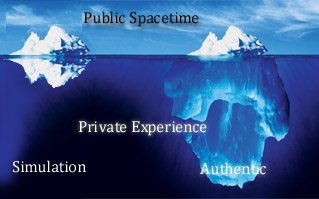
Another look at how the uncanny valley relates to the explanatory gap.
Attack and Redemption of Computational Theory of Mind
- 1. There is nothing at all which cannot be reduced to an encounter*, and that encounters can be presented directly (phenomenally) or re-presented indirectly (physically or semiotically).
- 2. That the nature of encounters can be described as aesthetic re-acquaintance, nested sensory-motive participation, or simply sense.**
- 3. In consideration of 1, sense is understood in all cases to be pre-mechanical, pre-arithmetic, and inescapably fundamental.
My challenge then, is for CTM to provide a functional account of how numbers encounter each other, and how they came to be separated from the whole of arithmetic truth in the first place. We know that an actual machine must encounter data through physical input to a hardware substrate, but how does an ideal machine (e.g. Turing machine, Universal Machine or program) encounter data? How does it insulate itself from data which is not relevant to the machine?
Failing a satisfactory explanation of the fundamental mechanism behind computation, I conclude that:
- 4. The logic which compels us to seek a computational or mechanical theory of mind is rooted in an expectation of functional necessity.
- 5. This logic is directly contradicted by the absence of critical inquiry to the mechanisms which provide arithmetic function.
- 6. CTM should be understood to be compromised by petito principii fallacy, as it begs its own question by feigning to explain macro level mental phenomena through brute inflation of its own micro level mental phenomena which is overlooked entirely within CTM.
- 7. In consideration of 1-6, it must be seen that CTM is invalid, and should possibly be replaced by an approach which addresses the fallacy directly.
The next three points have to do with my own hypothesis (Multisense Realism), submitted here only for those who might ne interested.
- 8. PIP (Primordial Identity Pansensitivity) offers a trans-theoretical explanation in which the capacity for sense encounters is the sole axiom.
PIP is the conjecture that sensitivity is the sole capability that is required for all phenomena. If we wanted to conceptualize a ‘unit’ of this pansensitivity, I suggest the aforementioned terms ‘aesthetic encounter’, ‘sensory-motive participation’, ‘re-acquaintance’, etc, or any other neologism which suggests a pre-monadic generator of pre-self and self-like perspectives.
My conjecture is that self is a type of symmetry within sense. There is no self except for self vs not-self. What is distributed by pansensitivity is not solipsism, but opportunities to modulate self-like symmetries. Selfhood is a particular form of sense distribution in which the symmetry between the absolute and the conditional is recapitulated twice. From the absolute perspective, the self becomes a branch toward isolated locality, while from the conditioned perspective, the self (the condition) stands in for the absolute.
- 9. CTM can be rehabilitated, and all of its mathematical science can be redeemed by translating into PIP terms, which amounts to reversing the foundations of number theory so that they are sense-subordinate.
Here I am talking about turning the assumptions of mathematical theory on its head. Platonic forms, for instance, would be conceived of as superficial emblems of sense rather than profound and perfect absolutes. Sacred geometry, while imbued with numinous meaning locally to a self (as it reflects the symmetry to which it owes its elaboration), but from the absolute perspective, sacred geometry is akin to a test pattern – crystallized reflections of aesthetic depth, but containing no depths themselves.
- 10. This effectively renders CTM a theory of mind-like simulation, rather than simulating macro level minds, however, mind-simulation proceeds from PIP as a perfectly viable cosmological inquiry, albeit from an impersonal, theoretical platform of sense.
All that I mean here is that because CTM trades in symbols of reflected sense-making rather than sense encounters, it doesn’t ever have a chance of capturing the important features of consciousness. It can, however, capture important features of how consciousness is distributed.
EDIT: Details added for clarity –
*Encounter can be thought of as ‘stimuli’, but need not include any information. It can be thought of as ‘qualia’ but it need not include any subject or object. The intention here is to reduce all phenomena to its absolute minimum – an opportunity for modes and motives for discernment to arise.
**This sounds jargony, for sure, but I’m inventing a precise vocabulary here, so as to avoid being misconstrued as a standard argument for what might be called ‘pseudo-subtance idealism’ (everything is made of energy, love, vibration, fields, etc) or information panpsychism (conscious experiences are produced by complex systems, functional states, etc).
John Weldon’s “To Be”
If you say yes to the scientist, you are saying that originality is an illusion and simulation is absolute. Arithmetic can do so many things, but it can’t do something that can only be done once. Think of consciousness as not only that which can’t be done more than once, it is that which cannot even be fully completed one time. It doesn’t begin or end, and it is neither finite nor infinite, progressing or static, but instead it is the fundamental ability for beginnings and endings to seem to exist and to relate to each other sensibly. Consciousness is orthogonal to all process and form, but it reflects itself in different sensible ways through every appreciation of form.
The not-even-done-onceness of consciousness and the done-over-and-overness of its self reflection can be made to seem equivalent from any local perspective, since the very act of looking through a local perspective requires a comparison with prior perspectives, and therefore attention to the done-over-and-overness – the rigorously measured and recorded. In this way, the diagonalization of originality is preserved, but always behind our back. Paradoxically, it is only when we suspend our rigid attention and unexamine the forms presented within consciousness and the world that we can become the understanding that we expect.
Die Enge des Bewusstseins, ‘the narrowness of consciousness’
To invent, I have said, is to choose; but the word is perhaps not wholly exact. It makes one think of a purchaser before whom are displayed a large number of samples, and who examines them, one after the other, to make a choice. Here the samples would be so numerous that a whole lifetime would not suffice to examine them. This is not the actual state of things. The sterile combinations do not even present themselves to the mind of the inventor. – Henri Poincaré
As part of his response, Albert Einstein writes:
… It is also clear that the desire to arrive finally at logically connected concepts is the emotional basis of this rather vague play with the above-mentioned elements. But taken from a psychological viewpoint, this combinatory play seems to be the essential feature in productive thought — before there is any connection with logical construction in words or other kinds of signs which can be communicated to others.
…It seems to me that what you call full consciousness is a limit case which can never be fully accomplished. This seems to me connected with the fact called the narrowness of consciousness (Enge des Bewußtseins)*.
Here Poincaré and Einstein are discussing the nature of creativity and the particular issue of how our personal awareness both does and does not generate novelty. Like the debate over free will, I see this as largely about the hierarchical flow of subjectivity. The personal level of awareness, as noted by Freud and Jung among others, is sandwiched between what could be called a sub-personal or sub-conscious range (Id) and a super-personal or metaphenomenal range (Collective Unconscious). Jung picked up where Freud left off, seeing that Super-Ego was not necessarily just a facade of social pressures against which the Ego cowers, but a living, trans-personal terrain of archetypal influences. The Jungian view looked at this terrain as being tied up in his idea of synchronicity – meaningful coincidence which can be decoded through a language of cross-cultural metaphor. Joseph Campbell wrote and spoke extensively on this language (‘The Power of Myth, ‘The Hero With A Thousand Faces’, etc.).
What I have not seen is a physical theory which takes the synchronicity and myth seriously. When we do take it seriously, I think that it meshes perfectly with the implications of the Theory of Relativity, and with what Poincaré and Einstein are talking about with the narrowness of consciousness. All that needs to be done is to relocate the concept of literal inertial frames of reference with a more figurative notion of phenomenal inertial framing. The idea of levels of consciousness is probably one of the most ancient and enduring concepts in mysticism. Whether they are seen as levels which can only be attained through a proscribed path or as introspective potentials which we can all access by ourselves, the desire to partition human experience as a hierarchy seems to be irresistible. Irresistible, that is, until recently. Contemporary psychology has largely moved away from hierarchies and grand schemas, focusing instead (with debatable success) on more modular, pharmacologically addressable functions.
While I appreciate many of the hierarchical maps of consciousness, like those so diligently compiled by Ken Wilber, I suggest that we begin from scratch, with an eye toward simplicity and correlation with general systems. In addition, the foundation for this view should be sensory-motive rather than information-theoretic or material-energetic. By sensory-motive, I refer to what Einstein talks about above. While the effect of creativity is teleological and communicative, the process itself is driven by what he calls combinatory play: ‘the essential feature in productive thought — before there is any connection with logical construction in words’.
Just as this sub-cognitive sensible engagement is overlooked in modern, computational theories of mind, so too is the possibility of microsensory phenomena overlooked in modern physics. I see this not as an accident, but rather the same oversight on a different scale. The idea that our own sensations emerge from a different source than the sensations which are telegraphed from the source to instrument of detection to scientific observer is not necessary if we generalize Einstein’s ‘combinatory play’ to the outer-shell of all of physics.
The MSR hypothesis is called Eigenmorphism. It is that what separates our body from our sub-conscious experience, and our sub-conscious from our personal experience can be understood in terms of a psychophysically extended narrowness of consciousness. There aren’t any inertial frames which simply exist, but only those which can be inferred through the combination of sensed perspectives. Modes of description, whether in the aesthetic of substances, quantities, or qualities are all ultimately narrowed channels of fundamental sense-making, which must be absolutely primordial. The various forms and functions which can be measured publicly are comparable to what Einstein meant about what is logically motivated and communicable, but what the deeper participation cannot be seen as the object of sight. Light, as a the most pervasive version of sense, is not a thing or an energy, but a participation multiplier – a way of being simultaneously here, there, and not literally here or there. I project my narrow attention through a mind which is already narrowed by a hierarchy of sub-personal and super-personal filters, each of which are also narrowed from scales of sensory participation so vast and unfamiliar that I read them only by the mechanical, impersonal traces that they leave. The universe that we live in is not a solipsistic narrowing of consciousness, but a nested universality of aesthetics – a combinatory play.
*The narrowness of consciousness which Einstein mentions is from William James:
“The sum total of our impressions never enters into our experience, consciously so called, which runs through this sum total like a tiny rill through a flowery mead. Yet the physical impressions which do not count are there as much as those that do, and affect our sense-organs just as energetically. Why they fail to pierce the mind is a mystery which is only named and not explained when we invoke die Enge des Bewusstseins, the narrowness of consciousness’ as its grounds.”.
Philosophy of Mind Flowchart

The idea here is that if we want to take the full spectrum of phenomena into account, we have to either begin with a reductionist realism and work upward, or a holistic idealism and work downward.
When we suppose that consciousness is a phenomenon that arises out of unconscious phenomena, we are saying that mechanism, through some act of emergence (generally by complexity), the mechanism in question (generally physical or computational mechanism) becomes enchanted with itself. In this case, as David Chalmers famously points out, there would have to be some threshold beyond which it would be impossible to tell the difference between a real person and a machine which acts just like a real person (a philosophical zombie). Finding this unacceptable, he suggests instead some variety of panpsychism should be explored, including perhaps, what I would call a promiscuous or ‘leaky’ panpsychism in which devices such as thermostats would have to be considered aware in some sense.
Finding both of these alternatives unacceptable, I suggest that we move over to the right side and begin with a downward facing ideal absolute. For the spiritually inclined, this could be called by any number of theistic names, however, it can also be conceived of equally well in completely non-spiritual, atheistic terms. When we suppose that awareness itself is inescapable and inevitable in all possible or theoretical universes, we are saying that through some divergence or illusion, awareness takes on a temporary solid appearance. In MSR, I suggest that this is a more plausible option than brute emergence from nothingness…modulated constraint within everythingness.*
Rather than positing an appeal to future scientific understanding to explain the emergence of aesthetic realism from mechanism, the divergence of mechanism from total awareness can be made palatable through a nested modulation of insensitivity. Intentionally partitioning intention itself so that it appears unintentional given a certain amount of insensitivity. This could be viewed either in the religious sense of ‘God’s divine plan is not visible to us’, or in a more conservative sense of ‘Shit happens coincidentally, but coincidental shit also happens to be meaningful from some perspective’.
If anyone is interested in what the crazy pink cone and all that is, I can explain in more detail, but briefly, if we take the MSR road from disenchanted idealism (the conservative ‘Shit happens’ option), then instead of the Chalmers dilemma of zombies vs leaky panpsychism, we get a continuum in which local sense is selectively blinded to the sense of non-human experiences, through a combination of frame rate mismatch (time scale difference cause entropy and local sense approximates) and distance (literal spatial scale difference, as well as experiential unfamiliarity).**
The other ten dollar words there, ‘tessellated monism’ and ‘eigenmetric diffraction’ both refer to the juxtaposition of sensitivity and insensitivity, through which a kind of metabolism of accumulating significance (solitrophy) in the face of fading sense (entropy) and fading motive (gravity).
*I call this cosmology the Sole Entropy Well hypothesis and it has to do with reversing Boltzmann’s solution to Loschmidt’s paradox so that entropy is a bottomless absolute, like c, in which local ranges of entropy and extropy stretch and multiply in a fractal-like reproduction.
**I call this aspect of MSR Eigenmorphism, which has to do with things appearing to be more doll-like and less familiar from a distance. This makes, for example, the presence of atoms and solar systems in our experience more similar to each other than either of them seems like a tree or a cell. The limits of our perception coincide with the simplicity of ontology, and they are, in a sense, the same thing (given eigenmorphism). As a rule of thumb, distance = the significance of insignficance.


Recent Comments