Archive
Rosetta Codex

Following up on the Tree of Life post and MSR Legend post.
Multisense Tree of Life

Multisense Tree of Life
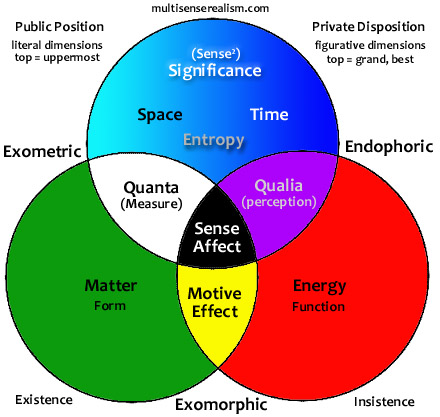
I noticed that this formulation was starting to take on Kabbalistic dimensions, so I put it into that form. There’s some new propositions to consider here that have come out of this. Beginning with sense, which I symbolize as -ℵ (negative Aleph) and as =. This is the fundamental concept of MSR and the idea of ℵ in mathematics as cardinality fits with this definition, since equality ‘is equal to’ anti-cardinality. Sense is the unity which underlies all multiplicity, so that it can indeed be thought of as a kind of negative cardinality – not unity, but pre-cardinality.
Moving up and to the right from sense, there is Qualia, now defined as -ℵ/ש (Aleph over Shin), where ש (Shin) refers to the diffraction of the Absolute ॐ (Om). This means that Q = -ℵ/ש or, private sense is the sense of a share of eternal being – it is “a” being. In Leibniz terms this is a monad, and it is also the origin of origination, and of the number 1. From these two entities, we have the two parts of the Absolute, which mathematically would be “=1”. Eternal being is the likeness of a being, i.e. the ability to pretend. (Insert Joseph Campbell’s myths and Carl Jung’s archetypes, shamanism, imagination, etc..,) Fiction is ‘like something’, just as Qualia is what it is like to be, or what being ‘seems like’.
Rounding out the primordial trinity from sense along with Qualia is Quanta and Motive. I call the Absolute ‘Qua’ to symbolize its relation as the reconciling parent of Qualia and Quanta. Quanta (ω, lower case omega), here meaning the essence of computation, is given the formula √(ℵ),(root of Aleph). This works surprisingly well. Originally I was going with 0.00…1 and then 0.x to represent Quanta, to specify that Quanta is always the tiniest fragment of Qualia – the drive toward absolutely monotonous precision, but always beneath the threshold of unity, of wholeness. All quanta are parts and abstractions; information-theoretic rather than aesthetic/sensory-motive.
This ended up working well with √(ℵ) (root of Aleph) as it makes clear the complementarity-antagonism with Quanta and sense. Computation is the essence of cardinality, of difference. The stepped reckoning of mechanism is an impersonation of sense, it has no capacity to negate the separations and to build feeling from fragmented quantities. Since negative Aleph (-ℵ) corresponds to 1, then Quanta would be the square root of -1, or i. I used the symbol >.< as well, to denote the clipping of sense through measurement: digitization. Quantification is fantastically useful because it paralyzes whatever it fixes its gaze on.
Motive, the third leaf of the sense trinity, has the formula ℵ±ש (Aleph plus/minus Shin), which emphasizes its similarity to Quanta and Qualia but with an irreducible difference, will. Will is the ± (plus/minus) which requires a participant to end what sense started (thus the use of Ω, Omega). To have a motive is to de-cide, to kill off all options except one. This is the ‘waveform collapse’ of QM, but it is also ordinary ‘free will’. Will is the connection between unconscious cardinality and the Absolute. We don’t know how to make our body move or our how to focus our mind’s attention, we simply become our mind or body and the universe does the rest. There is a cost to our efforts, however. In the drive toward Significance (Solitrophy, Φ), entropy is born.
The unchosen path of Motive becomes the unintentional twin of Significance. Significance, -ℵ² (Aleph squared), while mathematically would equal ℵ (Aleph) as 1, there is an irreducible numinosity to the power relation. Significance holds Q not only as the sense of one quality out of the Totality (ש) (Shin, Qua) but it holds one Q as equal to any number of qualities or meta-qualitative relationships. This is semiotics. Not just = but =². Not phoric (sense) but meta-phoric. Quanta is not phoric but metric – it takes the ² nesting of Significance (Σ) (Sigma) but negates the feeling, leaving only the essence of that figurative quality. Significance is sense squared, Quanta is the square root of pretend sense, the meta-phor is inverted. Figurative language is loose. It draws from associations from within the Totality. Quanta is the opposite, drawing from strictly disambiguated logic. It has no phoric or morphic content, no feelings or forms, only the skeletal coordinates associated with them.
If Significance is like the universal bank account of metaphors and of experiences which have meant something in particular, then Entropy is the compost heap of all of the unchosen and unchoosability in the universe. It’s symbol H is taken from Shannon’s Information theory, and its formula here is ॐ/-Ω, (Om divided by negative Omega). Using the ॐ Om rather than the ש Shin is to emphasize that this relates to the ‘return trip’, the catabolic, arterial part of the cosmic circulation. Shin has more of a sense of the diffraction and creativity of the whole. With Entropy, it is the Totality’s raw, untamed nature which is divided by negative motive. This correctly applies to the nature of Entropy as indifferent, literally and figuratively. No motive. This is where the universe doesn’t care.
Between H of Entropy and Σ of Significance winds the Φ of what I call Solitrophy. Solitrophy is what makes the difference between something that can care and something that can’t. Burning a pile of garbage and burning down a town might produce the same amount of energy and entropy, but burning down a town has a human cost which doesn’t show up on a spreadsheet. As aesthetic significance accumulates, the range between one outcome and another increases. A human being has more at stake, simply by being a human being with a vastly rich aesthetic experience, than it seem like an ant has, or even an anthill. Solitrophy describes this great anchor of all sanities, and builder of worlds (I call them, perceptual inertial frames or castes).
This leaves Matter, Energy, and Qua itself. Matter and Space are listed together, as are Energy and Time. This is to emphasize their relation in MSR, teasing apart their differences rather than conflating them relativistically. The difference between time and space is Solitrophic. It doen’t show up in physics, because physics, by definition is conducted to reduce Solitrophy to an absolute minimum. Physics is asolirexic. Here. Space is defined ω+H and Time as ω*Φ, so that space is about entropy’s quantitative expansion and time is about the quantification of the growth through Solitrophy. The effect of Quanta on Φ is to limit the ‘size of the now’ – the frequency and range of memory of any given participant. Space and time are perpendicular, so that all of eternity is represented spatially by Quanta’s filtering of sense, but that representation is a vanishingly thin slice. Space, by comparison, allows access to the entire continuum of scales which have been accumulated through Solitrophy, but not in a way which allows us to experience it directly.
Matter’s formula is Σ*H, describing mass – the significance of Entropy. As everything is reflected and juxtaposed within MSR, Matter, mass, and space are aspects of the same thing, They are the unintentional, automatic consequences of all spatial scales, collapsed into a single scale. That’s how you get bodies which collide on one inertial frame, but pass right through each other if they are relevant to vastly different scales. This is obviously a rule of thumb – just a way of understanding how space is really an artifact of matter’s sense of its own non-sense and how time is about how functional tropes (routines), constrain and define energy. Energy, therefore, has the formula Ω ± ω (Omega plus minus lowercase omega), with Ω being Motive, now here given another nesting (Ω is already ±. so Ω ± is ±±) and ω being Quanta. Energy is a motive to motivate, or perhaps from to motorize, i.e. to translate a private effect publicly. The Quanta here emphasizes that this translation from motive to motor involves modulating both the frequency and the amplitude of the effect. Energy turns motive effect into work and power.
Finally, the crown of the tree, is Qua. I have covered this a lot already, but here the relation between sense, Qualia, and the Absolute can be seen. If sense is =, and Qualia is 1, then the Absolute is ‘=1’. The inclusiveness of the Absolute is total. It is the largest possible inertial frame. Our personal experiences are part of the whole, and the whole is every part of us.
MSR Legend 3
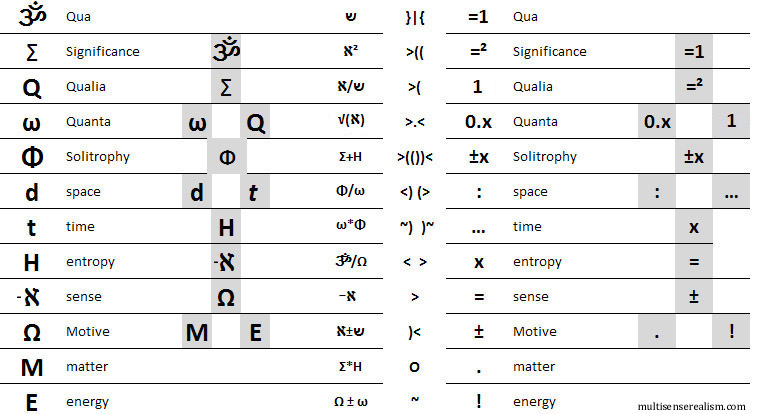
One more of these for tonight, as i’m still in a semiotic frenzy, as I’m sure you can tell.
MSR Legend

A first second draft of a Rosetta Stone for MSR terms, including the debut of new quasi-alchemical code.
Second draft 7/22/13, added Solitrophy and updated the formulas of time and space to clarify.
Realism Cartoon
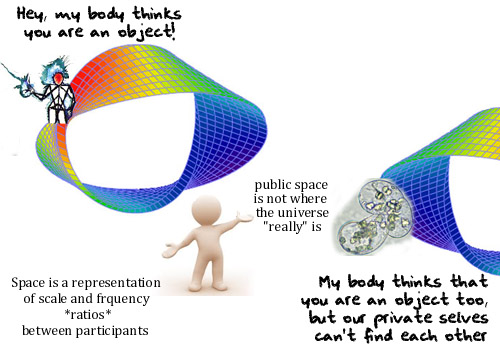
Above, the little person on the cool end of the spectrum is the image that the participant on the warm end of the spectrum has of themselves, or rather of their body as seen by themselves on the scale which is native to the individual (as opposed to looking in the mirror and seeing billions of cells or gazillions of molecules). It is the scale of the participants experience going back to the beginning of the universe (I know this sounds insane), which is ultimately a reflection of its history more than mechanics. My conjecture is that experiential histories develop into perceptual inertial frames, or castes which, like the frequency ranges of the electromagnetic spectrum, make visible light phenomena relate to a different modalities and circumstances than say radio waves.
What we see as objects are tokens, snapshots of private disposition which are represented as public positions – forms in places. We can’t relate to some ‘one’ who is as small as a single cell, and what or whoever it is that is represented to us by the cell finds us much too large to relate to. This is a rather fantastic way of utilizing everything subjectively and objectively. Everything gets to be the star of its own show on one level, and to be surrounded by the public facing fragments of every other star to use as props, tools, and worlds.
Comparing Worldviews

Side by side comparison of what seems to be the prevailing cosmology (above) and MSR (below). In the consensus worldview, aka Western post-modern view, quantitative function replaces all other modalities of sense and sense itself is absorbed into automatism. Energy is merged with matter as ‘particle-waves’ or ‘probability wave functions’, just as space is merged with time through relativity. Rather than a universe of concrete participation, the illusion of realism ’emerges’ from the evolving complexity of statistical interactions. At what level this emergence occurs, why it occurs, or how are left to future generations to explore.
Conspicuously absent are all traces of subjectivity, participation, and significance. Motive effect is understood only as a caused effect – the playing out of inevitable mechanical agendas which stem from a few ‘simple rules’. All forms of privacy are unknown and entropy is divorced from sensory interpretations. All sensations are thought to be partial revelations of an objective truth, so that any deviation from that empirical fact is considered an error.
MSR sees the absence of sense as a the gaping hole in this schema. While emergence is appropriate for understanding how many phenomena which appear to be novel are often found to be inevitable upon further inspection, it is entirely an entirely inappropriate machina ex deus for phenomena which have no plausible origin from the known functions of the system. The consequences of overlooking the key principle which unites all phenomena (sense), are that we wind up with an impoverished worldview, a Straw Man of cosmology in which we ourselves have no possible place.
What is Information? Reality as Information – Is there Intrinsic Meaning? Sentient Life & Bits
Dolors Jou Torras: I think all one needs to do is redefine information and then it all clicks into place. Information: a perceived difference that can make a difference. You start with an awareness of a difference (reality differentiating itself and becoming aware of it). Then you move on to an awareness of a difference which in turn makes a difference (this awareness of differentiation enables learning, growth, knowledge, etc).
At some point this ability to perceive a difference becomes able to not only perceive a difference (of states) but can also perceive a difference in such a way that order can be assigned (as in before / after). Time is born – or rather, it evolves (= the ability to perceive a difference + assign order and duration).
You escalate this ability to perceive differences, etc, to an information field which can model consciousness (consciousness being defined in line with self-awareness, ability to self-modify, intelligence, ability to evolve, etc).
Then you get to the point where “physical” universes can evolve (within consciousness “space”) and so space-time and matter evolve… This goes hand in hand with the evolution of individual conscious observers experiencing this physical universes
So the paradigm goes like this: information—> consciousness & time —> laws of physics—> individual observers + space-time & matter
Craig Weinberg: I agree with what you are saying, especially the part about adding the qualifier of “a perceived” to “difference”. I would say though that that makes this capacity to perceive more fundamental than what is perceived. Even if we understand that of course information must be perceived, I still think that the word information carries an implicitly objective connotation. All that information can be is an experience in which some sensory context is informed. This capacity to perceive is already awareness, so that even though we could say that the term ‘consciousness’ refers to an awareness of awareness, I don’t see that such an awareness requires any information at all. All that is required is a quality of awareness in which the presence of awareness is felt. There is no feeling of the absence of awareness, so it is not a matter of discerning a difference or being informed about anything, it is simply an expectation of persistence and participation.
I like to break down the word information into three parts: “in” (which is input-output of sensory-affect/motor-effect), “form” (which is material shapes divided by space), and “ation” (which is recursive functions united through time). Where we are at now I think is to overlook the “in” part entirely and treat formations as the primitive context, when in fact the formations are the objects of appreciation and participation of the true primitive capacity for sense.
Dolors Jou Torras: Defining information and consciousness differently is what makes the descriptions of what is ultimately primary different… I completely understand what you are saying, when I put myself inside your theoretical framework Don’t disagree at all, but I can see that it all boils down to the precise details of how one defines information, awareness, consciousness and so on.
Craig Weinberg: Yes, for most contexts it is more useful to talk about information in the traditional sense. I think it’s only when we need to really get a maximum close up on that boundary between firstness and secondness or between the front and back end of the snake who is eating its tail. We are very much on the same page about the semiotic relation. I would suggest to consider that information is not non-physical, so much as physics is experiential and information is part of experience.
What makes an experience seem ‘physical’ is that it is out of bounds of our intimate sensory range. That which is too fast, too slow, too large, too small, or too unlike us in another sense is experienced in increasing degrees of dissimilarity to experience. Experience is the sense of who we are and the motive of why we do what we do, but matter is bodies nested within larger bodies. Matter is the what and how, the re-presentation of first person presentations.
Information is when one level of experience exploits another, more distant (and therefore more matter-like; discrete positions, subject to public inspection, etc) level. We take a sheet of cellulose molecules, which on their own level are holding on to each other, oxidizing slowly, etc and we inscribe a quantity of ink (also an experiential reality on its native fluid-molecular level). This inscription can be modeled as a trade off of entropy, we are fixing our private ideas and expressions on various levels, conscious and subconscious in public spacetime. Public spacetime freezes private sense into public form and private motive into public function. The information entropy of the writer’s idea is discharged in the act of writing, a process to be revisited in reverse when the reader understands what has been written. The low entropy signal of the written word is traded for an aesthetic entropy increase in the reader’s experience – they imagine, they think, their mental experience reverberates and ‘warms up’, creating novelty and creativity. This is significance. Significance lights up previous memories and pulls them together, bringing a sense of integration within. (Understanding = entero-standing…inner settling).
information is not physical in the sense that the effect of being informed is experiential, but information media is physical, which means that it is down-rev experiential, so to speak. We use experiences which are dumber and smaller than we are to carry our messages. Thinking of it this way brings matter, mind, and meaning together as one ecosystem of sense-making.
Dolors Jou Torras: I will cover the physical vs non-physical debate in another video soon, but defining information as essentially non-physical has to do with several factors:
– I relate information to qualia (perception, experience)
– That in this “physical” universe, in general we need to embed or engrave information in physical matter or energy via symbols or signs, does not make information itself physical.
The laws of physics do not preceed information hence information is not bound by physical laws (information is primary)
There is compelling evidence, in my opinion, that non-local effects point in the direction that our physical universe (space-time plus matter) is a subset of a larger reality. What is “physical” is a moving target
Information (in theory) can be used as a basic currency to describe any reality, not only what our current physics can describe (or is attempting to describe).
Information therefore can be used to move away from duality… “Physical” vs “non-physical” is not a matter of substance dualism; these are purely subjective terms that we mostly associate with what our current science can measure with its instruments.
Craig Weinberg:
“defining information as essentially non-physical has to do with several factors:
– I relate information to qualia (perception, experience)”
I agree in the conventional sense of ‘physical’, information would be non-physical, but I think that in an absolute sense, the physical and non-physical can only be different perspectives (private-facing and public-facing orientations) of the same thing. What I am trying to pioneer is the idea that this thing is sense: the universal capacity for aesthetic participation, aka the capacity to generate, experience, and appreciate qualia.
“- That in this “physical” universe, in general we need to embed or engrave information in physical matter or energy via symbols or signs, does not make information itself physical”
Right, symbols or signs are independent of matter, but not independent of the capacity to experience (sense). A particular piece of information, such as a page in a book, can obviously exist without my experience of it, but it cannot exist without some capacity for interpretation somewhere in the universe.
The question that I put to you, however, is ‘can awareness exist without information?’. I think that it can. I think that a feeling need not inform us. I think that information is always a reflection or representation of sense, and never the genuine presentation itself. Eating a meal is not simply an information processing event where knowledge of nutritional conditions are stored in the body and in our understanding, it is a concretely visceral, mouth watering, chewing, gobbling, licking, swallowing orgy of sensual participation. We can extract information from the experience, but when we do, that extraction is inevitably reductive. It is an accounting of events from a hypothetical voyeur’s perspective rather than the genuine and indispensable experience.
In my view, qualia is not a representation, it is a presentation – an aesthetic presence. Information is a particular kind of qualia, a presentation in which another presentation has been abstracted as an a-signifying, quantifiable figure. Such a figure is public-facing and communicable, so long as the receiver of the communication can re-signify some of what has been frozen as a spatial-form/temporal-function.
“The laws of physics do not preceed information hence information is not bound by physical laws (information is primary)”
Because you are including the aesthetic experience of information as information, I agree with you here too. Matter-Space/Energy-Time would be types of information (Form-Sense/Function-Motive). If we conflate information with sense, however, then we would have to explain why sentience does not emerge from information itself. Why can’t we write a story which has feelings itself? Why do we react unfavorably to impersonated entities like mannequins and automatons (uncanny valley effect)? Part of my contribution here is to get very specific and show how the relation between sense, information, and matter can be juxtaposed to yield unity or contrast but that sense is the essential commonality. Information can be forged and copied, it is generic and implicitly impossible to truly own. Sense is absolutely proprietary and authentic, ineffable, unreproducible.
Information is the manifestation of the intention to circulate publicly, but sense is the private anchoring of a disposition between the sensor/self and the universe. This opposition relation of sense and information is recapitulated and exteriorized as the relation between matter and energy, and matter-energy/space-time. It’s the same theme of reflection through orthogonal juxtaposition. It’s very tricky of course, because we can toggle foreground/background from any perspective. Einstein grabbed mass-energy and it gave him space-time. If you grab information-sense, it gives you physical machines and non-physical machines. My proposal is to grab sense-motive and get all of the others: form-matter-space::function-energy-time. Square that and you get public entropy::private significance.
“There is compelling evidence, in my opinion, that non-local effects point in the direction that our physical universe (space-time plus matter) is a subset of a larger reality. What is “physical” is a moving target”
I agree completely, although I think that the larger reality is the sum-total of all sensory experiences in the history of the universe. The larger reality is experiential while space+matter is a frozen slice – a tokenized representation of part of that reality as experienced from a particular perspective and presented as a public context. Physical to means only that something is intended as a concrete presentation rather than a pure representation. The idea of a train is physical, in the sense that ideas are physical experiences, but the train which is confabulated within the idea is not physical. Non-local? Certainly. Locality is a low level sense protocol. I think that’s part of what the atoms are doing on the microcosm, sending each other messages (we call quantum) to generate locality through spacetime coordinates. The universe is inside the big bang/Abolute, and all space is a presentation within it’s sense.
“Information (in theory) can be used as a basic currency to describe any reality, not only what our current physics can describe (or is attempting to describe).”
Yes, but only if you are assuming that information includes sense. Think of how the same information on a DVD can be heard as music or seen as a video though. A computer reads that DVD anesthetically, as data. Low level electronic sensation in all likelihood, but the data is not giving the DVD player an experience of watching a movie.
“Information therefore can be used to move away from duality… “Physical” vs “non-physical” is not a matter of substance dualism; these are purely subjective terms that we mostly associate with what our current science can measure with its instruments.”
Yes, in the absolute sense, but if we don’t explain that subjective polarization and connect it to public and private presentations, then we have not really explained the universe that we live in. With my view, all dualisms, monisms, and multiplicities fall out naturally from the capacities of sense and motive to diffract entropy spatiotemporally and recover significance experientially.
Consciousness, in Black and White
It occurs to me that it might be easier to explain my view of consciousness and its relation to physics if I begin at the beginning. In this case, I think that the beginning was in asking ‘What if the fundamental principle in the universe were a simple form of awareness rather than something else?’
Our choices in tracing the lineage of consciousness back seem to be limited. Either it ’emerged’ from complexity, at some arbitrary stage of biological evolution, or its complexity evolved without emergence, as elaboration of a simple foundational panpsychic property.
In considering which of these two is more likely, I suggest that we first consider the odd, unfamiliar option. The phenomenon of contrast as a good place to start to characterize the theme of awareness. Absolute contrasts are especially compelling. Full and empty, black and white, hot and cold, etc. Our language is replete with evidence of this binary hyperbole. Not only does it seem necessary for communication, but there seems also to be an artistic satisfaction in making opposites as robust as possible. Famously this tendency for exaggeration clouds our thinking with prejudice, but it also clarifies and makes distinction more understandable. In politics, mathematics, science, philosophy, and theology, concepts of a balance of opposites can be found as the embodiment of its essential concepts.
For this reason alone, I think that we can say with certainty that consciousness has to do with a discernment of contrasts. Beneath the linguistic and conceptual embodiments of absolute contrasts are the more zoological contrasting pairs – hungry and full, alive and dead, tired and alert, sick and healthy, etc. At this point we should ask, is consciousness complex or is it simple? Is the difference between pain and pleasure something that should require billions of cellular interactions over billions of years of evolution to arrive at accidentally, or does that seem like something which is so simple and primordial that nothing could ever ‘arrive’ at it?
Repetition is a special form of contrast, because whether it is an event which repeats cyclically through a sequence or a form which repeats spatially across a pattern, the underlying nature of what repeats is that it is in some sense identical or similar, and in another sense not precisely identical as it can be located in memory or position as a separate instance.
I use the phrase “repeats cyclically through a sequence” instead of “repeats sequentially through time” because if we take our beginning premise of simple qualities and capacities of awareness as preceding even physics, then the idea of time should be grounded in experience rather than an abstract metric. Instead of conceiving of time as a dimension in which events are contained, we must begin with the capacity of events to ‘know’ each other or in some way retain their continuity while allowing discontinuity. An event which repeats, such as a heartbeat or the circadian rhythms of sunlight, is fundamentally a rhythm or cycle. That is the actual sense experience. Regular, frequent, variation. Modulation of regularity.
Likewise, I use the phrase “repeats spatially across a pattern” instead of “repeats as a pattern across space” because again, we must flip the expectation of physics if we are to remain consistent to the premise of sense-first. What we see is not objects in space, it is shapes separated by contrasting negative shapes. What we can touch are solids, liquids, and gases separated from each other by contrasting sense of their densities. Here too, the sense of opposites dominates, separating the substantial from the insubstantial, heavy from light, hard from soft.
An important point to make here is that we are adapted, as human beings with bodies of a particular density and size, to feel the world that relates appropriately to our body. It is only through the hard lessons like plague and radiation that we have learned that indeed things which are too small for us to see or feel can destroy our bodies and kill us. The terror of this fact has inspired science to pursue knowledge with an aggressive urgency, and justifiably so. Scientists are heroes, informing medicine, transportation, public safety, etc as never before in the history of the world and inspiring a fantastic curiosity for knowledge about reality rather than ideas about God or songs about love. The trauma of that shattering of naive realism haunts our culture as whole, and has echoes in the lives of each generation, family, and individual. Innocence lost. The response to this trauma varies, but it is hard to remain neutral about. People either adapt to the cold hard world beyond themselves with fear or with anger. It’s an extension of self-consciousness which seems uniquely human and often associated with mortality. I think that it’s more than confronting their own death that freaks out the humans, it’s the chasm of unknowable impotence which frames our entire experience on all sides. We know that we don’t really know.
The human agenda becomes not merely survival and reproduction, but also to fill the existential chasm with answers, or failing answers, to at least feel fulfilled with dramatic feelings – with entertainments, achievements, and discoveries. We want something thrilling and significant to compensate for our now unforgettable discovery of our own insignificance. With modernism came a kind of Stockholm syndrome turn. We learned how to embrace the chasm, or at least to behave that way.
At the same time that Einstein began to call the entire foundation of our assumptions about physics into question, the philosophy of Neitzsche, along with the science of Darwin and Freud had begun to sink in politically. Revolutions from both the Left and Right rocked the world, followed in some nations by totalitarianism and total war. The arts were transformed by an unprecedented radicalism as well, from Duchamp, Picasso, and Malevich to Stravinsky and Le Corbusier. After all of the pageantry and tradition, all of the stifling politeness and patriarchy, suddenly Westerners stopped giving a shit about the past. All at once, the azimuth of the collective psyche pitched Westward all the way, toward annihilation in a glorious future. If humans could not live forever, then we will become part of whatever does live forever. The human agenda went transhuman, and everyone became their own philosophical free agent. God was indeed dead. For a while. But the body lives on.
The point of this detour was to underscore the importance of what we are in the world – the size and density of our body, to what we think that the world is. Not only do we only perceive a narrow range of frequencies of light and sound, but also of events. Events which are too slow or too fast for us to perceive as events are perceived as permanent conditions. What we experience exists as a perceptual relativity between these two absolutes. Like the speed of light, c, perception has aesthetic boundaries. Realism is personal, but it is more than personal also. We find agreement in other people and in other creatures which we can relate to. Anything which has a face earns a certain empathy and esteem. Anything that we can eat has a significance to us. Sometimes the two overlap, which gives us something to think about. Consciousness, at least the consciousness which is directed outwardly from our body, is all about these kinds of judgment calls or bets. We are betting that animals that we eat are not as significant as we are, so we enjoy eating them, or we are betting that such a thought is immoral so we abstain. Society reflects back these judgments and amplifies them through language, customs, belief systems, and laws. Since the modernist revolution, the media has blanketed the social landscape with mass production of cliches and dramatizations, which seems to have wound up leaking a mixture of vanity and schadenfreude, with endless reenactments, sequels, and series.
It is out of this bubble of reflected self-deflection that the current philosophies rooted in both reductionism and emergentism find their appeal. Beginning with the assumption of mechanism or functionalism as the universal principle, the task of understanding our own consciousness becomes a strictly empirical occupation. Though the daunting complexity of neuroscience cannot be overstated, the idea is that it is inevitable that we eventually uncover the methods and means by which data takes on its fancy experiential forms. The psyche can only be a kind of evolutionary bag of tricks which has developed to serve the agenda of biological repetition. Color, flavor, sound, as well as philosophy and science are all social peacock displays and data-compressing virtual appendages. The show of significance is an illusion, an Eloi veneer of aesthetics over the Morlock machinations of pure function.
To see oneself as a community of insignificance in which an illusion of significance is invested is a win-win for the postmodern ego. We get to claim arbitrary superiority over all previous incarnations, while at the same time claiming absolute humility. It’s a calculated position, and like a game theory simulation, it aims to minimize vulnerability. Facts are immutable and real, experiences are irrelevant. From this voyeuristic vantage point, the holder of mechanist views about free will is free to deny that he has it without noticing the contradiction. The emergent consciousness can speak glowingly out of both sides of its mouth of its great knowledge and understanding in which all knowledge and understanding is rendered void by statistical mechanics. Indeed the position offers no choice, having backed itself into a corner, but to saw off its own limbs with one hand and reattach them with another when it is not looking.
What is gained from this exercise in futility beyond the comfort that comes with conformity to academic consensus is the sense that whatever happens, it can be justified with randomness or determinism. The chasm has been tamed, not by filling it in or denying it, but by deciding that we are simply not present in the way that we think. DNA acts, neurons fire, therefore we are not thinking. Death is no different than life which has paused indefinitely. An interesting side effect is that as people are reduced to emergent machines, machines are elevated to sentient beings, and the circle is complete. We are not, but our products are. It seems to me the very embodiment of suburban neuroses. The vicarious society of invisible drones.
Just as 20th century physics exploded the atom, I would like to see 21st century physics explode the machine. Instead of releasing raw energy and fragmentation, I see that the blasting open of mathematical assumptions will yield an implosion into meaning. Pattern recognition, not information, is the true source of authenticity and significance. They are the same thing ultimately. The authenticity of significance and the significance of authenticity speak to origination and individuation over repetition. Not contrast and dialectic, not forces and fields, but the sense in which all of these facets are yoked together. Sense is the meta-syzygy. It is the capacity to focus multiplicity into unity (as in perception or afference) and the capacity for unity to project into multiplicity (participation or efference).
These are only metaphorical descriptions of function however. What sense really is and what it does can only be experienced directly. You make sense because everything makes sense…in some sense. That doesn’t happen by accident. It doesn’t mean there has to be a human-like deity presiding over all of it, to the contrary, only half of what we can experience makes sense intentionally, the other half (or slightly less) makes sense unintentionally, as a consequence of larger and smaller sequences which have been set in motion intentionally. We are the evidence. Sense is evident to us and there is nothing which can be evident except through sense and sense making.
Questions About Human Senses
“Thanks for always writing such great responses to my questions.
I was wondering if you could, either as a response here or in a post, comment on sensation itself, that is to say on the sensory modalities we experience as humans. It strikes me that one of the great unasked metaphysical questions is whether the 5 senses that we know exhaust the kinds of sense available to being. Some see a deep truth in this, as 5 is a number closely associated with phi and the Fibonacci sequence (we also have 5 digits on our appendages). Even the existence of the 5 platonic solids makes one wonder if our senses somehow represent a phenomenological analog to this geometric truth. And what does each of the senses make sense of? What sense do the senses make?
Much has been made of echolocation as a possibly alien form of sense (and the basis of serious anti-reductionist arguments in philosophy of mind, as with Nagel’s classic essay) but it’s just as easy to imagine, perhaps easier, that echolocation is simply the bat’s way of generating visual sense, or perhaps some synesthesian fusion of visual and auditory modalities.
Synesthesia itself presents phenomenological conundrums that are worth teasing apart. If synesthesia is possible why have we evolved with such separation to our senses? Does a person with synesthesia loose as much as he gains? And, could a total, radical, singular sysesthesic unitary SENSE be imagined?
Finally, there is the complicated relation of sensory experience to thought. Though the two are generally conceptually separated (could there be anything seemingly less “sensory” than abstract thinking) I bet the real story is far more complicated. My intuition is that all thought is sensory through and through though the way thoughts, and, in particular, language, represent (experience?) sensation is mind-boggingly subtle. (Is this Hume’s distinction between ideas and impressions again?)
Love to hear your thoughts on the senses. Seems important for MR.”
Thanks for the topic and the interest. Starting with the five senses, I’m not sure that the number is particularly significant. The difference between olfactory and gustatory sense seems to me like a difference in degree rather than a difference in kind. There is a lot of overlap between flavors and smells although you could argue that there are some tastes that you cannot smell. Can something smell salty? Something can smell sour or bitter but not ‘upside down’ or ‘high pitched’.
There are also categories of sensation which do not fall easily into the five. Vestibular-kinesthetic sense and proprioception can maybe be considered forms of tactile ‘feeling’, but your skin can’t feel dizzy and the relation between your body and the world can’t really itch or hurt. Then there’s more metaphorical kinds of sense, but are they really metaphorical or are they just deeper within the context of personal experience? Sense of humor, moral sense, sense of gratitude, intuition, business sense…these are arguably irreducible to general awareness or some other sense modality.
If I were to apply an alchemical read of the senses, I would go with more of a tetragrammaton view with the masculine elements corresponding to aural and tactile sense and the feminine corresponding to visual and olfactory-gustatory sense. This four-way symmetry provides a rich vein of fun associations to ponder…the stereotypical masculine preference for fast vehicles and loud noises vs the feminine stereotype ‘candy and flowers’ offering give a hint. A five point comparison has more of a person-hood connotation – like the five digits on our hands or the five appendages radiating from our torso, the emphasis is on the utility of sense as they pertain to our agency in the world. In MR I am dealing not so much with human sense modalities in particular but the underlying phenomena of sensory presentation. I can see how the number five would have interesting numerological and mathematical properties, although all of the other integers do as well. Five is the recapitulation of one, the middle number, associated with qualities of growth and constraint. Five suggests ratios and leverage in a way that the first four integers do not. The thumb rules over the fingers as the head rules over the limbs, etc. Perhaps it characterizes the relation of the conscious self to the more mechanistic (four-like) subconscious.
“If synesthesia is possible why have we evolved with such separation to our senses? Does a person with synesthesia loose as much as he gains? And, could a total, radical, singular sysesthesic unitary SENSE be imagined?”
Synesthesia is very interesting to me because it really deflates the assumption that the aesthetic presentation of our subjective experience is simply a package deal which emerges from the characteristics of data. We see that indeed sounds can be smelled, numbers and days of the week can have colors, but also that syneasthetes do not share the same bundlings of sense. This suggests to me that aesthetics are not in fact generated by the brain, but rather appreciated through the brain, body, and the body’s environment, as well as subjective experience augmenting itself over time. Congenitally blind people do not see visual phenomena when their visual cortex is stimulated, they feel tactile stimulation instead. This debunks the assumption that sensory modalities simply correspond to brain region.
As for what a synesthete gains or loses, I can only guess. From the accounts I have read it seems like it is mostly benign, occasionally spectacular (one case gave a man the ability compose music visually…a head injury I think). Some seem to feel a bit insecure about it. Being a person is strange enough as it is without seeing or tasting things that nobody else does.
As far as a unitary sense, I suspect that just as the human body corresponds to a particular palette of sense capacities, a human stem cell might correspond to a more undifferentiated palette. That could be explored experimentally with the right technology. My hypothesis is that the unitary sense is a continuum between tight-stress-high frequency, loose-relaxed, low frequency oscillation.
“My intuition is that all thought is sensory through and through”
I agree. My working model is that thought is cognitive quality sensation, and that it is essentially a feeling in which other feelings are represented. As algebraic variables are to actual values, thoughts are transparent containers for reflected icons of hypothetical experiences. An understanding of audio sense in comparison to sight is revealing I think, given that our thoughts typically persist as interior verbal presentations. Sound waves, unlike light, require matter to propagate from node to node, so there is an inference that I make about acoustics being a body-to-body interaction. The cochlea and the dual role of the inner ear for hearing and balance seems particularly three dimensional – a sense of volumes of matter. Musical instruments are sculptural and tangible, and acoustic sensation pierces the ear the high end and engulfs the body on the low end. Thought is similarly about encapsulation, it is a semiotic pre-packaging which is formulated for public distribution. It paradoxically frees subjectivity from the subject while encoding the subject’s intention as an independent form. Maybe this is why William S. Burroughs and others have described language in alien terms, as viruses and memes.
I hope that made enough sense to be worthwhile. Thanks again.
Public Space, Private Time, and the Aperture of Consciousness

In the first diagram, I’m trying to show the relation between public and private physics, and how the aperture of consciousness modulates which range is emphasized. Contrary to the folk model of time that we currently use, multisense realism proposes that time is only conceivable from the perspective of a experiential narrative. Time cannot be translated literally into the public range of experience, only inferred figuratively by comparing the positions of objects.
Through general relativity, we can understand spacetime as a single entity defined by gravity and acceleration – to quote Einstein, a
“non-rigid reference-body, which might appropriately be termed a “reference-mollusk,” is in the main equivalent to a Gaussian four-dimensional co-ordinate system chosen arbitrarily”.
While space and time can indeed be modeled that way successfully, what has been overlooked is the opportunity to see another profoundly fundamental symmetry. What GR does is to spatialize time. This is a great boon to physics since physics has focused exclusively on public phenomena (for good reason, initially), GR has enabled accurate computations on astronomical scales, taught us how to make cell phone networks work on a global scale, send satellites into orbit, etc. Einstein accomplished this by collapsing the subjective experience of time passing (which can change depending on how you feel about what’s going on) into a one dimensional vector of ‘observation’. Not any special kind of observation, just a point of reference without aesthetic dimensions of feeling, hearing, tasting – only a generic sense of position and acceleration. This is the public perspective of privacy, i.e. not private at all, but a footprint which points to the privacy which has been overlooked but assumed.
This is great for modeling some aspects of public phenomena, but in reality, there is no actual public perspective that we can conceive of. There is no voyeur’s view from nowhere which defines perspectives without any mode of sensory description. That view from ‘out there’ is purely an intellectual abstraction, a hypothetical vantage point. Why is this a big deal? It’s not until you want to really understand subjectivity in its own terms – private terms. By spatializing time, GR strips out the orthogonal symmetry of space vs time which we experience and redefines it as an illusion. Our native experience of time is as much the opposite of space as it is similar. Time is autobiographical, it is memory and anticipation. We can stay in the same place while time passes. Our time also moves with us, with our thoughts and actions.
Space, by contrast, is a public field in which we are tangibly located. If we want our thoughts to stay somewhere, we must leave some material trace – write a note or make a sign. When we want to meet someone, establishing the spatial coordinate for the meeting is based on a literal location – a physical address or reference (by the palm tree in the South Square Mall). The time coordinate is more figurative. We look at clocks with made up numbers which we have intentionally synchronized, or pick an event in our shared narrative experience (after the movie is over). If our watches are wrong, it doesn’t matter as long as they are both wrong in the same way. If we actually need to be a specific palm tree, it doesn’t matter if we are both wrong in the same way, we will still be at the wrong location. Time, in this sense is a social convention, while space is an objective fact.
Looking at the diagram, I have put this sense of time as a social convention in the center right, as the clip art alarm clock. This is the familiar sense of time as personal commodity. Running out of time. The bells emphasize the intrusive nature of this face of time – our behavior is constrained by conflicting agendas between self and others, home and school or work, etc. There is a pie to be allotted and when the clock strikes X, the agenda is expected to follow the X schedule. The label just under this clock marks the point of punctuality, where the time that you care about personally no longer matters, and the public expectation of time takes over.
Above this personal, work-a-day agenda sense of time, I have included a Mayan calendar to reference a super-personal sense of time. Time which stretches from eternity to the eternal now. Time which is measured in fleeting flashes and awe-inspiring syzygies. Time as cosmological poetry, shedding light on experience through experience. This is time as a dance with wholeness.
Beneath the alarm clock I have used the guts of a digital clock to emphasize the sub-personal sense of time. The alarm clock face of time collapses the mandala-calendar’s eternal cycle into personal cycles, but the digital clock breaks down even the numbers themselves into spatial configurations. Time is no longer moving forward or even cycling, but blinking on and off instantaneously.
This all correlates to the diagram, where I tried to juxtapose the public space side of the camera with the private experience side. The subjective disposition of our awareness contracts and dilates to influence our view. At the subjective extreme, the view is near sighted publicly and far sighted privately. For the objective-minded individuals and cultures, the view outside is clear and deep, but the interior view is purely technical. The little icons have some subtle details that came out serendipitously too – with the headless guy on top vs the camera guy on the bottom, but I won’t go into that…rabbit hole alert. The last few posts on psychedelics and language relate…it’s all about how spacetime extends intentionality from private aesthetics to public realism through diffraction of experience.

 Multisense Realism
Recent Comments