Archive
Colorball Diagram Explained
420anorexorcist said: Can you please explain that?
Sure, thanks for asking!
The diagram is based on ideas from my reality theory, Multisense Realism. I have found that many of these ideas coincide with previous concepts in philosophy, but if I’m on the right track, then MSR offers a new and more complete integration of scientific observations and subjective reports.
To make it clearer, I have added a numbering scheme, with negative numbers on the Left or West side, and positive numbers on the East side or Orient. In addition to the version of the colorball diagram that has been posted, there will be another version in a future post which has the same schema but introduces some new terms which qualify the frame set by degree of aesthetic depth rather than kind.
Key I
Teleological-Absolute (+∞) :: Universal-Axiomatic (-∞)
Mytho-Poetic (+3) :: Geometric-Algebraic (-3)
Mental-Emotional (+2) :: Scientific-Mechanical (-2)
Sensory-Motive/Perceptual (+1) :: Electro-Magnetic/Relativistic (-1)
Proto-Aesthetic (+0) :: Quantum-Digital (-0)
Key II
Absolute (+∞) :: Anesthetic (-∞)
Entelethetic (+3) :: Hypothetic (-3)
Aesthetic (+2) :: Exthetic (-2)
Immediate (+1) :: Etheric (-1)
Protosthetic (+0) :: Pseudethetic (-0)
There are a lot of other diagrams that I have done as collages or graphs, but what I was trying to do here is to give a sense of these ranges of aesthetic (sensed, felt, appreciated) qualities as a spherical-banded on one side and flat-concentric on the other. The idea of making the experiential side spherical is that it represents that given the assumption of Pansensitivity that MSR makes, the totality of experience is the largest possibility. The total of all experiences throughout eternity (assuming nested relativistic time frequencies) dwarfs all possible sets of phenomena or structures within that possibility.
It’s a big idea that gets discussed on the website in more detail. Suffice to say, the universe of conscious experience is being compared to a big colorful ball, but has only its surface to express some view of eternity. Thinking of the numbers of the Keys above, the higher the positive integer, the more translucent the surface becomes and the more of what might be called the genius of eternity (the most illuminated views of the past and all future potentials) is illuminated at once. The lower the number, the more opaque and reflective the surface becomes, so that individual sensations ground awareness in the immediacy of the moment.
The negative numbers can be thought of as ignoring the depth and surface of the sphere completely, but adding structure and realism by cutting across the interior. Unlike direct awareness, the power of math and science to help us infer what we cannot see for ourselves is timeless in an entirely different way. The universe of science is the orthogonal cross section of the universe of feeling and experience, so that its formula and theorems emerge from reading between the cracks of experience. The scientific mind tries to subtract themselves out of the picture, to create a perfect experimental vacuum for impartial, unbiased truth. What the Western side lacks in vitality and wisdom, it makes up for with knowledge and intelligence. The concentric circles also represent the way that the most extreme physical conditions (quantum, astrophysics) share the same forces but differ from the kinds of phenomena found in mid-sized, macroscopic scales (medicine, agriculture).
Monochord
On the East side of the colorball, the prismatic banding emphasizes a loose hierarchy of what could be called aesthetic prestige. Besides just modulating how much of the eternal experience can come to the surface of awareness, there nature of privacy is such that there is a hierarchy significance. Even if we wanted to, it would be hard to take the life of a flea or dandelion to be as interesting or important as a person. Each band signifies a ‘leveling up’ or ascending within the totality of awareness. There is a ton of legitimate and flaky stuff out there about this kind of thing of course (Ken Wilber’s work has extensive correlations of these kinds of systems) so I try not to dwell on what its about, but generally, my system tries to simplify and science-ify the whole thing, so that it does seem as likely to relate only to the experiences of human beings.
Roughly mapping to the Chakra system and other monochord designs, the journey of improving sense can be compared to language. The basic unit would be phenomena in the orange Sensory-Motive (+1) range and can be compared to [letters or syllables] in a word. These would be raw sensations and sensory qualities, aka the root nature of qualia.
Going up the ranks, the yellow Mental-Emotional (+2) range would be like [words and paragraphs] to the +1 [letters and syllables]. This level is the garden variety waking state of mind for most people. Getting things done, thinking, and being a person. It’s the range we could call Natural and Aesthetic.
When consciousness becomes so elevated that realism begins to become transparent, past and future mingle and the ordinary becomes extraordinary. The Mytho-Poetic (+3) band corresponds to ideas like the collective unconscious and archetypes, but also just regular old imagination and fictional stories. This level would correspond to [paragraphs and stories], and it is super-personal in the sense of it reaches for the heroic and divine. It is also cultural and prophetic, psychedelic, delusional. etc. As the integer increases and the surface becomes more illuminated, the interconnectedness of things is revealed as metaphor and coincidence.
The monochord can be thought of as a logarithmic scale of relative time as well. The ‘now’ of a sensation can be less than a second, but to think and feel like a person in the world requires a larger ‘now’, of hours. The Mytho-Poetic seems supernatural to us because I think that it represents our sensitivity into the larger now of weeks, years, and lifetimes. Under heightened conditions of consciousness, it is common to experience the feeling that time has stopped, whereas under sedative or narcotic masking of consciousness, time can seem to be lost or forgotten. Because higher consciousness dilates experienced time, high states can be visionary and far-sighted, or just ‘far-out’. The Mytho-Poetic level is notoriously ambiguous and deceptive, possibly because because we are glimpsing experiences which are, from our local perspective, still half-baked.
The Teleological-Absolute (+∞) can be God, if we prefer a Western metaphor. In that case it would correspond to the [author or artist] writing the stories, that are made of words, that are made of letters.Teleological = Top Down, like I am writing this from a single intention which cascades down through my wording mind, through the finger-tapping keys and the bit-byte-ing computer hardware that we share.
If, like me, you don’t resonate so much with an anthropomorphic God, the Totality can be the Absolute inertial frame instead, and the authors and artists are themselves written by the art – by sense itself. It sounds crazy, but it makes sense to me as a next step after ‘We are spiritual beings having a human experience’ to just say, ‘we are a human experience’. I call this Primordial Identity Pansensitivity.There are many concepts within Eastern philosophy and Western mysticism which reflect this kind of non-deity generator of everythingness, but I think that it is important that we understand this as physics – the physics of privacy.
If the East side is about time and experience, the West side is about scales of space and experiences in which we deduce and infer hidden patterns which explain our experience. This is Science rather than Art, and Science begins in the opposite way as the Teleological Absolute – it begins with a blank slate…or does it? The universe of space is based on laws which are taken to be axiomatic. The Universal-Axiomatic (-∞) means that when we want to get real and we have to stop looking for metaphysical truths, and instead accept that ‘stuff exists’, including laws which guide and propagate changes in the cosmos.
The Geometric-Algebraic (-3) range is the most ancient range of the Western thesis. Classical mathematics and philosophy are inseparable, and like the +3 Mytho-Poetic, range that it opposes, it has to do with perfection. Where the +3 phenomena are perfectly actualized expressions of timeless themes and characters, the -3 phenomena are elegant in their purity. This is not sense for the sake of sensation, but sense-making for the sake of permanence. +3 has its dragons and goddesses, but -3 has Pi, and Euler’s Identity, hypoteneuse, etc.
As Geometry and Algebra become more sophisticated, Trigonometry and Calculus ushered in the Enlightenment Era and modernism in science. The Scientific-Mechanical (-2) level splits Science from Philosophy, with Descartes, Copernicus, Leibniz and Newton, among others building on Renaissance advances since Galileo. The Reformation echoes the philosophical break, with top-heavy Roman Catholicism and angels-on-the-head-of-a-pin Scholasticism yielding to the rise of classical mechanics, empiricism and the industrial revolution.
From the work of scientists like James Clerk Maxwell and Marie Curie, the nature of Electro-Magnetic/Relativistic (-1) phenomena was brought to light. The electric era, followed by the radio, atomic, and electronic era tap into an invisible, etheric layer of structure. Unlike any of the previous conceptual models based on forms and volumes, the pervasiveness of vibrations and waves constructed only of frequencies and wavelengths is, in my opinion, the correlate to +1 Sensory-Motor/Perceptual phenomena, and I think that there is a lot of indication that this could be true, given the utility that neuroscience has found in electromagnetic access to the brain.
Finally, the Quantum-Digital (-0) level, picking up where Einstein left off, is giving us a taste of an information-theoretic universe. The heroes of Quantum Theory include Planck, Bohr, Heisenberg, Feynman, etc as well as Turing, Shannon, Bateson, and many others for introducing a probabilistic Wonderland in which reality can only be calculated, but not understood. Each of these levels deserves a dissertation, and then another set of dissertations about how they all relate. Hopefully that is enough to give anyone who has stuck with it this far a taste of that this is all about.
*+0 is rounded off, but it would really be +0.00…1, since absolute zero is impossible under MSR. Same with -0.00…1; rounded off here to -0.
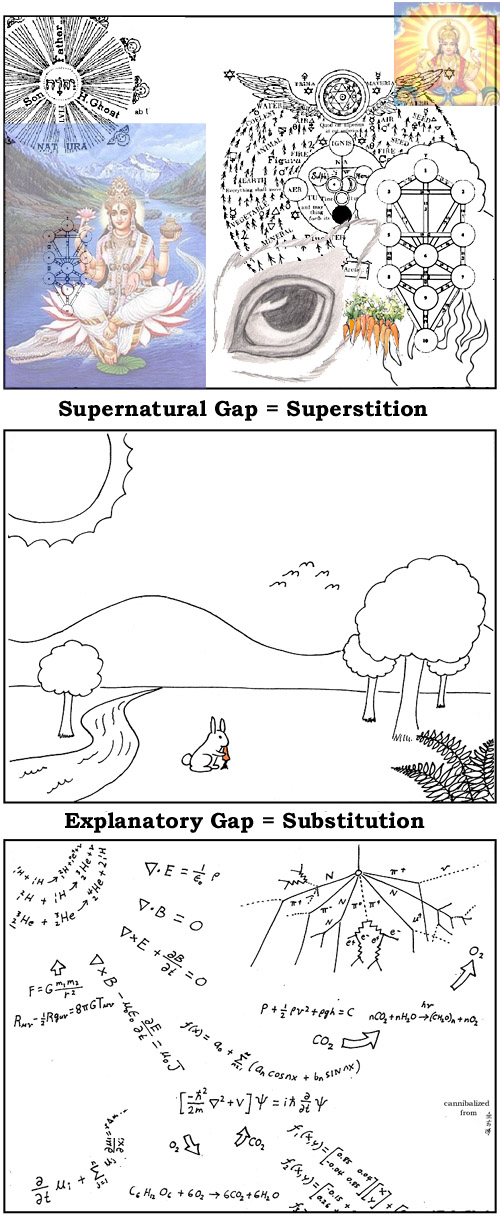
Metaphor, Electricity, Sun and Moon…
Electrophoric Magnetemorphism
If you had walked up to someone living in prehistoric times and had a conversation about the Sun and the Moon, it would probably be an easy way of talking about the concept of opposites. It’s an embodied metaphor which is almost absurdly plain. The Sun, a featureless disk of blinding radiance, unchanging yet burning – it looks like it could be a circular window into pure and infinite energy. The Moon is like everything that the Sun is not like. Its changing phases reveal shapes and features on the surface, sometimes orb-like, sometimes disc-like. The Moon’s darkness reveals that it reflects and receives the Sun’s light rather than produces its own, and because of that, and its association with the night and the tides, seems cool, and silvery to the sun’s golden warmth. Moonlight isn’t bright enough to allow us to see color, as noted in that Moody Blues song:
Cold hearted orb that rules the night
Removes the colours from our sight
Red is gray and yellow, white
But we decide which is right
And which is an illusion
How surprised a prehistoric astronomer would be to travel into the 21st century AD and find that all of that is complete horseshit. We now understand that most of what makes the Sun and Moon perfectly alike and unlike, from their similar apparent size to their duality, to their role in marking time and mytho-poetic extremes are purely coincidental. We just so happen to orbit one star, and be orbited by one natural satellite. The ratio of distance to size just happens to equal out so that the discs in the sky can often appear to be the same size, especially in conjunction. Indeed, the Sun is not only just an unremarkable star, but stars are just balls of exploding gas – huge spheres that have life cycles of their own.
There are some things that both the archaic and modern astronomer could use as a basis to preserve some symmetry of comparison. The Earth is to the Sun as the Moon is to the Earth as far as orbits are concerned. The Earth metabolizes the Suns energy with a biosphere generated atmosphere, where the Moon mainly reflects it.
The way that we treat the Sun and Moon now, compared to the way that humans had always treated them before science can be understood as a four dimensional dipole – a circuit through time, or really a meta-circuit since the dipole begins with a polar mytho-poetic understanding and ends with an elliptical mass-energetic understanding. Which leads me to some crazed ideas about electrostatic and magnetic force.
Notes on magnetism:
Watching the Khan Academy Introduction to Magnetism, I feel like I am finally making some headway into understanding the difference between electric and magnetic force. As he explains in the video, magnetic fields have are dipoles, they have North and South poles no matter how you break them up*. Electrostatic force is about positive and negative charge, but they can stand alone…at least (I’m thinking), alone at any given time.
What’s the difference? If we think of magnetic force as a spatial dipole, because its polarity is always adjacent, then why not think of electric charge as a dipole across time? But wait, it gets better. Because time is not fixed and is open ended, the electric metaphor poses charge like a question which can be answered at any time, and which wants to be answered and asked again and again. For the positively charged mass, negative charge exists as an image, an expectation of a presence which is currently absent but must eventually be present in the fullness of time (eternity, if necessary).
It could be said that the electric force, figuratively if not literally (but maybe literally, given a rehabilitated view of physics), creates time. It is the animation of circuitry. Electricity is algebraic and logical as it arcs from vector to vector directly, like a lightning bolt, hopping across gaps in logical steps. It is a path finder and path maker.
The magnetic force would then make sense as the creator or projector of space. It is the container of time, flattening cycles to circles. The magnetic force doesn’t draw lines, it aligns and orients, receives and presents spatial aesthetics to and from surrounding territories. If electricity is sensory motivation, then magnetism is motive sensation – a spatial feeling and knowing to match electrostatic being and doing.
Through Maxwell and then Einstein, we understand that these two modalities of interaction are the same thing but phase shifted by relativistic frame of reference. My understanding now leans toward seeing electricity as marking the “arctic” polar extremes in reference frames; the Innermost Metaphorical and the Outermost Binary kinds of relation, while magnetism presents the “tropic” counterpoint, describing how smaller and larger scaled bodies are nested within each other. Current flowing through a wire creates a magnetic force around the wire, it’s about the embodiment of the wire as a whole and how it relates to other macroscopically. The electric force is universal and infinitesimal, but it has no sense of figure and form, no orientation (needs a Ground).
This nugget came across my screen recently…it kind of makes sense, but I’ll leave that to you to interpret.
In Larry Niven’s story “The Kiteman,” we learn that the most important maxim in the Smoke Ring is: “East takes you Out, Out takes you West, West takes you In, In takes you East. North and South bring you back.”
Parting shot: Relativity is based on frames of reference, while Quantum Theory uses digital probability – eigenstates. Like magnetism and electricity, they are both the same thing seen from a different frame of reference. Together they describe how ‘reference’ is ‘framed’, but they both share the same blind spot, which is explaining what ‘ference’ is that these frames ‘re-fer’ to. I think that ference can only be one thing – not energy, and not information (which are really metaphors for spatial-magnetic and temporal-algebraic), but awareness itself: sensory-motive aesthetics.
*Some claim there might be magnetic monopoles also.
Breaking the Nth Wall

- Eliminative Materialism: The picture is the only reality, so the artist is an illusion.
- Idealism: The artist is real and the picture is an illusion.
- Dual Aspect: The artist and the painting are two halves of the whole.
- Monotheism: Norman Rockwell is omnipotent and immortal.
- Computationalism: Norman Rockwell is an emergent property of jpeg compression. Any sufficiently complex compression becomes Norman Rockwell.
- Multisense Realism: The picture, artist, audience, illusion, Norman Rockwell, and computation are all sensory experiences which make sense in different but sensibly related ways.
Free Will Isn’t a Predictive Statistical Model
Free will is a program guessing what could happen if resources were spent executing code before having to execute it.
I suggest that Free Will is not merely the feeling of predicting effects, but is the power to dictate effects. It gets complicated because when we introspect on our own introspection, our personal awareness unravels into a hall of sub-personal mirrors. When we ask ourselves ‘why did I eat that pizza’, we can trace back a chain of ‘because…I wanted to. Because I was hungry…Because I saw a pizza on TV…’ and we are tempted to conclude that our own involvement was just to passively rubber stamp a course of multiple-choice actions that were already in motion.
If instead, we look at the entire ensemble of our responses to the influences, from TV image, to the body’s hunger, to the preference for pizza, etc as more of a kaleidoscope gestalt of ‘me’, then we can understand will on a personal level rather than a mechanical level. On the sub-personal level, where there is processing of information in the brain and competing drives in the mind, we, as individuals do not exist. This is the mistake of the neuroscientific experiments thus far. They assume a bottom-up production of consciousness from unconscious microphysical processes, rather than seeing a bi-directional relation between many levels of description and multiple kinds of relation between micro and macro, physical and phenomenal.
My big interest is in how intention causes action
I think that intention is already an action, and in a human being that action takes place on the neurochemical level if we look at it from the outside. For the motive effect of the brain to translate into the motor effect of the rest of the body involves the sub-personal imitation of the personal motive, or you could say the diffraction of the personal motive as it is made increasingly impersonal, slower, larger, and more public-facing (mechanical) process.
Strawson on Realistic Monism
In this brief essay “Realistic Monism: Why Physicalism Entails Panpsychism”, Galen Strawson covers a lot of the territory that I have tried to write about here. From the fallacy of brute emergence to the necessity of sensation as a concrete physical phenomenon, he gives a great overview of how to see the problem and where to look for a solution. I would like to think that my conjectures are designed to pick up where he leaves off, in the sense that they relate to filling in the gaps between micropsychism and realism. He writes:
“The experiential/non-experiential divide, assuming that it exists at all, is the most fundamental divide in nature (the only way it can fail to exist is for there to be nothing non-experiential in nature)”
Here my response is that the fundamental divide can exist conditionally – IF – nature’s monism is the division-providing sense itself. In that case nothing in nature is non-experiential from an absolute perspective, but locally, our experience can consist of side views and rear views of other experiences which are so foreign to our own in scale and character that they seem to be inert to us and all those who inhabit a similar perceptual inertial frame as we do (other humans, animals, organisms…).
“Emergence can’t be brute”
Exactly (see The Failure of Emergence). I can follow his reasoning with perfect clarity as it is very close to my own regarding the appeal to emergence as a kind of metaphysical Santa Claus clothed in a magical wardrobe of arbitrary inevitability. He does an exemplary job of covering the core issue of why emergence makes sense to explain liquidity from non-liquidity, but not experiences from non-experiences. To paraphrase David Chalmers, since physics is consistent with the absence of consciousness, consciousness must be a further fact about the world.
Strawson gets into spatial extension and how it can or cannot emerge from non-space. MSR, PIP, and Eignemorphism work together to explain how space, time, and entropy are forms of insensitivity – gaps and range constraints within the primordial pansensitivity which privatize one perspective by mechanizing all other perspectives to different degrees. The monism can be conceived, metaphorically, as a prism in which both the white beam of extended publicity and the diffracted spectrum of intentional privacy are within the prism itself, and change places depending on how the prism is viewed.
It’s difficult because rather than comparing (private phenomenal) apples to (public structural) apples, Eigenmorphism is the proposal that the former and latter apples have absolutely opposite orientations. Public structures are identifiable as isolated obstructions in space or stepped procedures through time (forms and functions), while the proposed view is for phenomenal privacy to persist as a subtractive phenomenon – a ‘hole in wholeness’ through which particular qualities of experience are disentangled along a temporal gradient from the event horizon of eternal experience. Rather than functions or forms, private physics is appreciation and participation.
Under eigenmorphism, awareness would not be produced from the dynamics of microstructures any more than multi-level parking lots are produced by the parking behaviors of vehicles. Instead of presuming that the micro-apples of physics are producing a macro-apple of phenomenology, Eigenmorphism expects that all of the apples of phenomenology (micro, macro, and cosmo) are more like apples of the metaphorical variety; apple images, flavors, logos, memories. A Beatles album. A personal computer from the 1980s. Une pomme. Not to say that phenomenology is metaphorical from the absolute perspective, but from our local perspective, the contents of the psyche are real as qualia and metaphor while the perimeter of the local awareness is staged with seemingly non-experiential quanta (public realism). MSR imagines that these perspectives fit like lock and key – not with each other, but with the underlying unity of primordial sense.
Strawson’s Micropsychism is very similar to what I have proposed, although by MSR, every experience is to some extent micro or mega relative to some other experience, as our top-down awareness is informed from ‘above the top’ intuition as well. We’re not just built of psychic Legos, but are also a megapsychic Taj Mahal executed in micropsychic Legos.
Highly recommend.
Free Will and the Unconscious
The key oversight, in my opinion, in the approach taken by neuroscientific research into free will (Libet et al) is in the presumption that all that is not available to us personally is ‘unconscious’ rather than conscious sub-personally. When we read these words, we are not conscious of their translation from pixels to patches of contrasting optical conditions, to loops and lines, to letters and words. From the perspective of our personal awareness, the words are presented as a priori readable and meaningful. We are not reminded of learning to read in kindergarten and have no feeling for what the gibberish that we are decoding would look like to someone who could not read English. The presentation of our world is materially altered at the sub-personal, but not ‘unconscious’ level. If it were unconscious, then we would be shocked to find that words were made of lines and loops or pixels.
In the same way, a robotic task is quickly anticipated, even 10 seconds ahead of time, without our personality getting involved. This does not mean that it is not ‘us’ making the choice, only that there is no need for such an easy and insignificant choice to be recognized by another layer of ‘us’, and reported by a third layer of ‘us’ to the personal layer of us.
When we work on the sub-personal level of neurons, we are addressing a layer of reality in which we, as persons, do not exist. Because we have not yet factored in perceptual relativity as a defining existential influence, we are making the mistake of treating a human being as if they were made of generic Legos instead of a single unique and unrepeatable living cell which has intentionally reproduced itself a trillion times over – each carrying the potential for intention and self-modifying teleology.
Biology From The Inside

This gif is one of the set that has been going around, but it reminds me of the concept that I have of biological awareness (as opposed to primordial awareness which is embodied by physics and does not require biology). Whether the inorganic universe is four dimensional (3 + 1 time) or just seems that way from within a two dimensional hologram, it seems likely to me that the experience of biological organisms is best modeled along a fifth axis (aesthetic qualities as more than the sum of their conditional parts).
What I like about the repeating gif, besides the coincidental “5” relating to the fifth dimension, is that it suggests a kind of morphological respiration. Front to back, parts to whole, a seamless, self-metabolizing transformation. As a biological organism, my experience of the outside world is limited to that which can be modeled as objects – that is, through an aesthetically reduced feature set in which a bunch of five dimensional urges and responses are flattened into a four dimensional narrative on multiple levels.
In a previous post, I was looking at how sensitivity might be understood as being ‘key composited’ or perhaps ‘discomposed’ across multiple frames of reference. By this I mean that the apparent distribution of our psychological interface across the tissue of the brain can be compared to a flatland visualization:
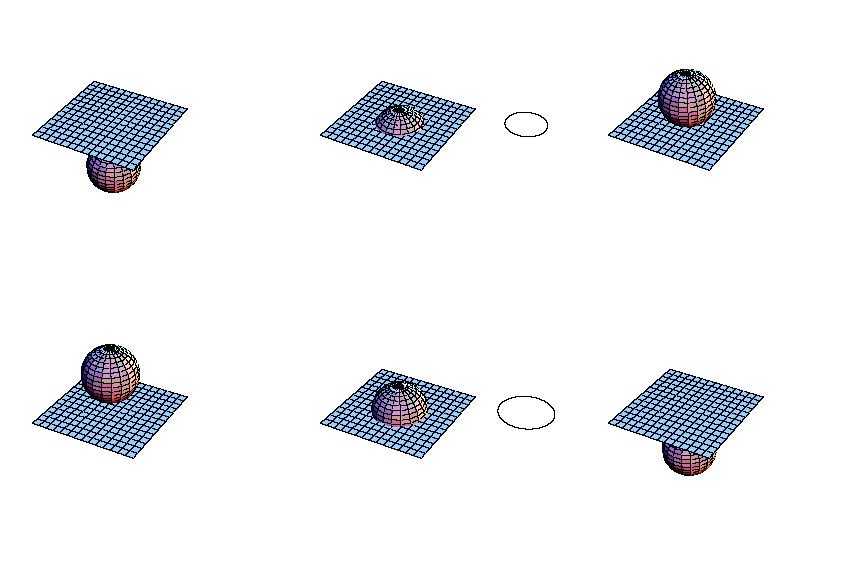
If instead of the sphere, it were a hand passing through the flatland plane, it would appear to the omniscient flatlander that there were five separate circles appearing separately, yet somehow seeming coordinated in their action. The fingers are part of a single hand, but within the constraint of the two dimensional sensitivity, the unity of the hand is discomposed across space in the literal sense, but figuratively some kind of unity can be inferred through the synchronized coincidence of the movement.
Now imagine that instead of another graphable dimension, the fifth dimension is one which is as orthogonal to spacetime as the three dimensions of space are to the one dimension of time. Feeling, like pain and pleasure, are like a coloring, or keying which cuts across multiple layers of seemingly unrelated public events. Not only is feeling a different kind of thing as forms or functions but it is a dimension in which dimension itself is transcended. Feeling is not a model or a measure, but rather it is the primordial context from which all measure is derived and all modeling is made demonstrable.
From the discomposed perspective ‘out there’, we are a coincidence of coincidences. A mysteriously synchronized, dynamic orchestration of hundreds of billions of neurons, organelles, molecules, etc which corresponds to the behavior of an animal’s body.

The feelings which we experience are not located in the tissue of the brain, rather the brain itself is part of the wider landscape of the totality of experience. The brain as a whole is, like our body as a whole and all of the cells and molecules that make it up at any given time, a four dimensional reduction of a transdimensional privacy.
Under Eigenmorphism, the base of each pyramid of perception is made up of the apex of countless low level pyramids of perception. When we look at an fMRI or the brain, we are trying to look at the view from top of our own pyramid through the blind eyes of its own bottom. Feeling is stripped out (not to mention the higher dimensions of meta-feeling/emotion/cognition/intuition) and we are left with a four dimensional mechanical skeleton with no interiority.
Being so impressed with ourselves and what we have accomplished by questioning our naive introspection with science, we naturalize the discomposed view and epiphenomenalize the native, gestalt perspective. All of this makes perfect sense within the flatlanded context of topological physics, where spontaneous appearances and disappearances are assumed only to reflect each other, rather than private transdimensional presentations.
I suspect that the universe which is experienced in the absence of all living organisms is a much different thing that it would appear to us. What we see as a four or two dimensional manifold is only a snapshot of discomposed histories. It seems inanimate to us because we seem so animated to ourselves. The highest awareness of our own interior physics seems to us unreal and crazy…and it is, relative to the inertia of human awareness as a whole. Like the inverted image of our retina however, I think that because our disposition spans so many levels of life and physical experience, we tend to see the mechanical patterns which all of the layers have in common, rather than the coincidence which is also animating them from the top down.
Like the transformer car in the gif, the signature of our presence and intention coincides with the interplay of entropy and significance. The living cell, from our perspective looking through our eyes and a microscope’s lens, looks like a homeostatic emergence. Seemingly conjured, like Brownian motion, from the statistical collisions of countless microphysical conditions.
This is not completely untrue. The mechanical conditions of a cell can be disrupted mechanically. There is bottom up causality. What has not been properly investigated yet is the other perspective. The one responsible for the biological property of healing and global integrity. If we think of the flux between entropy and significance as a carrier tone for biological life, then it might be easier to conceptualize how the universe is as much a dynamic interaction of nested simplicities as it is a mechanical progression from simplicity to complexity. The image of the metabolic transformer stands in contrast to the stillness of the axis of its transformation.
Why an Atom is More Like a Person Than a Doll Is
Another thing that really puzzles me is the way that you agree with me that nothing is inanimate, and yet you repeatedly use arguments that are based on the premise that some things are inanimate. Is this just an *apparent* contradiction because we use the term ‘inanimate’ in fundamentally different ways, or is it a contradiction in your thinking? Could you perhaps explain this?
It makes sense that it would seem contradictory, as this issue is really a more advanced concept that goes beyond accepting the initial premises which we agree on. Lets say that we want to create a whole other Everything from scratch. In my view, as long as we keep things relatively simple, as in no complex organic life, our views are pretty much interchangeable. It doesn’t matter whether information processes are irreducibly animate as you say, or whether information processes are actually the self-diffracted gaps in the primordial identity pansensitivity, as I suggest. The effect is indistinguishable and we have cool stuff going on, with physics, aesthetics, entropy all naturally falling out as parameters.
The question of primordial identity begins to seem more important as multicellular life begins and we have to choose to bet on whether the body of any dividing cell is type identical to the experience associated with the organism as a whole, or whether there are multiple layers of experience going on. If there are multiple layers of awareness going on, does one of the layers act as an umbrella for the others, and if so, is it a summary/identity layer as the color white would be to the visible spectrum of colors, or is it an emergent layer which is produced by transfers of quantitative results, so that the cellular experiences are a priori ‘real’ and the macrophenomenal experiences are generated as a kind of projection which is less than primitively real.
What I do with MSR is to assume that the primary relation is perceptual relativity. This means that spacetime is scaled to the significance of experiences rather than fixed to a scalar index. By this I mean that the cell level microphenomenal experience is simultaneous with the organism level macrophenomenal experience, but that their simultaneity is asymmetric, as the macro appears smeared across time from the micro perspective. When we use microscopic scales to poke around in the body and brain, we are essentially driving a wedge between the macro and micro, but without recognizing that microphysical effects refer only to microphenomenal affects and not macrophenomenal affects.
At the level of the cell or molecule, the organism as a whole, if it is a complex organism, does not exist. Literally. There is no {your name here} to your DNA. Its a completely different level of description in which the public side relates mechanically (molecules must functionally produce cells and be produced by cells), and the private side relates *metaphorically*. It’s a complete divergence which does not appear prominently in pre-biotic phenomena. Each organism is evolving separately on the inside than it is on the outside, and that dimorphism is getting exponentially more pronounced as it evolves. The public body side appears to be physically recapitulating itself as a growing, multiplying, dividing structure in space, while the private experiential side has no appearance and is felt as the invariant nexus of a story about the world which appears to be repeating in nested cycles and progressing in a linear narrative.
The two stories are different. The microphenomenal story appears to relate to physical events, which we can observe in everything from a viral infection to changes in temperature or pressure in the environment. The macrophenomenal story, at least for us, is consumed by history and teleology. We respond to the environment based on our accumulated experience and intention. This so-called mind-body split is actually worse than that. Coming from a time where we had no understanding of microphysics, the simplistic mind-body mapping flattens human awareness into a single horizontal dualism. What I suggest is that dualism is actually an orthogonal monism, but that each horizontal dualism is part of a vertical stack. The cell that is seen by the organism in the organisms world is only a snapshot that it can see during one if its moments. To look at one of your blood cells under a microscope is for the cell to see itself from two different evolutionary times, with the newer, larger experience looking at a moment of the older, smaller experience and seeing it from the outside, as an object or machine. This is how the aesthetics of distance works for us – when we outgrow an experience, the here and now associated with us is recontextualized aesthetically as a there and then which is associated with “it”.
I don’t know if that makes it seem even more confusing, but what I am trying to get at is that the more the universe recapitulates itself as increasingly nested experiences, the more important it is that we see that which is nesting itself as primary and the overall nest as ‘inanimate’. Pragmatically, we can’t walk around the house worried about how the carpet fibers feel, or whether we have underestimated the feelings of the avatar we have created in a computer game. If it is the nesting instead which is primary rather than what is being nested, then we have no justification at all for our intuitions about life and death or organic vs artificial processes and we can only turn to a kind of gradient of probable intelligence based on complexity.
There are a lot of problems with that, not the least of which is that we are required to take the word of any sufficiently sophisticated machine over our own understanding. We become unable to justify any significant difference between an interactive cartoon character that acts like a person, and a fellow human being. A successful stock market trading program would be entitled to staff companies entirely with copies of itself and reduce the entire human population to an unemployed resource liability. I’m just throwing out a few wild examples, but there are many less extreme but undesirable consequences to personifying information processes, as we are starting to see with the rise of corporate personhood in the US. A corporation is an information process, as is a city, but we have to decide whether the employees and citizens ultimately serve the motives of the process or whether the processes are to extend from their motives. If process is primary, then we are mere spectators to the process of our own irrelevance. If sense and motive are primary, then the process is ours to do with it as we wish. Nothing short of the future of the universe hangs in the balance. It is more convenient to work with measurable processes and theories than messy emotions and sensations, yet the universe has found a way to do that, and I think so should we.
If we think of the world that we see through our eyes as an experience in the moment rather than the whole truth of existence, it is no longer a given that configurations and complexity are creators of life. The cellular machinery only relates to extra-cellular machinery on far micro and far macro levels of description. The most dynamic range is the fertile middle. Humans have, as far as we know, the broadest range between the mechanistic ‘out there’ and animistic ‘in here’. This is what makes us human. Any theory which does not clearly understand why that is important is not a complete theory, and is therefore ultimately a theory of the destruction of humanity. I’m not a huge fan of humanity myself, so I say this not as some Cassandra-esque wolf crying, but as a consequence of what seems to be the case when I add up everything to get a big picture. Information cannot feel. These words are not generic patterns produced by inevitable process alone. They are my words, and I am instantiating them directly on my own irreducibly macrophenomenal level.
There is no Objective Color thread
That’s really interesting, too much for me to all read but I appreciate the effort put into this.
I do disagree on your first point though. There is such a thing as objective color. Photons have wavelengths, and specific wavelengths are specific colors, regardless of how our eyes and brains interpret them.I read a part of the article you linked, and if you do take into account how the eye and brain interpret colors, there is still objective color. Apparently we do all have different ratio’s of red vs green vs blue cone cells, but as the article says, our brains are still in agreement over what exactly is yellow. So our eyes might be different, but our brains correct that difference.
Think about the nature of the visible spectrum. We perceive it as being composed of soft but distinct bands of hues, usually seven or eight: red, orange, yellow, green, cyan, indigo, violet, and sometimes fuchsia, which is not a spectral color. Colors such as grey, white, brown, beige, and pink do not correspond to any one frequency, so they cannot be said to map to the wavelength of any particular photon, yet we perceive them as discernible colors.

The color palette is of course, also a wheel in which colors are seen as ‘opposite’ to each other, and which generate various effects when placed adjacent to each other, as seen in various optical ‘illusions’:

I put scare quotes around the word illusions because this information has helped me understand that what we see is never an illusion, only our cognitive expectations about what we see can be illusory. By manipulating the various layers of sensation and perception to expose their conflicts, we can tease out the truth about color, and by extension consciousness. There is no ‘actually’, there is only ‘seems like from some perspective’. The experiment showed that our color perception can be altered for weeks after subjects return to an unaltered optical state*. Our brains correct the difference because they are not translating the wavelength of photons but mimicking relations within the optical experience as a whole.
Now think about the visible range of the electromagnetic spectrum. Does it have seven soft bands or is it an absolutely smooth quantitative continuum? Does the continuum form a wheel with primary and secondary oppositions, or is it an unbounded linear progression? Does it repeat in octaves, where one frequency suddenly recapitulates and merges the beginning and ending of a sequence, or does it monotonously extend into the invisible spectrum?

Our eyes tend to differ, and photons might be the same, but color is not photons. In fact, photons from the outside world only do one thing in our retina, and that’s isomerize rhodopsin molecules – meaning that the proteins in our rod and cone cells are studded with vitamin A molecules which stretch out in the presence of visible light. From there, the folded proteins in the cells sort of swell open and actually cut off what is know as ‘Dark Current’ – the continuous flow of glutamate which is interpreted as seeing light *in its absence*. Physical light, in a sense turns our experience of darkness off.

Once we let all of this information sink in, it should be clear that the experience of color is just that – an experience. It correlates to optical conditions, but it also correlates to conditions in which there are no optical inputs at all. Even where it is isomorphic to exterior measurements, there are no colored photons inside of the brain that we are seeing. We are seeing the same neural conditions that we feel, smell, taste, and hear, and synesthesia confirms that as well. This does not mean that neural conditions are a solipsistic simulation, however, but that’s a whole other conversation (which I have my own ‘crackpot’ theory for 🙂 http://multisenserealism.com)
*http://color.psych.upenn.edu/brainard/papers/AIC01.pdf
 Multisense Realism
Recent Comments