Archive
Law of Conservation of Mystery
Law of Conservation of Mystery – Refers to the weird tendency for profound and fundamental issues to resist final resolution. Under eigenmorphism, both the microcosmic and cosmic frames (the infinitesimal and the great) relate to the fusion of chance and choice. It is as if the personal, macrocosmic range of awareness might act as a lens, bending the impersonality of the universe into a personal bubble, and in another sense, the personal bubble may project an illusion of impersonality outwardly. Both of these can be thought of not as illusions or distortions, but of mutual relation between foreground and background which constitutes a tessellated synergy.
Both the sub-personal quirkiness of QM and the super-personal spookiness of divination (such as the I Ching or Tarot cards) exemplify that the perception of spiritual or mechanical absolutes is elusive and bound to the choice between belief and belief in disbelief. In both quantum mechanics and divination, the human participant is responsible for the interpretation – the individual is the prism which splits the beam of their interpretation between chance and choice…or the individual is responsible for remaining skeptical and resisting pseudoscientific claims. If we choose to allow choice on the cosmological level, even there, the continuum between luck which is intentionally or unintentionally fateful and karma which is divinely mechanistic reflects a difference in degree of universal approbation. The Law of Conservation of Mystery is particularly applicable to paranormal phenomena. Everything from UFOs to NDEs have passionately devoted supporters who are either seen as deluded fools stuck in a prescientific past or prophets of enlightenment ahead of their time. What preserves that bifocal antagonism is technically eigenmorphism – it’s how different perceptual inertial frames maintain their character, but this special case of perceptual relativity is on us. It keeps us guessing and pushing further, but it also keeps us blind and stuck in our assumptions.
Superposition of the Absolute – The concept of superposition has enjoyed wide acceptance on the microcosmic level of quantum physics, but the idea of the Totality of the universe having a kind of multistable nature has not yet been widely considered as far as I know. The superposition of a wavefunction is tolerated because it helps us justify what we have measured, but any escalation of this kind of merged possibility to the macrocosm is strictly forbidden. Under PIP, the entire cosmos can be understood to be perpetually in superposition, or perhaps meta-superposition. Any event can be meaningful or meaningless according to one’s interpretation, but some events are more insistent upon meaningful interpretations than others.
Coincidence and pattern invariably count as evidence of the Absolute, whether the Absolute is regarded as mechanical law, divine will, or existential indifference. In this way, the insistence or existence of pattern can be understood as the wavefunction collapse of eternity. This is hard to grasp since eternity is the opposite of instantaneous, so that the ‘collapse’ is occurring in some sense across all time, weaving through it as a mysterious thread that pulls every participant forward into their own knowledge and delusion. On the Absolute scale, every lifetime is a single moment that echoes forever, and the echo of the forever-now into nested subroutines of smaller and smaller ‘nows’.
On the super-personal level (super-private/transpersonal/collective), when coincidence seems to become something more (synchronicity, precognition, or destiny), the collapse can be understood as a collapse on multiple nested frames at once. “Then it all made sense”, Eureka!, I hit bottom. etc. The multiplicity of conflicting possibilities can, for a moment, pop into a single focus that will resonate for a lifetime.
On the quantum level, probability is used in a particular way to explain behaviors of phenomena to which we attribute no intentional choice. Einstein’s famous objection ‘God does not play dice’ perhaps echoes a deep intuition that people have always had about the way that nature reflects a partially hidden order. This expectation is perhaps the common thread of all three epistemological branches – the theological, the philosophical, and the scientific. The value of prediction is particularly powerful for both scientific and theocratic authority as evidence of positive connection with either natural law or divine will. Science demands theories predict successfully, while religion demands prophetic promise. Under the Superposition of the Absolute, the ultimate natural law can be seen to become more flexible and porous, and the localization of divine will can be seen to have limitations and natural constraints. If PIP is to make a prediction itself, it would be to suggest that all wavefunctions share the identical, nested, non-well-founded superposition, one which can be understood as sense or perceptual relativity itself.
Primordial Syzygy
syz·y·gy
[siz-i-jee] noun, plural -gies.
1.Astronomy . an alignment of three celestial objects, as the sun, the earth, and either the moon or a planet: Syzygy in the sun-earth-moon system occurs at the time of full moon and new moon.
2. any two related things, either alike or opposite.
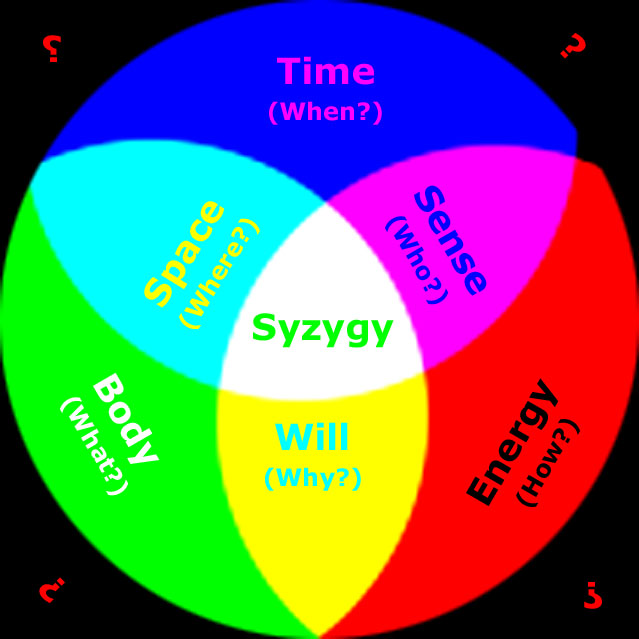
This is the primordial syzygy for multisense realism. The overlapping RGB regions can be grouped in different ways to bring out different meanings.
The primary spectral hues with the perimeter orientation are juxtaposed with the pastel hues having center-radial orientation. This produces a dialectic of subjective introversion versus objective extroversion as well as a three syzygies:
Subject Thesis (Who & Why, Sense & Motive, Pink & Yellow) minus Space (Subjects are always ‘here’)
Object Antithesis (What & How, Matter & Energy, Green & Red) minus Time (Objects are always ‘now’)
Realism Synthesis (When & Where, Time & Space, Light Blue & Deep Blue) is inferred by triangulating Subject & Object
Using this symmetry to solve the Hard Problem and bridge the Explanatory Gap:
Think of the living brain as the what and how of what we are, and consciousness is the who and the why. Neither supervenes on the other but, neither are they separable entirely. Like the syzygy, they are elements which are separate in some sense, united in some sense, overlapping and underlapping in some sense, defined by each other in some sense, and defining a super-signifying whole which is more than the sum of its parts in another sense.
Consider that of the seven billion people alive today, each one has a different identity and life, yet we all share more or less the same physiology. We cannot expect to locate the who & why of our identity in the what and how terms of our body.
The question marks outside of the circle represent the another dialectic, between the anthropic significance of the syzygy and the a-signifying mechanism of entropy.
”?” is used to connote the unconscious fully. Not merely the absence of awareness but the absence of the capacity for awareness of the absence. There is nothing there to signify a label of nothingness or oblivion, it simply is not anything.
Syzygy vs ?:
acceleration vs inertia
sequence vs consequence
significance vs entropy
pattern vs coincidence
initiative vs randomness
signal vs noise
orientation vs disorientation
teleology (purpose) vs teleonomy (evolution)
animism vs mechanism
augmentation vs cancellation
positive vs negative
multiplication vs division
Tags: consciousness, cosmology, explantory gap, hard problem of consciousness
 Multisense Realism
Recent Comments