Archive
Dr. Neil Theise Interview
Great Stuff from Dr. Theise and Sean Webb (The Walrus) Starting from about halfway through, I suggest that the low level randomness of the body is a symptom of greater penetration of consciousness into the physicalized vocabulary either in an absolute sense or relative sense or both, rather than a cause of emergence by something like entropy modulation. In the relative sense, I mean that it may be the case that on a slow enough and large enough scale, even the lowest levels of randomness take on life-like appearances, so that living organisms appear to have more low level randomness to us because we are alive and therefore more sensitive to our own class of ‘likeness’. I propose that like experiences have more access and more nuanced renderings of each other, so that any experiences of a sufficiently similar perceptual sampling rate will be experienced as ‘alive’, or more alive to each other than dissimilarly timescaled experiences.
I also think that the appearance of emergent symptoms in artificial systems need not be an indication of a rich, multi-sensory experience, i.e. that a simulation has begun for the bits or avatar collection of bits, but rather reflects the ‘autistic’ ghost-limb type residuation of the isolated band of intellectualized-game theoretic sense which has put the bit-nursing technology together in the first place. The bits aren’t having an experience, we are using matter as a resonator/reflector to conjure an image of one surface or bounded slice of the continuum of universal perception. Computers mirror an image of intelligence back to that intelligence (such as ours) but are not themselves hosting intelligence. By contrast, the brain is an image (our image shared by macro scale animal experiences) of sub-personal experience that is actually bridging the gap between personal and impersonal (astrophysical) scales of experience. Brain has computational properties but is not computing anything. A computer has low level experiential properties but those are not accumulating a higher order of experience via constitutive, many-to-one emergence. I think that all experiences are a top-down divergence riding on a bottom up pseudo-emergence, as well as a center-out/in expansion. In other words, we are part beast, part angel, and part unique/unprecedented person. The beast part is, in its own context part micro-beast (cell), part sub-person or sub-self (impulses, urges, id), and part person (its ‘God’/superego/trans-subself…how the animal’s body is influenced by its unseen master…our personal will influences our body from the top down via voluntary control over efferent nervous impulses > muscle tissue).
As far as self-organization goes, I would add that while I think all phenomena are conscious experience in some sense and scale, the way that organization emerges or is implemented may not be visible to the experiences whose ‘body’/exterior facing rendering is being organized. It may not be strictly correct to say that unintelligent agents ‘self-organize’, or that the appearance of spontaneous organization is a symptom of the micro-intelligence of what is being organized. We may be observing a teleonomy based, ad hoc statistical organization rather than a teleologically based intent to organize. There may be teleology, but not on the same level as the body appearance of organization.
A nit picky thing, Dr. Theise was talking about mass emerging from fundamental energy, i.e. particles appearing randomly in the primordial quantum context. It seems to me that this connects to what he was saying about figure/ground switching in an ambiguous image (like this famous face-vase one:
Isn’t the difference between mass and energy a figure-ground relation based on frame of reference? So I’m thinking that while from any given perspective/perceptual frame massive particles appear and disappear in a given local scope of perception, those events are reflections of overlap between one part of the scope and another which are appearing and disappearing…freckles of self-impermeability…a sense of self-spatiotemporalizing insensitivities which serve to spatialize and temporalize (objectify and subjectify) the sense of tangibility from tactile sense qualia. Maybe that was sort of implied though.
In the second half, the conversation goes into a direction that really meshes perfectly with what I suggest in MSR:

The main difference is that I’m trying to replace all references to emergence of one level of consciousness from many agents on another level to a model of a kind of parallel divergence into different levels of unity and “unit-y” (disunity). This is not to say that I don’t believe our bodies evolved from biology, or that biology didn’t evolve from chemistry in a sense, but that since I think that the universe is primarily driven by the teleological saturation/signficance-seeking nature of consciousness into richer and richer subjectivity (sensation > perception > consciousness ‘phorologies‘*), the evolution of tangible objects and structures (physical > chemical > biological morphologies) is only an unintended/teleonomical consequence of the separation of otherwise united experience-lines. The ants are causing the ant hill, but the ant hill may or may not be a symptom of ant hill-scale subjectivity. The ant is building the ant hill, but if the ant hill has a conscious experience associated with it, I would expect it to be as much biosphere consciousness from the top down as it is ant consciousness from the bottom up. Yes, at the bottom and the top of the stack (quantum and cosmological scales) there is a dissolving or transcending of the subject-object dualism, but again that appearance and disappearance of dualism is itself perspective-dependent. If I change my perspective, my frequency-scale of permeability-impermeability to the Totality of consciousness, then what I can see as duality and non-duality changes. In a psychologically contracted/focused state, I see diametrically opposed subject-object (phoric-morphic) duality. In a deep trance, psychedelic state, etc, “I” don’t exist except as a metaphor for a particular expression/diffraction of human archetype. Under general anesthetic “I” don’t exist except as a particular sequence of genetic semaphores repeating within a community of cells.

My suspicion is that the boundaries of any conscious experience will be rendered as being driven by quasi-random (bottom facing coincidence) or quasi-fateful (top facing synchronicities). The random/fated appearance is just our own scope’s bias, its ‘red shift’ toward the bottom of its stack or its blue-violet shift toward the top of the stack. In terms of causality, within any given experience, it is the bottom end of the stack that can be controlled by tangible means, technology and instruments which extend the exterior, body-world facing senses of touch-move while the top end of the stack controls us by intangible means…serendipities and synchronicities which open our intuitive sense modalities to be ‘touched’ and ‘moved’ by the transcendent ‘spirit’ world. There is a meta thing I’m doing there also in contrasting the literal and metaphorical sense of touch and move (see diagram above…metaphorical = high end of the stack, ‘semaphorical’ = low end of the stack).
*phorologies = neologism for aesthetic elaborations of direct feeling and sensation, as diametrically opposed to ‘morphologies’, which would be morphological-topological renderings of indirect feeling/sensation.
Top = Transpersonal = Metaphoric
Center = Personal = Phoric
Bottom = Subpersonal = Semaphoric
Top = Cosmological scale spacetime = Metamorphic
Center = Meso-scale objects & subjects = Morphic-Phoric
Bottom = Quantum-scale particle-wave = Semaphoric

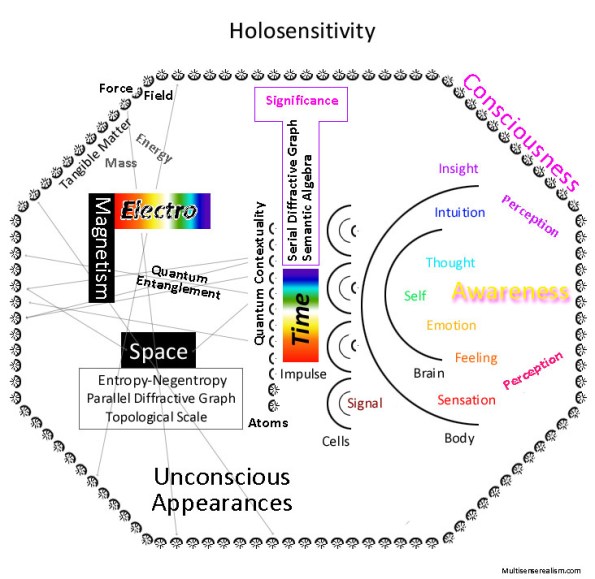
 Version 2 better or worse?
Can Qualia Be Simulated?
My response to this Quora question:
There are several considerations upon which the answer to this question hinges:
- The nature of simulation and behavior.
-
- The term simulation is an informal one. I don’t place a high value on discussing the definition of words, but I think that it is essential that if we are talking about something that exists in the world, we have to understand what that thing is supposed to be. I would say that the contemporary sense of ‘simulation’ goes back to early applications of computer software, specifically Flight Simulator programs. We have since become accustomed to using video ‘simulations’ of everything from fighting on a battlefield to performing surgery. Does it make sense to ask whether a flight simulator is producing the same behavior as an airplane? If it did, would we say that the program had produced a flight from Rome to New York? If the flight simulator crashed, would we have to have a funeral for the simulated passengers? I would say no. Common sense would tell us that the simulation is just software…the airplane isn’t real. This takes us to the next consideration, what is real?
- The term real is an informal one as well. We talk about ‘reality’ but that can refer to some abstract truth that we seem to agree on or to a concrete world that we seem to share. To understand why there may be an important difference between a simulation and the ‘real thing’ that is being simulated, we should approach it in a more rigorous way. Flying a real airplane involves tons of physical matter, as well as countless causal links to the world/universe. The real airplane is the result of billions of years of accumulated change in the physical universe, as well as the evolution of numerous species and societies to engineer flight. There is a common comparison of the flight of an airplane to the flight of a bird or insect, where we are meant to think of both types of physical acts as ‘flying’, even though that flight is accomplished in quite different ways. I think that this comparison, however, is misleading. I would look to the famous quote by Alfred Korzybski, “The map is not the territory” instead when relating to simulating consciousness. Whether it is a literal geographical map or some other piece of graphic ‘art’ that ‘maps’ to a potentially real (in the concrete, worldly sense) place, the idea is that just because something appears visually similar to us does not mean that there is any other deep connection between the two. I’m not a photograph of my face. I’m not even a video of myself talking. This understanding is also expressed in the famous Magritte painting “The Treachery of Images”.
- The nature of qualia.
- Properly understood, what the term ‘qualia’ refers to exists by definition. It can get a little mystical if we rely on descriptions of qualia such as “what X is like” or “what it is like to feel X”, so I think it adds clarity if we look at it this way: Qualia is what is experienced. Information is a concept. Matter is a concept. Concepts are experienced also, but what the concept of matter refers to should/must be divided into the idea of matter as defined by the Standard Model (which has to do with exotic elementary “particles/waves” such as bosons and fermions which make up slightly less exotic atoms). Physical matter is made of atoms on the periodic table.
- What we experience directly is not physical matter. What we experience are aesthetic presentations with tactile/tangible qualities such as shape, position, weight, texture, etc. We can dream of worlds filled with tangible objects, and we can interact with them as if they were physical matter, but these dream objects are not composed of the elements on the periodic table. The question of whether these objects are real depends on whether we are able to wake up from the dream. If we do not ever awaken from a dream, I don’t see any way of evaluating the realism of the contents of the dream. To the contrary, when we do awaken from a dream, we are often puzzled by our acceptance of dream conditions which seem clearly absurd and impossible.
- That fact is very important in my view, as it tells us that either it is impossible to ever know whether anything we are experiencing is real, or it tells us that if we can know reality when we truly experience it, then experience must be anchored to reality in way that is deeper than the contents of what is experienced. In other words, if I can’t tell that I’m dreaming when the pink elephant offers me a cigarette, and if I can have dreams which include false awakenings, then I can’t logically ever know that I’m not dreaming. If, however, actual awakening is unmistakable as it seems, then there must be some capacity of our consciousness to know reality that extends beyond any sort of empirical symptom or logical deduction.
- Qualia then, refers to the inarguably real experience of the color red, regardless of whether that experience is associated with the excitation of physical matter producing visible-wavelength electromagnetism in our physical eyeballs, or whether that experience is purely in our imagination. If we want to say that even imagination is surely the product of physical activity in the brain, we can make that assumption of physicalism, but now we have two completely different sources of ‘red’. They are so mechanically different, and the conversion of either one of the sources into ‘experienced red’ is so poorly understood, that all that physicalism can offer is that somehow there must be some mathematical similarity between the visible EM in the eyeball and the invisible neurochemistry scattered in many different regions of the brain which will eventually account for their apparent unity. We do not seem to be able to define a difference between red that is seen in a dream and red that is seen through our eyes, and we also are not able to define how either a brain or photon produces that quale of experienced red. The hard problem of consciousness is to imagine a reason why any such thing as experienced red exists at all, when all physical evidence points only to biochemical changes which are not red.
- The nature of information, physical matter, and qualia.
- Now that we have separated qualia (aesthetic-participatory presentations) from matter (scientific concept of concrete structures in public space), we can move on to understanding information. This is a very controversial subject, made more controversial by the fact that many people do not think it is controversial. There is a popular view that information is physically real, and will cite factual relationships with concepts of physical theory such as entropy. To make it more confusing, there is a separate concept of information entropy, based on the work of engineers like Claude Shannon who studied communication. Depending on how you look at it, information entropy and thermodynamic entropy can be equivalent or opposite.
- In any case, the concept of entropy seems to blur together the behavior of physical structures and the perception of groups of structures and appearances into ‘systems’. This whole area is like intellectual quicksand, and getting ourselves out of it requires a very disciplined effort to separate different levels of sensation, perception, ‘figuration’ or identification, attention, and understanding. Because of my experience of having learned to read English as a child, I no longer have access to the raw sensation or perception level of English writing. I can’t look at these shapes on my screen and not see Latin characters and English words. Even upside down, I am still ‘informed’ by the training of my perception to read English. This would not be the case for someone who had never read English, however most adults on Earth would be able to identify the look of them as words in the English language, even though they can’t read or pronounce them. Anyone who does read English could at least try to phonetically sound out other European languages, but they may not be able to even attempt that for other languages that don’t use the Latin alphabet.
- All of this to say that there may be no such thing as information ‘out there’. The degree to which we are ‘informed’ is limited by our capacities for both sensing and making sense. There may be no such thing as a ‘pattern’ which is separate from a conscious experience in which an aesthetic presentation is recognized as a pattern. This was a heavy revelation for me, and one which transformed my view of nature from an essentially computationalist/physicalist framework based on pattern to one based on an aesthetic-participatory framework in which nature is made of a kind of universal ‘qualia’.
- If my view is on the right track, information does not produce qualia at all, rather information is one minimalist presentation of qualia which is perceived as having a quality of potentially ‘re-presenting’ another conscious experience. This too is a major revelation, since if true, it means that machines like computers don’t actually compute. They don’t actually input, output, or store numbers, they just serve as a physical mechanism which we use to modify our own conscious experience in a very precisely controlled way. If we unplug our monitors, nothing changes as far as the computer is concerned. If we are playing a game, the computer will continue to execute the program in total darkness. We could even plug in some kind of audio device instead of a video screen and now hear a cacophony of noises that doesn’t resemble a game at all. The information is the same from the computer’s point of view, but the change in the aesthetic presentation has made that information inaccessible to us. My hypothesis then is that perceptual access precedes information. If information is a “difference that makes a difference” then perception is the “afferent” phenomena which have to be available for an “efferent” act of comparison and recognition as “different”.
- The assumption of emergent properties.
- The idea that the integration of information produces qualia such as sights, sounds, and feelings depends on the idea of emergence. This idea is, in turn, is based our correlation between our conscious experience and the behavior of a brain. We have to be convinced that our conscious experience is generated by the physical matter of the brain. This alone provides us with the need to resort to a strong emergence theory of consciousness simply being a thing that brains do, or that biology does, or that complex, information integrating physical structures of any sort do (as in IIT).
- Balanced against that is the increasing number of anomalies that suggest that the brain, while clearly having a role in how human and animal consciousness is made available, may not be a generator of consciousness. It may be the case that our particular sort of consciousness has conditioned us to prioritize the tangible, visible aspects of our experience as being the most real, but there is no logical, objective reason to assume that is true. It may be that physics and information ‘emerge’ from the way a complex conscious experience interacts with other concurrent experiences on vastly different scales. Trying to build a simulation of a brain and expecting a personal conscious experience to emerge from it may be as misguided as building a special boat to try to sail down an impossible canal in an Escher drawing.
Perverting a Survey of AI Theories
In this post, I shamelessly cannibalize, invert, and repurpose a great diagram of contemporary AI theory categories from here.
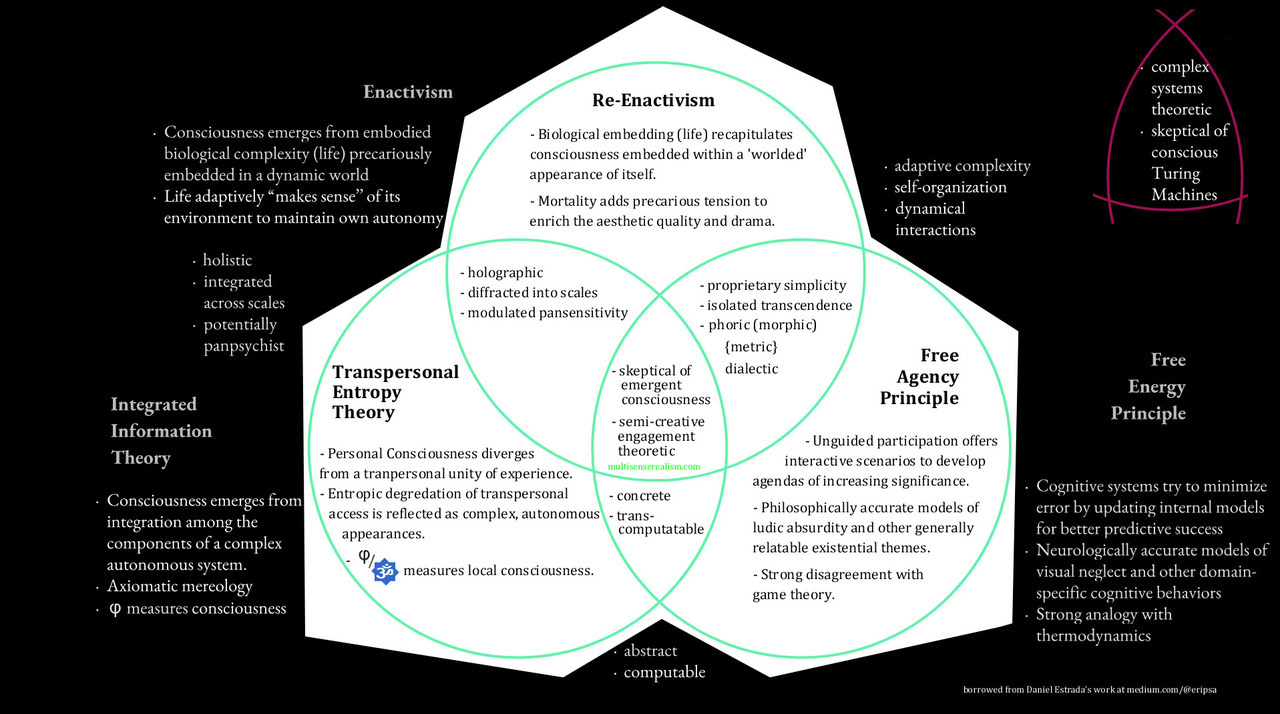
 Multisense Realism
Recent Comments