Archive
MSR Legend 3
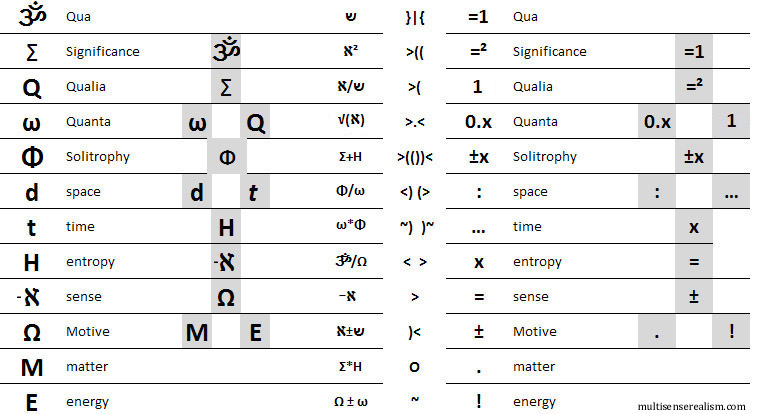
One more of these for tonight, as i’m still in a semiotic frenzy, as I’m sure you can tell.
MSR Legend

A first second draft of a Rosetta Stone for MSR terms, including the debut of new quasi-alchemical code.
Second draft 7/22/13, added Solitrophy and updated the formulas of time and space to clarify.
Comparing Worldviews

Side by side comparison of what seems to be the prevailing cosmology (above) and MSR (below). In the consensus worldview, aka Western post-modern view, quantitative function replaces all other modalities of sense and sense itself is absorbed into automatism. Energy is merged with matter as ‘particle-waves’ or ‘probability wave functions’, just as space is merged with time through relativity. Rather than a universe of concrete participation, the illusion of realism ’emerges’ from the evolving complexity of statistical interactions. At what level this emergence occurs, why it occurs, or how are left to future generations to explore.
Conspicuously absent are all traces of subjectivity, participation, and significance. Motive effect is understood only as a caused effect – the playing out of inevitable mechanical agendas which stem from a few ‘simple rules’. All forms of privacy are unknown and entropy is divorced from sensory interpretations. All sensations are thought to be partial revelations of an objective truth, so that any deviation from that empirical fact is considered an error.
MSR sees the absence of sense as a the gaping hole in this schema. While emergence is appropriate for understanding how many phenomena which appear to be novel are often found to be inevitable upon further inspection, it is entirely an entirely inappropriate machina ex deus for phenomena which have no plausible origin from the known functions of the system. The consequences of overlooking the key principle which unites all phenomena (sense), are that we wind up with an impoverished worldview, a Straw Man of cosmology in which we ourselves have no possible place.
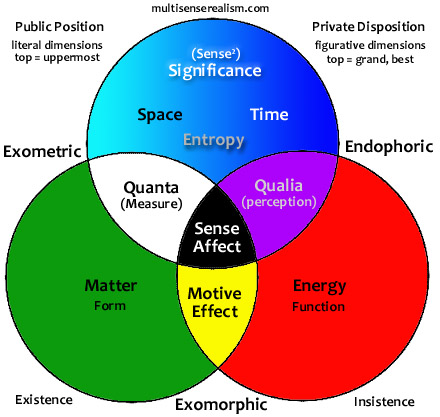
Breaking The Fourth Wall

Sense (in the Absolute sense) reveals itself reflexively as the Uni-verse, aka monad of non-orientable self-juxtaposition, aka, “the Pansensitive Meta-Lectic Solitrophic-Holarchic Multiphoric-Unametry”, provider of implicit unity (likeness) across multiplicity (private sensory afference) and explicit participation (public motor efference) through intentional animism and automatic mechanism.
reflexive
1. Directed back on itself.involution
entanglement; a spiraling inwards; intricacy
(mathematics) A function, transformation, or operator that is equal to its inverse, i.e., which gives the identity when applied to itself.tessellation
the careful juxtaposition of shapes in a pattern; “a tessellation of hexagons”.non-orientable
A surface S in the Euclidean spaceR3 is orientable if a two-dimensional figure (for example,) cannot be moved around the surface and back to where it started so that it looks like its own mirror image (
). Otherwise the surface is non-orientable.
The Möbius strip is a non-orientable surface
The Ouroboros or Uroboros is an ancient symbol depicting a serpent or dragon eating its own tail.
The Ouroboros often symbolize self-reflexivity or cyclicality, especially in the sense of something constantly re-creating itself, the eternal return, and other things such as the phoenix which operate in cycles that begin anew as soon as they end. It can also represent the idea of primordial unity related to something existing in or persisting from the beginning with such force or qualities it cannot be extinguished. While first emerging in Ancient Egypt, the Ouroboros has been important in religious and mythological symbolism, but has also been frequently used in alchemical illustrations, where it symbolizes the circular nature of the alchemist’s opus. It is also often associated with Gnosticism, and Hermeticism. Carl Jung interpreted the Ouroboros as having an archetypal significance to the human psyche.[citation needed] The Jungian psychologist Erich Neumann writes of it as a representation of the pre-ego “dawn state”, depicting the undifferentiated infancy experience of both mankind and the individual child.
Early alchemical ouroboros illustration. From the work of Cleopatra the Alchemist (Greco-Roman Egypt).Autopoiesis (from Greek auto-, meaning “self”, and poiesis, meaning “creation, production”) refers to a closed system capable of creating itself. The term was introduced in 1972 by Chilean biologists Humberto Maturana and Francisco Varela to define to the self-maintaining chemistry of living cells. Since then the concept has been also applied to the fields of systems theory and sociology.
Bootstrapping or booting refers to a group of metaphors which refer to a self-sustaining process that proceeds without external help.
The phrase appears to have originated in the early 19th century United States (particularly in the sense “pull oneself over a fence by one’s bootstraps”), to mean an absurdly impossible action, an adynaton.Trompe l’œil (French for deceive the eye) is an art technique that uses realistic imagery to create the optical illusion that depicted objects exist in three dimensions. Forced perspective is a comparable illusion in architecture.
Breaking the fourth wall is when a character acknowledges their fictionality, by either indirectly or directly addressing the audience. Alternatively, they may interact with their creator (the author of the book, the director of the movie, the artist of the comic book, etc.). This is more akin to breaking one of the walls of the set, but the existence of a director implies the existence of an audience, so it’s still indirectly Breaking The Fourth Wall. This trope is usually used for comedic purposes.



What is Information? Reality as Information – Is there Intrinsic Meaning? Sentient Life & Bits
Dolors Jou Torras: I think all one needs to do is redefine information and then it all clicks into place. Information: a perceived difference that can make a difference. You start with an awareness of a difference (reality differentiating itself and becoming aware of it). Then you move on to an awareness of a difference which in turn makes a difference (this awareness of differentiation enables learning, growth, knowledge, etc).
At some point this ability to perceive a difference becomes able to not only perceive a difference (of states) but can also perceive a difference in such a way that order can be assigned (as in before / after). Time is born – or rather, it evolves (= the ability to perceive a difference + assign order and duration).
You escalate this ability to perceive differences, etc, to an information field which can model consciousness (consciousness being defined in line with self-awareness, ability to self-modify, intelligence, ability to evolve, etc).
Then you get to the point where “physical” universes can evolve (within consciousness “space”) and so space-time and matter evolve… This goes hand in hand with the evolution of individual conscious observers experiencing this physical universes
So the paradigm goes like this: information—> consciousness & time —> laws of physics—> individual observers + space-time & matter
Craig Weinberg: I agree with what you are saying, especially the part about adding the qualifier of “a perceived” to “difference”. I would say though that that makes this capacity to perceive more fundamental than what is perceived. Even if we understand that of course information must be perceived, I still think that the word information carries an implicitly objective connotation. All that information can be is an experience in which some sensory context is informed. This capacity to perceive is already awareness, so that even though we could say that the term ‘consciousness’ refers to an awareness of awareness, I don’t see that such an awareness requires any information at all. All that is required is a quality of awareness in which the presence of awareness is felt. There is no feeling of the absence of awareness, so it is not a matter of discerning a difference or being informed about anything, it is simply an expectation of persistence and participation.
I like to break down the word information into three parts: “in” (which is input-output of sensory-affect/motor-effect), “form” (which is material shapes divided by space), and “ation” (which is recursive functions united through time). Where we are at now I think is to overlook the “in” part entirely and treat formations as the primitive context, when in fact the formations are the objects of appreciation and participation of the true primitive capacity for sense.
Dolors Jou Torras: Defining information and consciousness differently is what makes the descriptions of what is ultimately primary different… I completely understand what you are saying, when I put myself inside your theoretical framework Don’t disagree at all, but I can see that it all boils down to the precise details of how one defines information, awareness, consciousness and so on.
Craig Weinberg: Yes, for most contexts it is more useful to talk about information in the traditional sense. I think it’s only when we need to really get a maximum close up on that boundary between firstness and secondness or between the front and back end of the snake who is eating its tail. We are very much on the same page about the semiotic relation. I would suggest to consider that information is not non-physical, so much as physics is experiential and information is part of experience.
What makes an experience seem ‘physical’ is that it is out of bounds of our intimate sensory range. That which is too fast, too slow, too large, too small, or too unlike us in another sense is experienced in increasing degrees of dissimilarity to experience. Experience is the sense of who we are and the motive of why we do what we do, but matter is bodies nested within larger bodies. Matter is the what and how, the re-presentation of first person presentations.
Information is when one level of experience exploits another, more distant (and therefore more matter-like; discrete positions, subject to public inspection, etc) level. We take a sheet of cellulose molecules, which on their own level are holding on to each other, oxidizing slowly, etc and we inscribe a quantity of ink (also an experiential reality on its native fluid-molecular level). This inscription can be modeled as a trade off of entropy, we are fixing our private ideas and expressions on various levels, conscious and subconscious in public spacetime. Public spacetime freezes private sense into public form and private motive into public function. The information entropy of the writer’s idea is discharged in the act of writing, a process to be revisited in reverse when the reader understands what has been written. The low entropy signal of the written word is traded for an aesthetic entropy increase in the reader’s experience – they imagine, they think, their mental experience reverberates and ‘warms up’, creating novelty and creativity. This is significance. Significance lights up previous memories and pulls them together, bringing a sense of integration within. (Understanding = entero-standing…inner settling).
information is not physical in the sense that the effect of being informed is experiential, but information media is physical, which means that it is down-rev experiential, so to speak. We use experiences which are dumber and smaller than we are to carry our messages. Thinking of it this way brings matter, mind, and meaning together as one ecosystem of sense-making.
Dolors Jou Torras: I will cover the physical vs non-physical debate in another video soon, but defining information as essentially non-physical has to do with several factors:
– I relate information to qualia (perception, experience)
– That in this “physical” universe, in general we need to embed or engrave information in physical matter or energy via symbols or signs, does not make information itself physical.
The laws of physics do not preceed information hence information is not bound by physical laws (information is primary)
There is compelling evidence, in my opinion, that non-local effects point in the direction that our physical universe (space-time plus matter) is a subset of a larger reality. What is “physical” is a moving target
Information (in theory) can be used as a basic currency to describe any reality, not only what our current physics can describe (or is attempting to describe).
Information therefore can be used to move away from duality… “Physical” vs “non-physical” is not a matter of substance dualism; these are purely subjective terms that we mostly associate with what our current science can measure with its instruments.
Craig Weinberg:
“defining information as essentially non-physical has to do with several factors:
– I relate information to qualia (perception, experience)”
I agree in the conventional sense of ‘physical’, information would be non-physical, but I think that in an absolute sense, the physical and non-physical can only be different perspectives (private-facing and public-facing orientations) of the same thing. What I am trying to pioneer is the idea that this thing is sense: the universal capacity for aesthetic participation, aka the capacity to generate, experience, and appreciate qualia.
“- That in this “physical” universe, in general we need to embed or engrave information in physical matter or energy via symbols or signs, does not make information itself physical”
Right, symbols or signs are independent of matter, but not independent of the capacity to experience (sense). A particular piece of information, such as a page in a book, can obviously exist without my experience of it, but it cannot exist without some capacity for interpretation somewhere in the universe.
The question that I put to you, however, is ‘can awareness exist without information?’. I think that it can. I think that a feeling need not inform us. I think that information is always a reflection or representation of sense, and never the genuine presentation itself. Eating a meal is not simply an information processing event where knowledge of nutritional conditions are stored in the body and in our understanding, it is a concretely visceral, mouth watering, chewing, gobbling, licking, swallowing orgy of sensual participation. We can extract information from the experience, but when we do, that extraction is inevitably reductive. It is an accounting of events from a hypothetical voyeur’s perspective rather than the genuine and indispensable experience.
In my view, qualia is not a representation, it is a presentation – an aesthetic presence. Information is a particular kind of qualia, a presentation in which another presentation has been abstracted as an a-signifying, quantifiable figure. Such a figure is public-facing and communicable, so long as the receiver of the communication can re-signify some of what has been frozen as a spatial-form/temporal-function.
“The laws of physics do not preceed information hence information is not bound by physical laws (information is primary)”
Because you are including the aesthetic experience of information as information, I agree with you here too. Matter-Space/Energy-Time would be types of information (Form-Sense/Function-Motive). If we conflate information with sense, however, then we would have to explain why sentience does not emerge from information itself. Why can’t we write a story which has feelings itself? Why do we react unfavorably to impersonated entities like mannequins and automatons (uncanny valley effect)? Part of my contribution here is to get very specific and show how the relation between sense, information, and matter can be juxtaposed to yield unity or contrast but that sense is the essential commonality. Information can be forged and copied, it is generic and implicitly impossible to truly own. Sense is absolutely proprietary and authentic, ineffable, unreproducible.
Information is the manifestation of the intention to circulate publicly, but sense is the private anchoring of a disposition between the sensor/self and the universe. This opposition relation of sense and information is recapitulated and exteriorized as the relation between matter and energy, and matter-energy/space-time. It’s the same theme of reflection through orthogonal juxtaposition. It’s very tricky of course, because we can toggle foreground/background from any perspective. Einstein grabbed mass-energy and it gave him space-time. If you grab information-sense, it gives you physical machines and non-physical machines. My proposal is to grab sense-motive and get all of the others: form-matter-space::function-energy-time. Square that and you get public entropy::private significance.
“There is compelling evidence, in my opinion, that non-local effects point in the direction that our physical universe (space-time plus matter) is a subset of a larger reality. What is “physical” is a moving target”
I agree completely, although I think that the larger reality is the sum-total of all sensory experiences in the history of the universe. The larger reality is experiential while space+matter is a frozen slice – a tokenized representation of part of that reality as experienced from a particular perspective and presented as a public context. Physical to means only that something is intended as a concrete presentation rather than a pure representation. The idea of a train is physical, in the sense that ideas are physical experiences, but the train which is confabulated within the idea is not physical. Non-local? Certainly. Locality is a low level sense protocol. I think that’s part of what the atoms are doing on the microcosm, sending each other messages (we call quantum) to generate locality through spacetime coordinates. The universe is inside the big bang/Abolute, and all space is a presentation within it’s sense.
“Information (in theory) can be used as a basic currency to describe any reality, not only what our current physics can describe (or is attempting to describe).”
Yes, but only if you are assuming that information includes sense. Think of how the same information on a DVD can be heard as music or seen as a video though. A computer reads that DVD anesthetically, as data. Low level electronic sensation in all likelihood, but the data is not giving the DVD player an experience of watching a movie.
“Information therefore can be used to move away from duality… “Physical” vs “non-physical” is not a matter of substance dualism; these are purely subjective terms that we mostly associate with what our current science can measure with its instruments.”
Yes, in the absolute sense, but if we don’t explain that subjective polarization and connect it to public and private presentations, then we have not really explained the universe that we live in. With my view, all dualisms, monisms, and multiplicities fall out naturally from the capacities of sense and motive to diffract entropy spatiotemporally and recover significance experientially.
Likelihood is the ultimate unlikelihood: Notes on sense as sole synthetic a priori manifestation of improbability
In the contemporary Western model of the universe, mechanism is presumed to be the sole synthetic a priori. The general noumenal schema which can only be considered an eternal given and without which no phenomena can arise. In particular, the mechanism of statistical probability is seen as the engine of all possibility. Richard Dawkins title “The Blind Watchmaker” is an apt description – a kind of deism with no deity. Lawrence Krauss’ “A Universe From Nothing” is another apt title. The implication of both is that the universality of statistical distribution is the inevitable and inescapable self-evident truth of all phenomena.
What is overlooked in these models is the nature of probability itself – the concept of likelihood, and indeed the concept of ‘like’. The etymology of the word probable extends from French and Latin meanings of ‘provable’ and ‘agreeable’, a sense of credibility. What we like and what we find acceptable are similar concepts which both relate to, well, similarity. Agreement and likeness are in agreement. The two words are a-like. What is like alikeness though? What is similar to similarity or equivalent to equivalence?
Consider the equal sign. “=” is a visual onomatopoeia. It is a direct icon which looks like what it represents. Two parallel lines which illustrate precise congruence by their relation to each other. It’s an effective sign only because no further description is possible. So ubiquitous is the sense of comparison by similarity that we can’t easily get under it. It simply is the case that one line appears identical to the other, and when something is identical to another thing, we can notice that, and it doesn’t matter if its a thought, feeling, sensation, experience…anything can be similar to something. It could be said also that anything can be similar to anything in some sense. The universe can’t include something which is not similar to the universe in the exact way in which constitutes its inclusion. Inclusion by definition is commonality and commonality is some kind of agreement.
Agreement is not a concept, it is the agent of all coherence, real and imagined – all forms and functions, all things and experiences are coherent precisely because they are ‘like’ other things and experiences, and that there is (to quote David Chalmers) ‘something that it is like’ to experience those phenomena. Without this ontological glue, this associative capacity which all participants in the universe share, there can be no patterns or events, no consistency or parts, only unrelated fragments. That would truly be a universe from nothing, but it would not be a universe.
The question then of where this capacity for agreement comes from is actually moot, since we know that nothing can come from anything which does not already possess this synthetic a priori capacity for inclusion – to cohere as that which seems similar in some sense to itself in spite of dissimilarity in other ways. Something that happens which is similar to something that happened at a different time is said to be happening again. A thing which is similar to another thing in a different location can be said to be ‘the same kind of thing’. This is what consciousness is all about and it is what physics, mathematics, art, philosophy, law, etc are all about. It is what nature is all about. The unity behind multiplicity and the multiplicity behind unity. Indra’s Net, Bohm’s Implicate Order, QM’s vacuum energy, etc, are all metaphors for this same quality…a quality which is embodied as metaphor itself in human psychology. Metaphor is meta-likeness. It links essential likeness across the existential divide. Metaphor bridges the explanatory gap, not by explanation, but by example. Like the = sign, the medium is the message.
Aside from their duty of ‘ferrying-over meaning’ from the public example to private experience and private example to public application, metaphors tell the story of metaphors themselves. Implicitly within each metaphor is the bootstrap code, the instruction set for producing metaphors. Metaphor is the meta-meme and memes are meta-metaphors. This self nesting is a theme (a meme theme, ugh) of sense, and a hint that sense itself is insuperable. Mathematically, you could say that the axiom of foundation is itself a non-well-founded set. The rule of rules does not obey any rules. Regularity is, by definition, the cardinal irregularity, as it can only emerge from its own absence if it emerges at all. If it does not emerge, then is still the cardinal exception to its own regularity since everything else in the universe does emerge from something. First cause then, by being uncaused itself, is the ultimate un-likelihood. First cause by definition is singular and cannot be like anything else and there can be nothing that it is like to be it. At the same time, everything that is not the first cause is like the first cause and there is something that it is like to be that difference from the first cause – some aesthetic dissimilarity which constitutes some sense of partial separation (diffraction).
To get at the probability which is assumed by the Western mindset’s mechanistic universe, we have to begin with the Absolutely improbable. This is akin to realizing that dark is the absence of light when it was formerly assumed that dark was only something which could be added to a light background. Improbability is the fundamental, the synthetic a priori from which commonality is derived. Statistical analysis is a second or third order abstraction, not a primary mechanism. The primary mechanism is likeness itself, not likelihood. Likelihood follows from likeness, which follows from Absolute uniqueness, from the single all-but-impossible Everythingness rather than a plurality of inevitable nothingness.
Our Mathematical Universe
I have not read Max Tegmark’s new book, but the argument that mathematics is the ultimate reality of the universe is a strong one that has been around for a long time. I would agree that mathematics is an irreplaceable tool for understanding the universe, and for understanding knowledge, but mathematics alone is not sufficient to derive the actual universe which we experience.
In my view, mathematics can only be an emergent property of representation and therefore ephiphenomenal. The underlying (and overarching) phenomena of presence or presentation is fundamentally aesthetic and consists of sensory-motor experiences. This is not a biocentric view as inorganic matter is also, by my understanding, a tokenization of aesthetic experiences. The universe is a significance-building machine, where significance is the temporal super-saturation and transcendence of sensory qualities.
As far as comparing mathematics to computation, mathematics seems to be a broader category which would embrace ideas which computation cannot, such as irrational numbers and geometric forms. While computation can be used to drive a sensory experience in which geometric forms are inscribed visually or sculpted tangibly, those outputs are irrelevant to the computation itself and are desirable to us purely for aesthetic reasons.
Computation is, however, closer to empirical realism than other kinds of mathematics, since it is rooted in digital interactions which can be reproduced and re-presented in any solid-body/persistent-position form-function. If there is no discrete fundamental unit which is subject to reliable inspection (which is an experiential and aesthetic property that is generally overlooked ) then computation cannot be initiated or preserved.
I get into this a bit here: https://multisenserealism.com/2013/06/06/mathmatical-musings/
Mathematics requires a mind and a brain while computation requires only a brain substitute. By this I mean that the sense of computation is a low level sensory-motor interaction through which higher level interactions can be transported from one location to another. This transportation offers the opportunity for reconstruction only if the receiver has the appropriate frame of reference to imitate the sender’s intents. We use a computer to listen to music or watch a video, but in the absence of human receivers, there would only product would be disconnected instants of acoustic or optical activity.
Mathematics similarly owes its universality to its exploitation of a low level ‘common sense’ which depends on similarly overlooked assumptions about the validity of conceptual realism. Mathematics depends on sanity in the intellectual and logical sense. It presumes an aesthetic minimalism. Where computation can be more clearly seen to depend on concrete mechanisms of read/write/erase, storage, pattern recognition, loops, etc., mathematics seeks a more anesthetic representation – as Baudrillard might have said, a simulacra: A representation without any presentation. In my understanding, mathematics can be thought of as an ultimate reality only in the sense that all of our intellectual models of reality can be rendered in mathematical ways.
Unfortunately, most people conflate the idea of reality with the experience of it, and have developed a misplaced authority for “information” as the progenitor of physics and awareness. This is, in my view, almost correct, but actually upside down as information can only ride on top of an aesthetic exchange of experiences, which involves public to private extractions of significance and private to public export of entropy. Information, by itself, has never done anything. No byte of data will ever feel anything, be anything, want anything, go anywhere, etc. Mathematics deals in figures, which have no form or function but represent forms and functions. What figures cannot represent is presence itself. There is no substitute for experience, and that is why it is experience which is the ultimate reality – the absolute and authentic substrate of the universe is a unique agenda of aesthetics, not a generic consequence of configured figures.
Mathematical Musings
Here are some of the more mathematical concepts related to Multisense Realism.
Position on Mathematics
Mathematics does not exist on its own. It does not haunt the vacuum of space. It does not manifest as public objects or substances. It has no will or motivation.
Mathematics is two distinctly different (opposite) things:
1) A private experience of imagined sensory symbol-figures which accompany a motive of quantitative reasoning.
2) A collection of public objects interacting in a logical, causal way, without any private representations, as a consequence of the shapes of multiple rigid bodies.
The problem with functionalist expectations is that they seduce us into a shell game so that when we look at math ‘out there’ (2), we smuggle in the meaning from ‘in here’ (1), and when we look at meaning in here (1) we mis-attribute it to the blind enactment of material bodies.
We assume that the world outside of our minds runs on math not because it actually does, but because our awareness of the public arena is a grossly reduced, indirect logical construction. The universe without, like the universe within, runs on qualitative sensory-motor experiences.
Turning the functionalist expectations around then, we find that the activity of the brain is not the source of human experience, but rather the effect of many kinds of experience on many levels (physical, chemical, biological). These experiences are not generated by information or mathematics, but rather information is an analysis of experiences by someone who knows almost nothing about them first hand.
We are used to thinking of ‘data’ in terms of digital vs analog. Consider however that both of these categories are a-signifying formats. I would like to propose a principle by which subjective, signifying experience is introduced – a qualitative instrumentality of being.

Think of the number line – abstract, linear, literal. A conception of pure quantitative non-awareness. It’s a semantic artifact from which all qualitative content has been stripped. It’s like a Supremetist work of art, really.
The act of measurement itself is to invert qualitative experience – to collapse it into value coordinates on a numberline, allowing us to treat it as a hypothetical object, aka, a figure.
Ordinal position applies to the literal, outward facing specifications of rank. This is where the universe gets the ideas for front and back (anterior and posterior) and interior exterior. As in Chess, rank refers to the relative power of the piece – the order of their significance to the game.
Ordinal disposition applies to the figurative, inward facing qualities associated with rank. This is where the universe gets the ideas for best and worst (superior and inferior). Feeling like a King or Queen, being treated like royalty, having access to first choice in dividing the spoils, etc. Ordinal disposition is about the experiential privilege of rank while ordinal position is about the mechanics associated with delivering or deriving that privilege.
by contrast, Cardinal position I am saying refers to the relative size of a real public phenomenon. The range here is along an axis from the micro to the mega, and can refer to increasing scopes and scale or increasing quantitative complexity. This is about structures nested within structures, separated by spaces of varying size. Rather than in/out, front/back, or high/low-superior/inferior, cardinal position is about spatial-topological extension – long/short, large/small.
Cardinal disposition rounds out the four as an evaluation based on rarity. Like the pawns in chess, their generic abundance relative to the two unique pieces and the three duplicated pieces indicates their disposable rank. This is different from ordinal disposition in that superiority/inferiority derives not from order in a sequence, but from degree of commonality. Where cardinal position is about space and geometry, cardinal disposition is about feelings derived from time and algebra; frequency. How often. Sooner/later. Cheap/dear. Ordinary/exotic. The magic here is in pattern recognition. ‘Three in a row’ is an example of how low caste occurrences can ascend to uncommon value.
The terms for the columns and rows in chess, rank and file, are useful here. The rank can be seen as the vertical axis of qualitative position and disposition, while the single-file of pawns exemplifies the horizontal axis of quantitative position and disposition. Poker hands are a good metaphor to see this as well. Pairs, three and four of a kind, flushes display cardinal significance, straights, high cards, and Royal flushes display ordinal significance. The other hands, full house, straight flush, demonstrate an appreciation of the cardinal disposition of combined cardinal and ordinal values.
Causation Diagram
 I suggest that consciousness isn’t built up from nothing by tiny parts, it is recovered from everything by sensitivity. Unlike traditional causation models, Multisense Realism posits a radiant centripetal locus (‘here and now’) divided into lower (interior) and upper (exterior) sense conjugates. The blue and yellow connote the mirroring of the conjugates, signifying that subjective and objective modalities are not merely different but are opposite, or orthomodular ontologies:
Yellow: Interior significance (doing*being)(timespace) and
Blue: Exterior entropy (matter/energy)/spacetime
In the lower yellow half, the subjective experience of ‘now’ (M1) represents the tip of an iceberg of mental events (M) through constraints on experiential scope . The scope of a human experience is limited on the ‘near’ end by sampling rate and on the ‘far’ end by long term memory. The event horizon of the M1 now degenerates from proprietary availability toward Mφ (totality of experience, significance, or consciousness itself) along a proposed fractional Fibonacci ratio.
The blue upper half, by contrast, depicts the counterpart to M1 as ΣP, or the sum of all physical presentations relative to any given M stack. Note that physical presentations (P) are understood to be the ‘back end’ of mental presentations (M), i.e. a better symbol for physical presentations here might be shaped like a W to mirror M.
In the blue half of the diagram, the fading nested ellipses represent a different, public kind of constraint on sense – obstruction and scale. Beginning from the outside at P1 (the Big Bang) and proliferating into smaller and more granular forms. The spread between the cosmic and the microcosmic pushes out from the middle.
Degree of figurativeness in qualia equates to privacy of qualia.
1. Subjects necessarily have access to more qualia which applies to their autobiographical experience than qualia which refers to external, publicly accessible experience.
2. It is proposed that the more strictly personal a quale is, the greater the set of interconnected psychological associations that exists for the individual and the richer and more imaginative those associations can be.
3. Mathematically, the more personal an experience is to us, the more ways we can shift its meaning, making qualitative floridity and associative fluidity directly proportional to privacy.
Sole Entropy Well Model
Loschmidt’s Paradox, which as I understand it is basically “If the universe is always increasing from low entropy to high entropy, then where did the initial low entropy come from?” can be approached in a different way than what has been suggested so far. Boltzmann’s entropy curve proposes that our universe’s Big Bang is only one of many bubbles or waves which we find ourselves in anthropically.
What I propose instead is a single well of bottomless low entropy, which perpetually lengthens as all possible Boltzmann entropy waves are anticipated and absorbed before they can threaten the negentropic monopoly of the well.
In this view, the range of possible kinds of signals becomes quantitatively bound on one extreme by the Absolute (where all signals are fused in singularity of significance) and spacetime (where all signals are divided in absolute cardinality or insignificance). Like velocity, which ranges from stillness to c, the phenomenon of significance actually defines the parameters of its own measure. Entropy has meaning only in relation to expected significance, such that anything less than 100% entropy has some portion of Absolute significance. The most insignificant event can still only have 99.999…% entropy, and even the negentropic monopoly of the Absolute can only ever attain 0.000…1% entropy.
This way, the Big Bang becomes a perpetually receding event horizon of absolute and eternal negentropy, – a Borg-like ‘bright whole’ which tyrannically absorbs and subordinates all potentials and possibilities into a single continuum-schema of sense. This continuum must accommodate all paradoxes which amounts to a lot of fancy devices like nesting signals within each other on multiple interrelated layers or castes, and orthomodular juxtapositions such as private-public. These devices accomplish what I call the Big Diffraction.

The initial signal, which is the bootstrap for all sense-motor phenomena, is initiation itself, and as it defines all future coherence, it is perpetually hogging all possible signals for all time, banishing any rival Multiverse by perpetual deferment and delay.
 Multisense Realism

Recent Comments