Archive
Off the Descartes
It’s funny that the last name of Rene Descartes was used to refer to his Cartesian coordinate system, which in turn has became the basis for much of our sense of creating charts.

The word card as well as playing cards themselves appear to have been introduced to Europe by way of Egypt, and China and the Indus Valley before that.*
Latin charta “leaf of paper, tablet,” from Greek khartes “layer of papyrus,” probably from Egyptian


The root of ‘cartoon’ refers to the cardboard (carton) sketches that artists used in the 19th century. This is a bit different from the sense that I get from playing cards and charting coordinates, which is strongly quantitative and digital, like dominoes and dice. The word dice may be related to ‘datum’ (“given”), but the word origins of both domino and dice are hazy. Dice also have a roundabout connection with Descartes and philosophy in general, by way of Platonic solids and three dimensional (x, y, z) geometry.

Ancient Greece, 5th-3rd century BC. The earliest dice! Made from the knuckle-bone of an animal, drilled and filled with lead for weighting.
Cartoons are now rendered directly in coordinate geometry, using domino-like computers, which are displayed on card or chart-like screens. The object, symbol, paper and calculation – to plan, like an artist, in hypothesis and rehearsal in advance of the fact. The strategic panopticon of the scientific approach marks and defines before the final will is executed. All possibilities are accounted for beforehand as a Hilbert or configuration space – a containment of physical permutations given an assumption of generic recombination, like hands dealt from a finite deck. This is not the anima, not the giver or the taker, but an animation of the given, data about giving and taking.

When we insist upon looking only at the given ‘data’, we are limited to an outward-facing perspective on public spaces. In this mode, time is fragmented into instants of measurement rather than fluid memories. From binary code to the I Ching, quantum to DNA, our notions of Turing emulation and quantum mechanics hinge on this methodical charting of possible positions and dispositions. This world of information is not our world, it is a world that is perpetually out there, but only ephemerally in here. To join the world out there requires bodies and death. The butterfly must be pinned and dried to be displayed and recorded.
*”The earliest authentic references to playing-cards in Europe date from 1377, but, despite their long history, it is only in recent decades that clues about their origins have begun to be understood. Cards must have been invented in China, where paper was invented. Even today some of the packs used in China have suits of coins and strings of coins – which Mah Jong players know as circles and bamboos (i.e. sticks). Cards entered Europe from the Islamic empire, where cups and swords were added as suit-symbols, as well as (non-figurative) court cards. It was in Europe that these were replaced by representations of courtly human beings: kings and their attendants – knights (on horseback) and foot-servants. To this day, packs of Italian playing-cards do not have queens – nor do packs in Spain, Germany and Switzerland (among others). There is evidence that Islamic cards also entered Spain, but it now seems likely that the modern cards which we call Spanish originated in France, ousting the early Arab-influenced designs.” – source
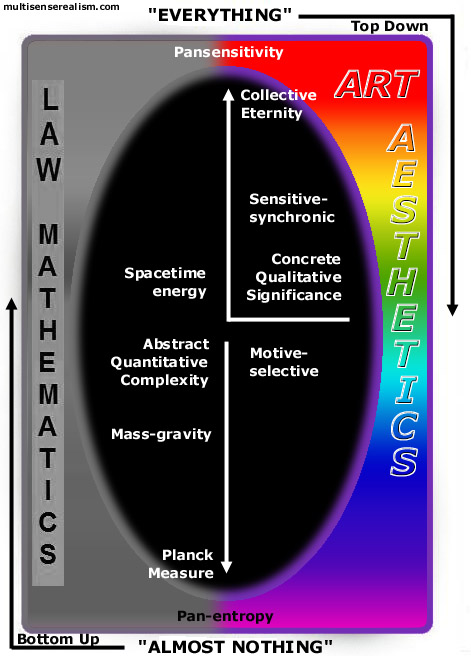
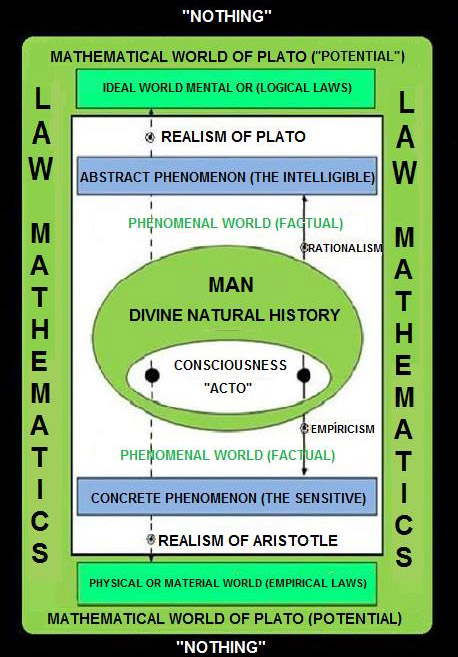
My response (top) to a diagram that I came across (lower). Some differences include:
- Outer edge is a continuum between “Everything” and “Almost Nothing” rather than “Nothing”
This reflects the idea that nothing cannot exist except as an expectation that something has about the absence of everything. It is therefore presence, rather than absence which is the primordial identity, and all phenomena are defined by substitutable gaps in pansensitivity. Awareness is localized by entropic masking or insensitivity rather than mechanical projection on top of “nothing”.
- Art – Aesthetics shares equal if not slightly greater prominence with Law – Mathematics
This overturns the Western assumption that appreciation of phenomena is a side effect of functionality. While locally true, for example, that humans like sugar because of its evolutionary value, the specific pleasure of sweet flavor is not itself describable by function, nor can it be assembled mechanically. That the universe is fundamentally an aesthetic agenda which works in order to play rather than the other way around is one of the major consequences of Primordial Identity Pansensitivity. The universe is a feeler of experiences, not just a producer of unfelt mechanisms.
- Color vs Greyscale connotes the relation between the concrete-experiential and the abstract-measured as one of reductionism rather then essentialism.
The idea here is that the rational is only a higher octave of the empirical, and the empirical is only an objectified reduction of the subjective-aesthetic. There is one continuous spectrum of sensitivity which reflects itself as desaturated forms and functions.
The top down and bottom up arrows show the circulation of intentional sequence and unintentional consequence throughout the continuum. From the pansensitivity pole on the top, where all substitutable gaps of sensitivity have been filled in and sense is total, to the pan-entropy pole on the bottom, where the ratio of gap to connection is almost infinitely great, a picture of cosmos emerges as a hyperplasticity of perspective.
- Synchronic and selective are new additions to the sensory-motive side. I think that it might work to call them electro-synchronic and magneto-selective. Electric force would seem to embody the gap-jumping, meta-phoric principle of sense-making, while magnetic fields are about orientation and masses moving themselves in relation to each other.
Beyond Probability
What is the probability that “pattern” can exist at all?
Can’t be calculated.
Because we cannot empirically calculate it, or because it is ontologically incalculable? Are there other comparably incalculable examples, or do all incalculables share a common ‘absolute’ quality (relating to primordial origins, consciousness, etc)
Ontologically incalculable. There is no way to measure the total possible outcomes.
In another way, it is super-calculable. Only one outcome results in the possibility of measurement. The probability of pattern existing in a universe in which the question of probability can be asked would be 100%…or even “infinitely greater” than 100%, as there is no possibility at all of measurement in a context that is devoid of pattern.
In another sense, the possibility of pattern is the most improbable condition in the sense that no ‘probability’ can precede pattern. Probability is an expectation of a particular type of pattern so by definition, pattern is not just incalculable, but pre-calculation (calculations are also pattern recognition).
Fair enough…
Prime Spiral
The prime spiral, also known as Ulam’s spiral, is a plot in which the positive integers are arranged in a spiral with primes indicated in some way along the spiral. Unexpected patterns of diagonal lines are apparent in such a plot. This construction was first made by Polish-American mathematician Stanislaw Ulam (1909-1986) in 1963 while doodling during a boring talk at a scientific meeting. While drawing a grid of lines, he decided to number the intersections according to a spiral pattern, and then began circling the numbers in the spiral that were primes. Surprisingly, the circled primes appeared to fall along a number of diagonal straight lines or, in Ulam’s slightly more formal prose, it “appears to exhibit a strongly nonrandom appearance”
In the above variation of the Ulam spiral, red squares represent prime numbers and white squares represent non-primes.


I can’t decide if I care about prime numbers. On the one hand, the idea of indivisibility is interesting as it relates to consciousness. In some sense, I think that the universe, and each experience of it, is a one-hit-wonder. All appearances of repetition are local to some frame of reference. If someone is color blind, they may see alternating red and green dots as a repeating grey dot. If you listen to someone speaking a language that you can’t understand, it can seem, on some level, that they are saying the same kinds of sounds over and over again.

I wondered if any random constraint would appear to contain pattern when mapped as a spiral like that. This one above is yellow hex if the number spelled out contains the letter i. Writing these out I noticed how the language we use to name the numbers is isomorphic above ten. A trivial observation, I know, but I think that this logical version of onomatopoeia reveals some insights about recursive enumeration, and its foundation in an expectation of the absolutely generic.
To someone who is fascinated by prime numbers (often in a hypnotic, compulsive kind of way, as these spirals suggest), part of the appeal may be that the patterns that they seem to make defy this expectation of generic, interchangeability as the basis of counting. Three isn’t really supposed to be different from two or one, it’s just “the next one after two”. Finding these cosmic Easter eggs by poring over mathematics is, as the movie Pi dramatized, a weird kind of quasi-religious calling. Seeking to sleuth out a hidden intelligence where neither intelligence nor secrecy would seem possible. Numbers are supposed to be universal; publicly accessible. There shouldn’t be any proprietary codes lurking in there.
Maybe there aren’t? Without mapping primes into these spirals to look at with our eyes, the interesting sequences and ratios in mathematics would not be so interesting. Mathematics may provide the most neutral and bland medium possible for the projection of patterns. Like a supernatural oracle or Rorschach inkblot, an ideal medium for pareidolia and conjuring of simulacra from the subconscious.
Math is haunted alright, but by pattern recognition – sense making, rather than Platonic essences. Because math is an ideal conductor and insulator for sense, it does end up reflecting sense in a clear and concise way, however I think it is mainly a reflection. Math is not the heart of the universe, not the whole, but the hole in the whole – a divider which shaves off differences with the power of indifference.
The Primacy of Spontaneous Unique Simplicity
This post is inspired by a long running (perpetual?) debate that I have going with a fellow consciousness aficionado who is a mathematics professor. He has some unique insights into artificial intelligence, particularly where advanced interpretations of the likes of Gödel, Turing, Kleene open up to speculations on the nature of machine consciousness. One of his results has been sort of a Multiple Worlds Interpretation in which numbers themselves would replace metaphysics, so that things like matter become inevitable illusions from within the experience of Platonic-arithmetic machines.
His theory is perhaps nowhere crystallized more understandably than in his Universal Dovetailer Argument (UDA) in which there is a single machine which runs through every possible combination of programs, thereby creating everything that can be possible from basic arithmetic elements such as numbers, addition, and multiplication. This is based on the assumption that computation can duplicate the machinery which generates human consciousness – which is the assumption that I question. Below, I try to run through a treatment where the conceptual problems of computationalism lie, and how to get passed them by inverting the order in which his UD (Universal Dovetailer) runs. Instead of a program that mechanically writes increasingly complex programs, some of which achieve a threshold of self-awareness, I use PIP (Primordial Identity Pansensitivity) to put sense first and numbers second. Here’s how it goes:
I. Trailing Dovetail Argument (TDA)
A. Computationalism makes two ontological assumptions which have not been properly challenged:
- The universality of recursive cardinality
- Complexity driven novelty.
Both of these, I intend to show, are intrinsically related to consciousness in a non-obvious way.
B. Universal Recursive Cardinality
Mathematics, I suggest is defined by the assumption of universal cardinality: The universe is reducible to a multiplicity of discretely quantifiable units. The origin of cardinality, I suggest, is the partitioning or multiplication of a single, original unit, so that every subsequent unit is a recursive copy of the original.
Because recursiveness is assumed to be fundamental through math, the idea of a new ‘one’ is impossible. Every instance of one is a recurrence of the identical and self-same ‘one’, or an inevitable permutation derived from it. By overlooking the possibility of absolute uniqueness, computationalism must conceive of all events as local reproductions of stereotypes from a Platonic template rather than ‘true originals’.
A ‘true original’ is that which has no possible precedent. The number one would be a true original, but then all other integers represent multiple copies of one. All rational numbers represent partial copies of one. All prime numbers are still divisible by one, so not truly “prime”, but pseudo-prime in comparison to one. One, by contrast, is prime, relative to mathematics, but no number can be a true original since it is divisible and repeatable and therefore non-unique. A true original must be indivisible and unrepeatable, like an experience, or a person. Even an experience which is part of an experiential chain that is highly repetitive is, on some level unique in the history of the universe, unlike a mathematical expression such as 5 x 4 = 20, which is never any different than 5 x 4 = 20, regardless of the context.
I think that when we assert a universe of recursive recombinations that know no true originality, we should not disregard the fact that this strongly contradicts our intuitions about the proprietary nature of identity. A generic universe would seem to counterfactually predict a very low interest in qualities such as individuality and originality, and identification with trivial personal preferences. Of course, what we see the precise opposite, as all celebrity it propelled by some suggestion unrepeatability and the fine tuning of lifestyle choices is arguably the most prolific and successful feature of consumerism.
If the experienced universe were strictly an outcropping of a machine that by definition can create only trivially ‘new’ combinations of copies, why would those kinds of quantitatively recombined differences such as that between 456098209093457976534 and 45609420909345797353 seem insignificant to us, but the difference between a belt worn by Elvis and a copy of that belt to be demonstrably significant to many people?
C. Complexity Driven Novelty
Because computationalism assumes finite simplicity, that is, it provides only a pseudo-uniqueness by virtue of the relatively low statistical probability of large numbers overlapping each other precisely. There is no irreducible originality to the original Mona Lisa, only the vastness of the physical painting’s microstructure prevents it from being exactly reproduced very easily. Such a perfect reproduction, under computationalism is indistinguishable from the original and therefore neither can be more original than the other (or if there are unavoidable differences due to uncertainty and incompleteness, they would be noise differences which we would be of no consequence).
This is where information theory departs from realism, since reality provides memories and evidence of which Mona Lisa is new and which one was painted by Leonardo da Vinci at the beginning of the 16th century in Florence, Italy, Earth, Sol, Milky Way Galaxy*.
Mathematics can be said to allow for the possibility of novelty only in one direction; that of higher complexity. New qualities, by computationalism, must arise on the event horizons of something like the Universal Dovetailer. If that is the case, it seems odd that the language of qualia is one of rich simplicity rather than cumbersome computables. With comp, there can be no new ‘one’, but in reality, every human experience is exactly that – a new day, a new experience, even if it often seems much like the one before. Numbers don’t work that way. Each mechanical result is identical. A = A. A does not ‘seem much like the A before, yet in a new way‘. This is a huge problem with mathematics and theoretical physics. They don’t get the connection between novelty and simplicity, so they hope to find it out in the vastness of super-human complexity.
II. Computation as Puppetry
I think that even David Chalmers, who I respect immensely for his contributions to philosophy of mind and in communicating the Hard Problem missed the a subtle but important distinction. The difference between a puppet and a zombie, while superficially innocuous, has profound implications for the formulation of a realistic critique of Strong AI. When Chalmers introduced or popularized the term zombie in reference to hypothetical perfect human duplicates which lack qualia and subjective experience, he inadvertently let an unscientific assumption leak in.
A zombie is supernatural because it implies the presence of an absence. It is an animated, un-dead cadaver in which a living person is no longer present. The unconsciousness of a puppet, however, is merely tautological – it is the natural absence of presence of consciousness which is the case with any symbolic representation of a character, such as a doll, cartoon, or emoticon. A symbolic representation, such as Bugs Bunny, can be mass produced using any suitable material substance or communication media. Even though Bugs is treated as a unique intellectual property, in reality, the title to that property is not unique and can be transferred, sold, shared, etc.
The reason that Intellectual Property law is such a problem is because anyone can take some ordinary piece of junk, put a Bugs Bunny picture on it, and sell more of it than they would have otherwise. Bugs can’t object to having his good name sullied by hack counterfeiters, so the image of Bugs Bunny is used both to falsely endorse an inferior product and to falsely impugn the reputation of a brand. The problem is, any reasonable facsimile of Bugs Bunny is just as authentic, in an Absolute sense, as any other. The only true original Bugs Bunny is the one we experience through our imagination and the imagination of Mel Blanc and the Looney Tunes animators.
The impulse to reify the legitimacy of intellectual property into law is related to the impulse to project agency and awareness onto machines. As a branch of the “pathetic fallacy” which takes literally those human qualities which have been applied to non-humans as figurative conveniences of language, the computationalistic fallacy projects an assumed character-hood on the machine as a whole. Reasoning (falsely, I think) that since all that our body can see of ourselves is a body, it is the body which is the original object from which the subject is produced through its functions. Such a conclusion, when we begin from mechanism, seems unavoidable at first.
III. Hypothesis
I propose that we reverse the two assumptions of mathematics above, so that
- Recursion is assumed to be derived from primordial spontaneity rather than the other way around.
- Novelty can only be meaningful if it re-asserts simplicity in addition to complexity.This would mean:
- The expanding event horizon of the Universal Dovetailer would have to be composed of recordings of sensed experiences after the fact, rather than precursors to subjective simulation of the computation.
- Comp is untrue by virtue of diagonalization of immeasurable novelty against incompleteness.
- Sense out-incompletes arithmetic truth, and therefore leaves it frozen in stasis by comparison in every instant, and in eternity.
- Computation cannot animate anything except through the gullibility of the pathetic fallacy.
This may seem like an unfair or insulting to the many great minds who have been pioneering AI theory and development, but that is not my intent. By assertively pointing out the need to move from a model of consciousness which hinges on simulated spontaneity to a model in which spontaneity can never, by definition be simulated, I am trying to express the importance and urgency of this shift. If I am right, the future of human understanding depends ultimately on our ability to graduate from the cul-de-sac of mechanistic supremacy to the more profound truth of rehabilitated animism. Feeling does compute because computation is how the masking of feeling into a localized unfeeling becomes possible.
IV. Reversing the Dovetailer
By uncovering the intrinsic antagonism between the above mathematical assumptions and the authentic nature of consciousness, it might be possible to ascertain a truer model of consciousness by reversing the order of the Universal Dovetailer (machine that builds the multiverse out of programs).
- The universality of recursive cardinality reverses as the Diagonalization of the Unique
- Complexity driven novelty can be reversed by Pushing the UD.
A. Diagonalization of the Unique
Under the hypothesis that computation lags behind experience*, no simulation of a brain can ever catch up to what a natural person can feel through that brain, since the natural person is constantly consuming the uniqueness of their experience before it can be measured by anything else. Since the uniqueness of subjectivity is immeasurable and unprecedented within its own inertial frame, no instrument from outside of that frame can capture it before it decoheres into cascades of increasingly generic public reflections.
PIP flips the presumption of Universal Recursive Cardinality inherent in mathematics so that all novelty exists as truly original simplicity, as well as a relatively new complex recombination, such that the continuum of novelty extends in both directions. This, if properly understood, should be a lightning bolt that recontextualizes the whole of mathematics. It is like discovering a new kind of negative number. Things like color and human feeling may exploit the addressing scheme that complex computation offers, but the important part of color or feeling is not in that address, but in the hyper-simplicity and absolute novelty that ‘now’ corresponds to that address. The incardinality of sense means that all feelings are more primitive than even the number one or the concept of singularity. They are rooted in the eternal ‘becoming of one’; before and after cardinality. Under PIP, computation is a public repetition of what is irreducibly unrepeatable and private. Computation can never get ahead of experience, because computation is an a posteriori measurement of it.
For example, a computer model of what an athlete will do on the field that is based on their past performance will always fail to account for the possibility that the next performance will be the first time that athlete does something that they never have done before and that they could not have done before. Natural identities (not characters, puppets, etc) are not only self-diagonalizing, natural identity itself is self-diagonalization. We are that which has not yet experienced the totality of its lifetime, and that incompleteness infuses our entire experience. The emergence of the unique always cheats prediction, since all prediction belongs to the measurements of an expired world which did not yet contain the next novelty.
B. Pushing the UD – If the UD is a program which pulls the experienced universe behind it as it extends, the computed realm, faster than light, ahead of local appearances. It assumes all phenomena are built bottom up from generic, interchangeable bits. The hypothesis under PIP is that if there were a UD, it would be pushed by experience from the top down, as well as recollecting fragments of previous experiences from the bottom up. Each experience decays from immeasurable private qualia that is unique into public reflections that are generic recombinations of fixed elements. Reversing the Dovetailer puts universality on the defense so that it becomes a storage device rather than a pseudo-primitive mechina ex deus.
The primacy of sense is corroborated by the intuition that every measure requires a ruler. Some example which is presented as an index for comparison. The uniqueness comes first, and the computability follows by imitation. The un-numbered Great War becomes World War II only in retrospect. The second war does not follow the rule of world wars, it creates the rule by virtue of its similarities. The second war is unprecedented in its own right, as an original second world war, but unlike the number two, it is not literally another World War I. In short, experiences do not follow from rules; rules follow from experience.
V. Conclusions
If we extrapolate the assumptions of Compuationalism out, I think that they would predict that the painting of the Mona Lisa is what always happens under the mathematical conditions posed by a combination of celestial motions, cells, bodies, brains, etc. There can be no truly original artwork, as all art works are inevitable under some computable probability, even if the the particular work is not predictable specifically by computation. Comp makes all originals derivatives of duplication. I suggest that it makes more sense that the primordial identity of sense experience is a fundamental originality from which duplication is derived. The number one is a generic copy – a one-ness which comments on an aspect of what is ultimately boundaryless inclusion rather than naming originality itself.
Under Multisense Realism (MSR), the sense-first view ultimately makes the most sense but it allows that the counter perspective, in which sense follows computation or physics, would appear to be true in another way, one which yields meaningful insights that could not be accessed otherwise.
When we shift our attention from the figure of comp in the background of sense to the figure of sense in the background of comp, the relation of originality shifts also. With sense first, true originality makes all computations into imposters. With computation first, arithmetic truth makes local appearances of originality artifacts of machine self-reference. Both are trivially true, but if the comp-first view were Absolutely true, there would be no plausible justification for such appearances of originality as qualitatively significant. A copy and an original should have no greater difference than a fifteenth copy and a sixteenth copy, and being the first person to discover America should have no more import than being the 1,588,237th person to discover America. The title of this post as 2013/10/13/2562 would be as good of a title as any other referenceable string.
*This is not to suggest that human experience lags behind neurological computation. MSR proposes a model called eigenmorphism to clarify the personal/sub-personal distinction in which neurological-level computation corresponds to sub-personal experience rather than personal level experience. This explains the disappearance of free will in neuroscientific experiments such as Libet, et. al. Human personhood is a simple but deep. Simultaneity is relative, and nowhere is that more true than along the continuum between the microphysical and the macrophenomenal. What can be experimented on publicly is, under MSR, a combination of near isomorphic and near contra-isomorphic to private experience.
P, PP, PIP, MSR Disambiguation
Pansensitivity (P) proposes that sensation is a universal property.
Primordial Pansensitivity (PP) proposes that because sensation is primitive, mechanism is derived from insensitivity. Whether it is mechanism that assumes form without sensibility (materialism) or function without sensation (computationalism), they both can only view feeling as a black box/epiphenomenon/illusion.
Under PP, both materialism and computationalism make sense as partial negative images of P, so that PP is the only continuum or capacity needed to explain feeling and doing (sense-motive), objective forms and functions (mass-energy), and informative positions and dispositions (space-time).
PP says that the appearance of forms and functions are, from an absolute perspective, sensory-motive experiences which have been alienated through time and across space.
Primordial Identity Pansensitivity (PIP) adds to the Ouroboran Monism of PP, (sense twisted within itself = private experience vs public bodies) by suggesting that PP is not only irreducible, but it is irreducibility itself.
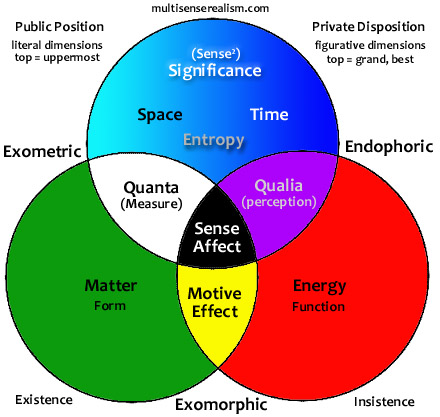
PIP suggests that distance is a kind of insensitivity, so that all other primitive possibilities which are grounded in mechanism, such as information or energy, are reductionist in a way which oversignifies the distanced perspective, while anthropomorphic primitives such as love or divinity are holistic in a way which oversignifies the local perspective. Local and distant are assumed to be Cartesian opposites, but PIP maps locality and distance as the same in terms of being two opposite branches of insensitivity. Both the holistic and reductionist views ignore the production of distance which they both rely on for their perspective, both take perspective itself, perception, and relativity for granted.
MSR (Multisense Realism) tries to rehabilitate reductionism and holism by understanding them as bifocal strategies which arise naturally, each appropriate for a particular context of perceived distance. Both are near-sighted and far-sighted in opposite ways, as the subject seeks to first project anthropomorphism outward onto the world and then, following a crisis of disillusionment, seeks the opposite – to project exterior mechanism into the self. MSR invites us to step outside of the bifocal antagonism and into a balanced appreciation of the totality.
Diogenes Revenge: Cynicism, Semiotics, and the Evaporating Standard
Diogenes was called Kynos — Greek for dog — for his lifestyle and contrariness. It was from this word for dog that we get the word Cynic.
Diogenes is also said to have worked minting coins with his father until he was 60, but was then exiled for debasing the coinage. – source
In comparing the semiotics of CS Pierce and Jean Baudrillard, two related themes emerge concerning the nature of signs. Pierce famously used trichotomy arrangements to describe the relations, while Baudrillard talked about four stages of simulation, each more removed from authenticity. In Pierce’s formulation, Index, Icon, and Symbol work as separate strategies for encoding meaning. An index is a direct consequence or indication of some reality. An icon is a likeness of some reality. A symbol is a code which has its meaning assigned intentionally.
Baudrillard saw sign as a succession of adulterations – first in which an original reality is copied, then when the copy masks the original in some way, third, as a denatured copy in which the debasement has been masked, and fourth as a pure simulacra; a copy with no original, composed only of signs reflecting each other.
Whether we use three categories or four stages, or some other number of partitions along a continuum, an overall pattern can be arranged which suggests a logarithmic evaporation, an evolution from the authentic and local to the generic and universal. Korzybski’s map and territory distinction fits in here too, as human efforts to automate nature result in maps, maps of maps, and maps of all possible mapping.
The history of human timekeeping reveals the earthy roots of time as a social construct based on physical norms. Timekeeping was, from the beginning linked with government and control of resources.
According to Callisthenes, the Persians were using water clocks in 328 BC to ensure a just and exact distribution of water from qanats to their shareholders for agricultural irrigation. The use of water clocks in Iran, especially in Zeebad, dates back to 500BC. Later they were also used to determine the exact holy days of pre-Islamic religions, such as the Nowruz, Chelah, or Yalda- – the shortest, longest, and equal-length days and nights of the years. The water clocks used in Iran were one of the most practical ancient tools for timing the yearly calendar. source
Anything which burns or flows at a steady rate can be used as a clock. Oil lamps, candles, can incense have been used as clocks, as well as the more familiar sand hourglass, shadow clocks, and clepsydrae (water clocks). During the day, a simple stick in the ground can provide an index of the sun’s position. These kinds of clocks, in which the nature of physics is accessed directly would correspond to Baudrillard’s first level of simulation – they are faithful copies of the sun’s movement, or of the depletion of some material condition.
Staying within this same agricultural era of civilization, we can understand the birth of currency in the same way. Trading of everyday commodities could be indexed with concentrated physical commodities like livestock, and also other objects like shells which had intrinsic value for being attractive and uncommon, as well as secondary value for being durable and portable objects to trade. In the same way that coins came to replace shells, mechanical clocks and watches came to replace physical index clocks. The notions of time and money, while different in that time refers to a commodity beyond the scope of human control and money referring specifically to human control, both serve as regulatory standards for civilization, as well as equivalents for each other in many instances (‘man hours’, productivity).
In the next phase of simulation, coins combined the intrinsic and secondary values of things like shells with a mint mark to ensure transactional viability on the token. The icon of money, as Diogenes discovered, can be extended much further than the index, as anything that bears the official seal will be taken as money, regardless of the actual metal content of the coin. The idea of bank notes was as a promise to pay the bearer a sum of coins. In the world of time measurement, the production of clocks, clocktowers, and watches spread the clock face icon around the world, each one synchronized to a local, and eventually a coordinated universal time. Industrial workers were divided into shifts, with each crew punching a timeclock to verify their hours at work and breaks. While the nature of time makes counterfeiting a different kind of prospect, the practice of having others clock out for you or having a cab driver take the long way around to run the meter longer are ways that the iconic nature of the mechanical clock can be exploited. Being one step removed from the physical reality, iconic technologies provide an early opportunity for ‘hacking’.
| physical territory > index | local map > icon | symbol > universal map |
| water clock, sand clock | sundial/clock face | digital timecode |
| trade > shells | coins > check > paper | plastic > digital > virtual |
| production > organization | bonds > stock | futures > derivatives |
| real estate | mortgage, rent | speculation > derivatives |
| genuine aesthetic | imitation synthetic | artificial emulation |
| non-verbal communication | language | data |
The last three decades have been marked by the rise of the digital economy. Paper money and coins have largely been replaced by plastic cards connected to electronic accounts, which have in turn entered the final stage of simulacra – a pure digital encoding. The promissory note iconography and the physical indexicality of wealth have been stripped away, leaving behind a residue of immediate abstraction. The transaction is not a promise, it is instantaneous. It is not wealth, it is only a license to obtain wealth from the coordinated universal system.
Time has entered its symbolic phase as well. The first exposure to computers that consumers had in the 1970s was in the form of digital watches and calculators. Time and money. First LED, and then LCD displays became available, both in expensive and inexpensive versions. For a whole generation of kids, their first electronic devices were digital calculators and watches. There had been digital clocks before, based on turning wheels or flipping tiles, but the difference here was that the electronic numbers did not look like regular numbers. Nobody had ever seen numbers rendered as these kind of generic combinatorial figures before. Every kid quickly learned how to spell out words by turning the numbers upside down (you couldn’t make much.. 710 77345 spells ShELL OIL)…sort of like emoticons.
Beneath the surface however, something had changed. The digital readout was not even real numbers, they were icons of numbers, and icons which exposed the mechanics of their iconography. Each number was only a combinatorial pattern of binary segments – a specific fraction of the full 8.8.8.8.8.8.8.8. pattern. You could even see the faint outlines of the complete pattern of 8’s if you looked closely, both in LED and LCD. The semiotic process had moved one step closer to the technological and away from the consumer. Making sense of these patterns as numbers was now part of your job, and the language of Arabic numerals became data to be processed.
Since that time, the digital revolution has shaped the making and breaking of world markets. Each financial bubble spread out, Diogenes style, through the banking and finance industry behind a tide of abstraction. Ultra-fast trading which leverages meaningless shifts in transaction patterns has become the new standard, replacing traditional market analysis. From leveraged buyouts in the 1980s to junk bonds, tech IPOs, Credit Default Swaps, and the rest, the world economy is no longer an index or icon of wealth, it is a symbol which refers only to itself.
The advent of 3D printing marks the opposite trend. Where conventional computer printing to allow consumers to generate their own 2D icons from machines running on symbols, the new wave of micro-fabrication technology extend that beyond the icon and the index level. Parts, devices, food, even living tissue can be extruded from symbol directly into material reality. Perhaps this is a fifth level of simulation – the copy with no original which replaces the need for the original…a trophy in Diogenes’ honor.
Pink Floyd, Money
Delving deeper into the Non-Well-Founded Identity Principle that I proposed earlier, here is an illustration which applies the principle to money – US dollars specifically.

What I intend to show is that a dollar is defined by the integral which spans a continuum from the most literal (a dollar “simply is” one hundred cents) to the most figurative. The most figurative end of the continuum is another continuum – an orthogonal continuum which contains the entire top level continuum from what is meant literally as one hundred cents to every other meaning, association, context and contingency, from every perspective, throughout eternity.

This stack of figurative extensions can yield many loose morphological analogs – electron shell type morphology, stepped pyramid, color wheel mandalas, etc. The closest figures to associate with the dollar would be other kinds of currencies: Euros, Deutschmarks, Yen, etc. These are all of the things which are like dollars, but not dollars, and which dollars can actually buy. The associations radiate out from there to include references to any transaction with dollars. Ultimately this would stretch to encompass any real or imagined transaction which has ever occurred, every transaction which could occur, or could not occur…until the set includes the entire contents of eternity (aka, the Absolute Inertial Frame, or the Totality*).
Once you recover from that (seriously, come back later…I have already had one person say they got a headache thinking about this), then have a look at the diagram below. Same thing, only from the Absolute perspective. Borrowing from the Dark Side of The Moon Prism, I attempt to show how the cosmos is the continuum of self-individuating, nested, Ouroboran Monism. Rather than the Blue Sky icon representing the Totality, it represents any individual thing as a generic presence.

In the top diagram, I show how the individuality of a dollar implies the figuratively nested Totality, and in this diagram, it is the Totality which is considered the individual identity which is spread across the continuum of its own absolutely individuated cardinality or literal granularity.
Another point to make about the continuum is that the bottom limits of the integrals represent both that which is common to each and every unity. The cents which ‘make up’ a dollar represent the quantitative definition which describes any particular dollar, and therefore all dollars. The top end of the integrals represent the opposite definitions – that which is increasingly unique to a particular event in time or associated with a unique group of less particular experiences (qualia, concepts).
You’re welcome 😉
 Multisense Realism



Recent Comments