Archive
Critique and Revision of A Unifying Principle Diagram
Based on Raymond de Lacaze‘s post at https://infobiotecnologia.blogspot.com/2026/06/from-void-to-mind-universe-as-process.html I made some revisions to illustrate the Multisense Realism view. I borrowed some of the generated graphic and design elements that he used and added a few of my own from Chat GPT.
What I am illustrating are the following similarities and differences:
Lacaze’s diagram describes “The Unifying Principle”, whereby “energy” becomes “information” by organizing. In his view, self-organizing energy generates complexity, which then evolves from universe to life to mind/consciousness by adding more and more complexity. It is complexity, he says, that “gives rise to awareness, reflection, and understanding (consciousness)”.
My view under MSR can also be used to describe a flow of a single self-evolving phenomenon, however, I propose that this phenomenon was never a ‘void’ or ‘potential’, nor could it have ever unconsciously informed, ordered, or defined that order as complex. Such qualities are all conscious reactions to consciously experienced aesthetic qualities. Unconscious phenomena, if they could even exist, would be devoid of aesthetic qualities or reactions to them. There would be nothing to see/feel/know or care whether those appearances seem simple or complex, orderly or chaotic, informative or semantically inert. To me, it makes more sense to consider the possibility that the universe was always and only a single, eternal “here and now” of conscious experience in which all phenomena are presented as irreducibly aesthetic and participatory appearances.
Within that Totality or Holos of aesthetic presentations, different variations and versions of the Holos are diffracted or graphed through the modulation of limited insensitivity. Unbounded sense and motive is the thesis, masking by insensitivity (entropy and negentropy are the antithesis of sensitivity), to arrive at a synthesis of conscious experience that are aesthetically saturated (high Significance, proprietary, unique) and desaturated (low Significance, generic, repetitive). In other words, by winnowing down the eternal Now by temporarily allowing only partial access to sense modalities and participatory power, experiences such as mortality and time are made possible as additions within the Totality. Human experience, as well as other types of biologically constrained experience are only some examples of a much larger spectrum of awareness that extends well beyond human scales and modalities of sensitivity. From the human perspective, non-human consciousness appears as zoological or supernatural. Everything else appears as figures and forms on biological, geological, chemical, or astrophysical scales.
What Multisense Realism (MSR) suggests is that these forms are actually only iconic sensory snapshots that retain only those details that minimally overlap across scales and modes of sensory-motor access. We seeing objects, and we are seen as an object, but both the ability to see and the objects that appear in our vision are not objects, they are percepts. Objects are generated by, for, and within perception, not the other way around. Objects can’t bind to percepts or concepts, they can only really do one thing: Change each other’s shape and movement with their own shape and movement. Forces, fields, energy, charge, waves, and other scientific concepts describe only different aspects of when and how those changes to shape and motion occur. Nothing in science explains how geometric changes could begin to inform or allow any such thing as experiences with aesthetic qualities such as order or complexity to emerge. Geometry does not contain any formula to transcend geometry, nor can it without assuming such transcendence as a foregone conclusion from circular reasoning.
Under MSR it is not the body or system that is conscious, it is consciousness that renders itself as having bodies (or cells, molecules, planets, galaxies) or other systemic appearances (math, language, logic, intuition) through a process that I call eigenmorphism and diffractivity. Together, the Aesthetic thesis or Holos and the Anesthetic antithesis or ‘Graphing process’ yield a subtractive synthesis of limited conscious experience, such as the experience of mortality or human personal awareness.
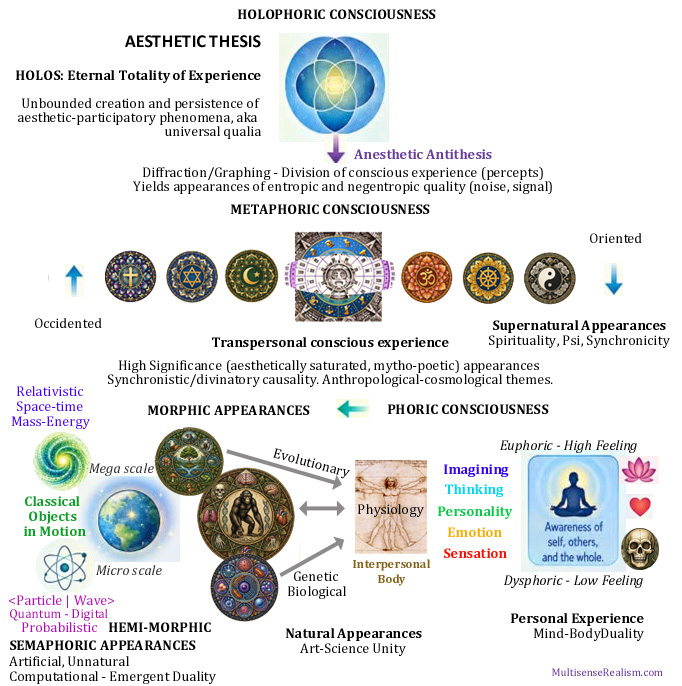
In my cannibalized diagram, I use various prefixes, Holo-, Meta-, hemi-, and sema- to refer to scales of awareness that are beyond and beneath direct personal participation. The scale that is proposed here, then is one that begins with Total awareness (Holophoric Consciousness) nested into multiple subordinated scales and modalities of awareness (Transpersonal and Interpersonal = Metaphoric Consciousness, Personal or individual scales = Phoric Consciousness with Morphic Appearances, and Subpersonal or Impersonal scales = Semaphoric/Hemimorphic Appearances).
The Lacaze view, by contrast, posits consciousness as an end result of a linear process that presumably takes place in the absence of all conscious experience and aesthetic appearances, including any capacity to discern ‘things’ from nothingness, or to care about any such discernments. This, while being the most popular view is, in my understanding, impossible and self-negating. Potential isn’t a necessary phenomenon since consciousness can create appearances of potential or void by invoking various features of masking or insensitivity. Through the partial amnesia of sleep states we are able to sculpt out a sense of successive experiences in linear time. Forgetting and remembering work together to limit our focus and cultivate an appreciation for the significance of each set of aesthetic presentations and how they might relate to each other. I reject the premise of an ontological entity that exists by virtue of its own pure non-existence/void or pure existence-to-be/potential and understand all appearances of void or potential to be artifacts of how subordinated conscious experiences perceive their own limitation relative to themselves and to the Totality. Nothingness, as I like to say, can only ever be something’s idea of the absence of everything. In an absolute sense, there are only conscious experiences of greater and lesser access to the Totality.
Next in the chain, Lacaze points to Energy as being the first thing to be realized out of the pre-realized context of void/potential. I have talked previously about how the term energy is used in other writing on the Multisense Realism site, and while I make no claim of expertise in physical theory, I do think that I understand enough to say that energy ultimately appears to be an abstract concept that reduces to geometry. Energy is the geometry of non-inertial movement of some material substance (concrete objects or shapes…particles, waves) in public space. I find that even those who are experts in physical theory disagree with each other or admit ignorance about what ‘energy’ is, what its powers actually are, and even whether it exists as a concrete ontological presence or an abstract heuristic concept. Because the authority of physical theory ultimately derives from parsimony, it makes sense to me to discard any vague extensions to what energy could be or do as metaphysical speculation. Metaphysical speculation is fine, it just has no business underpinning theoretical physics or assuming academic authority based on associations with physics that are suggested rather than proved.
As far as I can see, energy need not be anything more concrete than the (conscious) observation of how material objects move each other around. Even quantum mechanics is ultimately nothing more than an elaborate algebraic metaphor for the changes in position of geometric appearances we detect with specialized material instruments. I don’t reject the idea of energy as an ontological entity, however, I suspect that it should be rejected in favor of the heuristic interpretation. Further, I suspect that what we call energy is ultimately an expression of conscious experiences intentionally participating in changing shared aesthetic qualities. Energy is a formula to predict the cascade of geometric-mechanical consequences that necessarily must appear from physical change instigated by conscious response to aesthetic stimulation. Energy is consciousness stepping on the accelerator or brakes or turning the steering wheel. If we do consider energy to be a concrete rather than abstract entity, I propose that the entity is a way of turning aesthetic responses (motive affect) to aesthetic stimulation (sense affect) into appearances of mechanical causality (motor effects).
I see Lecaze’s middle phases of the chain; Information, Order, and Complexity as being almost interchangeable semantically. They all refer to the same kind of thing – the clustering together of what I call aesthetic appearances, and their relation to each other and to logical modalities of sense-making within conscious experience. They don’t make sense outside of the assumption of conscious experience, without which nothing could be ‘informed’ in the first place. Unconsciousness can’t value one configuration over another as more orderly or complex. This is not a prejudice against unconsciousness, it is only a reminder that parsimony is a critical ingredient for any theory of everything that borrows its authority from association with established academic ‘hard’ science such as physics or computer science. Getting from energy to information is already impossible without assuming some unacknowledged capacity to inform and be informed that is somehow neither consciousness nor physical mechanism. As we move up the scale from physics to biology, we carried this unacknowledged assumption with us. Organs that we use to concentrate and amplify different types of sensitivity in our conscious experience became ‘sense organs’, as if organs were unconsciously sensing rather than organs being sense appearances in the first place.
Using Occam’s Razor, I see no reason to make a leap of emergent properties from mindless, automatic physical formation to semi-mindful, semi-participatory information. It’s a story that we have invented because of our mental experience of developing and using software, however software only exists for us, not for the hardware that we use to ‘run programs’ on. In reality, computer hardware no more runs software than an abacus does arithmetic or fingers count to ten. This projection of symbolic concepts onto percepts and then from percepts onto physical objects is so widely and deeply misunderstood that it literally undermines all of our efforts to understand consciousness and recognize its primacy. We mistake the local limitation of our own experience for limits of experience in general. This tends to lead us to one of two pathological conclusions – that consciousness arises accidentally out of the unperceived complexity of unconscious mechanism, or that the physical universe is an illusion with illusory mechanisms. With Multisense Realism, I attempt to explain why both extremes of mechanistic physicalism and solipsistic idealism negate themselves and how relativity, quantum mechanics, and transpersonal psychology hint at a larger continuum of conscious experience in which perspectives such as mechanism and solipsism appear as divergent biases of specialized awareness.
Multisense Realism Diagram Chronophoria v1.6

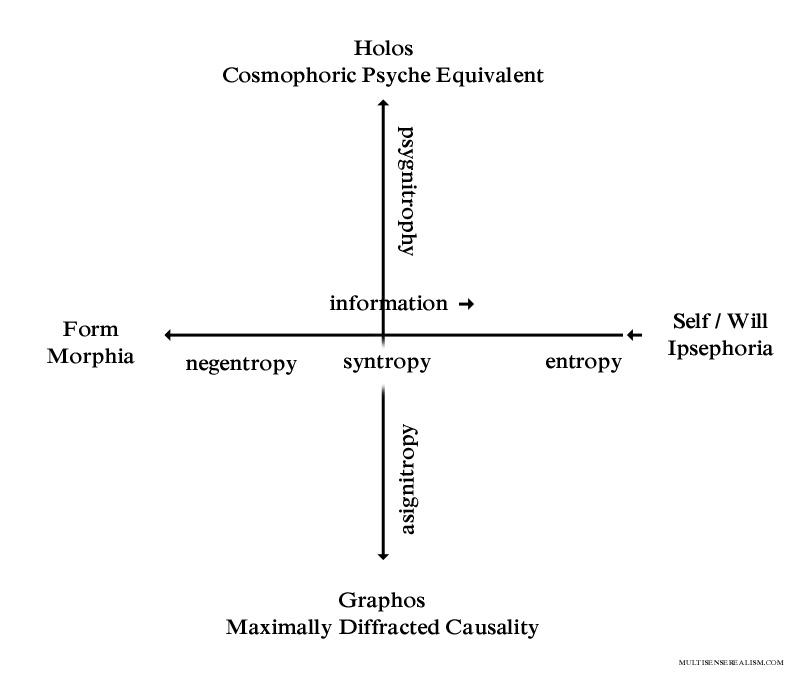
I gave this the name Chronophoria after realizing that I could add the polar extremes of time to the top and bottom. A tiny detail that probably deserves more attention, however, it is there near the bottom “Instantaneously”, referring to the Anesthetic Antithesis and “Eternally”, referring to the Aesthetic Thesis near the top.
The top and bottom ends should really also include “Significance” and “Insignificance” respectively, as well as “Holos” and “Graphos”.
After a comment from the Multisense Realism page, I have added Significance and Complexity, and made a couple of other tweaks at the bottom.
1.6 Added Language and Metric-Spatial aesthetic holons.

Evan Thompson Live! Consciousness Live! S4 E12 CW comments, part 2
At 57:15 Richard is posing the question of why objects in a simulated world aren’t real objects in a real digital world. To this I say what is being overlooked is sense modality. We have to be as literal as we possibly can be when discussing these topics. Objects, in the most literal sense, are not images or numbers, they are tangible shapes. Solid, liquid, and gaseous volumes in public spacetime. Real objects are composed of molecules that are made up of atoms on the periodic table. Sense experience is the only thing that can generate realism. When we think of a simulation, we are thinking of some artificially stimulated sense experience – a GUI image that *we* see (birds don’t see it, hamsters don’t see it) on screen hardware. Without this, there is nothing begin simulated.
The interface hardware cannot be simulated. There is no software that can be written that will generate colors for the color blind in the way that software could be written to solve math problems for people who aren’t able to do math. No amount of computation or complexity will yield a new primary color. Eventually we will likely have hardware that is wired into the visual cortex directly but we still don’t know how or why changes in the states of cells would ‘seem like’ or ‘appear’ as anything other than what they physically are. If any data is being processed, the changes in the cellular states already ARE the data processing events. If an organ evolved to have a higher, meta-level governance of its own processes, then that too would only be and could only be more cells that are performing cellular functions which only happen to mirror a sampling of the lower level processes. There can be a functional link – for every 100 neurons that fire on a lower level, 2 neurons fire on the meta-level, and that would accomplish the result that our experience of ‘modeling’ allows us to accomplish functionally, but without any such thing as modeling. The relation of the “model” plane and the “actual” plane is metaphorical. They are both physical objects of different size and composition. It is only in human perception and association that one could seem to ‘model’ the other. There are no models in physics, chemistry, or biology, unless we understand those domains (as I do) to be scales of conscious interaction.
I very much agree with what Evan is saying around 1:05 about bits not existing apart from our practices of imposing maps and schemes. This gets us close to the big revelation that I’m pushing all of the time – It’s SENSE that matters. Matter doesn’t sense. Or it wouldn’t, if matter were primitive and real, but matter itself is just a lower rung of sense and motive engagement. That’s why QM and relativity describe the scale limits of physicality, rather than Cartesian coordinate objects. That’s why quantum contextuality and entanglement. The common denominator is always ultimately sense. Not even the sense-of-being-a-sensor or using a sensory, but sense experience itself: qualia. Matter can be qualia, information can be qualia, but neither information or matter can turn themselves into qualia materially or logically, nor can they turn themselves into each other. That’s perhaps the more important clue.
Software cannot find hardware and vice versa. When we ‘compile’ ‘code’, we are performing a physical task that just pushes physical changes in physical circuits. There isn’t a literal ‘conversion’ from ideas to physics, it’s just that the way that we set up the machine seems *to us* (and to the sense and sense making modalities we can access) to be isomorphic. There is no ‘code’ in physics – no concepts, only tangible shapes or regions where tangible shapes move in certain ways.
Electromagnetism can be reduced to that – to changes in the motion of particles. We can undo all notion of fields and forces, undo the intuitions of Maxwell and Faraday, and replace them all with sensory-motive engagements. These are the phenomena from which all laws and forces emerge. Something has to sense something before a change – any change – can be present. Present where? How? What is changing is always and only some sensed quality or property, like position of a tangible shape relative to another shape and to a memory or perception of that position quality being altered. We can look at it the other way around also, with stasis in the background and motion in the foreground. We can think of stillness as an artificial appearance that our sense filtering is presenting, and that without that filter, everything is motion on some timescale. Without sense, no present or presences can be accessed.
I don’t have much to add about the rest of the talk. I think it gets close to where my view begins to take shape, as far as Kant, Husserl, and Whitehead questioning the distinction of subjective and objective categories, etc. I agree that is the right direction to go in. Where I end up with it is that objectivity and noumenality are relative rather than absolute, and that existence itself is phenomenological, without being subjective or objective. The appearance of subjective and objective seeming qualities are artifacts of a particular scope of awareness, typically is divided and nested by timescale and distinction of modality. Scope of awareness lens each other to appear in these kinds of aesthetic categories. What we understand as the geological timescale is so slow compared to our own that we can’t empathize with it or directly access its flow. It seems static. The laws of physics, hold forever as far as we are concerned, but in an absolute sense, they may be more of a set of useful habits from which the longest and shortest timescale events are built.
Here’s a terrible hack set of images to try to illustrate what I mean:
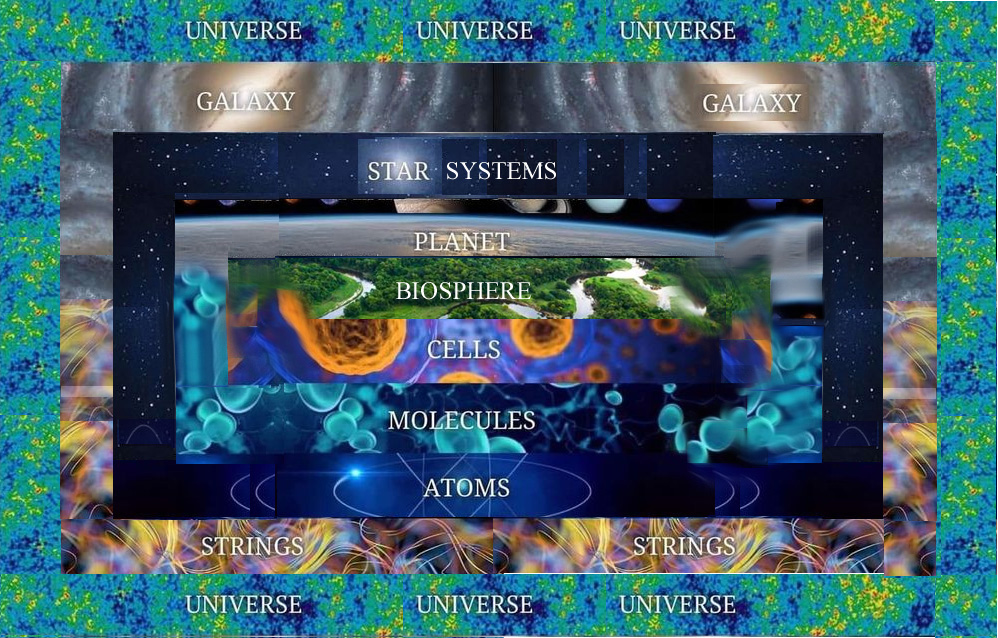

Got it? Spacetime scales are nested inward so that astropysical timescales (longest and shortest duration, largest and smallest size) envelope geo-molecular (next longest and next shortest duration and next largest and smallest size), which envelope the most medium scaled durations and size (eco-cellular).
Now think of that in an orthogonal relation to the other half of the universe, which correlates to size and duration, but is defined by intensity of aesthetic-participatory richness, aka Significance.
The main takeaway that I can offer as a response to the video, if nothing else, is the idea that
1. The distinction between anesthetic-participatory and anesthetic-mechanical is more fundamental than phenomenal/noumenal or subjective/objective.
2. Anesthetic mechanisms are either concrete (geometric mass-energetic force-field operations) or abstract (algebraic information-processing functions)3. Anesthetic mechanisms do not exist on their own and are in all cases a reduced, exteriorized reflection between two disparately scaled modes of aesthetic-participation.


Recent Comments