Archive
Three-Phase Model of Will
Within the Multisense Realism (MSR) model, all of nature is conceived of as a continuum of experiential or aesthetic phenomena. This ‘spectrum of perceivability’ can be divided, like the visible light spectrum, into two, three, four, or millions of qualitative hues, each with their own particular properties, and each which contribute to the overall sense of the spectrum.
For this post, I’ll focus on a three-level view of the spectrum: Sub-personal, Personal, and Transpersonal. Use of the MSR neologisms ‘Semaphoric, Phoric, and Metaphoric’ may be annoying to some readers, but I think that it adds some important connections and properly places the spectrum of perceivability in a cosmological context rather than in an anthropocentric or biocentric one.
In my view, nature is composed of experiences, and the primary difference between the experiences of biological organisms (which appear as synonymous with cellular-organic bodies to each other) and experiences which appear to us as inorganic chemistry, atoms, planets, stars, etc is the scale of time and space which are involved and the effect of that scale difference on what I call perceptual lensing or eigenmorphism.
In other words, I am saying that the universe is made of experiences-within-experiences, and that the relation of any given experience to the totality of experience is a defining feature of the properties of the universe which appear most real or significant. If you are an animal, you have certain kind of experiences in which other animals are perceived as members of one’s own family, or as friends, pets, food, or pests. These categories are normally rather firm, and we do not want to eat our friends or pets, we understand that what constitutes a pet or pest in some cultures may be desirable as food in others. We understand that the palette can shift, for example, many with a vegan diet sooner or later find meat eating in general to be repulsive. This kind of shift can be expressed within the MSR model as a change in the lensing of personal gustatory awareness so that the entire class of zoological life is identified with more directly. The scope of empathy has expanded so that the all creatures with ‘two eyes and a mother’ are seen in a context of kinship rather than predation.
Enslavement is another example of how the lens of human awareness has changed. For millennia slavery was practiced in various cultures much like eating meat is practiced now. It was a fact of life that people of a different social class or race, women or children could be treated as slaves by the dominant group, or by men or adults. The scope of empathy was so contracted* by default that even members of the same human species were identified somewhere between pet and food rather than friends or family. As this scope of awareness (which is ultimately identical with empathy) expanded those who were on the leading edge of the expansion and those who were on the trailing edge began to see each other in polarized terms. There is a psychological mechanism at work which fosters the projection of negative qualities on the opposing group. In the case of 19th century American slavery, this opposition manifested in the Civil War.
Possibly all of the most divisive issues in society are about perception and how empathy is scoped. Is it an embryo or an unborn child? Are the poor part of the human family or are they pests? Should employees have rights as equals with employers or does wealth confer a right of employers to treat employees more like domesticated animals? All of these questions are contested within the lives of individuals, families, and societies and would fall under the middle range of the three tiered view of the MSR spectrum: The Phoric scope of awareness.
Phoric range: Consciousness is personal and interpersonal narrative with a clearly delineated first person subject, second person social, and third person object division. Subjective experience is intangible and difficult to categorize in a linear hierarchy. Social experience is intangible but semiotically grounded in gestures and expressions of the body. Consider the difference between the human ‘voice’ and the ‘sounds’ that we hear other animals make. The further apart the participants are from each other, the more their participation is de-personalized. Objective experience (more accurately objective-facing or public-facing experience) is totally depersonalized and presented as tangible objects rather than bodies. Tangible objects are fairly easy to stratify by time/space scale: Roughly human sized or larger animals are studied in a context of zoology. Smaller organisms and cells comprise the field of biology. As the ‘bodies’ get smaller and lives get shorter/faster relative to our own, the scope of our empathy contracts (unless perhaps if you’re a microbiologist), so that we tend to consider the physical presence of microorganisms and viruses somewhere in between bodies and objects.
Even though we see more and more evidence of objects on these sub-cellular scales behaving with seeming intelligence or responsiveness, it is difficult to think of them as beings rather than mechanical structures. Plants, even though their size can vary even more than animals, are so alien to our aesthetic sense of ourselves that they tend to be categorized in the lower empathy ranges: Food rather than friends, fiber rather than flesh. This again is all pertaining to the boundary beteween the personal or phoric range of the MSR spectrum and the semaphoric range, sub-personal. The personal view of an external sempahore is an object (morphic phenomenon). The morphic scope is a reflection within the phoric range of experiences which are perceptually qualified as impersonal but tangible. It is a range populated by solid bodies, liquids, and gas which are animated by intangible ‘forces’ or ‘energies’**. Depending on who is judging those energies and the scale and aesthetics of the object perceived, the force or energy behind the behavior of the body is presumed to be somewhere along an axis which extends from ‘person’, where full fledged subjective intent governs the body’s behavior to ‘mechanism’ where behaviors are governed by impersonal physical forces which are automatic and unintentional.
Zooming in on this boundary between sentience and automaticity, we can isolate a guiding principle in which ‘signals’ embody the translation between mechanical-morphic forms and metric-dynamic functions which are supposed to operate without sensation, and those events which are perceived with participatory qualities such as feeling, thinking, seeing, etc. While this sub-personal level is very distant from our personal scope of empathy, it is no less controversial as far as the acrimony between those who perceive no special difference between sensation and mechanical events, and those who perceive a clear dichotomy which cannot be bridged from the bottom up. To the former group, the difference between signal (semaphore) and physical function (let’s call it ‘metamorph’) is purely a semantic convention, and those who are on the far end of the latter group appear as technophobes or religious fanatics. To the latter group, the difference between feelings and functions is of the utmost significance – even to divine vs diabolical extremes. For the creationist and the anti-abortionist, human life is not divisible to mere operations of genetic objects or evolving animal species. Their perception of the animating force of human behavior is not mere stochastic computation and thermodynamics, but ‘free will’ and perhaps the sacred ‘soul’. What is going on here? Where are these ideas of supernatural influences coming from and why do they remain popular in spite of centuries of scientific enlightenment?
This is where the third level of the spectrum comes in, the metaphoric or holophoric range.
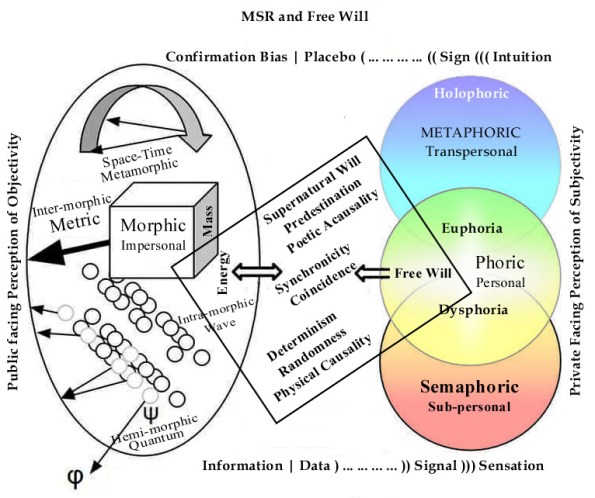
To review: Semaphoric: Consciousness on this level is seen as limited to signal-based interactions. The expectation of a capacity to send and receive ‘signs’ or ‘messages’ is an interesting place to spend some time on because it is so poorly defined within science. Electromagnetic signals are described in terms of charge or attraction/repulsion but it is at the same time presumed to be unexperienced. Computer science takes signal for granted. It is a body of knowledge which begins with an assumption that there already is hardware which has some capacity for input, output, storage, and comparison of ‘data’. Again, the phenomenal content of this process of data processing is poorly understood, and it is easy to grant proto-experiential qualities to programs when we want them to seem intelligent, or to withdraw those qualities when we want them to see them as completely controllable or programmable. Data is the semaphoric equivalent of body on the phoric level. The data side of the semaphore is the generic, syntactic, outside view of the signal. Data is a fictional ‘packet’ or ‘digit’ abstractly ‘moving’ through a series of concrete mechanical states of the physical hardware. There is widespread confusion over this, and people disagree what the relation between data, information, and experience is. MSR allows us to see the entire unit as semaphore; sensory-motive phenomena which is maximally contracted from transpersonal unity and minimally presented as sub-personal unit.
Like the vegan who no longer sees meat as food, the software developer or cognitive scientist may not see data as a fictional abstraction overlaid on top of the material conditions of electronic components, but instead as carriers of a kind of proto-phenomenal currency which can learn and understand. Data for the programmer may seem intrinsically semantic – units whose logical constraints make them building blocks of thought and knowledge that add up to more than the sum of their parts. There is a sense that data is in and of itself informative, and through additional processing can be enhanced to the status of ‘information’.
In my view, this blurring of the lines between sensation, signal, data, and information reflects the psychology of this moment in the history of human consciousness. It is the Post-Enlightenment version of superstition (if we want to be pejorative) or re-enchantment (if we want to be supportive). Where the pre-Enlightenment mind was comfortable blurring the lines between physical events and supernatural influences, the sophisticated thinker of the 21st century has no qualms about seeing human experience as a vast collection of data signals in a biochemical computer network. Where it was once popular among the most enlightened to see the work of God in our everyday life, it is now the image of the machine which has captured the imagination of professional thinkers and amateur enthusiasts alike. Everything is a ‘system’. Every human experience traces back to a cause in the body, its cells and molecules, and to the blind mechanism of their aggregate statistical evolutions.
To recap: The MSR model proposes that all of nature can be modeled meaningfully within a ‘spectrum of perceivability’ framework. This spectrum can be divided into any number of qualitative ranges, but the number of partitions used has a defining effect on the character of the spectrum as a whole. The ‘lower’, semaphoric or ‘signal’ end of the spectrum presents a world of sub-personal sensations or impulses which relate to each other as impersonal data processes. Whether this perception is valid in an objective sense, or whether it is the result of the contraction of empathy that characterizes the relation between the personal scope of awareness and its objectification of the sub-personal is a question which itself is subject to the same question. If you don’t believe that consciousness is more fundamental than matter, then you aren’t going to believe that your sensitivity has an effect on how objective phenomena are defined. If you already see personal consciousness as a function of data processing organic chemistry, then you’re not going to want to take seriously the idea that chemical bonding is driven by sensory-empathic instincts rather than mathematical law. If you’re on the other end of the psychological spectrum however, it may be difficult to imagine why anyone would even want to deny the possibility that our own consciousness is composed of authentic and irreducible of feelings.
In either case, we can probably all agree that activity on the microscopic scale seems less willful and more automatic than the activity which we participate in as human beings. Those who favor the bottom-up view see this ‘emergence’ of willful appearance as a kind of illusion, and that actually all choices we make are predetermined by the mechanics of physical conditions. Those who favor the top-down view may also see the appearance of human will as an illusion, but driven by supernatural influences and entities rather than mathematical ones. Thus, the personal range of awareness is bounded on the bottom by semaphore (sensation <> signal < || > data <> information) and on the top by what I call metaphor (fate <> synchronicity < || > intuition <> divinity).
As we move above the personal level, with its personal-subject, social groups and impersonal objects, to the transpersonal level, the significance of our personal will increases. Even though religiosity tends to impose limits on human will in the face of overwhelming influence from divine will, there is an equally powerful tendency to elevate individual human will to a super-significant role. The conscience or superego is mediator between personal self and the transpersonal. It even appears as a metaphor in cartoons as angel and devil on the shoulder. Most religious practices stress the responsibility of the individual to align their personal will to the will of God by finding and following the better angels of conscience or suffer the consequences. The consequences range from the mild forms of disappointing reincarnation or being stuck in repeating cycles of karma to Earth shaking consequences for the entire universe (as in Scientology). From the most extreme transpersonal perspective, the personal level of will is either inflated so that every action a person takes, including what they choose to think and feel is a tribute or affront to God, and gets us closer to paradise or damnation. Simultaneously personal or it is deflated or degraded so that the entirety of human effort is pathetic and futile in the face of Higher Power.
Notice the symmetry between the quantum (extreme semaphoric or ‘hemi-morphic’) concept of ‘superposition’ and the transpersonal concept of ‘synchronicity’. Superposition is brought in to tame the paradox of simultaneous randomness and determinism of subatomic phenomena, while synchronicity is brought into psychology as a kind of metaphoric, poetic, or acausal intrusion from the transpersonal scope of awareness to the personal. This allows a bridge natural determinism of time and transpersonal from beyond our limited awareness of time. Superposition and synchronicity are ways of describing the gateways between spacetime and the nonlocal absolute. If these gateways form the opposite extremes of the continuum of personal awareness, then the sense of free will would be the very center of that continuum. At any given moment, even though we are presented with conditions and inertial patterns which influence our will, we are also presented with opportunities to condition our will itself. We can feel within ourselves a power to oppose inertia and change conditions in the world, or we can feel completely powerless to change anything that we are experiencing.
There’s a paradox here, in that how we feel about our own willpower factors in to the feeling of how powerful our will is or can be. There is a chicken-egg relation between mood and will which tends to polarize people psychologically. Feeling that we are destined to feel depressed corresponds to a set of truths about life which are difficult to accept in the sense that they lead to nihilism and despair. Feeling that it is up to us to change how we feel so that we can improve our lives or the world corresponds to a difference set of truths about our lives which can be equally difficult to accept but in the opposite sense that they lead to risk taking and the possibility that our effort can end up causing more harm than good to ourselves and others. To be or not to be each have their strengths and weakness.
As with the other social-psychological dichotomies mentioned earlier, each side sees the other in a scope of diminished empathy; The downbeat introvert sees themselves as facing the bitter facts of mortality and the human condition with courage and honesty, while their positive-thinking counterparts are seen as deluded ninnies…intellectual lightweights who don’t have the stomach to face the existential abyss. The upbeat idealist sees themselves as heroically facing the challenge of rescuing their own life from the abyss while the realist appears to be willfully blind to their own power, and consciously or unconsciously wallow in a prison of their own making. This polarity of the phoric range of consciousness can be understood as its euphoric and dysphoric orientations. Those who have ‘mood disorders’ are familiar with these extremes and how inadequate the term ‘mood’ is to describe the totality of change in how the universe and one’s own life is presented. It is not simply that these opposing phoric ‘charges’ feel very good or bad, it is that the individual find themselves in a universe which is very good – (maybe too ‘good’), or very bad. In the current time of political transformation, we find ourselves to be drawn to align with one social polarity or another, each with its own euphoric-dysphoric signifiers and each with a separate narrative of history and the possible future. More than any time in the US since the 1960s, the questions of our personal agency and the possibilities for our future freedoms have become important. How important may be up to us individually, or we may find that fate and coincidence conspire to make them more important.
*This is not to say that slavery is not still going on, or that everyone has evolved the same level of conscience about race, gender, and age.
**I have issues with the concept of energy, but I use it here as a popular way to make the reference.
21st century madman’s picture of God

In/out : Electromotive-sensory force ::
Around and around : Gravitoentropic-Magnetic a-motive field
Fooling Computer Image Recognition is Easier Than it Should Be
This 2016 study, Universal Adversarial Perturbations, demonstrates how the introduction of specially designed low level noise into image data makes state of the art neural networks misclassify natural images with high probability. Because the noise is almost imperceptible to the human eye, I think it should be a clue that image processing technology is not ‘seeing’ images.

It is not only the fact that it is possible to throw off the technology so easily that is significant, but that the kinds of miscalculations that are made are so broad and unnatural. Had the program had any real sense of an image, adding some digital grit to a picture of a coffee pot or plant should not cause a ‘macaw’ hit, but rather some other visually similar object or plant.
While many will choose to see this paper as a suggestion for a need to improve recognition methods, I see it as supporting a shift away from outside-in, bottom-up models of perception altogether. As I have suggested in other posts, all of out current AI models are inside out.
3/16/17 – see also http://www.popsci.com/byzantine-science-deceiving-artificial-intelligence
Dereference Theory of Consciousness
Draft 1.1
IMO machine consciousness will ultimately prove to be an oxymoron, but if we did want to look for consciousness analogs in machine behavior, here is an idea that occurred to me recently:
Look for nested dereferencing, i.e. places where persistent information processing structures load real-time sense data about the loading of all-time sense data.

At the intersection of philosophy of mind, computer science, and quantum mechanics is the problem of instantiating awareness. What follows is an attempt to provide a deeper understanding of the significance of dereferencing and how it applies to integration of information and the quantum measurement problem. This is a broad conjecture about the nature of sensation as it pertains to the function of larger information processes, with an eye toward defining and identifying specific neuroscientific or cognitive signatures to correlate with conscious activity.
A dereference event can be thought of as the precise point in which a system that is designed or evolved to expect a range of inputs receives the real input itself. This sentence, for example, invites an expectation of a terminal clause, the terms of which are expected to be English words which are semantically linked to the rest of the sentence. English grammar provides templates of possible communication, but the actual communication relies on specific content to fill in those forms. The ability to parse English communication can be simulated by unconscious, rule-based mechanisms, however, I suggest that the ability to understand that communication involves a rule-breaking replacement of an existing parse theory with empirical, semantic fact. The structure of a language, its dictionary etc, is a reference body for timeless logic structures. Its purpose is to enable a channel for sending, receiving, and modifying messages which pertain to dereferenced events in real time. It is through the contact with real time sense events that communication channels can develop in the first place, and to continue to self modify.
What is proposed here is an alternative to Multi-World Interpretation of Quantum Wave Function collapse – an inversion of the fundamental assumption in which all possible phenomena diverge or diffract within a single context of concretely sensed events. The wave function collapse in this view is not the result of a measurement of what is already objectively ‘out there’, nor is it the creation of objective reality by subjective experiences ‘in here’, but a quantized return to an increasingly ‘re-contextualized’ state. A perpetual and unpredictable re-acquaintance with unpredictable re-acquaintance.
In programmatic terms, the variable *p is dereferenced to the concrete value (*p = “the current temperature”, dereferenced p = “is now 78 degrees Fahrenheit″). To get to a better model of conscious experience (and I think that this this plugs into Orch OR, IIT, Interface Theory, and Global Workspace), we should look at the nested or double dereferencing operation. The dereferencing of dereferencing (**p) is functionally identical to awareness of awareness or perception of perception. In the *p = “the current temperature” example, **p is “the current check of the current check of the temperature”. This not only points us to the familiar Strange loop models of consciousness, but extends the loop outward to the environment and the environment into the loop. Checking the environment of the environmental check is a gateway to veridical perception. The loop modifies its own capacity for self-modification.
Disclaimer: This description of consciousness as meta-dereferencing is intended as a metaphor only. In my view, information processing cannot generate conscious experience, however, conscious experience can possibly be better traced by studying dereferencing functions. This view differs from Gödel sentences or strange loops in that those structures refer to reference (This sentence is true) while the dereference loop specifically points away from pointers, rules, programs, formal systems, etc and toward i/o conditioning of i/o conditions. This would be a way for information-theoretic principles to escape the nonlocality of superposition and access an inflection point for authentic realization (in public space-time as shared experience). “Bing” = **Φ. In other words, by dereferencing dereference, the potentially concrete is made truly concrete. Sense experience is embodied as stereo-morphic tangible realism and tangible realism is disembodied as a sense of fact-gathering about sensed fact-gatherings.
Dereference theory is an appeal to anti-simulation ontology. Because this description of cognition implicates nested input/output operations across physically or qualitatively *real* events, the subjective result is a reduced set of real sense conditions rather than confabulated, solipsistic phenomenology. The subjective sense condition does not refer only to private or generic labels within a feed-forward thinking mechanism, but also to a model-free foundation and genuine sensitivity of the local ‘hardware’ to external conditions in the public here-and-now. This sensitivity can be conceived initially as universal property of some or all physical substrates (material panpsychism), however, I think that it is vital to progress beyond this assumption toward a nondual fundamental awareness view. In other words, subjective consciousness is derived from a dereference of a local inertial frame of expectation to a universal inertial frame of unprecedented novelties which decay as repetition. Each event is instantiated as an eternally unique experience, but propagated as repetitive/normalized translations in every other frame of experience. That propagation is the foundation for causality and entropy.
QM, Perception, and Reality
What is a property such as colour in the absence of context / environment and in the absence of observation? Can properties exist independently of context and / or observation? Could what we call illusion be more real than we think it is (or could reality be less real than we think it is)? “
https://www.facebook.com/CrackingTheNutshell/?hc_ref=NEWSFEED&fref=nf
This is the key to the whole thing. I would agree that color always appears within a wider context if that context is ‘lighter/darker’ or ‘contrast’ or other colors, however I would disagree that it must always appear in a context which is larger because of conceptual relations.
When we push on our eyeball (um, with the lids closed), we can see color without any context other than the default color of our closed-eye visual scope. We are not looking at a thing which is blue/green (in my case), we are looking at the visual field presenting itself with a specific phosphene hue which stands out from the background hue.
This is a first step toward understanding how reality is derived from realism, which is a potential derived from the accumulation of perceptual qualities. Perception is not derived from reality, only from larger scales and scopes of (non-human) perception.
First Consciousness or Reality?
When answering the above question, please provide definitions for reality and consciousness because I’m not even sure I fully understand what they are. Thank you.

These are my understandings and should not be taken to constitute knowledge which is considered consensus science or philosophy. These are conjectures offered to inspire a deeper understanding into the nature of consciousness and reality.
Reality = Conscious experience in which relative qualities of realism are present. These qualities typically include persistence in memory, coherence, non-contradiction in causality, and shared pervasiveness, however we know that in a dream, even the most surreal conditions can be taken for reality. From this we can conclude that while on one level we believe that reality is based on qualities of realism, consciousness can be spoofed into assigning realistic qualities to any experience.
Logically we might think that the experience of waking up is what creates the difference between reality and dreaming, and that our waking life is simply a dream which we have not yet awakened from. There is another possibility, which is that our personal consciousness is part of a larger hierarchy or holarchy of conscious experiences, such that our sense of waking as being conscious of that which is finally and authentically real may be a sense which is as real as anything can ever be.
Consciousness = All that is not present in complete unconsciousness. We can use a lot of different terms to specify limits on this or that aspect of conscious experience. We can talk about awareness, perception, feeling, sensing, etc, or attention and being awake, being alive. In my view the point is not to make the subject more complicated but to distill it to its essence. We know what unconsciousness is. We know what general anesthesia is.
We can look at a term like ‘local anesthetic’ and see an intuitive connection between numbing of sensation and the annihilation of consciousness in general anesthesia. Between and opposing these poles, we can triangulate a term like ‘aesthesia’ or ‘aesthetic phenomena’ to refer to all that exists which is contingent upon the presence of direct presence of sensory perception and participation. Sense can be understood as the content of all experience, including thoughts and ideas, but not limited in any way to human beings, biology, or physical substances.
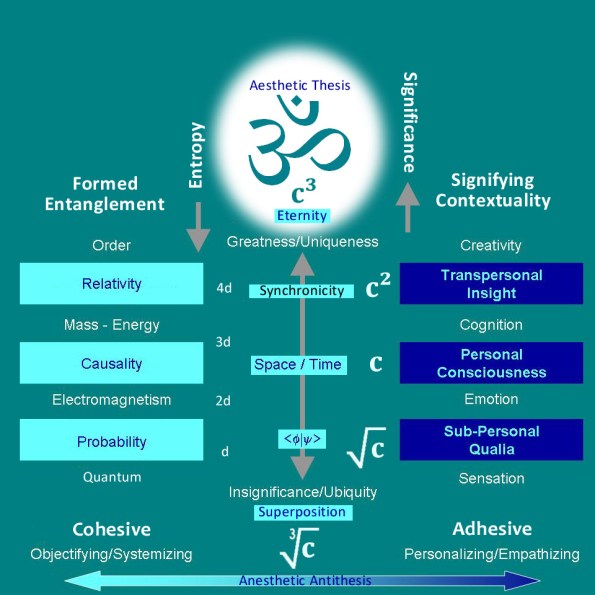
The point of a term like ‘aesthetic’ is to make a distinction between experiential phenomena which are indisputably concrete and anesthetic phenomena such as physical forms and logical functions (physics or information processing), which are, as far as we can ever know, hypothetical and abstract. We cannot know physics except by an indirect experience through our body and we cannot know information except by an indirect experience through our intellectual contemplation. Both of these are dependent upon conscious powers of perceptual participation and comparison.
To answer the OP question then, we must first completely sever any connection between consciousness, reality and the particular context of human beings so that consciousness as sense-perception/motive participation can be fairly considered alongside the other possibilities of physical mass-energy/space-time/force-field and information-theoretic form-functions/data-processes. If we fail to detach consciousness or qualia from the human experience then we are not comparing apples to apples. It would be like mistaking all forms of matter for parts of our physical body.
Next, we should see that there is no reality which cannot be dreamed. Lucid dreamers report that their dreams can be examined in excruciating detail and can contain experiences which are indistinguishable from waking reality. We should also leave the possibility open that even though our final reality could be a dream, it still could be different from any other dream. This difference could be an authentic sense that waking life is not any dream, but the only dream which is shared by all conscious experiences. It is the dream which counts more than all others because of its shared access, and because of the significance which is accumulated in a universe of experience which is felt so intensely for so many, for so long a time. I consider significance to be a concrete metaphysical feature – an aesthetic saturation which underlies both the privately impressive power of symbolic and archetypal phenomena and the publicly expressed power of energy, mass, matter and gravity.
Significance manifests tangibly as an arrest of motive effects, a slowing or marking of time and intensification of attention. The physical universe is a view of significance – the persistence of all experience as viewed from an anthropocentric scope of sensitivity/insensitivity. It is collection of many layers of limits of our human awareness which we see as the gaps between ourselves and our mind, brain, body, and universe of bodies. If our awareness were to expand to a transpersonal scope, we would appreciate directly that consciousness is not only a human phenomenon, but the only possible phenomenon which can make any and all other phenomena possible.
Without physics or information, we can still conceive of a universe of raw feelings, colors, sounds, etc. There could still be a dream in which things like matter or narrative activities could be present. Without consciousness/qualia, we can fool ourselves into thinking that a universe of Reality could ‘exist’ but when examined more carefully, our notion of ‘existence’ unravels into a purely abstract, faith-based concept which seems likely to me to be derived from our subjective sense of separation within consciousness rather than an objective sense of objectivity.
When we ask why something which we imagine has no experience, like a stone, it becomes a problem to rationally expect that any sort of experience should develop at all. A universe which is a physical machine cannot include immaterial feelings and thoughts without support from physics. A universe which is immaterial ‘simulation data’ also cannot include real aesthetic qualities other than the literal qualities which constitute each separate switch or branch in the data-processing substrate (be it material or otherwise). If we include conscious experiences as ‘emergent properties’ of either physics or information, we have become guilty of chasing our tail. Since the purpose of reducing our model of nature to a single phenomenon is to rationally explain every phenomenon with that single phenomenon, resorting to emergence amounts to inventing an unacknowledged second substance which has no rational connection to the first.
The solution to this in my view is to begin with the single phenomenon of sense (pan-aesthesia or pansensitivity) as the Absolute. From there, we get principles such as symmetry and reason with which to identify relations between physics and information as a Hegelian dialectic which reflects, rather than produces the original thesis of sense. Sense is the thesis, physics and information are the dual-aspect or double antithesis (antithesis of each other and of sense), significance is the synthesis, and entropy or insensitivity is the antithesis of the synthesis (the shadow of the thesis within the thesis). Because this quadruplicity is absolute, if we call it panpsychism we must be careful not to confuse it with what I call promiscuous panpsychism in which every thing, such as stones or signs have consciousness. Under pansensitivity, every “thing” is an appearance of consciousness within itself. We are not a body which has become conscious, we are a conscious experience which has foregrounded itself by back-grounding other conscious experiences as bodies.
In my view, a stone is what we see through the sense perspective of a human body in an anthropocentric timescale. In its native geological-astrophysical timescale, the events associated with the formation of minerals and planets are as dynamic and creative as biology or psychology. We see a stone because our sense of the experience which stretches back billions of years is frozen, relative to the scale of our own human experience. To us, it is a stone. Without us, there is no stone, only an aesthetic dream which speeds along at sampling rates too extreme for us to sense personally. The mineral level of experience is both too fast on the molecular level and too slow on the interstellar level for us to relate to directly.
The relation between a medium-rate human experience and an extreme-rate inorganic experience is presented as a truncated and collapsed aesthetic: as classical physics; density, mass, gravity, persistence of linear duration and causality, etc. Our human experience is nested within a deeper biological-zoological body experience, which is nested within a deeper organic-chemical experience, which is nested within a deeper inorganic-astrophysical experience.
Each of these nested ‘gears’ is concurrent with our own, even down to the Big Bang, which is eternally present as both an event in time and as the diffraction of sense into physical and psychological phenomena from beyond time. In this way, the Absolute is itself in ‘superposition’ of being sense experience which is becoming more significant sense experience by its diffraction as the physics vs information duality. This duality can be seen on the quantum scale as entanglement and contextuality. I think that entanglement is the parent of space and physics, since non-locality is a contrast against locality. For space or distance to exist, there must be a parallel, simultaneous relation which juxtaposes a non-local experience of ‘here’ with multiple experiences of ‘there, and there’. For time or causality to exist, there must be a serial contextuality in which a de-contextualized or immutable time-traveller is defined against the context of its ongoing mutable experience.
The physics-information duality shows up in relativity also as energy is defined in terms of spatiotemporalized mass (E = mc²). Energy, as the capacity to perform work is, in my view, the event horizon of conscious participation as it makes its teleological impact on what has been perceived. Energy is the footprint of subjectivity upon the subjective perception of objectivity, as it expresses the motive power to cause significant effects (or effect increasing significance). Gravity is the shadow of E = mc²…the significance-masking effect which we can conceive of as both physical entropy and information entropy. Gravity is the collapse of former significance in a given frame of reference which results in an increase in mass and aesthetic ‘seriousness’ of what remains.
To sum up: Reality is what consciousness finds serious and significant. It is a relation between the local frame of perception (such as a human lifetime) and the larger frames of reference in which that frame is nested (the history of the human species, zoology, biology, chemistry, physics, and metaphysics). In this relation the relative insignificance of the local frame is presented as a heightened quality of significance of the distal frames. We are thus presented with a way to use our limited consciousness to partially transcend its own limitation, by recognizing its own incompleteness as a material fact. This is ironic as it is the unbounded, absolute power of consciousness to transcend itself which gives rise to the nearly-absolute boundedness of realism into ‘Reality’. In other words, reality seems real because consciousness needs to become partially unreal to itself to create realism. Realism is the local appearance of phenomena beyond local appearance: Non-local consciousness (pansensitivity) as localized, decontextualed, de-sensitized, mechanics.
Reality is the way that consciousness creates the possibility of greater and greater enchantment through the appearance of disenchantment.
 Multisense Realism
Recent Comments