Archive
On The Pomposity of Science, Religion, and Philosophy
I have called science a ‘performance enhancing philosophy’, and like philosophy, it is biased against subjectivity from the start in that all formal writing is publicly directed. When we are doing science or philosophy, we are automatically put into the perspective of being a generic ‘one’ who says this or demonstrates that. The vocabulary and cadence implicitly evoke a style which would be equally well suited for a Classical Greek oration as a 17th century treatise. In all cases, the author is conscious of themselves as a person according to society’s most official protocols. They write as a potentially esteemed public person appealing to other esteemed public persons, and invite them to consider propositions and conclusions which can be esteemed publicly.
This may not be doing us any favors when it comes to considering consciousness itself. With our intimate personal contents neatly tucked away behind dramatic flourishes of prose and persuasion, our impressionable minds soon forget that we could be anything else but fine upstanding members of the human zoo. We speak as if we were one-of-many rather than a unique and unrepeatable image of eternity.
The interior view, which was so much more prominent when we were just waking up this morning, and which we can barely remember surrounded us as young children, now becomes completely transparent to the protocols and politics of the public view. To do philosophy or science, we need not even objectify subjectivity any further than it already has been, because we are already standing three yards behind the toy model of ourselves which has been dressed up for the occasion in a robe, toga, or lab-coat. Suddenly the product of insight and reason alone is not enough to survive the marketplace of ideas. It must be groomed and packaged and toilet trained out of its native poetry in order to fit in with the customers expectations. In a way, philosophy seems to compensate for its inability to get out of its own way in considering subjectivity fairly by taking itself too seriously. We wear the disguise of formalism that keeps us pointing to a picture of a mirror rather than taking a look at our own reflection.
While religion differs from both philosophy and science in that it projects a subjective significance onto the public world, both philosophy and science owe their serious demeanor to religion. Ritual and ceremony are public interactions in which the event is made to signify itself – to represent self-consciousness socially as a performance of particulars.
The aesthetics of temples and cathedrals are monumentally pompous, as are those of elite universities, and for good reason:
pomp (n.) c.1300, from Old French pompe “pomp, magnificence” (13c.) and directly from Latin pompa “procession, pomp,” from Greek pompe “solemn procession, display,” literally “a sending,” from pempein “to send.” In Church Latin, used in deprecatory sense for “worldly display, vain show.”
The paradox of religion is that in order to send the message of spiritual other-worldliness into the world, it succeeds in direct proportion to its hypocrisy. The more magnificent its public image, the more popular the religion tends to be, and the more quiet contemplation of private depths becomes a choreographed sporting event tied to military conquest and political control.
Can this state of affairs be improved, even on this internet where time and worldliness are switched on or off at will, or is the public perspective perpetually predisposed to pomposity?
Law of Conservation of Mystery
Law of Conservation of Mystery – Refers to the weird tendency for profound and fundamental issues to resist final resolution. Under eigenmorphism, both the microcosmic and cosmic frames (the infinitesimal and the great) relate to the fusion of chance and choice. It is as if the personal, macrocosmic range of awareness might act as a lens, bending the impersonality of the universe into a personal bubble, and in another sense, the personal bubble may project an illusion of impersonality outwardly. Both of these can be thought of not as illusions or distortions, but of mutual relation between foreground and background which constitutes a tessellated synergy.
Both the sub-personal quirkiness of QM and the super-personal spookiness of divination (such as the I Ching or Tarot cards) exemplify that the perception of spiritual or mechanical absolutes is elusive and bound to the choice between belief and belief in disbelief. In both quantum mechanics and divination, the human participant is responsible for the interpretation – the individual is the prism which splits the beam of their interpretation between chance and choice…or the individual is responsible for remaining skeptical and resisting pseudoscientific claims. If we choose to allow choice on the cosmological level, even there, the continuum between luck which is intentionally or unintentionally fateful and karma which is divinely mechanistic reflects a difference in degree of universal approbation. The Law of Conservation of Mystery is particularly applicable to paranormal phenomena. Everything from UFOs to NDEs have passionately devoted supporters who are either seen as deluded fools stuck in a prescientific past or prophets of enlightenment ahead of their time. What preserves that bifocal antagonism is technically eigenmorphism – it’s how different perceptual inertial frames maintain their character, but this special case of perceptual relativity is on us. It keeps us guessing and pushing further, but it also keeps us blind and stuck in our assumptions.
Superposition of the Absolute – The concept of superposition has enjoyed wide acceptance on the microcosmic level of quantum physics, but the idea of the Totality of the universe having a kind of multistable nature has not yet been widely considered as far as I know. The superposition of a wavefunction is tolerated because it helps us justify what we have measured, but any escalation of this kind of merged possibility to the macrocosm is strictly forbidden. Under PIP, the entire cosmos can be understood to be perpetually in superposition, or perhaps meta-superposition. Any event can be meaningful or meaningless according to one’s interpretation, but some events are more insistent upon meaningful interpretations than others.
Coincidence and pattern invariably count as evidence of the Absolute, whether the Absolute is regarded as mechanical law, divine will, or existential indifference. In this way, the insistence or existence of pattern can be understood as the wavefunction collapse of eternity. This is hard to grasp since eternity is the opposite of instantaneous, so that the ‘collapse’ is occurring in some sense across all time, weaving through it as a mysterious thread that pulls every participant forward into their own knowledge and delusion. On the Absolute scale, every lifetime is a single moment that echoes forever, and the echo of the forever-now into nested subroutines of smaller and smaller ‘nows’.
On the super-personal level (super-private/transpersonal/collective), when coincidence seems to become something more (synchronicity, precognition, or destiny), the collapse can be understood as a collapse on multiple nested frames at once. “Then it all made sense”, Eureka!, I hit bottom. etc. The multiplicity of conflicting possibilities can, for a moment, pop into a single focus that will resonate for a lifetime.
On the quantum level, probability is used in a particular way to explain behaviors of phenomena to which we attribute no intentional choice. Einstein’s famous objection ‘God does not play dice’ perhaps echoes a deep intuition that people have always had about the way that nature reflects a partially hidden order. This expectation is perhaps the common thread of all three epistemological branches – the theological, the philosophical, and the scientific. The value of prediction is particularly powerful for both scientific and theocratic authority as evidence of positive connection with either natural law or divine will. Science demands theories predict successfully, while religion demands prophetic promise. Under the Superposition of the Absolute, the ultimate natural law can be seen to become more flexible and porous, and the localization of divine will can be seen to have limitations and natural constraints. If PIP is to make a prediction itself, it would be to suggest that all wavefunctions share the identical, nested, non-well-founded superposition, one which can be understood as sense or perceptual relativity itself.
P, PP, PIP, MSR Disambiguation
Pansensitivity (P) proposes that sensation is a universal property.
Primordial Pansensitivity (PP) proposes that because sensation is primitive, mechanism is derived from insensitivity. Whether it is mechanism that assumes form without sensibility (materialism) or function without sensation (computationalism), they both can only view feeling as a black box/epiphenomenon/illusion.
Under PP, both materialism and computationalism make sense as partial negative images of P, so that PP is the only continuum or capacity needed to explain feeling and doing (sense-motive), objective forms and functions (mass-energy), and informative positions and dispositions (space-time).
PP says that the appearance of forms and functions are, from an absolute perspective, sensory-motive experiences which have been alienated through time and across space.
Primordial Identity Pansensitivity (PIP) adds to the Ouroboran Monism of PP, (sense twisted within itself = private experience vs public bodies) by suggesting that PP is not only irreducible, but it is irreducibility itself.
PIP suggests that distance is a kind of insensitivity, so that all other primitive possibilities which are grounded in mechanism, such as information or energy, are reductionist in a way which oversignifies the distanced perspective, while anthropomorphic primitives such as love or divinity are holistic in a way which oversignifies the local perspective. Local and distant are assumed to be Cartesian opposites, but PIP maps locality and distance as the same in terms of being two opposite branches of insensitivity. Both the holistic and reductionist views ignore the production of distance which they both rely on for their perspective, both take perspective itself, perception, and relativity for granted.
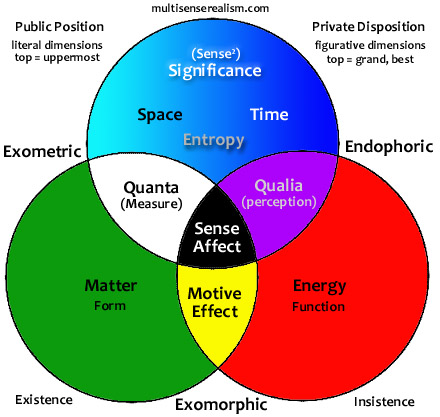
MSR (Multisense Realism) tries to rehabilitate reductionism and holism by understanding them as bifocal strategies which arise naturally, each appropriate for a particular context of perceived distance. Both are near-sighted and far-sighted in opposite ways, as the subject seeks to first project anthropomorphism outward onto the world and then, following a crisis of disillusionment, seeks the opposite – to project exterior mechanism into the self. MSR invites us to step outside of the bifocal antagonism and into a balanced appreciation of the totality.
Wittgenstein in Wonderland, Einstein under Glass
If I understand the idea correctly – that is, if there is enough of the idea which is not private to Ludwig Wittgenstein that it can be understood by anyone in general or myself in particular, then I think that he may have mistaken the concrete nature of experienced privacy for an abstract concept of isolation. From Philosophical Investigations:
The words of this language are to refer to what can be known only to the speaker; to his immediate, private, sensations. So another cannot understand the language. – http://plato.stanford.edu/entries/private-language/
To begin with, craniopagus (brain conjoined) twins, do actually share sensations that we would consider private.
The results of the test did not surprise the family, who had long suspected that even when one girl’s vision was angled away from the television, she was laughing at the images flashing in front of her sister’s eyes. The sensory exchange, they believe, extends to the girls’ taste buds: Krista likes ketchup, and Tatiana does not, something the family discovered when Tatiana tried to scrape the condiment off her own tongue, even when she was not eating it.
There should be no reason that it would not be technologically feasible to eventually export the connectivity which craniopagus twins experience through some kind of neural implant or neuroelectric multiplier. There are already computers that can be controlled directly through the brain.
Brain-computer interfaces that monitor brainwaves through EEG have already made their way to the market. NeuroSky’s headset uses EEG readings as well as electromyography to pick up signals about a person’s level of concentration to control toys and games (see “Next-Generation Toys Read Brain Waves, May Help Kids Focus”). Emotiv Systems sells a headset that reads EEG and facial expression to enhance the experience of gaming (see “Mind-Reading Game Controller”).
All that would be required in principle would be to reverse the technology to make them run in the receiving direction (computer>brain) and then imitate the kinds of neural connections which brain conjoined twins have that allow them to share sensations. The neural connections themselves would not be aware of anything on a human level, so it would not need to be public in the sense that sensations would be available without the benefit of a living human brain, only that the awareness could, to some extent, incite a version of itself in an experientially merged environment.
Because of the success and precision of science has extended our knowledge so far beyond our native instruments, sometimes contradicting them successfully, we tend to believe that the view that diagnostic technology provides is superior to, or serves as a replacement for our own awareness. While it is true that our own experience cannot reveal the same kinds of things that an fMRI or EEG can, I see that as a small detail compared to the wealth of value that our own awareness provides about the brain, the body, and the worlds we live in. Natural awareness is the ultimate diagnostic technology. Even though we can certainly benefit from a view outside of our own, there’s really no good reason to assume that what we feel, think, and experience isn’t a deeper level of insight into the nature of biochemical physics than we could possibly gain otherwise. We are evidence that physics does something besides collide particles in a void. Our experience is richer, smarter, and more empirically factual than what an instrument outside of our body can generate on its own. The problem is that our experience is so rich and so convoluted with private, proprietary knots, that we can’t share very much of it. We, and the universe, are made of private language. It is the public reduction of privacy which is temporary and localized…it’s just localized as a lowest common denominator.
While It is true that at this stage in our technical development, subjective experience can only be reported in a way which is limited by local social skills, there is no need to invoke a permanent ban on the future of communication and trans-private experience. Instead of trying to report on a subjective experience, it could be possible to share that experience through a neurological interface – or at least to exchange some empathic connection that would go farther than public communication.
If I had some psychedelic experience which allowed me to see a new primary color, I can’t communicate that publicly. If I can just put on a device that allows our brains to connect, then someone else might be able to share the memory of what that looked like.
It seems to me that Wittgenstein’s private language argument (sacrosanct as it seems to be among the philosophically inclined) assumes privacy as identical to isolation, rather than the primordial identity pansensitivty which I think it could be. If privacy is accomplished as I suggest, by the spatiotemporal ‘masking’ of eternity, than any experience that can be had is not a nonsense language to be ‘passed over in silence’, but rather a personally articulated fragment of the Totality. Language is only communication – intellectual measurement for sharing public-facing expressions. What we share privately is transmeasurable and inherently permeable to the Totality beneath the threshold of intellect.
Said another way, everything that we can experience is already shared by billions of neurons. Adding someone else’s neurons to that group should indeed be only a matter of building a synchronization technology. If, for instance, brain conjoined twins have some experience that nobody else has (like being the first brain conjoined twins to survive to age 40 or something), then they already share that experience, so it would no longer be a ‘private language’. The true future of AI may not be in simulating awareness as information, but in using information to share awareness. Certainly the success of social networking and MMPGs has shown us that what we really want out of computers is not for them to be us, but for us to be with each other in worlds we create.
I propose that rather than beginning from the position of awareness being a simulation to represent a reality that is senseless and unconscious, we should try assuming that awareness itself is the undoubtable absolute. I would guess that each kind of awareness already understands itself far better than we understand math or physics, it is only the vastness of human experience which prevents that understanding to be shared on all levels of itself, all of the time.
The way to understand consciousness would not be to reduce it to a public language of physics and math, since our understanding of our public experience is itself robotic and approximated by multiple filters of measurement. To get at the nature of qualia and quanta requires stripping down the whole of nature to Absolute fundamentals – beyond language and beyond measurement. We must question sense itself, and we must rehabilitate our worldview so that we ourselves can live inside of it. We should seek the transmeasurable nature of ourselves, not just the cells of our brain or the behavioral games that we have evolved as one particular species in the world. The toy model of consciousness provided by logical positivism and structural realism is, in my opinion, a good start, but in the wrong direction – a necessary detour which is uniquely (privately?) appropriate to a particular phase of modernism. To progress beyond that I think requires making the greatest cosmological 180 since Galileo. Einstein had it right, but he did not generalize relativity far enough. His view was so advanced in the spatialization of time and light that he reduced awareness to a one dimensional vector. What I think he missed, is that if we begin with sensitivity, then light becomes a capacity with which to modulate insensitivity – which is exactly what we see when we share light across more than one slit – a modulation of masked sensitivity shared by matter independently of spacetime.
Jesse Prinz -On the (Dis)unity of Consciousness
Jesse Prinz gives a well developed perspective on neuronal synchronization as the correlate to attention and explores the question of binding. As always, neuroscience offers important details and clues for us to guide our understanding, however, knowledge alone may not be the pure and unbiased resource that we presume it to be. The assumptions that we make about a world in which we have already defined consciousness to be the behavior of neurons are not neutral. They direct and some cases self-validate the approach as much as any cognitive bias could. For those who watch the video, here are my comments:
To begin with, aren’t unity and disunity qualitative discernments within consciousness? To me, the binding problem is most likely generated from the assumption that consciousness arises a posteriori of distinctions like part-whole, when in fact, awareness may be identical to the capacity for any distinction at all, and is therefore outside of any notion of ‘it-ness’, ‘unity’, or multiplicity. To me, it is clear that consciousness is unified, not-unified, both unified and not unified, and neither unified nor not unified. If we call consciousness ‘attention’, what should we call our awareness of the periphery of our awareness – of memories and intuitions?
The assumption that needs to be questioned is that sub-conscious awareness is different from consciousness in some material way. Our awareness of our awareness is of course limited, but that doesn’t mean that low level ‘processing’ is not also private experience in its own right.
Pointing to synchronization of neuronal activity as causing attention just pushes the hard problem down to a microphenomenal level. In order to synchronize with each other, neurons themselves would ostensibly have to be aware and pay attention to each other in some way.
Synchrony may not be the cause, but the symptom. Experience is stepped down from the top and up from the bottom in the same way that I am using codes of letters to make words which together communicate my top-down ideas. Neurons are the brain’s ‘alphabet’, they are not the author of consciousness, they are not sufficient for consciousness, but they are necessary for a human quality of consciousness. (In my opinion).
Later on, when he covers the idea of Primitive Unity, he dismisses holistic awareness on the basis of separate areas of the brain contribute separate information, but that is based on an expectation that the brain is the cause of awareness rather than the event horizon of privacy as it becomes public (and vice versa) on many levels and scales. The whole idea of ‘building whole experiences’ from atomistic parts assumes holism as a possibility, even as it seeks to deny that possibility. How can a whole experience be built without an expectation of wholes?
Attention is not what consciousness is, it is what consciousness does. In order for attention to exist, there must first be the capacity to receive sensation and to appreciate that sensation qualitatively. Only then, when we have something to pay attention to, can be find our capacity to participate actively in what we perceive.
As far as the refrigerator light idea goes, I think that is a good line of thought to explore with consciousness as I think it should lead to a questioning not only of the constancy of the light, but of the darkness as well. We cannot assume that either the naive state of light on or the sophisticated state of light on with door open/off when closed is more real than the other. Instead, each view only reflects the perspective which is getting the attention. When we look at consciousness from the point of view of a brain, we can only find explanations which break consciousness apart into subconscious and impersonal operations. It is a confirmation bias of a different sort which is never considered.
Diogenes Revenge: Cynicism, Semiotics, and the Evaporating Standard
Diogenes was called Kynos — Greek for dog — for his lifestyle and contrariness. It was from this word for dog that we get the word Cynic.
Diogenes is also said to have worked minting coins with his father until he was 60, but was then exiled for debasing the coinage. – source
In comparing the semiotics of CS Pierce and Jean Baudrillard, two related themes emerge concerning the nature of signs. Pierce famously used trichotomy arrangements to describe the relations, while Baudrillard talked about four stages of simulation, each more removed from authenticity. In Pierce’s formulation, Index, Icon, and Symbol work as separate strategies for encoding meaning. An index is a direct consequence or indication of some reality. An icon is a likeness of some reality. A symbol is a code which has its meaning assigned intentionally.
Baudrillard saw sign as a succession of adulterations – first in which an original reality is copied, then when the copy masks the original in some way, third, as a denatured copy in which the debasement has been masked, and fourth as a pure simulacra; a copy with no original, composed only of signs reflecting each other.
Whether we use three categories or four stages, or some other number of partitions along a continuum, an overall pattern can be arranged which suggests a logarithmic evaporation, an evolution from the authentic and local to the generic and universal. Korzybski’s map and territory distinction fits in here too, as human efforts to automate nature result in maps, maps of maps, and maps of all possible mapping.
The history of human timekeeping reveals the earthy roots of time as a social construct based on physical norms. Timekeeping was, from the beginning linked with government and control of resources.
According to Callisthenes, the Persians were using water clocks in 328 BC to ensure a just and exact distribution of water from qanats to their shareholders for agricultural irrigation. The use of water clocks in Iran, especially in Zeebad, dates back to 500BC. Later they were also used to determine the exact holy days of pre-Islamic religions, such as the Nowruz, Chelah, or Yalda- – the shortest, longest, and equal-length days and nights of the years. The water clocks used in Iran were one of the most practical ancient tools for timing the yearly calendar. source
Anything which burns or flows at a steady rate can be used as a clock. Oil lamps, candles, can incense have been used as clocks, as well as the more familiar sand hourglass, shadow clocks, and clepsydrae (water clocks). During the day, a simple stick in the ground can provide an index of the sun’s position. These kinds of clocks, in which the nature of physics is accessed directly would correspond to Baudrillard’s first level of simulation – they are faithful copies of the sun’s movement, or of the depletion of some material condition.
Staying within this same agricultural era of civilization, we can understand the birth of currency in the same way. Trading of everyday commodities could be indexed with concentrated physical commodities like livestock, and also other objects like shells which had intrinsic value for being attractive and uncommon, as well as secondary value for being durable and portable objects to trade. In the same way that coins came to replace shells, mechanical clocks and watches came to replace physical index clocks. The notions of time and money, while different in that time refers to a commodity beyond the scope of human control and money referring specifically to human control, both serve as regulatory standards for civilization, as well as equivalents for each other in many instances (‘man hours’, productivity).
In the next phase of simulation, coins combined the intrinsic and secondary values of things like shells with a mint mark to ensure transactional viability on the token. The icon of money, as Diogenes discovered, can be extended much further than the index, as anything that bears the official seal will be taken as money, regardless of the actual metal content of the coin. The idea of bank notes was as a promise to pay the bearer a sum of coins. In the world of time measurement, the production of clocks, clocktowers, and watches spread the clock face icon around the world, each one synchronized to a local, and eventually a coordinated universal time. Industrial workers were divided into shifts, with each crew punching a timeclock to verify their hours at work and breaks. While the nature of time makes counterfeiting a different kind of prospect, the practice of having others clock out for you or having a cab driver take the long way around to run the meter longer are ways that the iconic nature of the mechanical clock can be exploited. Being one step removed from the physical reality, iconic technologies provide an early opportunity for ‘hacking’.
| physical territory > index | local map > icon | symbol > universal map |
| water clock, sand clock | sundial/clock face | digital timecode |
| trade > shells | coins > check > paper | plastic > digital > virtual |
| production > organization | bonds > stock | futures > derivatives |
| real estate | mortgage, rent | speculation > derivatives |
| genuine aesthetic | imitation synthetic | artificial emulation |
| non-verbal communication | language | data |
The last three decades have been marked by the rise of the digital economy. Paper money and coins have largely been replaced by plastic cards connected to electronic accounts, which have in turn entered the final stage of simulacra – a pure digital encoding. The promissory note iconography and the physical indexicality of wealth have been stripped away, leaving behind a residue of immediate abstraction. The transaction is not a promise, it is instantaneous. It is not wealth, it is only a license to obtain wealth from the coordinated universal system.
Time has entered its symbolic phase as well. The first exposure to computers that consumers had in the 1970s was in the form of digital watches and calculators. Time and money. First LED, and then LCD displays became available, both in expensive and inexpensive versions. For a whole generation of kids, their first electronic devices were digital calculators and watches. There had been digital clocks before, based on turning wheels or flipping tiles, but the difference here was that the electronic numbers did not look like regular numbers. Nobody had ever seen numbers rendered as these kind of generic combinatorial figures before. Every kid quickly learned how to spell out words by turning the numbers upside down (you couldn’t make much.. 710 77345 spells ShELL OIL)…sort of like emoticons.
Beneath the surface however, something had changed. The digital readout was not even real numbers, they were icons of numbers, and icons which exposed the mechanics of their iconography. Each number was only a combinatorial pattern of binary segments – a specific fraction of the full 8.8.8.8.8.8.8.8. pattern. You could even see the faint outlines of the complete pattern of 8’s if you looked closely, both in LED and LCD. The semiotic process had moved one step closer to the technological and away from the consumer. Making sense of these patterns as numbers was now part of your job, and the language of Arabic numerals became data to be processed.
Since that time, the digital revolution has shaped the making and breaking of world markets. Each financial bubble spread out, Diogenes style, through the banking and finance industry behind a tide of abstraction. Ultra-fast trading which leverages meaningless shifts in transaction patterns has become the new standard, replacing traditional market analysis. From leveraged buyouts in the 1980s to junk bonds, tech IPOs, Credit Default Swaps, and the rest, the world economy is no longer an index or icon of wealth, it is a symbol which refers only to itself.
The advent of 3D printing marks the opposite trend. Where conventional computer printing to allow consumers to generate their own 2D icons from machines running on symbols, the new wave of micro-fabrication technology extend that beyond the icon and the index level. Parts, devices, food, even living tissue can be extruded from symbol directly into material reality. Perhaps this is a fifth level of simulation – the copy with no original which replaces the need for the original…a trophy in Diogenes’ honor.
Light, Vision, and Optics

In the above diagram, the nature of light is examined from a semiotic perspective. As with Piercian sign trichotomies, and semiotics in general the theme of interpretation is deconstructed as it pertains to meanings, interpreters, and objects. In this case the object or sign is “Optics”. This would be the classical, macroscopic appearance of light as beams or rays which can be focused and projected, Color wheels and primary colors are among the tools we use to orient our own human experience of vision with the universal nature of material illumination.
On the other side of bottom of the triangle is “Vision”. This is the component which gives vision a visual quality. The arrows leading to and from vision denote the incoming receptivity from optics and the outgoing engagement toward “Light”. When we see, our awareness is informed from the bottom up and the top down. Seeing rides on top of the low level interactions of our cells, while looking is our way of projecting our will as attention to the visual field.
While optics dictate measurable relationships among physical properties of light on the macroscopic scale, ‘light’ is the hypothetical third partner in the sensory triad. Light is both the microphysical functions of quantum electrodynamics and the absolute frame of perceptual relativity from which various perceptual inertial frames emerge. The span between light and optics is marked by the polar graph and label “Image” to describe the role of resemblance and relativity. Image is a fusion of the cosmological truth of all that can be seen and illuminated (light), with the localization to a particular inertial frame (optics-in-space), and recapitulation by a particular interpreter – who is a time-feeler of private experience.
This triangle schema is not limited to light. Any sense can be used with varying degrees of success:

The overall picture can be generalized as well:

Note that the afferent and efferent sided of the triangle have a push-pull orientation, while the quanta side is an expanding graph. This is due to the difference between participation within spacetime, which is proprietary feeling, and the measured positions between participants on multiple scales or frames of participation. Sense is the totality of experience from which subjective extractions are derived. The physical mode describes the relation between each subjective experience and between other frames of subjective experience as representational tokens: bodies or forms. It’s all a kind of trail of breadcrumbs which lead back to the source, which is originality itself.
Why PIP (and MSR) Solves the Hard Problem of Consciousness
The Hard Problem of consciousness asks why there is a gap between our explanation of matter, or biology, or neurology, and our experience in the first place. What is it there which even suggests to us that there should be a gap, and why should there be a such thing as experience to stand apart from the functions of that which we can explain.
Materialism only miniaturizes the gap and relies on a machina ex deus (intentionally reversed deus ex machina) of ‘complexity’ to save the day. An interesting question would be, why does dualism seem to be easier to overlook when we are imagining the body of a neuron, or a collection of molecules? I submit that it is because miniaturization and complexity challenge the limitations of our cognitive ability, we find it easy to conflate that sort of quantitative incomprehensibility with the other incomprehensibility being considered, namely aesthetic* awareness. What consciousness does with phenomena which pertain to a distantly scaled perceptual frame is to under-signify it. It becomes less important, less real, less worthy of attention.
Idealism only fictionalizes the gap. I argue that idealism makes more sense on its face than materialism for addressing the Hard Problem, since material would have no plausible excuse for becoming aware or being entitled to access an unacknowledged a priori possibility of awareness. Idealism however, fails at commanding the respect of a sophisticated perspective since it relies on naive denial of objectivity. Why so many molecules? Why so many terrible and tragic experiences? Why so much enduring of suffering and injustice? The thought of an afterlife is too seductive of a way to wish this all away. The concept of maya, that the world is a veil of illusion is too facile to satisfy our scientific curiosity.
Dualism multiplies the gap. Acknowledging the gap is a good first step, but without a bridge, the gap is diagonalized and stuck in infinite regress. In order for experience to connect in some way with physics, some kind of homunculus is invoked, some third force or function interceding on behalf of the two incommensurable substances. The third force requires a fourth and fifth force on either side, and so forth, as in a Zeno paradox. Each homunculus has its own Explanatory Gap.
Dual Aspect Monism retreats from the gap. The concept of material and experience being two aspects of a continuous whole is the best one so far – getting very close. The only problem is that it does not explain what this monism is, or where the aspects come from. It rightfully honors the importance of opposites and duality, but it does not question what they actually are. Laws? Information?
Panpsychism toys with the gap.Depending on what kind of panpsychism is employed, it can miniaturize, multiply, or retreat from the gap. At least it is committing to closing the gap in a way which does not take human exceptionalism for granted, but it still does not attempt to integrate qualia itself with quanta in a detailed way. Tononi’s IIT might be an exception in that it is detailed, but only from the quantitative end. The hard problem, which involves justifying the reason for integrated information being associated with a private ‘experience’ is still only picked at from a distance.
Primordial Identity Pansensitivity, my candidate for nomination, uses a different approach than the above. PIP solves the hard problem by putting the entire universe inside the gap. Consciousness is the Explanatory Gap. Naturally, it follows serendipitously that consciousness is also itself explanatory. The role of consciousness is to make plain – to bring into aesthetic evidence that which can be made evident. How is that different from what physics does? What does the universe do other than generate aesthetic textures and narrative fragments? It is not awareness which must fit into our physics or our science, our religion or philosophy, it is the totality of eternity which must gain meaning and evidence through sensory presentation.
*Is awareness ‘aesthetic’? That we call a substance which causes the loss of consciousness a general anesthetic might be a serendipitous clue. If so, the term local anesthetic as an agent which deadens sensation is another hint about our intuitive correlation between discrete sensations and overall capacity to be ‘awake’. Between sensations (I would call sub-private) and personal awareness (privacy) would be a spectrum of nested channels of awareness.
 Multisense Realism



Recent Comments