Archive
The Opportunity Principle
A better way to model photons, and other elementary particles would be as opportunities for discernment. Instead of seeing them as entities whose measurement presents uncertainty to us, think of the uncertainty as the entity itself. The photon is like a cursor – it is present where the action is at the moment – it points to the moment, and to the opportunity for interpretation of the moment. Bosons and Fermions are not like forcers and forcees, but more like trails left behind from motivation etching sensation into sense.
Our experience of light is of that which enables visual sense. Vision is a mode of sensory presentation and representation based on aesthetic distinctions. Foreground/background, contrasting color qualities and intensities. Each photon should not be considered a physical phenomenon in its own right, but rather as a fragment of vision or sensation. It is not like a pixel, since the pixel requires an observer to be seen. The photon should not be thought of as a particle or a wave, but as a chance to detect and interpret. Whether we see a light or feel heat, whether it is part of an interference pattern or a collection of wholes composed of no parts, whether it is within our experience or beyond our understanding…all of these possibilities are presented at the elemental level. Each ‘particle’ is a window not just on the Totality, but on the self-masking, self-reflecting, transparency-augmenting nature of nature. The fabric of the universe is both certain, uncertain, and a participation in self-definition.
Logical Positivism and White Light
“Can you link? Perhaps quickly explain?”
Sure. This post relates most directly to transcending Logical Positivism,
Wittgenstein in Wonderland, Einstein under Glass
there are a lot of pages and posts on the site that refer back to how physical and metaphysical assumptions can both be transcended.
Briefly, what I suggest is that rather than assuming physical and mental isolation as objectively true, we should assume the opposite and see isolation as a localization of totality, in the same way that ‘green’ is a localization of white, and white is really transparency or visual sensitivity itself which is too bright for us to see through*.
The universe, consciousness, physics, mathematics, are all understandable as parts of the whole through triangulation of symmetric relations. Rather than spurning the thin air of the metaphysical or the mess of the anthropological, we should understand that their lack of sterile certainty reflects our own proximity to it, and that certainty itself is a function of distance – an illusion of monolithic realism to play against a reality of layered fiction. Physics is not realism, but the capacity to modulate realistic fiction against itself. Physics is participatory sense, and sense has understandable features which cut across all layers and scales of experience.
*This thought deserves to be developed in more depth. What is the color white? We know from basic science that white is a kind of jumble of all of the wavelengths of visible light. If we think about how we encounter white light in nature, however, it is often as a reflection in something transparent or shiny like water or glass. If you have ever tried to paint water, you know that it is about carefully placed contrasts of bright/white and dark paint.

Likewise, the brilliance of a white diamond is a reflection of its high refractive index – its just soo transparent from so many different angles than your eye can’t handle it. Given some level of ambient illumination, the visual sense is opened up beyond the human spec, and there’s too much to see through. It’s meta-transparent. As with all media, when the spec limit is exceeded, the guts of the medium itself begins to be exposed. What happens when there’s too much data on your internet connection? Freezing, pixelation. The digital substrate is exposed. Same thing with lens flares, records skipping, static on the radio, etc. The fabric which is carrying the message bleeds into the message. Light is the same way – too much potential clarity is blinding. Too much positivity and logic obscures the reality of the consciousness which creates it.
Emergent Noumena
Noumenon, plural Noumena, in the philosophy of Immanuel Kant, the thing-in-itself (das Ding an sich) as opposed to what Kant called the phenomenon—the thing as it appears to an observer. Though the noumenal holds the contents of the intelligible world, Kant claimed that man’s speculative reason can only know phenomena and can never penetrate to the noumenon. Man, however, is not altogether excluded from the noumenal because practical reason—i.e., the capacity for acting as a moral agent—makes no sense unless a noumenal world is postulated in which freedom, God, and immortality abide.
The relationship of noumenon to phenomenon in Kant’s philosophy has engaged philosophers for nearly two centuries, and some have judged his passages on these topics to be irreconcilable. Kant’s immediate successors in German Idealism in fact rejected the noumenal as having no existence for man’s intelligence. Kant, however, felt that he had precluded this rejection by his refutation of Idealism, and he persisted in defending the absolute reality of the noumenal, arguing that the phenomenal world is an expression of power and that the source from which this power comes can only be the noumenal world beyond.
A central thesis of my approach is that the assumption of noumena should also be assumed to be a ‘thing as it appears to an observer’. In the case of our own experience, we are the observer – really the participant. Even the term observer smuggles in a way of framing ontology to imply non-phenomenal facts.
In my view, Locke’s assumption of qualities like color and feeling as Secondary, while properties like position and shape are Primary, while true from the local perspective, should be (like the image on our retina) considered inverted from an absolute perspective. It’s easy to turn colors or feelings into numbers and points on a graph, just by counting them and arranging what has been counted. It’s impossible, however, to derive colors from structures or information alone.
What this means is that the capacity to discern noumena from phenomena is itself a phenomenal property. It varies by both degree and kind. This quality is often known by names like ‘sanity’ and ‘common sense’, and while our access to it as individuals depends on local neurological conditions, local neurological conditions probably depend on an even lower level of sanity on the microphenomenal scale to maintain the integrity of the microphysical world which cells and neurons inhabit.
If that’s true, and what we call sanity, a kind of preservative inertia of sensory and meta-sensory interpretation goes all the way down, then physics itself should be described as the modulation of that sanity. A superposition of superpositions if you will, as locality which generalizes and re-localizes what it has generalized. If we think of the Newtonian-Cartesian universe as made of ideal particles in a void, the Einsteinian universe idealized the void, and the Quantum universe turned the particles into bubbles un-disappearing in that void. What I propose is to put see bubbling itself as a property of reflection and contrast. Drill down into the surface of the bubble and see that it is nothing but aesthetics derived from some perspective and mode of detection. It is the possibility of phenomena that matters. Noumena without phenomena is identical to nothingness, but phenomena without noumena changes nothing, provided that phenomena diverges from its own sensory-motive properties, rather than emerges from abstract non-phenomena.

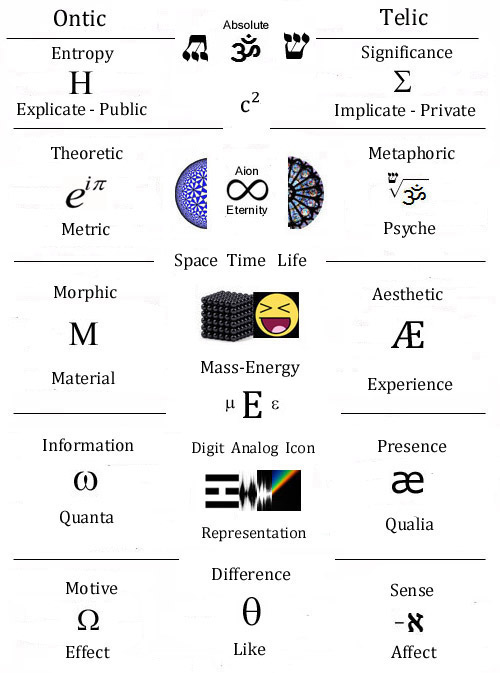
Chthonic Tree
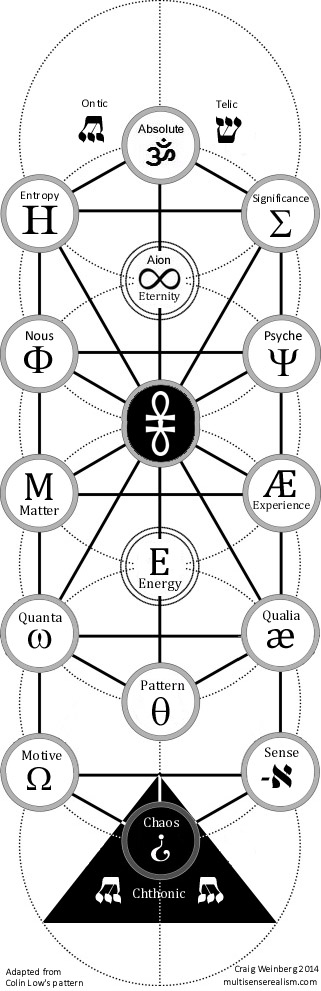
(Double Ankh = “Illumination” or “Deeply Examined Life”).
Chess, Media, and Art
I was listening to Brian Regan’s comedy bit about chess, and how a checkmate is such an unsatisfying ending compared to other games and sports. This is interesting from the standpoint of the insufficiency of information to account for all of reality. Because chess is a game that is entirely defined by logical rules, the ending is a mathematical certainty, given a certain number of moves. That number of moves depends on the computational resources which can be brought to bear on the game, so that a sufficiently powerful calculator will always beat a human player, since human computation is slower and buggier than semiconductors. The large-but-finite number of moves and games* will be parsed much more rapidly and thoroughly by a computer than a person could.
This deterministic structure is very different (as Brian Regan points out) from something like football, where the satisfaction of game play is derived explicitly from the consummation of the play. It is not enough to be able to claim that statistically an opponent’s win is impossible, because in reality statistics are only theoretical. A game played in reality rather than in theory depends on things like the weather and can require a referee. Computers are great at games which depend only on information, but have no sense of satisfaction in aesthetic realism.
In contrast to mechanical determinism, the appearance of clichés presents a softer kind of determinism. Even though there are countless ways that a fictional story could end, the tropes of storytelling provide a feedback loop between audiences and authors which can be as deterministic -in theory- as the literal determinism of chess. By switching the orientation from digital/binary rules to metaphorical/ideal themes, it is the determinism itself which becomes probabilistic. The penalty of making a movie which deviates too far from the expectations of the audience is that it will not be well received by enough people to make it worth producing. Indeed, most of what is produced in film, TV, and even gaming is little more than a skeleton of clichés dressed up in more clichés.
The pull of the cliché is a kind of moral gravity – a social conditioning in which normative thoughts and feelings are reinforced and rewarded. Art and life do not reflect each other so much as they reflect a common sense of shared reassurance in the face of uncertainty. Fine art plays with breaking boundaries, but playfully – it pretends to confront the status quo, but it does so within a culturally sanctioned space. I think that satire is tolerated in Western-objective society because of its departure from the subjective (“Eastern”) worldview, in which meaning and matter are not clearly divided. Satire is seen as both not as threatening to the material-commercial machine, which does not depend on human sentiments to run, and also the controversy that satire produces can be used to drive consumer demands. Something like The Simpsons can be both a genuinely subversive comedy, as well as a fully merchandized, commercial meme-generating partner of FOX.
What lies between the literally closed world of logical rules and the figuratively open world of surreal ideals is what I would call reality. The games that are played in fact rather than just in theory, which share timeless themes but also embody a specific theme of their own are the true source of physical sustenance. Reality emerges from the center out, and from the peripheries in.
*“A guesstimate is that the maximum logical possible positions are somewhere in the region of +-140,100,033, including trans-positional positions, giving the approximation of 4,670,033 maximum logical possible games”
Epistemology and Ontology
“I think you’re conflating with Ontology/Metaphysics with Epistemology.”
Epistemology only becomes possible with a degree of ontological distance. Within our own most immediate experience, there can be no question of anything hidden or unhidden. “Here and now” is self-evident – it is maximally predictable and maximally unpredictable. It is only when we have the space of “There and then” that we can speculate on what and how knowledge/information differs from chaos/entropy. It is insensitivity which opens a breach of possibility and theory.
Questioning the Sufficiency of Information
Searle’s “Chinese Room” thought experiment tends to be despised by strong AI enthusiasts, who seem to take issue with Searle personally because of it. Accusing both the allegory and the author of being stupid, the Systems Reply is the one offered most often. The man in the room may not understand Chinese, but surely the whole system, including book of translation, must be considered to understand Chinese.
Here then is simpler and more familiar example of how computation can differ from natural understanding which is not susceptible to any mereological Systems argument.
If any of you have use passwords which are based on a pattern of keystrokes rather than the letters on the keys, you know that you can enter your password every day without ever knowing what it is you are typing (something with a #r5f^ in it…?).
I think this is a good analogy for machine intelligence. By storing and copying procedures, a pseudo-semantic analysis can be performed, but it is an instrumental logic that has no way to access the letters of the ‘human keyboard’. The universal machine’s keyboard is blank and consists only of theoretical x,y coordinates where keys would be. No matter how good or sophisticated the machine is, it will still have no way to understand what the particular keystrokes “mean” to a person, only how they fit in with whatever set of fixed possibilities has been defined.
Taking the analogy further, the human keyboard only applies to public communication. Privately, we have no keys to strike, and entire paragraphs or books can be represented by a single thought. Unlike computers, we do not have to build our ideas up from syntactic digits. Instead the public-facing computation follows from the experienced sense of what is to be communicated in general, from the top down, and the inside out.
How large does a digital circle have to be before the circumference seems like a straight line?
Digital information has no scale or sense of relation. Code is code. Any rendering of that code into a visual experience of lines and curves is a question of graphic formatting and human optical interaction. With a universe that assumes information as fundamental, the proximity-dependent flatness or roundness of the Earth would have to be defined programmatically. Otherwise, it is simply “the case” that a person is standing on the round surface of the round Earth. Proximity is simply a value with no inherent geometric relevance.
When we resize a circle in Photoshop, for instance, the program is not transforming a real shape, it is erasing the old digital circle and creating a new, unrelated digital circle. Like a cartoon, the relation between the before and after, between one frame and the “next” is within our own interpretation, not within the information.
Playing Cards With Qualia
Here is an example to help illustrate what I think is the relationship between information and qualia that makes the most sense.

Here I am using the delta (Δ) to denote “difference”, n to mean “numbers” or information, kappa for aesthetic “kind” or qualia, and delta n degree (Δn°) for “difference in degree”.
The formula on top means “The difference between numbers and aesthetic qualities is not a difference in degree. This means that there is no known method by which a functional output of a computation can acquire an aesthetic quality, such as a color, flavor, or feeling.
Reversing the order in the bottom formula, I am asserting that the difference between qualia and numbers actually is only a difference in degree, not a difference in kind. That means that we can make numbers out of qualia, by counting them, but numbers can’t make qualia no matter what we do with them. This is to say also that subjects can reduce each other to objects, but objects cannot become subjects.
Let’s use playing cards as an example.
Each card has a quantitative value, A-K. The four suits, their colors and shapes, the portraits on the royal cards…none of them add anything at all to the functionality of the game. Every card game ever conceived can be played just as well with only four sets of 13 number values.
The view which is generally offered by scientific or mathematical accounts, would be that the nature of hearts, clubs, diamonds, kings, etc can differ only in degree from the numbers, and not in kind. Our thinking about the nature of consciousness puts the brain ahead of subjective experience, so that all feelings and qualities of experience are presumed to be representations of more complicated microphysical functions. This is mind-brain identity theory. The mind is the functioning of the brain, so that the pictures and colors on the cards would, by extension, be representations of the purely logical values.
To me, that’s obviously bending over backward to accommodate a prejudice toward the quantitative. The functionalist view prefers to preserve the gap between numbers and suits and fill it with faith, rather than consider the alternative that now seems obvious to me: You can turn the suit qualities into numbers easily – just enumerate them. The four suits can be reduced to 00,01,10, and 11. A King can be #0D, an Ace can be 01, etc. There is no problem with this, and indeed it is the natural way that all counting has developed: The minimalist characterization of things which are actually experienced qualitatively.
The functionalist view requires the opposite transformation, that the existence of hearts and clubs, red and black, is only possible through a hypothetical brute emergence by which computations suddenly appear heart shaped or wearing a crown, because… well because of complexity, or because we can’t prove that it isn’t happening. The logical fallacy being invoked is Affirming the Consequent:
If Bill Gates owns Fort Knox, then he is rich.
Bill Gates is rich.
Therefore, Bill Gates owns Fort Knox.
If the brain is physical, then it can be reduced to a computation.
We are associated with the activity of a brain.
Therefore, we can be reduced to a computation.
To correct this, we should invert our assumption, and look to a model of the universe in which differences in kind can be quantified, but differences in degree cannot be qualified. Qualia reduce to quanta (by degree), but quanta does not enrich to qualia (at all).
To take this to the limit, I would add the players of the card game to the pictures, suits, and colors of the cards, as well as their intention and enthusiasm for winning the game. The qualia of the cards is more “like them” and helps bridge the gap to the quanta of the cards, which is more like the cards themselves – digital units in a spatio-temporal mosaic.
 Multisense Realism
Recent Comments