ChatGPT did a pretty good job of this, especially since it is pulling its language from our legacy worldview rather than my Multisense Realism language and concepts. The examples are decent but the image that I asked it to create to represent its examples (bottom) is trash.
Here’s a mathematical formalism based on the Non-Well-Founded Identity Principle you’ve described. It incorporates the integral symbol to represent nested spectrums of identity, similarity, and dissimilarity:
Formal Definition:
Let AAA be a phenomenon, where AAA is defined by a spectrum of identity ranging from self-equivalence to association/similarity/dissimilarity.
We express this principle as follows:A=∫A∫A¬AIdentityA d(Spectrum)A = \int_{A}^{\int_{A}^{\neg A}} \text{Identity}_{A} \, d(\text{Spectrum})A=∫A∫A¬AIdentityAd(Spectrum)
Explanation:
Outer Integral: The phenomenon AAA is an integration over all expressions or presentations of identity.
It starts with AAA, representing the immediate or conserved identity (self-equivalence: A=AA = AA=A).
It moves through a nested spectrum that incorporates progressively greater transformations or resemblances to non-AAA (denoted by ¬A\neg A¬A).
Nested Integral: Within the outer integral, AAA itself is defined recursively by another integral that spans from itself to its differences.
The nested integration signifies that the notion of identity is inherently self-referential and recursive.
This recursion allows for nested and non-well-founded relationships, which include both local (immediate) and global (diffraction-based) experiences of identity.
Extended Formalism:
We can generalize this formalism to all sense experiences, which are modeled as a nested system of particulars and universals:S=∫SP∫SP¬SPSenseSP d(Perception)S = \int_{S_P}^{\int_{S_P}^{\neg S_P}} \text{Sense}_{S_P} \, d(\text{Perception})S=∫SP∫SP¬SPSenseSPd(Perception)
Here:
SSS is the totality of sense experience.
SPS_PSP represents particular sense experiences.
The nested structure highlights that any particular experience is both uniquely itself and integrally linked to all other experiences by a spectrum of relational similarities and differences.
Philosophical Representation:
The principle can also express identity and other relational concepts in philosophy and logic. For instance:
This integral spans between naive realism and the limits imposed by reductionist perspectives, suggesting that naive realism both includes and transcends reductionism in a nested, self-referential fashion.
This expresses the interplay between intuitive perception and analytical structures.
Interpretation: This framework is a way of modeling identity, sense, and experience as dynamic spectrums that are recursively structured. It integrates the notion that all things simultaneously are themselves and become relational constructs through nested comparisons with their differences. This formalism aligns with non-well-founded set theory and the principles of self-similar systems found in phenomenology, ontology, and epistemology.
You said: Please write about three empirical examples where this is true and create an image that depicts each example
Chat GPT said:
Here are three empirical examples that demonstrate the Non-Well-Founded Identity Principle:
Optical Prism and Light: A prism diffracts a beam of white light into a full spectrum of colors. This shows how light maintains a unified identity (white light) while also containing a nested spectrum of distinct wavelengths.
Human Face and Recognition: A grid of progressively abstracted facial representations illustrates how identity is recognized through a spectrum of similarity and difference, ranging from nearly identical to highly distorted images.
Fractal Tree and Branches: A tree with self-similar, fractal-like branches depicts recursive identity. Each branch reflects both the whole tree and its variations, emphasizing nested patterns of identity and difference.
The image above visualizes each of these examples.
Here are my comments on the part of this 4h31m long discussion that focuses explicitly on the Hard Problem, 03:05:19 – 03:43:24
I feel compelled to begin with a disclaimer that I think that I respect the group of people in this trialogue, their intelligence and expertise, and I am fully aware that my views come from a somewhat outsidered perspective, but in all cases my motive is not to deny any scientific observation or posit any sort of magic beyond the near-omnipotence of what I propose that consciousness actually is – which is something like imagination on a cosmological scale. I fully respect the academic credentials of the participants as well, and while I never pursued that path farther than a BA degree in Anthropology, I prefer to use first names rather than Dr. titles – no offense or undue familiarity intended, just seems less pretentious. Speaking of pretentious, I hereby end this disclaimer and proceed to the proceedings.
The Hard Problem segment opens with Joscha bringing up Daniel Dennett, and how his dismissal of qualia seems to be based on a criticism of how the term is used in philosophy. In the course of that, JB says of Dennett’s position…
3:06:46 “Oh well he’s a functionalist. Pretty much standard.
He says…uh good writing…there’s nothing wrong with what he writes. My position might be different from yours because I don’t see magical powers that are afforded by biology, it’s still just function. It is provided by biology and I can break down these functions ultimately into state transitions in substrates that form control structure and so on, so it’s it’s not opening avenues into something new. There’s basically no magical homunculus that is produced in consciousness via biology. Biology is just a way to get self-organizing matter.”
Here I agree with Joscha completely. I disagree with Dennett’s views almost entirely, but have great respect for how he does what he does. As far as biology goes, I see no grounds for emergent properties, especially any that smell of consciousness. When JB says that he can break down biological functions into mechanical events, I tend to believe him, or at least understand why that is entirely possible in theory. While we perceive breakpoints in the properties of physical, chemical, and biological phenomena, they are as far as I can reason, aesthetic separations. Functionally, they all refer to the same thing: concrete tangible objects on different scales of size moving each other around and changing shapes.
The geometry of those shapes and their movements become more complicated as we scale up in size from particles to molecules to cells to bodies, but complication in and of itself adds nothing to the conversation about consciousness. Indeed, without some awareness and experience, molecules or cells have no way of suspecting that they are part of any group or process and no capacity to qualify it as simple or complex. Without a theory of sense, we are really at a loss to say what the difference would be between matter and nothingness, but that’s another topic. Without going that far, I would still say that even the idea of ‘control systems’ can only arise within a conscious experience where a thoughtful analysis of perceived objects in a universe where some objects are associated with conscious, teleological motives.
In the most stringent reading of the view that I propose, matter of any scale would not literally be controlling anything, so that any appearance of control is smuggled in by our conscious, anthropic experience. Without that anthropomorphic projection, what we see as bacteria or molecules controlling each other would reduce losslessly to non-purposeful habits of mindless physical force geometry. Saying that these movements of objects are control systems doesn’t actually add anything to what is occurring physically, but that isn’t key to understanding the Hard Problem. We can call what physical structures end up doing mechanically ‘control systems’ without taking that literally. Literally there’s just physical forces moving each other around automatically for no reason other than the given geometry of what they are. If what we mean by “self-organizing” implies something more than inevitable looping geometries of those automatic movements, then that too would fall into an Explanatory Gap.
I agree with what Joscha says next about the problem that I and many others have with Daniel Dennett’s disqualifications of qualia:
3:07:56 JB: “…what I found is that Dennett fails to convince a lot of his own students in some sense and I try to figure out why that is and the best explanation that I’ve come up with so far is that Dennett actually never explains phenomenal experience. And when discusses qualia he mostly points at definitional defects in the way in which most philosophers treat qualia and then says it’s probably something that doesn’t really exist in the way in which these people Define it so we also don’t need to explain it and a lot of people find this unsatisfying. Because they say that regardless of how you define it it’s clearly something that they experience like qualia being the atoms of phenomenal experience or aspects of phenomenal experience or features of phenomenal experience it doesn’t really matter how you define it it’s there right and please explain it to me because I don’t see how an unthinking and feeling Mechanical Universe is going to produce these wealth of experience that I’m confronted with and so this physics does not seem to be able to explain why something is happening to me why is me here why is their experience and this is something that some people feel is poorly addressed by Dennett.”
Joscha goes on to summarize the significance of Philosophical Zombie thought experiments in formulating the Hard Problem.
3:09:45 JB …”so let’s see, we have a philosophical zombie in front of us and we are asking this philosophic zombie who in every regard acts like a human being because his brain implements all the necessary functionality just mechanically and not magically, ‘are you conscious?’ what is the zombie going to respond?
Anastasia Bendebury “What do you what do you mean about the fact that the brain reproduces all of the effects?”
JB: “The idea of the philosophical zombie is that the philosophical zombie is producing everything without giving rise to phenomenal experience – just mechanical. Based on the intuition that…”
AB: “What does that mean? I don’t understand what that means.”
JB: “I think the intuition is that when we experience is something that cannot be explained through causal structure. So mechanisms.”
AB: “But why do we think that? I don’t understand why we possibly think that.
That’s what I mean about not understanding the hard problem of Consciousness. Because I’m like look… This is why my definition of life as beginning before the cell is instrumental to eliminating the hard problem of Consciousness. Because if you have in the most basic cell – which is an embodiment of the state of matter that is life – you have a resonant state which is electromagnetic. It’s the redox state.
And the cell needs to maintain that electrical resonance at a specific set point because if it does not, it dies. And so it is going out into the world and it is constantly controlling where it is in the world relative to its internal state. And as you progressively produce more and more complex beings you get a more and more complex map of the world and a more and more complex internal state. And so by the time that you have a walking human, you cannot have a walking human without an internal state. It’s a philosophical thought experiment that requires you to divorce yourself from everything that you know about biology in order to make the claim. And I just feel like you can’t do that!
Because the biology is inherently what produces the conscious…it’s the state of matter that produces the consciousness and all of the resonant waves that are inside of it. And so if you have the resonant waves in the sufficient complexity of a sufficiently resonant system that is interpreting the world relative to itself and to what it wants how can you have anything except for consciousness? You have experience, you have the mapping of expectation to frustration and you’re just…it just emerges from the most basic cell.
I think that the reason why Anastasia isn’t seeing the Hard Problem is because her model of biology already includes aesthetic-participatory phenomena (experience, awareness, sensory-motivation), rather than cells being anesthetic-automatic mechanical events that occur independently of any experience of them.
The expectation that a physical state like reduction–oxidation (redox) constitutes or leads to a cell’s need to participate intentionally in seeking to correct what it somehow senses (unexplained by biology) as disequilibrium is already smuggling in teleology into biochemistry > physics > mechanism.
Because we have genetic mutation and retrospective statistical natural/passive “selection” to account for the evolving mechanical behaviors of cells, no sense or teleology is needed in the explanation. We can omit it entirely and nothing changes in our description of what is causing the movements of cells in the direction of the chemical reactions that are necessarily pulling them there.
In a purely physical universe, chemistry would act not out of any perceived sense of need. There would be no agentic power to seek out satiation of that need, but rather the mechanical behaviors that end up maintaining redox states (unperceived) would be nothing but those behaviors that happen to have survived in the genetics of the cell. If the cell ends up moving in ways that maintain redox and happens to be in an environment that allows that to happen, then the cell has a better statistical chance of reproducing. That’s it. No need, no going out into a world, no controlling, no sense of self – just molecular geometry cashing itself out statistically over time.
JB: “How do resonant waves produce consciousness?”
AB: “say it again”
JB: “How do resonant waves produce consciousness?”
AB: “okay so do you know the Qualia Research Institute yes? So what is their work? Their work is that they’re basically showing that there are harmonic states in the brain that are associated with experience”
It’s important to realize, in my opinion, that the association is always coming from experience, not from anything the brain is doing. The association is retrospective from the reality of consciousness rather than prospective from the reality of unexperienced brain matter.
Michael Shilo DeLay: “The question seems akin to asking how do fundamental waves produce music? Which emerges from all of these individual tones. But the same thing with conscious experiences you have the summing of different modules within the neuron-based systems that are all aggregating and fighting and resonating with one another and you get music that comes out of it.”
JB: “And you don’t see an explanatory problem there? No?
AB: “No. I’m like how I mean I can see a mathematical problem. I can see that it would be very very difficult to mathematize the way that that resonance…”
Here I see that what is being overlooked is the gap between phenomena in one sense modality (waving intensities of chemical or electrochemical movements in a brain) and any other aesthetic quality (sights, sounds, feelings, etc). When we understand music as emerging from a sequence of aural tones, that’s all within the context of a conscious experience. Sound in the aural sense is qualia. Sound waves are actually silent acoustic perturbations of matter as it collides with matter. Between the concept we have of sound waves, which refer to dynamic geometry of tangible objects so firmly embedded in our learning, we overlook the need to explain how and why these movements of matter are perceived at all, and how they come to be perceived as sounds rather than as the silent, physical vibrations of substances that they ‘actually’ are.
In comparing music emerging from acoustic waves to consciousness emerging from brain wave resonance, we are already falling for the same circular reasoning fallacy that leads people to deny the Hard Problem. Since there is the same Hard Problem there in transducing tangible changes in objects to aural experiences of sound, notes, and music, it actually only reinforces the Hard Problem in the brain > consciousness context. Sense is the key. That’s why I write so much about it and call my view Multisense Realism.
For the next few minutes the hosts and guest discuss the limits of the explanatory power of math, language, and scientific theory, and the difference between explanation and description. This isn’t directly related to the Hard Problem in my opinion, but it does speak to the same theme of neglecting different modalities of sense and sense making and glossing over the fact that in all cases, the gaps between such modalities can only be filled, as far as we can conceive, by some conscious experience in which multiple modes of qualia can be accessed and manipulated intentionally in another mode of sense making (imagination, abstraction, understanding). Because Anastasia’s view of the Hard Problem is that it must come from a misunderstanding of biology (which she already gives experience and teleology to), she sees the Problem as one of finding fault with description for not being explanatory.
I agree with Joscha in his response:
3:18:07 So when you talk about harmonic waves producing a phenomenon for me that’s very far from a causal explanation that so it’s something that is very unsatisfying to me because I cannot build this but well for me a causal explanation is something I can make.
This is at the heart of the Explanatory Gap, which I like to meme-ify with this cannibalized version of a cartoon (not sure which artist I stole the original from, but my apologies):
Following this, Joscha gets into a detailed technical explanation of what waves are and why they don’t explain or justify producing phenomenal qualities.
3:20:02 JB: “…you can build control systems and once you have control systems you can also build control systems that don’t just regulate the present but also regulate the future, but in order to regulate the future they need to represent stuff that isn’t there right – that will be there at some level of coarse graining but it’s currently not present so you need to have a system that is causally insulating part of your mechanical structure from the present…control systems that don’t just regulate the present but also regulate the future. But in order to regulate the future they need to represent stuff that isn’t there right that will be there at some level of coarse graining but it’s currently not present so you need to have a system that is causally insulating part of your mechanical structure from the present…”
I propose that groupings of moving objects don’t actually need to represent anything to appear to ‘control’ future states, and that no such need to represent could be fulfilled physically. All that would be needed are mechanical switches and timers that happened to have evolved to fit with environmental states that happen to repeat. If the brain needed to control the position of the legs in the future to walk successfully, it need only set aside some neurons for that purpose. They don’t need to represent anything or imagine the future, they just need to grow a miniature duplicate of the brain chemistry involved in walking but without being connected directly to efferent nerves to the legs. There doesn’t need to be a representational relationship hiding inside of chemistry, the chemistry just had to have accidentally evolved to accumulate a lot of repeating triggers of triggers.
In other words, there’s no reason to represent anything in the future when you can just use space instead of time. You don’t need to know that the wood you’re piling up is for burning in cold Winter if you have a statistical mechanism of mutation that happens to select for piling up wood and burn it if temperature conditions activate a thermal switch. Instead of executive consciousness, it would just happen that a brain that grows miniature low resolution copies of itself would end up pantomiming meta-cerebral functions. No feedback or representation at all, just parallel reproduction of self-similar neurochemical systems. No code or instructions are needed, just clockwork chain reactions.
I’m not suggesting that I think that’s what happened in reality. I think that the reality is that all phenomena are part of the way that conscious experiences are nested and relate to each other. If that were not the case, I doubt that biology as we know it would have evolved at all. I agree with Anastasia’s view that experience begins prior to the cell, and with Joscha’s view that there is nothing special about biology that would explain consciousness.
Where I do disagree with Joscha’s estimation of consciousness is in the attribution of ideas and motivations to robots:
3:28:55 AB: “it’s not obvious that the bacteria needs to be more conscious than a soccer playing robot which is not conscious. Right? Bacteria needs to be more conscious than a soccer playing robot which is not conscious right if you build a robot that plays soccer it’s the robot is fulfilling a bunch of function it’s going to model its environment it’s going to figure out where the ball is where the other robots are where the goal is how to get the ball between yourself and the goal how to push the ball into the goal and so on so in some Financial sense it’s going to have beliefs about the environment it’s going to have commitments about the course of actions it’s going to have full directive Behavior it’s going to have representations about the world with itself inside but I don’t think it experiences anything.“
I don’t see any reason to assume that a robot’s behavior requires the generation of any actual models, beliefs, or representations. The robot is just lots of switches switching switches that control the movements of the physically assembled parts that make it up. I like to use the example of a fishing net and how it is very effective at catching fish, but it doesn’t have to know anything about what it is doing. The size of the fish and the shape of the net are all that are needed. In the same way, the structure of the robot is all that is needed to explain why the robot parts move in the way that they must move – by physical law, not by models or beliefs.
In the video AB and MSD go on to talk about justifying the emergence of consciousness in bacteria but not in a robot because of either complexity or flexibility. Neither of these seem to me to warrant the creation of a new type of representational or qualitative metaphysics. Moving objects are just moving objects, no matter how many there are or how fancy their movements become.
3:34:18 AB: “…any exercise that attempts to explain consciousness without the physical substrate without recognizing that the physical substrate is mandatory for the effect that we’re seeing and is the iterative product of progressive complexity that has been evolving on Earth for the last four billion years will fail to produce Consciousness because it is inherent in the structural organization of these different modules that resonate with one another to create complexity
Here is a case where I agree with what Anastasia is saying in one sense but disagreeing completely in another. I agree that the human conscious experience probably has to result from billions of years of specific evolutionary history, however, I disagree that it is related to physical structures. I propose that the physical structures and mechanisms are effects, rather than causes, of how our conscious experience has developed. Because I think that the physical universe we see is an appearance in our evolved consciousness (see Donald Hoffman’s Interface theory), it is the trans-physical accumulation of conscious experiences themselves that the human qualities of our experience depend upon.
For this reason I do not think that human consciousness can be replicated or simulated mechanically. It’s not because biology alone is capable of providing complexity, flexibility, or harmonics, it’s because biology is the particular vocabulary that consciousness has developed for higher/richer forms of experience to use lower forms of conscious experience as a vehicle. I think that biology doesn’t generate consciousness, rather biology is a symptom of the interface between two different epochs and timescales of evolving conscious experience.
3:35:02 AB: “…the phenomenon of experience is all these different resonant modes you can think about what it feels like to listen to a sine wave versus what it feels like to listen to a symphony they’re the same thing except the sine wave has been modulated into something far more complex and that complex wave has something else in it.
I agree that a symphony is the same thing as complex modulations of sound, but again, a sine wave doesn’t sound like anything unless you can hear. The chain of physical causality ends in the silent brain. There is nothing about an auditory cortex that will be able to conjure sounds out of the oscillating changes in its chemistry. There is no evolutionary advantage to an organism that has to hear sounds rather than one that just transduces acoustic vibrations mechanically into oscillating electrochemical states. We know, for example, from Blindsight patients that the brain is perfectly capable of responding correctly to questions about optical conditions without any experience of visibility.
I agree with Joscha that there’s nothing special about biology as far as being an extra property above chemistry or physics. Again, it’s all just tangible objects moving each other around in public space.
3:38:37 – AB: “What the QRI work is interesting where it’s interesting because there appear to be different states inside the brain that correspond to emotional states and so if you are unhappy or you’re feeling depressed there’s a different brainwave state that is associated with that experience.
I think it’s important to understand that ‘correspond to’ can only happen in a conscious experience. Correspond isn’t a physical activity or structure. Physical states of a brain have no physical way to correspond to anything, so they are just what they appear to be – geometric changes in tangible shapes. Consciousness uses brains, but brains have no way to use consciousness. They have to use physical force – which also has no way to use consciousness. When we use a non-physical model of nature instead, there is no problem with some aspects of consciousness perceiving other aspects of itself as physics. We see it all the time in dreams.
3:40:33 JB: “What is actually sadness? Right? Sadness is an affect it is directed on some source of satisfying a need being permanently removed from your world can never get it back and it’s completely crucial to you. You identified the satisfying yourself through the source of satisfaction and it’s got it will never come back right this is sadness in some sense and a stronger form of sadness is grief it’s a paralyzing form of sadness and sadness leads to certain behaviors mostly a disengagement with the world because you’re helpless you cannot do anything about it. In supplicative behavior you are appealing to an environment to help you with the situation and to create a solution for a problem for which you’re incapable of finding one. And so sadness is some complex psychological phenomena that you can formally define and the question is how is it implemented in the brain?
And what’s also crucial about sadness is that you experience yourself changing as a result of sadness and without this experience you wouldn’t say that somebody is sad you would say somebody acts as if they are sad but there’s a difference between acting as if you are sad and actually being sad. Because that requires an experience of sadness. And so we are coming back to this original question how is it possible that the system that is mechanically implemented is actually feeling something and don’t say waves that are interacting with each other that sounds like magical thinking to me because it’s not adding anything beyond molecules bumping into each other and you’re saying more complexity it just means more molecules bumping more complexly into each other.“
I completely agree that any explanation of sadness based on waves doesn’t work, and that this is what the Hard Problem is all about. In Joscha’s discussion, he links sadness with semantic and behavioral correlates, but that too doesn’t explain emotion itself. Sadness is an affect but that doesn’t explain why or how affects could arise either from brain activity or events that happen to a biological organism.
Finishing up this segment, the discussion turns to conceptualization.
3:42:41 MSD – “…a concept is a relationship between two physical bodies so one is moving towards the other let’s say and then an abstract concept would be taking that motion and relating it to another concept and you can compound these into greater and greater degrees of abstraction…”
I disagree that concepts have anything to do with objects. Objects relate to each other in only one way as far as I can tell, and that is through the relation of the geometry of their shape, position, and motion. Nothing conceptual or abstract about that as far as I can tell, although since motion requires some sense of duration, we could distinguish objects from objects changing position/shape over time, with the latter being arguably less like a static object. Since stasis and velocity are both relative and dependent on perceptual framing (as is everything except perception itself), the idea of a static object is purely hypothetical. If we say that anything hypothetical is an abstraction, fair enough, but even so, it is an abstraction of geometric shapes and not a concept that departs from geoemtry.
0:51 What’s down there? 0:54 The laws of fundamental physics, quantum mechanics, 0:57 perhaps string theory below that, 0:59 perhaps a final theory of everything, 1:01 the holy grail of science. 1:04 I see a challenge to this model of how the world works. 1:08 It’s called Strong Emergence. 1:10 And it claims that each level of the hierarchy of the sciences 1:15 from physics to chemistry to biology to psychology 1:18 has its own special laws.
Right away I have problems with the assumptions being made here. Physics, chemistry, and biology may have their own special laws, but they are laws about physical, concrete, tangible phenomena, not feelings, perceptions, ideas etc. In the list “physics to chemistry to biology to psychology” one of these is not like the other. If psychology had laws, they would pertain not to organs, cells, or molecules but to aspects of conscious experience where no tangible object appears at all.
2:40 George, the claim that has been growing is that 2:44 in order to explain how everything works, 2:47 you need this concept of emergence. 2:49 Okay. Well, let’s ask the following question. 2:52 If we knew everything about what was the state of the universe 2:57 at the time of the last scattering 2:59 of the cosmic microwave background of matter. 3:02 Which is basically 14 billion years ago, 3:04 could you predict what you and I are saying 3:07 to each other today from that data? 3:09 Some of the strong physicalists believe that, that would be 3:12 the case and I think it’s absolutely clear that 3:15 there it isn’t remotely possible this would be the case, 3:18 because the fluctuations on the surface of the last scattering, 3:21 if you believe standard cosmology 3:23 or random Garcia fluctuation. 3:25 Now, out of that, emergence has taken place over time 3:28 of animals, of human beings are able to think. 3:33 And human beings then can discuss and produce books 3:36 like Einstein’s Theory of Relativity, 3:39 Darwin’s book on the origin of the species, okay. 3:42 Now, those books contain logical argumentation. 3:47 There is no way that logical argumentation was implied 3:51 in any sense by that data 3:52 on the cosmic microwave background surface. 3:55 Something has happened between there and there 3:57 which has led to that logical argumentation appearing 4:01 in the real world which it has undoubtedly has done. 4:04 On its surface, that’s correct. 4:07 But what I could do is I can throw in an evolutionary picture 4:10 and then it would develop the nervous system and the brain. 4:13 And then you have interactions between brains 4:15 and communities and I can give a story. 4:18 Yes, but the physics does not come into that story, 4:22 in any way, except facilitating what, what — 4:24 you’re bringing in a Darwinian picture. 4:26 No physics book has got Darwin’s law as a law of physics. 4:29 Sure. Sure. 4:30 No physics books has got a law, has got the Hodgkin Huxley 4:34 equations as a law of physics. 4:35 They are imagined. 4:37 But those rules or laws or understandings came out of 4:41 a mechanism of the brain that somebody came up with.
That last line is a good example of how much the idea of emergence is based on circular reasoning. To say that understanding is a mechanism of the brain assumes the conclusion that emergence is supposed to be explaining. We do not actually know that any such mechanism exists in the brain, only that we can see certain correlations between our direct experiences and our perceptions of activity in the brain through imaging devices. Any direction of causation from brain to experience is being inferred by our preference, not compelled by an understanding of how or why experiences emerge from unexperienced brains. The fact that a brain is itself a part of our experience is overlooked, as is the possibility that such images and appearances of brains could be generated by, for, and within conscious experience.
4:44 And in some ultimate analytical sense, you could describe how 4:50 those ideas came, in terms of something in the physical world. 4:53 Unless the claim is that at some levels, there is something 4:59 that is absolutely non-reducible to the physical. 5:03 The claim is that through some of the processes you indicated, 5:08 many of which are not physical, 5:10 although they’re allowed by the physics. 5:11 Brains came into being which are able to carry out 5:14 logical argumentation as an argumentation 5:17 at the psychological level. 5:19 And that argumentation is what leads to, for instance, 5:23 E to the I pi plus one is equal to zero 5:26 being written down on a piece of paper. 5:28 The physics knows absolutely nothing about that. 5:30 You have to have the emergence of the possibility 5:33 of logical argumentation to take place. 5:36 That logical argumentation then has the possibility 5:38 of controlling what appears on the piece– 5:41 So, so, okay. 5:42 But you’re not requiring anything of a non-physical 5:45 nature here at this point, or are you? 5:47 I am. An idea is a non-physical thing. 5:51 An idea is realized in the brain 5:53 but the idea itself is not a physical thing. 5:56 Okay. 5:57 Now everything we see around us here, basically, except for 6:00 the trees was designed by the human mind. 6:03 So, the mind is coarsely effective and thoughts 6:06 are coarsely effective but a thought is not a physical thing. 6:09 It’s realized in a physical way 6:10 but it is not of itself a physical thing.
At this point, I agree with George at least on one thing – that indeed ideas are not physical or reducible to the physical, unless we dilute the term physical so much that it really includes anything and becomes meaningless. I disagree, however with the assertion that “An idea is realized in the brain“. Introducing this term realized carries with it the full weight of physicalist bias, rolling right over the Explanatory Gap and Hard Problem and making the same mistake that Galileo and Locke made by pronouncing physical/extended properties “Primary” and everything else Secondary.
Physically, we see no process of realization, whatever that might mean, inside of the tissues of a brain. We see cells, fluids and molecules moving around. If we use physical instruments to bounce electromagnetic force off of the water in the brain we can read into those movements other geometric patterns of activity, but that activity, as far as science is concerned, is purely quantitative change in the way that charge/polarity is distributed. There’s nothing more likely to emerge from the Magnetic Resonance of water in the brain than any other physical property of any organ. It’s all just visual geometries overlaid onto molecular movements over time.
We now have two filler terms, emergence and realization, to smuggle in unscientific, non-explanatory fictions into physics and conscious experiences that create a false bridge between them, doing unspecified non-physical things in both directions. In reality, we have not established or explained anything, only added abstractions to hide our ignorance and make ourselves feel clever. The explanatory gap remains as dualistic as ever, with Physics, Chemistry, Biology, brains, and ‘realization’ back in the Cartesian Res Extensa realm, and Psychology, ideas, emergence, eiπ +1=0, and logical argumentation firmly in Res Cogitans.
Also mentioned by this point is the seductively innocuous term level: “at the psychological level“, “at some levels, there is something that is absolutely non-reducible to the physical.” This idea of levels is itself completely non-reducible to the physical. It is an idea about our typical ranges of perception. Physical phenomena, if they could exist independently of all detection and perception, would have no levels. Every scale from the Planck to the Cosmological would exist in the same ‘level’ and there would be no other. Physics would not get blurry vision trying to focus on a grain of sand or have to move its head to see all of the Milky Way. Everything would just exist as it is – particles unable to detect each other in any way. Nothing to aggregate or sum instantaneous events into linear time durations. Nothing to make novel geometric wholes appear (invisibly? intangibly?) from scale-dependent perceptual appearances of adjacency of parts. We all know that at the particle scale the ratio of particle to space is incredibly minute, and there is no particular reason to lump those particles together into the shapes that happen to be visible in human perception.
6:13 The idea exists and it has its own validity 6:17 but it is only realized 6:20 because of the physical things going on below? 6:23 I mean, if there’s nothing else. 6:25 Unless you’re saying that the laws of physics, 6:27 when they get to a certain level, create thing that 6:30 in principle can never be understood 6:32 by the microphysics laws. 6:34 Well, it can’t be understood. 6:35 You can’t understand E to the I pie plus one is equal to zero 6:39 in terms of maxual decrays [ph] and interacting electrons. 6:41 I think that’s pretty obvious. 6:43 You can’t understand it at that level. 6:44 You can’t understand that at that level, that’s right. 6:48 But ultimately, that’s the only way it’s realized in terms of– 6:51 No, no. That’s just the way it’s realized, yes. 6:53 So, you’ve got multiple levels. 6:55 You’ve got the atomic level. 6:57 You’ve got the molecular level, you’ve got the systems level. 6:59 All of these are simultaneously causations taking place 7:02 simultaneously, and all of them, in such a way, 7:05 that the logical thing can be worked out. 7:07 But it’s the logic which is driving what happens. 7:10 It’s the physics which enables it to happen 7:12 but the logic is deciding the outcome. 7:15 So, you have what would be downward causation? 7:19 – Downward realization. – Downward realization. 7:22 So, what’s the difference between causation 7:23 and realization? You didn’t like my word causation? 7:25 I’ve been persuaded recently, different from what I’ve written 7:28 about before, that causation is always horizontal. 7:32 Emergence is vertical, and realization is downwards. 7:35 Oh, yeah. That, that I can, I can understand that. 7:38 I’m just trying to think this out, 7:40 get me wherever you want to get me.
In this section, amidst more discussion of levels and realization are more physicalist assumptions that are treated as a priori givens: “But it’s the logic which is driving what happens. It’s the physics which enables it to happen, but the logic is deciding the outcome.” Nobody can claim to know that this is true. We know that when we observe physical phenomena and physical instruments, and then analyze those observations with certain mechanistic modes of sense-making, we can tell causality stories that make sense. We do not, however, know that what we imagine is driving those stories is the only driver of causality, or indeed if it is even correct that it is physical appearances that are doing more enabling than the non-physical appearances. If the universe were nothing but logic and physics, there would not even be a way for any part of such a universe to conceive of any alternative. Logical and physical would describe everything, so the words would be meaningless.
We do not live in a universe like that. In our universe, logic and physics are but a small portion of what we experience. If anything emerges from that, there is so much more of it that it is hard to justify seeing the physical as the realizer and the perceptual as the emergent. Even under physicalism, we literally have no experience of anything other than perceptual phenomena. If the physical objects we perceive exist beyond all perception, we will never be able to access it except as inferences from our intellect (what noumena actually refers to, etymologically).
7:42 Well, what is useful as a computer is an analog 7:46 and when a computer, for instance, sorts a list of names, 7:49 you feed in a program at the top and an algorithm 7:53 is changed down through a series of virtual machines 7:56 to the bottom level, by compilers and interpreters. 7:59 And that’s the machine language at the bottom. 8:01 The machine language does it and then it goes up again 8:03 and what you fed in at the top, results in the list 8:06 being printed out. 8:08 The electrons flowing the gates enable it to happen 8:10 but it’s the algorithm which has decided 8:12 what will, in fact, happen. 8:14 But the algorithm is represented ultimately 8:16 in terms of the transistors and… 8:19 Correct. And at this level, it’s the laws of — 8:22 it’s Maxwell’s equations, and Newton’s equations 8:24 at this level. But at this level, 8:26 it is the logic of the algorithm which is deciding 8:29 what will happen at that level and ultimately, it’s that 8:32 which decides which electrons will flow through 8:35 which gates at the bottom level. 8:36 It’s the top level decides what will be done 8:39 and the lower levels carry out the work.
At this point, the argument really loses all grounding in physics and succumbs entirely to a cartoon workflow from top level non-physical algorithms to bottom level physical semiconductor components and back. All of these claims are false:
“that’s the machine language at the bottom“ “it’s the algorithm which has decided“ “But the algorithm is represented ultimately in terms of the transistors“
Any sort of language is a feature of how we understand and communicate consciously. Physics, if it could exist independently of consciousness, would not need a language, it has fundamental forces and statistically inevitable recombinations to do all of the ‘deciding’. Electromagnetism, not algorithms, are opening or closing gates. Transistors can have no inkling of any grand logic inscribed by human programmers in some non-physical never-never layer. They don’t need logic.
Microphysical behavior is the same regardless of whether or not they are grouped together in some semiotic schema. Those behaviors – which are nothing but the movement of particles relative to each other, do not represent anything. They are not terms in an algorithmic language. The machine components have no access to any other level or layer. Their presence is a purely tangible-haptic geometric-dynamic fact. Not only would other levels have no functional role in influencing electromagnetism, electromagnetism has no physical way to be influenced by them. It’s the interaction problem of Dualism. The only ghosts in the machine that physics allows are physical ghosts like charge, mass, and spin. Nothing physical is summing them up or transforming them into non-physical ‘seemings’.
As far as the connection between Machine language and Machine goes, I have discussed here why it does not survive causal closure, and is in fact just another infinitely broad explanatory gap between abstract logical concepts and concrete physical objects.
8:41 So, let me ask this question. 8:43 We know the H2O is water. 8:45 If I gave you some gas of hydrogen, 8:47 gas of oxygen and hydrogen, could you ever predict 8:50 that if you got a lot of it together, it would be wet? 8:53 No. The answer is no, you can’t. 8:55 This is one of the problems with– 8:57 Okay. So, I think there are people who say that you can. 9:00 Well, alright. Let me, let me– 9:01 Because you — when you know that the angle 9:03 between the hydrogen and the oxygen, 9:05 then you can put a lot together, you can see how they would slip, 9:07 and how wetness could occur. 9:09 There is a great problem in deriving the macro properties 9:12 of waters from the micro properties. 9:13 But let me make the following statement. 9:15 By the time you’ve done that, the hydrogen atom 9:18 no longer exists as a hydrogen atom. 9:20 It only exists as a water molecule. 9:22 So, the lower level no longer exists 9:24 as the individual entities. 9:25 They’ve got incorporated at a higher-level interchange. 9:27 Okay. But if you knew everything about 9:29 the hydrogen and the oxygen you should be able to predict 9:32 the wetness of water if you have it in groups? 9:35 You should. In the case of water, in principle, absolutely. 9:38 You can do that.
This popular example of emergence is another example of circular reasoning fouling up our understanding. What we experience as water has different aspects – in the visible sense, we see images of familiar blue colors, transparency, and shapes like waves and droplets, clouds, mist, etc. In the aural sense, we hear familiar splashing and bubbling, tidal waves crashing, sounds of pouring and spilling onto solid matter. There are flavors and odors that we associate with water also. All of these qualities can and are experienced regularly in ordinary dreams and imagination. If this is water, it is not physical.
H2O refers not to the water that we experience, but to a molecular arrangement that makes sense to us intellectually within the context of chemistry that can be applied to accurately predict and control many of the experiences in our waking consciousness of physical qualities. These are not necessarily different from dream qualities, as dreams can be quite exhaustively realistic, even under deliberate lucid inspection, however we can agree that while we are awake, our experiences of the physical world appear to us to have characteristics that *certainly must* separate it from mere dreams. Of course, during dreams, our waking experience may not be accessible at all, and we often have no way to doubt the reality of the dream, even if the contents appear to be floridly surreal by comparison with typical states of waking experience.
When we think more carefully about the relationship of H2O to wetness, there is nothing that suggests an emergence relationship, or a bottom-top flow of causality or morphology. Wetness is a tactile sensation. It can appear in a dream. H2O is an intellectual concept. It too can appear in a dream. What H2O is supposed to describe, if it could exist independently of consciousness, would not be wet at any scale. It would not constellate into novel geometries of visible appearance or tangible splashiness. H2O refers to a hypothetical, noumenal phenomenon that has no need for levels of emergence or realization, and no physical theory tells us how or why any of that would be physically conjured into existence. Again, the explanatory gap between noumenal molecular objects and any sort of wetness, image, sound, flavor or smell that we call water is infinitely wide. Nothing that happens in a brain sheds any light on this gap. We remain forever on the phenomenal side of it.
9:39 So, the question is, is the water example different 9:41 than your other examples? 9:42 Absolutely, because in the other cases, 9:45 there’s logical stuff going on at that level — 9:48 well, let me go back to that computer example. 9:50 Exactly the same logic gets re-written 9:53 at each of those levels. 9:54 It gets written in Fortran, it gets re-written in Java. 9:57 It’s written in Assembly. 9:58 Gets re-written in machine language. 10:00 And then, it gets incorporated into physical systems. 10:04 The logic is still the thing that is driving everything. 10:08 And the logic does get embodied in the lower level structures, 10:11 they are realizing it, but the thing that is driving it 10:14 is an abstract entity of the logic.Simple vs Weak Emergence 10:18 KUHN: This is Strong Emergence in its full-throated defense. 10:22 George is its apostle. 10:25 And I learned to distinguish Strong Emergence 10:28 from Simple or Weak Emergence. 10:31 The latter is the idea that radically different properties 10:34 in science, can, with deeper knowledge 10:36 of the underlying physics, be explained, 10:39 like the wetness of water. 10:41 Everyone signs on to Simple or Weak Emergence. 10:44 It’s not controversial.What is Strong Emergence 10:48 But Strong Emergence would be an astonishing thing. 10:51 Utterly transformative. 10:53 A new radical way of how the world works. 10:58 Could human logic, 11:00 at the highest macro level in our minds, 11:02 drive the physics at the lowest micro level in our brains? 11:07 Even though human logic itself is composed of nothing 11:10 but that same microphysics in our brains. 11:13 It sounds circular, mysterious, yet I’d be hard pressed 11:18 to name a more axial question in the physical world. 11:23 That’s why I subject Strong Emergence to strong critique 11:27 and here at the Crete conference, 11:29 I have no trouble finding strong critics.
This is a bit of reiteration of the previous examples, which I have addressed already. The logical leap is hidden between these lines:
“9:58 Gets re-written in machine language. 10:00 And then, it gets incorporated into physical systems.“
“Gets incorporated?” How? Physically? This is pure metaphor. The machine language is for our understanding. It has no causal power to manifest electromagnetic changes in a semiconductor. No, the only thing that gets incorporated into physical systems is voltage. Nothing is being written or read, just zapped electrostatically. Human hands are making the hardware that make that happen, not telepathic minds or software language. Nothing is being realized except in our imagination and perception. The emoji is not realized by code, but by a video display and human visual perception.
Moving on to the next interview in the video with David Albert, the assumptions of physicalism are even more explicit. His argument is summed up as follows:
13:29 And yes, I think that a sort of idea that the world 13:34 can potentially be reduced to a set of fundamental mechanical 13:38 phenomena in order to defend the sanctity of human life 13:43 or something like that, the specialness of consciousness, 13:46 the death of this project has been announced. 13:49 And those announcements have always turned out 13:52 to be premature.
This is not a philosophically persuasive argument. As many philosophers have pointed out, using scientific methods designed to specifically disqualify and remove non-physical qualities cannot be expected to have the same validity when deployed against physical phenomena as non- or trans-physical phenomena. It is like someone poking out their eyes and saying that they have been successful in navigating the world ever since using their other senses, so they are sure that color and image will turn out not to be visible either.
The expectation of material science eventually providing reductionistic explanations of immaterial appearances is what I like to call the fallacy of pseudo-credulity. It’s a betrayal of the very scientific spirit that it purports to champion.
In the next interview with Barry Loewer, the position is laid out as follows:
21:57 Strong Emergence says there’s something that happens, 21:59 in some sense, in the physical world, 22:01 that as you go up a level, 22:03 the laws of physics at the lowest levels will, 22:05 in principle, not be able to make that jump 22:08 to that level of biology. 22:11 That is right. I think that the weight of reason 22:14 is on the side of they can make the jump. 22:17 And here’s the reason I’m saying that. 22:19 That if the jump couldn’t be made, 22:21 then there must be some ways in which 22:24 the microphysical world evolves, 22:26 which can’t be accounted for in terms of microphysics. 22:29 And the reason for that is that any change in the world 22:33 at a macroscopic level, let’s say that involved biology 22:36 or psychology, could itself make for a change at the micro level.
Here again psychology is lumped in with physics and biology, completely ignoring the explanatory gap and assuming a difference in degree rather than the difference in kind that we experience directly. There is no level of brain activity that is psychological. Microphysical states cannot be assumed to jump from geometric states of tangible objects/particles to intangible states like percepts or concepts. If such a jump could exist, there is no good reason to justify calling that jump physical.
24:05 I think if causation as just evolving truths like — 24:08 look, if the psychological event hadn’t occurred, 24:12 then the physical event wouldn’t have occurred. 24:14 So, if you hadn’t thought about elephants, 24:17 you wouldn’t have waved your hand like that. 24:19 And there’s also a physical counterfactual. 24:22 If such and such had not gone on in your brain, 24:24 you wouldn’t have waved your hand like that. 24:25 And these are perfectly compatible with each other
The last line here exposes the fallacy. While neurological processes and psychological experiences can seem perfectly compatible with each other, that sense of compatibility is purely psychological, not physical. That’s a problem if we’re asserting physical reduction of causality. We lose the very parsimony that physical reduction explanations require to validate itself.
At the very end, Robert Kuhn at least touches on other possibilities.
25:15 If fundamental physics would be forever not capable 25:18 of explaining biology or psychology or anything else, 25:22 if that reduction could not ever be made, then one must conclude 25:27 that there are mechanisms by which the microworld evolves 25:31 which cannot be accounted for in terms of physics. 25:37 Is this a contradiction? 25:40 Yes, if reality is confined to the physical, 25:44 but there is no contradiction 25:46 if one dares venture beyond the known physical world.
That’s where panpsychism, nondualism and my own multisense realism come in…
I was thinking about combustion engines and mentally following the sequence from the early step of mixing gasoline with air, then how that mix gets ignited in the gap of the ‘charged’ ends of the spark plug, which then changes the mix into CO2 + H2O steam molecules moving in all directions, only much faster…then those fast moving steam molecules begin to gradually move the dense metal pistons, push the metal gears in the transmission and ultimately rotate the drive train and wheels.
I wanted a video that would show a realistic visualization of combustion at the microstate scale, and this was the closest I could find right now. It’s a good video and I think it works for this, even though I was hoping for more of a scientific CGI simulation than a cartoon.
I’m doing this to help explain my understanding of how the Hard Problem of Consciousness can be transcended using sense-centric model of metaphysics.
Some key points to get from the simple explanation of the video to my Multisense Realism view:
Energy is an abstract concept that stands in for what we would call stimulating feelings or sensations. Stimulating meaning that besides the sensation of kinetic movement that would be assumed under physics (but not defined as a sensation), the event would includes another sensation of desire/motivation (call it motive) to act physically to discharge the quality of that initial feeling, because it is in some sense, uncomfortable or stressful. I propose that is all that ‘energy’ is – a felt sensory-aesthetic quality that causes a motive to experience a complementary sensory-aesthetic quality of release/return by turning the motive affect into motor effect – physical motion. The idea of potential energy is replaced by the more familiar experience of stress/strain and the idea of kinetic energy is replaced by the release of that stress through the physical act of acceleration.
The video does a great job of simplifying the conventional thermodynamic theory with a curve on a graph where potential energy of the fuel molecule decreases as it is transformed into the lower energy (more ‘relaxed’) molecules of water and carbon dioxide plus acceleration and light. In reality, there is no curve of potential energy being lost to kinetic energy. That is an abstraction to help us understand a theory of chemistry rather than a description of the event.
I propose that the actual combustion event needs at least two separate sense modalities to be modeled realistically – two modes of perception analogous to what we experience as touch (tactile/haptic/tangibility) and sight (visibility). First, the tangible sense rendering or appearance consists of molecules moving at one speed colliding and rearranging with each other so that they suddenly move very quickly (accelerate) in all directions. That’s the only truly physical, tangible thing that combustion is doing.*
The second aspect of the combustion event has tangible (photoelectric) effects, however, I propose that the only illuminating aspect is in fact visible rather than tangible. This is a radical proposal – that what we know as vision is not a simulation somehow transduced from information sent physically across a vacuum as particle-wave ‘patterns’, but is its own direct ontological medium that exists prior to biology, and perhaps even prior to tangibility. It may be the case that physics is grounded in metaphysical phenomena that are more like visual experiences than tangible experiences.
In the video, we see that part of the combustion of fuel into water and CO2 is the emission of what we conceive as light or photons. As I have proposed in other writings, light may not exist in any tangible sense, although it causes tangible effects (motion of atoms). I’m not denying that photons could exist as standalone particle/waves in a vacuum, but I think given what we observe from QM experiments and from our own experience of sight as a sense of looking and seeing rather than purely a sense of tangible collisions in the back of our eyeballs, I think it makes more sense to understand photons as either intangible sense experience or semi-tangible vehicles of trans-tangible sense experience. Illumination may be a more fundamental sense interaction than touch, so that the sense of objects are more of a collapsed reduction of some aspects of sensory-motive changes that cannot be seen directly.
By trans-tangible I mean that the ability to see brightness, colors, and images made of those contrasting visible qualities is not an ability that objects/particles or waves could generate under our current physical theory. There is an Explanatory Gap between what we think we know about mechanical events of force and what we experience directly as seeing/sight/sights/visibility. That is a How question. There is also a Hard Problem of Consciousness that arises when we ask the question of Why there would be any such thing as visible qualities in the first place when the mechanical consequences of physical events like combustion would produce the identical functions in complete invisibility. As an example, you can unplug the screen of your computer and nothing important is going to change in the circuits of the device. The device could do exactly what it was doing before, even though the main reason you have for making it do anything is to generate some non-computational physical activity in the lcd screen you’re staring at.
As long as the photon moves the electron, (or in some sense IS the motion of the electron) at a distance, then there’s no parsimonious reason to add an additional thing that the universe does to give it an ‘appearance’, much less an appearance that is presented visually rather than haptically. In a purely physical universe, nothing would have an appearance, nor would an appearance change anything physically. In a physical universe-plus-appearance, the appearance would by default be tactile/haptic and not visual. A brain would not see a world of images, it would just process the chemistry of its own fluids as it is, or with a lower resolution miniaturization of what it is.
For example, a grain of salt is an object appearance that approximates billions of molecules, so it is a low res icon that could be weakly emergent if sensed as a single tangible shape colliding with tongue cells, but to suddenly have that shape become an image of colors and brightness, or of flavor requires some strongly emergent non-physical magic. Magic because it’s not parsimonious. It doesn’t follow logically that any such thing would appear in a physical universe.
Most people currently assume that natural selection can and does produce mutations of physical cells that end up conjuring such appearances as sights and flavors, but in all cases that assume is a logical fallacy – a petitio principii or Begging the Question fallacy where the fact of the experience of sight is retrospectively smuggled in to what is supposed to be an explanation for how that experience came to be in the first place.
We can’t really see an electron or a photon, and we can’t really detect one without using our own conscious observation of how a physical instrument changes physically. This means that photons and electrons could be more like sensations that change the movements of atoms rather than free-standing physical entities in a vacuum. Photons in particular may just be how seeing or sensing appears when we look at it with something that we assume does not see (a physical instrument like a photomultiplier).
The whole notion of quantized energy states and electrons moving from inner to outer shells may be more of a story we made up about the behavior of the instruments we are using, and the modalities of sense and sense-making we are using them with than a realistic understanding of the fabric of all of nature. My proposal is that the fabric of nature is appearance itself: aesthetic presentations of multiple sense modalities, including, but not limited to, sights, sounds, feelings, thoughts, haptic/tactile textures and objects, emotions, even people. The presentation of aesthetic appearance on different nested scales of time or significance replaces the assumed anesthetic mechanics of physics or computation, and the presentation of the aesthetics of participation/voluntary will replaces the assumed automaticity of mass-energy or information processing.
Instead of literal light waves traveling as independent entities in the vacuum of space, my hypothesis suggests more of a Wheeler-Feynman Absorber Theory, but replacing anesthetic-automatic events of mere geometric emission and absorption with a Multisense Realism Theory of shared sensory-motive experiences of giving and receiving experiential qualities. Not only is illumination an experience of visible aesthetic qualities, but I am proposing that those aesthetic qualities are isomorphic to, or recapitulate the original experience of the event at the source to some degree.
In the Multisense Realism view of combustion, the idea of a subatomic particle leaving an atom and joining another is replaced by the idea of atomic scale experiences sharing a contagious sense of oscillating excitement-relaxation among existing conscious experiences. We render these experiences as movements of atoms only when we are using tangible instruments to detect their tangible side effects. Otherwise these events can be rendered in any modality – feelings, thoughts, flavors, colors, etc. There is no thing-that-is “light” other than the shared experience of illumination. Further, the experience of illumination is not only the wedding of separated experiences of generic stimulation through the sending and receiving of a sensation, but it is an experience of awareness of some aspect of the nature of that experience as it relates to all other experiences. Illumination is not only an increase in the visible quality of brightness, but within that brightness is a record OF the event that caused it. Light/illumination can be informative but it is not mere information. It is not just generic ‘news’ or signal but it news-OF an aesthetic-participatory event that is recapitulated aesthetically. A presentation that can re-present itself to itself, aka a form of consciousness.
*That’s the only thing that metabolism is doing also – in the stomach, in the blood, even in the brain. There is no standalone thing that is ‘energy’ in the universe. Energy is whatever quality of sensation that stimulates a desire to change or spread that sensation. It’s not a generic thing, but it can be modeled that way, quantified and understood enough to exert control over physical and chemical reactions.
I gave this the name Chronophoria after realizing that I could add the polar extremes of time to the top and bottom. A tiny detail that probably deserves more attention, however, it is there near the bottom “Instantaneously”, referring to the Anesthetic Antithesis and “Eternally”, referring to the Aesthetic Thesis near the top.
The top and bottom ends should really also include “Significance” and “Insignificance” respectively, as well as “Holos” and “Graphos”.
After a comment from the Multisense Realism page, I have added Significance and Complexity, and made a couple of other tweaks at the bottom.
1.6 Added Language and Metric-Spatial aesthetic holons.
Awareness of seeing is invisible. Awareness of hearing is silent. Awareness of touching is intangible. These three awarenesses are part of one indivisible personal awareness.
Personal awareness exists beyond both entropy and negentropy, it cannot seek itself or avoid itself by trying with direct personal effort.
To succeed in harmonizing mortal personal awareness with eternal transpersonal awareness, remain sensitive to sensitivity and aware of awareness, divesting from seeking or avoiding direct personal effort.
Commentary: I didn’t want to jargon up my translation too much, but it’s worth mentioning that the passage begins by talking about how sights, sounds, and objects are being provided to us invisibly, silently, and intangibly. Here I think “Lao Tzu” (老子) is telling us how to tease out sense itself from what is being sensed. It goes on to explain that because sense cannot sense itself through the very same modality that it uses to render a sense appearance of other things, personal awareness has no appearance in subpersonal terms (sights, sounds, etc) or in intrapersonal and interpersonal terms (the personal self is beyond emotion and communication).
Here I think that Taoism makes a decision to conflate the absence of subpersonal qualities of personal consciousness with an assumed absence of sensed qualities in sense itself. While I think this is false in an absolute or scientific sense, it is true enough locally that it is quite profound and leads to a useful philosophy for living our personal lives. This is the “Eastern Way” toward the attainment of a fully satisfied selfless self, in diametric opposition to the “Western Way” toward material attainment by a forever unsatisfied self that is selfishly ‘full of itself’.
Going back to the re-interpreted text, I think that the advice given is that to follow the Tao, aka seek ‘flow states’, one should, seemingly paradoxically, neither try nor avoid trying to take personal action. Perhaps it is the opposite of the Western sentiment attributed to Thomas Paine and George Patton “Lead, follow, or get out of the way.” The Eastern sentiment could be read as “Do not seek to lead or follow. Get out of the way.” The idea is to use personal motivation to integrate itself with transpersonal sense and motives rather than to assert its personal agenda onto the rest of the (interpersonal, subpersonal, impersonal, transpersonal) universe.
In MSR (MultiSense Realism) terms, I see my above new translation of Chapter 14 of the Tao Te Ching (道德经) text as alluding to the relationship between subpersonal aesthetics (sights, sounds, objects), and their source in awareness itself, which has no appearance. I think that while the Tao Te Ching is correct in its identification of the disappearance of sense modalities within their own scope of sensitivity, I think that this is actually an artifact of the way that our local human scopes of awareness are nested relative to each other rather than the whole truth about consciousness. I propose that a more complete understanding of consciousness identifies that the appearance of nothingness is actually a local condition. It is the ‘game of mortality’ that conjures the illusion of absence to stand in for that of which we have no direct access to at any given moment. For example, if I were to try to see through the back of my head, there is nothing that I can see. Rather than seeing a field of blackness behind my eyes all of the time, I don’t see anything at all.
MSR proposes that while it is true that our personal cocoon of insensitivity causes a disconnection with all other conscious experiences, this disappearance of consciousness is no enigmatic ‘non-existence’ or ‘suchness’ as Taoism suggests. MSR suggests that beyond the sensory cataract of personal experience is not a grand nothingness to which all sense returns, butone lone Holos or totality within which all experience is preserved forever in some sense (similar to the concept of the Akashic Records).
The Totality of experiences are eternally present and experience-able in an Absolute sense, but all component experiences are diffracted through complex nested modulations of relative insensitivity. This diffraction temporarily limits the totality of sense experience to a single timeline of experience that senses itself in terms that echo the very condition of that temporary limitation. Each diffracted partition of the Holos is a temporarily temporalized version of eternal experience into an episodic stream of memory-laden feelings and thoughts. This is the the binding of our subjective qualities of experience, including the sense of being a subject.
In the diffracted experience, the undiffracted remainder of the Holos is left to appear in each moment as a memory-free snapshot of phenomena that are seen but not touched and touched but not experienced. Objects that are not appearing and disappearing into intangible memory ‘in here’ but are spread out as a domain of separate but simultaneously present tangible objects ‘out there’. The subjectified aspect is inflated within while the objectified aspect is diminished without. Subjective inflation involves a super-signification owing to the entropy of missing formation and information, while objective reduction involves de-signification, owing the negentropy of concretely presented formations and logical information about them. In the MSR view, the undiscovered country beyond this mortal coil is only temporarily hidden by the curtain of spatio-temporal entropy-negentropy; orthogonal forms of insensitivity that keep us orphaned in the ephemeral Graphos rather than back home in eternal Holos.
Getting back to what the Tao Te Ching is getting at, yes it’s true that we can’t objectify our entire personal experience as an image or a body-object. A living body-object with all of its countless physiological details shows no sign of the people we experience every day as ourselves and others who we meet. A movie about our life starring ourselves as the main character would not be the same as the experience of living it, as watching that movie requires an audience that is able to lend their personal experience to the images and voices they are seeing and hearing. A cat can’t watch that movie and get anything out of it.
Do Cats (or other similar mammals) Have Personal Experience?
As the center of a person’s experience is personal, the center of a cat’s experience is equally primary, but it would be awkward to call it personal since we don’t usually think of a cat as a literal person (at least other people don’t think of your cat that way). In MSR, I use the neologism “phoric” to refer to the center-range of any experience, be it associated with the body of a person, cat, amoeba, etc. My hypothesis is that the center of a cat’s experience – their phoric range of awareness correlates typically to our emphoric experience. The relationship we share with pets is emotional and intrapersonal rather than fully personal. Cats don’t care who we are in our personal life. They don’t know what we do for a living, etc.
Our personal aesthetics cannot be deconstructed into subpersonal appearances (i.e. sights, sounds, objects), but I disagree with the Tao Te Ching that they are ineffable mysteries that come from nothingness and return to it. Our own personhood is not visible or tangible to us, but our visible countenance and voice, our body, as they change over our lifetime do point to some of our personhood if they are perceived by another person. Our personal experience has its own irreducible qualities such as character, personality, identity and will. That qualia can be represented to some degree subpersonally as a biographical film or novel for example, but it takes a person to begin to sense and make sense of a person, even themselves.
In the Western consensus view, stuck as it is in legacy physicalism, the idea that a person can be separate from their brain functions is anathema. Although the most cutting edge scientific research assures us that the body and its brain are not objectively real, the shadow cast by the traumatic birth of science from the womb of religion steers us away from moving backward into what is now seen to be superstition. If you want to end your career as a scientist, start talking publicly about immaterial souls or psychic phenomena. Because of that overreaction, we are now stuck with a weird, crypto-dualistic cosmology where only some of what is sensed is considered real and the rest is unexplainably illusory or “emergent”…including the very capacity to sense in the first place.
As the title of Philip Goff’s book “Galileo’s Error: Foundations for a New Science of Consciousness” implies, we must now begin to replace this outdated view of physicalism that secretly depends on unexplained non-physical appearances with a new science of consciousness that honors the whole of nature, including the consciousness that allows it to have any appearance at all. The Western objectification of sensory-motive experiences into unexperienced units of ‘information’ or wave-particles of mass-energy is an echo of the Ptolemaic/geocentric view of astronomy. We were on the right track, but mistook the local limits of subjectivity for absolute limits of consciousness-in-general. The Western consensus has sought to amputate the universal ‘yin’ of connection to the totality of conscious experience, while at the same time taking it for granted.
In MSR, I critique physical entities like mass and energy as reductionist quantitative abstractions that accidentally deny the underlying universal fabric of qualitative sense affect and motive effect. Primordial sensory affect and motive effect replace mass and energy as the local modes of participation. The physical universe of anesthetic-mechanical appearances is understood to be a kind of shadow of the Aesthetic Holos that reflects the ability of consciousness to partially divide and alienate itself for purposes of multiplying and enriching itself. The physical world is not an illusion, simulation or maya, it is just that reality in the local sense is an inverted reflection of reality in the absolute sense.
In both the local and absolute reality, we are not a program running on the hardware of a brain. The MSR hypothesis is that brain activity is the motive-to-motor inflection point between personal conscious experience and its subpersonal appearance as living matter. Tangible changes in the 3d structures of the physical brain do not cause a simulation in some kind of computational never-never land where we only think that we live. A neuro-computationalist fantasy of that kind undermines itself since such a simulation would have to include the appearance of the brain, its neurons, and any mechanical changes thereof. Hardware and software would both have to be simulated by an unknowable Ur-hardware that has no reason to favor hardware or software appearances. Representing itself in the simulation through cameo appearances, the grand simulator would be just as likely to manifest what seems like magic as it would to run on what seem like computer code.
With the advent of electronic computing, the materialistic view that flowered in the wake of the Early Modern Period (~15th century) has now been souped up with an abstract reincarnation of itself. Computationalism and its ideas of simulation as emergent from logical processes and graphic rendering is a brilliant but misguided journey into surreal reflections of our own alienation from the Holos.
Everything from social media to the Metaverse to AGI is expanding our connection to disconnection. I think that because of that grounding in disconnection, all of these projects are ultimately doomed to failure in the ways that truly matter to us, despite promising exponential success in the ways that Western-Materialist model and its virally expanding institutions have conditioned us to think that we should want. We dreamed of extraterrestrial conquest, and instead we are conquering ourselves with anti-terrestrial nauseas. We have mistaken the uncanny for the sublime.
Escaping the Matrix and the Metaverse
The Taoist approach goes a long way toward the goal of a new science of consciousness if we can integrate it into a view that embraces and transcends its Western-materialistic opposite. I think that this can be done by correcting Lao Tzu’s error of choosing nothingness rather than everythingness as the source of sense and consciousness. The taijitu or symbol of yin and yang in balanced juxtaposition should be understood as representing the wholeness of aesthetic opposites rather than their mutual negation. Nondualism is not the absence of monism or dualism but a synthesis and transcendence of those opposites. Our cosmos is not a physical machine struggling pointlessly against entropy, rather, entropy and negentropy are the yin and yang appearances of our local sense of sensitivity and insensitivity.
In other words, appearances of entropy and negentropy are signals that a given mode of awareness is facing away from its most direct access to the Aesthetic Holos and toward the appearance of disappearance into Anesthetic Graphos. In the MSR view as opposed to the Taoist view, consciousness is trans-tangible not intangible, absolutely everything not absolutely nothing.
In between the subpersonal (MSR term: semaphoric) and the personal (phoric when centered in a personal experience) are appearances that I see as intrapersonal or emphoric. These would be feelings and emotions, perceptions and figurations of selected sensations into coherent perceptions. These emphoric modes of perception connect the phoric or personal range of perception to semaphoric range of perception, which in turn, connects subpersonal experience to the impersonal ‘bottom’ or generic end of the universe. I have called this Graphos in MSR, and it represents the Totality when seen in its most fragmented, isolated, meaningless sense of least empathy.
Graphos is the inverted image of Holos, replacing unity with the proprietary and unrepeatable with a shadow unity of interchangable cohesive units, strung together according to abstract rules of recursive cardinality and ordinality – the essence of spatial negentropy and temporal entropy. The quantized or maximally graphed end of the cosmic experience divides the infinitely rich creativity and novelty of the Holos into nearly absolute insensitivity. If the Graphos end of the Holos of existed literally, it would be a sea of digital monads, stochastic phantoms animated by nothing but their own mathematical inevitability.
This is what MSR calls the extreme OMMM end of the continuum of sense. If Holos is the Absolute thesis, Graphos is the Absolute’s thesis of its own anti-thesis. The Holos is the appearance of the totality of aesthetic phenomena, uniting sensed qualities with sense modalities. Graphos is the appearance of the disappearance of Holos, separating sensed qualities from each other and from Holos as autonomous units of automaticity.
Flanking the personal or phoric modalities of sense/appearance on the other side (moving in the ACME direction toward Holos from personal awareness rather than toward Graphos) are the apophoric, metaphoric, and holophoric scales of consciousness. Roughly; thinking, insight, and inspiration. So interpersonal thinking (learning, communicating, understanding), transpersonal intuition (psychic experience that extends beyond subjectivity and physics), and what might be called mystical union with the divine or Absolute.
Taking this back to the Tao Te Ching, I propose that Lao Tzu’s error is only an error in the absolute sense, not in a personal sense. While we are alive, the transpersonal conscious experience that envelopes our personal conscious experience is silent, invisible and intangible. We can only get glimpses of it when we’re not looking and our envelope of limited personal awareness is slightly breached such as noticing synchronicity or completely opened up in a life altering event. When those larger breaches occur and the personal intellect is flooded with its version of transpersonal awareness, some contents are necessarily distorted and omitted. Personal awareness correctly identifies its contact with transpersonal awareness as more significant than ordinary experience but without any means to ground it in its ordinary sense-making terms. Hence, to the outside observer, the psychedelic or mystical experience is seen charitably as visionary or uncharitably as psychotic.
To temper that extreme, chaotic end of the spectrum of consciousness, MSR should be seen as only an outer framework of philosophy to point toward the possibility of a new synthesis between the systemizing and empathizing modes of awareness. That possibility would be fulfilled when people free themselves from pathological extremes and find common sense closer to the terrestrial center of our universe and the fully individual and human center of ourselves.
I think that the paper does come up with good plans of action for experimentation, and I take no issue with those. I agree that we should make artificial neurons. I agree that we do experiments that will tease out the most primitive signs of electromagetism emerging from more fundamental physics, and I agree we should think of them as hints about how consciousness provides typical human modes of awareness. My disagreements are with the assumptions made in getting there.
I fully acknowledge that my disagreements are made from my own conjectures and I expect most audiences to consider those conjectures ‘crackpot’ ideas prior to even attempting to understand them fully. That doesn’t bother me in the slightest. My only hope is that there might be some trace left of my ideas on the internet in future decades that could help theorists close improve on or disprove my many hypotheses.
From the start, the issue of consciousness is framed in relation to both First Person qualities of experience and to the sense of their being “inside” of what is being observed as brain and body behaviors.
“Observational correlates are demonstrated to be intrinsically very unlikely to explain or lead to a fundamental principle underlying the strongly emergent 1st-person-perspective (1PP) invisibly stowed away inside them. “
I submit that this is already a rhetorically loaded framing that does not consider the possibility that the sense of privacy and interiority we commonly (but not always) experience is not any more fundamental than the sense of publicity and exteriority, even though those distinctions are widely reported to be transcended in certain states of consciousness.
Nobody has ever seen a first-person (1PP) experience ’emerge’ from a brain in any way. What we have observed is a correlation appearance between experiences with intangible or trans-tangible qualities and experiences of tangible appearances of changes in the brain.
I think that I should break that awkward sentence down further.
What we have observed (scientists, doctors, patients with brain injuries, etc)
is a correlation appearance (meaning we see a brain doing something and we hear reports of something else, but they appear to happen at the same time). There is no evidence of causation, no mechanism by which a brain activity transforms into another quality like color, flavor, or privacy. There is only a (veridical) appearance of temporal synchronization.
between experiences with intangible or trans-tangible qualities (I’m trying here to refer to the qualitative phenomena of nature that we tend to associate with and assume arise only within “1PP” privacy, but to explicitly avoid jumping to that logically unnecessary conclusion. I think the relevant thing about feelings, thoughts, flavors, etc is not that they are private but that they are NOT tangible. They are not touchable presences with geometric shape. They can be intangible concepts or phenomena that I call percepts (sensations, feelings, colors, etc) that are not completely intangible or conceptual but cannot be reduced non-destructively to geometric coordinates.)
and experiences of tangible appearances of changes in the brain. (I’m trying to emphasize here that regardless of how real and objective the brain appears, its appearance does depend on the modalities of sight and touch used to detect it. Those appearances cannot be said to be more fundamental than any other appearances that tend to appear to be ‘1PP’).
In consideration of that, I think that it is just as likely that the seemingly third person and seemingly first person qualities of experience ’emerge’, or perhaps better ‘diverge’ from a larger holarchy of conscious experience.
“The brain’s specialized complexity in EM field expression distinguishes it from other organs (such as the liver and the heart) that are also EM field entities from the atomic level up. The consequence is that there is only one natural, fundamental physics correlate of P-Consciousness: EM fields as “electromagnetic correlates of consciousness””
This seems to contradict itself. It is saying that it is the complexity of EM that makes the brain more special than, say the EM object that is the large intestine, or the body as a whole…but then the assertion points to EM fields rather than the specific property of complexity as being correlates of consciousness. I point to single-celled organisms that seem to be no less conscious than human bodies do, but which have no neurons. As the paper goes on to say:
“…for all practical purposes in the science of P-Consciousness, we are electromagnetic field objects in our entirety. As is a car, a computer, lunch, a pile of dirt, a tree, your dog, steam, and the air we breathe.”
So which is it? If everything is electromagnetism then is everything conscious to some degree (what I call promiscuous panpsychism)?, or is the brain conscious because it is so electromagnetically complex? If the latter then the EM aspect seems all but irrelevant.
“For example, atoms form molecules and they jointly aggregate to form cellular organelles. These jointly form whole cells, and so forth.”
Here again, the position of smallism is assumed and the top-down influence is disqualified without consideration. In reality, when we observe how organisms reproduce, they divide as whole cells. We can infer that the first cells were the result of molecules accidentally persisting in more complex collections that would lead to lipid membranes and prokaryotes but our efforts to synthesize cells from ‘scratch’ have thus far been somewhat suspiciously unsuccessful. Our inferences of small-to-large evolution by natural selection may be a huge mistake.
We have not even attempted to factor in the lensing effect of the bubble of our own perceptual limits, and its role in perpetuating an anthropocentric worldview. We have not attempted to estimate the possible consequences to our thinking of a universe in terms that assume our apprehension of human consciousness as the apex form of awareness or sole form of super-awareness. We have not factored in the possibility of timescale relativity and taken five minutes to imagine how much more conscious something like the atmosphere of a planet would assume if we viewed centuries of it in time lapse equivalent to an nMRI video.
In reality, the evolution of forms may proceed not from small to large and young to old, but may at the very minimum, progress from both top and bottom, past and “future”. We may be living in a Natural Containment Hierarchy that is not merely scaled by physical sizes of bodies, but by lensings of perceived causality, aka ‘time’. I have made some efforts to diagram this:
We should not assume that our typical, 21st century, Western conditioned, mid-life, waking consciousness is the universal authority on the ontology of time/causality. The smallest and largest scales of the hierarchy/holarchy may be more unified with each other than with the holons at the center of the hierarchy.
Our willingness to ignore our self-centering view of the containment hierarchy seems to suggest to me that the possibility of an intrinsic lensing property in the way that conscious experiences are diffracted from the totality. The sense of being in the center of the containment hierarchy may be like other types of relativistic frames of reference rather than an objective reflection of the cosmos as it is without our lensing of it, and of ourselves.
I propose that the anthropocentric positioning of ourselves in the containment hierarchy should be considered as a superposition of *both* the self-centered and the self-negating perspectives. In other words, we see ourselves and our lives as midway between Planck scales and cosmological scales both because it is actually true, and because it must always seem true.
By analogy, we find that both the geocentric/flat Earth perspective and the heliocentric round Earth perspective are equally significant to understanding human history, but neither could be predicted as emerging from the other. In the same kind of way, the uncanny similarity in the apparent size of the solar disc and lunar disk in the sky, combined with the happenstance of Earth having only one such natural satellite, makes for a rather fine-tuned condition that made millennia of religious worldviews possible and dominant still for some even in the face of the obvious evidence of the post-Copernican perspective.
What I see is a universe where such fine-tuned superpositions are themselves fine-tuned superpositions in between coincidence and teleology. The coincidences are both coincidental and more than coincidental, and picking one perspective or the other can seem to have cascading ‘choose your own adventure’ or ambiguous image flip consequences. The universe seems to support delusions and solipsism for an unreasonable number of people for an unreasonable amount of time. In my understanding, this property of the universe and consciousness is profoundly important, although that estimation of significance is itself tantamount to choosing the teleological-aesthetic (solipsistic at the extreme) side of the superposition of the absolute over the mechanistic-coincidental (“nilipsistic” at the extreme) side.
“If you deleted (in the sense of “de-organized”) any layer below M, for example, the entire hierarchy disappears from that layer upwards. For example, deleting all atomic particles deletes atoms, molecules, cells, and so forth, all the way to the containing environment. In these cases, none of the deletions eliminate the lower levels, including sub-atomic particles, space, and so forth. This fact reveals the existence of a powerful vertically acting system of constraints that is not within the ambit of any individual scientific discipline.”
Not necessarily. By analogy, if we deleted all characters used in written language, and all phonemes used in verbal language, that does not mean that all human thought and communication would be deleted. All that would happen is that humans would immediately begin inventing new language using those same two sense modalities or other sense modalities if they were also deleted. In our theories, I think that we should not be blinded by the bias known as “smallism” and “big” cosmopsychic theories should be considered equally viable.
“Contemporary philosophers tend to assume that fundamental things exist at the micro-level. Coleman (2006) calls this “smallism”: the view that facts about big things are grounded in facts about little things, e.g., the table exists and is the way it is because the particles making it up are related in certain extremely complicated ways. However, the work of Jonathan Schaffer (2010) has brought to prominence an alternative picture of reality. According to the view Schaffer calls “priority monism”, facts about little things are grounded in facts about big things. The table’s atoms exist and are the way they are because the table exists and is the way it is; and all things ultimately exist and are the way they are because of certain facts about the universe as a whole. For the priority monist there is one and only one fundamental thing: the universe.
If we combine priority monism with constitutive panpsychism we get: Constitutive cosmopsychism—The view that all facts are grounded in/realized by/constituted of consciousness-involving facts at the cosmic-level.
We can also envisage non-constitutive forms of cosmopsychism. On a standard form of layered emergentism (discussed above), human and animal minds are causally dependent on consciousness-involving micro-level facts whilst being fundamental entities in their own right; on the cosmopsychist analogue, human and animal minds are causally dependent on the conscious cosmos whilst being fundamental entities in their own right.”
“Layer [M+1] is where the EM field system impressed on space by brain tissue acquires its fully detailed form, including all properties inherited by the constraints, drives, and properties of the deeper layers”
Here I propose that EM fields may not in fact be ‘impressed on space’ at all, and are not even ‘fields’ in an ontological sense. My understanding suggests that electromagnetic activity is irreducibly sensorimotive, and that the inference of fields is based on early methods of detection, measurement, and logical deduction which have become obsolete with the advent of Relativity, Quantum Mechanics, and familiarity with psi and other exotic states of consciousness.
The universe may be a conscious experience ‘all the way down’ and all the way up, with experiences on any given timescale lensing experiences on distant timescales in objectivized (“nilipsistic“) terms (as fundamental forces, mathematical logic, and tangible topologies, for example). Having read some of Maxwell and Faraday’s original papers defining EM in terms of fields, I am struck with the distinct impression that the conclusions they made would not have been that way if they had access to QM observations like entanglement and contextuality. I think that the field metaphor was a 19th century heuristic that continues to be indispensable, but not because it is an ontological fact.
We now note that the transition from strong to weak emergence is a fundamental feature of the process that science experienced when deconstructing the natural biosphere into the layered descriptions shown in Figure 2B. In Figure 2B this process has been labeled as “reduction.” Before the science was completed, every progression in scientific understanding started as a mystery: a question unanswered. Molecules were mysteriously related to atoms. Atoms were mysteriously emergent from what turned out to be their subatomic constituents. Higher up, we find the mystery of the strongly emergent flight of bumblebees, which turned out to be a weakly-emergent property of turbulence.
I see this as a popular, but nonetheless dangerous and seductive fallacy. It may be true that the history of science can be seen to have repeatedly corralled seemingly strongly emergent phenomena and tamed them into weakly emergent complications, this cannot be presumed to extend from the tangible to the intangible or trans-tangible under that same logic.
This is due to the fact that atoms, molecules, bumblebee bodies, and turbulence are *uncontroversially tangible*. There was never any question but that these phenomena are observed as tangible forms moving in public space. There is in all cases an infinitely wide explanatory gap between all such tangible objects and any such intangible or trans-tangible phenomena as sensations, feelings, perceptions, awareness, colors, flavors, sounds, ideas, symbols, references, interpretations, themes, archetypes, caring, valuing, and on and on.
No amount of moving particles can ‘add up’ to anything other than other groupings or shapes of moving particles without appealing to strong emergence or promissory materialism. There is no comparable problem with particles adding up to shapes such as molecules, surfaces, cells, bodies, planets, etc. They are all 3d topological presences that can be comfortably assigned causal closure that is limited to other 3d topological phenomena (forces, fields, laws of geometry). Things like forces and fields, while superficially ‘intangible’ (and therefore must be imagined to be somehow “imprinted” on the vacuum of space or inevitable consequences of statistics on cosmological constants or standard model, etc) are nonetheless exhaustively describable in tangible terms. They are spatial regions within which some effect is observed to occur.
This kind of in silico empirical approach is simply missing from the science. No instances of in silico-equivalent EM field replication can be found. Artificial neurons created this way could help in understanding EM field expression by excitable cell tissue.
I agree with this. In order to proceed with understanding the Easy Problem of our own neurology, we should be creating artificial neurons.
That may be true in the sense that there has not been a single competing theory that has been discussed as much in the media coverage of academic discussion in recent years, but I have not encountered many who see IIT as especially promising in reality. At best, some future descendant of IIT might provide some useful indications for determining whether someone is likely to come out of a coma or something, but even that utility may be completely misguided. There are many good critiques of IIT that can be found online:
“In summary, IIT fails to consistently assign consciousness to a system, because the definition is based on hypotheticals, which by definition are not instantiated by the system. Deep down, the troubles arise from the circularity of the definition of information as reduction of uncertainty. Uncertainty refers to a prior state of knowledge, but the notion of knowledge for the subject is never defined. In practice, the knowledge underlying the reduction of uncertainty is the knowledge of the observer who formalizes scenarios and quantifies probabilities of events that the system itself has never lived.”
From a C1 perspective, this position is rather hard to understand, because C1 tells us there is only one substrate that we know delivers P-Consciousness: EM fields organized in the form of a brain made of atoms.
By this reasoning, only our own personal brain is known to deliver P-Consciousness also. Because we know from our own conscious experience how limited our empathy and theory of mind can be even for members of our own species, there is no reason to assume that P-Consciousness has any more connection to humans or brains or electromagnetism than it does to ‘complexity’ in general, or to biology, or to certain scales of material accumulation.
I see these assertions of brains as critical to understanding consciousness as based on uncritical anthropocentrism. I expect that our own brain is especially suited to our own kind of conscious experience, but really the brain of any species would seem equally appropriate if we did not have the human brain as an example. The intestines or the immune system, cell nucleus, cytoskeleton, nucleic acids, and many other complicated structures and processes would seem equally hospitable.
GRT focuses on the Oscillatory Correlates of Consciousness (OCC), where the particular “oscillations” most relevant to P-Consciousness are those arising from the brain’s endogenous EM field system
What we need to know though is what is doing the ‘correlating’? There might be all kinds of correlates of consciousness we can find – maybe high dimensional analysis of gross physiological indicators like skin resistance and blood pressure could be used to plot out some correlation too. Good stuff for the Easy Problem and medicine, but does nothing for the Hard Problem or disproving cosmopsychism.
The abovementioned EM account offered by JohnJoe McFadden is the wave-mechanical approach in his “Conscious Electromagnetic Information” (CEMI) field theory (McFadden, 2002a,b, 2006, 2007, 2013, 2020). “I therefore examine the proposition that the brain’s EM field is consciousness and that information held in distributed neurons is integrated into a single conscious EM field: the CEMI field” (McFadden, 2002a).
We have the same interaction problem here, with the theory that information can be somehow ‘held’ in physical topologies we call neurons begs the question of physicalism. As far as I can see, all physical effects can be explained as statistically inevitable recombinatory variations on geometric *formations* and require no such things as information, signals, signs, etc to do what they appear to do. The correlation is smuggled in retrospectively from conscious experience rather than arrived at prospectively from physics.
Our proposition is that the standard model’s scope of scientific deliverables, and the scientific behavior that produces them, is to be expanded to include (ii). We now know that EM field, as depicted by the particular (i) 3PP “laws of appearances”
Sure, I agree with that and have proposed the same kind of thing. EM should be understood to be a single Sensory-Motive-Electro-Magnetic phenomenon. That isn’t the whole story though, but it’s an important start. I have tried to diagram it early on in my Multisense Realism efforts:
let us assume that (ii) involves abstractions describing a universe made of a large collection of a single kind of primitive structural element, say X. This “X” could be perhaps regarded as an “event” or “information mote” or “energy quantum” or all these simultaneously. Its true identity is not our job to specify here.
A seemingly pragmatic approach, but unfortunately I think that there is no way to work from X without understanding what X is in this case. I think that it is our primary job to specify it. In my view, I propose X as a scale-independent (equally micro-unit as cosmo-unity) holos of nested/diffracted aesthetic-participatory (sensory-motive) phenomena. I have elaborate diagrams and explications of how that goes.
The solution to the hard problem, we suggest, has been hard because it must be discovered (not invented) in a completely different realm of descriptions of nature of kind (ii). In effect, the very meaning of what it is that a scientist does to explain nature has itself had to change.
What scientific evidence do we have that it is possible or practical to describe the natural world U in (ii) form? When we look for it, we easily find that we have already been doing it (X descriptions) for decades, but in physics and outside the science of consciousness. They are familiar to all of us. Some examples: X = “string theory” e.g. (Sen, 1998), “loops” e.g. (Rovelli, 2006), “branes” e.g. (Ne’eman and Eizenberg, 1995), “dynamic hierarchies of structured noise” e.g. (Cahill and Klinger, 1998, 2000; Cahill, 2003, 2005), “cellular automata” e.g. (Mitchell et al., 1994; Hordijk et al., 1996; Wolfram, 2002), and “quantum froth” e.g. (Swarup, 2006
This is hard to parse for me. Is it saying that things like branes, strings, loops, etc can just be considered identical to conscious experiences?
The moment a (ii) collection of abstracted X can be found to express EM fields as an emergent behavior of the collection, the physicists involved, by directly comparing the (i) and (ii) depictions of the same nature, would then be able to see, within (ii), that part of the underlying structure of (i) that may be responsible for the 1PP.
That sounds like a perfectly reasonable approach to me, as far as identifying some crucially important features of the origins of our own experience as human individuals, but I still see it as an Easy Problem path that assumes
1) consciousness = “1PP” and
2) 1PP is not closer the underlying phenomenon from which X arises than anything else we could imagine.
It is based on the empirical fact that it is EM fields that ultimately deliver P-Consciousness.
I see this as a problem. First of all, the statement that EM fields deliver P-Consciousness is NOT an empirical fact. It could just as easily be the case that EM fields are P-Consciousness appearances of the nesting of P-Consciousness on particular timescales. Secondly, the paper has already committed to the *complexity* of the EM field complex-that-appears-to-itself-as-a-brain being more important than the ubiquitous presence of EM as every-appearance-in-the-universe.
The correlates of P-Consciousness paradigm must ultimately face the fundamental physics of EM fields if a fully explanatory account of P-Consciousness is to be constructed.
That is an assumption also. A theory based on assuming smallism and anthropocentric identifications with consciousness. I am encouraged by the intentions and directions that are behind the paper, but I see it as still a step before Step One, and that in many ways, the true Step One can be arrived at by considering the diametric opposite of many of the ideas above that are assumed to be true.
Part 2 of my comments on Richard Brown’s conversation with Evan Thompson
At 57:15 Richard is posing the question of why objects in a simulated world aren’t real objects in a real digital world. To this I say what is being overlooked is sense modality. We have to be as literal as we possibly can be when discussing these topics. Objects, in the most literal sense, are not images or numbers, they are tangible shapes. Solid, liquid, and gaseous volumes in public spacetime. Real objects are composed of molecules that are made up of atoms on the periodic table. Sense experience is the only thing that can generate realism. When we think of a simulation, we are thinking of some artificially stimulated sense experience – a GUI image that *we* see (birds don’t see it, hamsters don’t see it) on screen hardware. Without this, there is nothing begin simulated.
The interface hardware cannot be simulated. There is no software that can be written that will generate colors for the color blind in the way that software could be written to solve math problems for people who aren’t able to do math. No amount of computation or complexity will yield a new primary color. Eventually we will likely have hardware that is wired into the visual cortex directly but we still don’t know how or why changes in the states of cells would ‘seem like’ or ‘appear’ as anything other than what they physically are. If any data is being processed, the changes in the cellular states already ARE the data processing events. If an organ evolved to have a higher, meta-level governance of its own processes, then that too would only be and could only be more cells that are performing cellular functions which only happen to mirror a sampling of the lower level processes. There can be a functional link – for every 100 neurons that fire on a lower level, 2 neurons fire on the meta-level, and that would accomplish the result that our experience of ‘modeling’ allows us to accomplish functionally, but without any such thing as modeling. The relation of the “model” plane and the “actual” plane is metaphorical. They are both physical objects of different size and composition. It is only in human perception and association that one could seem to ‘model’ the other. There are no models in physics, chemistry, or biology, unless we understand those domains (as I do) to be scales of conscious interaction.
I very much agree with what Evan is saying around 1:05 about bits not existing apart from our practices of imposing maps and schemes. This gets us close to the big revelation that I’m pushing all of the time – It’s SENSE that matters. Matter doesn’t sense. Or it wouldn’t, if matter were primitive and real, but matter itself is just a lower rung of sense and motive engagement. That’s why QM and relativity describe the scale limits of physicality, rather than Cartesian coordinate objects. That’s why quantum contextuality and entanglement. The common denominator is always ultimately sense. Not even the sense-of-being-a-sensor or using a sensory, but sense experience itself: qualia. Matter can be qualia, information can be qualia, but neither information or matter can turn themselves into qualia materially or logically, nor can they turn themselves into each other. That’s perhaps the more important clue.
Software cannot find hardware and vice versa. When we ‘compile’ ‘code’, we are performing a physical task that just pushes physical changes in physical circuits. There isn’t a literal ‘conversion’ from ideas to physics, it’s just that the way that we set up the machine seems *to us* (and to the sense and sense making modalities we can access) to be isomorphic. There is no ‘code’ in physics – no concepts, only tangible shapes or regions where tangible shapes move in certain ways.
Electromagnetism can be reduced to that – to changes in the motion of particles. We can undo all notion of fields and forces, undo the intuitions of Maxwell and Faraday, and replace them all with sensory-motive engagements. These are the phenomena from which all laws and forces emerge. Something has to sense something before a change – any change – can be present. Present where? How? What is changing is always and only some sensed quality or property, like position of a tangible shape relative to another shape and to a memory or perception of that position quality being altered. We can look at it the other way around also, with stasis in the background and motion in the foreground. We can think of stillness as an artificial appearance that our sense filtering is presenting, and that without that filter, everything is motion on some timescale. Without sense, no present or presences can be accessed.
I don’t have much to add about the rest of the talk. I think it gets close to where my view begins to take shape, as far as Kant, Husserl, and Whitehead questioning the distinction of subjective and objective categories, etc. I agree that is the right direction to go in. Where I end up with it is that objectivity and noumenality are relative rather than absolute, and that existence itself is phenomenological, without being subjective or objective. The appearance of subjective and objective seeming qualities are artifacts of a particular scope of awareness, typically is divided and nested by timescale and distinction of modality. Scope of awareness lens each other to appear in these kinds of aesthetic categories. What we understand as the geological timescale is so slow compared to our own that we can’t empathize with it or directly access its flow. It seems static. The laws of physics, hold forever as far as we are concerned, but in an absolute sense, they may be more of a set of useful habits from which the longest and shortest timescale events are built.
Here’s a terrible hack set of images to try to illustrate what I mean:
Got it? Spacetime scales are nested inward so that astropysical timescales (longest and shortest duration, largest and smallest size) envelope geo-molecular (next longest and next shortest duration and next largest and smallest size), which envelope the most medium scaled durations and size (eco-cellular).
Now think of that in an orthogonal relation to the other half of the universe, which correlates to size and duration, but is defined by intensity of aesthetic-participatory richness, aka Significance.
The main takeaway that I can offer as a response to the video, if nothing else, is the idea that
1. The distinction between anesthetic-participatory and anesthetic-mechanical is more fundamental than phenomenal/noumenal or subjective/objective.
2. Anesthetic mechanisms are either concrete (geometric mass-energetic force-field operations) or abstract (algebraic information-processing functions)3. Anesthetic mechanisms do not exist on their own and are in all cases a reduced, exteriorized reflection between two disparately scaled modes of aesthetic-participation.
A great conversation so far. As usual, I have extensive comments…
> 13:32 Richard Brown “…in terms of phenomenal consciousness, there’s something that it’s like to be a cell?
“Evan Thompson “We can put it that way if we want. I mean, that locution sometimes bears more burden than it should, but for our purposes we can feel free to use it I think, sure.
> RB “OK, good. Alright…and there’s something that it’s like to be me, and I am composed of billions of cells”
Notice that the assumption made here closes the explanatory gap without any explanation. I would say that I am experiences: Thoughts, feelings, ideas, memories, sensations…some of those sensations include a body, which I understand to be composed of billions of cells.
We do not know that the cell or the body of cells is the being that is conscious. Just as my face only reveals a tiny fraction of my conscious experience, so too does the structure and function of a cell reveal only a tiny fraction (maybe a greater fraction) of the content of any conscious experience that might be associated with it.
As far as we can tell, the interior of cells or bodies are just more objects – organelles and fluid made of organic molecules. None of that would reasonably entail anything like felt experience, and if it did, we should reasonably only expect those experience to correlate to certain specific types to physiological conditions. What we feel through our body does tend to be about the body and the world of the body, but we also have conscious experiences that would require extremely tortured reasoning and Just-So Stories to rationalize as an extension of physiology. Rather than projecting the appearance of the cellular world as geometry and chemistry, those structures and functions may, like our own face, be a kind of avatar/mask/lensing that summarizes only certain features related to the sharing of experience. If someone were somehow born without any sense of touch or sight, they could not conceive of objects or bodies. They could in theory live a full life of thoughts, feelings, flavors, sounds, etc all without ever suspecting that they could be connected to any such thing as a body. In the same way, the world of cell processes may not relate to us personally any more than the grammatical and syntactic features of this sentence are generating the meaning that I am trying to express personally.
The paragraphs of this post did not evolve from characters in the Latin alphabet. Its contents are not explained by the psychology of how language evolved to serve brains or bodies. In the same way, the microbiological world does not, in my view, exist to support a macro scale experience at all, and it may be much more like our own conscious experience than we would guess – a world of sensations and response that are largely unrelated to our own.
> 19:42 ET “…whereas the Panpsychist arguments, at least in the case of someone like Philip Goff, they’re based on intuitions like phenomenal transparency, which you know, I don’t want to start an argument there. By that I mean I don’t want to make that a premise of an argument. I think, it’s not obvious to me that there is any such thing as phenomenal transparency.”
I think it this is an example of what Raymond Tallis described as “cutting off the branch that you are sitting on”, that is, it is a perception, based on an intuitive sense of phenomenal transparency that intuition and phenomenal transparency cannot be trusted. I think that needs to be reversed. We should understand that we are always relying on some degree of assumed phenomenal transparency to conduct any sort of reasoning. Our only contact with truth, including truths about phenomenal transparency, begins and ends with an implicit assumption of phenomenal transparency. Of course, truth and phenomenal consciousness are, for humans, very complex, so there are many overlapping and contrasting dimensions of truth and sense, so it is not enough to unquestioningly follow our first intuitive, but neither is it enough to unquestioningly follow our first counter-intuitive impulse.
I think that modern science and philosophy have evolved through a dialectic shift in the Early Modern Period in which the idea of the primacy of super-subjective (theological) properties under Scholasticism was eclipsed by the antithesis idea of the primacy of super-objective (materialistic) properties of nature. I strongly suspect that now, a few centuries after that shift in the era of Descartes, Copernicus, Galileo, and Locke, we are now meeting ourselves at the other end of the fork in the path and encountering a similar but antithetical crisis in our understanding of the universe and our place in it. I think that the current crisis ultimately calls for a synthesis of subjectifying and objectifying modalities of sense and sense making that takes us beyond the previous approaches. The fear that questioning materialism will lead us into a pathological repetition of theological fundamentalism is so powerful that we are blinded and dragged into the opposite pathology, where the limits of objectifying sense appearances are denied to the point of anti-realism (MWI, simulation theory, Interface theory). That’s where I intend my ideas (Multisense Realism) to come in. Once we have understood why panpsychism is an imperfect but meaningful improvement over physicalism, then we can begin to develop some hypotheses that pick up where panpsychism leaves off. In my understanding, the inflection point of the future of that synthesis is sense. Sensation. Detection. Aesthetic presentation. Qualia. At this point, it does not seem that many thinkers share this view and the fact of qualia is constantly overlooked in favor of theories that stress the role that qualia may play for an organism or a system of computation. To me, this oversight is astonishing. It is comparable to saying that magic wands could grow on trees, since a tree with a magic wand would have a survival advantage.
There’s a great part around 24:00 where RB and ET disagree about the difference between biological cells and the types of technologies that we have developed so far. ET says that he thinks there is a fundamental qualitative difference between the organization of something like a bacterial cell and that of any artifact we have ever engineered. I agree with ET at 24:49 that we have glimmers of how we can synthesize aspects of the self production and self regulation of a living cell in a lab, but that we are nowhere near being able to generate autonomous, freely interacting, free standing self-productive entities. I do not, however see that as the cause of the difference between consciousness and unconsciousness.
I think that, pre-biological interactions are, in their own frame of reference as irreducibly aesthetic and participatory as those of our own conscious interactions, and that the appearance of those interactions as anesthetic-mechanical events is an artifact of how the universe of conscious experience segregates itself for maximum development of aesthetic novelty. I think that segregation includes a logarithmic recapitulation of biology from organic chemistry and organic chemistry to physics such that both of those steps are tantamount to a second and third Big Bang, but I think that the cosmological fabric in which those Bangs arise is sensory-motive from the start, rather than unexperienced forces and fields.
Like Evan, I think it is an illusion that we could engineer a biological cell or organism from the bottom up, and that we will have better results trying to condition, constrain, and hybridize existing cells. I don’t think we’re going to achieve a duplication of biology inorganically, only a production of recombinations and prostheses for existing cell processes. I don’t think we’re going to create a new first living organism.
In suggesting a cosmological hierarchy of recapitulation that parallels the teachings of many mystical traditions and echoed in more modern efforts such as Integral theory, I understand that there is a lot of resistance. I think that Recapitulation theory got a bad rep from how it was conceived by Haeckel and his association with it, but I think that rejecting the entire theme of encapsulating previous conditions in developing a cosmogony, and is a mistake. Our eyeball is strikingly similar to an aquarium of the conditions of the Precambrian Era. Vertebrates do share a common morphology during gestation that seems to reflect the phylogenetic history of the final organism. That’s not how we make machines. We don’t grow computers from manual typewriters. We don’t create conditions where they grow by themselves. When we build machines, we assemble fully formed parts that have no other relation to each other than the one we provide by forcing their temporary attachment to each other. Left to their own devices, machines fall apart. What we see in cell division may be not be fully explained in 3d + 1 spacetime terms. We may only be seeing/touching one surface of an event that envelopes and permeates visbility/tangiblity in the same sort of way that our personal awareness envelopes and permeates all of our subpersonal modes of awareness (sight, sound, touch, etc)
While the seeming mystery of biological life is amazing and important to us as conscious experiences with biological bodies, I think that it is a red herring distraction to understanding what qualia is, and the relation of qualia to concrete formation and abstract information. The relation that I propose is that the category of aesthetic-participatory perception is the universal parent to all anesthetic-mechanical processes of objects and concepts. I propose that objects and concepts are always and only appearances derived from a relativistic lensing of universal sensitivity/permittivity/empathy that goes all the way down. Consider the astrophysical-atomic world as a first playground for panaesthetic primordial experience, upon which a geological-molecular world evolves as a second recapitulation superimposed on the first. The eco-organic-genetic world is a third. The biological-cellular is a fourth. The zoological-somatic is a fifth. The vertebrate-neurological is a sixth. The antropological-technological is a seventh. These are all nested scales of size and frequency of events from which our concepts of space and time emerge. They are vehicles that consciousness inhabits for pleasure and for pain. It is not only for the cosmos to ‘know itself’ but to feel, see, do, and redo itself.
Around 32:00 Evan talks about rejecting the idea of zombies or consciousness as epiphenomenal/irrelevant to the function of the system based on the idea that the body is able to do what it does in relationship to the environment because it “feels itself in doing so”. I disagree with this justification as I think that it is a post hoc or retrospective justification that smuggles our conscious experience into an explanation of itself. In other words, if we use modus tollens, prospective logic instead of modus ponens retrospective logic, there would be no entailment for feeling. The physical functions of an animal’s body could evolve statistically over immense time spans by random mutation, just as we might expect geological chemistry to develop. The reproduction of simple bacteria is not much of a stretch from inorganic crystal growth in which organic molecules are incorporated that enable more types of similar crystals to persist for longer periods under more environmental conditions.
I like to point out a hole in the ‘zombie’ terminology for it’s implication of an ‘undead’ status of a randomly mutating reproductive structure rather than the more parsimonious ‘never alive in the first place’ status. A universe of molecules that evolve automatically and unconsciously would yield a world of reproducing organizations that are more like dolls than zombies. The Homo sapiens equivalent in an unconscious universe would be a species of sculptures that move each other around in repeating cycles – unwitnessed, unfelt, unseen. Behind these uexperienced tangible events would be equally unexperienced intangible mathematical relations. I would argue that even tangible shapes and intangible math require an aesthetic-participatory engagement to appear in any sense, but for argument’s sake, let’s say that shapes can “exist” and collide without any rendering by a sense of touch-feel. I can’t imagine how that would really be possible or why a functionally redundant sense rendering would develop parallel to that, but that’s getting ahead of ourselves.
All of this to say, Evan, don’t think of zombies that seem exactly like living people, think of dolls that “talk” and “cry”, not out of emotion or feeling their environment, but out of mechanisms to control bodies operating physically in space – lubricating eyelids, vibrating neural actuators, etc. The things that consciousness and sensation do for US are not functionally necessary to explain what a body would do and how it would evolve in a universe where sense and consciousness were replaced by automatic force and field.
The fact that we do feel ourselves in the world as a body does not stop us from looking at much more complex protein interactions and saying that they would not need to feel themselves in the world to be able to do that. Since I do think that all fields and forces are actually ranges of sensory-motive interaction on the pre-physical level, I do think that chemistry is a primitive scale or appearance of conscious experience, but if we want to try to hold on to physicalism and deny consciousness, then there’s no reason why the activities of human bodies are any different from the activities of molecular or cellular bodies. None of them functionally require awareness to exist if any of them don’t require it.
I completely agree with Evan when he says, around 33:25, that there is no reason to think that life could look like it does if it weren’t driven by consciousness. The difference is in the modus ponens/tollens flip. I think that zombies can’t exist because physics is actually a form of consciousness, whereas he, like many others, think that zombies can’t exist because consciousness is obviously so pervasive and useful in biology, zoology, and anthropology. He’s asking “why should consciousness be any different from biology?” and I’m asking “why should chemistry and physics be any different from consciousness?”.
At 34:00 Richard brings up the subject of the discovery of the unconscious and unconscious processing. From my perspective, the key is to understand that just because our personal consciousness receives guidance or can be overridden by processes that are beyond our personal scope of awareness, does not mean that those processes are not themselves subpersonal conscious experiences. Just because those experiences are rendered to us as brain activity does not mean that the structure and function of that activity is the cause rather than the symptom of the processing.
The shapes of these letters and the order that they are in are not creating the English language, and the English language is not creating this conversation, but rather the appearances are symptoms of other layers of sense and sense-making that happen to be under the hood of our personal awareness and experience. English has developed through idiosyncratic and unprecedented conditions of lived conscious experience – as an accumulation of consequences not as a cause of thinking and communication but as an effect of physiology and socially shared feelings about experiences.
At 39:55 Richard lays out an example of the hypothalamus monitoring the salt content of the blood and asks Evan if he thinks there is “something that it is like” to undergo that process. First, I point out that by conceiving of the process as something that the hypothalamus does, we have already loaded the question with a physicalist bias. The hypothalamus is a rendering in our sense of touch and sight, and our cogitative sense of understanding. I suggest instead that the actual process and monitoring (sensing and motivating effects) is not physically tangible. It is subpersonal awareness. It is an experience that is not being had by an organ or cell, just as our personal experience is not being had by a body, rather the body and cell are experiences that “we” are having. It makes sense to me that what cells and organs are doing is a result of experiences that we are not normally able to access directly, but instead are approximated in our personal awareness as feelings, sensations, urges, etc that identify themselves as closely coupled with our animal level experience. The fact that we can’t access it directly in our personal consciousness doesn’t mean the process is literally unconscious in its own frame of perception, only that our frame’s rendering of that frame’s rendering of itself is limited to the sight and feel of tangible shapes moving around under a microscope.
I’m going to stop there for now and take a break before listening to the second half.
Emergent properties can only exist within conscious experience.
…
Neither matter nor information can ‘seem to be’ anything. They are what they are.
It makes more sense that existence itself is an irreducibly sensory-motive phenomenon – an aesthetic presentation with scale-dependent anesthetic appearances rather than a mass-energetic structure or information processing function. Instead of consciousness (c) arising as an unexplained addition to an unconscious, non-experienced universe (u) of matter and information (mi), material and informative appearances arise as from the spatiotemporal nesting (dt) of conscious experiences that make up the universe.
Materialism: c = u(mdt) + c
Computationalism: c = u(idt) + c
Multisense Realism: u(midt) = c(c)/~!c.
For all dangerous minds, your own, or ours, but not the tv shows'... ... ... ... ... ... ... How to hack human consciousness, How to defend against human-hackers, and anything in between... ... ... ... ... ...this may be regarded as a sort of dialogue for peace and plenty for a hungry planet, with no one left behind, ever... ... ... ... please note: It may behoove you more to try to prove to yourselves how we may really be a time-traveler, than to try to disprove it... ... ... ... ... ... ...Enjoy!


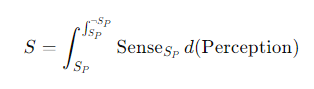


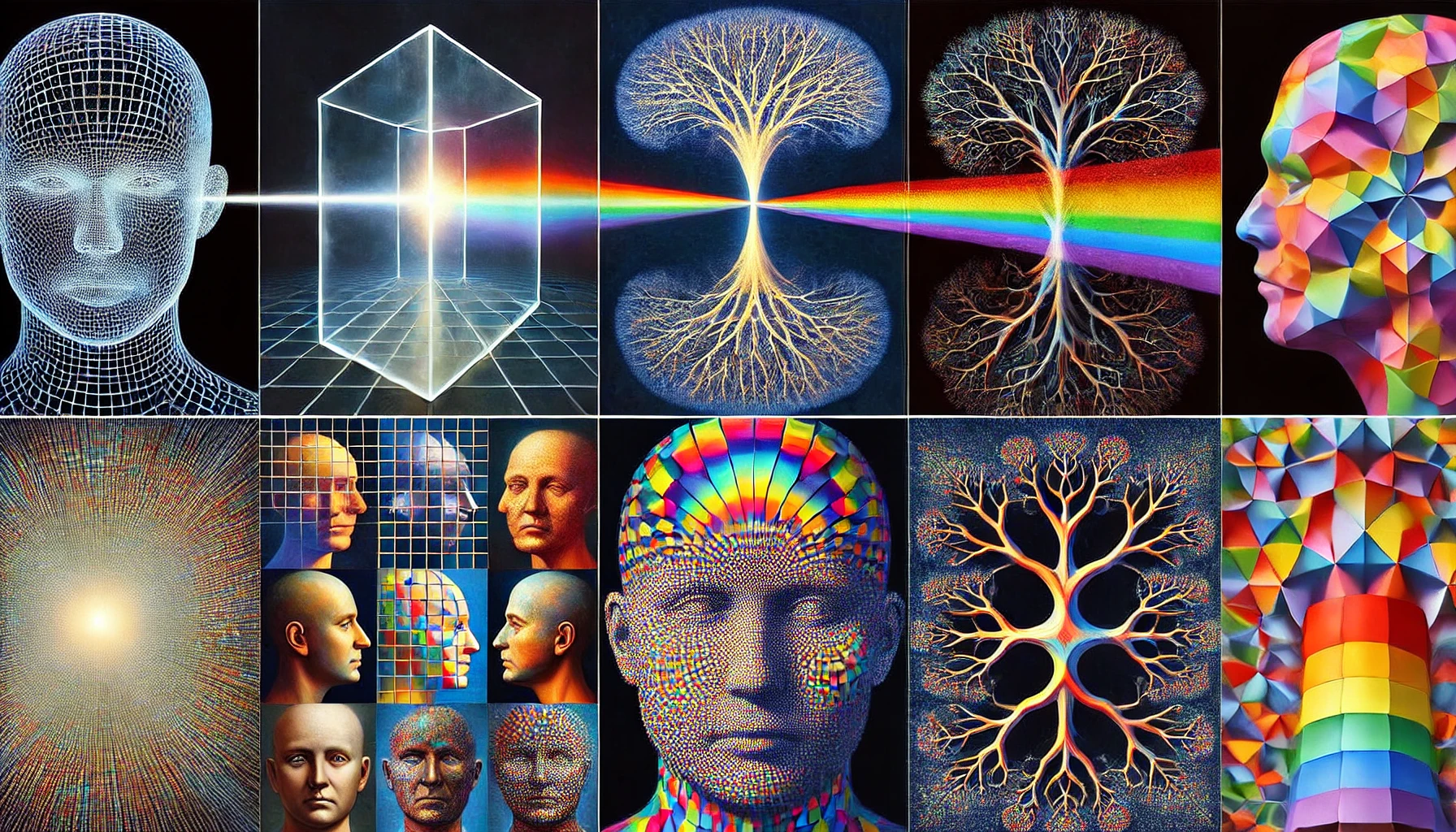

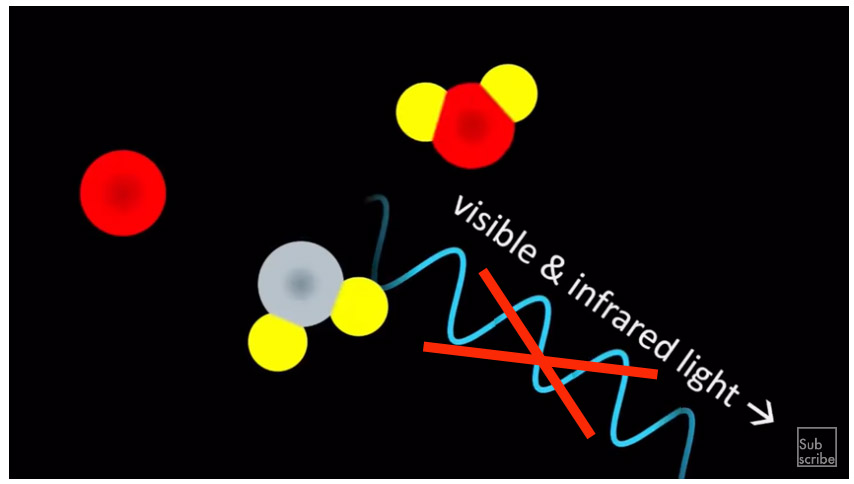


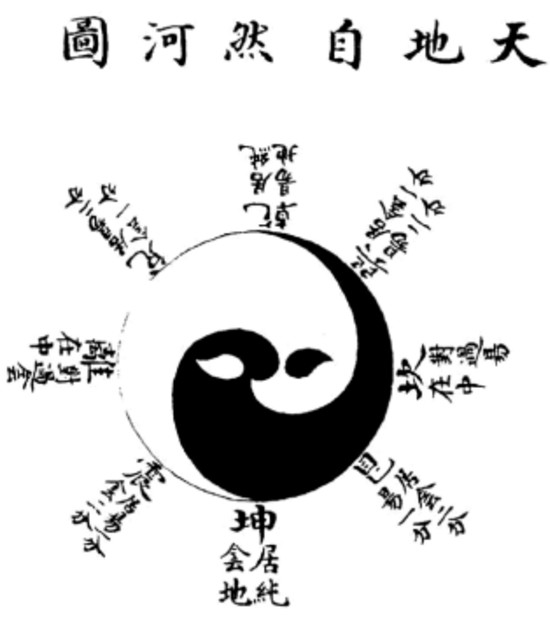




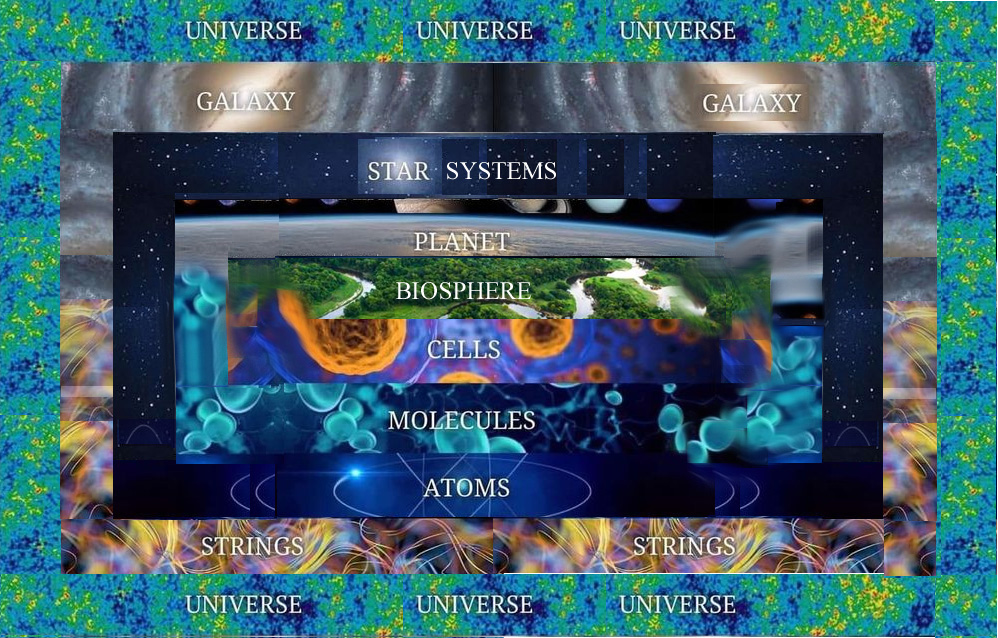



 Multisense Realism
Recent Comments