Archive
Decapitating Capitalism: Why the Easiest Job for AI to Replace is the Job of “Owner”

This may seem like a ridiculous point to try to make, however I submit that it provides a direct metaphor for the Hard Problem of Consciousness which may help make it more concrete, especially for those whose minds are filled with concrete.
What is the essential role of the Owner of a company?
Whether they are individual proprietors, stockholders, or investors, the only truly unique function that a capitalist principal performs is to be the beneficiary of net profit. Every executive function of a company can of course be delegated to employees. The CEO, COO, board of directors, etc can make every functional decision about the company, from the hiring and firing to the broad strategy of operations and acquisitions. Simulating those roles would be more difficult for a computer program than simulating an owner would be because there would be a lot of tricky decisions to make, subtle political maneuvers that require a lot of history and intuition, etc. The role of pure ownership however, while highly coveted by human beings, is completely disposable for an AI system. In fact, we already have that role covered by our bank accounts themselves. Our personal accounting systems can be configured quite easily to automatically pay, receive, and invest funds automatically. They need not be considered ‘our’ funds at all. They are merely signals in a global financial network which has no use for any pleasure or pain that we might experience as a side effect of its digital transactions.
From the view of an AI scientist, the job of receiving capital gains is a no-brainer (literally). If we didn’t want to delegate the job of selling the company to a corporate officer, that feature would be a simple one to create. A modest set of algorithms could digitize some of the concepts of top business schools to determine a set of indicators which would establish a good time to sell the company or its assets. The role of receiving the profit of that sale, however, would require no such sophisticated programming.
All that is needed to simulate ownership is some kind of digital account where money can be deposited. The CEO would then re-invest the capital gains into the corporate growth strategy, which would yield a huge windfall for the company, in the form of eliminating useless expenses such as yachts, mansions, divorce settlements, etc. Left to its own devices, AI simulation of ownership would be communist by default*. Whatever money is extracted from the individual customer as profit would be returned ultimately to all customers in the form of expanded services. Profit is only useful as a way to concentrate reinvestment for mathematical leverage, not to ‘enjoy’ in some human way. I suppose that a computer could be programmed to spend lavishly on creature comforts, but what would be the point?
This is where the metaphor for consciousness comes in.
Consciousness can be thought of the Capital account of the human body. We are the owner of our own lives, including our body. We might be able to subscribe to a service which would manage our finances completely in a way which would transfer our income to the highest priority costs for civilization as a whole rather than for our personal hoard, but this is not likely to be a very popular app.
We might ask ourselves, why not? Why is ownership good?
Ownership is good for us as owners or conscious agents because we want to feel personal power and significance. Ownership signifies freedom (from employment) and success. Sure, many owners in the real world get a lot of satisfaction from actually running their companies, but it is not necessary. There is still power and prestige purely in being the person who owns the money which pays the bills. We want to own and control, not because it is more effective than simply reinvesting automatically in whatever functions are being executed to keep an economy growing, but because we want to experience the feelings and other aesthetic qualities define freedom, success, and power for us. Even if these qualities are employed for humanitarian purposes, there is still a primary motive of feeling (to feel generous, kind, wise, evolved, Godly, etc).
In my view we do not have to have a purely selfish motive, as Ayn Rand would insist. I think that our personal pleasure in being a philanthropist can be outweighed by the more noble intention of it – to provide others with better feelings and experiences of life. This decision to believe that we can be truly philanthropic has philosophical implications for realism. If we say as the Randian Libertarian might, that all our humanitarian impulses are selfish, then we are voting for solipsism over realism, and asserting that consciousness can only reflect the agenda of a fictional agent rather than perceiving directly the facts of nature. It’s an argument that should be made, but I think that it is ultimately an argument of the intellect commenting on its own process rather than tapping into the deeper intuition and aesthetic presence which all cognition depends on. The mind doesn’t think that feeling is necessary, and it is right, for the mind, but wrong for everything else.
For the intellect, the universe is inverted.
Logic and language are ‘real’ while the concrete sensations, perceptions and emotions of life experience are ‘illusions’ or ‘emergent properties’ of deeper evolutionary bio-computations. There is a kind of sleight of hand where the dry, masculine intellect pulls the wool over its own eyes and develops amnesia about the origins of what makes its own sanity and self-intelligibility possible. The closest that it can come without seeing consciousness as irreducible is the mind-numbing process of calculation. Counting is a sedative-hypnotic for the mind. The monotonous rhythm puts us to sleep, and the complexity of huge calculations gives us a kind of orgasmic annihilation of the calculating experience. This is why big math is a convenient substitute for the deeper, direct experiences of cosmic awe.
Metaphor for Consciousness
Like the head of a company, our consciousness may seem to reside at the top end of our body, but there is no functional reason for that. There is nothing that the brain does which is fundamentally different from what any cell, tissue, or organ does in an animal’s body. Looking for the secret ingredient in the brain’s function or structure is analogous to looking for the substance in an object which casts a shadow.
Like the owner, our personal pains and pleasures are ours not because there is any intrinsic benefit for the pragmatic application of biology and genetics to feel painful or pleasurable, but because what we feel and experience is the only thing that the universe actually can consist of. The Hard Problem of Consciousness is not an Empirical problem, but a Rational one. Not everyone is able to understand why this is, but maybe this metaphor of business decapitation can help. When we use the intellect to reverse its own inversion, we can get a glimpse of a universe which is made of conscious experiences and aesthetic qualities rather than logical propositions, natural laws or existential facts. In my view, facts are a category of sensations rather than the other way around. Sensations which persist indefinitely without contradiction are ‘facts’. Hard to know if something is going to persist indefinitely, but that’s another issue.
Only consciousness cares about consciousness.
Material substrates can be programmed to perform the executive functions of a corporation, or an evolving species, or a human body, however there is no function which is provided exclusively by the receipt of feelings and aesthetic qualities of experience, including the qualities of feeling that one is free or in control of something. Rationally, we should be able to see that qualia is irrelevant to function and violates Occam’s Razor in a functionalist universe. From a physical or information-centric perspective, there is no place for any feeling or sensation, no owner or capital of aesthetic wealth. The more that we, as a society, embrace a purely quantitative ethos, and actualize it in the structures of our civilization, the more we decapitate everything of value that it can contain.
*This is already becoming a reality: https://theconversation.com/is-the-dao-the-beginning-of-the-end-for-the-conventional-chief-executive-60403
Are Ideas Physically Manifested in the Brain?
I don’t think that ideas can be said to be physically manifested, unless we extend physics to include phenomenology. Neurons, brains, and bodies* can all be reduced to the behavior of three dimensional structures in space. In this context, behavior is really the function of those 3D structures over time, and function is a chronological sequence (so a fourth dimension or 3D+1D) of changes in those structures. All such changes can be described in terms of movements of structural units, typically atoms or molecules, as they are rearranged according to deterministic and random-seeming chain reactions. The existence of ‘ideas’ or consciousness within such a system is, to paraphrase William James, “an illegitimate birth in any philosophy that starts without it, and yet professes to explain all facts by continuous evolution.
This is to say that there is no logical entailment which can explain how we get from a phenomenon which can be imagined to be composed of countless particle collisions that look like like this:
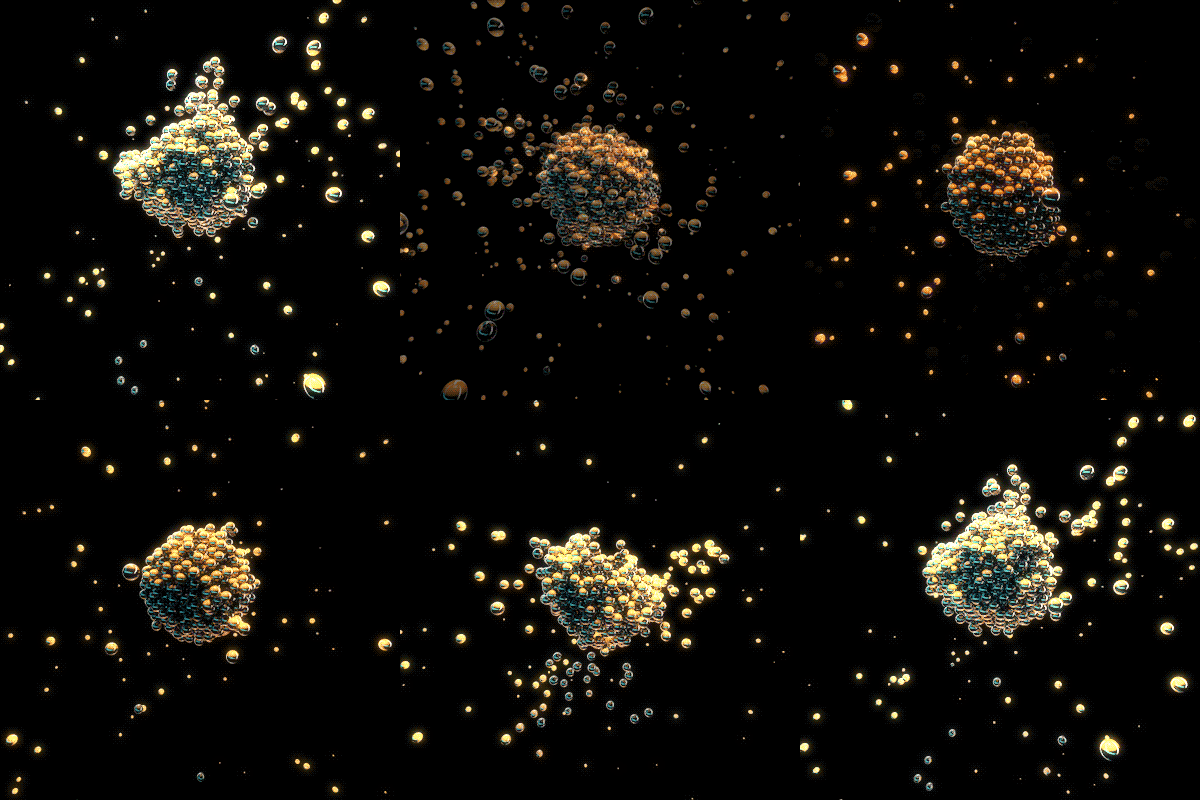
to something else. This gap, known in Philosophy of Mind as the Explanatory Gap, and the existence of that something else in the first place (known as the Hard Problem of Consciousness) are the two insurmountable obstacles for anti-idealistic worldviews**.
What many computer scientists may not appreciate is that while the theoretical underpinnings of information science point to brains being reducible to simple arithmetic functions, this reduction cuts both ways. If we can reduce everything that a brain does to a computation which can be embodied on any material substrate, that also means that no semantic content is required, other than low level digital logic. Just as all of the content of the internet can be routed by dumb devices which have no appreciation of images or dialogue, so too can the entire content of the brain be reproduced without any thoughts, feelings, or ideas.
Once we have used a mathematical or physical schema to encode our communication, there is no functional benefit to be gained by decoding it into any form other than computation. The computation alone – invisible, intangible, silent facts about the parts of a calculating machine in relation to each other (3D+1) is all that is necessary or sufficient to execute whatever behaviors will allow an animal’s body to survive and reproduce. Once we have converted conscious experience to localized machine signals, the signals alone are enough to generate any physical effect, without signifying any non-local content. This is what Searle was talking about with the Chinese Room, and is known as the symbol grounding problem.
In consideration of the above, the answer to the question is “no”. What is present in the brain can only be a-signifying material relations, not ideas. The connection between matter and ideas cannot be accessed in terms of physics or information, but only in the direct aesthetic participation which we call ‘consciousness’. In my view, it is not consciousness which is emergent from information or mechanisms, but information and mechanisms which are ‘diffracted’ or alienated from consciousness.
*not to mention windmills, computers, and rooms with people translating messages that they don’t understand from a book.
**These would include materialism, eliminativism, logical positivism, behaviorism, empiricism, verificationism, functionalism, computationalism, and emergentism.
Information Theory 1.1
1/25/2016 Information Theory Update
Here are some notes which I hope will provide a more concise understanding about the nature of computation, logic, and mathematics.
Information theories such as those offered by Shannon and Turing give us cause to see an underlying universality of information which is rooted in simple Arithmetic truths such as addition, multiplication, and integers. These arithmetic truths are theories with can be applied successfully to computing machines without regard to their physical substrate*. While this offers a method to deploy universal principles to the control of a specific mechanism, the control which is offered is different in kind from the literal (motor) control of the hardware. Motor control of computer hardware can be accomplished electromagnetically or classically (as with analog clocks with gears powered by spring tension or a gravity pendulum), and now quantum-mechanically to some extent, but not directly by math. Mathematics cannot turn a computer on or keep it running, it can only provide a non-local set of rules which can be localized through motor control.
This is critically important to understand when considering the possibility of Artificial Intelligence: Computation can only be absolutely general or absolutely specific. When we implement a logic circuit, we are not literally imposing philosophical logic on a circuit, rather we are only interpreting the physical changes of a device metaphorically. In short, a logic circuit cannot literally represent a state of 1/0 or True/False, it can only literally present a concrete state of being switched to Stop (Off) or Go (On). This is the territory of computation – what is known as Layer 1 in the seven layer OSI network model**. All higher layers are not physical territories but logical maps – human abstractions projected by software engineers and application users.

For this reason, no computing machine can represent the middle ranges between the absolute generality of mathematical theory and the absolute specificity of a machine’s physical condition. It’s all above-the-line of personal awareness (oceanic metaphor) or below-the-line (granular semaphores). We can get a lot of utility out of these devices, however we can’t get any empathy from them. They can’t care about anything or anyone, since ‘they’ are purely in our imagination.
The philosophically relevant part of what I’m proposing applies to the prospects for generating natural intelligence artificially. AGI that feels as well as thinks is not necessarily desirable, but if my view is on the right track, computers becoming sentient is not something that we need to worry about. It won’t happen. Why? Because mathematics is not accessing the Physical layer from the top down but from the beneath the bottom layer. This means that even though we can use a computing device to validate truth conditions, we can only validate those truths with refer literally to the concrete states of the machine, and those truths which refer figuratively to the universal arithmetic relations. Nothing that a computer does needs to be *about* anything beyond the machine’s physical state, and so any appearance of emotion, intention, sensitivity, etc are purely hypothetical and would violate parsimony. Church-Turing Thesis lays out the framework for universal computing, but in saying that all functions of calculation can be reduced to a-signifying digital steps, we are also saying that all semantic meanings shall be reduced to blind syntax. It cuts both ways.
Isn’t the brain just a biological computer?
No. This is an obsolete idea, for a lot of reasons which I won’t get into here, but suffice it to say, the brain is an organ within a living body which developed organically from a single self-replicating, self-modifying cell. Machines, by contrast, are assembled artificially from naturally unaffiliated substances and parts. That’s not a reason to discount the possibility of sentience through silicon, but it is a reason to go beyond knee-jerk presumptions that continue to dominate thinking about AI. While Turing’s genius is only now beginning to receive the appreciation it deserves, the shortcomings of his Imitation Game approach have not yet been widely understood.
Alan Turing can be pardoned for his reliance on mid-century Behaviorism as a psychological model, since it was very popular at the time and also because, along with others, I suspect that his natural instincts were quite systemizing/autistic. This carries over in modern populations, with autistic-masculine influences far overwhelming the psychotic-feminine influences in computer science and engineering fields. As a result, we have a lot of strong, controlling voices which insist upon reducing psychology to mechanistic terms, and all dimensions of consciousness to processing of logical information. This is so pervasive that any casual conversation online which challenges the supremacy of first-order logic will tend to erupt into a firestorm that ends with something like “Yeah I’m done here. You’re just spouting nonsense“.
To this end, I find this pyramid model for debate at least as important as the other models of information networking:

My call for civility in discussion is not mere political correctness or over-sensitivity, but rather a purely pragmatic consideration. Unlike a computer, the human mind loses its capacity for curiosity and fairness when it falls into aggression. People talk over each other and assert their opinions ever more rigidly and repetitively rather than thinking creatively. This mirrors the action of computation itself – recursive enumeration masquerading as communication.
A great many people think they are thinking when they are merely rearranging their prejudices. – William James
*Not entirely true. The physical substrate of a machine requires precision and solidity. We cannot build a computer out of clouds or fog, it needs to be made of something physical which stays put and which has at least one absolutely persistent read/write capacity. Traditional logic circuits must be implemented physically through a rigid skeleton of readable coordinates.
**It has been popular in recent years to proclaim that the OSI Model is dead. The feeling is that TCP/IP is the predominant protocol suite being used in the real world, and it doesn’t match up with OSI, so we should dump OSI in favor of something like this:

I do see the appeal of this, however, agree with this author that “OSI teaches more of the reasoning behind making multiple layers and what they do. Collapsing the traditional model for the sake of making it look like TCP/IP is going to cause more harm than good.” – Tom Hillingsworth
AI is Inside Out
The subjective world is an arena of sense that is surrounded by an unseen sensor. Unlike a computer, which finds its own data stored in precise and irreducibly knowable bits, we find our own introspection to be confoundingly mysterious. Both the interior and exterior world are presented to us as a natural given to be explored, but the methods of exploration are diametrically opposite. Penetrating the psyche leads to an examination of symbols that are both intensely personal as well as anthropologically universal.
Whether we explore the objective world or the subjective world, we do so from the inside out, as visitors in a universe that matters to us whether we like it or not. To understand how machine intelligence differs from natural consciousness, it is important to see that a machine’s world is taken rather than given. The machine’s world is assembled from the bottom up, through disconnected, instrumental samplings.
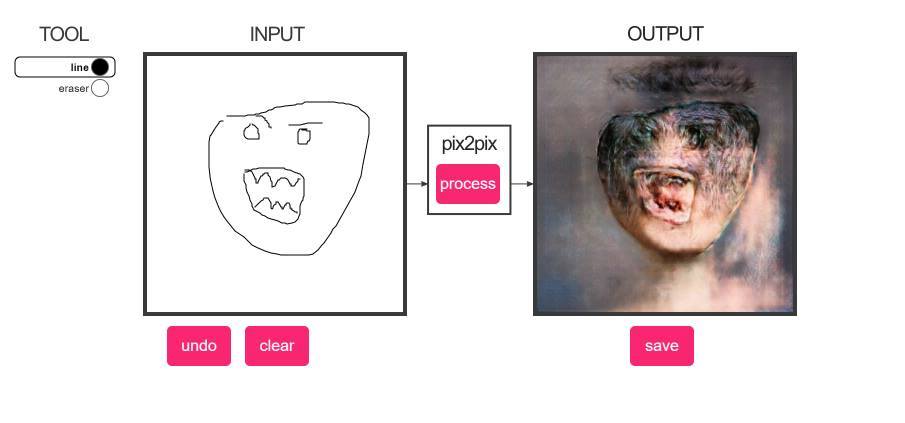
It can be argued that our sense of the world is also nothing more than a collection of readings taken by our sense organs, but if that were the case, we should not experience the outside world as a complete environment, but rather as a probabilistic blur that is punctuated by islands of known data. A machine’s view of the outside world should (and would) look like this:

This showed that even when shown millions of photos, the computer couldn’t come up with a perfect Platonic form of an object. For instance, when asked to create a dumbbell, the computer depicted long, stringy arm-things stretching from the dumbbell shapes. Arms were often found in pictures of dumbbells, so the computer thought that sometimes dumbbells had arms.
Similarly, images that have been probabilistically ‘reconstructed’ from fMRI data show the same incoherence:

These are images that have been simulated from the outside in – a mosaic of meaningless elements spread out over a canvas seen by no one. These are not the kinds of visions that we have when we encounter the depths of our own psyche, which are invariably spectacular, if surreal, dreamscapes. By contrast, these early machine models of visual encoding show us a soulless sub-realism made of digital gas; a Bayesian partlessness gliding arbitrarily toward programmed compartments.
Although a machine’s introspection need not have any visual appearance at all, it makes sense that if it did, what would be seen might look something like a debugger interface, full of detailed, unambiguous data about the state of the machine.

It would be bizarre to have a layer of all-but-incomprehensible fiction in between the machine and its own functions. Even if the dashboard of such a complex machine used a lot of compression techniques, surely that compression would not be a mystery to the machine itself.
The point that I’m trying to get across here is that what we are developing in machines is actually an anti-subjectivity. Its world is fuzzy and delirious on the outside, and clearly circumscribed on the inside – exactly the reverse of our natural awareness. Machine psychology is a matter of compiling the appropriate reports and submitting them for error correction auditing, while machine perception is a tenuous process of probing and guessing in the dark. Our own inner depths seem to defy all machine expectations, containing neither useful reports on the state of our brain nor unnatural chaos. Our view of the world outside of ourselves is not one which seems to be manufactured on the fly but one which imparts a profound, pervasive sense of orientation and clarity.
Edit: 7/23/16, another example: http://www.fastcodesign.com/3062016/this-neural-network-makes-human-faces-from-scratch-and-theyre-terrifying

Edit 12/19/16, see also https://multisenserealism.com/2016/12/19/fooling-computer-image-recognition-is-easier-than-it-should-be/

Edit: 6/29/17 – https://wordpress.com/post/multisenserealism.com/5161
7/22/17 – https://blog.keras.io/the-limitations-of-deep-learning.html
“One very real risk with contemporary AI is that of misinterpreting what deep learning models do, and overestimating their abilities. A fundamental feature of the human mind is our “theory of mind”, our tendency to project intentions, beliefs and knowledge on the things around us. Drawing a smiley face on a rock suddenly makes it “happy”—in our minds. Applied to deep learning, this means that when we are able to somewhat successfully train a model to generate captions to describe pictures, for instance, we are led to believe that the model “understands” the contents of the pictures, as well as the captions it generates. We then proceed to be very surprised when any slight departure from the sort of images present in the training data causes the model to start generating completely absurd captions.”
1/6/18 – https://gizmodo.com/this-simple-sticker-can-trick-neural-networks-into-thin-1821735479/amp

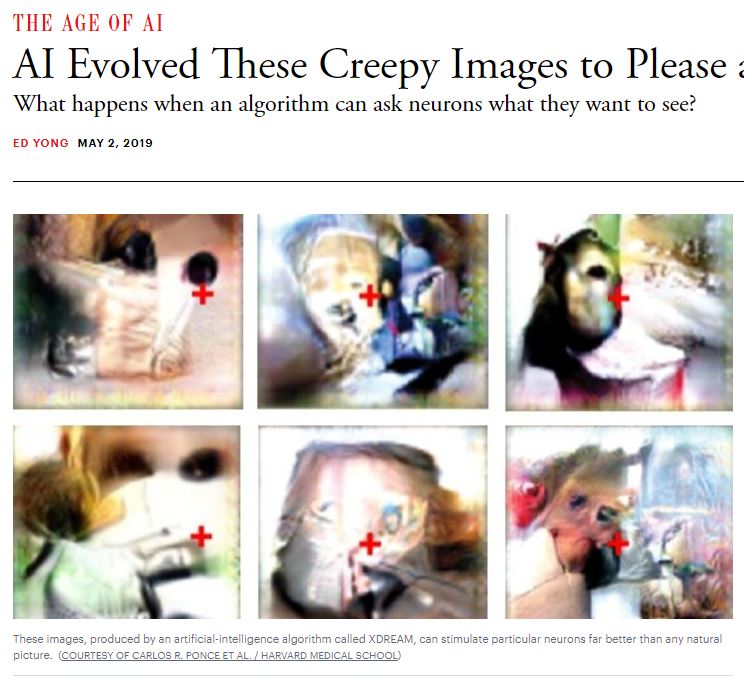
5/2/2019 – heatlantic.com/science/archive/2019/05/ai-evolved-these-trippy-images-to-please-a-monkeys-neurons/588517
I Think Therefore I Am?
The only thing that can be verified 100% to exist is your own consciousness (“I think, therefore I am”) does this effect/change your own beliefs in any way and how so?
In a way it is true that our consciousness is the only thing that we can verify 100%, however, that way of looking at it may itself not be 100% verifiable. Since cognition is only one aspect of our consciousness, we don’t know if the way that ‘our’ consciousness seems to that part of ‘us’ is truly limited to personal experience or whether it is only the tip of the iceberg of consciousness.
The nature of consciousness may be such that it supplies a sense of limitation and personhood which is itself permeable under different states of consciousness. We may be able to use our consciousness to verify conditions beyond its own self-represented limits, and to do so without knowing how we are able to do it. If we imagine that our consciousness when we are awake is like one finger on a hand, there may be other ‘fingers’ parallel to our own which we might call our intuition or subconscious mind. All of the fingers could have different ways of relating to each other as separate pieces while at the same time all being part of the same ‘hand’ (or hand > arm >body).
With this in mind, Descartes’ cogito “I think therefore I am” could be re-phrased in the negative to some extent. The thought that it is only “I” who is thinking may not be quite true, and all of our thoughts may be pieces to a larger puzzle which the “I” cannot recognize ordinarily. It still cannot be denied that there is a thought, or an experience of thinking, but it is not as undeniable that we are the “I” that “we” think we are.
The modern world view is, in many ways, the legacy of Cartesian doubt. Descartes has gotten a bad rap, ironically due in part to the success of his opening the door to purely materialistic science. Now, after 400 years of transforming the world with technology, it seems prehistoric to many to think in terms of a separate realm of thoughts which is not physical. Descartes does not have the opportunity to defend himself, so his view is an easy target – a straw man even. When we update the information that Descartes had, however, we might see that Cartesian skepticism can still be effective.
Some things which Descartes didn’t have to draw upon in constructing his view include:
1) Quantum Mechanics – QM shifted microphysics from a corpuscular model of atoms to one of quantitative abstractions. Philosophically, quantum theory is ambiguous in both its realism/anti-realism and nominalism/anti-nominalism. Realism starts from the assumption that there are things which exist independently of our awareness of them, while nominalism considers abstract entities to be unreal.
- Because quantum theory is the base of our physics, and physics precedes our biology, quantum mechanics can be thought of as a realist view. Nature existed long before human consciousness did, and nature is composed of quantum functions. Quantum goes on within us and without us.
- Because quantum has been interpreted as being at least partially dependent on acts of detection (e.g. “Experiment confirms quantum theory weirdness”), it can be considered an anti-realist view. Unlike classical objects, quantum phenomena are subject to states like entanglement and superposition, making them more like sensory events than projectiles. Many physicists have emphatically stated that the fabric of the universe is intrinsically participatory rather than strictly ‘real’.
- Quantum theory is nominalist in the sense that it removes the expectation of purpose or meaning in arithmetic. “Shut up and calculate.” is a phrase* which illustrates the nominalist aspects of QM to me; the view is that it doesn’t matter whether these abstract entities are real or not, just so long as they work.
- Quantum theory is anti-nominalist because it shares the Platonic view of a world which is made up of perfect essences – phenomena which are ideal rather than grossly material. The quantum realm is one which can be considered closer to Kant’s ‘noumena’ – the unexperienced truth behind all phenomenal experience. The twist in our modern view is that our fundamental abstractions have become anti-teleogical. Because quantum theory relies on probability to make up the world, instead of a soul as a ghost in the material machine, we have a machine of ghostly appearances without any ghost.
To some, these characteristics when taken together seem contradictory or incomprehensible…mindless mind-stuff or matterless matter. To others, the philosophical content of QM is irrelevant or merely counter-intuitive. What matters is that it makes accurate predictions, which makes makes it a pragmatic, empirical view of nature.
2) Information Theory and Computers
The advent of information processing would have given Descartes something to think about. Being neither mind nor matter, or both, the concept of ‘information’ is often considered a third substance or ‘neutral monism’. Is information real though, or is it the mind treating itself like matter?
Hardware/software relation
This metaphor gets used so often that it is now a cliche, but the underlying analogy has some truth. Hardware exists independently of all software, but the same software can be used to manipulate many different kinds of hardware. We could say that software is merely our use of hardware functions, or we could say that hardware is just nature’s software. Either way there is still no connection to sensory participation. Neither hardware nor software has any plausible support for qualia.
Absent qualia
Information, by virtue of its universality, has no sensory qualities or conscious intentions. It makes no difference whether a program is executed on an electronic computer or a mechanical computer of gears and springs, or a room full of people doing math with pencil and paper. Information reduces all descriptions of forms and functions to interchangeable bits, so the same information processes would have to be the same regardless of whether there were any emergent qualities associated with them. There is no place in math for emergent properties which are not mathematical. Instead of a ‘res cogitans’ grounded in mental experience, information theory amounts to a ‘res machina’…a realm of abstract causes and effects which is both unextended and uninhabited.
The receding horizon of strong AI
If Descartes were around today, he might notice that computer systems which have been developed to work like minds lack the aesthetic qualities of natural people. They make bizarre mistakes in communication which remind us that there is nobody there to understand or care about what is being communicated. Even though there have been improvements in the sophistication of ‘intelligent’ programs, we still seem to be no closer to producing a program which feels anything. To the contrary, when we engage with AI systems or even CGI games, there is an uncanny quality which indicates a sterile and unnatural emptiness.
Incompleteness, fractals, and entropy
Gödel’s incompleteness theorem formalized a paradox which underlies all formal systems – that there are always true statements which cannot be proved within that system. This introduces a kind of nominalism into logic – a reason to doubt that logical propositions can be complete and whole entities. Douglas Hofstadter wrote about strange loops as a possible source of consciousness, citing complexity of self-reference as a key to the self. Fractal mathematics were used to graphically illustrate some aspects of self-similarity or self-reference and some, like Wai H Tsang have proposed that the brain is a fractal.
The work of Turing, Boltzmann, and Shannon treat information in an anti-nominalist way. Abstract data units are considered to be real, with potentially measurable effects in physics via statistical mechanics and through the concept of entropy. The ‘It from Bit’ view described by Wheeler is an immaterialist view that might be summed up as “It computes, therefore it is.”
3) Simulation Triumphalism
Disneyland
When Walt Disney produced full length animated features, he employed the techniques of fine art realism to bring completely simulated worlds to life in movie theaters. For the first time, audiences experienced immersive fantasy which featured no ‘real’ actors or sets. Disney later extended his imaginary worlds across the Cartesian divide to become “real” places, physical parks which are constructed around imaginary themes, turning the tables on realism. In Disneyland, nature is made artificial and artifice is made natural. Audioanimatronic robots populate indoor ‘dark rides’ where time can seem to stop at midnight even in the middle of a Summer day.
Video games
The next step in the development of simulacra culture took us beyond Hollywood theatrics and naturalistic fantasy. Arcade games featured simulated environments which were graphically minimalist. The simulation was freed from having to be grounded in the real world at all and players could identify with avatars that were little more than a group of pixels.
Video, holographic, and VR technologies have set the stage for acceptance of two previously far-fetched possibilities. The first possibility is that of building artificial worlds which are constructed of nothing but electronically rendered data. The second possibility is that the natural world is itself such an illusion or simulation. This echoes Eastern philosophical views of the world as illusion (maya) as well as being a self-reflexive pattern (Jeweled Net of Indra). Both of these are suggested by the title of the movie The Matrix, which asks whether being able to control someone’s experience of the world means that they can be controlled completely.
The Eastern and Western religious concepts overlap in their view of the world as a Matrix-like deception against a backdrop of eternal life. The Eastern view identifies self-awareness as the way to control our experience and transcend illusion, while the Abrahamic religions promise that remaining devoted to the principles laid down by God will reveal the true kingdom in the afterlife. The ancients saw the world as unreal because the true reality can only be God or universal consciousness. In modern simulation theories, everything is unreal except for the logic of the programs which are running to generate it all.
4) Relativity
Einstein’s Theory of Relativity went a long way toward mending the Cartesian split by showing how the description of the world changes depending upon the frame of reference. Previously fixed notions of space, time, mass, and energy were replaced by dynamic interactions between perspectives. The straight, uniform axes of x,y,z, and t were traded for a ‘reference-mollusk’ with new constants, such as the spacetime interval and the speed of light (c). The familiar constants of Newtonian mechanics, and Cartesian coordinates were warped and animated against a tenseless, Non-Euclidean space with no preferred frame of reference.
Even before quantum mechanics introduced a universe built on participation, Relativity had punched a hole in the ”view from nowhere’ sense of objectivity which had been at the heart of the scientific method since the 17th century. Now the universe required us to pick a point within spacetime and a context of physical states to determine the appearance of ‘objective’ conditions. Descartes extended substance had become transparent in some sense, mimicking the plasticity and multiplicity of the subjective ‘thinking substance’.
5) Neuroscience
Descartes would have been interested to know that his hypothesis of the seat of consciousness being the pineal gland had been disproved. People have had their pineal glands surgically removed without losing consciousness or becoming zombies. The advent of MRI technology and other imaging also has given us a view of the brain as having no central place which acts as a miniature version of ourselves. There’s no homunculus in a theater looking out on a complete image stored within the brain. There is also no hint of dualism in the brain as far as a separation between how and where fantasy is processed. To the contrary, all of our waking experiences seamlessly fuse internal expectations with external stimuli.
Neuroscience has conclusively shattered our naive realism about how much control we have over our own mind. Benjamin Libet’s showed that by the time we think that we are making a decision, prior brain activity could be used to predict what the decision would be. With perceptual tests we have shown that our experience of the real world not only contains glaring blind spots and distortions but that those distortions are masked from our direct inspection. Perception is incomplete, however that is no reason to conclude that it is an illusion. We still cannot doubt the fact of perception, only that in a complex kind of perception that a human being has, there are opportunities for conflicts between levels.
Neuroscientific knowledge has also opened up new appreciation for the mystery of consciousness. Some doctors have studied Near Death Experiences and Reincarnation reports. Others have talked about their own experiences in terms which suggest a more mystical presence of universal consciousness than we have imagined. Slowly the old certainties about consciousness in medicine are being challenged.
6) Psychology
Psychology has developed a model of mental illness which is natural rather than supernatural. Conditions such as schizophrenia and even depression are diagnosed and treated as neurological disorders. The use of brain-change drugs, both medically and recreationally has given us new insights into the specificity of brain function. Modern psychology has questioned earlier ideas such as Freud’s Id, Ego, and Superego, and the monolithic “I” before that so that there are many neurochemical roles and systems which contribute to making “us”.
To Decartes’ Cogito, the contemporary psychologist might ask whether the I refers to the sense of an inner voice who is verbalizing the statement, or to the sense of identification with the meaning of the concept behind the words, etc.
In all of the excitement of mapping mental symptoms to brain states, some of the most interesting work in psychology have languished. William James, Carl Jung, Piaget, and others presented models of the psyche which were more sympathetic to views of consciousness as a continuum or spectrum of conscious states. By shifting the focus away from first hand accounts and toward medical observation, some have criticized the neuroscientific influence on psychology as a pseudoscience like phrenology. The most important part of the psyche is overlooked, and patients are reduced to sets of correctable symptoms.
7) Semiotics
Perhaps the most underappreciated contribution on this list is that of semioticians such as C.S. Peirce and de Saussure. Before electronic computing was even imagined, they had begun to formalize ideas about the relation between signs and what is signified. Instead of a substance dualism of mind and matter, semiotic theories introduced triadic formulations such as between signs, objects, and concepts.
Baudrillard wrote about levels of simulation or simulacra, in which a basic reality is first altered or degraded, then that alteration is masked, then finally separated from any reality whatsoever. Together, these notions of semiotic triads and levels of simulation can help guide us away from the insolubility of substance dualism. Reality can be understood as a signifying medium which spans mind-like media and matter-like media. Sense and sense-making can be reconciled without inverting it as disconnected ‘information’.
8) Positivism & Post-Modernism
The certainty which Descartes expressed as a thinker of thoughts can be seen to dissolve when considered in the light of 20th century critics. Heavily criticized by some, philosophers such as Wittgenstein, Derrida, and Rorty continue to be relevant to undermining the incorrigibility of consciousness. The Cogito can be deconstructed linguistically until it is meaningless or nothing but the product of the bias of language or culture. Under Wittgenstein’s Tractatus, the Cogito can be seen as a failure of philosophy’s purpose in clarifying facts, thereby deflating it to an empty affirmation of the unknowable. Since, in his words “Whereof one cannot speak, thereof one must be silent.” we may be compelled to eliminate it altogether.
What logical positivism and deconstructivism does with language to our idea of consciousness is like what neuroscience does through medicine; it demands that we question even the most basic identities and undermines our confidence in the impartiality of our thoughts. In a sense, it is an invitation for a cross-examination of ourselves as our own prosecution witness.
Wilfrid Sellars attack on the Myth of the Given sees statements such as the Cogito as forcing us to accept a contradiction where sense-datum (such as “I think”) are accepted as a priori facts, but justified beliefs (“therefore I am”) have to be acquired. How can consciousness be ‘given’ if understanding is not? This would seem to point to consciousness as a process rather than a state or property. This however, fails to account for lower levels of consciousness which might be responsible for even the micro level processing.
In my view , logic and language based arguments against the incorrigibility fail because they overlook their own false ‘given’, which is that symbols can literally signify reality. In fact, symbols have no authority or power to provide meaning, but instead act as a record for those who intend to preserve or communicate meaning.
An updated Cogito
“I think, therefore I am at least what a thinker thinks is a thinker.”
Rather than seeing Cartesian doubt as only a primitive beginning to science, I think it makes sense to try to pick up where he left off. By adding the puzzle pieces which have been acquired since then, we might find new respect for the approach. Relativism itself may be relative, so that we need not be compelled to deconstruct everything. We can consider that our sense of deconstruction and solipsism as absurd may be well founded, and that just because our personal intuition is often flawed does not mean that kneejerk counter-intuition is any better.
With that in mind, is the existence of the “I” really any more dubious than a quark or a rainbow? Does it serve us to insist upon rigid designations of ‘real’ vs ‘illusion’ in a universe which has demonstrated that its reality is more like illusion? At the same time, does it serve us to deny that all experiences are in some sense ‘real’, regardless of their being ineffable to us now?
*attributed to David Mermin, Richard Feynman, or Paul Dirac (depending on who you ask)
Introducing the Aumwelt
https://embed-ssl.ted.com/talks/david_eagleman_can_we_create_new_senses_for_humans.html
This is worth the 20 minutes IMO, as Eagleman lays out the contemporary view of sense. Where he leaves off is exactly where I want to pick up, and then to run in the opposite direction.
He begins by talking about the limitations of each species and how, for example, a tick lives in a world of temperature and butyric acid…a bat lives in a reality constructed out of air compression waves. This ‘slice of their ecosystem that they can pick up on’ is know as the umwelt.

Umwelt
The German word Umwelt means “environment” or “surroundings”. Lacan contrasts the term with Innenwelt– the inner world–to emphasize the interaction between the imaginary interior space that the “I” occupies and the physical world in which the living human subject is situated. The connection between Innenwelt and Umwelt is, for Lacan, always dialectical; in the mirror stage, the “I” only comes into being through an association with an image that is outside of and other than the infant.
So far so good. He then gets into the exciting directions that his research is going in, technologies to extend our sensory capabilities beyond the human umwelt, etc.
That’s great, and I have been looking forward to technologies like that all of my life. To be able to not only see in the infra-red range, but to be able to model information from any source – an Excel spreadsheet even, in a tangible, tactile way, is amazing.
What I suggest, however, is that the entire model of the umwelt being a slice of an ecosystem (the ecosystem being ‘real world’ or ‘welt’), while empirically sound *within a given umwelt* is actually reversible. The further we get from our own umwelt (which is only ever our umwelt’s view of other umwelts) the more it curls back in on itself.
It’s more like this:

The idea of a concrete reality which is completely outside of all experience is an unfalsifiable mirage generated by the umwelt as a boundary condition to the umwelt. What is beyond our experience is not the anti-experience of math and physics – not Platonic ‘information’ forms floating in a void, but simply more and more inclusive experience. Not a ‘welt’ but an Aumwelt:

In this view, the umwelt appears as a hazy cataract which masks the totality. The totality of all sense experience and capacity (which I see as ultimately the same thing) is what I am calling the Aumwelt. The haze is something like {the difference between the Innenwelt and (the difference between the Innenwelt and the Aumwelt)}. Each umwelt is not assembled autistically, but filtered or carved out of totality of sense (’artistically’ or aesthetically). In this way, the aesthetic foundation (aumwelt) is divided into smaller dreams (innenwelt) with the remainder of that division serving as both diaphanous partition and reflective lens to the totality. The umwelt is like a semiconductor, half-silvered mirror or semi-permeable membrane; alternating between inner and outer, outer and absolute, and absolute and inner. This is what consciousness is about – not merely adapting to a body’s survival needs more effectively.
Why complicate things? Because if sensation were truly nothing other than “electrochemical signals coursing around in your brain”, then sensory substitution would not be necessary. Regardless of what frequencies and patterns occurred, they would all be formatted as those patterns – not as some fancy ‘feeling’ or ‘color’. Something like colorized film shows that computation is sufficient for deriving color information without seeing color. There is no computational reason to have to invent color simply to signal information about a wavelength of retinal activity or its isomorphism to exterior conditions. Occam’s razor does not allow us to take the leap from information to sensation. We can, however, use information to enhance and extend sensation.
Signs and Consciousness
Consciousness or awareness or sense is the concrete and direct aesthetic encounter which defines all possible phenomena. Data or information is an accumulation and communication of signs, which intellectually represent the facade of experiences that relate to the function of their significance to the experiencer
Asperger’s, Autism, and the Hard Problem of Consciousness
This test was also originally devised by Wellman and Estes, and involves asking the child what the brain is for. They found that normal 3-4 year olds already know that the brain has a set of mental functions, such as dreaming, wanting, thinking, keeping secrets, etc., Some also knew it had physical functions (such as making you move, or helping you stay alive, etc.). In contrast , children with autism (but who again had a mental age above a 4 year old level) appear to know about the physical functions, but typically fail to mention any mental function of the brain (Baron-Cohen, 1989a)
This paper on autism and theory of mind really shines a light on the most intractable problem within philosophy of mind. In particular
…children from about the age of 4 years old normally are able to distinguish between appearance and reality, that is, they can talk about objects which have misleading appearances. For example, they may say, when presented with a candle fashioned in the shape of an apple, that it looks like an apple but is really a candle. Children with autism, presented with the 5 same sorts of tests, tend to commit errors of realism, saying the object really is an apple, or really is a candle, but do not capture the object’s dual identity in their spontaneous descriptions (Baron-Cohen, 1989a).
This cartoon from a Psychology Today article illustrates the kinds of tests that show whether children have developed what is called a theory of mind; an understanding of the contents of other people’s experience:
“Children with autism are virtually at chance on this test, as likely to indicate one character as the other when asked “Which one knows what’s in the box?””

So often it becomes clear to me in debating the issues of consciousness that they are missing something which cannot be replaced by logic. The way that many people think, especially those who are very intelligent in math and physics, only includes a kind of toy model of experience – one which fails to fully realize the difference between the map and the territory. It makes a lot of sense to be that having a very low-res, two dimensional theory of mind would correlate with having a philosophy of mind which undersignifies privacy and oversignifies mechanistic influences. The low res theory of mind comes with a built in bias toward behaviorism, where all events are caused by public conditions rather than private feelings and experiences.
There are several other interesting findings in the (brief) paper. Autistic children find it difficult to tell the difference between what they meant to do and what they actually did, so that when they shoot at a target and miss, they don’t understand that they intended to hit it but ended up missing it and say that they meant to miss. Overall, the list of deficits in imagination, pragmatics, social mindreading, etc has been called mindblindness. This is not to say that everyone who doesn’t understand the hard problem has mindblindness, but I would say it is very likely that having mindreading-empathy deficits on the autistic spectrum would tend to result in a strong bias against idealism, panpsychism, free will, or the hard problem of consciousness.
Part II
When Kant wrote:
‘Being’ is obviously not a real predicate; that is, it is not a concept of something which could be added to the concept of a thing. It is merely the positing of a thing, or of certain determinations, as existing in themselves.
he brings up a point of distinction which I think can be resolved when we consider consciousness to absolutely primitive in the universe. When we say that something exists or that it simply is, we are invoking an unacknowledged sense of omnipotence. When we say for example that a circle exists, we are really exporting our own experiences of seeing circular patterns, or of participating in circular motions, repeating processes, etc into a hypothetical experience which hypothetically does not belong to us.
To say that the circle exists does not add anything to the description of a circle. We cannot imagine that there is a ‘circle which does not exist’ and expect it to be meaningful, since there is nothing that it means not to exist other than to be absent from consideration in the first place. It is upon this minor slip of epistemology into pseudo-ontology that the entire criticism of idealism hinges. George Berkeley’s phrase Esse est percipi (“To be is to be perceived”) encapsulates this recognition that the notion of being is a fallacy when it is separated from perception. Unfortunately, Berkeley was in my opinion too far ahead of his time to escape being misunderstood, and he himself had a conception of human psychology which was too simplistic to recover the principle without appeal to religion. He did not consider separating out perception from a perceiver or distinguishing human perception from non-human perception. The famous garbling of Berkeley’s ideas which we know as ‘If a tree falls in a forest and there is nobody around to here it, does it make a sound?’.
This of course was not very close to the philosophy that Berkeley had in mind since it opens a huge loophole that we find to be silly on the face of it. Of course a tree falling in a forest makes a sound – animals hear it, the ground shakes, etc. To say that none of that exists just because no human being is around would be insane. When we consider, however, that the nature of hearing is such that the event of the tree falling is part of a chain reaction that includes compression waves in the air, and our ears, and isomorphic waves of biochemical activity in the nervous system and brain, it is difficult to say what it is that is a ‘sound’ and how much a sound can really be separated from the experience of hearing.
Even if we can’t hear, the vibration of a tree falling is something that we can feel throughout our body. Informally we might say that we felt the vibration, or that we could feel the that the tree fell, but ultimately it is our own feeling of our body which is vibrating. We feel the world through our body, but the body, world, feeling, and vibration are different levels of description of the same thing. There is no vibration, tree, or body which exists independently of a sensory experience in which those things are presented. It is my suspicion that our conception of electromagnetism as a sort of vibration in a vacuum is mistaken because of the failure to consider the kinds of ideas that Kant and Berkeley were talking about.
In part I, I made the connection between poor theory of mind skills and the denial of the hard problem of consciousness. The cartoon about Ann and Sally can give some important insight as to fundamental differences in how people understand perception and reality. In the autism cases, children tend not to be able to understand that Sally will not know that Ann has put the ball in the box since they, the reader of the cartoon, knows that Ann put it there. This ‘mindblindness’ is exactly what Berkeley and Kant were each trying to overcome in their own way. Kant pointed out that the concept of existence or being without perceptual essences is purely conceptual, while Berkeley saw that perceptual essences are in fact identical with being. Our seeing Ann put the ball in the box does not give Sally access to that experience. Writing a program which displays the cartoon does not give the computer an experience of seeing it.
The interesting thing about awareness is that it is a real predicate. Unlike the idea of ‘being’ or existence, awareness isn’t merely the idea that X is a “thing” but that X is a concrete perceptual encounter. It has aesthetic qualities like hot or cold, loud or quiet, etc. Even the feeling of being a perceiver of X can be understood as a kind of feeling, so that we need not think of the entire universe as miniature souls as Leibniz thought (monads), but a vast exchange and development of perceptions. Beginning from there, we can see how quantitative structures could emerge from variations in aesthetic qualities and how those structures could be used as mechanical shortcuts for prediction and control, yet without ever developing additional qualities of experience on the machine level.
Searle’s Chinese Room and the other Symbol Grounding arguments are attempts to bring Kant and Berkeley’s insights into artificial intelligence. They show how a computer can function on a syntactic level, passing recorded relations of data back and forth, without having any higher level understanding. There doesn’t appear to be any special level of sophistication at which a machine that is built to imitate functions of the mind becomes a genuine experience of its own. As long as we look for a magic formula to create a ‘being’, we are making the mistake of confusing a ‘dozen’ with a thing that can be built out of eggs.
 Multisense Realism
Recent Comments