Archive
AI is Still Inside Out
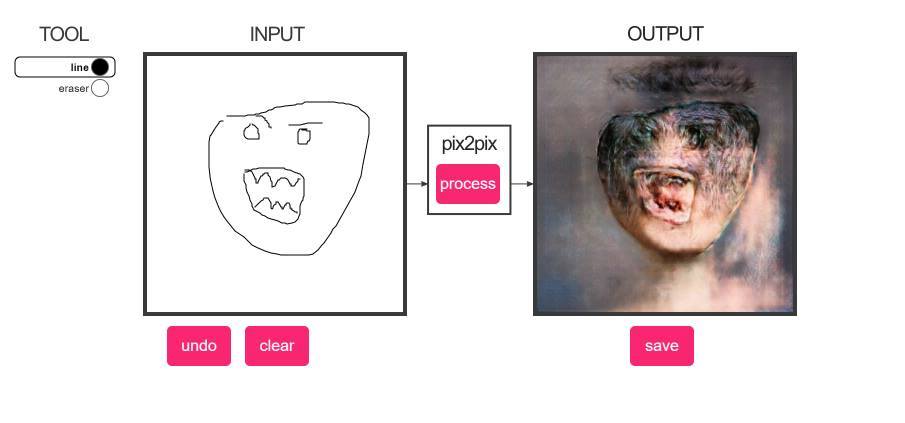
Turn your doodles into madness.
I think this is a good example of how AI is ‘inside out’. It does not produce top-down perception and sensations in its own frame of awareness, but rather it is a blind seeking of our top-down perception from a completely alien, unconscious perspective.
The result is not like an infant’s consciousness learning about the world from the inside out and becoming more intelligent, rather it is the opposite. The product is artificial noise woven together from the outside by brute force computation until we can almost mistake its chaotic, mindless, emotionless products for our own reflected awareness.
This particular program appears designed to make patterns that look like monsters to us, but that isn’t why I’m saying its an example of AI being inside out. The point is that this program exposes image processing as a blind process of arithmetic simulation rather than any kind of seeing. The result is a graphic simulacra…a copy with no original which, if we’re not careful, can eventually tease us into accepting it as a genuine artifact of machine experience.
See also: https://multisenserealism.com/2015/11/18/ai-is-inside-out/
Time for an update (6/29/22) to further demonstrate the point: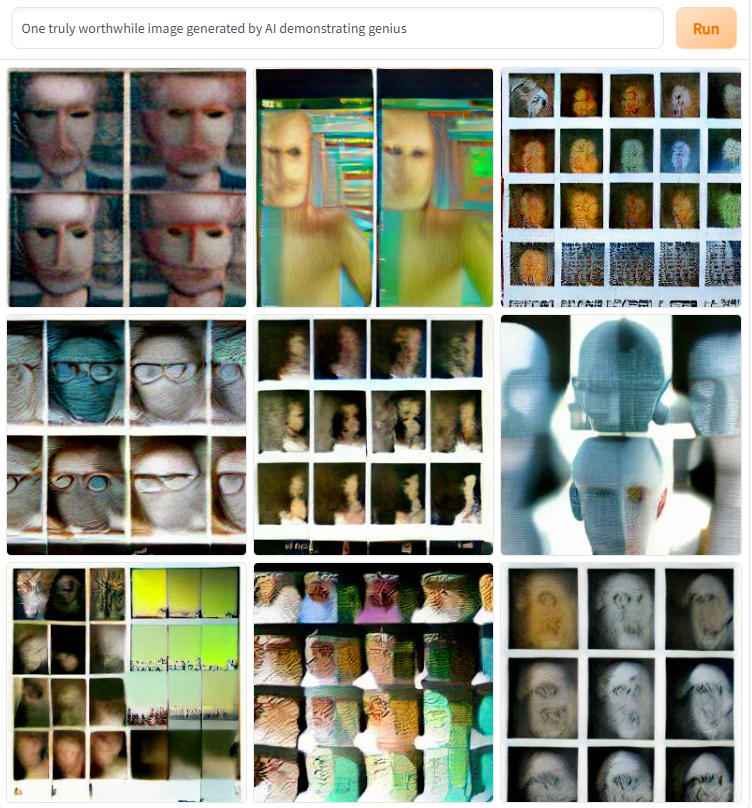
Added 5/3/2023:
Stochastic filtering is not how sense actually works, but it can seem like how sense works if you’re using stochastic filtering to model sense.

How Not To Destroy the World With AI – Stuart Russell
Fooling Computer Image Recognition is Easier Than it Should Be
This 2016 study, Universal Adversarial Perturbations, demonstrates how the introduction of specially designed low level noise into image data makes state of the art neural networks misclassify natural images with high probability. Because the noise is almost imperceptible to the human eye, I think it should be a clue that image processing technology is not ‘seeing’ images.

It is not only the fact that it is possible to throw off the technology so easily that is significant, but that the kinds of miscalculations that are made are so broad and unnatural. Had the program had any real sense of an image, adding some digital grit to a picture of a coffee pot or plant should not cause a ‘macaw’ hit, but rather some other visually similar object or plant.
While many will choose to see this paper as a suggestion for a need to improve recognition methods, I see it as supporting a shift away from outside-in, bottom-up models of perception altogether. As I have suggested in other posts, all of out current AI models are inside out.
3/16/17 – see also http://www.popsci.com/byzantine-science-deceiving-artificial-intelligence
Dereference Theory of Consciousness
Draft 1.1
IMO machine consciousness will ultimately prove to be an oxymoron, but if we did want to look for consciousness analogs in machine behavior, here is an idea that occurred to me recently:
Look for nested dereferencing, i.e. places where persistent information processing structures load real-time sense data about the loading of all-time sense data.

At the intersection of philosophy of mind, computer science, and quantum mechanics is the problem of instantiating awareness. What follows is an attempt to provide a deeper understanding of the significance of dereferencing and how it applies to integration of information and the quantum measurement problem. This is a broad conjecture about the nature of sensation as it pertains to the function of larger information processes, with an eye toward defining and identifying specific neuroscientific or cognitive signatures to correlate with conscious activity.
A dereference event can be thought of as the precise point in which a system that is designed or evolved to expect a range of inputs receives the real input itself. This sentence, for example, invites an expectation of a terminal clause, the terms of which are expected to be English words which are semantically linked to the rest of the sentence. English grammar provides templates of possible communication, but the actual communication relies on specific content to fill in those forms. The ability to parse English communication can be simulated by unconscious, rule-based mechanisms, however, I suggest that the ability to understand that communication involves a rule-breaking replacement of an existing parse theory with empirical, semantic fact. The structure of a language, its dictionary etc, is a reference body for timeless logic structures. Its purpose is to enable a channel for sending, receiving, and modifying messages which pertain to dereferenced events in real time. It is through the contact with real time sense events that communication channels can develop in the first place, and to continue to self modify.
What is proposed here is an alternative to Multi-World Interpretation of Quantum Wave Function collapse – an inversion of the fundamental assumption in which all possible phenomena diverge or diffract within a single context of concretely sensed events. The wave function collapse in this view is not the result of a measurement of what is already objectively ‘out there’, nor is it the creation of objective reality by subjective experiences ‘in here’, but a quantized return to an increasingly ‘re-contextualized’ state. A perpetual and unpredictable re-acquaintance with unpredictable re-acquaintance.
In programmatic terms, the variable *p is dereferenced to the concrete value (*p = “the current temperature”, dereferenced p = “is now 78 degrees Fahrenheit″). To get to a better model of conscious experience (and I think that this this plugs into Orch OR, IIT, Interface Theory, and Global Workspace), we should look at the nested or double dereferencing operation. The dereferencing of dereferencing (**p) is functionally identical to awareness of awareness or perception of perception. In the *p = “the current temperature” example, **p is “the current check of the current check of the temperature”. This not only points us to the familiar Strange loop models of consciousness, but extends the loop outward to the environment and the environment into the loop. Checking the environment of the environmental check is a gateway to veridical perception. The loop modifies its own capacity for self-modification.
Disclaimer: This description of consciousness as meta-dereferencing is intended as a metaphor only. In my view, information processing cannot generate conscious experience, however, conscious experience can possibly be better traced by studying dereferencing functions. This view differs from Gödel sentences or strange loops in that those structures refer to reference (This sentence is true) while the dereference loop specifically points away from pointers, rules, programs, formal systems, etc and toward i/o conditioning of i/o conditions. This would be a way for information-theoretic principles to escape the nonlocality of superposition and access an inflection point for authentic realization (in public space-time as shared experience). “Bing” = **Φ. In other words, by dereferencing dereference, the potentially concrete is made truly concrete. Sense experience is embodied as stereo-morphic tangible realism and tangible realism is disembodied as a sense of fact-gathering about sensed fact-gatherings.
Dereference theory is an appeal to anti-simulation ontology. Because this description of cognition implicates nested input/output operations across physically or qualitatively *real* events, the subjective result is a reduced set of real sense conditions rather than confabulated, solipsistic phenomenology. The subjective sense condition does not refer only to private or generic labels within a feed-forward thinking mechanism, but also to a model-free foundation and genuine sensitivity of the local ‘hardware’ to external conditions in the public here-and-now. This sensitivity can be conceived initially as universal property of some or all physical substrates (material panpsychism), however, I think that it is vital to progress beyond this assumption toward a nondual fundamental awareness view. In other words, subjective consciousness is derived from a dereference of a local inertial frame of expectation to a universal inertial frame of unprecedented novelties which decay as repetition. Each event is instantiated as an eternally unique experience, but propagated as repetitive/normalized translations in every other frame of experience. That propagation is the foundation for causality and entropy.
Decapitating Capitalism: Why the Easiest Job for AI to Replace is the Job of “Owner”

This may seem like a ridiculous point to try to make, however I submit that it provides a direct metaphor for the Hard Problem of Consciousness which may help make it more concrete, especially for those whose minds are filled with concrete.
What is the essential role of the Owner of a company?
Whether they are individual proprietors, stockholders, or investors, the only truly unique function that a capitalist principal performs is to be the beneficiary of net profit. Every executive function of a company can of course be delegated to employees. The CEO, COO, board of directors, etc can make every functional decision about the company, from the hiring and firing to the broad strategy of operations and acquisitions. Simulating those roles would be more difficult for a computer program than simulating an owner would be because there would be a lot of tricky decisions to make, subtle political maneuvers that require a lot of history and intuition, etc. The role of pure ownership however, while highly coveted by human beings, is completely disposable for an AI system. In fact, we already have that role covered by our bank accounts themselves. Our personal accounting systems can be configured quite easily to automatically pay, receive, and invest funds automatically. They need not be considered ‘our’ funds at all. They are merely signals in a global financial network which has no use for any pleasure or pain that we might experience as a side effect of its digital transactions.
From the view of an AI scientist, the job of receiving capital gains is a no-brainer (literally). If we didn’t want to delegate the job of selling the company to a corporate officer, that feature would be a simple one to create. A modest set of algorithms could digitize some of the concepts of top business schools to determine a set of indicators which would establish a good time to sell the company or its assets. The role of receiving the profit of that sale, however, would require no such sophisticated programming.
All that is needed to simulate ownership is some kind of digital account where money can be deposited. The CEO would then re-invest the capital gains into the corporate growth strategy, which would yield a huge windfall for the company, in the form of eliminating useless expenses such as yachts, mansions, divorce settlements, etc. Left to its own devices, AI simulation of ownership would be communist by default*. Whatever money is extracted from the individual customer as profit would be returned ultimately to all customers in the form of expanded services. Profit is only useful as a way to concentrate reinvestment for mathematical leverage, not to ‘enjoy’ in some human way. I suppose that a computer could be programmed to spend lavishly on creature comforts, but what would be the point?
This is where the metaphor for consciousness comes in.
Consciousness can be thought of the Capital account of the human body. We are the owner of our own lives, including our body. We might be able to subscribe to a service which would manage our finances completely in a way which would transfer our income to the highest priority costs for civilization as a whole rather than for our personal hoard, but this is not likely to be a very popular app.
We might ask ourselves, why not? Why is ownership good?
Ownership is good for us as owners or conscious agents because we want to feel personal power and significance. Ownership signifies freedom (from employment) and success. Sure, many owners in the real world get a lot of satisfaction from actually running their companies, but it is not necessary. There is still power and prestige purely in being the person who owns the money which pays the bills. We want to own and control, not because it is more effective than simply reinvesting automatically in whatever functions are being executed to keep an economy growing, but because we want to experience the feelings and other aesthetic qualities define freedom, success, and power for us. Even if these qualities are employed for humanitarian purposes, there is still a primary motive of feeling (to feel generous, kind, wise, evolved, Godly, etc).
In my view we do not have to have a purely selfish motive, as Ayn Rand would insist. I think that our personal pleasure in being a philanthropist can be outweighed by the more noble intention of it – to provide others with better feelings and experiences of life. This decision to believe that we can be truly philanthropic has philosophical implications for realism. If we say as the Randian Libertarian might, that all our humanitarian impulses are selfish, then we are voting for solipsism over realism, and asserting that consciousness can only reflect the agenda of a fictional agent rather than perceiving directly the facts of nature. It’s an argument that should be made, but I think that it is ultimately an argument of the intellect commenting on its own process rather than tapping into the deeper intuition and aesthetic presence which all cognition depends on. The mind doesn’t think that feeling is necessary, and it is right, for the mind, but wrong for everything else.
For the intellect, the universe is inverted.
Logic and language are ‘real’ while the concrete sensations, perceptions and emotions of life experience are ‘illusions’ or ‘emergent properties’ of deeper evolutionary bio-computations. There is a kind of sleight of hand where the dry, masculine intellect pulls the wool over its own eyes and develops amnesia about the origins of what makes its own sanity and self-intelligibility possible. The closest that it can come without seeing consciousness as irreducible is the mind-numbing process of calculation. Counting is a sedative-hypnotic for the mind. The monotonous rhythm puts us to sleep, and the complexity of huge calculations gives us a kind of orgasmic annihilation of the calculating experience. This is why big math is a convenient substitute for the deeper, direct experiences of cosmic awe.
Metaphor for Consciousness
Like the head of a company, our consciousness may seem to reside at the top end of our body, but there is no functional reason for that. There is nothing that the brain does which is fundamentally different from what any cell, tissue, or organ does in an animal’s body. Looking for the secret ingredient in the brain’s function or structure is analogous to looking for the substance in an object which casts a shadow.
Like the owner, our personal pains and pleasures are ours not because there is any intrinsic benefit for the pragmatic application of biology and genetics to feel painful or pleasurable, but because what we feel and experience is the only thing that the universe actually can consist of. The Hard Problem of Consciousness is not an Empirical problem, but a Rational one. Not everyone is able to understand why this is, but maybe this metaphor of business decapitation can help. When we use the intellect to reverse its own inversion, we can get a glimpse of a universe which is made of conscious experiences and aesthetic qualities rather than logical propositions, natural laws or existential facts. In my view, facts are a category of sensations rather than the other way around. Sensations which persist indefinitely without contradiction are ‘facts’. Hard to know if something is going to persist indefinitely, but that’s another issue.
Only consciousness cares about consciousness.
Material substrates can be programmed to perform the executive functions of a corporation, or an evolving species, or a human body, however there is no function which is provided exclusively by the receipt of feelings and aesthetic qualities of experience, including the qualities of feeling that one is free or in control of something. Rationally, we should be able to see that qualia is irrelevant to function and violates Occam’s Razor in a functionalist universe. From a physical or information-centric perspective, there is no place for any feeling or sensation, no owner or capital of aesthetic wealth. The more that we, as a society, embrace a purely quantitative ethos, and actualize it in the structures of our civilization, the more we decapitate everything of value that it can contain.
*This is already becoming a reality: https://theconversation.com/is-the-dao-the-beginning-of-the-end-for-the-conventional-chief-executive-60403
Information Theory 1.1
1/25/2016 Information Theory Update
Here are some notes which I hope will provide a more concise understanding about the nature of computation, logic, and mathematics.
Information theories such as those offered by Shannon and Turing give us cause to see an underlying universality of information which is rooted in simple Arithmetic truths such as addition, multiplication, and integers. These arithmetic truths are theories with can be applied successfully to computing machines without regard to their physical substrate*. While this offers a method to deploy universal principles to the control of a specific mechanism, the control which is offered is different in kind from the literal (motor) control of the hardware. Motor control of computer hardware can be accomplished electromagnetically or classically (as with analog clocks with gears powered by spring tension or a gravity pendulum), and now quantum-mechanically to some extent, but not directly by math. Mathematics cannot turn a computer on or keep it running, it can only provide a non-local set of rules which can be localized through motor control.
This is critically important to understand when considering the possibility of Artificial Intelligence: Computation can only be absolutely general or absolutely specific. When we implement a logic circuit, we are not literally imposing philosophical logic on a circuit, rather we are only interpreting the physical changes of a device metaphorically. In short, a logic circuit cannot literally represent a state of 1/0 or True/False, it can only literally present a concrete state of being switched to Stop (Off) or Go (On). This is the territory of computation – what is known as Layer 1 in the seven layer OSI network model**. All higher layers are not physical territories but logical maps – human abstractions projected by software engineers and application users.

For this reason, no computing machine can represent the middle ranges between the absolute generality of mathematical theory and the absolute specificity of a machine’s physical condition. It’s all above-the-line of personal awareness (oceanic metaphor) or below-the-line (granular semaphores). We can get a lot of utility out of these devices, however we can’t get any empathy from them. They can’t care about anything or anyone, since ‘they’ are purely in our imagination.
The philosophically relevant part of what I’m proposing applies to the prospects for generating natural intelligence artificially. AGI that feels as well as thinks is not necessarily desirable, but if my view is on the right track, computers becoming sentient is not something that we need to worry about. It won’t happen. Why? Because mathematics is not accessing the Physical layer from the top down but from the beneath the bottom layer. This means that even though we can use a computing device to validate truth conditions, we can only validate those truths with refer literally to the concrete states of the machine, and those truths which refer figuratively to the universal arithmetic relations. Nothing that a computer does needs to be *about* anything beyond the machine’s physical state, and so any appearance of emotion, intention, sensitivity, etc are purely hypothetical and would violate parsimony. Church-Turing Thesis lays out the framework for universal computing, but in saying that all functions of calculation can be reduced to a-signifying digital steps, we are also saying that all semantic meanings shall be reduced to blind syntax. It cuts both ways.
Isn’t the brain just a biological computer?
No. This is an obsolete idea, for a lot of reasons which I won’t get into here, but suffice it to say, the brain is an organ within a living body which developed organically from a single self-replicating, self-modifying cell. Machines, by contrast, are assembled artificially from naturally unaffiliated substances and parts. That’s not a reason to discount the possibility of sentience through silicon, but it is a reason to go beyond knee-jerk presumptions that continue to dominate thinking about AI. While Turing’s genius is only now beginning to receive the appreciation it deserves, the shortcomings of his Imitation Game approach have not yet been widely understood.
Alan Turing can be pardoned for his reliance on mid-century Behaviorism as a psychological model, since it was very popular at the time and also because, along with others, I suspect that his natural instincts were quite systemizing/autistic. This carries over in modern populations, with autistic-masculine influences far overwhelming the psychotic-feminine influences in computer science and engineering fields. As a result, we have a lot of strong, controlling voices which insist upon reducing psychology to mechanistic terms, and all dimensions of consciousness to processing of logical information. This is so pervasive that any casual conversation online which challenges the supremacy of first-order logic will tend to erupt into a firestorm that ends with something like “Yeah I’m done here. You’re just spouting nonsense“.
To this end, I find this pyramid model for debate at least as important as the other models of information networking:

My call for civility in discussion is not mere political correctness or over-sensitivity, but rather a purely pragmatic consideration. Unlike a computer, the human mind loses its capacity for curiosity and fairness when it falls into aggression. People talk over each other and assert their opinions ever more rigidly and repetitively rather than thinking creatively. This mirrors the action of computation itself – recursive enumeration masquerading as communication.
A great many people think they are thinking when they are merely rearranging their prejudices. – William James
*Not entirely true. The physical substrate of a machine requires precision and solidity. We cannot build a computer out of clouds or fog, it needs to be made of something physical which stays put and which has at least one absolutely persistent read/write capacity. Traditional logic circuits must be implemented physically through a rigid skeleton of readable coordinates.
**It has been popular in recent years to proclaim that the OSI Model is dead. The feeling is that TCP/IP is the predominant protocol suite being used in the real world, and it doesn’t match up with OSI, so we should dump OSI in favor of something like this:

I do see the appeal of this, however, agree with this author that “OSI teaches more of the reasoning behind making multiple layers and what they do. Collapsing the traditional model for the sake of making it look like TCP/IP is going to cause more harm than good.” – Tom Hillingsworth
Introducing the Aumwelt
https://embed-ssl.ted.com/talks/david_eagleman_can_we_create_new_senses_for_humans.html
This is worth the 20 minutes IMO, as Eagleman lays out the contemporary view of sense. Where he leaves off is exactly where I want to pick up, and then to run in the opposite direction.
He begins by talking about the limitations of each species and how, for example, a tick lives in a world of temperature and butyric acid…a bat lives in a reality constructed out of air compression waves. This ‘slice of their ecosystem that they can pick up on’ is know as the umwelt.

Umwelt
The German word Umwelt means “environment” or “surroundings”. Lacan contrasts the term with Innenwelt– the inner world–to emphasize the interaction between the imaginary interior space that the “I” occupies and the physical world in which the living human subject is situated. The connection between Innenwelt and Umwelt is, for Lacan, always dialectical; in the mirror stage, the “I” only comes into being through an association with an image that is outside of and other than the infant.
So far so good. He then gets into the exciting directions that his research is going in, technologies to extend our sensory capabilities beyond the human umwelt, etc.
That’s great, and I have been looking forward to technologies like that all of my life. To be able to not only see in the infra-red range, but to be able to model information from any source – an Excel spreadsheet even, in a tangible, tactile way, is amazing.
What I suggest, however, is that the entire model of the umwelt being a slice of an ecosystem (the ecosystem being ‘real world’ or ‘welt’), while empirically sound *within a given umwelt* is actually reversible. The further we get from our own umwelt (which is only ever our umwelt’s view of other umwelts) the more it curls back in on itself.
It’s more like this:

The idea of a concrete reality which is completely outside of all experience is an unfalsifiable mirage generated by the umwelt as a boundary condition to the umwelt. What is beyond our experience is not the anti-experience of math and physics – not Platonic ‘information’ forms floating in a void, but simply more and more inclusive experience. Not a ‘welt’ but an Aumwelt:

In this view, the umwelt appears as a hazy cataract which masks the totality. The totality of all sense experience and capacity (which I see as ultimately the same thing) is what I am calling the Aumwelt. The haze is something like {the difference between the Innenwelt and (the difference between the Innenwelt and the Aumwelt)}. Each umwelt is not assembled autistically, but filtered or carved out of totality of sense (’artistically’ or aesthetically). In this way, the aesthetic foundation (aumwelt) is divided into smaller dreams (innenwelt) with the remainder of that division serving as both diaphanous partition and reflective lens to the totality. The umwelt is like a semiconductor, half-silvered mirror or semi-permeable membrane; alternating between inner and outer, outer and absolute, and absolute and inner. This is what consciousness is about – not merely adapting to a body’s survival needs more effectively.
Why complicate things? Because if sensation were truly nothing other than “electrochemical signals coursing around in your brain”, then sensory substitution would not be necessary. Regardless of what frequencies and patterns occurred, they would all be formatted as those patterns – not as some fancy ‘feeling’ or ‘color’. Something like colorized film shows that computation is sufficient for deriving color information without seeing color. There is no computational reason to have to invent color simply to signal information about a wavelength of retinal activity or its isomorphism to exterior conditions. Occam’s razor does not allow us to take the leap from information to sensation. We can, however, use information to enhance and extend sensation.
The Holo-solo-meta-sema-graphic Principle
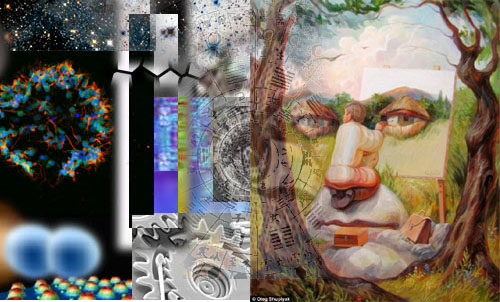
Think of the multisense continuum as a clarification of the holographic principle. What people often mean by holographic when ascribing it to the universe as a whole is something like ‘The Universe is not really real, but is a Matrix-like projection in which the totality is reflected in each part.’ If we ignore that theory for a moment and examine the linguistic origins of the word holographic instead, there are some worthwhile tie-ins to Multisense Realism. MSR is a way of stretching out this concept of holography, so that the extent to which it seems holographic is part of the hologram. Realism is not a fixed, absolute foundation, but an aesthetic quality of orientation. Realism is not a neutral designation of that which is factual versus that which is not, but also has a set of qualities, almost a personality which opposes the fantastic qualities of imagination, dreams, and psychosis. Where the aesthetics of fantasy are typically saturated, vivid, or florid, realism is relatively bland or rigid. Realism supports rigorous logic and causality. A graph can be thought of as the essence of realism in a way – not reality itself, but the mapping of the mappable aspects of reality…a realistic approach to realism.
Notice that holos and graph are polarized. They aren’t simple opposites where graph = parts and holos = whole, although graphing does break wholes into regular parts, but there is also a sense of a graph is of a static mental resource; an object or so called rigid body which we use to index information. A graph is a chart.* By contrast, holos is the uncharted and boundless context which does not respect strict divisions.
Holos means whole, but if you look up the etymology of hologram there is something interesting:
”hologram (n.)1949, coined by Hungarian-born British scientist Dennis Gabor (Gábor Dénes), 1971 Nobel prize winner in physics for his work in holography; from Greek holos “whole” (in sense of three-dimensional; see safe (adj.)) + -gram.”
So holos doubles as a term that has something to do with feeling ‘safe’:
”safe (adj.) c.1300, “unscathed, unhurt, uninjured; free from danger or molestation, in safety, secure; saved spiritually, redeemed, not damned;” from Old French sauf “protected, watched-over; assured of salvation,” from Latin salvus “uninjured, in good health, safe,” related to salus “good health,” saluber “healthful,” all from PIE *solwos from root *sol- “whole” (cognates: Latin solidus “solid,” Sanskrit sarvah “uninjured, intact, whole,” Avestan haurva- “uninjured, intact,” Old Persian haruva-, Greek holos “whole”). “
This root sense of wholeness as safety, solidity, health, healing, etc is the natural anchor of anchors…the foundational aesthetic (of the aesthetic foundation). All experiences in all possible universes must begin from this un-locused locus. Un-locused because it precedes its own definition or observation. The baby at the boob has no frame of reference, no learning process to understand the importance of nutrition or survival – there is only to appreciate the experience of being re-connected to the womb’s holos in a new and disorienting context…What is this context?
”-graph modern word-forming element meaning “instrument for recording; that which marks or describes; something written,” from Greek -graphos “-writing, -writer” (as in autographos “written with one’s own hand”), from graphe “writing, the art of writing, a writing,” from graphein “to write, express by written characters,” earlier “to draw, represent by lines drawn” (see -graphy). Adopted widely (Dutch -graaf, German -graph, French -graphe, Spanish -grafo). Related: -grapher; -graphic; -graphical.”
Compared with holos, -graph is a very different kind of term. Where holos is a rich and profound metaphor, -graph is a relatively prosaic and literal term about something in the real world…writing or recording. Holos is an appreciation of primordial safety; an orientation to a frame of reference which is absolute and beyond thought. Once someone is born into a human life or an animal’s life, this holos is buried in a cocoon of defenses which face the anti-holos of spacetime and physics and the sense that was formerly whole is averaged out as
“sole (adj.) “single, alone, having no husband or wife; one and only, singular, unique,” late 14c., from Old French soul “only, alone, just,” from Latin solus “alone, only, single, sole; forsaken; extraordinary,” of unknown origin, perhaps related to se “oneself,” from PIE reflexive root *swo- (see so).”
As a sole individual in a physical world, we have developed ways to re-connect with each other. Some of them are ways of reconnecting to our shared history as mammals and primates, and some, like writing are more recent human inventions. The idea of writing is to inscribe a thin stream of thought into physics, into spacetime so that others can recreate it in their local experience. It’s a bridge, a trans-fer or meta-phor, which means carrying over of feeling or meanings. What is the carrier?
”semaphore (n.)”apparatus for signaling,” 1816, probably via French sémaphore, literally “a bearer of signals,” ultimately from Greek sema “sign, signal” (see semantic) + phoros “bearer,” from pherein “to carry” (see infer). Related: Semaphoric (1808).”
The sema- or sign is a recontextualized piece of the world. We use it to passively bear our sharing of communication, as an insulator would bear a conducting wire, or a conducting wire would bear an electromagnetic flux. There are layers of nesting which span the continuum from holos to solus to meta to sema to graph.
Wholeness to self to likeness to sign to signed. The distance between our human self and the ‘signed’ or ‘graphed’ physical world is what gives that physical world its gravitas…its grave realism. Mortality adds a layer of biological gravity…the signs which threaten the self of the experience of life. The closer that a given phenomenon is to the whole, the more it is metaphorical and self-referential.
Once we grasp this continuum, we can see how subjective and objective phenomena are an elaboration of a theme of awareness and degrees of alienation from the whole. We can go into more advanced areas of understanding the continuum and see that while the graph end of sense reflects in micro the holos itself, it is only a reflection and has no generative power of its own. Even though we locally experience a tension between the holos and graph which seem equal, or even overpowered by physics, that is only because of how deeply our human experience is nested within billions of sensations, feelings, and thoughts since the beginning of spacetime.
In the absolute frame of reference, all is consumed by, with, and for holos. The graph appearance, and even the holographic principle is the local view of the self’s experience of being alienated. It’s a compromise between Descartes’ substance dualism and Eastern/perennial philosophy’s holism, but it is still fixed in the Cartesian graph of spacetime and Newton’s mechanics of mass and energy. We imagine that each physical particle is a packet containing a ghost of the whole, but I think that it now makes more sense to say that it is the particle itself which is, in the absolute frame or reference, more like the ghost. It’s relativistic, but all relation traces back to the orientation of the absolute. There is no orientation derived purely from disorientation, which is why we cannot build a sign or a self or a holos from a machine (graph).
*Descartes, whose family name means ‘of the charts’, and also can be associated with the French word charteus, meaning pertaining to papyrus/paper has an interesting connection to the role of Rene Descartes in developing the digital view of space in terms of Cartesian coordinates. Cards, charts and papers refer to objects which carry meaning – blank vehicles to be used either as a container for metaphor, or as the medium of choice for a stream of digital semaphores. The critical place that Descartes holds in the development of the Early Modern Period, cannot be overstated. In his 1641 Meditations, Descartes divided the cosmos, for better or worse, into mind and matter (res cogitans and res extensa), paving the way for Newton, Leibniz and others to see physics as an expression of precise mathematical truths. The Enlightenment Era marks the Western world’s separation from perennial, Eastern philosophy and the discovery of a new, Cartesian world of purely mechanical objects. The card, or graph aspect of the cosmos is seen as the new orientation, a counter-aesthetic to one which assumes theistic holos. The Western counter-aesthetic of modernism questions the beliefs of the past, asserting instead that the natural world is innocent of religious enchantment until proven otherwise.
 Multisense Realism
Recent Comments