Archive
“There is no information without representation”
My rebuttal to this from New Empiricism
Information is one of the most poorly defined terms in philosophy but it is a well defined concept in physical theory. How can it be that a clear idea in one branch of knowledge can be murky in another?
The physical meaning of information is succinctly summarised in the Wikibook on “Consciousness Studies”:
“The number of distinguishable states that a system can possess is the amount of information that can be encoded by the system.”
In most cases a “state of a system” boils down to arrangements of objects, either material objects laid out in the world or sequences of objects such as the succession of signals in a telephone line. So information is represented by physical things laid out in space and time. There is no information without this representation as an arrangement of physical objects.
Information can be processed by machines. As an example, computers use the “distinguishable states” of charge in electrical components to perform a host of useful tasks. They use the state of electrical charge in electronic components because charge can be manipulated rapidly and can be impressed on tiny components, however, computers could use the states of steel balls in boxes or carrots flowing on conveyor belts to achieve the same effect, albeit more slowly. There is nothing special about electronic computers beyond their speed, complexity and compactness. They are just machines that contain three dimensional arrangements of matter.
Philosophers use information in a much less well-defined fashion. Philosophical information is far more fuzzy and involves the quality of things such as hardness or blueness. So how does philosophical blueness differ from a physical information state?
Physical information about the world is a generalised state change that is related to particular events in the world and could be impressed on any substrate such as steel balls etc.. This allows information to be transmitted from place to place. As an example, a heat sensor in England could trigger a switch that opens a trapdoor that drops a ball that is monitored on a camera that causes changes in charge patterns in a computer that are transmitted as sounds on a radio in the USA. If the sound on the radio makes a cat jump and knock over a vase then it is probably valid to look at the vase and say “its hot in England”. So physical information is related to its source by the causal chain of preceding steps. Notice that each of these steps is a physical event so there is no information without representation as a state in the real world.
In the philosophical idea of information “hot” or “cold” are particular states in the mind. Our mental states are not uniquely related to the state of the world outside our bodies. As an example, human heat sensors are fickle so a blindfolded person might contain the state called “cold” when their hand is placed in water at 60 degrees or ice water at zero degrees. Our “cold” is subjective and does not have a fixed reference point in the world. Our own information is a particular state that could be induced by a variety of events in the world whereas physical information can be a variety of states triggered by a particular event in the world.
To summarise, information in physics is a state change in any substrate. It can be related to the state change in another substrate if a causal chain exists between the two substrates. Information in the mind is the state of the particular substrate that forms your particular mind.
Your mind is a state of a particular substrate but a “state” is an arrangement of events. The crucial questions for the scientist are “what events?” and “how many independent directions can be used for arranging these events?”. We can tell from our experience that at least four independent axes (or “dimensions”) are involved.
Note
The fact that there is no information without representation of the information as a physical state means that peculiar non-physical claims such as Cartesian Dualism and Dennett’s “logical space” are not credible.
Daniel C Dennett. (1991). Consciousness Explained. Little, Brown & Co. USA. Available as a Penguin Book.
Dennett says: “So we do have a way of making sense of the idea of phenomenal space – as a logical space. This is a space into which or in which nothing is literally projected; its properties are simply constituted by the beliefs of the (heterophenomenological) subject.” Dennett is wrong because if the space contains information then it must be instantiated as a physical entity, if it is not instantiated then it does not exist and Dennett is simply denying the experience that we all share to avoid explaining it. Either we have simultaneous events or are just a single point, if we have simultaneous events the space of our experience exists.
“So information is represented by physical things laid out in space and time.”
Why would physical things ‘represent’ anything though? Without some sensory interpretation that groups such things together so that they appear “laid out in space and time”, who is to say that there could be any ‘informing’ going on?
“computers use the “distinguishable states” of charge in electrical components to perform a host of useful tasks.”
Useful to whom? The beads of an abacus can be manipulated into states which are distinguishable by the user, but there is no reason to assume that this informs the beads, or the physical material that the beads are made of. Computers do not compute to serve their own sense or motives, they are blind, low level reflectors of extrinsically introduced conditions.
“Your mind is a state of a particular substrate but a “state” is an arrangement of events. ”
States and arrangements are not physical because they require a mode of interpretation which is qualitative and aesthetic. Just as there can be no disembodied information, there can be no ‘states’ or ‘arrangements’ which are disentangled from the totality of sensible relations, and from specific participatory subsets therein. Information is a ghost – an impostor which reflects this totality in a narrow quantitative sense which is eternal but metaphysical, and a physical sense which is tangible and present but in which all aesthetic qualities are reduced to a one dimensional schema of coordinate permutation. Neither information nor physics can relate to each other or represent anything by themselves. It is my view that we should flip the entire assumption of forms and functions as primitively real around, so that they are instead derived from a more fundamental capacity to appreciate sensory affects and participate in motivated effects. The primordial character of the universe can only be, in my view metaphenomenal, with physics, information, and subjectivity as sensible partitions of the whole.
Metaphysical vs Metaphenomenal
One of the most contentious areas in philosophy revolves around what I consider to be a misconception about the relation between the physical and phenomenal. In particular, the term ‘metaphysical’ forces supernatural connotations onto what would otherwise be non-ordinary but natural experiences and states of mind. I think that the problem is in failing to recognize the physical and phenomenal as each having their own ranges which both overlap and oppose each other. What I mean is, synchronicity and precognition are not metaphysical, they are metaphenomenal. The surprising part is that this means that the ordering of events in which we participate is actually a subjective experience nested within many other subjective and perhaps trans-subjective subjective experiences on different scales. Einstein talked about the relativity of simultaneity, and the metaphenomenal (aka collective unconscious) works in a similar way.
When we make time physical without acknowledging the role that phenomenology has in producing both the form and content of “time”, we introduce a false universal voyeur which effectively flattens all aesthetic qualities and participation into a one dimensional vector in one direction. By taking the term metaphysical, we unintentionally validate this flattened view of the universe in which physics is nature, and phenomenology, particularly deep or non-ordinary phenomenology, can only be non- or meta- physical and therefore supernatural, aka superstitious, aka illusory. If we look at how physics treats its own non-ordinary phenomena, such as quantum entanglement, quasars, and dark energy, we do not see the term ‘illusion’ or ‘folk astronomy’ being thrown around. Their strangeness is acknowledged in a way which invites curiosity rather than fear. The mystery is safely projected into the impersonal realm of physics and the super-impersonal realm of theoretical physics. By contrast, the metaphenomenal range is super-personal or transpersonal, containing experiences which challenge our conventional expectations about the realism of physical bodies, locality, and time.
It is not incorrect to say that for these reasons the metaphenomenal can be considered metaphysical, however I think that is where we are placing the emphasis on the wrong set of properties. Instead of using experiences such as intuition, synchronicity, and even divination as scientific clues to a super-personal range of awareness, we are distracted by the apparent contradiction to physics (as if ordinary awareness did not contradict physics already). To rehabilitate our perspective, I suggest considering the relation between the different ranges of physical (ontic) and phenomenal (telic) phenomena in this way:
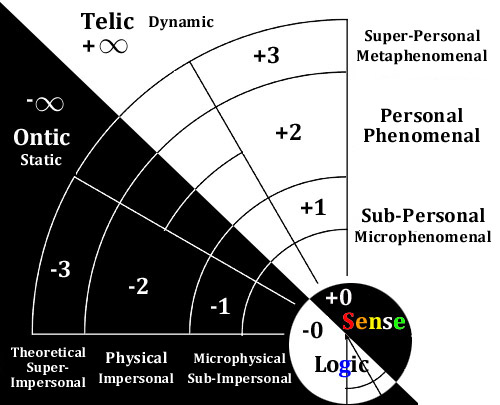
The term ‘paranormal’ is, like supernatural and metaphysical, the same kind of misnomer. If we see physics as a product of more primitive phenomenal sense, then it is consciousness itself which is doing the normalizing, so that it cannot be considered ‘normal’ itself. In another sense, since it is our consciousness which is defining normalcy, it does indeed identify its own regularity and meta-regularities and challenges those definitions as well. The metaphenomenal serves not only as an extension of the personal psyche into the collective unconscious, but also as a line in the sand beyond which sanity is not guaranteed.
Microphysical and Microphenomenal
The same thing occurs in another way, in an opposite way, on the bottom end of my chart. The sub-personal roots of microphenomenology and the sub-impersonal seeds of microphysics are the bottom up layers of causality and are more directly related than the top layers. The sub-personal (sub-conscious, id) urges and the microphysical (binary, semaphore-digital) are low level signs which are used to literally motivate and control. It is a common language of pushing things around.
To be able to exercise control it is necessary first to be able to see that which is to be controlled as separate in some sense from that which controls. There must be a way to sense them as ‘things’ or as a kind of inertial field which resists your intentions to cause a sensible effect. This experience of ‘things outside the self’ is the beginning of motivation, desire, intelligence, etc. In this way, motive and mechanism are born. The teeth in your mouth and the teeth of a gear exploit the same mechanical power to physically endure and prevail.
In the schema I propose, the fabric of the universe is tessellated or braided into these levels of nested counterpoint. The higher level objectifies the lower level into things because the higher level enjoys a more complete, but distanced panoramic view. The predator’s perspective engulfs the prey’s perspective. Biological organisms also objectify other living things and their own living body as higher than non-living things. Organisms with nervous systems take it one step beyond, seeing their own lives as a kind of meta-thing to direct as separate from the body. The human brain corresponds to a further, and perhaps ultimate mutation on the theme of self-reflection. There are physical implications for all of this but they have to do with time more than materials and structure. The expansion of time gives us more raw experiential material, more moments and more awareness of past and future within each moment. Technology and leisure make a virtuous cycle, bringing innovations which give us more things to do with our minds and bodies, and with the world.
Robert Anton Wilson wrote about the Jumping Jesus phenomenon – that it took X number of years for the first person to be born who had the impact of a Jesus or a Buddha, and how we now have several of them living at any particular moment. Buckminster Fuller and Terrence McKenna are among those who had this hyper-enthusiasm for the future which underlies today’s Singularity ethos. The ever ‘tightening gyre’, the transcendental object at the end of history, etc. It would seem, however, that at the same time, this enthusiasm is somehow perpetually deluded, and forever producing time wasting, leisure robbing coercions as well. As the acceleration increases, so does the mass, and a kind of stalemate plus or minus is maintained.
Conclusion
By shifting from the ad hoc, monolithic model of phenomenology as a kind of malfunctioning folk physics, or as physics belonging to an illusion that must be overcome spiritually, I propose a sense-based, multivalent view in which the metaphenomenal is understood to be both less than and more than physically real with high orthogonality, and the microphysical is understood to be less than and more than cosmologically meaningful with high isomrophism. The (one) mistake that David Chalmers made, in my opinion, is in accidentally introducing the idea of a zombie rather than a doll to the discussion of AI. Similar to error of the terms metaphysical and supernatural, the zombie specifies an expectation of personal level consciousness which is absent, rather than sub-personal level consciousness which is present on the microphysical levels. We can understand more clearly that a doll is not conscious on a personal level, no matter how many things it can say, or how many ways its limbs can be articulated. On the micro-physical level however, the material which makes up the doll expresses some sensory experience. It can be melted or frozen, broken or burned, etc. The material knows how to react to its environment sensibly and appropriately, and this is how material is in fact defined – by its sensible relations to material conditions. Just as we can assemble a 3D image on a 2D screen out of dumb pixels, so too can be automate a 5D human impostor on a 4D behavior stream of a doll.
By properly locating the micro-level physics beneath the personal-level phenomenology, we can see that beneath the micro-level physics there can be an even more primitive micro-phenomenology. On the top end as well, beyond the ontological truths of mathematics and logic, there are teleological apprehensions of aesthetics and meaning – without necessarily invoking a God personality (although that can work too, I just don’t see it as making as much sense as transpersonal Absolute).
*the super-impersonal is similar to the metaphenomenal in that it is difficult and esoteric, but opposite in that it is extrinsic rather than intrinsic. Where the metaphenomenal uses symbols as archetypes, loaded with metaphor and occult mystery, the superimpersonal (which would be more correct to call metaphysical) uses arcane mathematical and logical expressions. These are a kind of anti-metaphor as they relate to precisely defined, universally understood public information. The whole point is to expose the theory and completely, so that anyone is welcome to try to learn how to understand and use them, without any initiation rituals or strange pictures.
Computation as Shadow of Consciousness

I’m borrowing a (fantastic) image from
Incredible Shadow Art Created From Junk by Tim Noble & Sue Webster.
to make a point about the Map-Territory distinction and how it pertains to simulated intelligence.
Although a computer simulation produces an output over time, that does not mean that it is four dimensional (Time can be an additional dimension on any number of dimensions – a cartoon can be 2D but still last fifteen minutes.) By using the terms N and N-1 dimensional, I’m trying to make the point that no matter how extensive the measurements we make and how compelling their coherence seems to be, it can still be one dimension flatter than the original without our knowing it.
In the case of consciousness, I would say that it absolutely cannot be defined or described quantitatively, so that it truly is N dimensional, or trans-dimensional. Whatever number of dimensions we want to ascribe to some aspect of consciousness, that description will always be n-1 to the real thing. That is, in my understanding, the nature of representation – a destructive reduction of a presentation through a lower level (n-1 or n-x) medium which can be reconstructed by at the higher level if, and only if, there is a higher level interpreter.
Some might object to the metaphor on the grounds that computation is not like a shadow, since changing a computation has predictable effects, while changing a shadow’s appearance does not effect the object. That’s true, but again, in this case, I am using N dimensional phenomena, so that interactiveness is part of the conservation of the temporal, before and after/cause and effect axis. In such a scenario, the flatland effect itself is modified somewhat and there are more dimensions shared. More shared dimensions = more conservation of sensory-motive agreement, however, there is also more that is not shared (feeling, sensations, colors, understanding, for example).
Some who are more familiar with the spectacular capabilities of cutting edge computation might object to the over-simplification, and say that I am criticizing an older generation of approaches to machine learning. There is some truth to that, but in the rarefied air of higher math, we get into what I call the super-impersonal level of intelligence. By comparison, the super-personal level of awareness could be described as mythic or poetic. Synchronicity can be concentrated through divination techniques like Ouija boards and Tarot cards. The Platonic ‘realm’ accessed through ultra-sophisticated computation are, in my view, a dual of that kind of divination, except rooted in the generic and repeatable rather than the instantaneous and volitional. The computer is an oracle to impersonal truths about truth itself, and can build locally applicable strategies from there, however, it cannot factor in any kind of personal feeling or intention.
The computational oracle is much more seductive than divination, since it does not leave the interpretation up to the audience. The computational oracle’s output is to be interpreted as objective fact…which is tremendously useful of course, when we are talking about objects. The danger is when we start believing what it has to say about subejcts. As correct as the computer is about objective truth, it is equally incorrect about people. In the same/opposite way, the Ouija board is neither correct nor incorrect, but offers possibilities that tantalize the imagination.
Analogue, Brain Simulation Thread
Tell the difference between a set of algorithm’s in code that can mimic all the known processes for the input and output of a guitar into analogue equipment. The answer is no, because pros cant tell the difference. The entire analogue process has been sufficiently well modeled and encapsulated in the algorithmns. The inputs and outputs are physically realistic where the input and output are important. That is what substrate modelling of brain processes in computational neuroscience is about. i.e. Brain simulations.
Just because our analysis of what is going on in the brain reminds is of information processing does not mean that the brain is only an information processor, or that consciousness is conjured into existence as a kind of information-theoretic exhaust from the manipulation of bits.
What you are not considering is that beneath any mechanical or theoretical process (which is all that computation is as far as we know) is an intrinsic sensible-physical context which allows switches to load, store, and compare – allows recursive enumeration, digital identities,…a whole slew of rules about how generic functions work. This is already a low level kind of consciousness. That could still support Strong AI in theory, because bits being the tips of an iceberg of arithmetic awareness would make it natural to presume that low level awareness scales up neatly to high level awareness.
In practice, however, this does not have to be the case, and in fact what we see thus far is the opposite. The universally impersonal and uncanny nature of all artificial systems suggests the complete lack of personal presence. Regardless of how sophisticated the simulation, all imitations have some level at which some detector cannot be fooled. Consciousness itself however, like the wetness of water, cannot be fooled. No doll, puppet, or machine which is constructed from the outside in has any claim on sentience at the level which we have projected onto it. This is not about a substitution level, it is about the specific nature of sense being grounded in the unprecedented, genuine, simple, proprietary, and absolute rather than the opposite (probabilistic, reproducible, complex, generic, and local). From the low level to a high is not a difference in degree, but a difference in kind, even though the difference between the high level and low level is a difference in degree.
What I mean by that is that anything can be counted, but numbers cannot be reconstructed into what has been counted. I count my fingers…1, 2, 3, 4, 5. We have now destructively compressed the “information” of my hand, each unique finger and the thumb, into a figure. Five. Five can apply generically to anything, so we cannot imagine that five contains the recipe for fingers. This is obviously a reductio ad absurdum, but I introduce it not as a straw man but as a clear, simple illustration of the difference between sensory-motive realism and information-theoretic abstractions. You can map a territory, but you can’t make a territory out of a map regardless of how much the map reminds you of the territory.
So yes, digital representations can seem exactly like analog representations to us, but they are both representations within a sensory context rather than a sensory-motive presentation of their own. All forms of representation exist to communicate across space and time, bridging or eliding the entropic gaps in direct experience. It’s not a bad thing that modeling a brain will not result in a human consciousness, its a great thing. If it were not, it would be criminal to subject living beings to the horrors of being developed and enslaved in a lab. Fortunately, by modeling these beautiful 4-D dynamic sculptures of the recordings of our consciousness, we can tap into something very new and different from ourselves, but without being a threat to us (unless we take it for granted that they have true understanding, then we’re screwed).

Emergent Noumena
Noumenon, plural Noumena, in the philosophy of Immanuel Kant, the thing-in-itself (das Ding an sich) as opposed to what Kant called the phenomenon—the thing as it appears to an observer. Though the noumenal holds the contents of the intelligible world, Kant claimed that man’s speculative reason can only know phenomena and can never penetrate to the noumenon. Man, however, is not altogether excluded from the noumenal because practical reason—i.e., the capacity for acting as a moral agent—makes no sense unless a noumenal world is postulated in which freedom, God, and immortality abide.
The relationship of noumenon to phenomenon in Kant’s philosophy has engaged philosophers for nearly two centuries, and some have judged his passages on these topics to be irreconcilable. Kant’s immediate successors in German Idealism in fact rejected the noumenal as having no existence for man’s intelligence. Kant, however, felt that he had precluded this rejection by his refutation of Idealism, and he persisted in defending the absolute reality of the noumenal, arguing that the phenomenal world is an expression of power and that the source from which this power comes can only be the noumenal world beyond.
A central thesis of my approach is that the assumption of noumena should also be assumed to be a ‘thing as it appears to an observer’. In the case of our own experience, we are the observer – really the participant. Even the term observer smuggles in a way of framing ontology to imply non-phenomenal facts.
In my view, Locke’s assumption of qualities like color and feeling as Secondary, while properties like position and shape are Primary, while true from the local perspective, should be (like the image on our retina) considered inverted from an absolute perspective. It’s easy to turn colors or feelings into numbers and points on a graph, just by counting them and arranging what has been counted. It’s impossible, however, to derive colors from structures or information alone.
What this means is that the capacity to discern noumena from phenomena is itself a phenomenal property. It varies by both degree and kind. This quality is often known by names like ‘sanity’ and ‘common sense’, and while our access to it as individuals depends on local neurological conditions, local neurological conditions probably depend on an even lower level of sanity on the microphenomenal scale to maintain the integrity of the microphysical world which cells and neurons inhabit.
If that’s true, and what we call sanity, a kind of preservative inertia of sensory and meta-sensory interpretation goes all the way down, then physics itself should be described as the modulation of that sanity. A superposition of superpositions if you will, as locality which generalizes and re-localizes what it has generalized. If we think of the Newtonian-Cartesian universe as made of ideal particles in a void, the Einsteinian universe idealized the void, and the Quantum universe turned the particles into bubbles un-disappearing in that void. What I propose is to put see bubbling itself as a property of reflection and contrast. Drill down into the surface of the bubble and see that it is nothing but aesthetics derived from some perspective and mode of detection. It is the possibility of phenomena that matters. Noumena without phenomena is identical to nothingness, but phenomena without noumena changes nothing, provided that phenomena diverges from its own sensory-motive properties, rather than emerges from abstract non-phenomena.
Chess, Media, and Art
I was listening to Brian Regan’s comedy bit about chess, and how a checkmate is such an unsatisfying ending compared to other games and sports. This is interesting from the standpoint of the insufficiency of information to account for all of reality. Because chess is a game that is entirely defined by logical rules, the ending is a mathematical certainty, given a certain number of moves. That number of moves depends on the computational resources which can be brought to bear on the game, so that a sufficiently powerful calculator will always beat a human player, since human computation is slower and buggier than semiconductors. The large-but-finite number of moves and games* will be parsed much more rapidly and thoroughly by a computer than a person could.
This deterministic structure is very different (as Brian Regan points out) from something like football, where the satisfaction of game play is derived explicitly from the consummation of the play. It is not enough to be able to claim that statistically an opponent’s win is impossible, because in reality statistics are only theoretical. A game played in reality rather than in theory depends on things like the weather and can require a referee. Computers are great at games which depend only on information, but have no sense of satisfaction in aesthetic realism.
In contrast to mechanical determinism, the appearance of clichés presents a softer kind of determinism. Even though there are countless ways that a fictional story could end, the tropes of storytelling provide a feedback loop between audiences and authors which can be as deterministic -in theory- as the literal determinism of chess. By switching the orientation from digital/binary rules to metaphorical/ideal themes, it is the determinism itself which becomes probabilistic. The penalty of making a movie which deviates too far from the expectations of the audience is that it will not be well received by enough people to make it worth producing. Indeed, most of what is produced in film, TV, and even gaming is little more than a skeleton of clichés dressed up in more clichés.
The pull of the cliché is a kind of moral gravity – a social conditioning in which normative thoughts and feelings are reinforced and rewarded. Art and life do not reflect each other so much as they reflect a common sense of shared reassurance in the face of uncertainty. Fine art plays with breaking boundaries, but playfully – it pretends to confront the status quo, but it does so within a culturally sanctioned space. I think that satire is tolerated in Western-objective society because of its departure from the subjective (“Eastern”) worldview, in which meaning and matter are not clearly divided. Satire is seen as both not as threatening to the material-commercial machine, which does not depend on human sentiments to run, and also the controversy that satire produces can be used to drive consumer demands. Something like The Simpsons can be both a genuinely subversive comedy, as well as a fully merchandized, commercial meme-generating partner of FOX.
What lies between the literally closed world of logical rules and the figuratively open world of surreal ideals is what I would call reality. The games that are played in fact rather than just in theory, which share timeless themes but also embody a specific theme of their own are the true source of physical sustenance. Reality emerges from the center out, and from the peripheries in.
*“A guesstimate is that the maximum logical possible positions are somewhere in the region of +-140,100,033, including trans-positional positions, giving the approximation of 4,670,033 maximum logical possible games”
Consciousness and The Interface Theory of Perception, Donald Hoffman
A very good presentation with lot of overlap on my views. He proposes similar ideas about a sensory-motive primitive and the nature of the world as experience rather than “objective”. What is not factored in is the relation between local and remote experiences and how that relation actually defines the appearance of that relation. Instead of seeing agents as isolated mechanisms, I think they should be seen as more like breaches in the fabric of insensitivity.
It is a little misleading to say (near the end) that a spoon is no more public than a headache. In my view what makes a spoon different from a headache is precisely that the metal is more public than the private experience of a headache. If we make the mistake of assuming an Absolutely public perspective*, then yes, the spoon is not in it, because the spoon is different things depending on how small, large, fast, or slow you are. For the same reason, however, nothing can be said to be in such a perspective. There is no experience of the world which does not originate through the relativity of experience itself. Of course the spoon is more public than a headache, in our experience. To think otherwise as a literal truth would be psychotic or solipsistic. In the Absolute sense, sure, the spoon is a sensory phenomena and nothing else, it is not purely public (nothing is), but locally, is certainly is ‘more’ public.
Something that he mentioned in the presentation had to do with linear algebra and using a matrix of columns which add up to be one. To really jump off into a new level of understanding consciousness, I would think of the totality of experience as something like a matrix of columns which add up, not to 1, but to “=1”. Adding up to 1 is a good enough starting point, as it allows us to think of agents as holes which feel separate on one side and united on the other. Thinking of it as “=1” instead makes it into a portable unity that does something. Each hole recapitulates the totality as well as its own relation to that recapitulation: ‘just like’ unity. From there, the door is open to universal metaphor and local contrasts of degree and kind.
*mathematics invites to do this, because it inverts the naming function of language. Instead of describing a phenomenon in our experience through a common sense of language, math enumerates relationships between theories about experience. The difference is that language can either project itself publicly or integrate public-facing experiences privately, but math is a language which can only face itself. Through math, reflections of experience are fragmented and re-assembled into an ideal rationality – the ideal rationality which reflects the very ideal of rationality that it embodies.
Questioning the Sufficiency of Information
Searle’s “Chinese Room” thought experiment tends to be despised by strong AI enthusiasts, who seem to take issue with Searle personally because of it. Accusing both the allegory and the author of being stupid, the Systems Reply is the one offered most often. The man in the room may not understand Chinese, but surely the whole system, including book of translation, must be considered to understand Chinese.
Here then is simpler and more familiar example of how computation can differ from natural understanding which is not susceptible to any mereological Systems argument.
If any of you have use passwords which are based on a pattern of keystrokes rather than the letters on the keys, you know that you can enter your password every day without ever knowing what it is you are typing (something with a #r5f^ in it…?).
I think this is a good analogy for machine intelligence. By storing and copying procedures, a pseudo-semantic analysis can be performed, but it is an instrumental logic that has no way to access the letters of the ‘human keyboard’. The universal machine’s keyboard is blank and consists only of theoretical x,y coordinates where keys would be. No matter how good or sophisticated the machine is, it will still have no way to understand what the particular keystrokes “mean” to a person, only how they fit in with whatever set of fixed possibilities has been defined.
Taking the analogy further, the human keyboard only applies to public communication. Privately, we have no keys to strike, and entire paragraphs or books can be represented by a single thought. Unlike computers, we do not have to build our ideas up from syntactic digits. Instead the public-facing computation follows from the experienced sense of what is to be communicated in general, from the top down, and the inside out.
How large does a digital circle have to be before the circumference seems like a straight line?
Digital information has no scale or sense of relation. Code is code. Any rendering of that code into a visual experience of lines and curves is a question of graphic formatting and human optical interaction. With a universe that assumes information as fundamental, the proximity-dependent flatness or roundness of the Earth would have to be defined programmatically. Otherwise, it is simply “the case” that a person is standing on the round surface of the round Earth. Proximity is simply a value with no inherent geometric relevance.
When we resize a circle in Photoshop, for instance, the program is not transforming a real shape, it is erasing the old digital circle and creating a new, unrelated digital circle. Like a cartoon, the relation between the before and after, between one frame and the “next” is within our own interpretation, not within the information.
Playing Cards With Qualia
Here is an example to help illustrate what I think is the relationship between information and qualia that makes the most sense.

Here I am using the delta (Δ) to denote “difference”, n to mean “numbers” or information, kappa for aesthetic “kind” or qualia, and delta n degree (Δn°) for “difference in degree”.
The formula on top means “The difference between numbers and aesthetic qualities is not a difference in degree. This means that there is no known method by which a functional output of a computation can acquire an aesthetic quality, such as a color, flavor, or feeling.
Reversing the order in the bottom formula, I am asserting that the difference between qualia and numbers actually is only a difference in degree, not a difference in kind. That means that we can make numbers out of qualia, by counting them, but numbers can’t make qualia no matter what we do with them. This is to say also that subjects can reduce each other to objects, but objects cannot become subjects.
Let’s use playing cards as an example.
Each card has a quantitative value, A-K. The four suits, their colors and shapes, the portraits on the royal cards…none of them add anything at all to the functionality of the game. Every card game ever conceived can be played just as well with only four sets of 13 number values.
The view which is generally offered by scientific or mathematical accounts, would be that the nature of hearts, clubs, diamonds, kings, etc can differ only in degree from the numbers, and not in kind. Our thinking about the nature of consciousness puts the brain ahead of subjective experience, so that all feelings and qualities of experience are presumed to be representations of more complicated microphysical functions. This is mind-brain identity theory. The mind is the functioning of the brain, so that the pictures and colors on the cards would, by extension, be representations of the purely logical values.
To me, that’s obviously bending over backward to accommodate a prejudice toward the quantitative. The functionalist view prefers to preserve the gap between numbers and suits and fill it with faith, rather than consider the alternative that now seems obvious to me: You can turn the suit qualities into numbers easily – just enumerate them. The four suits can be reduced to 00,01,10, and 11. A King can be #0D, an Ace can be 01, etc. There is no problem with this, and indeed it is the natural way that all counting has developed: The minimalist characterization of things which are actually experienced qualitatively.
The functionalist view requires the opposite transformation, that the existence of hearts and clubs, red and black, is only possible through a hypothetical brute emergence by which computations suddenly appear heart shaped or wearing a crown, because… well because of complexity, or because we can’t prove that it isn’t happening. The logical fallacy being invoked is Affirming the Consequent:
If Bill Gates owns Fort Knox, then he is rich.
Bill Gates is rich.
Therefore, Bill Gates owns Fort Knox.
If the brain is physical, then it can be reduced to a computation.
We are associated with the activity of a brain.
Therefore, we can be reduced to a computation.
To correct this, we should invert our assumption, and look to a model of the universe in which differences in kind can be quantified, but differences in degree cannot be qualified. Qualia reduce to quanta (by degree), but quanta does not enrich to qualia (at all).
To take this to the limit, I would add the players of the card game to the pictures, suits, and colors of the cards, as well as their intention and enthusiasm for winning the game. The qualia of the cards is more “like them” and helps bridge the gap to the quanta of the cards, which is more like the cards themselves – digital units in a spatio-temporal mosaic.
 Multisense Realism
Recent Comments