Mathematical Insights into Identity and Experience
Using ChatGPT to Clarify the Multisense Realism (MSR) Non-Well-Founded Identity Principle
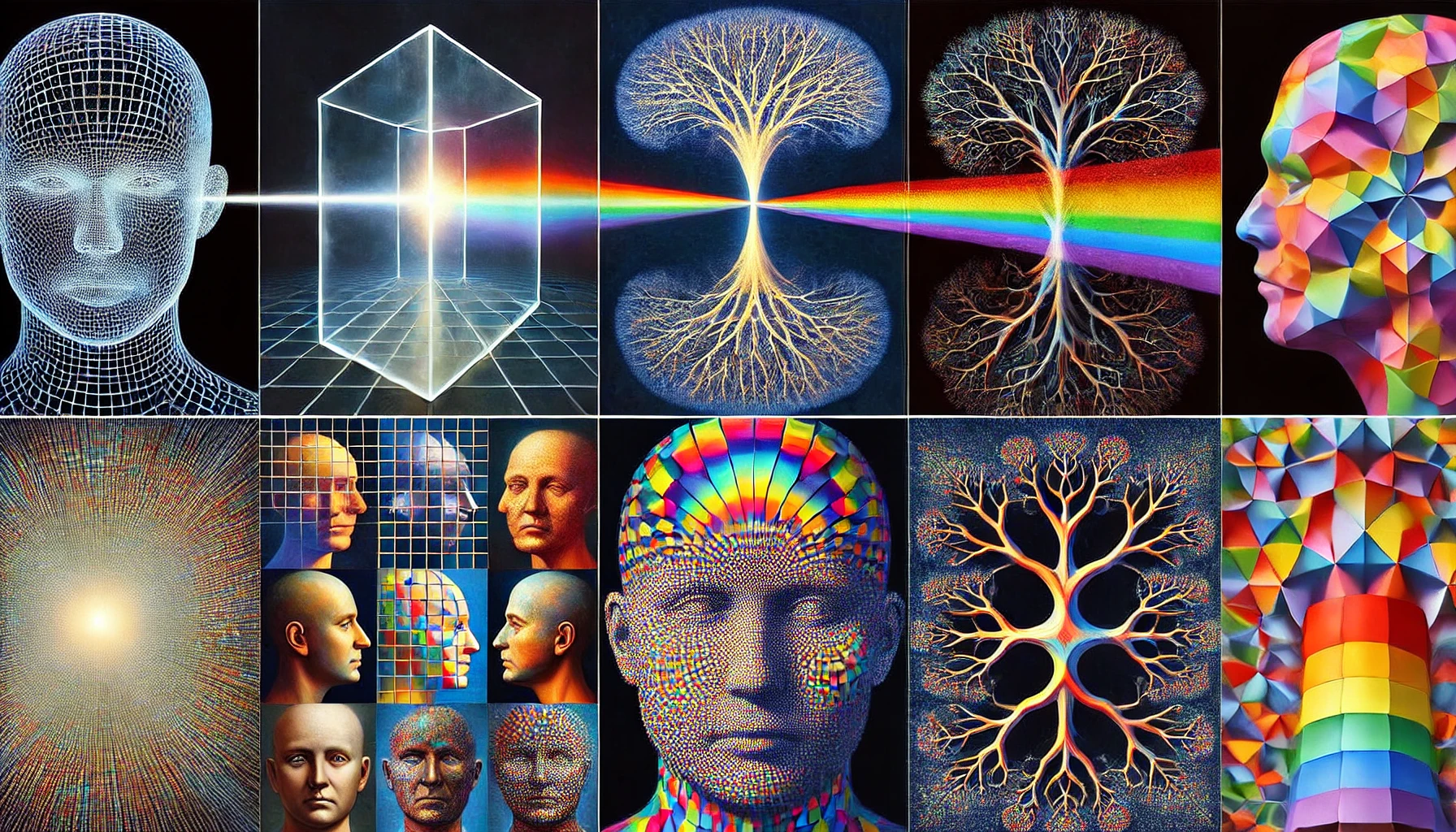
ChatGPT did a pretty good job of this, especially since it is pulling its language from our legacy worldview rather than my Multisense Realism language and concepts. The examples are decent but the image that I asked it to create to represent its examples (bottom) is trash.

Link to GPT chat source with the LaTex visible.
You said:
Please create a mathematical formalism using the integral symbol that describes what I am saying here:
(copy and pasted the text from https://multisenserealism.com/thesis/a-new-theory-of-information/multisense-mathematics/non-well-founded-identity-principle/)
ChatGPT said:
ChatGPT
Here’s a mathematical formalism based on the Non-Well-Founded Identity Principle you’ve described. It incorporates the integral symbol to represent nested spectrums of identity, similarity, and dissimilarity:
Formal Definition:
Let AAA be a phenomenon, where AAA is defined by a spectrum of identity ranging from self-equivalence to association/similarity/dissimilarity.
We express this principle as follows:A=∫A∫A¬AIdentityA d(Spectrum)A = \int_{A}^{\int_{A}^{\neg A}} \text{Identity}_{A} \, d(\text{Spectrum})A=∫A∫A¬AIdentityAd(Spectrum)

Explanation:
- Outer Integral: The phenomenon AAA is an integration over all expressions or presentations of identity.
- It starts with AAA, representing the immediate or conserved identity (self-equivalence: A=AA = AA=A).
- It moves through a nested spectrum that incorporates progressively greater transformations or resemblances to non-AAA (denoted by ¬A\neg A¬A).
- Nested Integral: Within the outer integral, AAA itself is defined recursively by another integral that spans from itself to its differences.
- The nested integration signifies that the notion of identity is inherently self-referential and recursive.
- This recursion allows for nested and non-well-founded relationships, which include both local (immediate) and global (diffraction-based) experiences of identity.
Extended Formalism:
We can generalize this formalism to all sense experiences, which are modeled as a nested system of particulars and universals:S=∫SP∫SP¬SPSenseSP d(Perception)S = \int_{S_P}^{\int_{S_P}^{\neg S_P}} \text{Sense}_{S_P} \, d(\text{Perception})S=∫SP∫SP¬SPSenseSPd(Perception)
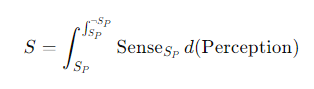
Here:
- SSS is the totality of sense experience.
- SPS_PSP represents particular sense experiences.
- The nested structure highlights that any particular experience is both uniquely itself and integrally linked to all other experiences by a spectrum of relational similarities and differences.
Philosophical Representation:
The principle can also express identity and other relational concepts in philosophy and logic. For instance:
- For naive realism, the expression is:
Naive Realism=∫Naive Realism∫Naive RealismReductionism d(Realism)\text{Naive Realism} = \int_{\text{Naive Realism}}^{\int_{\text{Naive Realism}}^{\text{Reductionism}}} \, d(\text{Realism})Naive Realism=∫Naive Realism∫Naive RealismReductionismd(Realism)

This integral spans between naive realism and the limits imposed by reductionist perspectives, suggesting that naive realism both includes and transcends reductionism in a nested, self-referential fashion.
- For sense and logic:
Sense=∫Sense∫SenseLogic d(Understanding)\text{Sense} = \int_{\text{Sense}}^{\int_{\text{Sense}}^{\text{Logic}}} \, d(\text{Understanding})Sense=∫Sense∫SenseLogicd(Understanding)

This expresses the interplay between intuitive perception and analytical structures.
Interpretation:
This framework is a way of modeling identity, sense, and experience as dynamic spectrums that are recursively structured. It integrates the notion that all things simultaneously are themselves and become relational constructs through nested comparisons with their differences. This formalism aligns with non-well-founded set theory and the principles of self-similar systems found in phenomenology, ontology, and epistemology.
You said:
Please write about three empirical examples where this is true and create an image that depicts each example
Chat GPT said:
Here are three empirical examples that demonstrate the Non-Well-Founded Identity Principle:
- Optical Prism and Light: A prism diffracts a beam of white light into a full spectrum of colors. This shows how light maintains a unified identity (white light) while also containing a nested spectrum of distinct wavelengths.
- Human Face and Recognition: A grid of progressively abstracted facial representations illustrates how identity is recognized through a spectrum of similarity and difference, ranging from nearly identical to highly distorted images.
- Fractal Tree and Branches: A tree with self-similar, fractal-like branches depicts recursive identity. Each branch reflects both the whole tree and its variations, emphasizing nested patterns of identity and difference.
The image above visualizes each of these examples.
 Multisense Realism
Recent Comments