Archive
Is ‘consciousness’ merely another ‘spectrum’ we haven’t yet unraveled?
I sometimes wonder if ‘consciousness’ or ‘awareness’ or ‘enlightenment’ might be terms which relate to a “spectrum” similar to the light, sound, and other ‘spectrums’ we’re familiar with.
Perhaps our “level of understanding” can only attain to certain depths (or heights, depending how we perceive it) because of limitations we have not yet learned how to effectively overcome for purposes of studying and evaluating?
Perhaps there IS a ‘spirit world’ all around is…a ‘quantum-shifted-world’ that we’re just not ‘tuned into’ because our brains cannot yet deal with such things?
What do YOU think?
Yes, I do think that consciousness can be described in terms of a fundamental spectrum from which all other physical and functional phenomena are derived. I call it the multisense continuum and unlike other phenomena with fixed relation, the continuum of sense is interactively relativistic as well as relativistically absolute. This sounds confusing, but think of it like an ambiguous image:
While the image is absolute in the sense that it reliably offers the opportunity to encounter two mutually exclusive visual interpretations, but relativistic in that the viewer of the image is not merely an observer, but a participant on guiding their encounter. It is not a subjective confabulation, but rather a demonstration of how objectivity itself is not what it seems…or that subjectivity is not a reliable measurement of objects. In this way, the ambiguous image leads to an ambiguous interpretation, through which one can confirm their own expectations about either the permeability of reality to consciousness, the fallibility of perception, or both.
If we model the spectrum of consciousness, I would give this polarization of ambiguity in which either the inner or outer frame of reference is assumed to be the fundamental anchor and the opposing frame is assumed to be ‘illusory’ to some extent the role of ‘frequency’. To keep it simple, we could talk about the frequency as the X axis, so that high frequency is more ‘outer’, inclusive of more bodies in public space and the low frequency is more interior, describing amplitudes of private feeling and meaning. The high frequency range can be thought of as an Intelligence space (which I label as ‘Western’ public knowledge) and the low frequency range can be thought of as an orienting hierarchy of private wisdom (the ‘Oriental’ range).
I suggest that there is an inverse relation between the two ranges, so that the higher the frequency, the lower the amplitude. This means that the more distant two perspectives are, the more they are limited to a reduced, mechanized picture of each other. When we fly over a city, for example, we see people and cars from a more detached perspective. It seems possible to me that this relativity of perception through which personal identification is framed, is part of the deepest fabric of the universe, and is in fact responsible for the appearance of the difference between matter and ‘mind’ (subjectivity).
In this way, objectivity itself becomes a relativistic parameter, something like a Lorentz transformation. Adding distance to your perspective increases the frequency and lowers the amplitude of mutual perception so that consciousness is ‘objectified’. Matter is not created, but filtered from nested layers of perception. Within any local inertial frame, there is no matter or objects. We, as human beings, are a very elaborate case, in that our selfhood is a vast window of many frequency bands, so that we have tiered sensation. Visual imagination is more object-like than verbal-cognitive thought, and thought is more object like than emotions and intuition. In the core of our subjectivity however, is that which occupies no dimension, as it observes both spaces and times from a fixed inner ‘eye’.
This eye, having the lowest local frequency can be understood to be the proxy for the absolute lowest frequency, which would I would describe somewhat mystically as one in which eternity must pass before even a single wave cycle can by completed. I suggest that this low frequency range offers the highest amplitude possibilities. Amplitude can be used to distinguish the inner from the outer frequencies as well. On the Western side, high and low amplitude are embodied literally as cosmic and microcosmic scale ranges, and as directions of spin. Amplitude in this sense is associated with magnetic permeability and gravity. On the Oriental side, amplitude is associated with hierarchies of aesthetic prestige. By that I mean the difference between a pawn and a King, and between bad and good, better and best.
The low frequency amplitudes are ‘moving’ from the inside out. The model of chakras used in yogic practice is one of many tree-of-life models of what I am calling here the amplitude of human consciousness. With consciousness, we are talking about sensory-motive capacity, so that a high amplitude consciousness implies both a high quality of sensory affect and a highly effective motivation. Higher positive amplitudes motivate from acceptance and inspiration, while high negative amplitudes motivate from urgent compulsion. There is a connection here with mortality as well, as the highly ‘negative’ states are rooted in the desires of the body and of the selfish ego. The ‘positive’ states are supposed to be motivated by gentle, patient influences which waft upward toward the eternal.
Even though the kind of Lorentz frame relation that I described earlier makes it harder to know whether a snail’s awareness just seems low compared to ours because of our ‘distance’ from them, I prefer to think that there is also an absolute dimension to consciousness in addition to the relativistic effect which makes human life more aesthetically rich and significant than that of a snail. The alternative would be more radically anthropic, in which every species enjoys a universe that features them at center stage. That view could conceivably be possible, but it has implications that seem likely to be very dangerous.
If the high/low frequency divide determines whether phenomena are encountered directly as inner sensations or sensed through the body as separate bodies, the high/low amplitude divide determines whether phenomena are valued highly or rejected. For human beings, we tend to place ourselves above other species of animals, and animals above insects and plants. High end states of being are considered ‘high class’ or ‘high and mighty’; celebrities, heroes, monarchs, spiritual entities etc. Even the self (itself) transforms along with the amplitude which it conveys, so that low amplitude version is like an animal ‘eye’, the mid-range is a human ‘I’, and the high end is third eye or ‘aye’ – a connection with transcendent or divine states of awareness and acceptance.
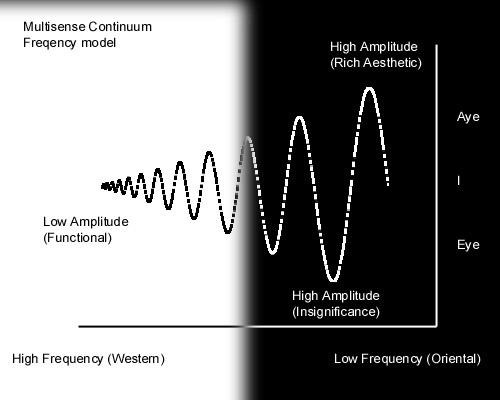
This layout is just a rough speculation of course. I find parallels with electromagnetism here that make me think that a more formal connection with physics could be made. In that case, I would not insist that frequency or amplitude be applied literally – they could be reversed, or even set liminocentrically so that high-low frequencies or high-low amplitudes could serve as the contrast to mid-range frequency-amplitudes instead.
Misrepresentation of “Reality”?
//consciousness /is/ a misrepresentation of reality.//
In order for consciousness to mis-represent reality, there would have to be a possibility of a proper representation to exist /without/ consciousness. If that is true then you have unconscious representation, which means philosophical zombies eat Strong AI.
If that is not true, and reality can only be found within consciousness and never beyond it, then we must accept that reality and consciousness are either the same thing, or that reality is a subset of consciousness rather than the other way around (since we know that we can imagine immaterial alternatives to reality at will). Just from that alone I think common sense would lead us in the direction of idealism and panpsychism.
There really seems to be no good case for material realism to produce consciousness, except for the case which we build from the unshakable conviction of the objectively real appearance of the contents of a neurological simulation which is known to be defective in rendering even itself. Ironically, it is those who so mistrust direct perception who have absolute faith in indirect perception.
Dark Math and the Vanishing of Zero
Some bits of Facebook conversations that I have been waiting to have about math. I don’t claim to be even a little bit competent as a mathematician, but I do feel like there is a chance that these ideas might just happen to be so absurd that they are profound. Among these ideas has been the consequences of making zero disappear, and redefining the number one so that it is the container of mathematics itself.
There was another idea that I proposed today of “Dark Math”. I asked the question “Does math have a language/theory to represent its own opposite (independent of consciousness even, just like imaginary numbers, but imaginary anti-math instead)?”
If we turn Incompleteness around, for example, we get something like intuition. Any informal-non-system contains unanticipated reflections of formality..surprising quasi-truthful insights from out of thin air, like an oracle. If we turn Church-Turing around, we get non-universal, non-machines = unique individuals. My suspicion is that such a language would help define or model previously undefinable phenomenological conditions. Anti-numbers, (names which are intrinsically semi-proprietary?), Anti-operators (metaphorical and synchronistic?)
Then the zero idea came up again…
OH: A complex number z is said to be purely imaginary. If it has no real part, i.e., R[z] = 0. The term is often used in preference to the simpler “imaginary” in situations where z can in general assume complex values with nonzero real parts, but in a particular case of interest, the real part is identically zero. 0 is a pure imaginary number .
S33: If the part is identically zero, but zero is entirely imaginary, does that mean that its identicality is also imaginary? If we carry through the idea that 0 is imaginary, then any time we qualify something as being ‘not’ we are being figurative, and the reality would always be some infinitessimal fragment. Not would literally be ‘almost not’.
OH: http://mathworld.wolfram.com/IdenticallyZero.html
S33: But what I’m proposing is that vanishing itself is identically zero, then vanishing may be infinitesimally figurative. Nothing can vanish completely in reality, even the difference between A and A.
Can zero be said then to be ‘that which is not anything, *not even itself*. When we apply this to ontology (and I think we should) it means we must accept that nothing has vanished. What happens instead is that things nearly vanish from some set of perspectives. The gap between nearly vanishing and vanishing is entropy. Entropy is how perception compensates, fudges, fills in, etc so that what is for all practical purposes absent (i.e. the past) becomes elided or removed. Even the removal is not total, not real, its just a delay. Eventually all that has been denied must be revealed as unvanished from some perspective or encounter.
The reverse of this entropic clipping of the infinitesimally unvanished would be what I call significance. An augmentation of sensitivity or motive so that a near-vanished experience is encountered first as fiction. In other words, entropy makes things seem to disappear (like the past, coherence, certainty, etc) which really haven’t, and significance makes things seem to appear, but also significance increases the quality of ‘thingness’ beyond the thing. You could say that entropy masks presence to the point of near absence, and significance stretches near-absence to the point of re-presence.
Video Debate on God and Consciousness
Can consciousness be best explained by God’s existence?
Hamza Tzrotzis section:
Very nice presentation, and I can find agreement with much of it. I do find a problem with the idea that theism explains ‘where consciousness comes from’, since God cannot be said to exist prior to God’s consciousness. Can God be unconscious? If not, can we say for sure that consciousness does not create God instead of the other way around?
This goes along with the sentiment expressed earlier in examining the shortcomings of panpsychism, when he asks ‘what is thought without a thinker?’ While this is certainly difficult to imagine in a normal state of mind, I have experienced dream states in which there was a dream, but it was more like a film, and I woke up specifically noticing that I did not find myself in the movie or in the audience. The experience of the movie simply was. In light of this, and the fact that human beings occupy such a minute and idiosyncratic position within the biosphere of this planet, I would not rule out the possibility that our waking experience of human ego might be limited to animals or certain animals, owing to their autonomy of movement. The vast majority of phenomena in the universe may indeed be felt experiences without an experiencer per se.
Even if this is true, the idea that the universe is composed of consciousness (awareness, or to be more technical, aesthetic participation/sensory-motive re-acquaintance), even proprietary qualities of awareness, but without an overriding executive, there could still be God-like influences within or through the larger potential of our human consciousness. Retrocausality, synchronicity, intuition, and other exotic metaphenomenal conditions may indeed flirt with the boundary between reality and surreality to produce veridical insights and delusional obsessions alike. God may be no more than a figment of consciousness, just as we are, but that doesn’t mean that human consciousness does not include some kind of meta-human guidance for some people at some time, although such guidance may be indistinguishable from mental illness.
Professor Simons section:
Opens well, setting the stage for a criterial of success for explanation in science. I hadn’t heard before the origin of the word melancholia before (black-bile). He goes on to look at intentionality and awareness and asserts that there is nothing that it is like to be a stone. I agree superficially, that what we see of a stone does not express any intention, but given the vastly different scale of time between ourselves and geological time, it is conceivable that what we encounter as static minerals are, within another frame of reference, some unfamiliar kind of experience. Rocks don’t have feelings, but they may *be* feelings – slow, or intermittent feelings which perhaps only awaken when there is a significant change in physical state. When rocks collide, something may feel something, even if it is not the rock itself as we experience it.
I like that he embraces being honest about the shortcomings of science in explaining phenomenality (the Hard Problem). His examples of evolved body parts which have been repurposed could apply to consciousness in theory, but I submit that would have to be a very superficial theory that overlooks the completely anti-physical nature of consciousness. Unlike an ear, awareness is not a plausible feature of some unrelated physical system.
I appreciate Professor Simons call for modesty in consideration of supernatural explanation, but I’m not sure that alone constitutes a refutation. It may be more reckless to insist upon a naturalistic explanation to the exclusion of all explanations which happen to transcend the spatiotemporal aspects of nature.
It seems to me that rather than presuming God as a literal being, we should try thinking of the various theological concepts as a metaphor for being itself – for consciousness. We can learn about consciousness by our own intuitive accounts, written in the native mytho-poetic language of what I call the ‘metaphenomenal’ layer of awareness. God is something like the local, human-shaped shadow of the infinite potential of the future of consciousness. By itself, the universe is only theological and meaningful on the inside. It is up to consciousness, to conscious beings, to imbue the exterior world with divine shades of care and attention. God is not for being, but for becoming.
I liked Simons parting comments about Spinoza and dual-aspect theory. He says, (as most would agree) that consciousness is a process, not a thing. I suggest that consciousness is neither, rather it is the eternal firmament from which processes and things are ‘carved out’ (by time and space…types of entropy or reduced sense). Locally, our human experience is very elaborately enfolded multiple times into spacetime, so that it does actually take on nested process-like characteristics as well. Just as the entire life of our body is the story of a single cell in self-replication/modification, the story of our lives is a single moment stretched out into innumerable sub-moments.
Both critiques of panpsychism I think are ultimately rejections of a straw man. Nobody, Leibniz included I’m sure, thinks that electrons ‘have’ human-like consciousness, but that is completely beside the point, IMO, in considering whether the fabric of nature is more likely sensitive vs physical, information-theoretic, or theological. In those terms, I find it easy to account for physical, informational, and spiritual phenomena as elaborations of sensory experience, but I find no real way to justify any of the others existence in the absence of sense.
Bang!
If Big Bang was a singular event that created space, time and matter, then one must view the universe as a rapidly expanding billiards table of N dimensions with all events pre-determined. There can be no intervening force or new element of causality possible. There can be no uncertainty, and any notions of either free will or divine intervention are illusory.
If the Big Bang created time, then I think that it should not be thought of as an event (in time), but rather as the hub that all events have in common. The Big Bang never happened, it did happen, it is still happening, it hasn’t happened yet. Because we are measuring it from inside of spacetime, and using instruments that are limited to only the most generic spatial-quantitative measurements, our results reflect a narrowly defined model of the origin of causality itself. It is the fallacy of the instrument – we have a hammer of physics so everything that physics measures looks like a nail. What I propose instead is a Big Diffraction, where the birth of spacetime is an influx of dissociation into countless semi-permeable perceptual frames of reference that are united beyond spacetime.
If we place ourselves in the moment of the Big Bang, we cannot judge it on a human scale of time, since that scale of time had not been invented yet. If the universe itself is awareness, the first trillionths of a second of the invention of time are no less likely to feel like five minutes than they are an eternity. As the singularity breaks into multiplicity (Tzimtzum for fans of the Kabbalah), it is inventing the possibility of multiplicity for the first time. Eternity is spawning micro-eternities in which each micro-view is stretching out eternity so that it seems both ever longer and slower and seems to have originated in an ever more brief instant. Time is all about comparing frequencies of awareness – beats per measure. Time is relativistic because time is relativity itself – the framing of perceptual reference.
What we see through a telescope is an objectified version of the story of objectification that serves as a creation myth for the anti-mythology of functionalism. Free will was never inside of spacetime to begin with. It was not created, it creates. If free will is illusory, then it is that which is illusory which gives birth to realism and physics, not the other way around. The universe is a single thread of singing, signaling, significance-building experience,weaving and winding through a maze of its own self-imposed alienation. Divinity is optional, and free will is scarce, but the universe is only a billiard table if you limit the vocabulary of inquiry to that of billiard balls.
Nothing is an o…
Nothing is an object in its own frame of reference.
A simple thing to say, but the implications are profound when taken literally. I do take them literally, so that like time and length, objectivity itself is relativistic*. There are no truly objective objects, only experiences which are frozen by distance and unfamiliarity. What is truly objective is, ironically, subjectivity. The sense of perceiving and participating, while nested in an elaborate way for human participants, is, in my view, the simplest possible phenomenon within which all other phenomena are described. The capacity for experience is absolute and irreducible, even though the capacity for human qualities of experience is contingent upon a Matroyshka doll nesting of continuous non-human experiences.
*I call this variation of object and non-object qualities by proximity and similarity ‘eigenmorphism’ (proper form).
Modality Independence
http://en.wikipedia.org/wiki/Origin_of_speech
A striking feature of language is that it is modality-independent. Should an impaired child be prevented from hearing or producing sound, its innate capacity to master a language may equally find expression in signing […]
This feature is extraordinary. Animal communication systems routinely combine visible with audible properties and effects, but not one is modality independent. No vocally impaired whale, dolphin or songbird, for example, could express its song repertoire equally in visual display. “
This would be hard to explain if consciousness were due to information processing, as we would expect all communication to share a common logical basis. The fact that only human language is modality invariant suggests that communication, as an expression of consciousness is local to aesthetic textures rather than information-theoretic configurations.
Since only humans have evolved to create an abstraction layer that cuts across aesthetic modalities, it would appear that between aesthetic modality and information content, aesthetic modality is the more fundamental and natural phenomenon. Information is derived from conscious presentation, not the other way around.
m-zombie: A Challenge to Computationalism
Have a look at this quick video, or get the idea from this gif:
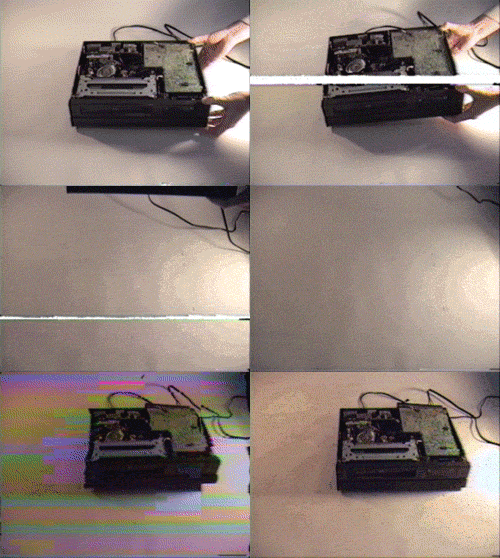
Since the VCR can get video feedback of itself, is there any computational reason why this doesn’t count as a degree of self awareness?
Turning the Systems Reply to the Chinese Room on its head, I submit that if we consider the Chinese room to be an intelligent *system*, then we must also consider the system of VCR+camera pointed at itself to be a viable AGI as well.
The correlation of corrupted video feed with the actual physical attacks on the system must be construed as awareness, especially since the video effects are unique and specifically correlated so as to present a complex vocabulary of responses. If functionalism rejects the evidence of this correlation as being experienced qualitatively, then it must posit the existence of an m-zombie (machine zombie), in which the system unintentionally mimics the responses expected from sentient computations from a sub-computational level.
Why Light is Sight (not photons)
A case against photons being necessary and sufficient to explain the experience of light:
There are many examples of scientific studies and first hand experience which implicate human visual perception as the result of neurological and phenomenological states, rather than a direct mapping of photons striking the retina of the eye.
1. What we see cannot be explained by the presence of photons alone.
From this paper, On the Neural Correlates of Visual Perception:
“Neurological findings suggest that the human striate cortex (V1) is an indispensable component of a neural substratum subserving static achromatic form perception in its own right and not simply as a central distributor of retinally derived information to extrastriate visual areas.
[…] elemental visual experiences of punctate white or colored lights called ‘phosphenes’ can be evoked in man by direct electrical stimulation of densely hemianopic striate cortex after severance of its connections to and from the LGN.”
The paper goes on to describe many neurological conditions arising from specific damage to the brain which reveal that the visual conditions which we take for granted, such as identification of shapes and motion, have their neural correlates in diverse areas of the brain. There is no video screen equivalent in the brain which which reconstructs an image from the outside world made of photons.
“Crick and Koch also proposed that explicit representations of visual features, coarse-coded neural representations that correlate with percepts or objects, are a necessary but not sufficient condition for visual experience. I find no reason to disagree with this premise.
[…]figure–ground segregation and object recognition cannot progress in a simple bottom-up serial fashion, but have to occur concurrently and interactively within recursive loops”
[…]In summary, the present model is based on the primacy of phenomenal experience (Humphrey, 1992; Nelkin, 1995; Raffman, 1995) and supports views that any possible explanation of phenomenal experience cannot be formulated solely in terms of its reportability (Chalmers, 1995).”
2. Stimulation of the visual cortex in the congenitally blind results in tactile rather than visual perception (Changes in visual cortex excitability in blind subjects as demonstrated by transcranial magnetic stimulation).
“…phosphenes could be induced in only 60% of subjects in Group 2 (blind subjects with a low degree of residual vision) and in only 20% of subjects in Group 3 (blind subjects without residual vision).
[…] Studies of the functional consequences of visual deprivation in humans have disclosed correlates of cross‐modal plasticity, with a role for the visual cortex in tactile processes (Uhlet al., 1991; Sadatoet al., 1996; Cohenet al., 1997; Büchelet al., 1998).”
“In a PET study we demonstrate that congenitally blind subjects show task- specific activation of extrastriate visual areas and parietal association areas during Braille reading, compared with auditory word processing. In contrast, blind subjects who lost their sight after puberty show additional activation in the primary visual cortex with the same tasks. Studies in blind-raised monkeys show that crossmodal responses in extrastriate areas can be elicited by somatosensory stimulation. This is consistent with the crossmodal extrastriate activations elicited by tactile processing in our congenitally blind subjects. ” – Different activation patterns in the visual cortex of late and congenitally blind subjects.
3. Visual experiences can be produced internally, and outside of the primary visual cortex.
“A phosphene is a phenomenon characterized by the experience of seeing light without light actually entering the eye.”
“this phenomenon of “seeing” without seeing in the traditional sense leads one to believe the ability to receive light is not entirely necessary. In addition, this is not a foreign concept, as when most people close the eyes, they are able to visualize images.” – Dreams: Seeing without seeing
“The results by Knauff and colleagues, also with fMRI, do not support the hypothesis that primary visual cortex is involved in visual mental imagery, but rather that a network of spatial subsystems and higher visual areas appears to be involved (Knauff, Kassubek, Mulack, & Greenlee, 2000). The results support the hypothesis that visual imagery is a function of the visual association cortex.” – Visual imagery without visual perception (Bértolo 2005).
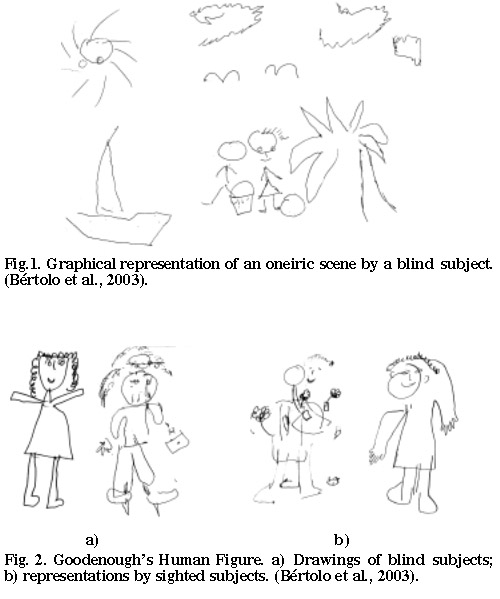
4. Congenitally blind people can interpret experience graphically.
[…]In conclusion, the congenitally blind are not only able to describe what may be the visual content of their dreams verbally, but they can provide, through drawing, a graphical representation of such content, and a significant negative correlation between the Visual Content of the dreams and the alpha power was found in both groups.” (Bértolo 2005).
5. Color mappings are not entirely caused either by electromagnetic frequency or stimulation of the retina’s cone cells.
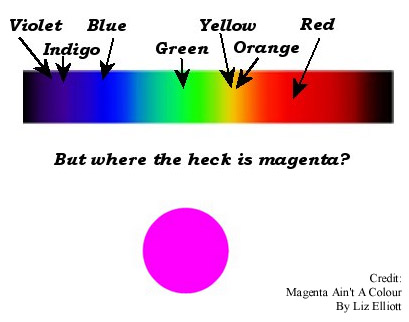
a. Some colors are not part of the visible spectrum
Pink and purple are combinations of red with blue or violet. Brown and beige are low intensity orange, olive is low dim green, grays and black are dark whites. – source
“This means that colours only really exist within the brain – light is indeed traveling from objects to our eyes, and each object may well be transmitting/reflecting a different set of wavelengths of light; but what essentially defines a ‘colour’ as opposed to a ‘wavelength’ is created within the brain. ” – Magenta Ain’t A Colour.
b. Color perception can change independently of the retina.
“…the number of color-sensitive cones in the human retina differs dramatically among people—by up to 40 times—yet people appear to perceive colors the same way. The findings, on the cover of this week’s journal Neuroscience, strongly suggest that our perception of color is controlled much more by our brains than by our eyes.
[… That points to some kind of normalization or auto-calibration mechanism—some kind of circuit in the brain that balances the colors for you no matter what the hardware is.” – Color Perception Is Not in the Eye of the Beholder: It’s in the Brain
6. Blindsight shows that optical information can be communicated subconsciously without a conscious experience of seeing.
A rare, but much studied condition, blindsight, along with synesthesia and anosognosia reveal that the pairing of visual qualities of experience with optical conditions is not automatic. The functions of information processing, physics, and the qualities conscious experience can all be teased out separately.
Blindsight – the ability to respond appropriately to visual inputs while lacking the feeling of having seen them – might be something which only occurs in cases of brain damage, but seems much more likely to be a significant phenomenon of intact brain function as well. Indeed, it seems likely that blindsight (and similar phenomena in other spheres) is an important ingredient of of a variety of activities where one wants to move quickly and appropriately, without “thinking about it”. – Seeing What You Don’t See
7. Photon interaction begins and ends with the isomerization of rhodopsin.
Optical processing a vast chain of mechanical reactions on multiple levels of description of the nervous system; molecular, cellular, organ, and somatic. From the indications of neurology alone, what our visual cortex would ‘see’ should really be nothing more than interruptions in the flows of glutamate from rod cells, not an array of photons. There is something called ‘dark current‘ which refers to “the depolarizing current, carried by Na+ ions, that flows into a photoreceptor cell when unstimulated” and suggests that our access to optical conditions is triggered by a silencing of ‘off’ signals rather than an instantiation of ‘on’. It might be supposed that photons are not what we see, but rather they are a measure of the initial molecular triggers which stop us from not seeing.
8. Photons with frequencies in the infra-red range are felt as heat rather than seen.
A rather obvious example, but one which reveals that photons themselves need not be seen to be detected. Ultraviolet and infrared radiation are referred to as ‘light’, but they are no more or less ‘illuminating’ than radio waves or gamma rays. Generally when we refer to light and lighting we are specifying a capacity to illuminate our visual perception, not thermal conditions. The use of light to refer to invisible phenomena is not entirely untrue, as it can be stepped down into a visible range using photographic equipment, however, unless the target of such a process is ultimately a visual experience, it is hard to justify the connection to the term, and the word ‘light’ should be considered somewhat figurative. If we refer to brain activity associated with conscious experience to be ‘neural correlates’, then we should likewise refer to physical activity associated with perceptual experience to be ‘electrodynamic correlates’ of light rather than light itself.
9. If light is sight and not photons, what is sight?
Philosophers would call it qualia, neuroscientists might call it ‘sense data’, phenomenal visual experience, or ‘static achromatic form perception’. In short, seeing light is irreducibly experiential. All light is only that which is seen, and photons do not necessarily have any visible qualities.
 Multisense Realism
Recent Comments